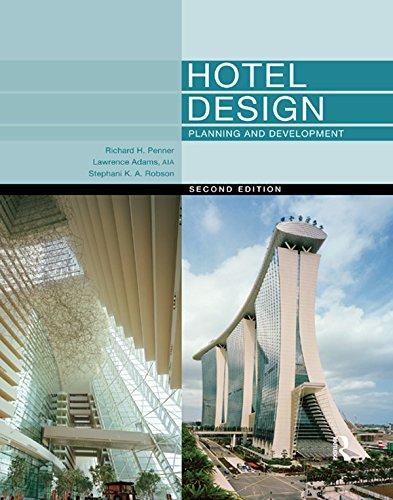
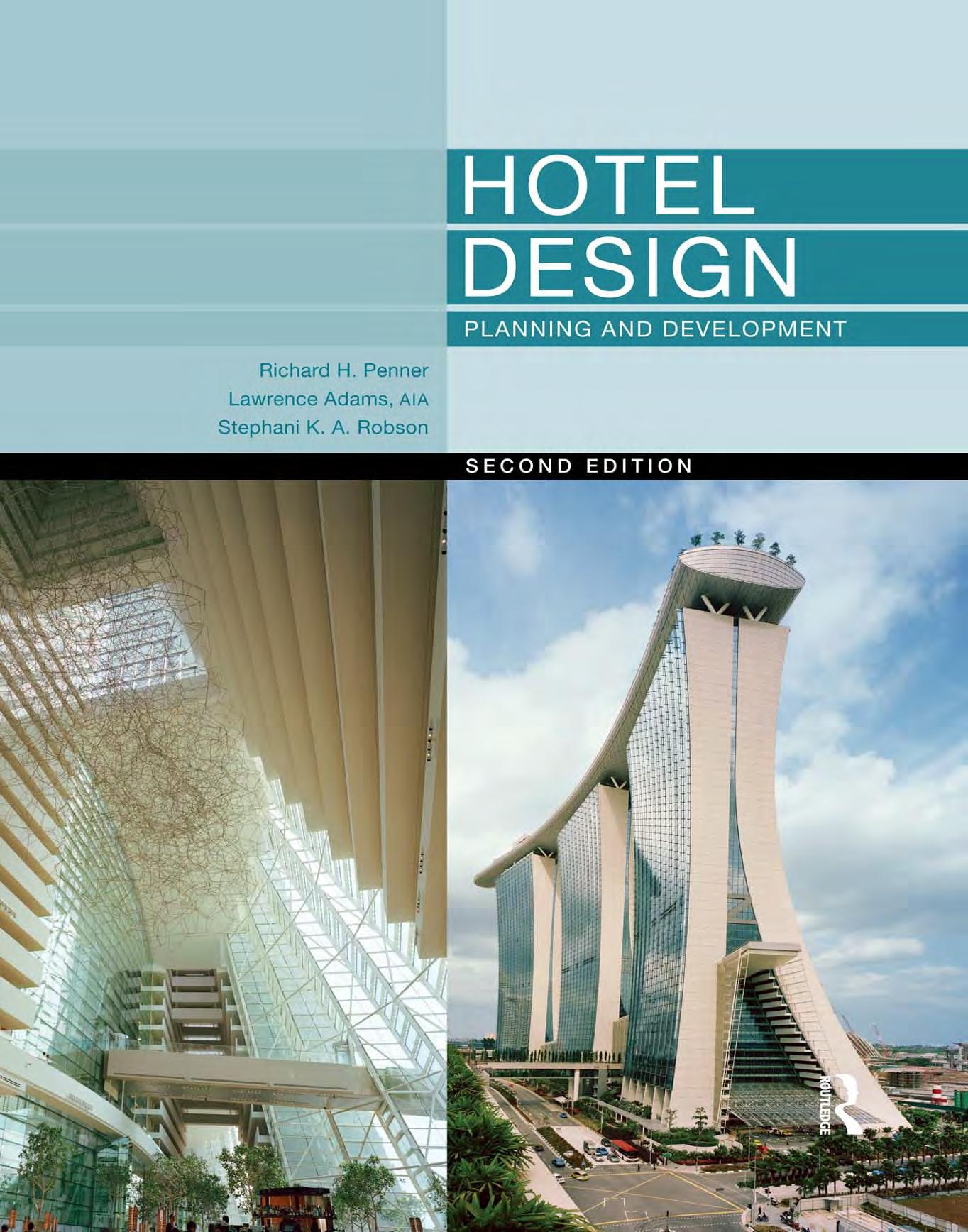
HotelDesign,PlanningandDevelopment2nd Edition,(EbookPDF)
https://ebookmass.com/product/hotel-design-planning-anddevelopment-2nd-edition-ebook-pdf/
Instant digital products (PDF, ePub, MOBI) ready for you
Download now and discover formats that fit your needs...
Planning and Urban Design Standards 2nd Edition
https://ebookmass.com/product/planning-and-urban-design-standards-2ndedition/
ebookmass.com
Creating Exhibitions: Collaboration in the Planning, Development, and Design of Innovative Experiences – Ebook PDF Version
https://ebookmass.com/product/creating-exhibitions-collaboration-inthe-planning-development-and-design-of-innovative-experiences-ebookpdf-version/
ebookmass.com
Practical Research: Planning and Design 11th Edition, (Ebook PDF)
https://ebookmass.com/product/practical-research-planning-anddesign-11th-edition-ebook-pdf/
ebookmass.com
Social Credit: The Warring States of China’s Emerging Data Empire Vincent Brussee
https://ebookmass.com/product/social-credit-the-warring-states-ofchinas-emerging-data-empire-vincent-brussee/
ebookmass.com
Marxism, Religion, and Emancipatory Politics Graeme
Kirkpatrick
https://ebookmass.com/product/marxism-religion-and-emancipatorypolitics-graeme-kirkpatrick/
ebookmass.com
Resisting Carceral Violence: Women's Imprisonment and the Politics of Abolition 1st ed. Edition Bree Carlton
https://ebookmass.com/product/resisting-carceral-violence-womensimprisonment-and-the-politics-of-abolition-1st-ed-edition-breecarlton/
ebookmass.com
AVR Workshop: A Hands-On Introduction with 60 Projects (NOT genuine pdf) 1st Edition John Boxall
https://ebookmass.com/product/avr-workshop-a-hands-on-introductionwith-60-projects-not-genuine-pdf-1st-edition-john-boxall/
ebookmass.com
Captured by the Alien Prince: A Scifi Alien Romance Novel (Rogue Warriors of Lorr Book 2) Celia Kyle & Anne Hale
https://ebookmass.com/product/captured-by-the-alien-prince-a-scifialien-romance-novel-rogue-warriors-of-lorr-book-2-celia-kyle-annehale/
ebookmass.com
Captivate (Knot Their Omega) E. J. Lawson
https://ebookmass.com/product/captivate-knot-their-omega-e-j-lawson/
ebookmass.com
12th Edition (eTextbook) PDF
https://ebookmass.com/product/database-systems-design-implementationand-management-12th-edition-etextbook-pdf/
ebookmass.com
hotel’s entrance, which becomes a celebratory focal point of the lobby space. Although the hotel is itself a dynamic environment, it is also situated within a larger set of attractions and cultural milieu. Hospitality environments today must engage and reflect local context, forging a symbiotic relationship with the cities and neighborhoods beyond their walls. By joining in the celebration of local festivals or assimilating regional ingredients in their culinary offerings, authentic flavors of the world can permeate the hotel in myriad ways. An East Asian hotel might offer a traditional tea service, for example, and staff uniforms may be designed by an emerging fashion star. Fostering a rich sense-of-place can transform a fleeting hotel stay into an enduring, memorable experience.
Through innovative uses of technology, hotels are able to reflect the interconnectedness of our lives today. From the moment you step into a hotel, smartly integrated, cutting-edge tools can transform and heighten previously tedious chores. Check-in desks are becoming a thing of the past. With advanced data-management systems, greeters can personally welcome each guest at the door by name. A cumbersome process becomes convenient, even leisurely, as travelers check in via iPad over a gin-and-tonic in the lounge. These are the least of the possibilities that our information age offers us. Rooms are equipped with a range of customizable features with which to personalize your space: at the touch of a button guests can control the lighting, changing the room’s entire mood, select a special aromatherapy-infused shower to shake off the drag of jet-lag, or conjure up a concealed high-end entertainment system.
This flexibility translates into a warmth and openness towards individual needs that complements the distinctive character of a hotel. Each guest brings with him or her a personal routine of comforts, which the hotel should respond to attentively with a finetuned menu of services. Quotidian rituals are enabled by diverse, dynamic spaces. In common areas, purposeful design can set the scene for spontaneous encounters and reveal unexpected and delightful details; everyone can find a favorite gathering spot—a lounge that allows intimate conversations, a lobby where you can go to see and be seen, or a comfortable corner to curl up with a book.
In tune with the tempo of the individual and resonating with multiple rhythms, the hotel environment today presents an inviting, comfortable haven. The most successful hotel interiors transform a sojourn into an unforgettable experience, however brief, and position guests as the curators of their own journeys.
The Developer’s Perspective
Barry Sternlicht Chairman Starwood Capital Group Greenwich, Connecticut
My mother is an accomplished artist. During our childhood, many of her paintings hung in the hallway of our home and in the living room. I loved the colors she used, the texture of her knife, and the calmness and feelings they evoked in me. Most of all, I marveled at the creative process, how on a blank canvas one could create such emotion and beauty. In high school, I took several art classes where I focused on painting. Good artists understand the delicacy of composition of the canvas … still lifes arranged just so—work … and others don’t. A picture taken at one angle tantalizes the viewer, but seen from another it is boring. The juxtaposition of one color against another is complementary and soothing, or dark, disturbing, and uncomfortable. While my parents suggested I not become an artist, I love design and architecture and so, for me, marrying design and real estate in the form of hotels was not work but the fulfillment of childhood ambitions.
Over the years, I bought an immense amount of property in many product types such as office, retail, golf courses, senior housing, and, of course, hotels. I marveled at design that worked, that powered occupancy, and achieved great rents versus that which did not. For example, when I lived in Chicago, I worked across the street from the Water Tower, perhaps America’s most successful vertical mall. The center was always busy and it felt busy. The mall was designed with anchor stores at either end, but in the center was a circular space four or five stories high in which were the glass elevators and all the escalators. You saw everyone in the mall! It was always busy and going up and down the escalators you could see all the stores you forgot were tenants or new stores you wanted to be sure to visit before you left.
What I noticed about the hotel industry in 1995, the year I decided I would do a national “boutique chain” that I named W Hotels, was that the industry had spent decades dumbing down the product, and competed on price but not on aesthetics. We had a $79 a night chain, followed by those at $99, $109, $139, and $179. My theory was that we could build a chain where we would compete on design: that design matters, that consumers would not only pay more for great design but that it would build an emotional attachment with them, that they might define themselves by our aesthetic and we would build brand loyalty and, therefore, give ourselves pricing power. In hotels, the product had become commoditized. One could not tell the brand by looking at the room. It seemed that interior designers had gone to the “one size fits all” box, like the failed K car of Chrysler where someone had the brilliant idea of building multiple bodies on the same chassis and engine. Consumers saw right through it and so, by trying to be all things to all people, you appealed to almost no one. Or, at least, we can say you built no brand loyalty.
There are certain spaces you walk into that put you at ease and make you feel comfortable. These are spaces that work:
proportions that are elegant, furniture that is sized appropriately for the space it occupies, pieces that speak to each other and enhance each other with their presence. We react to texture, to proportion, to color, and the immense talent of great interior designers is that they take the complex and make it look effortless, just as great athletes seem to hardly be trying when they are in their zone. A space may be filled with numerous wonderful textures, vibrant color, and surprising and dynamic innovative products. It simply feels right and yet it is, in my mind, just as hard as the great painter’s compositions executed in the physical space. Sometimes design makes you nervous, is unsettling, and you simply want to leave; sometimes you don’t even know why. And then there is design for design’s sake.
If you are working in hotel design, you can’t forget it’s about people, customers, and that they are going to be part of your “composition” when it is complete. Great designers can deftly edit a space, modify its contents, work across all the dimensions of design—scale, color, texture, lighting—in their heads, and the result will be spaces that work, that make people feel good, that are inviting. If the artist can execute this with great originality, it becomes memorable, a classic. To me, it’s about the human experience for, after all, hotels are meeting places for weary travelers. Why not dazzle them and amaze them and leave them yearning for one more night’s stay? Just as Apple, Samsung, and Aston Martin have created loyal customers through innovative industrial design, so too can great designers influence, strengthen, and even define a great brand.
Preface
Development and Design Interact
For their kind Foreword illuminating the timeless goals of the world’s largest industry, we immensely thank Michael Graves, David Rockwell, and Barry Sternlicht, who represent the major disciplines involved with hotel development and design.
Much has changed about hotels and the hospitality industry since the 2001 edition of Hotel Design, Planning and Development. In just over a decade, the Internet has risen to being the key form of communication for our guests and development teams alike and shapes how everyone does business everywhere in the world. Rapidly advancing technology is supporting the application of sustainable principles in design and operations. Robust growth in hotel supply during the 2000s reflected new segments, new markets, new lodging products, and new approaches to financing in a difficult economy. Today there are more hotel brands than ever, each demanding a specific set of design and operational requirements that make an integrated effort among the developer, operator, and design team paramount in order to ensure a successful outcome. In 2001, most hotel development was still taking place in North America. Now, Asia is the engine of much of the industry’s growth and other parts of the world are poised to follow suit. There has never been a more exciting or more challenging time to create hotel assets.
This book is intended to serve as a practical guide to the hotel building type for practitioners and students alike. Our inquiry begins with the word “hotel” itself, meaning mansion, borrowed from the French soon after the American Revolution in an effort to express the sophistication of the new multifaceted inns that then appeared. From their onset, these novel mixed-use establishments served the varied needs of a rapidly expanding society by freely adapting new residential, commercial, and industrial features to hotel use. These include the first grand ballroom in New York, an atrium and Merchants’ Exchange in Boston, a domed European lobby in New Orleans, and a theater, shops, and laundry in London. Their competitive nature meant that hotels were among the first buildings in most cities to incorporate the newest technologies such as gas and electric lighting, central heat, telephones, and elevators.
Such creative responses to consumer needs and desires more than ever drive hotel design and development today. There is no such thing as a “generic” limited-service or full-service hotel anymore. Ever-greater segmentation means that hotels need to be keenly focused from the very start of the development process. The specific requirements of the road-warrior business traveler, the design-savvy boutique guest, the family on vacation far from home, the meeting planner and corporate travel coordinator, as well as the hotel management company and the selected brand, all require careful consideration throughout the planning and design stages. And as digital technology continues to evolve at breakneck speed, developers and designers must constantly adapt to make sure that the amenities and infrastructure in all new projects keep pace. In the following chapters we expand upon the practices, features, and trends that shape the hotel development industry. So sophisticated are today’s markets that certain once-popular concepts have faded into oblivion while some previously negative traits are now considered attractions. Therefore, we are pleased to be able to interpret today’s design, technology, and creative concepts which continue to offer such bright prospects for the future.
Richard H. Penner
Lawrence Adams
Stephani K. A. Robson
x
We dedicate this book to the memory of Walter A. Rutes , FAIA, our late coauthor and mentor. Wally for many years was a hotel architect and corporate executive, responsible for many of the innovations in the last quarter of the twentieth century. We miss his spirit and good sense.
1 CHAPTER Overview
Arriving in Esfahan, Iran, centuries ago, you could stay outside the city gates at a roadside caravansary now called the Sha Abbas. Or desiring better service, you might continue to the Khan, an in-town hotel. As a “frequent traveler” journeying to Rome, you could stay at a downtown mansione, a boarding house on the Appian Way, or at a spa resort.
While the quality of hotels has advanced immeasurably over several centuries, especially their services, the basic functional elements remain almost as simple and familiar as in ancient times. But with increasing guest sophistication—and imaginative development and design—we anticipate growing demand globally for increasingly diverse and customized hotels, resorts, and related leisure-time amenities for the world’s largest industry. The first part of this book discusses and illustrates scores of different types of hotels and considers how their design is being refined and their markets reassessed. They range from sensible extended-stay residential units to lavish super-luxury urban suite hotels. Hotel developers are reconsidering the design and character of all hotel types, from ecotourist retreats to the adaptive reuse and restoration of existing urban infrastructure. The latter provides a variety of finely detailed hotels and entertainment amenities that dramatically upgrade inner-city environments. And family-oriented theme parks continue to serve as multi-resorts for major corporate trade exhibitions and conventions as well as for advanced leisure-park communities.
The explosive growth of our global economies has generated extravagant architectural and engineering accomplishments around the world: in the Middle East, China, India, and Russia, as well as in Europe and the United States. Such major resort destinations as the Palm Islands in Dubai have sprouted dozens of hotels featuring all the leading brands with luxury accommodations and residences. Resort World Sentosa, off the coast of Singapore, City of Dreams in Macau, and CityCenter in Las Vegas represent massive investments in multihotel, residential, retail, entertainment, gaming, and conferencing developments. Extraordinary hotel architecture continues to amaze travelers with such exceptional structures as the Marina Bay Sands in Singapore and with such iconic mixed-use developments as the Elbphilharmonie in Hamburg, Germany, which includes a philharmonic hall wrapped with hotel rooms. Design hotels extend the boutique fascination by emphasizing great architecture combined with chic interiors and now include fashion designers entering the fray with their own brands, such as Armani Burj Khalifa and Missoni Edinburgh. Fashionable downtown hotels such as Hotel Gansevoort and The Standard in New York’s Meatpacking district bring new vitality to dormant neighborhoods and serve as place-making destinations.
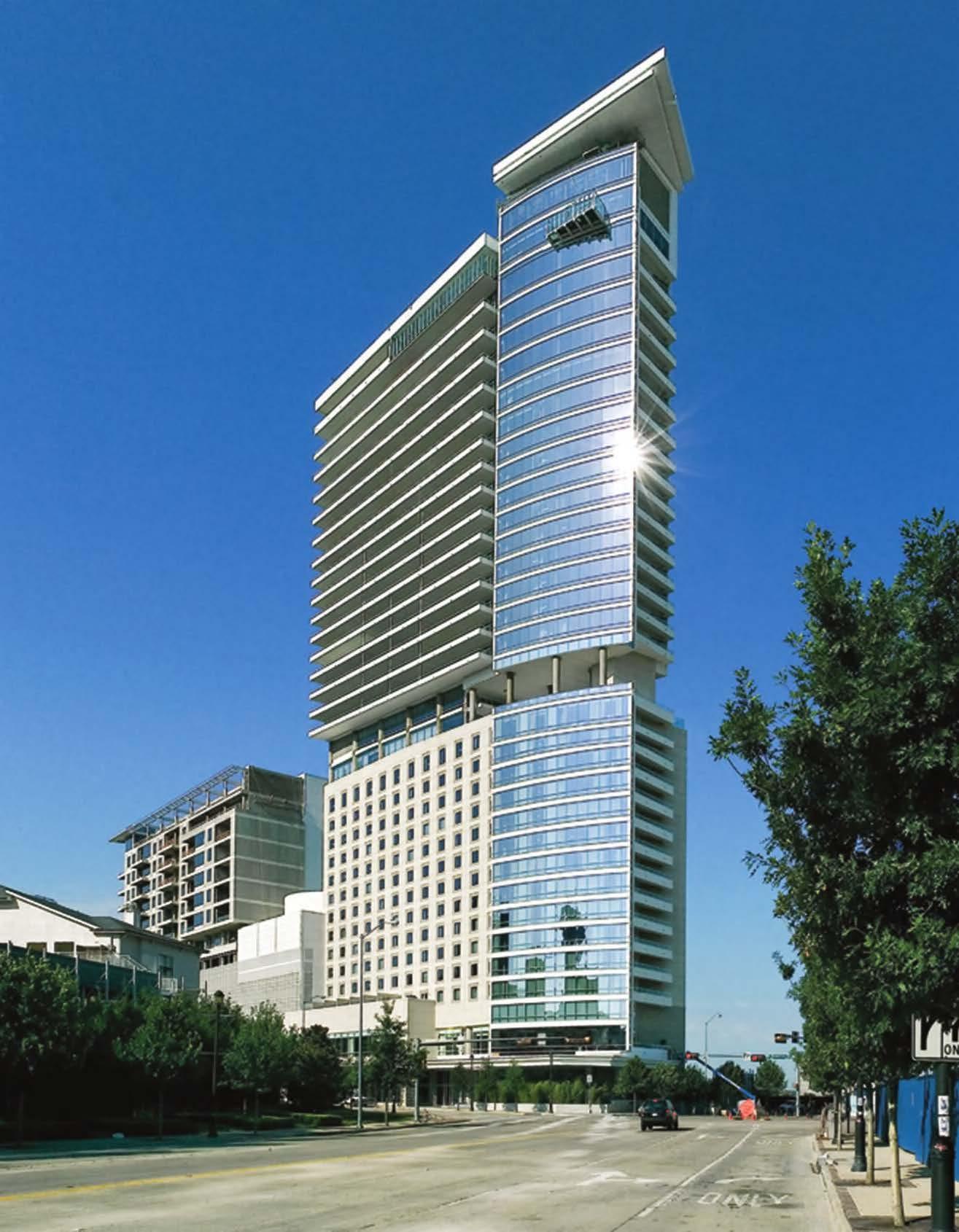
W Dallas Victory Hotel and Residences, Dallas, Texas
With 252 guestrooms and 94 luxury residences, this 33-story hotel and condominium tower is the centerpiece of the 72 acre (29 hectare) Victory master-planned development in Dallas. Designed by HKS Architects, the hotel includes a 10,000 sq ft (925 sq m) spa, pool, and fitness facility, 11,000 sq ft (1,020 sq m) of meeting space, and Ghostbar, a sleek and stylish rooftop venue.
Environmental responsibility has taken on new dimensions worldwide in all segments of the hotel and resort industry as new properties seek LEED certification or similar recognition by a number of other international green-design rating systems.
Other major prototype developments include hotels with themed shopping and entertainment atriums, all-villa enclaves, various types of vacation ownership resorts and spas, as well as vertically integrated mixed-use high-rise towers combining hotel functions with offices and trade centers incorporating flex-suites affording virtual officing. One type that has seen major growth in the past decade is multi-branded hotels, where one site or building houses two or more competing brand hotels. The next several chapters illustrate a wide range of the era’s most significant hotel types, from future concepts for world-class multi-resort destinations to the most innovative and cost-effective limited-service prototypes. While the opening chapters discuss the latest examples in each category, and describe the different features of each type of hotel, the Design Guide, Part 2, provides information on how to program and design the hotel guestroom, public, and back-of-house areas.
With concepts ranging from airport conference center hotels to exotic eco-tourist lodges and from high-fashion design hotels to gigantic casino hotels, Part 1 reviews more than fifty different types of hotels now flourishing in today’s increasingly customized marketplace. Separate chapters are devoted to each of 11 major categories. For example, suburban hotels offer many choices ranging from office-park hotels to country inns, while resorts encompass an ever-widening array from luxury wilderness lodges to remote island resorts. The repositioning of countless downtown and suburban properties is accomplished by innovative renovations, restoration, additions, or adaptive reuse. The conference center hotel, which significantly differs from the urban convention hotel, is discussed in terms of design options, planning, and development considerations, as well as social and cultural implications. Highly imaginative future hotel and resort development concepts are summarized in the final chapter. A continuing theme is the emphasis on carefully targeting specific market segments so that the hotel may better fulfill its function. For example, luxury resorts and super-luxury hotels need small, superb restaurants and health spas to maintain their clientele.
In industrialized nations, familiarity with new types of hotels is essential for developers to plan their expansion strategies and devise more imaginative prototypical features that attract new customers to hotels. Some types of hotels are as different as is a single-family home compared to a high-rise apartment tower in the residential field; it is essential for the designer to understand the variations in facilities, program areas, and circulation patterns required for each new form of hotel designed to serve a particular market niche. Also, an overall familiarity with diverse types encourages cross-fertilization of ideas, as, for example, introducing larger health spas to fill relaxation needs at conference centers, adding meeting rooms to turn country inns into instant conference retreats, and borrowing attributes of super-luxury hotels, such as original artwork, to better upgrade other types of hotels. New ideas for better hotels come from each member of the design team, ranging from market researchers to food and beverage (F&B) consultants, and include a variety of specialized disciplines from high-tech systems experts to talented landscape architects and
environmental designers. Chapter 19, Technical Coordination and Construction, discusses the development areas in which consultants are recommended—even required.
Classifications
Since hotels generally are classified by location, function, and other special characteristics, a given hotel may fit more than one category—for example, Ames Hotel in Boston is both a design (boutique) hotel and an example of adaptive reuse. A number of airport hotels could also be considered conference centers or convention properties. However, the overlap should not impair the usefulness of the classification system referenced in this book, which permits easy access to information by subject headings generally used in the hotel field and clear to the public.
While hotel classifications are necessary for purposes of organizing and referencing information, they are by no means perfect and no substitute for specific knowledge of the individual character and detailed ingredients of the hotel. As a writer in the New Haven Register lamented:
Along with new hotel types and almost infinite combinations and varieties, it is increasingly difficult for guests to select a hotel when labels are inadequate or misleading. Downtown hotels have as many tennis courts, pools and saunas as resorts. Resorts have as many convention or conference guests as downtown convention hotels or airport meeting centers. Motor inns are not necessarily superior to motels. And “inns” are not necessarily old. “Lodge,” “spa,” “guest ranch” also are unclear labels. Price is no indicator—expensive hotels may have small rooms, while budget hotels have larger, better appointed rooms. Buying on the basis of ingredients looks like the new wave.
Our late coauthor, Walter A. Rutes, FAIA, at the turn of the century wrote:
It is likely that today’s oxymoron marketing mantra of “mass customization” is increasing in the hotel field, after bringing gold to industries ranging from clothing to personalized vitamins. It responds to the consumer’s desire for individual treatment in an increasingly impersonal world. If the typical guest buys designer clothes and made-to-order music CDs from a long questionnaire, why not a virtual Ritz at Times Square?
(Rutes, Penner, and Adams, 2001, p. 6)
Therefore, in this book guest perceptions are emphasized as much as the actual differences among types of hotels. In other words, what’s “in” at the inn is even as important as what’s in it.
Planning and Design Considerations
Since each type of hotel seeks different kinds of guests, its planning requirements will vary by its location, quality level, size, image, space standards, circulation, and other characteristics. For example, convention hotels and conference centers require closeness to airports, while vacation villages and ski lodges do not. Airport hotels and roadside motels need high visibility and good highway signage, while conference centers, country inns, vacation villages, and ecotourist retreats seek seclusion. And while super-luxury hotels must be small to create an intimate atmosphere, upscale hotels must be large enough to justify the greater number of restaurants, lounges, and banquet rooms required by first-class or five-star international standards.
Design considerations also vary by hotel type. For example, resorts require larger rooms and more closet and drawer space than downtown hotels due to the longer stays of their guests and
Biblical times
Boarding houses existed
500 BC First resorts at mineral and hot springs in Greece
the higher number of occupants per room. Some roadside inns may require larger restaurants than other hotels for peak periods such as breakfast, yet offer no room service. Casino hotels require a glittering design, while conference center décor needs to be more understated. Also, similar design concepts are expressed differently in each type of hotel. For example, the social pastime of peoplewatching in the downtown or suburban hotel is accommodated in its lobby or atrium space. The same purpose is served by the pool deck at the resort, the sun deck at the ski lodge, the commons area at the conference center, the outdoor bar at the vacation village’s piazza, the tea lounge of the luxury hotel, or the high-fashion lobby of the boutique hotel.
While the specific facilities, area programs, and technical requirements are discussed in Part 2, Design Guide, this first section summarizes the main variations in planning and design for each distinct type of hotel.
Mansiones built along Roman roads to lodge government-sanctioned travelers; some inns existed for others
Romans spread spa resorts to England, Switzerland, and the Middle East; introduced campona (inns) in England. Riviera popular with Phoenician and Greek traders
Caravansaries, cloistered courtyard caravan stops, provided by government along roads in the Middle East
Khans, small inns, established in Middle East towns
Middle Ages Manorial lords, abbeys, and monasteries sheltered some travelers
Monastic inns run by religious orders. Hospices built as hospitals and shelters for travelers
Some inns developed in larger towns (no meals)
Rooming houses used as relay stations for mail, government transport, rest stops, changing horses
Hospitalers created shelters for Crusaders and pilgrims traveling to the Holy Land
1100s
1200s
1300s
1400s
1500s
1600s
Travel became safe in Europe. Inns prospered with freedom and right to travel, declined in times of lawlessness
The European inn gradually developed
The Three Kings Inn opened in Basel, Switzerland—earliest inn still operating
Guest houses, courier mail stations opened in China and Mongolia
Rooming and relay stations for mail, government transportation, rest stops
Cour St. Georges Inn opened in Ghent, Belgium
Angel Inn opened in Grantham, Lincolnshire, England
The English country inn developed; some inns in London
Castle Inn founded in Taunton, Somerset, England
French law required innkeepers to replace stolen property plus pay victims three times as much in damages
French law required hotel register
English law established regulations for inns
The Krone Inn in Solothurn, Switzerland, is earliest adaptive reuse—converted from residence
European spas revived in Carlsbad, Marienbad
Stagecoaches developed, using Roman road system; teams changed, carriages checked, and travelers rested at posting houses
English innkeepers set pattern for Europe and America to follow; 6,000 inns in England
Inn plan took form of enclosed courtyard with arched entrance, rooms along two sides, kitchen and public rooms at front side, stable and storage at rear
First travelers’ guide rating inns in France
Hotel industry developed in Europe with well-placed and reliable cuisine “at sign of insignia on a metal plaque, grating its rugged hinges in every wind”
Seaport inns developed in American cities: for example, the Blue Anchor in Philadelphia
Village inns developed as required by Massachusetts law in all towns: for example, the Old Yarmouth Inn at Yarmouthport
First scheduled coach service established in England
Table 1.1 Hotel milestones
Table 1.1 continued
1700s
Clubhouses similar to British clubs and Masonic lodges developed in America
Spa resorts developed in Yellow Springs, Pennsylvania, and White Sulphur Springs, West Virginia
Boodles and Coventry clubhouses opened in London
Market Square Taverne founded in Williamsburg, Virginia
Place Vendôme in Paris is first mixed-use complex
1780s
1790s
1800s
1810s
1820s
Dessien’s in Calais, France, was early large inn
Covent Garden Inn in London was early large inn
Industrial revolution stimulated hotels in England, Europe, and America; resorts developed
Corre’s Hotel and City Hotel in New York were first downtown hotels
Saratoga Springs, New York, developed as spa resort
White Hart Hotel opened in Salisbury, England
Royal Hotel founded in Plymouth, England
Luxury “swagger hotels” established in major cities
Early resorts built along French and Italian Riviera
Imposing clubhouses built
Fulton’s steamship Clermont launched on Hudson River
Exchange Coffee House in Boston was first atrium hotel
Ryokan guest houses developed in Japan
Dak bungalows, 24-hour guest stops, run by government of India
Catskill Mountain House in New York State was early major resort
City Hotel in Baltimore, Maryland, was first with partial gaslight
B&O Railroad began passenger service
Tremont House in Boston was first luxury downtown hotel with indoor toilets, locks on guestroom doors, and à la carte menu
1830s Saratoga Springs Hotel opened in New York State
American Hotel in New York City was first with gaslight throughout
Astor House opened in New York City
St. Charles and St. Louis Hotels established in New Orleans, Louisiana
Holt’s Hotel, opened in New York City, was first with an elevator for baggage
Reform Club in London had courtyard roofed in to become an early atrium
Euston Station Hotel, opened in London, was early example of railroad hotel
1840s Railroads replaced coaches; coach-route inns declined
Shepheard’s Hotel, opened in Cairo, was early major adaptive reuse
Hotel des Trois Couronnes founded in Vevey, Switzerland
Bar au Lac Hotel opened in Zurich, Switzerland
New York Hotel in New York City was first with private baths
Planter’s House Hotel founded in St. Louis, Missouri
The Homestead established in Hot Springs, Virginia
Resorts developed in Coney Island, New York
1850s
Spa resorts reached height of popularity
Resorts developed in Niagara Falls, New York, and New Jersey shore
Mills House opened in Charleston, South Carolina (rebuilt in 1970)
Parker House established in Boston (rebuilt in 1927)
Fifth Avenue Hotel in New York City was first with passenger elevators
1860s
1870s
Railroad terminal hotels such as Charing Cross in London were main type of hotels developed 1860s through 1920s
Mohonk Mountain House established in the Catskills in New York State
Central and Union Pacific Railroads were joined
Coney Island in New York was themed seaside resort with Queen Anne and Oriental-style hotels and amusement park with roller-coaster
Fashionable Vendome Hotel built in Boston
Palmer House opened in Chicago was largest of time and first built with a fireproof structure (rebuilt in 1925)
Palace Hotel opened in San Francisco was earliest hotel with a large atrium
Sherman House founded in Chicago
Grand Hotel built in Point Clear, Alabama
Continental opened in Paris (restored in 1970 by InterContinental)
1880s
Hotel Del Monte established in Monterey, California
Hotel Everett in New York City was first with partial electric lights
Sagamore Hotel at Lake George in New York State was first with electricity in all rooms
Chelsea Hotel in New York City was first large residential hotel
Mountainview House established in Whitefield, New Hampshire
Ponce De Leon Hotel in St. Augustine, Florida, was first built of concrete
Grand Hotel in Mackinac Island, Michigan, had largest veranda
Victoria Hotel in Kansas City, Missouri, was first with baths in all rooms
Hotel Del Coronado, opened in San Diego, California, was largest resort of its time
Whiteface Inn and Golf Club founded in Lake Placid, New York
The Savoy in London was first hotel with theater, chapel, print shop, laundry
1890s
The Broadmoor opened in Colorado Springs, Colorado
Brown Palace in Denver, Colorado, was earliest hotel atrium still operating
Copley Square Hotel opened in Boston
Ecole Hotelière in Lausanne, Switzerland, was first hotel school
Hotel Netherland in New York City was first with phones in all rooms
The Breakers opened in Palm Beach, Florida (rebuilt in 1906, again in 1926)
Lake Placid Club established in Lake Placid, New York
Original Waldorf=Astoria built in New York City, tallest of its time, at 17 stories (later site of 102-story Empire State Building)
Wentworth-by-the-Sea opened in New Castle, New Hampshire
Claridge’s, Berkeley, Connaught all opened in London
1900s
The Ritz founded in London
The Willard opened in Washington, DC
The Plaza, St. Regis, and Astor built in New York City
Taj Mahal Hotel opened in Bombay (restored in 1972 by InterContinental)
Statler in Buffalo, New York, established main principles of modern multi-story hotel and circulation flow
First cross-country U.S. auto trip
1910s
Grand Central Terminal in New York City was early mixed-use complex
Boarding-house resorts developed in Catskills in New York State
Bellevue Stratford opened in Philadelphia
Copley Plaza built in Boston
Beverly Hills Hotel established in California
The Greenbrier opened in White Sulphur Springs, West Virginia
Asilomar near Carmel, California, was first non-profit conference center
Kahler Hotel in Rochester, Minnesota, was first medical hotel
First trans-Atlantic flight and first scheduled airline
Hotel Pennsylvania in New York City, at 2,200 rooms, was largest of its time
1920s
Hotel boom #1 generated by economic prosperity
Grand Central District in New York City was example of further developed hotel complex connecting five hotels
Miami Beach developed with Mediterranean-style architecture; for example, Flamingo, Pancoast, and Roney Plaza hotels
School of Hotel Administration established at Cornell University
First non-stop cross-U.S. plane flight
Baker and Adolphus hotels opened in Dallas, Texas
Royal Hawaiian established in Honolulu
Prohibition caused decline of hotel/restaurant business
The Ritz-Carlton opened on the Boston Public Gardens
The Statler in Boston was first mixed-use hotel/office building
Ahwahnee Hotel built in Yosemite National Park in California
Biltmore founded in Santa Barbara, California
Stevens Hotel in Chicago had 2,700 rooms—largest of time
The Cloister opened in Sea Island, Georgia
Arizona Biltmore built in Phoenix
1930s Depression forced many U.S. hotels into receivership
1940s
The new Waldorf=Astoria in New York City, largest of its time, built during Depression
Statler in Washington, DC, was one of few hotels built during World War II
Flamingo in Las Vegas was first casino hotel
Statler Hotels in Los Angeles, California, Hartford, Connecticut, and Dallas, Texas, first post-war hotels
San Souci in Miami was first new post-war resort
1950s
Hotel boom #2 generated by expanded education and mass travel
Resorts developed in Caribbean
Vacation village concept developed by Club Med
Holiday Inns was first motel chain with large rooms
Casino hotels developed in Las Vegas, Nevada
Fontainbleau opened in Miami Beach
First commercial trans-Atlantic jet service
Airlines began developing hotels
1960s
23,000 hotels, 40,000 motels, and 170 chains operated in the U.S.
Resorts developed in Spanish Mediterranean, Portugal, Balearic Islands, Scandinavia, Greece, and Yugoslavia
Hyatt Regency in Atlanta, Georgia, reintroduced atrium concept
Arden House of Columbia University, Tarrytown House in Tarrytown, New York, and General Electric Co. in Crotonville, New York, were
first conference centers used extensively by businesses
Sheraton at Prudential Center in Boston was first major hotel/mixed-use complex
Hilton Palacio del Rio Hotel in San Antonio, Texas, was first built with prefabricated concrete modules
1970s
Boeing 747 introduced; airlines became active in hotel development through subsidiary chains
New hotel expansion took up slack caused by demolition and conversions of hotels to apartments and office buildings
Walt Disney World Resort near Orlando, Florida, opened as first major hotel/amusement destination center
Extensive hotel development in the Middle East generated by oil prosperity
Luxury condominiums developed offering hotel services
Hotel restorations extensively developed
First suite hotels converted from condos
Time-sharing and condominium resorts developed
MGM Grand casino hotel fire in Las Vegas caused changes in building and fire codes
Outbreak of Legionnaires’ Disease at Bellvue-Stratford Hotel in Philadelphia caused bankruptcy of hotel and changed engineering and maintenance operations
No-smoking rules took effect in federal buildings
Peachtree Plaza in Atlanta, Georgia, had 70 stories—tallest hotel
Multi-resort complexes developed in Maui, Hawaii, and Cancun, Mexico
China opened to foreign tourists; international hotel experts invited to participate in development of facilities
Middle East investments in U.S. real estate increased values of hotels and resorts
1980s
Hotel boom #3 generated by innovative marketing and development of specialized types of hotels, many combined with large-scale commercial complexes such as Copley Place and Lafayette Place in Boston
Airport hotels, conference centers, all-suite hotels, vacation villages, health spas, marina hotels, ski lodges, time-sharing and condo resorts developed rapidly
Casino hotels developed in Atlantic City, New Jersey
Condominium hotels developed, such as The Ritz-Carlton and Four Seasons in Boston and UN Plaza in New York City
Limited-service budget motels continued rapid growth
Popular revival of country inns
Marriott Marquis in Atlanta was largest convention hotel
Marriott Marquis in Times Square in New York City was highest-cost hotel project
Hyatt and Marriott open mega-hotels in Orlando, Florida
Hotel boom in China; 50 major hotels under construction or design including 2,000-room Lidu in Beijing; visitors increased from 200,000 at beginning of decade to 5,000,000 per year expected by end of century
Embassy Suites and Crowne Plaza by Holiday Inn, Courtyard by Marriott, and Residence Inn debut
Japanese investments in U.S. real estate increased values of hotels and resorts
Dow-Jones average of New York Stock Exchange plunged 508 points, or four times previous record one-day drop
Americans with Disabilities Act became law, affecting broad areas of hotel design and operations
Electronic key-card for hotel rooms was introduced by Ving
Resolution Trust Corporation sold off hotels as required due to failing savings and loans
First baby-boomers turned 50, Generation X gained economic power
Disney licensed operation of Tokyo Disneyland, east of the city in Urayasu, Chiba, Japan, the first Disney park outside the U.S.
1990s Gulf War slowed tourism
Recession of 1991 resulted in lowest financial record in hotel history, with majority of hotels not meeting debt service
Growth through conversions became more prevalent
Over 75 percent of top 25 U.S. chains engaged in global hotel development
Casinos and hotels on Native American reservations gained acceptance
Riverboat gaming on Mississippi River and Gulf Coast
Budget hotels were industry’s leading money-makers
Disney opened Disneyland Paris in Marne-la-Vallée, France, the second park outside the United States, with seven hotels and 5,800 rooms
Palace of the Lost City in Sun City, South Africa, based on a fantasy lost African tribe, was most costly casino resort
Wall Street–REIT investments in as many as 15 percent of all U.S. hotels turned back financial recession, with hotel values at levels higher than paid by previous waves of international investors in the 1970s and 1980s
Vacation ownership booming, with five million members investing record annual $6 billion at 7 percent yearly growth rate forecast
Regent Four Seasons built in New York was highest-cost hotel project
Mega-casino themed resorts rapidly expanding in Las Vegas, including New York, New York, Bellagio, Mandalay Bay, The Venetian, and Paris, increasingly attracting family market
Better shower offered at Holiday Inn in place of standard tub/shower combination
Cruise ships booming owing to unmatched appeal to affluent elderly population
Self-service business centers widely available to hotel guests
Hotel schools at Cornell University in Ithaca, New York, New York University, and the University of California at Los Angeles expand their role in international conferences and research activities in hotel, resort, travel, and leisure-time field, now the world’s largest industry
Universal Studios opens major resort theme park including first mega-hotel in Orlando
Disney announced expansion of its luxury resort, retail, dining, and entertainment center at Disneyland in Anaheim, California
Atlantis mega-hotel opened on Paradise Island, Bahamas
Internet, incorporating console control of lighting, temperature, security monitoring, non-disturb, maid, large-screen interactive infoentertainment centers with multiple language and time zone displays, city guide, speaker/video phones, data port, and speed dialing to home and office installed in hotels by INNCOM, SeaChange, GTE, TCI, LodgeNet, On Command, ViaTV, Travelers Telecom, Zenith, Panasonic, Thomson, Phillips, etc.
Hotel boom #4 generated by advanced technology, imaginative design, and the successful marketing of mass customization of hotels, resorts, and leisure-time amenities
Spas booming as baby-boomers perceived them as essential to health
Boutique hotels popular with business travelers; such developers as Ian Schrager, Bill Kimpton, and W brand by Starwood all converted older hotels or developed new properties
First billion-dollar Native American mixed-use casino complex completed in Connecticut, catapulting the region into a major gaming center
Entertainment hotels introduced in downtown areas, including New York City
Hilton Hotels acquired Promus, owner of Embassy Suites/Doubletree, making it the third largest global hotel company
Over 250 luxury and upscale hotels were announced for development worldwide
Ultra-high-rise mixed-use hotels developed in Shanghai, Bangkok, and other major Asian cities
2000s
2010s
Hotel Design, Planning and Development, first comprehensive book on hotel, resort and leisure-time field by Rutes, Penner, and Adams, published by Architectural Press and W. W. Norton
Pod hotels developed in urban business centers and airports throughout world
Many chains developed boutique (or “lifestyle”) hotel brands to compete with independent design-centric hotels
Urban hotels introduced massive spas, for both guests and city residents
Hotel chains introduced the lobby “great room” concept, encouraging socialization among guests
Guestroom layouts increasingly used stall showers in lieu of the tub/shower combination
Hotel operators frequently outsourced restaurant operations to independent operators or brands
Suites became more common, especially in resort destinations
All developers took greater interest in sustainable design, for operational efficiency, lower costs, and marketing reasons
Hotels co-brand with fashion houses
Increasing activity among niche brands of all types
Hotels introduced smartphone applications for check-in/out and use as room key
Greater customization of guestrooms common
Developers sought out carbon-neutral designs for hotels
Enhanced in-room entertainment systems became popular
Hotel companies achieved more efficient operations and economies by co-locating two or more of their brands on one property
Modular construction using factory-built components became commonplace
Urban Hotels
The City Hotel, built on lower Broadway in New York City in 1794, trumpeted a new form of hospitality building distinct from European inns and American seaport and village inns or taverns of that period. Larger than any inn, the five-story City Hotel had 73 guestrooms but, most significantly, housed a ballroom and banquet hall—public spaces that forecast the new role that hotels would play as the center of downtown social and business life for centuries to come. Expanding on that new role in 1809, the Exchange Coffee House in Boston featured an assortment of public social and business functions including a ballroom, a restaurant, a coffee room, and a Merchants’ Exchange floor beneath a 100 ft diameter (9.2 m) sky-lit dome, making this the first atrium hotel and further defining this new urban business and leisure hotel genre.
In this chapter we will examine a variety of urban hotels and the factors that influence their development and design. Dense downtown urban settings present numerous challenges and opportunities that must be accommodated and exploited for the hotel to be successful. In focusing on the characteristics inherent on downtown locations we will look at noteworthy examples of business and leisure, waterfront, entertainment, and super-luxury hotels.
Urban Business and Leisure Hotels
It was the Tremont House in Boston that established hotels as enduring monuments in the cityscape. Clad in Quincy granite, the Tremont was the most costly building in the United States in 1828. It earned the title “The Adam and Eve of the Modern Hotel Industry” by setting the standard for deluxe innovations including private locked rooms, indoor (although not private) bathrooms, à la carte menus, the first bellboys, and an annunciator system that allowed guests to call the front desk from their rooms. Architect Isaiah Rogers devised an ingenious floor plan of crossing corridors that splayed the public rooms across the front of the building with courtyards in the back and an intersecting guestroom wing that separated the public and private realms. Envious of the Tremont’s stature, John Jacob Astor hired Rogers seven years later to design the Astor House in New York City as the new best hotel in the country. Other U.S. cities joined the competition as each major city sought to own the most prestigious hotel in the land. In New Orleans, the French citizens boasted the St. Louis Hotel while the English had the St. Charles. Innovative design continued to flourish as each new hotel vied to outdo previous ones with such amenities as hot and cold running
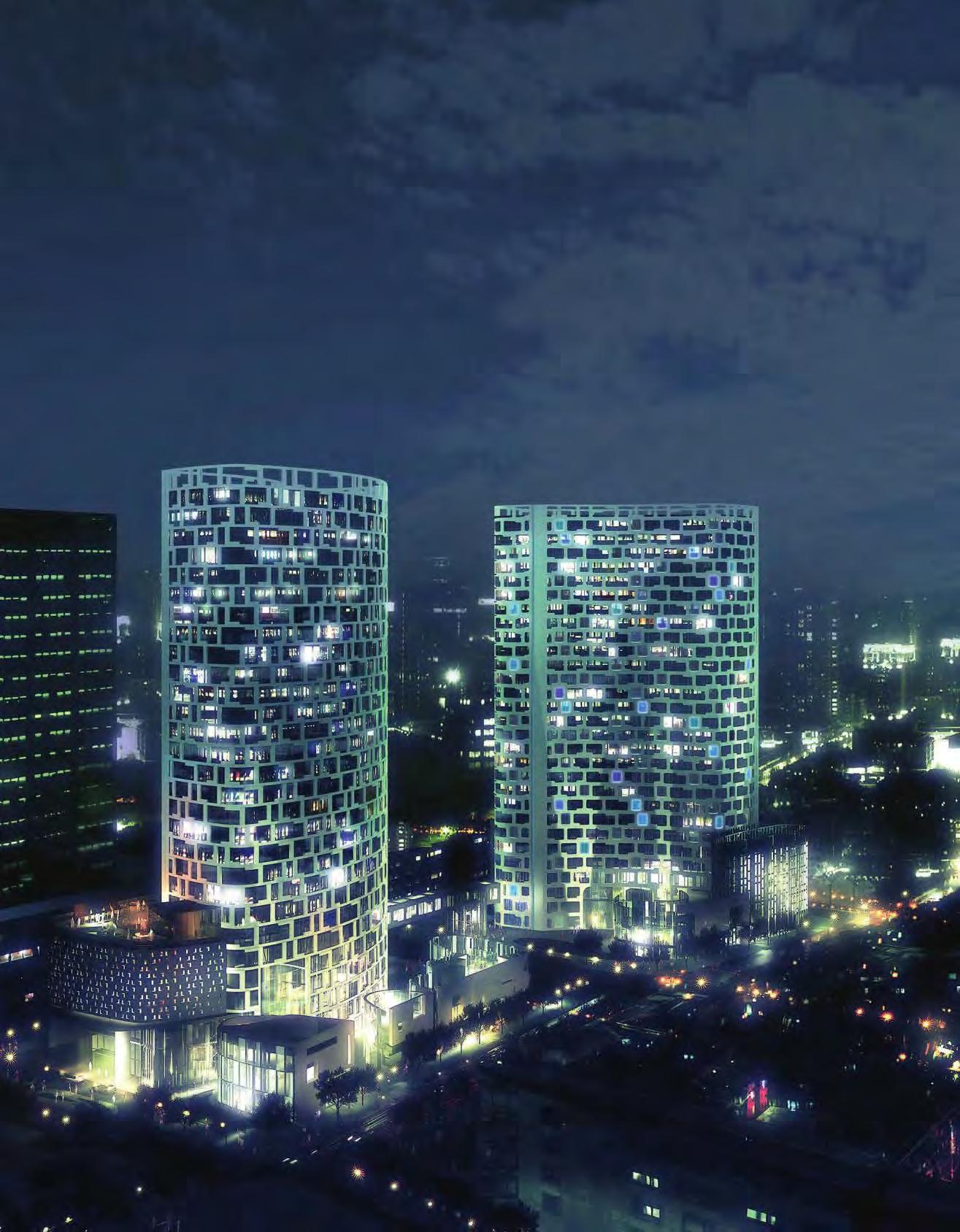
Andaz and Langham Xintiandi, Shanghai, China
Located next to the Xintiandi district, which is a redeveloped nightlife neighborhood populated by restaurants, outdoor cafés and nightclubs, the two luxuryclass hotel towers are joined by a dramatic curving pedestrian bridge. The façade of the 309-room Andaz is animated by multi-colored LED lighting activated into a random pattern once guests close their blackout shades. The façade of the 357-room Langham is inspired by traditional Chinese latticework (see pp. 47–49).
water in the rooms, bathrooms on each floor, gas lighting, steam heat, and room service. But no invention had a greater effect on future hotels and indeed the very skyline of the city than the passenger elevator, first used in 1859 in the Fifth Avenue Hotel in New York City. Locals referred to the elevator as a “vertical screw railway” while the English called it the “ascending room.”
By the turn of the century most major cities had at least one prestigious hotel. The Waldorf and Astor hotels were developed on New York’s Fifth Avenue. The Palmer House and the Sherman House, the largest hotels of their time, became the pride of Chicago’s State Street, while the Palace on San Francisco’s Market Street and the Brown Palace in downtown Denver displayed impressive atriums. Feeding off the frenetic growth in U.S. cities, The Savoy in London advanced the mixed-use nature of hotels by including a theater and a chapel. The Savoy had its own in-house laundry and, with 67 bathrooms to its 400 guestrooms, the builder was prompted to ask the developer if he was catering to amphibian guests.
Perhaps no hotel exhibited the extraordinary role that they would play as epicenters of the urban social, political, and business activity as the original Waldorf=Astoria. Designed by Henry J. Hardenbergh as two separate hotels for the feuding Astor cousins, the eventual reconciliation led to one of the prize public concourses of the day as Peacock Alley married the two hotels and was permanently symbolized in the hotel’s official spelling with the equal mark between Waldorf and Astor. As the “Unofficial Palace of New York,” The Waldorf=Astoria’s huge ballroom and 40 public rooms were used for the most important social and political events of the day. Peacock Alley was a fashionable runway where elegant gowns and the latest attire were on display for those who came to see and be seen. The Bull and Bear men’s café was where J. P. Morgan and Henry Clay Frick met to cut deals after the close of the New York Stock Exchange.
The early twentieth century saw the advent of the modern commercial hotel: Ellsworth M. Statler established the main principles of modern high-rise hotels when the Buffalo Statler was built in 1908 in western New York State, bringing the service departments up to the ground floor, surrounding them with restaurants, bars, and banquet facilities, and connecting them to the guestroom floors by means of service elevators. Though The Ritz in Paris was the first grand hotel to provide each guestroom with its own private bath, The Statler introduced the model for today’s bedroom and bathroom set and exemplified efficient planning with its doubleloaded guestroom floors. (See Chapter 15 for a discussion of planning the guestroom floor.)
Statler’s innovative prototype proved monumental as it defined a model of business-tourist hotels in cities for decades to come. Still evolving through the downtown hotel boom of the post-war 1920s and 1930s, its influence continues today, finding new forms in the rapid expansion of new types such as design hotels, downtown entertainment hotels, and mixed-use complexes. And technological advances have allowed hotels to soar to incredible new heights, once again dominating the skylines of major cities around the globe.
Planning and Development Considerations
Rail travel in the early twentieth century fostered development of hotels near city railroad terminals. Many hotels took advantage after the New York Central Railroad made acres of prime sites available along Park Avenue in the Terminal City development around Grand Central Terminal. Even after the decline of rail travel many of these locations remain viable hotel development sites since they have evolved into centers of concentrated business and retail activity and the terminals themselves have become commuter rail stations. In fact, restaurants and bars of hotels built near commuter train stations are usually at their peak performance just after quitting time.
The location of a hotel in the city in many ways defines its market and its character. In addition to rail terminals, urban hotels have gravitated to locations in close proximity to active business centers and fashionable shopping districts such as New York’s Fifth Avenue, Chicago’s Magnificent Mile, or Tokyo’s Ginza Strip. The Grand Hyatt Tokyo at Roppongi Hills is located in the heart of Japan’s largest private-sector urban redevelopment project near the famous Ginza shopping district comprising the world’s highest-priced real estate.
High-end residential neighborhoods with fashionable shops, museums, and art galleries often provide a magnet for luxury hotels whose character borrows from the residential surroundings. Some
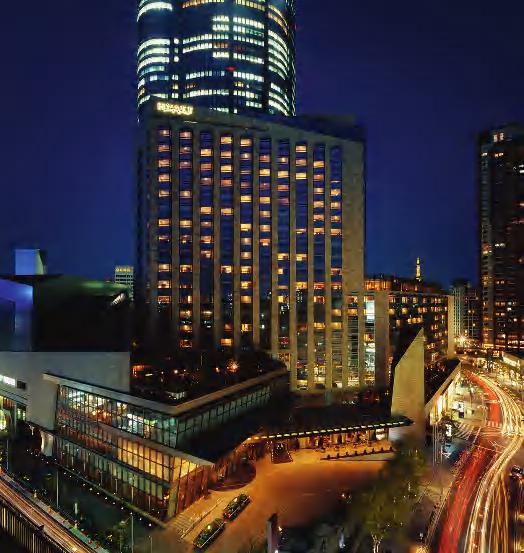
The Grand Hyatt Tokyo at Roppongi Hills, Tokyo, Japan Fusing art and intelligence, the Roppongi Hills development is known as the “Artelligent City.” It includes the 54-story mixed-use Mori Tower, also designed by the hotel’s architect, KPF. With 380 guestrooms, 10 restaurants and bars and 13 banquet rooms, the hotel serves a pivotal role in the livelihood of the development.
As
downtown
the
close
the
a
and retail
to the Stock Exchange and the popular
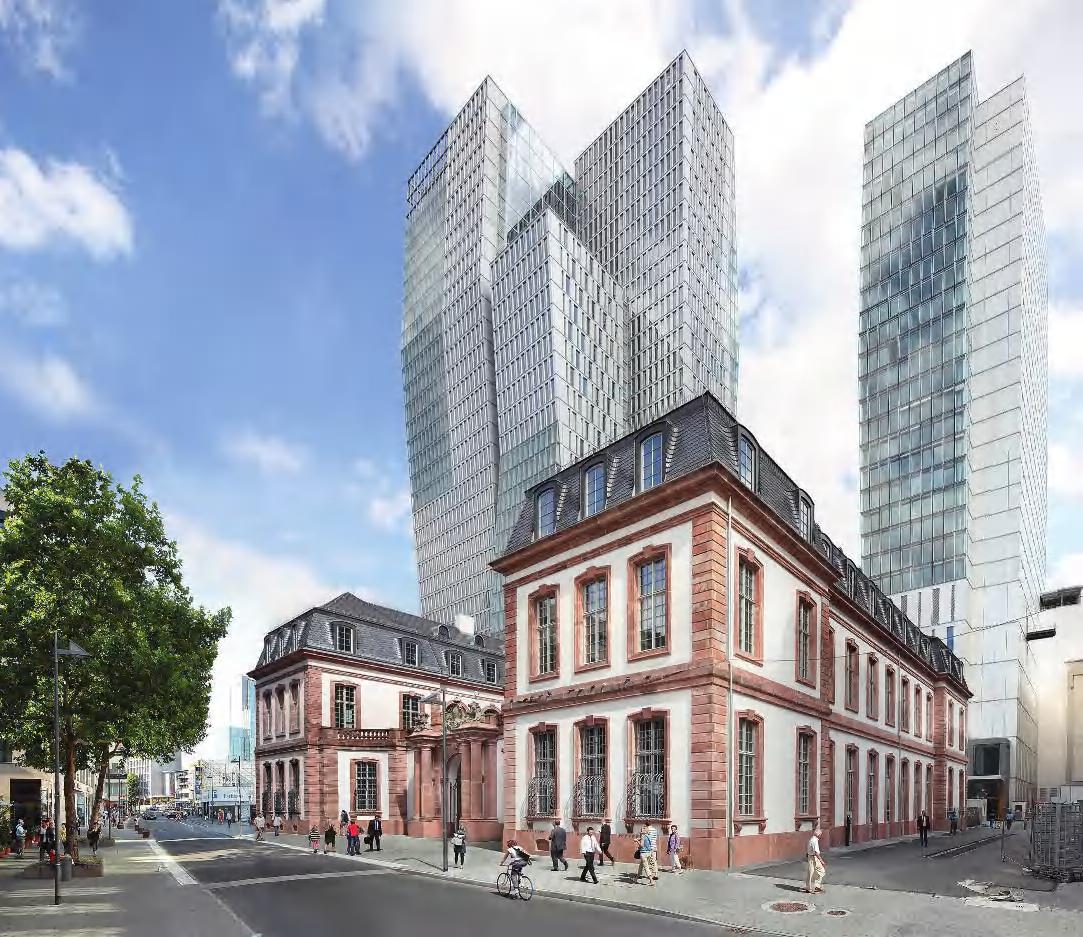
Frankfurt provides accommodations for both business and leisure travelers, with 218 guestrooms and suites, six multi-purpose meeting rooms, a 4,306 sq ft (400 sq m) ballroom and a world-class Talise spa.
hotels are identified with major city plazas and parks such as the Plaza Hotel on New York’s Central Park, the St. Francis on San Francisco’s Union Square, and the former Ritz-Carlton (now Taj Hotel) on Boston’s Public Gardens (see Urban Super-luxury Hotels, pages 44–51).
Urban renewal redevelopment efforts often seek hotels as a catalyst to attract other real estate development or to provide a necessary ingredient for the success of a project. The Jumeirah Frankfurt Hotel is a central component to the PalaisQuartier, an important leisure and
retail project in downtown Frankfurt, Germany, in close proximity to the Stock Exchange and the famous MyZeil shopping mall.
A new wave of urban entertainment venues led by the resurgence of center-city neighborhoods such as the burgeoning Downtown Miami Metropolitan district, New York’s Meatpacking District, Melbourne’s Crown Entertainment complex, London’s Leicester Square, and Singapore’s Bayfront Avenue Marina have provided fertile ground for a new type of hotel, exemplified by the dazzling Marina Bay Sands hotel development in Singapore (see pages 208–211)
Jumeirah Frankfurt Hotel, Frankfurt, Germany
a central component to
PalaisQuartier,
major leisure
project in
Frankfurt in
proximity
MyZeil shopping mall,
Jumeirah
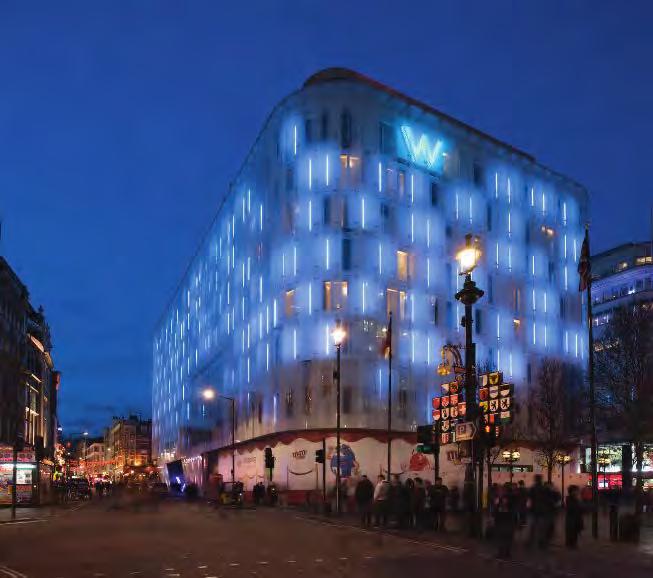
W London, London, United Kingdom
Evoking the cinematic legacy of Leicester Square, the hotel is wrapped with frameless glazing suspended from the face of the building like a floating sheer veil, etched with an undulating pattern like the folds of a theater curtain. Hundreds of energy-efficient light fixtures set into the outer main wall provide an infinite number of combinations and effects, controlled by sophisticated electronics from within the hotel, allowing the presence of the building to alter as day turns to night.
across the harbor from the city’s central business district. As cities are realizing the value of their waterfronts after long periods of neglect, mixed-use developments that include hotels are prospering in the context of cruise ship and ferry terminals, waterfront recreation facilities, and the air, light, and spectacular views afforded by the open expanse at the water’s edge (see Urban Waterfront Hotels, pages 36–43).
Boutique hotels originated in marginal neighborhoods where inexpensive and obsolete buildings were transformed into highfashion lodgings. With their explosive popularity and heavy investment from major chains, boutique hotels (variously referred to now as design, fashion, or lifestyle hotels) have expanded to more central upscale locations in the city (see Design Hotels, Chapter 3). Other markets that drive location in the urban center are for hotels located near major medical centers, government centers, convention centers, financial markets, courts, universities, and city halls.
Place-making: Hotels that Transform and Define Neighborhoods
Pioneering developers boldly pursuing their visions by investing in risky real estate transactions can transform quiet underserved neighborhoods into dynamic center-city destinations. As we have seen in New York City with the Mercer Hotel in SoHo or the Tribeca Grand, hotels as leading-edge urban interventions become a catalyst for place-making and defining the character of neighborhoods.
The trailblazing development of the Gansevoort Hotel in the drowsy Meatpacking District in Lower Manhattan was without question a key ingredient in transforming an obscure light-industrial neighborhood of a few bistros and boutiques scattered among beef-filled warehouses into a thriving and fashionable residential, commercial, and entertainment destination.
The Gansevoort, The Standard, and The James Hotel demonstrate that the most undeveloped real estate in urban areas is often their rooftops. In multi-story hotels structural loads require a tight
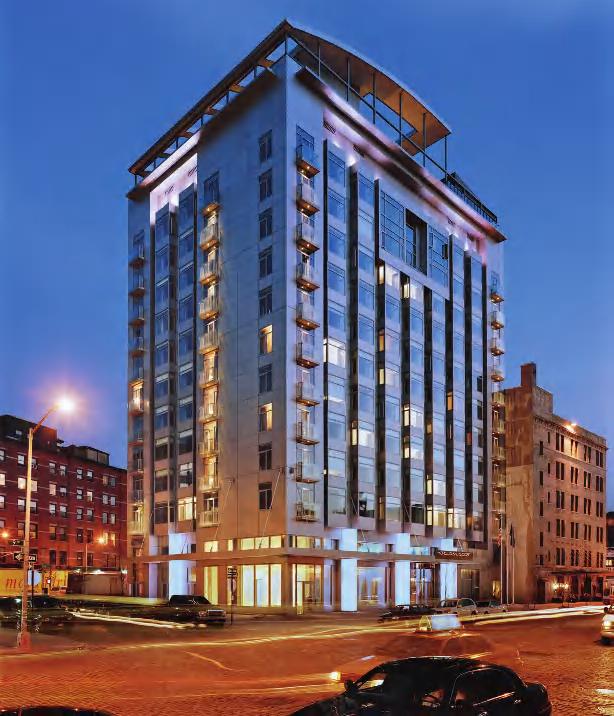
Gansevoort Hotel, New York, New York (top)
Beyond catering to its sleep-over guests, the hotel-as-nightclub model of the pioneering original Standard on Sunset Boulevard endures with the Gansevoort Meatpacking NYC Hotel. With 187 guestrooms and 23 suites, the 14-story hotel features lively rooftop amenities that attract guests and non-guests to its heated 45 ft pool with underwater music, “Plunge” Bar and Lounge, landscaped garden, and 360-degree panoramic views of New York City and sunsets over the Hudson River.
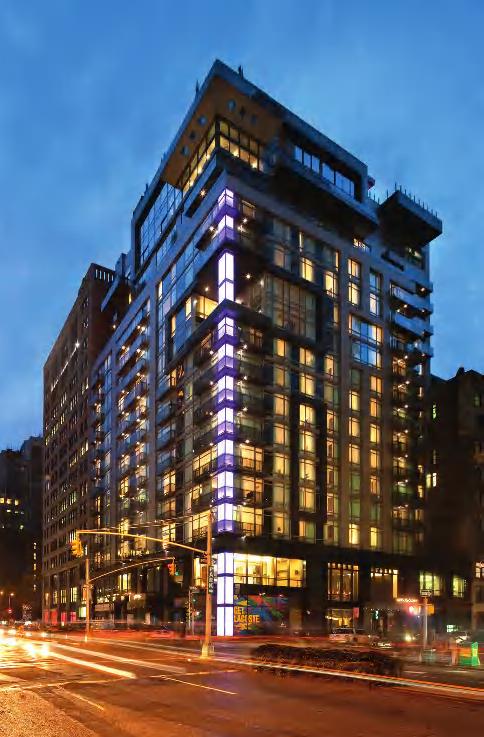
Gansevoort Hotel, New York, New York (bottom)
Once a thriving hotel district in the early twentieth century, Park Avenue South has long been underserved by luxury hotels. As those early hotels were epicenters of social life in the city, the Gansevoort Park presents a new standard of hotel luxury and destination-gathering for the area. Trumping the extravagance of the Gansevoort downtown rooftop, the Park Avenue hotel’s 20,000 sq ft triple-level complex features an indoor/outdoor heated pool with underwater music and multiple connected nightlife venues.
grid of columns on most floors but rooftops can be relatively column-free, providing guests with open space, abundant light and panoramic views. Views from mid-rise buildings are different from rooftop observatories on high-rise structures like the Empire State Building or Sears Tower, which provide sweeping vistas of the entire region.
Building on the successful formula of their earlier hotel on the lower West Side, the Gansevoort Park Avenue expanded the concept of urban resort with extravagant rooftop venues by creating a new entertainment destination and breathing new life into the previously lackluster Park Avenue South neighborhood in New York City.
Style and Theater
As an outgrowth of the exploding popularity of boutique hotels and an intense interest in cutting-edge design by brand-name
architects, hotel developers are finding high-style design to be a significant advantage in achieving notoriety and resultant market value. Technological advances in building systems and applications of amazing new computer design programs are resulting in fantastic forms and building envelopes in all types of buildings. The hospitality industry is realizing that investment in avant-garde architecture pays off in marketing appeal.
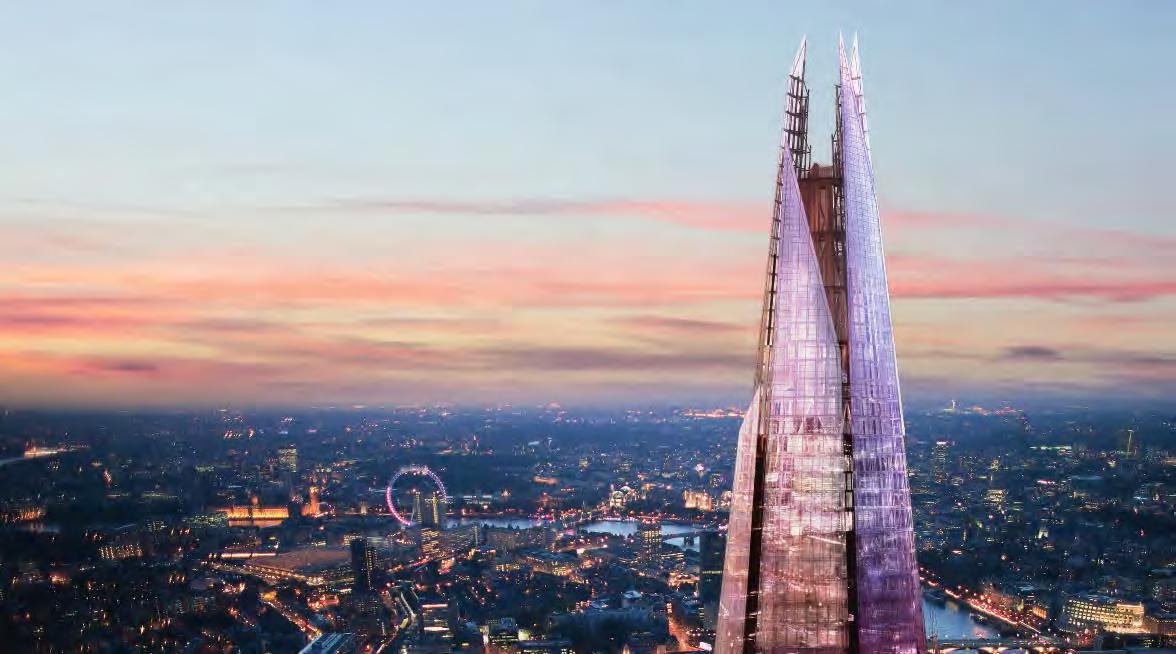
Dubai, Abu Dhabi, and Shanghai have become virtual laboratories for ultramodern hotel buildings where construction budgets are aimed at daring experimentations of architectural fancy. Hotels are part of bold and extravagant mixed-use buildings such as Burj Khalifa, Marina Bay Sands, Meydan Grandstand and Hotel, India Tower, Crystal Island Tower, and the Shard in London. Other examples of extraordinary super-modern design include the Renaissance Paris Arc de Triomphe Hotel, the Silken Puerta América Hotel, The Address Hotel, and Frank Gehry’s remarkable Marqués de Riscal Hotel in the Spanish wine region.
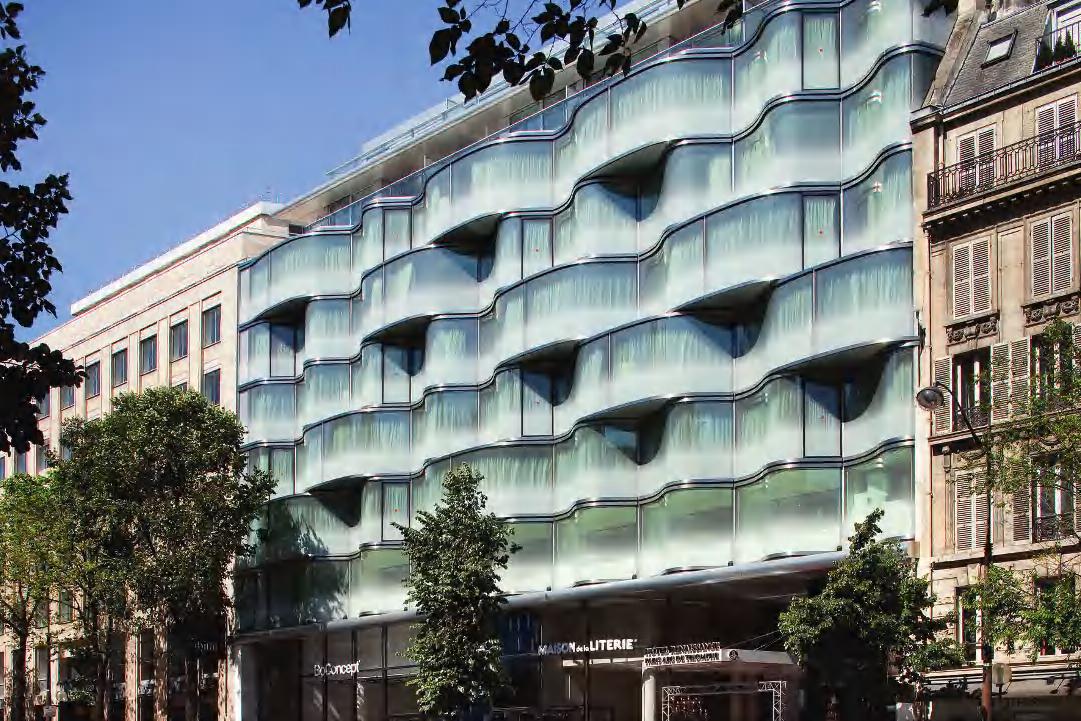
Renaissance Paris Arc de Triomphe Hotel, Paris, France
Atelier Christian de Portzamparc designed a striking façade for the hotel with undulating horizontal glazed bands. The undulations become bay windows in the guestrooms, affording views up and down the avenue toward the Arc de Triomphe and Place des Ternes. The hotel has direct and exclusive access to Salle Wagram, the famous banquet and event venue built in 1865, which has been fully restored according to Portzamparc’s design.
The Shard, London, United Kingdom (top)
At 1,016 ft high, Renzo Piano’s Shard is one of the tallest buildings in Europe and one of the most ambitious architectural achievements in the United Kingdom. The deluxe 195-room Shangri-La Hotel, at the Shard, London, is accessed by a dedicated entrance at street level and occupies floors 34 to 52 of the iconic London Bridge Tower.
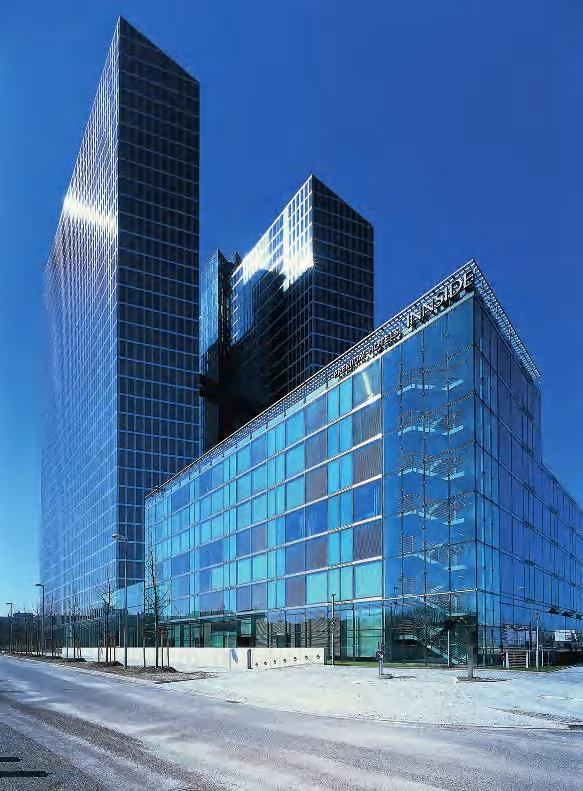
Innside Premium Hotel, Munich, Germany (left)
As one part of a four-piece architectural ensemble which includes two office towers and a low-rise office building designed by Helmut Jahn in Munich’s burgeoning urban redevelopment project, Parkstadt Schwabing, the Innside Premium Hotel caters to the design-conscious business traveler with 160 guestrooms and suites, a restaurant, fitness club, and conference rooms.
Celebrity architects or “starchitects” are in high demand as developers and hotel companies seek the wow-factor and media attention they bring to their hospitality developments. Michael Graves, Tadeo Ando, Norman Foster, Renzo Piano, Frank Gehry, Kengo Kuma, Rem Koolhaas, Arata Isozaki, Enrique Norton, Jean Nouvel, I. M. Pei, and Helmut Jahn are among those whose celebrity and critical acclaim have transformed them into idols of the architectural world. They are eagerly sought after by hotel developers to bring status and value to their projects.
Place and Tradition
In the Imperial Hotel in Tokyo, Frank Lloyd Wright demonstrated early in the twentieth century that hotels must reflect place and tradition. Hotels that establish their primary aesthetic identity by creating a contextual fit to the architectural heritage of the city they inhabit reflect this same sensitivity and provide real value to preserving a sense of place in the city.
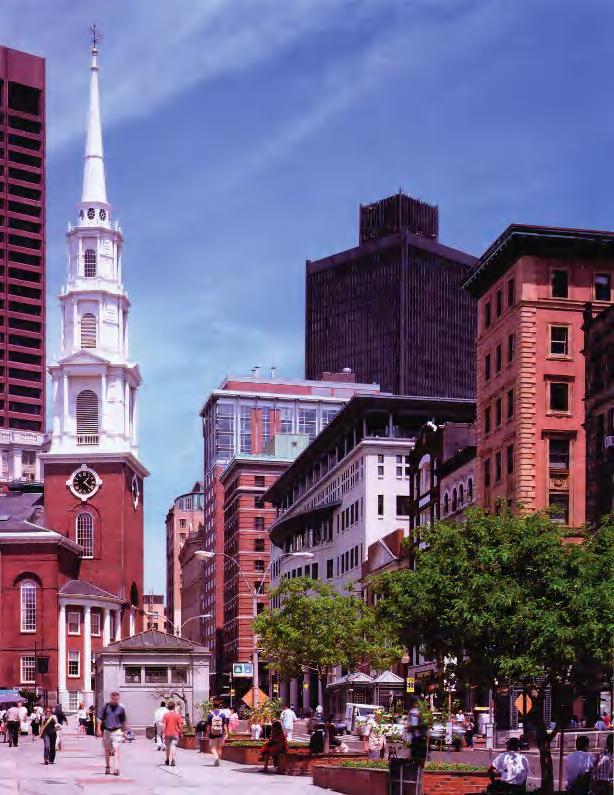
Only a few doors down from the original site of the famed Tremont Hotel, Kimpton’s Nine Zero Hotel is surrounded by the rich history of
Boston Common, Beacon Hill, Faneuil Hall, and Quincy Market. The architects faced the rigors of the Boston Redevelopment Authority and Boston Civic Design Commission in delivering an appropriate contemporary building design in the heart of one of the oldest cities in the United States.
Beyond hotels that contain facilities for performance and entertainment (see Urban Entertainment Hotels, pages 31–35) there is a fundamental quality of downtown hotels that provides a setting where the theater of human life is played. Morris Lapidus laid bare the theatrical aspect of hotels in the 1950s with his designs for the Fontainebleau and Eden Roc hotels in Miami Beach. Here guests were cast as performers while dining in an elevated stage-like restaurant or while climbing up and down grand stairs that might have been built for Loretta Young or Scarlett O’Hara. From the Astor in New York to the Hotel Ritz in Paris, hotels have long embodied an architecture of theatricality defining a place for the drama of human activity and experience.
The prestige of Atlanta, Georgia, soared after its first atrium hotel, Hyatt Regency Atlanta, triggered a wave of new development and catapulted the city into the future, further defining its role as capital of the New South. The symbolic image of Quebec City has long been shaped by the commanding presence of the Hotel Frontenac high above the bluffs on the St. Lawrence River. Hotels as highly visible monuments and prized trophies have elevated the self-esteem of cities since the architect Isaiah Rogers produced the Tremont House in Boston and the Astor House in New York City in the early 1800s and the stately Taj Mahal Palace hotel overlooking the Arabian Sea in Mumbai opened in 1903.
Making a dominant visual statement on the skyline has long been a goal of hotel owners, supported by architects and developers alike. The majestic domed roof of the St. Louis Hotel in early nineteenthcentury New Orleans could be seen miles away on the Mississippi River, and the superb twin copper spires of The Waldorf=Astoria have adorned New York City’s skyline for seventy years.
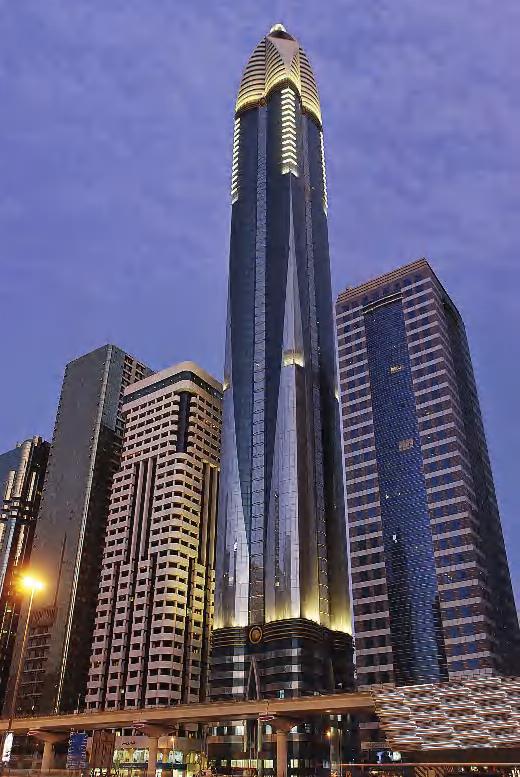
The current title-holder for tallest hotel in the world is the Rose Rayhaan Hotel in Dubai superseding the former champion, the nearby Burj al Arab Hotel. The 72-story Rose tower soars to a height of 1,100 ft (333 m), offering a sleek icon on the Dubai skyline.
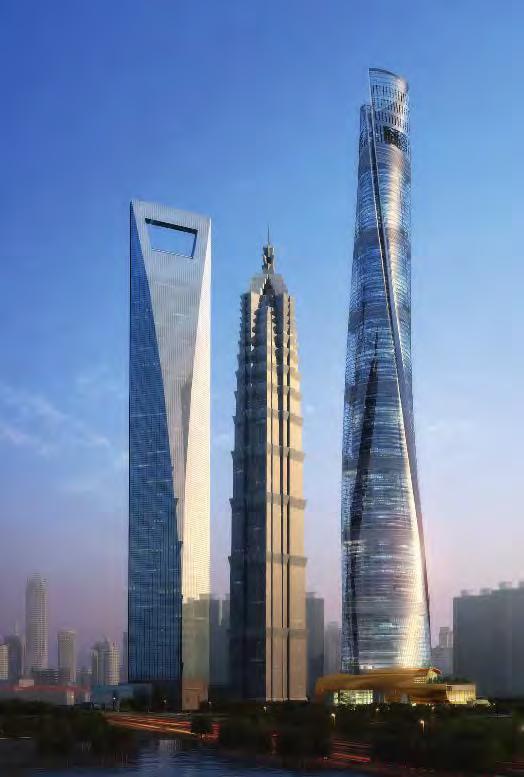
Mixed-use towers allow hotels to bask in the glory of magnificent skyscrapers while occupying only a fraction of the floor area. The Park Hyatt Shanghai in the World Financial Center and the neighboring Grand Hyatt Shanghai in Jin Mao Tower both once claimed to be the “highest” hotel. Surpassing both, the Shanghai Tower J-Hotel is the centerpiece of the stunning 121-story Shanghai Tower being constructed in the hub of the central business district of Lujiazui, shoulder to shoulder with the other two towers. (See Mixed-use Developments, Chapter 6)
Nine Zero Hotel, Boston, Massachusetts
In combining traditional red brick and limestone with sleek nickel, chrome, stainless steel, and glass, the façade of this 190-key downtown hotel echoes the timeless use of materials of its surrounding classic architecture, punctuated with an elegant modern style.
The slender steel and glass tower rises from a relatively small footprint of 10,000 sq ft (929 sq m), requiring the architects and engineers to incorporate the latest structural and architectural solutions in skyscraper design for this 482-key hotel, the tallest all-hotel building on the planet.
Public Spaces
Since a hotel’s architecture is often obscured and overwhelmed by its dense urban surroundings, the entrance lobbies in downtown hotels must make bold statements and lasting impressions. More than any other element, the lobby quickly sets the hotel’s tone and ambience.
The grand hotels of the 1920s and 1930s saw dramatic swings in size and extravagance of their public spaces. The original Waldorf=Astoria on Fifth Avenue was rendered obsolete by the Plaza Hotel when it opened offering New York society its immense ballroom and its sumptuous palm court, parlors, and lobbies. The New Netherland built in New York in 1926 during Prohibition avoided lavish public halls and placed its emphasis on luxurious appointments in the private realms of guestrooms and suites where many guests availed
Shanghai World Financial Center, Jin Mao Tower, and Shanghai Tower, Shanghai, China
Within a tight three-block area of downtown Shanghai, the three dueling skyscrapers each boast first-class hotels as their crowning elements. In Gensler Architects’ Shanghai Tower, the lobby of the J-Hotel is located on the 101st floor of the building and the hotel itself includes 258 guest rooms within floors 84–110.
themselves of room service with bootleg trimmings. Then the new Waldorf=Astoria emerged on Park Avenue in 1931 to reclaim the title as the “Unofficial Palace of New York,” as vast lobbies and ballrooms returned en vogue
In the late 1960s, Hyatt Regency Atlanta expanded on such historic models as San Francisco’s Palace Hotel and Denver’s Brown Palace and set a new pace with its towering atrium offering a bold new dramatic form for downtown hotel lobbies. With or without atriums the trend in the 1970s and early 1980s was for large impressive lobbies. That trend has taken on new dimensions with brands such as Gaylord Hotels, where huge atriums cover acres of landscaped gardens and terraces and enclose a wonderland of restaurants, lounges, shopping streets, and performance venues. In reaction to the expense and perceived lack of warmth, many developers returned in the twenty-first century to more intimate interior spaces
Rose Rayhaan by Rotana Hotel, Dubai, United Arab Emirates
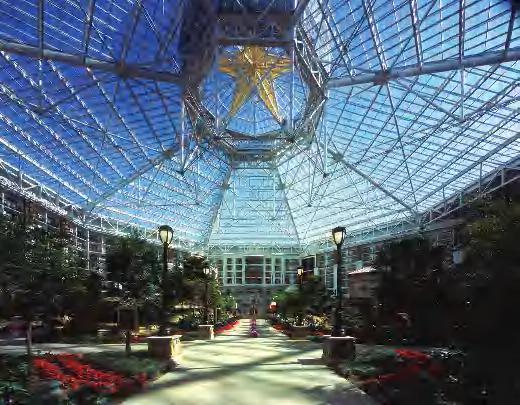
Texan Resort and Convention Center, Dallas, Texas
With 4.5 acres (1.8 hectares) of indoor gardens and winding waterways, the 1,500-room hotel boasts over 400,000 sq ft (37,150 sq m) of flexible meeting space, including the 180,000 sq ft (16,700 sq m) Longhorn Exhibit Hall. The hotel’s 165 ft (50.3 m) high glass-framed atrium houses a San Antonio-themed Riverwalk complete with replicas of the Alamo and other Spanish missions.
and focused interior budgets on high-quality materials, lighting and artwork to achieve the sense of grandeur.
Planning Controls
A deciding factor in hotel location is very often the influence of city zoning regulations that regulate use, density and bulk on any given development site. City guidelines may also offer zoning bonus or tax incentive programs that are aimed at fostering the beneficial qualities a hotel brings to a neighborhood. Zoning constraints can rule out a site for hotel development by not permitting transient use, not allowing sufficient floor area to be built for the project to become feasible, requiring immense amounts of parking, or through some other regulation that checkmates the developer’s goals. For example, one prime downtown site could not be developed as a hotel because, though city zoning regulations required two loading berths based on the proposed size of the hotel, another regulation prohibited curb cuts along the avenue frontage, thereby precluding the required loading dock and thus preventing hotel development. In order to solve the dilemma the developer had to acquire an adjacent parcel that fronted on another street that did allow curb cuts so that the hotel could build the required truck docks.
Land values in urban areas are normally so high that development calls for building the maximum allowable floor area that a site can bear. City planners regulate density in different areas of the city based on the desire to keep the character of a neighborhood lowscale and residential or to encourage large-scale development and high-rise construction. Density, therefore, is regulated by a formula relating the area of the building lot with a density factor sometimes
called floor area ratio or FAR. FAR is a multiplier used to calculate the amount of floor area that can be built on the site. For instance, a site of 10,000 sq ft with a mandated FAR on the site of 15 allows a maximum of 150,000 sq ft gross (10,000 x 15) of zoning floor area to be built above grade. (Cellars and sub-cellars usually are unlimited.) If that turns out not to be enough area to make the hotel project fly, then other options may be available, such as an FAR bonus or the purchase of air rights (also called unused development rights) from an adjacent property owner. The New York City zoning map describes a theater sub-district that, in order to encourage construction and renovation of theaters, provides a floor area bonus to developers who build or renovate legitimate theaters in that district, in addition to building their own project.
City zoning regulations may also control the shape of the building in order to define view corridors, street walls, and building height. But most often bulk regulations are aimed at preventing dark stagnant streetscapes and are designed to permit light and air to penetrate down to street level and make it a healthier environment. These
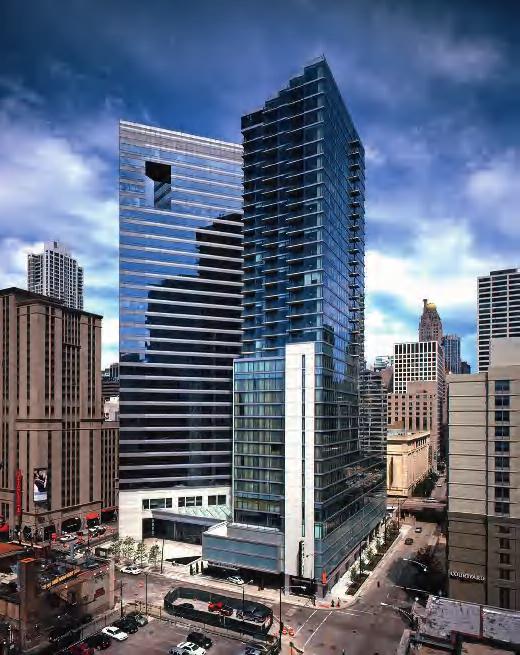
Shaping their design within the stringent regulations of the River North zoning district in the heart of downtown Chicago, GREC Architects sculpted the Palomar’s glass and concrete envelope with an array of purposefully placed building setbacks in response to zoning requirements for sufficient light and air. Notwithstanding the restrictive zoning constraints, the limited views caused by the adjacent American Medical Association tower, and the miniature size of the property, the architects managed to incorporate a great deal of building onto the site.
Kimpton Palomar, Chicago, Illinois
Gaylord
Many cities now have commissions and agencies whose duty it is to oversee construction on or near its historic buildings and landmarks. In many cases whole neighborhoods are designated landmark districts so any new building must be scrutinized for its contextual appropriateness. Architects and developers often must conduct exhaustive research and prepare convincing documentation to present to the landmarks authority for approval before construction can begin. The degree to which faithful reproduction of details and design is required usually depends on the value and status of the landmark itself.
Site Factors
In any hotel development a survey of elements surrounding the site is as important as surveying the site itself. The density of urban settings presents a multitude of special problems. Placing your entrance next to an adjacent property’s loading dock may be worse than putting it next to your own. Also, care should be taken when locating close to a movie theater, where long ticket queues and exiting crowds may disrupt your entrance. Some cities have regulations that prohibit alcoholic beverages being served within a certain distance of a church or school, making a liquor license impossible to obtain. Due diligence to avoid these types of surprises is essential.
Views add real value to a hotel property. Hotels routinely demand higher rates for rooms with great views of the skyline, the waterfront, or a park than for those facing an adjacent office building. Therefore, it is important to know about and even to predict where views will exist. It may govern decisions on how high to build to assure that upper-floor specialty suites gain a spectacular view over surrounding buildings. A developer may be faced with the economic decision to build a 40-story hotel with 15 guestrooms per floor as opposed to a more efficient and less costly 20-story hotel with 30 keys per floor. The added expense of building the taller structure must be weighed against the potential of higher room rates for the added value of spectacular views and the intangible value of a more significant presence on the city’s skyline.
regulations are sometimes referred to as height and set-back rules and are best illustrated by New York City’s 1916 Zoning Resolution that prescribed specific set-backs from the street based on sun angle studies. The result of that law defined the character of skyscraper design for decades to come, as illustrated by the remarkable renderings of Hugh Ferriss. The Shelton Hotel, the world’s tallest hotel when built in 1923 with 34 floors and 1,200 rooms, was a beautifully proportioned response to 1916 zoning and set the tone for many of New York’s great buildings of the 1920s and 1930s.
Use regulations can also have important ramifications in the design and development of hotels. Retail continuity was a requirement for the New York Four Seasons, built on a fashionable shopping street. According to the zoning regulation only 20 percent of the street frontage could be anything other than retail use. Therefore, the hotel entrance became very narrow, contradicting the developer’s wishes for the hotel to have great presence on 57th Street. The architects, thus, were compelled to raise the lobby to the second level above the stores that flanked the entrance.
In designing a hotel in New York City, the developer and architects for the RIHGA Royal (now The London Hotel) were aware of plans for a large bulky office tower directly across the street that would limit views towards the south. In response they devised a system of bay windows so that every room had views looking east and west. Similarly, sunlight and shadows are another consideration when designing a hotel in the urban landscape. Whenever possible, roof terraces and main entrances should be arranged to receive maximum sunlight.
Space Maximization
The density of urban sites requires much tighter control over matters of efficiency and layout. The designer must make every square foot count to a degree not usually required in other hotel types such as resorts and suburban hotels where space is not such a premium.
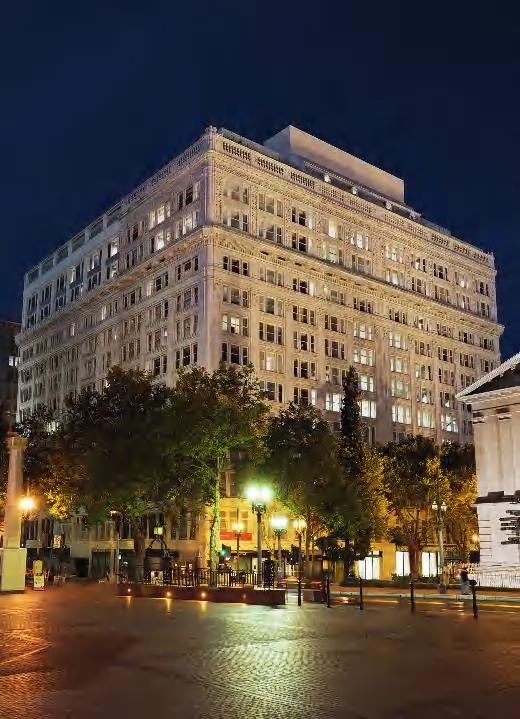
The Nines Hotel, Portland, Oregon
In converting the 1905 vintage Meier & Frank building in downtown Portland to The Nines Hotel, SERA Architects worked closely with the Portland Development Commission in carefully maintaining the building’s historic character, allowing it to maintain its status on the National Register of Historic Places (NRHP). The project won a National Preservation Award from the NRHP.