FOREWORD
Clayborne Carson
It has been more than a half century since Martin Luther King, Jr , published his final book, Where Do We Go from Here: Chaos or Community? Although King’s subtitle expressed the urgent need to avoid chaos, he offered only tentative suggestions during his remaining months of life about how to build a just and peaceful world community Based on the insightful essays in this book, I suspect that Bayard Rustin might well have thought that he was the person best prepared through long experience as an activist and advisor to respond to King’s question
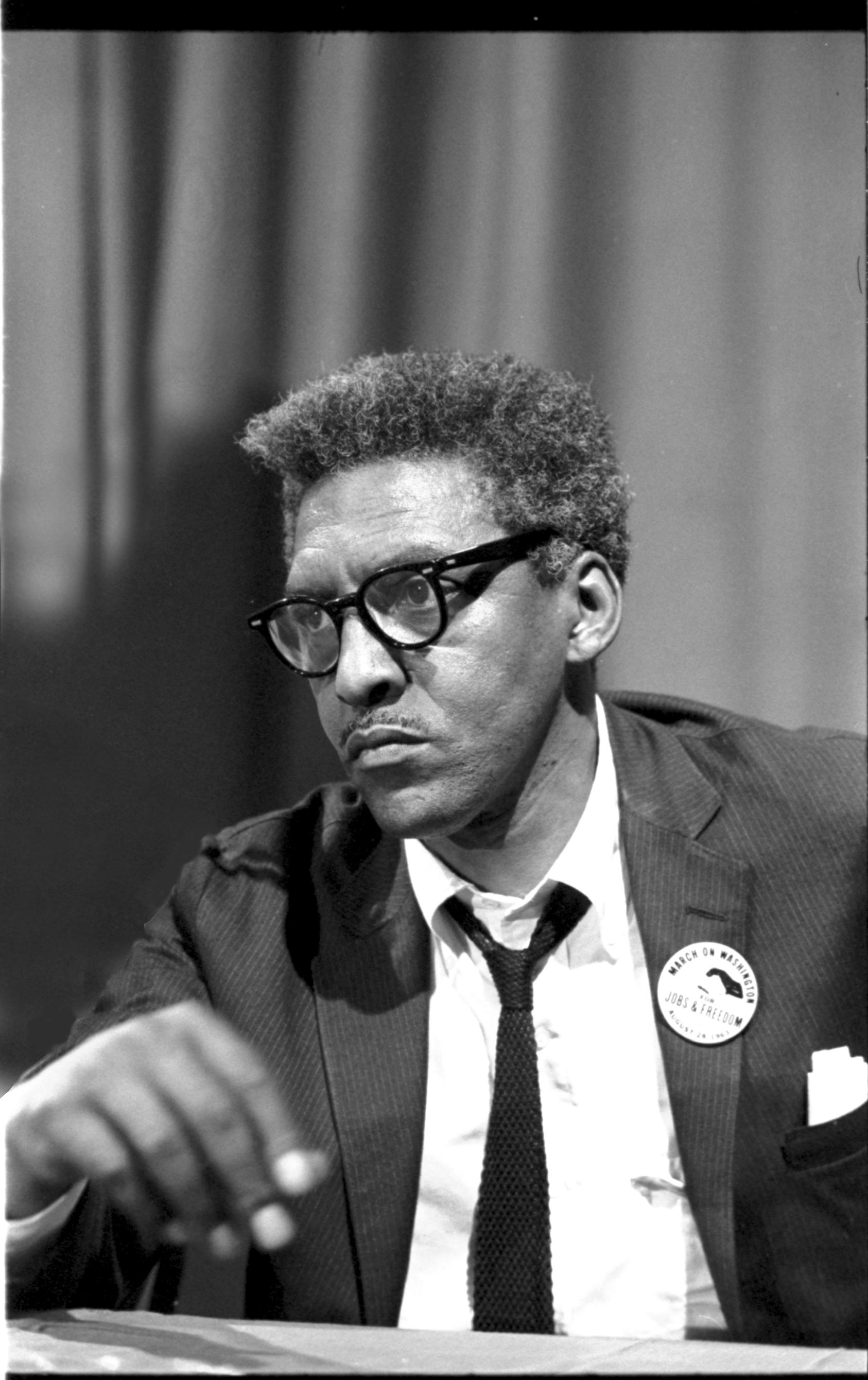
The fact that King’s “I Have a Dream” speech at the 1963 March on Washington is remembered far more than the person who organized the march helps us understand why this collection of essays about Bayard Rustin is necessary and overdue Although Rustin’s controversial past led him to avoid drawing attention to his advisory role, he made possible King’s swift assent from leadership of a bus boycott movement in Montgomery, Alabama, to become the prime symbol of a civil rights movement that transformed the nation and inspired the world
These essays are by no means hagiography They reveal Rustin’s flaws as well as his virtues, the limitations as well as the breadth of his vision He was controversial because of his early involvement during the 1930s with the Young Communist League and because of his sometimes furtive homosexuality Prominent Black leaders such as A Philip Randolph, Ella Baker, Martin Luther King, and many others were willing to look beyond Rustin’s baggage because they appreciated his unique assets
Although still a teenager when I attended the March on Washington and became aware of Rustin’s significance as a behindthe-scenes organizer, he soon attracted my curiosity once I became a part-time journalist for the Los Angeles Free Press and ultimately a full-time graduate student at UCLA When I began the research that ultimately resulted in my dissertation about the Student Nonviolent Coordinating Committee (SNCC), I realized that I needed to know more about the man who seemed always on the periphery of my main topic
I would discover that Rustin had been invited to address SNCC’s first conference in October 1960, but the invitation was withdrawn when a union sponsoring the conference objected to Rustin’s radical reputation SNCC members would soon regret giving in to anticommunist hysteria, but some would later deride Rustin as an ally of the liberal establishment that opposed seating the Mississippi Freedom Democratic Party (MFDP) delegation to the 1964 Democratic Party convention in place of the all-white “regular” delegation from Mississippi
Stokely Carmichael, with whom I became acquainted shortly before the March on Washington, would later tell me about his effort as a Howard University student to arrange a debate between Rustin and Malcolm X He recalled being impressed by both men, although Rustin strongly criticized Stokely’s adoption of the Black Power slogan, dismissing it as “positively harmful” because it would remove Black Americans from “the main area of political struggle ”1 At the time, I shared Stokely’s distrust of Democratic Party
liberalism, but agreed with their shared belief that protests were not sufficient to achieve economic and political power
Perhaps because I ultimately came to know so many of Rustin’s acquaintances, one of my greatest disappointments was that I was never able to meet and interview Rustin Once I began the research for my first book, In Struggle: SNCC and the Black Awakening of the 1960s, I tried in vain to write and call him to arrange an interview By then, he had become head of the A Philip Randolph Institute and perhaps too preoccupied to pay much attention to a fledgling scholar I decided to stop by his office and accepted his assistant’s offer to wait outside just in case he found time to meet with me
Thus, for me, this anthology substitutes for the extended, probing interview for which I patiently waited
and House Second, you are a socialist, and many people think that socialism and communism are basically the same thing Thirdly, you admit that you belonged to the Young Communist League And then there’s the whole business of you having been arrested in California on a sex charge Now, do you think we ought to bring all that into the March on Washington? Because it’s gonna come out, you know?”
Opponents of the march, according to Wilkins, could and would use Rustin’s complicated and problematic past as fodder for undermining the entire protest So rather than sacrificing the success of the march, the prudent move would be to sacrifice Rustin
“I know, I know,” Rustin replied “But what happens depends on you people who are the main leaders If you stand up and have some courage, it [my past] will do no damage ”1
At a July 2 meeting about the march, three of the Big Six civil rights leaders—Martin Luther King, Jr , James Farmer, and John Lewis—showed some courage and stood up to the NAACP head In the end, A Philip Randolph became the official director, and he named Rustin as his deputy director, a position that effectively made Rustin the march’s main organizer
It’s still shocking that a pacifist, socialist, ex-convict, former communist, openly gay, Black man was largely responsible for planning and executing the most significant event in US protest history But just as jolting is Rustin’s refusal to roll over and surrender after acknowledging that he would be the direct target of the march’s opponents as well as the subject of intense media scrutiny
If there is anything that the March on Washington reveals about Rustin other than his organizing genius, it’s his ambitious refusal to confine himself to the shadows of history Indeed, near the conclusion of the march, Rustin strode to the microphone and, with his clenched right fist thrust high, led the massive crowd in supporting each of the march’s ten demands In that moment, at a protest broadcast around the world, Rustin took center stage and made history He was no shrinking violet He was a Black radical, at least in that moment
Indeed, one of the most overlooked parts of the march is its radicalism Not everything about the march was radical, of course Rustin
originally conceived of the day as including mass lobbying at the US Capitol, an act that would shut down regular business for the day; a defiant march past, and an encircling of, the White House; and a rally that would include speeches from unemployed people But by the time Rustin completed his plans, he had left these ideas behind, earning the wrath of militants in the Student Nonviolent Coordinating Committee (SNCC) who had been looking forward to shutting down Congress and calling President Kennedy to task For them, the watered-down march was little more than a friendly picnic
But that criticism was not entirely fair Despite de-radicalizing his plans, Rustin ensured that at least some of the march’s content remained radical
Both Rustin and A Philip Randolph were fervent democratic socialists, and one of their goals was to use the march as a platform for sharing their socialist vision and calling for its enactment The two socialists achieved at least part of their goal by ensconcing it within the march’s list of ten demands Thanks to Rustin and Randolph, the march officially demanded “a massive federal program to train and place all unemployed workers—Negro and white—on meaningful and dignified jobs at decent wages,” as well as “a national minimum wage act that will give all Americans a decent standard of living ”2
Randolph also used his opening speech to declare war against US capitalism “The sanctity of private property takes second place to the sanctity of the human personality,” he said
“It falls to the Negro to reassert this priority of values because our ancestors were transformed from human personalities into private property It falls to us to demand new forms of social planning, to create full employment and to put automation at the service of human needs, not at the service of profits—for we are the worst victims of unemployment ”3
Randolph’s speech, coupled with Rustin’s militant presentation of the march’s demands, represented the first time that millions of white Americans heard prominent Black leaders deliver not only a sharp critique of capitalism but also a demand for a socialist approach to the nation’s economic challenges Together, Randolph and Rustin left
a remarkably radical and threatening legacy, one that is usually ignored in annual feel-good celebrations of the march and its leaders
Beyond that, the march inspired countless people to fight for racial justice and helped to create the conditions that led to the passage of the 1964 Civil Rights Act Just as important, the historic protest stirred other oppressed people to rise up, and even provided a template for subsequent protest marches In the years to come, millions of protesters, many of whom had marched in 1963, would similarly march on Washington for women’s rights, labor rights, LGBTQIA rights, and so much more No protest in US history has been more influential and consequential than the 1963 march
However significant the march was, and however radical part of it was, the legacy of the march—and thus Rustin’s legacy—is tainted
On August 16, the march’s administrative committee held its last meeting before everyone headed to Washington Anna Arnold Hedgeman, the only woman on the committee, asked for the floor “In light of the role of Negro women in the struggle for freedom,” she said, “it is incredible that no woman should appear as a speaker at the historic March on Washington Meeting at the Lincoln Memorial ”4 Hedgeman, joined by Dorothy Height and others, had pleaded with Rustin and Randolph to include a Black woman as a speaker, but the two men adamantly refused, saying that the program was already full and that choosing one woman would create jealousies among other women leaders
Hedgeman’s final plea changed that At the last minute, the Big Ten— the Big Six had added four white men to the inner circle— decided that the program would now include a woman-led “Tribute to Negro Women, Fighters for Freedom ” Still, though, no woman would be allowed to deliver one of the major speeches at the march The exclusion stung Black women were not only the backbone of the civil rights movement; they were also its head, neck, body, and legs
It might be difficult for some of us to believe this, but Rustin and Randolph, like all of us, were not saints Nor is their legacy at the march the hallmark of saintly politics and protest Just ask the women
Given the significance of the March on Washington for Jobs and Freedom, the common tendency to see Rustin’s legacy only in relation to the march is understandable Plus, our culture likes to freeze its heroes in certain times and places, particularly those that seem safe and unthreatening We prefer heroes who are uncomplicated, one-dimensional, shallow But Rustin was much more than “Mr March on Washington,” and to reduce him to the march would be to ignore the depth and breadth and complexity of his longtime fight for economic, racial, social, and political justice 5
Our book avoids this reductionist tendency and shows that Rustin’s legacy is deep and wide—that it has roots in numerous social movements and institutions in the United States and across the globe Rustin traveled through his times like a fast-moving octopus with very long tentacles, and the sheer size and extent of his legacy is breathtaking
By exploring his large legacy in its complexity, we depict Rustin not as the one-dimensional figure often spotlighted and celebrated in annual articles about the march, but as a complicated activist who left multiple legacies, many of them praiseworthy and some of them troubling, that defy simple characterization
Legacies are never easy to describe with accuracy and certainty They are like moral character—best viewed from many different angles, in historical context, and over a long period
Rustin’s legacy, when viewed this way, is especially difficult to describe Though a pacifist, Rustin refused to join the peace movement during the Vietnam War, and years later he called for the US government to send jets to Israel Though an openly gay tactician, he did not join the LGBTQIA movement of the late 1960s and 1970s; it would take almost two decades after the Stonewall Uprising before he would become a visible activist in the movement Though strongly committed to alleviating poverty, he did not support the Poor People’s Campaign until after King’s assassination And, as we have seen, though an enthusiastic proponent of equality, Rustin treated women leaders at the 1963 march as second-class citizens The difficulty of describing Rustin’s legacy is, at the very least, a testament to the complexity of his personality and life
Like studies of moral character, explorations of legacies also lead to a culminating question: Is there anything that ties the different parts together? Is there a unifying element in the various legacies that Rustin left us? Although answers to this question emerge throughout this book, Rustin’s own words hint at possible answers “My activism did not spring from my being gay, or for that matter, from my being black,” Rustin wrote “Rather, it is rooted, fundamentally, in my Quaker upbringing and the values that were instilled in me by my grandparents who reared me Those values are based on the concept of a single human family and the belief that all members of that family are equal ”6 Should we take Rustin’s words here at face value? Is Quaker morality the tie that binds together Rustin’s legacies? Or is there something else? Or could it be that there is no accurate way for us to synthesize the many legacies Rustin left us? Perhaps a quest to tie together Rustin’s various legacies is fundamentally wrongheaded
One thing remains clear: much of Rustin’s legacy remains unfulfilled Consider, for example, the two march demands already mentioned Despite Rustin’s efforts, there is no massive federal program that trains and places all unemployed workers, and there is no national minimum wage that gives all Americans a decent standard of living Both demands are unmet, even though they are at least as important today, when sky-high inflation forces poor people to skip meals, as they did in 1963
Then there is the demand that appeared on a placard that Rustin approved as an official sign of the march: “We Demand an End to Police Brutality Now!”7 If there is any doubt that Rustin’s legacy is relevant for today, call to mind the recent murders of George Floyd, Breonna Taylor, and numerous other innocent Black people Their unjustifiable deaths cry out for us to take Rustin’s legacy seriously
The pages ahead will describe other ways that Rustin’s legacy is relevant for today If we take Rustin’s legacy seriously enough to move beyond the march, as this book does, we will see his ongoing relevance for electoral politics, criminal justice reform, democratic socialism, anticolonialism, and militarism, among other things As he was during his lifetime, Rustin is a rich resource for achieving justice
Of course, when we realize that so many of Rustin’s demands for justice remain unfulfilled, we might become overwhelmed and grow too tired to march on Perhaps in that moment, Rustin’s written words—yes, the remarkable legacy of his words—can help In a 1969 letter to a woman who had complained about how tired she was from having to deal with anti-Semitism, Rustin wrote:
I am not sympathetic to your cry of being tired, Mrs Greenstone I am black and I have lived and fought with racism my entire life I have been in prison 23 times— serving 28 months in a federal penitentiary and 30 days on a North Carolina chain gang among other punishments
I have seen periods of progress followed by reaction I have seen the hopes and aspirations of Negroes rise during World War II, only to be smashed during the Eisenhower years I am seeing the victories of the Kennedy and Johnson Administrations destroyed by Richard Nixon I have seen black young people become more and more bitter I have seen dope addiction rise in the Negro communities across the country
I have been in a bombed church My best friends, closest associates and colleagues-in-arms have been beaten and assassinated Yet, to remain human and to fulfill my commitment to a just society, I must continue to fight for the liberation of all men There will be times when each of us will have doubts But I trust that neither of us will desert our great cause 8
In the final analysis, Rustin’s legacy is not about hope for a pie in the sky It’s not a legacy that promises that one day we will indeed get to the Promised Land Instead, Rustin left us a legacy marked by grit and determination—a relentless commitment to building the beloved community one block at a time, even after it’s been torn down or blown apart far too many times, even if there is no promise of it coming to fruition At last, Rustin’s legacy invites us to fight unceasingly for the freedom of all, no matter what the result might be It’s as simple, and as complicated, as that
PROTESTS, POLITICS, AND PART-
NERS
PROTESTS, POLITICS, AND PARTNERS
Rustin’s Legacy of Civil Resistance in the US
e ri C a Chenoweth
Civil resistance is a form of struggle in which unarmed civilians mobilize using a series of coordinated methods like protest, noncooperation, and the building of alternative institutions to confront their opponents People have used methods of civil resistance—like protests, strikes, or acts of civil disobedience—in North America for hundreds of years However, there was little comprehension of the potential strategic and moral potential of civil resistance as a systematic approach to building and wielding power against oppression until Mohandas Gandhi popularized the concept within the Indian context 1
Bayard Rustin was one of the first people—if not the first person—to systematically apply the theory and practice of nonviolent civil resistance to race relations in the United States 2 At the time of its introduction to the US context, civil resistance was still an emerging technology of resistance, with anticolonial movements following Gandhi’s example by experimenting with the tactics, strategy, and philosophy of nonviolent action Although Rustin is often considered a “giant of post–World War II pacifist and civil rights activism,”3 he left a profound legacy in solidifying a popular understanding and use of civil resistance in the United States
Rustin’s Early Experiments with Nonviolent Action
Rustin first encountered ideas about the power of nonviolence during his childhood He was raised by Quakers who were active members of the NAACP in West Chester, Pennsylvania As a high school student, he experimented with techniques of nonviolent resistance through noncooperation with segregation For instance, he was arrested in his hometown for sitting in a whites-only area of the local movie theater—a sign of the moral clarity he possessed from an early stage of his life
As Rustin was coming of age, a stirring series of events was unfolding across the world In 1930, when Rustin was in his late teens, Mohandas Gandhi launched a pivotal campaign in popularizing the concept of civil resistance: the Salt March The satyagraha’s deliberate lawbreaking of an oppressive colonial salt monopoly hit the world wires, whose attention was inspired in part by the brutality of the colonial administration’s heavy-handed response The events were covered extensively in American newspapers, including among the Black press 4 Gandhi correctly expected that his arrest during the Salt Satyagraha would outrage audiences both inside and outside of India And the brutality visited upon those who protested Gandhi’s imprisonment brought new levels of global sympathy for the claim of Indian independence
More broadly, the Salt Satyagraha inspired a new wave of interest in Gandhi’s strategic mastery of resistance to colonial rule Because Gandhi was both a prolific writer and correspondent, he had developed a significant body of writings outlining his theory of how Indians could liberate themselves from colonialism through nonviolence In the 1930s, several of Gandhi’s interlocuters—such as prominent followers Richard B Gregg and Krishnalal Shridharani— published books that introduced the ideas of nonviolent action to American audiences 5 Prominent pacifist, religious, socialist, and civil rights leaders took notice of these works but had little experience implementing sustained, strategic campaigns of nonviolent resistance in the US context themselves
Bayard Rustin entered Wilberforce University two years after the Salt March began, but he was expelled from the university in 1936 for organizing a strike He later left Cheyney State Teachers College without a degree, moving instead to Harlem, where he was inspired by the Harlem Renaissance and was able to live more openly with his sexuality He completed an activist training course organized by the American Friends Service Committee and enrolled in the City College of New York Later, he was involved in a campaign to free nine Black teenagers who were accused of raping two white women in Alabama
As he began his more formal career as a youth organizer, Rustin was deeply influenced by Black labor organizer A Philip Randolph, who himself had a deep instinct that Black people could effect change only through mass politics The Roosevelt administration’s commitment to major economic reforms, the onset of World War II, and the demands for labor that it produced provided new opportunities for Black political mobilization to confront racism, discrimination, and sexism Prior to Pearl Harbor, Randolph had pressed President Roosevelt for an order to end segregation in the defense industry When Roosevelt demurred, Randolph threatened to organize the first ever March on Washington as a way to end racial discrimination in recruitment to the defense industry and armed forces In a statement to the press, Randolph wrote, in part: “Power and pressure do not reside in the few, an intelligentsia They lie in and flow from the masses Power does not even rest with the masses as such Power is the active principle of only the organized masses, the masses united for a definite purpose ”6
Randolph briefly enlisted Bayard Rustin as a youth organizer for the march But Randolph ultimately called off the march, as the mere threat of the action had had the desired effect: Roosevelt issued an executive order guaranteeing fair employment practices in both defense industries and government and established a commission to enforce this antidiscrimination decree As a result, within the next few years, the employment rates of Black people in such jobs grew from less than 1 percent to 8 percent, helping to solidify the
economic foothold of Black Americans in the North 7 Reflecting on the impact of this victory, Rustin later wrote: “This campaign was the symbolic inauguration of the modern civil rights movement [and] the first mass protest ever seriously threatened by Negro Americans ”8
Inspired by the struggles of conscientious objectors, Rustin joined the Fellowship of Reconciliation (FOR), a national pacifist organization that provided support for people who had refused to serve in the armed forces As an organizer with FOR, he began to hold workshops all over the country training people in nonviolent direct action and experimenting with the technique himself, challenging segregation in department stores and restaurants 9
In 1942, Rustin helped fellow FOR member James Farmer create the Congress of Racial Equality (CORE) as a way to build momentum from the success of the threatened March on Washington in 1941 Founded by pacifists, CORE was dedicated to “democracy, integration, and nonviolence [as] its hallmark principles ”10 Rustin later wrote that “CORE’s principles were Mohandas Gandhi’s principles Next to A Philip Randolph, Gandhi has more direct influence on the development of a civil rights strategy during the 1940s than any other individual, here or abroad ”11 Rustin drew on Gandhi’s theory and practice of satyagraha to refine his own understanding of Black history, Black resistance, and the roots of the moral authority of Black opposition to segregation and discrimination Indeed, Rustin himself possessed an analysis of racial and economic discrimination in the United States as a manifestation of a “caste” system—a way of understanding race and class that has recently been revived in American discourse 12
In 1943, Rustin received a draft summons When he refused to report to the draft board, he was arrested and imprisoned as a conscientious objector While serving his sentence in federal prison between 1944 and 1946, Rustin continued experimenting with nonviolent action, organizing protests against racial segregation in the prison cafeteria He endured beatings on account of his pacifism and was put in isolation on account of his homosexuality The
isolation facility in this case was the prison library, where Rustin indulged in reading and learning while incarcerated for twentyeight months While in prison, he also organized FOR’s Free India Committee and, upon his release, began protesting against British colonialism in India and Africa 13
In the postwar period, new political opportunities emerged that accelerated and catalyzed Black political activism For instance, in 1946, the Supreme Court issued a landmark decision, known as the Irene Morgan decision, that banned segregated seating in interstate travel Yet the ruling was not enforced Newly free from prison and settling into an activist community in New York City, Rustin began talking with George Houser about how nonviolent action could be applied to the issue of segregation on interstate transportation Together, they initiated the 1947 Freedom Ride, which they dubbed the Journey of Reconciliation, as a way to directly challenge segregation on interstate buses in some of the northernmost Jim Crow states The theory was that, by refusing to cooperate with the injustice of segregation, their acts of defiance would force the federal government to begin to enforce its own rulings Rustin was among those arrested in Chapel Hill, North Carolina, for violating segregation laws He and three others were convicted and soon appealed to overturn the ruling
While awaiting the results of the appeal, Rustin traveled to India for several weeks to meet with Gandhi’s followers, give talks, and learn more about Gandhian methods of resistance This visit continued the yearslong interchange that had taken place between African American organizers, clergy, and intellectuals and Indian independence dissidents, who were eager to see how Gandhi’s ideas might apply to desegregation of the US (as well as to other anticolonial contexts) 14 Other stalwarts of the civil rights movement— such as James Lawson and Martin Luther King, Jr also eventually traveled to India, drawing on Gandhi’s example to inspire and inform their own campaigns
Upon his return from India, Rustin served twenty- two days of hard labor on a chain gang in North Carolina in relation to his