PREFACE FROM EMPIRE TO WHERE?
IN JUNE 2016, Britain1 voted to come out of the European Union (EU). Everyone rightly said that this was, and is, a pivotal historic moment. The book can in part be read as showing how Britain has got to this point and considering the consequences. This entails looking at the postwar (post–World War II) world, in particular the economic problems, political issues, and social changes leading up to Britain joining the Common Market or European Economic Community, the predecessor of the EU, in 1973. There was the deindustrialization that, without necessarily being linked to this, followed, as well as the more acute pressures arising from globalization, especially from the 1980s, notably the decline of industry, and as a related factor, of the old industrial areas, as well as the marked growth of the service economy, and the rise of London.
As a result of these and other factors, a metropolitan liberal elite emerged and came to dominate both the Conservative and the Labour parties, as well as Britain in general. In turn, there was disillusionment, notably with the rise of Scottish nationalism from the late 1960s, and later, what can be seen, in the vote to leave the EU,
as the revolt of the English provinces, both rural and old urban. This vote is leading to a reshaping of Britain, economically, socially, geographically, politically, and maybe demographically, a reshaping that has already proved be deeply problematic. This summary provides a chronological dynamic for what is the first historical account of our new dramatically changing times.
Let us turn back to the start. Exhausted by war, Britain in 1945, nevertheless, was victorious and was still the world’s greatest empire. That was, and is, clear. Its subsequent path and destination, however, have repeatedly been unsettled and uncertain, but they have been of consequence not only for Britain but also, to a degree, at the world scale. This is that history. Of course, the impact of the present on our understanding of the past is most readily apparent for recent history. The present to which this history appears to be trending changes constantly, as British history in 2014–23 has repeatedly demonstrated, and with those changes comes altering assessments of the past and of the significance of developments within it. This is the case not only in general but also with reference to particular topics such as environmental change or military history.
In the specific case of modern Britain, major developments in the 2010s, notably in Scottish politics and in the relations with the European mainland, led to a reading back and doing so very much looking for anticipations or, indeed, contrasts. So in the 2010s did the high rate of demographic (population) growth. This then is a history from the early 2020s of post-1945 Britain, and a history for the early 2020s. It is up to date and will also look to the future. This history will not require any prior knowledge of British history. The book will be largely designed for non-British, especially American, readers, but will also be pertinent for their British counterparts.
I have written before on parts of the period but not for more than a decade and not covering the period as a whole. Moreover, the nature of the present and our understanding of the past have both altered. The “death of Tory Britain,” which appeared readily apparent during the Blair government (1997–2007) after three successive Labour victories in general elections in 1997, 2001, and 2005 is no longer the case, or at least, not as far as England is concerned.
Moreover, in 2016, the Conservatives took second place in the elections to the Scottish Parliament behind the Scottish National Party, pushing Labour into third place, results that earlier, and as recently as the early 2010s, would have seemed inconceivable. The current projections for the next British parliamentary election, due by the winter of 2024–25, point to a Labour majority.
I have benefited greatly from teaching the subject and from traveling widely in the British Isles, the latter taking me to many different environments, from Holy Communion service at Holy Trinity Dalston in London, with its largely black and markedly enthusiastic congregation, to the far reaches of the Outer Hebrides. I have also been fortunate to be able to meet and talk with several of those mentioned in this text including Kenneth Baker, Tony Benn, Alec Douglas-Home, Michael Gove, Douglas Hurd, Edward Heath, Kwasi Kwarteng, John Major, Theresa May, Robert Runcie, Margaret Thatcher, and Jeremy Thorpe.
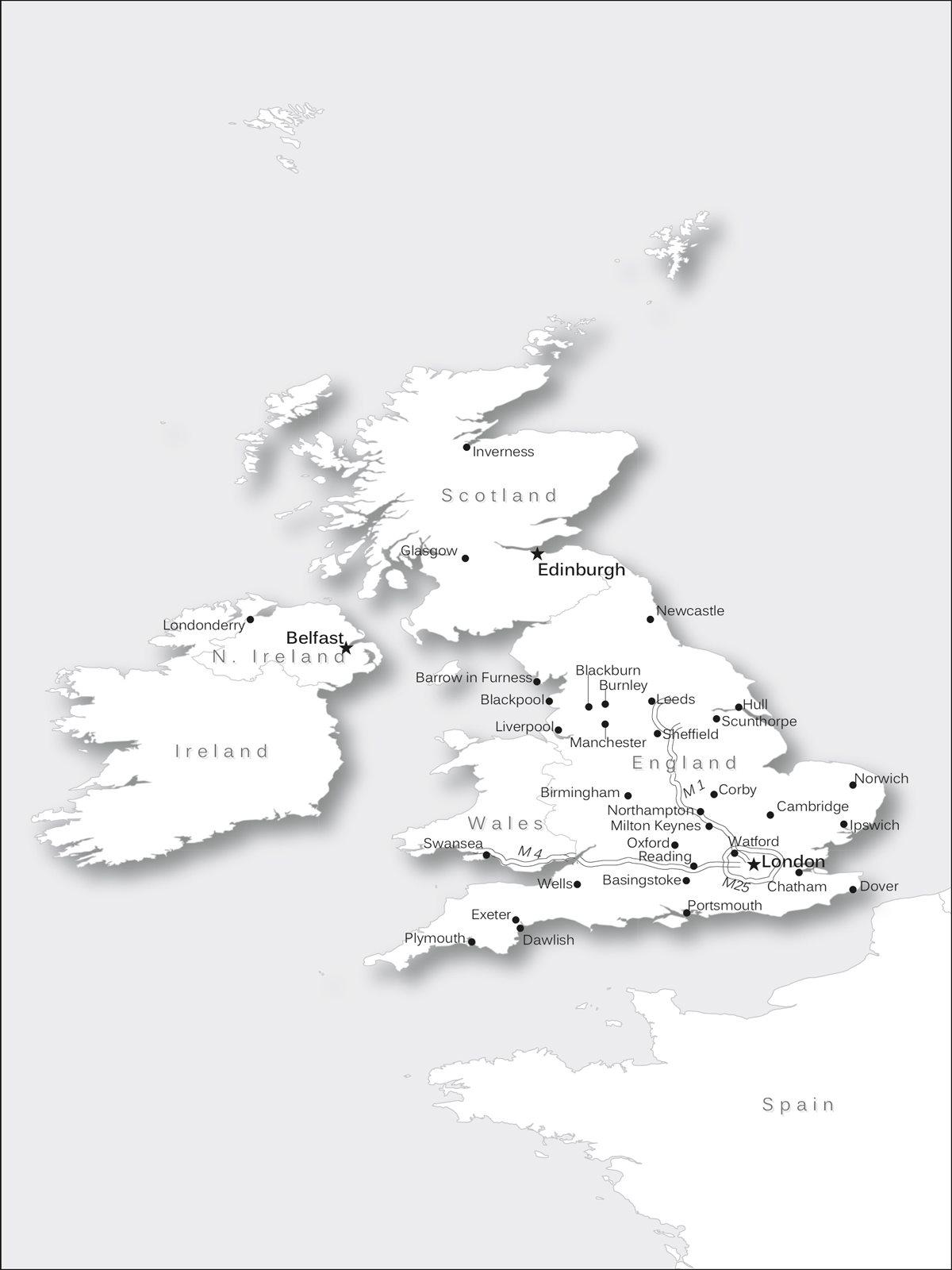
While thinking about and writing this book, I discussed themes with a number of Members of Parliament (MPs), including Ben Bradshaw, Douglas Carswell, Greg Clark, Geoffrey Clifton-Brown, Oliver Colvile, Graham Evans, Michael Gove, Damian Green, John Howell, Andrew Lansley, Julian Lewis, Oliver Letwin, David Lidington, Peter Luff, Gordon Marsden, Andrew Mitchell, and David Willetts, as well as with others, including Melvyn Bragg, Phil Collins, Richard Dales, and Frank Kitson. Clearly, this is in part a personal account, but that is true of all recent history. I would like to thank Steve Bodger, George Boyce, Roger Burt, David Coleman, Eileen Cox, Bill Gibson, David Gladstone, Sergio José Rodríguez González, Nick Lewis, Thomas Otte, Murray Pittock, Peter Spear, Peter TempleMorris, Richard Toye, Nick White, and two anonymous readers for commenting on all or part of an earlier draft. I have benefited in considering this topic from opportunities to speak to the Foreign Policy Research Institute, the World Affairs Council, the University of Virginia’s Oxford program, and Sherborne School. I am most grateful to Dan Crissman for proving a most helpful publisher. Thanks also to Theresa Quill for creating the map.
This book is dedicated to Anne Foreman, a neighbor whose friendship I greatly appreciate.
PRIME MINISTERS FROM 1945
Clement Attlee, Labour, 1945–51
Winston Churchill, Conservative, 1951–55
Anthony Eden, Conservative, 1955–57
Harold Macmillan, Conservative, 1957–63
Alec Douglas-Home, Conservative, 1963–64
Harold Wilson, Labour, 1964–70
Edward Heath, Conservative, 1970–74
Harold Wilson, Labour, 1974–76
James Callaghan, Labour, 1976–79
Margaret Thatcher, Conservative, 1979–90
John Major, Conservative, 1990–97
Tony Blair, Labour, 1997–2007
Gordon Brown, Labour, 2007–10
David Cameron, Conservative, 2010–16
Theresa May, Conservative, 2016–2019
Boris Johnson, Conservative, 2019–2022
Liz Truss, Conservative, 2022
Rishi Sunak, Conservative, 2022–
ABBREVIATIONS
BBC British Broadcasting Corporation
Brexit Britain exiting from the EU
EEC European Economic Community
EU European Union
IRA Irish Republican Army
MP Member of Parliament (of the House of Commons)
NHS National Health Service
NUM National Union of Mineworkers
ONS Office for National Statistics
SNP Scottish National Party
UK United Kingdom
ENVIRONMENT UNDER STRAIN
POPULATION
IN WRITING ON Britain in the late twentieth century and to the present, the theme of the environment under strain principally referred, for much of the public, to “green” issues. This assessment reflected the extent to which these issues, and the related attitudes, both of which had developed from the 1960s, had been diffused more widely into the political community. In contrast, by the mid2010s, there was, for many, a more specific and pointed concern, that of people, and more particularly their number. This concern related to anxieties about the consequences of both large-scale immigration and population aging due to higher life expectancy and, linked to that, of a future acceleration in the already-pronounced rise in population, with all the consequences that brought or allegedly brought or might bring, categories that people were often slipshod about in their comments. The population of the United Kingdom (UK) rose from 50.2 million in 1945 to 68.14 million by July 2023,
and such figures were regarded as reasonably accurate and, if anything, as an underestimate.
Trends and projections indicate a continuation of the present direction of change. The population of England and Wales on Census Day, March 21, 2021, was 59.6 million, an increase of 6.3 percent since 2011 when it was 56.1 million. The population grew in each of the nine regions of England and also in Wales. Scotland’s population as estimated to be 5.5 million in mid-June 2021, reflecting an increase of 8.2 percent from mid-2001. Immigration in the shape of net migration was a key element in the population of England and Wales, with the migrant share of the population rising from 8.9 percent (2001) to 13.4 percent (2011) and 16.8 percent (2021), the last 1 in 6 of the population, about 10 million in total. This is a larger growth than that due to natural change, the difference between births and deaths. Immigration is also a crucial factor in natural change, as women born overseas, but giving birth after migrating, had higher birth rates than women born in Britain. This trend is likely to continue.
Alongside birth rates and immigration, an aging population, due to higher life expectancy, is a key factor in the rise of the UK population. Indeed, over-65s are expected to be the fastest growing age group in all regions, with increases of more than 20 percent in most areas. Moreover, the number of local authority areas in which more than a quarter of residents are over sixty-five is expected to triple—from 28 to 84—between 2014 and 2024, with West Somerset having 36.5 percent of residents in that category, followed by North Norfolk, another predominantly rural area, with 34.6 percent, and the number of people in England over the age of ninety passing five hundred thousand in 2017, and reaching one million by 2034. In the 2021 census, North Norfolk had a median age of 54, Rother of 53, and East Lindsey of 52. The English region with the highest median age was the South West at 44, whereas London had the youngest, at 35. The youngest borough there was Tower Hamlets, a center of immigration, at 30. Other cities had low figures, notably Manchester and Nottingham at 31.
Regional differences in population figures and trends are projected by the Office for National Statistics (ONS) to be pronounced, with growth in Britain strongest in the South and East of England. The local authority with the highest increase in residents born outside the UK was the London borough of Barking and Dagenham, where the percentage rose from 31 to 41 in 2021, while the highest growth in EU nationals in 2011–21 was in Boston in Lincolnshire, which also provided the highest leave vote in the 2016 Brexit referendum. EU-born residents in 2011 were 2.5 million, and in 2021 3.6 million.
The 2020–21 COVID pandemic affected detailed local figures in that period, not least with movement out of London. Nevertheless, many earlier trends continued. Thus, some areas in northern England saw falls in population. Moreover, Scotland continues to not have growth rates to match those of England, in part due to much less immigration, both current and historic, and also to considerable recent emigration, both to England and abroad. The October 2016 ONS figures suggested that of the eleven largest city regions, London had the largest percentage growth in 2011–15, followed by Bristol, the West Midlands, and Greater Manchester, in that order, with Glasgow, at 1 percent, having the lowest rate of growth, followed by Liverpool at 1.2 percent.
A plethora of figures may confuse or, indeed, become tedious. The overall impression, however, is clear, and the figures tend to provide different aspects of it, as well as to help explain aspects of the situation and the trend. Moreover, looking at the figures in detail highlights important chronological and regional variations and reveals their significance. There is no sign that this situation will change. In addition, population trends provide a key product of, and focus for, developments across a range of spheres, including, crucially, economic shifts, migration, and social welfare policies. The implications of population changes for land use, resource pressures, housing, transport, and public services, notably education, health, and social care, are immense. At the same time, population is a key —arguably, the most significant—source of pressure on the environment.
NIMBYISM
Each interpretation of environmental crisis, and every discussion of future trends, focused wider issues, but also reflected the sense that Britain itself was under pressure. In reality, that has always been the case. Britain has been an inhabited landscape for thousands of years and, throughout that period, has been affected by major changes in land use, as well as by successive waves of immigration. It would be extraordinary if these processes should cease, although population growth at a great rate nearly stopped in the 1970s and 1980s, before immigration took off again in the years of Tony Blair’s prime ministership (1997–2007). Nevertheless, the often vociferous aspiration for continuity and for opposition to change, on the part of many, generally tells us more about (some) attitudes than about practicalities. This aspiration is particularly expressed in terms of “nimbyism,” or “not in my backyard,” an opposition to development in the particular areas of those concerned.
The charge of nimbyism was regularly thrown at those who opposed change and usually in order to claim or suggest that they were privileged and selfish people who were unwilling to share the fruits of their privilege. This charge had a basis in fact and notably so in terms of opposition to new housing in rural areas or to “social housing” (housing for the poor) in affluent urban neighborhoods and also, starting in the mid-2010s, to fracking for natural gas. Strong opposition to the expansion of Heathrow Airport starting in the 2010s, especially in West London, was seen in these terms by critics.
Thus, nimbyism served a critical agenda suggesting that hostility to development represented class interest. This agenda was particularly present in the 1960s and 1980s as, respectively, Labour and Conservative governments sought to push through change. It was also more generally the case as far as local government was concerned and, notably, its often pronounced hostility to interests and views that opposed its development plans. An aspect of nimbyism was provided by what David Willetts, a modernizing, “one nation,” Conservative minister in the early 2010s, referred to as
“bring backery,” by which imaginative use of the language he meant a conservative yearning for the past.
In reality, this placing of nimbyism, while well founded in part, also totally failed to capture the range of opposition to developments, and the extent to which much of it was well merited. The UK was not, as often presented, a battlefield of reform versus self-interest, nor of merit versus tradition, but instead, a far more complex tension of motives and causes; and nimbyism was frequently an aspect of local democracy as in opposition in Lancashire to fracking from the mid-2010s. Moreover, the extent and pace of change in the years since 1945 have been great. Linked to these, confidence about their processes and consequences has been generally limited. This has been more particularly the case after postwar optimism about a “brave new world” ebbed in the 1970s and 1980s, and in many respects, was shattered, a process repeated across the political spectrum, albeit for different reasons, over the past decade.
Nimbyism also had a pronounced regional dynamic. It was particularly notable in the South and Midlands of England, although its consequences can be UK-wide, as with the surcharge for flood protection on buildings’ insurance policies. There is a connection between nimbyism and the major population growth after 1980 in southern England. In its turn, this growth, and the major restrictions placed on it in terms of planning permission, had a great and lasting impact on house prices. Nimbyism therefore played a role in the misguided increased building on floodplains in the crowded South.
ENVIRONMENT
In discussing the environment, and indeed other issues, we have to distinguish between change and crisis. Furthermore, we have to accept the dependence of the latter on perception and, more specifically, on clashing perceptions. The intensity of change is in part a matter of perception. We also need to distinguish between issues specific to Britain and, what is far more common, the British manifestations of wider, often global, trends—for example, climate
change and rising population. None of these points minimize the extent of change in Britain. Climate change has been held responsible for a range of developments, including the greater numbers of sharks and jellyfish in British waters, both especially notable since 2016. Thus, Portuguese men-o-war and bioluminescent jellyfish became more common.
As humans are not the sole species, it is valuable to appreciate the extent to which it is often not the human environment that is most under strain but, instead, those of animals and plants. In both instances (and each encompasses a broad range of cases), there were many issues posed by the nature of sharing territory. The usual approach would be to comment on the advance of humans at the expense of other animals, notably birds and butterflies, and to focus, in particular, on the destruction of animal habitats, such as hedgerows, copses (small woods), and ponds.
These changes are indeed occurring, as they have long done. In particular, the loss of habitats for plant and animal species is a longestablished process.1 However, at present, change is frequently at an unprecedented rate. At the same time, the process is far more complex. Consider Exeter, a growing city of 133,000 people, the historic county town of Devon, where I have lived since 1996. To urban dwellers there, and the overwhelming majority of the British population live in cities or towns, the situation is not one of the retreat of animals but, rather, one in which some animals adapt to living with humans and not always in a fashion that appeals to humans. The quest for garbage is a key issue. The city, like many others, including many inland cities, echoes to the sound of seagulls, who have no natural predators and who are protected by law. The seagulls have moved inland as there is now fewer fish in the sea and less fishing at sea to produce food. Trash bags and takeaway food remains discarded in the streets now provide key sources of food for seagulls, foxes, squirrels, and badgers.
Badgers and foxes have moved into the cities, often following the railway tracks into the inner cities. Both have taken up residence near me. Foxes have become a common sight in the cities, including
in London. These wild animals that have no natural predators attack other animals that humans prefer, notably domestic pets and small birds. Domestic rabbits and cats are killed by foxes, and sometimes by seagulls, and the latter have also killed dogs and tortoises. Indeed, like foxes, they appear to be losing their fear of humans. There is an increasing number of attacks on humans by seagulls.
There are also periodic panics in popular newspapers when foxes attack young children, although they do so less frequently than dogs that are pets. Indeed, attacks of the latter type have been increasing, and that despite the 1999 Dangerous Dogs Act, under which particular breeds were prohibited. In 2016, a group of squirrels biting a child in Cornwall caused alarm. Less seriously, deer eat flowers in suburban as well as rural gardens. Indeed, without natural predators, the number of deer in Britain is allegedly at a historic high. Bats and squirrels nest in houses, the latter eating through electric wires.
These are simply conspicuous instances of a wider process. Trash is also attractive to smaller creatures, such as snails and woodlice. Warm environments, for example hospitals, attract cockroaches and mice. The rat population is rising rapidly and becoming more conspicuous, benefiting from less attention being paid to animal infestation, and also from the extent that traditional poisons are no longer so effective, or are prohibited, an issue that also affects dealing with moles.
The rat situation appears to have deteriorated markedly, not least as water companies are devoting less of an effort to pest control. There are frequent comments on the proximity of rats to humans and various statistics, all unsettling, about how close rats are living to the average human. This is also the case with mice. Both mice and rats can regularly be observed on the platforms of London Underground stations. “Can be,” in this case, also means that I have seen them, as I have also seen a large rat walking down the pavement at midday in the scenic Somerset town of Wells.2 In houses that lack cats, mice and squirrel infestation is often a problem, and pest controllers, or burglar alarm engineers dealing
with malfunctions, often first ask householders if they have cats. Mice, rats, and other animals have adapted to opportunities in other respects than those offered by trash or eating through cables. For example, the hot water outflows of washing machines provide a means of entry into houses. As a result, glass fragments are added to the plaster in which these outflows are located. Animals also carry disease. In 2016, it was claimed that one-third of dogs carried ticks, while deer are held responsible for the spread of Lyme disease, which is becoming an increasing problem.
There is much more concern about the radical reduction of wildlife numbers in the countryside as a result of habitat loss and the chemicals used in intensive farming. Both have hit butterflies. That is also apparent in the marked diminution or disappearance of garden birds, for example, pied flycatchers, starlings, greenfinches, and even sparrows. Population growth will make this situation even worse. So may technology. In 2016, concern was expressed about the danger to birds from test flights for Amazon’s drone delivery service. Also in 2016, it was predicted that one-tenth of the wild species living in Britain would soon disappear.
HEALTH
The declining effectiveness of recent remedies is a key element for microbes as well as rats and mice. As elsewhere in the world, the ability of antibiotics, the wonder drugs of the late twentieth century, to tackle infectious diseases has declined. The rise of methicillinresistant Staphylococcus aureus (MRSA) and multidrug-resistant tuberculosis, among other antibiotic-resistant strands, is notable. Indeed, as a result, going to the hospital is now possibly a more dangerous activity than used to be the case or, at least, is discussed in such terms.
Given that the National Health Service (NHS), established in 1948 by the Attlee Labour government, has been a key element in subsequent national identity, that itself is a potent change. The malaise that has affected the NHS in recent years owes something to a sense of unsafe hospitals, as well as of inadequate care, notably
with a major scandal surrounding the treatment of patients in the Mid-Staffordshire Hospital in the late 2000s, specifically the neglect of necessary care. This scandal, one of many, which took far too long to investigate and then report on, influenced the public and governmental discussion of the NHS in the mid-2010s. Concerns over inadequate health care in part arise from increased demand, notably from an aging population and from immigration, but the issues posed by demands for standardized care are significant, as are the difficulties of providing adequate management. At any rate, it is important to note both major commitment to the institution and also concern about its state. By 2022, there were waiting lists of 7 million people, including over 380,00 waiting more than a year, and 2.5 million were recorded as unable to work due to illness. The last is despite a vast amount of money being spent on the NHS, the largest employer in Europe. Prior to the COVID pandemic, this was 9 percent GDP, but by 2022 this had risen to about 12 percent. Yet, each year brings dire warnings, from within the NHS, that unless more is spent, there will be a breakdown in services. When the NHS was established, the government could not afford to finance an actuarial system of national health insurance (or, with its socialist approach, did not seek to do so), with the result that the taxpayer has been landed with a financial bottomless pit. The European-style insurance-based healthcare systems are restricted to those who go “privately.” Labour and, even more, the trade unions show reluctance about any change at all that is designed to increase efficiency, even if it came from the Blair government of 1997–2007, and, as in the 2015 general election and the 2016 Labour leadership contest, complain at once about alleged privatization of the NHS. The danger is that this national icon, this essentially very good but often inefficient and badly run nationalized industry, staggers on until the day comes when it will either be reformed or will bankrupt the country. Both Conservative and Labour governments have sought to reform the NHS since the 1980s, but, by 2022, in the aftermath of the COVID pandemic, ambulance response times were poor and falling, while there were serious problems in hospital accident and emergency units.
The population aging is partly an inheritance of past declines in the birth rate. The age structure of the population had changed totally as a result, in large part, of the fall in the birth rate from the use of family planning. Contraceptive developments dramatically increased the ability of women to control their own fertility. These developments played a major role in the emancipation of women, as well as in the “sexual revolution,” a change in general sexual norms, from the 1960s onward. After 1921, when Marie Stopes founded the Society for Constructive Birth Control, it became increasingly acceptable socially for women to control their own fertility. Contraceptives became widely available and notably so from the 1960s. In addition, after the 1967 Abortion Act, the number of legal abortions in the United Kingdom was 184,000 in 1990, rising to 214,000 in 2021.. Meanwhile, the fertility of the approximately 20 percent of couples (about 10 percent of adults) who were infertile was enhanced by new techniques such as in vitro fertilization.
Average life expectancy for all age groups consistently rose during the twentieth century, the major exception being those aged between fifteen and forty-four during the 1980s. Average life span increased by an average of two years every decade in the 1960s–1990s. Longer life expectancy, which was only slightly tempered by the COVID pandemic, is gradually becoming more important and will be the dominant factor after the mid-twenty-first century, when population aging due to past declines in the birth rate will slow down in part as a result of a higher birth rate. Population aging led to a new age structure as a result of the increasing number of pensioners, and to problems of dependency posed by the greater number of people over eighty-five: 12.6 percent of Norfolk’s population were over sixty-five in 1951 and only 9.2 percent a century earlier. But by 1990, the percentage was 19.6.
As a result of this trend, Britain’s potential support ratio (of working-age to retirement-age citizens) is predicted to be 2.4 by 2050. The actual ratio is worse than the demographically defined one as workforce participation is much less than 100 percent. However, forecasts of dependency mostly rely on fixed boundaries of working age, which are misleading; these forecasts exaggerate the