Why Confucianism?
From the sixth to third century bce, China was the setting for one of the world’s richest outbursts of philosophical activity. It was also among the bloodiest times. The unifying political power of the Zhou dynasty, founded in the 11th century bce, took a decisive blow when the capital was sacked in 771 bce and the new emperor was forced to move the capital to the east. Small states and independent cities began to compete openly for power, the more successful conquering and incorporating their neighbors. For centuries, hardly a single year passed without at least one war, usually more. This period of struggle—divided into the “Spring and Autumn” and then “Warring States” periods—lasted until the Qin state overcame the last of its rivals in 221 bce, unifying China. The Qin dynasty lasted just 15 years, but it set the foundation for the Han dynasty, which held China more or less together for four centuries.
The suffering brought by centuries of constant warfare is almost impossible to imagine. Mozi, one of the most important philosophers of that time, describes how the victors acted:
They enter the borders, mow down their grains, chop down their trees, and topple their city walls to fill in the moats and ponds. They burn down their ancestral temples and kill their sacrificial animals. Those of the people who resist are executed; those who do not resist are bound and brought back, the men used to care
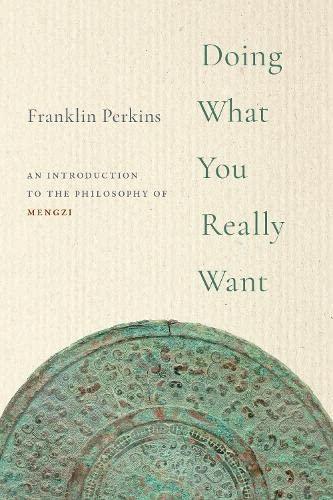
Doing What You Really Want. Franklin Perkins, Oxford University Press. © Oxford University Press 2022. DOI: 10.1093/oso/9780197574911.003.0001
for livestock or serve in chains, the women used to pound grain and pour drinks.1
Those not killed on the battlefield are enslaved, their livelihood destroyed. Occupied with entering or fleeing battles, few were left to plant or harvest, adding famines to the suffering. Mengzi, the Confucian philosopher at the center of this book, describes one state he visited:
The current system for the people’s livelihood is such that above there is not enough to serve their parents and below there is not enough to raise a wife and children. In good years, the people live their whole lives in hardship and, in bad years, they cannot avoid death and destruction. They strive only to avoid death and yet fear they won’t succeed. How can they spare time to cultivate propriety and rightness! (M 1A7)
Even in relatively good years, people can think of nothing but bare survival, and desperate circumstances lead to desperate actions. As Mengzi goes on to say, few people have a steady heart if they do not have a steady livelihood.
The political and economic turmoil of the declining centuries of the Zhou dynasty upset the whole complex of Zhou culture— customs, rituals, ethics, family relations, political authority, religion. The founders of the dynasty, King Wen and King Wu, claimed that their success demonstrated divine support, and that this support came because of their superior virtue (dé 德) and care for the people. They had the “mandate of heaven” (tiānmìng 天命). That world made sense. Centuries of suffering without effective political leadership made it hard to believe. The traditions were not working; no divine being came to the rescue. This crisis led to an explosion of philosophical and religious views, with each thinker offering advice for how to live in and make sense of this seemingly chaotic and cruel world.
While the authority of the past broke down, pressures to innovate increased. The lack of central power elevated competition among states, families, and individuals. Social order was destabilized. A person who was particularly clever, ruthless, or lucky could rise to power. A class of educated, skilled advisers emerged, known as shì 士. The shi lacked high-level hereditary positions but had access to power as consultants, administrators, critics, and teachers. The term is sometimes translated as “officials,” and a verbal form of the character (shì 仕) specifically means to hold office, but one could be a shi without an official position. One could even refuse to take office and still be a shi, a “shi in hiding” (yǐnshì 隱士). The power of the shi came through their education and cultural capital, so another common translation is “scholar.” That is misleading, as even when engaged in what we would call scholarly activities, the main concern of the shi was political engagement. In his study of early Chinese political thought, Yuri Pines argues against translating the term at all, but suggests that “intellectual” is often appropriate.2 Kurtis Hagen and Steve Coutinho generally translate shi as “aspirant,” which nicely implies both aspiring to a position of power and aspiring toward an ethical idea.3 Another possible translation of shi would be “leaders,” if we allow that someone could be a leader without holding an official position. Modern society does not have the same social group, but our equivalent would be those who lack immense inherited wealth but whose education gives them influence and potential access to power. If you are reading this book, the shi would likely include you.
This classical period is called the time of “one hundred schools” to represent its diversity. Some promoted ways of reforming the world in order to bring peace; some advanced strategies for accumulating power and personal benefits; some advocated withdrawing from the world of politics and struggle, preferring the safety and contentment of a life of simplicity. All of these views appear in a context of immense turmoil and suffering for regular people and the breakdown of traditional forms of authority. Most of those we now
call philosophers were shi: leaders/intellectuals/aspirants. They tried to solve conceptual problems and determine the truth, but that was not their primary aim or activity. If we limit our standards to contemporary academia, we might doubt that these shi were philosophers (even if they undeniably did some philosophy). Contemporary academic philosophy, though, is a recent and peculiar invention.4 Through most of European history, the purpose of philosophy was to live philosophically. This conception of philosophy, which we might follow Pierre Hadot in calling “philosophy as a way of life,” has been a common endeavor across cultures, appearing in India, China, and the classical Mediterranean.5 Both within and across these traditions one finds common ideals and techniques but also disagreements and disputes. Differences in material conditions lead to distinctive approaches. Chinese philosophy arose not just from speculation or wonder and not just from the pursuit of personal excellence or enlightenment but also in response to widespread hardship and misery. Chinese philosophers were also unusually this-worldly in their orientation, attaching no significance to a life after death or release from this world. These factors make early Chinese philosophy inherently political. Even those who refused to engage in political life did so through a critique of politics. We can say that the central question at the origin of Chinese philosophy was—how can we fix the problems of the world? The goal of the philosopher was not just to determine the right answer to that question but to actually fix the problems. More precisely, the goal was to become the kind of person who could fix those problems. There have been plenty of philosophers in Europe whom Kongzi and Mengzi would recognize as fellow shi Seneca, Marcus Aurelius, Wilhelm Gottfried Leibniz, and John Locke come to mind—but that is no longer the paradigm of philosophical life. So how do we fix the world? There were many responses in China, including those who said that trying to fix it will only make it worse. This book systematically presents a way that became the dominant Chinese tradition for those seeking to fix the world, known in
English as “Confucianism” and in Chinese as Rú 儒. Kongzi 孔子, better known by the Latinized name Confucius, was one of the many shi who traveled from state to state, offering advice and explaining why his way was better than others. His ideas are known through short quotations and dialogues that were handed down and eventually collected into books. The most influential of these collections is the Lunyu 論語, known in English as the Analects. Kongzi had little immediate political influence. His impact was through his followers and later generations of philosophers who developed his ideas, often in quite different forms. The core of this book comes from one of those philosophers, Mengzi 孟子 (Mencius). Mengzi was born around 385 bce in a small state called Zou in what is now Shandong province. He considered himself an interpreter, defender, and follower of Kongzi. At some point, Mengzi set out to save the world by engaging in politics, traveling from state to state, giving advice to rulers and seeking a position from which to enact his ideals. Although he succeeded in meeting (and insulting) some of the most powerful rulers of his time, he never convinced one to practice his Confucian way. Like Kongzi, Mengzi’s main influence was on later generations. For more than two thousand years, his writings have been a source of guidance and inspiration for those set on doing something about the state of the world.
Worrying about peace of mind
This book is an introduction to the philosophy of Mengzi, but I didn’t write it as a history lesson. I wrote it because Mengzi’s philosophy has much to offer in making sense of how a meaningful life involves attempting to change the world. The core of the manuscript was written in a 6-week frenzy almost 20 years ago, in the summer of 2002. It was politically a tense time, the summer between the US invasion of Afghanistan and the second invasion of Iraq. It was also a time of personal crisis for me. The previous
summer I had moved to a new city and started my first job as a professor. I was having serious doubts about the value of academic philosophy. My application to move into a communal house for people dedicated to social justice was rejected, and even I wasn’t fully convinced by my arguments for the value of philosophy. I had started doing a little work at a center for assisting refugees and became involved with organizing to prevent the Iraq war. In that time, I was profoundly impressed by several people I met who were truly dedicated to living ethically and who focused their life on working to make the world a better place. Many of them were deeply religious. I began teaching at a Catholic university that took seriously the mission of St. Vincent DePaul. I also found myself in discussions with people interested in Asian philosophies, but almost always either Buddhism or Daoism (usually in some Americanized form). In these various contexts, I could not resist advocating Mengzi’s form of Confucianism, but when people asked me what they should read, I was at a loss. The original texts compile fragments that are difficult to make sense of, let alone appreciate. Books about Confucianism are usually too introductory or too academic. In that summer of 2002, facing two months alone in Berlin with a grant to do research I had already finished, I tried to write the book I could give those people to read.
What attracted me to Mengzi’s philosophy? Historically, religion has been an inspiration for changing the world but also an obstacle. Religions inspire activism and quietism. Consider the claim that the world was created by a God who is perfectly good. If God is good, then we should be good, and if being good involves making the world a better place, then God wants us to work for change. There is a problem, though. If this God is also omnipotent and made this world, isn’t the world already the way that it should be? As Leibniz pointed out, if God is good and all powerful, this must be the best of all possible worlds. So shouldn’t we accept the world as expressing God’s will? When that is difficult, we can say things like “God works in mysterious ways.” Throw in the comfort of an afterlife where
everyone gets what they deserve, and you can see why Karl Marx called Christianity the “opiate of the masses.” A Christian can reply that we must work for change because that is what God wants us to do, but the effort still seems superfluous. If God wanted there to be a better world, it would already exist. Our struggles have no more significance than a training ground or tryout for the afterlife. Beliefs based on karma avoid the awkwardness of having a god command us to do things that need no doing, but they have a similar outcome. If everything happens according to karma, then it all works out fairly no matter what we do. The problem exists for any religion that believes the ultimate ground of the universe is good or fair. The Confucians do not make such claims, nor do they believe it all gets worked out after death.6 If the world is to be better, it is up to human beings to make it so.
The basic problem applies even to vaguer forms of spirituality. To commit to changing the world is to reject the way things are. That contradicts spiritual positions based on embracing, accepting, or affirming the world. Activism is inherently oppositional, while religion relies on an impulse toward reconciliation and acceptance, whether directed toward a transcendent god or the world itself. These two attitudes are not easily reconciled. It is hard to embrace the world at the same time that one fights to change it. Mengzi’s philosophy is dedicated to changing the world and yet it maintains an element of reconciliation. That is why I wanted people to read it. On one side, Mengzi argues that a life dedicated to making the world a better place is more fulfilling, more in keeping with our natural desires, than a life of contemplation or a life accumulating wealth and power. On the other side, he roots the struggle for change in a continuity and harmony with nature and the divine, in his terms, with tiān 天 (heaven). How this reconciliation works out will be a central theme of this book.
The tension between opposition and reconciliation has an emotional dimension. Across time and traditions, many of those who take philosophy as a way of life do so to promote peace of mind.
That goes along with accepting the world as it is. This concern is particularly common in popular spirituality that draws on Asian traditions, such as Buddhism, Daoism, or yoga. Such views have great attraction and great power, as a trip to any bookstore confirms. It is easy to see why. If the problem we face is unfulfilled desire, solving it can go in two ways. One way is to increase our power so that we can fulfill our desires, getting the things we want. The other way is to reduce our desires so as to be more easily fulfilled. Nearly every wisdom tradition recognizes the futility of the former, yet we live in a culture that relentlessly teaches us the opposite. Our entire economic order depends on making us want more and more. Consumer culture uses desires that have been recognized as dangerous for thousands of years— the desire for sex, the craving for prestige, and the thrill of violence. It does not take a sage to see that such a culture leads to dissatisfaction and unrest. In this context, realizing that happiness lies down a different path is a relief, even a little subversive. That is good.
The problem with seeking contentment is that we live in a world where terrible things happen, often. Every one of us is implicated in the global systems that enable those things. In such a world, it seems we should fight injustice rather than cultivate peace of mind. Imagine what the world would be like if all the hours spent on “selfhelp” activities, including practices such as meditation and yoga, were instead spent helping other people. Confucians recognize the need for contentment and happiness, but they are suspicious of them. The 20th-century Confucian philosopher Xu Fuguan 徐 復觀 advocated a “sense of concern and worry,” yōuhuàn yìshí 憂 患意識 and a feeling of awe or reverence (jìng 敬) at the responsibility borne by each of us.7 This complex sense of responsibility, anxiety, and awe, is fundamental to Confucianism as a way of life. As the Song dynasty Confucian Fan Zhongyan 范仲淹 famously put it: “Go ahead in worrying about the world’s worries; go behind in enjoying the world’s joys.”8
I find Fan’s words inspiring, but part of me finds them ridiculous. Promising extra worry and less enjoyment won’t get you far as a self-help guru. Even Mengzi thinks it isn’t always the best advice. Yet Mengzi’s philosophy justifies and makes sense of this orientation, not as a sacrifice that we should make out of duty but rather as an expression of what we really want. Understanding the coherence of that way of life requires a broad account of Mengzi’s philosophy. I begin with his views of the world and the place of human beings in nature (chapter 1). The next two chapters explain natural human tendencies (chapter 2) and the value and nature of emotions (chapter 3). These three chapters set up the account of reality that justifies the way of life Mengzi promotes. They are followed by three chapters on the ways in which we can deliberately change and cultivate ourselves: by managing emotions and desires (chapter 4), through study and learning (chapter 5), and in rituals and embodied practices (chapter 6). That completes Mengzi’s account of the good life for human beings, but Mengzi was most concerned about getting things done, so the final two chapters turn to issues that arise in practice. Chapter 7 gathers advice from Mengzi and other Confucians on how to address six things that tempt us away from improving the world. Chapter 8 turns to a Confucian analysis of power and how to have an impact.
I have tried to bring out the coherence of Mengzi’s way, ranging from his philosophy of nature to human psychology to practical advice, and to let him speak for himself, sometimes with long quotations. My goal is to explain his philosophy in a plausible way, and that involves showing how his advice is grounded in a coherent vision of human beings and the world. At the same time, learning from Mengzi does not require accepting the whole system. In some cases, he might be wrong in the details but right at a more general level. In other cases, key positions in his philosophy can be replaced with different claims that do the same work. Because of their practical focus, many of his claims and advice can be taken from his context and placed into others. The history of Confucianism reveals
just this kind of process of adaptation, revision, and renewal. What you read here unavoidably is a result of my own processing of the text, but I have tried to leave as much space as possible for the reader to do that work as well.
Mengzi in context
It should be clear by now that I am approaching ancient Chinese texts with my own concerns. If we want to learn from other cultures rather than just describe them, we must bring them into our own terms and make them living options. At the same time, we must try to understand the other culture in its own terms, to recreate what Mengzi himself thought and how he saw the world, and to see the coherence in the various things he says. Without that effort, we just project our own thoughts into words that sound more exotic and profound. That deprives us of any new insights, which is the point of turning to another culture in the first place. Europeans have a long history of appropriating Chinese thought for their own purposes, from the Jesuit missionaries who first translated and named “Confucius” and “Mencius” in Latin to the contemporary “translators” of the Daodejing who do not read Chinese. Popular writings on Asian thought usually err in the direction of appropriation. That was the case with the original draft of this book, written before I could read much of the original Chinese. Academic writings err in the opposite direction, sacrificing relevance for precision. I have tried to strike the right balance in this book, which should be seen as coauthored by me and a less academic version of me from a long time ago. It could not have been written by either of us alone.
In his own context, Mengzi was most concerned with fighting greed and the glorification of power, war, and luxury. That is still where his philosophy is most relevant. Among other shi philosophers, he said that his two main rivals were Yang Zhu and
Mozi (M 7A26). We know little about Yang Zhu.9 Mengzi says that he advocated being concerned only for his own self or body, and that if he could benefit the world by pulling out one hair from his body, he still wouldn’t do it. Yang’s point probably was that we should take care of our own health and our own life and let other things follow their own course. We know much more about the thought of Mozi.10 He was a fascinating figure with a philosophy based on concern for the lower classes and opposition to offensive wars. His best-known position is inclusive or impartial care, jiān ài 兼愛, which claimed that the benefit of all people should be considered in decisions, not just that of our family, friends, or compatriots. Mengzi absorbed aspects of this doctrine but also argued that it contradicted natural human feelings and undermined the importance of the family. The Mohists vehemently criticized the extravagance of the ruling classes, specifically arguing for reducing elaborate funeral ceremonies and for eliminating musical performances. As ritual specialists, the Ru responded by justifying the value of ritual and music on humanistic grounds. The Mohist system was supported by a belief in tiān 天 (heaven) as a vaguely anthropomorphic deity that rewarded those who cared inclusively and punished those who were selfish and biased. That provided an easy answer to the question: Why should I be good? If you aren’t, heaven will punish you. The Mohists accused the Ru of denying a providential deity, and at least in the case of Mengzi and Xunzi, their charge is correct. In the Warring States period, the Confucians and the Mohists were the two dominant philosophical movements directed toward making the world better through political action. That made them fierce competitors, but they had much in common, so much so that the phrase “RuMo” became a general term for people dedicated to using an ethical vision to reform the world.
Although Mengzi presents Mozi and Yang Zhu as his main rivals, I want to set him against one other perspective, that best exemplified in parts of the Zhuangzi 莊子. 11 Zhuangzi lived a little later than Mengzi. He is considered one of the two originators of
Daoist philosophy, along with Laozi 老子, the supposed author of the Daodejing 道德經. The book known as the Zhuangzi contains many different viewpoints, and we do not know which parts reflect the ideas of Zhuangzi himself. I use “Zhuangzi” to label one of those viewpoints, the view dominant in the first seven chapters of the text (known as the “Inner Chapters”). The philosophy of these chapters is sophisticated but slippery, presented in anecdotes and short dialogues that careen from one perspective to another. While there are debates on the place of ethics in this philosophy, no one will deny that these chapters of the Zhuangzi are profoundly antiactivist. This stance arises from a skeptical attack on human categories, judgments, and labels, which follows a radical rejection of anthropocentrism. Nature does not center on us. Our values, concepts, and concerns have no priority; they are merely ours, lacking an objective foundation in nature itself. Once we give up our labels and judgments, we can appreciate the moment, find joy in whatever the world brings, and skillfully respond to immediate circumstances. We can call this outcome “peace of mind.” Zhuangzi calls it xiāo yáo yóu 逍遙遊, which Burton Watson translates as “free and easy wandering” and Brook Ziporyn as “wandering far and unfettered.”12 To equate Zhuangzi with popular spirituality concentrated on peace of mind misses the radicalness and the complexity of Zhuangzi’s philosophy. Nonetheless, the ways in which the philosophy of Mengzi resists the position of Zhuangzi are also the ways in which Mengzi is most relevant now.
Authors and texts
This book discusses a time nearly 2,500 years ago. As much as I strive to give an accurate account, speaking of Mengzi or Zhuangzi, Confucianism or Daoism, involves retrospective construction. As in Greece and India, Chinese philosophy began in oral discussions and debates. At some point before Mengzi’s birth, people began to
write philosophical ideas on strips of bamboo, which were then tied into bundles that could be rolled out and read, rolled up and put away. Copied by hand and disseminated from person to person and state to state, the wording could shift and phrases might be added or cut. The same lines or stories could end up in different texts making different points or spoken by different people. During the Han dynasty, these earlier materials were gathered, compared, edited, and combined. Books like the Mengzi, Zhuangzi, and Lunyu are products of that effort.
Archeologists in China have recently found many texts from before the Han dynasty, including several collections that were probably buried in Mengzi’s youth.13 Those bamboo texts give us direct evidence about early Chinese philosophy, but they also reveal how heavily revised and edited the transmitted texts must be. To make matters worse, the authoritative weight of the past led later thinkers to attribute their own ideas to earlier philosophers. The text taken as the most authoritative source on the thought of Kongzi, the Lunyu or Analects, contains numerous sayings attributed to Kongzi, yet we have no way of knowing if Kongzi really said them, and even if he did, we do not know how much the wording shifted over time. The Mengzi is taken as more consistently representing the viewpoint of one person, but surely some of the lines attributed to Mengzi were really said by his disciples, his teachers, or later interpreters. No one knows how much these sayings changed over the thousands of years they took to reach us.
Regardless of authorship, the Mengzi is consistent in expressing a vision of human life that derives goodness from our natural ways of responding to the world. That philosophy is the core of this book, and for convenience I refer to its author as Mengzi. There are many different and conflicting Confucian philosophies but they largely agree in practice, so on many issues I draw freely from texts other than the Mengzi, most of all from the Lunyu but also from the Liji 禮記, the Record of Rituals, particularly the Zhongyong 中庸, best known in English as the Doctrine of the Mean, and the Daxue 大學,
the Greatest Learning. My approach follows a long-standing Confucian tradition of reading the “Four Books” (sìshū 四書) together. I also draw materials from recently excavated texts, and even from Xunzi, a self-proclaimed opponent of Mengzi who argued that our natural dispositions lead us astray. In spite of their theoretical differences, these Confucians can be seen as sharing a common way of life dedicated to social change. In that sense, this book itself is a Confucian project, but my goal is not to promote “Confucianism” as a movement, religion, or tradition. That would require much more attention to the bad aspects of Confucianism, most of all its long and deep tradition of patriarchy. Here, I just draw out a core philosophy that I find relevant, interesting, and plausible. Anyone who claims to have the true meaning of a classical Chinese text is fooling you or fooling themselves. The texts are inherently ambiguous. They make different philosophies when read from different perspectives. I have given my own interpretation in this book without much justification or alternate readings.14 Those who want that kind of argument can consult my book, Heaven and Earth Are Not Humane: The Problem of Evil in Classical Chinese Philosophy (2014), which includes a chapter on Mengzi as well chapters on Zhuangzi and Mozi. I have cited works by other people only when I borrow specific ideas from them or when I think they might be of interest to a general reader seeking more information on a specific topic.