Pirate Enlightenment, or the Real Libertalia David Graeber
https://ebookmass.com/product/pirate-enlightenment-or-the-reallibertalia-david-graeber/
ebookmass.com
The Maritime Turn in EU Foreign and Security Policies : Aims, Actors and Mechanisms of Integration 1st Edition Marianne Riddervold (Auth.)
https://ebookmass.com/product/the-maritime-turn-in-eu-foreign-andsecurity-policies-aims-actors-and-mechanisms-of-integration-1stedition-marianne-riddervold-auth/ ebookmass.com
Roommates with the Bad Boy (Bad Boys on Campus Book 3) Josie Max
https://ebookmass.com/product/roommates-with-the-bad-boy-bad-boys-oncampus-book-3-josie-max/
ebookmass.com
The Icy Planet: Saving Earth's Refrigerator Colin P. Summerhayes
https://ebookmass.com/product/the-icy-planet-saving-earthsrefrigerator-colin-p-summerhayes/
ebookmass.com
Landscapes of the First World War 1st ed. Edition Selena Daly
https://ebookmass.com/product/landscapes-of-the-first-world-war-1sted-edition-selena-daly/
ebookmass.com
British, French and American Relations on the Western Front, 1914–1918 1st ed. Edition Chris Kempshall
https://ebookmass.com/product/british-french-and-american-relationson-the-western-front-1914-1918-1st-ed-edition-chris-kempshall/ ebookmass.com
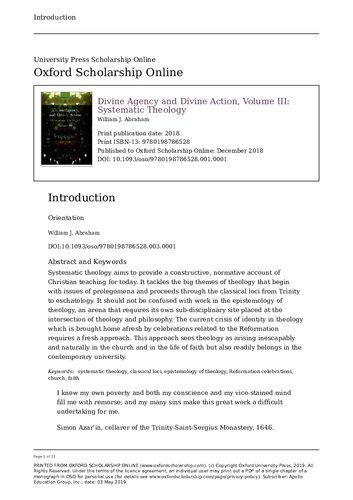
University Press Scholarship Online
Oxford Scholarship Online
Divine Agency and Divine Action, Volume III: Systematic
Theology
William J. Abraham
Print publication date: 2018
Print ISBN-13: 9780198786528
Published to Oxford Scholarship Online: December 2018
DOI: 10.1093/oso/9780198786528.001.0001
Introduction
Orientation
William J. Abraham
DOI:10.1093/oso/9780198786528.003.0001
Abstract and Keywords
Systematic theology aims to provide a constructive, normative account of Christian teaching for today. It tackles the big themes of theology that begin with issues of prolegomena and proceeds through the classical loci from Trinity to eschatology. It should not be confused with work in the epistemology of theology, an arena that requires its own sub-disciplinary site placed at the intersection of theology and philosophy. The current crisis of identity in theology which is brought home afresh by celebrations related to the Reformation requires a fresh approach. This approach sees theology as arising inescapably and naturally in the church and in the life of faith but also readily belongs in the contemporary university.
Keywords: systematic theology,classical loci,epistemology of theology,Reformation celebrations, church,faith
I know my own poverty and both my conscience and my vice-stained mind fill me with remorse; and my many sins make this great work a difficult undertaking for me.
Simon Azar’in, cellarer of the Trinity-Saint-Sergius Monastery, 1646.
Page 1 of 11
PRINTED FROM OXFORD SCHOLARSHIP ONLINE (www.oxfordscholarship.com). (c) Copyright Oxford University Press, 2019. All Rights Reserved. Under the terms of the licence agreement, an individual user may print out a PDF of a single chapter of a monograph in OSO for personal use (for details see www.oxfordscholarship.com/page/privacy-policy). Subscriber: Apollo Education Group, Inc.; date: 03 May 2019
This volume represents the third in a tetralogy dealing with fundamental questions about divine agency and divine action. The first reviewed the debate about divine action that arose at Oxford in the 1950s and at Chicago in the 1960s. The basic argument there is that efforts to secure a closed concept of action and the correlative efforts to identify and solve “the problem of divine action” were a dead end. There is no closed conception of action and, even if there was, it would not help us understand—beyond a mere account of the necessary and sufficient conditions of every action—the network of specific divine actions that show up in the Christian tradition. Once we get rid of this mental cramp, we realize that when we start looking at the specific actions attributed to God then we are in fact doing theology. The whole debate over the last century has taken place in a kind of self-imposed island cut off from the mainland to which it was originally attached.
Hence, the second volume took a series of soundings in the history of the Christian tradition in order to immerse ourselves in a much richer body of material and reflection that was not handicapped by our wayward contemporary worries. So, I ran a series of field-tests from Paul to Molina in order to furnish the discussion with a sense of the diverse set of questions that actually and rightly arises in debates about divine action. For example, I looked at divine inspiration in Irenaeus and Origen, the problem of freedom and grace in Augustine, transubstantiation in Aquinas, and divine locutions in Teresa of Avila. This was a wonderfully enriching exercise, for it opened up vistas on divine action in the history of Christian theology that can operate as paradigms of salutary reflection. The focus was in part historical for I wanted to find out how past theologians thought and reasoned; however, the angle of (p.2) vision was also one of doctrinal criticism, for it was clear from the start that there were at times acute problems in what was presented.
Page 2 of 11
PRINTED FROM OXFORD SCHOLARSHIP ONLINE (www.oxfordscholarship.com). (c) Copyright Oxford University Press, 2019. All Rights Reserved. Under the terms of the licence agreement, an individual user may print out a PDF of a single chapter of a monograph in OSO for personal use (for details see www.oxfordscholarship.com/page/privacy-policy). Subscriber: Apollo Education Group, Inc.; date: 03 May 2019
In this volume, I move entirely into my own voice and into a prescriptive mode. It has long been clear that Christian systematic theology has a very definite center of gravity; the intention is to understand what God has done in creation and redemption. So, all along I planned a volume in systematic theology that would take divine agency and divine action as its center of gravity. Nowadays, the emphasis on divine agency and divine action is often expressed by saying that Christianity operates as a story that runs from creation to final consummation in the life to come. I do not reject this theme but it too readily becomes a kind of mantra that masks more than it reveals. Thus, it evades, for example, radical questions about the truth of the story and how it is to be defended intellectually. It tends either to offer a simplistic answer to the epistemological issues that need to be addressed or it evades them entirely. Yet there are difficulties in the neighborhood for systematic theology. If the systematic theologian really takes up the full gamut of questions in the epistemology of theology, then theology proper, that is, full-bodied articulation of the central themes of systematic theology, can readily get short-changed. The solution to this challenge is to address it head-on and go to work on the epistemology of theology as a new sub-discipline in the borderlands between theology and philosophy.
The worries about the truth claims of the Christian tradition bring to light a further difficulty that needs to be identified, namely, how we should conceive systematic theology as a constructive operation in its own right. We face at this point a fascinating paradox. We live in a golden period of academic work in theological studies. The various departments in theological studies are flourishing. So, we have an abundance of work in biblical studies, the history of the church and of doctrine, practical theology, philosophy of religion, and so on. Indeed, there is so much work and so many angles of vision in play that it is easy to be completely disoriented in systematic theology. To be sure, there is plenty of lamentation about the sad state of theological studies and the disarray it displays, but this manifests much too gloomy a response.
Page 3 of 11
PRINTED FROM OXFORD SCHOLARSHIP ONLINE (www.oxfordscholarship.com). (c) Copyright Oxford University Press, 2019. All Rights Reserved. Under the terms of the licence agreement, an individual user may print out a PDF of a single chapter of a monograph in OSO for personal use (for details see www.oxfordscholarship.com/page/privacy-policy). Subscriber: Apollo Education Group, Inc.; date: 03 May 2019
Premodern theology was for the most part systematic theology conceived in broad terms. It was interested in the big questions about the nature of God, creation, redemption, the life to come, and so on. All this has been shattered in the modern period and the arrival of postmodernity has simply pushed us out of the frying pan into the fire. I sensed the disarray in theology right from the beginning of my academic studies when I majored in philosophy and psychology. After the rigors of experimental work in psychology and of analytical thinking in philosophy, I found much of what I encountered in contemporary systematic theology intellectually disappointing in terms of rigor and more generally in terms of substance. It took time to figure out how to read such work; and it took longer to come to terms with the rigor of work in the (p.3) premodern period. My initial response to this was to stick with philosophy of religion and ethics, take up the other assignments in the study of evangelism and Methodist studies that had been added to my portfolio, and give up entirely on systematic theology. However, from the beginning I was interested in questions about God, so I could not let go of the questions that kept me awake at night and that deeply affected my life and my work in the church. Even when not working in systematic theology I was always circling back to the great themes it explored. I kept alive my interest in divine agency and divine action but kept my distance from systematic theology as best I could.
When the opportunity to take up formal work in systematic theology came more or less by accident, I was as puzzled as ever as to how to proceed. However, the curriculum into which I stepped was very clear on several fronts. First, in systematic theology it was crucial in the end to speak in one’s own voice; second, there was a clear set of themes in systematic theology that ran from prolegomena to eschatology that required attention; and third, colleagues with whom I worked were very clear that the enterprise was deadly serious both in its content and in its significance for the life of faith and the life of the church. It took time to get my bearings, for I continued my work in philosophy of religion, not least on issues related to the epistemology of theology. Happily, I had long before discovered that there were issues within systematic theology that benefited from serious work in analytic philosophy.
Page 4 of 11
PRINTED FROM OXFORD SCHOLARSHIP ONLINE (www.oxfordscholarship.com). (c) Copyright Oxford University Press, 2019. All Rights Reserved. Under the terms of the licence agreement, an individual user may print out a PDF of a single chapter of a monograph in OSO for personal use (for details see www.oxfordscholarship.com/page/privacy-policy). Subscriber: Apollo Education Group, Inc.; date: 03 May 2019
Returning to the topic of disarray in theological studies, it is obvious that the Christian tradition has long been in crisis since it lost its place in the social and political life of the West. One can trace this in various ways; my favored narrative works through the epistemological crisis that arrived with the Reformation and then played itself out in secular and post-Christian forms, initially in Europe and then on a global scale. One can speak of this as a crisis of identity as Christians have sought to negotiate their place in a world that looks upon Christianity at best as passé and at worst as intolerant and even poisonous. My own special interest was the place that historical investigation played both in understanding and in undermining the deep faith of the church, especially as it was applied to Scripture. The narrative can easily be extended to take on board developments in science, in philosophy, and in politics. There is no need to rehearse the story of decline, as the death of Christendom is now readily acknowledged. It is much less clear how we should respond to this massive challenge. Current efforts to look again at the Reformation and its aftermath bring the challenge back on the table in fresh and interesting ways.
As I have worked through the research agenda related to the present volumes, it has become clear to me that the agenda is one effort to work through to a future that will be spiritually nourishing, intellectually defensible, and fruitful for the church. In the end the work involved cannot avoid being theologically prescriptive in nature. The challenge is to speak of God with (p.4) passion and intellectual boldness. Iain Provan, in a splendid contribution to the significance of the Reformation, provides a handy map that is worth pondering at this point.1 His focus is less on work in systematic theology and more on the challenge of a proper reading of Scripture; however, his taxonomy is well worth pondering. The focus on Scripture reflects his own effort to appropriate crucial elements that came to birth at the Reformation. His interest in both the nature of historical investigation and in the wider cultural developments after Christendom dovetail with my own; so, it will be helpful to indicate the main options he identifies in order to place my own work by way of comparison.
Page 5 of 11
PRINTED FROM OXFORD SCHOLARSHIP ONLINE (www.oxfordscholarship.com). (c) Copyright Oxford University Press, 2019. All Rights Reserved. Under the terms of the licence agreement, an individual user may print out a PDF of a single chapter of a monograph in OSO for personal use (for details see www.oxfordscholarship.com/page/privacy-policy). Subscriber: Apollo Education Group, Inc.; date: 03 May 2019
Provan gives us five options. First, we can follow through on developments in the historical study of Scripture and see where that takes us. Clearly, no Christian theologian can ignore the study of Scripture. Provan’s worry is that much that happens in biblical studies prevents Scripture from speaking to the church; and even where it may do so, biblical scholars are not too sure that God really does speak to us today in Scripture. Second, we can opt for a postmodern reading of Scripture where Scripture is seen as an artifact and is studied with a minimum of interest in theology; in fact, God tends not to refer to a person, but to call for justice. Clearly, while making the rounds in some “emergent” church circles, this approach will bear limited fruit by way of serious content. Third, we can take what he calls the “Chicago” option and dig in for a long-haul fight with modernity and postmodernity, seeing the latter as the fundamental cause of the misfortunes that have befallen Christianity over the last three centuries. The plan is to double down on doctrines of inerrancy and opt for a continuation of a very particular rendering of the Reformation that focuses on one interpretation of its doctrine of Scripture. Provan clearly rejects this option, noting its failure to deal with a more nuanced account of the Reformation option on Scripture and its failure to recognize that many of the causes of the misfortunes of the Christian faith arise from problems within theology, not outside theology. Fourth, we can opt for a counter-Reformational Protestantism that gives a richer place for tradition, for spiritual readings of texts, and even for the adoption of Neoplatonism as the way forward. Here the difficulties begin with a much too negative reading of Protestantism and a readiness to move away from exact, “literal” readings of the biblical text. And turning the clock back to Plato repeats the perennial mistake of looking to some great philosopher to save the day.
Provan’s own fifth way does not lend itself to easy description, but at its heart it involves a retrieval of the Reformers’ emphasis on Scripture as the norm of Christian theology and on the perspicuity of Scripture on pertinent matters of faith and practice. He defends the former by a fresh reading of the (p.5) patristic evidence on the place of Scripture in theology and the latter by a wideranging discussion of hermeneutical practice. He thus paves the way for a fresh appropriation of a confessional theology that is robustly rooted in the teaching of Magisterial Protestants. Taken as a whole, it is a first-rate volume written with passion, erudition, and intellectual depth. I predict that it will have a significant impact, not least on evangelicals in the Reformed tradition; and it will provide a deep defense of crucial elements in the big story that he sees as the heart of the teaching of Scripture.
Page 6 of 11
PRINTED FROM OXFORD SCHOLARSHIP ONLINE (www.oxfordscholarship.com). (c) Copyright Oxford University Press, 2019. All Rights Reserved. Under the terms of the licence agreement, an individual user may print out a PDF of a single chapter of a monograph in OSO for personal use (for details see www.oxfordscholarship.com/page/privacy-policy). Subscriber: Apollo Education Group, Inc.; date: 03 May 2019
I share Provan’s depiction of the current scene within Protestantism; we face afresh the crisis that arose with the loss of the Christian tradition in Western culture. I make no claim to have solved it, even as I have come to recognize my own affinities with many of his concerns. Thus, I share his positive account of the place of historical study in understanding Scripture, his claim that much of the misfortune we experience is of our own making, and that the way forward for a doctrine of Scripture is to see its primary role to be soteriological. I also agree that the other four options that he identifies are less than compelling. I see much of his work as complementing my own, even as I acknowledge that he has many irons in the fire that are not front and center in my own work. However, the journey I propose is significantly different and will help readers see where they are headed in this volume. Perhaps the following will help the reader become better oriented for what follows.
First, in order to sort through any appeal to Scripture, the real issue is how we think through the topic of divine revelation and the wider debates in the epistemology of theology. Thus, we need more than a better account of how to read Scripture. We need to tackle the nature of warrant in theology and then return afresh to Scripture and its place in theology. Provan is illuminating on the former issue: our reading of texts in their historical settings. He tends to reiterate the standard account of canon and roots it in a conventional interpretation of the patristic materials. My own account of canon is significantly different and takes much more seriously the diversity of patristic appeals to Scripture and ancillary commitments. There are watershed issues here; it is not likely that we will reach agreement; however, how we resolve them is critical for the shape and content of theology as a whole. Both of us look to continuity with the patristic era but we have very different understandings of what that means.
Second, we need a more apt way to deal with the role of the creeds in systematic theology. The classical creeds are not just handy summaries of Scripture; and they are much more important for understanding the genesis of systematic theology than is commonly recognized. So too, more generally for the place of tradition in theology. In this latter domain, much greater attention needs to be given initially to developments in the Eastern tradition; we need to transcend the typical standoff between Rome, Geneva, and Wittenberg that has come back to life in current treatments of the Reformation. Equally, far (p.6) more attention needs to be given to Methodism and its offspring; the tendency of Magisterial Protestants to blame all sorts of ills on pietism and revivalism should have been abandoned a long time ago but it lingers on, in part because of an enormous lacuna in historical studies that shows no sign of repair. This is unfortunate because the demographic changes in contemporary Christianity show that there is enormous vitality in traditions that stem from what we might call the Methodist underworld.
Page 7 of 11
PRINTED FROM OXFORD SCHOLARSHIP ONLINE (www.oxfordscholarship.com). (c) Copyright Oxford University Press, 2019. All Rights Reserved. Under the terms of the licence agreement, an individual user may print out a PDF of a single chapter of a monograph in OSO for personal use (for details see www.oxfordscholarship.com/page/privacy-policy). Subscriber: Apollo Education Group, Inc.; date: 03 May 2019
Third, if we are to deal with the crisis in the life and work of the church, then we need to come to terms with the place of systematic theology in the training of church leaders. At the moment, many theologians come close to despising the life of the church and her clergy. They set up a bogus disjunction between “academic theology” and the training of church leaders. The systematic effort on the part of scholars in religious studies to banish theology from the university is also a critical element in the pathology involved. Not surprisingly, some church leaders return the compliment by cutting themselves off from rigorous work in theological studies. The results are disastrous. Provan notes the ruinous consequences for learning the biblical languages. However, the damage extends across the board, not least into serious work in philosophy and in philosophy of religion. The damage envisaged here is broadly academic and intellectual in nature.
Equally noteworthy is the damage done in the church at large when the vacuum is filled by mega-church pastors and other self-appointed gurus who become the real teachers of local clergy. Some of these populists are brilliant in their own way and most of them have the best intentions, even though the temptation to succumb to messianic ambitions is all too visible. Yet they tend to provide ephemeral solutions that readily assimilate some of the worst elements of contemporary culture; high-intensity piety tied to half-baked theology is not exactly what we need in the long run. The solution to our challenges is not to appoint a new set of “epistocrats” to lead the church, that is, a self-appointed academic elite who are entrusted with the public authority to lecture the church on what to do in the ongoing crises of legitimacy and fruitful practice. As Josiah Ober has noted in another context, “That solution is unrealistic. Like Plato before them, twenty-first century epistocrats lack any feasible plan for convincing an ignorant democratic majority to submit peacefully to the rule of a putative wise majority.”2 In the end the church is utterly dependent on God for her life and her survival; epistocrats in the theological arena are often more of a menace than a solution to the problems we face. At best, academics are like royalty; they should be locked away, brought out when needed, and then sent back to prepare for the next occasion when summoned to offer advice. We need local and national church leadership whose first love (p.7) is the love of God and who have learned to teach the ways of God in a complex and often hostile world inside and outside the church. But, this is just a fancy way of saying we need the treasures of systematic theology if the church is to flourish and be faithful to the Gospel. It is not enough to hand over this work to those who have mastered the original languages of Scripture; this is but one element in the toolkit that is needed.
Page 8 of 11
PRINTED FROM OXFORD SCHOLARSHIP ONLINE (www.oxfordscholarship.com). (c) Copyright Oxford University Press, 2019. All Rights Reserved. Under the terms of the licence agreement, an individual user may print out a PDF of a single chapter of a monograph in OSO for personal use (for details see www.oxfordscholarship.com/page/privacy-policy). Subscriber: Apollo Education Group, Inc.; date: 03 May 2019
We can come at the problem from another angle. What is at stake is the extraordinary intellectual demands that are laid upon scholars who work in systematic theology. There are standard ways of coping that are worth noting. One is to turn theology into an exercise in confessional repetition and hermeneutics, shoring up its claims with a fresh round of biblical exegesis. Another is to reduce theology to a sub-discipline in history by returning to some great figure of the past, say, Rahner, Barth, or Aquinas, or Wesley, or Maximus, or whoever, and sheltering within his shadow. Another is to fall in line with this or that political project, or with the pursuits of some favored interest group, and move forward as best we can. Yet another is to draw on the resources of a favored secular discipline, say, philosophy or cultural studies, and use their assets to fill out a chosen theological theme or network of themes. Perhaps the most ambitious plan of all is to develop a théologie totale in which every possible avenue of investigation is brought to bear on the great themes of systematic theology.
All of these projects yield their own harvests of fruit for good or ill. They will be and should be pursued with flair. Yet they intentionally or unintentionally draw us away from the realistic formation of church leaders who are at the front lines in the teaching of Christian theology. This strikes me as disastrous in the end for the crisis we face. Failure at this level will guarantee failure to tackle the wider crisis of the breakdown of Christendom; we will have generals galore but no foot soldiers. Moreover, systematic theology is related to the formation of clergy just as medicine is tied to the formation of doctors. If we do not have robust formation in systematic theology, we will ensure widespread malpractice in the church. The cure of souls will become a dangerous enterprise. Thus, in this volume I have sought to practice a form of systematic theology that is fitting for this task without losing its moorings in the life of the academy.
Page 9 of 11
PRINTED FROM OXFORD SCHOLARSHIP ONLINE (www.oxfordscholarship.com). (c) Copyright Oxford University Press, 2019. All Rights Reserved. Under the terms of the licence agreement, an individual user may print out a PDF of a single chapter of a monograph in OSO for personal use (for details see www.oxfordscholarship.com/page/privacy-policy). Subscriber: Apollo Education Group, Inc.; date: 03 May 2019
This is not the place to offer a defense of what I have done. In the end, any practice justifies itself by its fruit; so, I am happy to let the practice speak for itself. Suffice it to say at this stage that the issue of the nature of systematic theology and its methods is taken up formally in the two chapters on prolegomena. I argue there for a conception of systematic theology that is deflationary. By deflationary I mean here a systematic theology that avoids being distracted by the host of ancillary questions, say, in exegesis, history, epistemology, metaphysics, cultural studies, and the like. I desire to speak directly and frankly about God in his amazing work of creation and redemption. And we cannot speak of God in a neutral tone of voice; we are not dealing here with a (p.8) prosaic item like a cat on a mat, or a complex item, like a quark or the intricacy of constitutional law. We are dealing with our extraordinary Creator and Savior, with nothing less than the God who is named as Father, Son, and Holy Spirit and upon whom we depend for the very air we breathe. This is a daring and dangerous enterprise that we approach in fear and trembling, and with joy and adoration. Only after we have come to terms with this basic material can we speak of everything else in so far as it relates to God. To this end I argue that the heart of systematic theology has rightly been located in the standard loci or themes that show up in systematic theology, running from the doctrine of God, through Christology, pneumatology, divine creation, divine providence, human nature, ecclesiology, salvation, and eschatology. These are not a ragbag of themes cobbled together for convenience; they constitute the bricks and mortar of the trade. I do not follow slavishly the emphasis on divine agency and divine action but deploy appropriate ruminations on these where relevant; thus, there is an obvious center of gravity in the work as a whole. There is a natural flow from one topic to the next which also reflects the flow of divine action from creation to consummation in the life to come.
I have kept the footnotes to a minimum; I do not want to clutter the text with endless references that will distract the reader from entering into conversation with the text in hand. Think of taking a journey into a new world where we visit a network of distinct parks with their own flora and fauna. Or think of this work as an invitation to enter a conversation with a friend whose aim eventually is to evoke further investigation and reflection. I have no interest in writing several volumes of the kind that have been common in the past, much as I have learned from such materials. I aim at a volume that can stand alone and that will provide the reader with a rounded account of Christian teaching that is formative for their journey of faith and a platform for work across the board in theological studies.
Page 10 of 11
PRINTED FROM OXFORD SCHOLARSHIP ONLINE (www.oxfordscholarship.com). (c) Copyright Oxford University Press, 2019. All Rights Reserved. Under the terms of the licence agreement, an individual user may print out a PDF of a single chapter of a monograph in OSO for personal use (for details see www.oxfordscholarship.com/page/privacy-policy). Subscriber: Apollo Education Group, Inc.; date: 03 May 2019
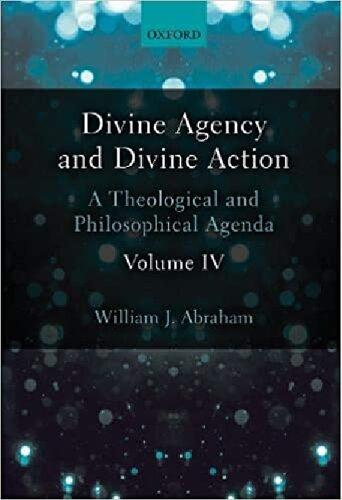
I also want to write a volume that is genuinely helpful for the formation of church leaders. The other volumes in the tetralogy provide a prelude and postlude for the work here. The first volume sorts out the tangled debate about divine agency and divine action without which we will be severely handicapped conceptually and historically. The second volume provides a rich immersion in debates about specific divine action up to the modern period. The fourth will take up some central questions that are thrown up by systematic theology as I conceive it. However, to constantly step aside and deal with these would be a distraction. Perhaps the most important issue to tackle is my claim that God is best conceived as an Agent. For this volume, it is essentially a matter of first things first. We need a manageable treatment of the great themes of Christian theology that boldly speaks directly about God with intellectual depth and clarity. This deflationary vision of systematic theology has significant implications for curricular changes but sufficient unto the day are the troubles thereof.
Notes:
(1)Iain Provan, The Reformation and the Right Reading of Scripture (Waco, TX: Baylor University Press, 2017).
(2)Josiah Ober, Demopolis: Democracy before Liberalism in Theory and Practice (Cambridge: Cambridge University Press, 2017), 179–80.
Access
brought to you by:
Page 11 of 11
PRINTED FROM OXFORD SCHOLARSHIP ONLINE (www.oxfordscholarship.com). (c) Copyright Oxford University Press, 2019. All Rights Reserved. Under the terms of the licence agreement, an individual user may print out a PDF of a single chapter of a monograph in OSO for personal use (for details see www.oxfordscholarship.com/page/privacy-policy). Subscriber: Apollo Education Group, Inc.; date: 03 May 2019
University Press Scholarship Online
Oxford Scholarship Online
Divine Agency and Divine Action, Volume III: Systematic
Theology
William J. Abraham
Print publication date: 2018
Print ISBN-13: 9780198786528
Published to Oxford Scholarship Online: December 2018
DOI: 10.1093/oso/9780198786528.001.0001
Prolegomena
Systematic Theology as Christian Instruction
William J. Abraham
DOI:10.1093/oso/9780198786528.003.0002
Abstract and Keywords
Systematic theology is formally an exercise in university-level, post-baptismal Christian instruction. Materially it is a contemporary articulation of the Christian faith that focuses on divine agency and divine action. Theologians face a dilemma on securing the content of the classical loci of Christian theology. This can be resolved by noting that systematic theology first arose only after reception of the Gospel and initiation into the church. The latter required adoption of the creed which in turn supplied the motivation for and the content of Christian theology. The creed did not include an epistemology of theology, a move developed later which had serious negative consequences of the faith of the church. We need to return to this premodern vision of the place of epistemology in theology and focus afresh on the ancient turn to divine action in creation and redemption as the heartbeat of theology.
Keywords: prolegomena,systematic theology,Gospel,catechesis,canon,epistemology,divine action
Therefore let us go on toward perfection, leaving behind the basic teaching about Christ, and not laying again the foundation: repentance from dead works and faith toward God, instructions about baptisms, laying on of hands, resurrection from the dead, and eternal judgment. And we will do this if God permits.
Page 1 of 18
PRINTED FROM OXFORD SCHOLARSHIP ONLINE (www.oxfordscholarship.com). (c) Copyright Oxford University Press, 2019. All Rights Reserved. Under the terms of the licence agreement, an individual user may print out a PDF of a single chapter of a monograph in OSO for personal use (for details see www.oxfordscholarship.com/page/privacy-policy). Subscriber: Apollo Education Group, Inc.; date: 03 May 2019
Hebrews 6:1–3.
Systematic theology, I propose, is formally an exercise in university-level, postbaptismal Christian instruction. Materially, systematic theology is a deep, contemporary articulation of the Christian faith in terms that focus on divine agency and divine action. Both of these claims are contentious, the first much more so than the second, so let me begin by tackling the rationale for this surprisingly deflationary vision of Christian theology. Happily, the rationale will enable me to defend very briefly and effectively the second, that is, the focus on divine agency and divine action.
Contemporary systematic theologians are faced at the outset with a dilemma at the core of their work. On the one hand, they are committed to certain essential themes that are well known: creation, redemption, the church, the last things, and so on. There is a conventional network of topics or loci that stretches from creation to eschatology. One naturally asks: Where do these come from? How come we all agree that these topics have to be covered? Why don’t we leave the theologian to develop his or her own themes?
When I first started thinking seriously about systematic theology, I came up with a totally different schema for systematics.1 It came as a shock to me that this was not allowed. Naturally, I started ruminating on how on earth we (p.10) ended up with the themes we do have. The best answer I know to this question is historical. The answer is simple: the classical loci or topics of systematic theology clearly reflect the various articles of the Apostles’ and Nicene creeds. The standard topics arise naturally once the new convert begins to inhabit the fresh new world of the creeds, as they run through a narrative of what God has done and will do from creation through surprising restoration all the way to final consummation in the world to come.2 Hence, adoption of these themes is embarrassingly and critically dependent on the creeds; it is the creeds that lie in the background and without them the choice of loci ceases to make sense.
On the other hand, the contemporary systematic theologian cannot really start from anything even indirectly related to the creeds with a good conscience. If we do, we are immediately thought of as being archaic, of being hopelessly repetitive, and, surely, worst of all, doomed to begging the whole question of truth from the outset. A minority, perhaps more than a minority, would go so far as to be hostile to the creeds. At best, any kind of creedal materials, even their schema, can start the conversation. At worst, they get in the way of truth, and maybe they are morally poisonous. It is small wonder that many private universities that have Christian foundations refuse to allow theology as a genuine academic discipline with its own place in the curriculum for undergraduates. The interest in truth is thought to be entirely secondary.
Page 2 of 18
PRINTED FROM OXFORD SCHOLARSHIP ONLINE (www.oxfordscholarship.com). (c) Copyright Oxford University Press, 2019. All Rights Reserved. Under the terms of the licence agreement, an individual user may print out a PDF of a single chapter of a monograph in OSO for personal use (for details see www.oxfordscholarship.com/page/privacy-policy). Subscriber: Apollo Education Group, Inc.; date: 03 May 2019
The standard way to resolve the dilemma just articulated is to work up a prolegomenon where, among other things, you provide a method for getting at the truth or, better still, a criterion for settling issues of truth and falsehood in theology. You seek to work out an epistemology of theology. In this you critically explore how theological assertions are to be grounded, what warrants should be deployed, how you arrive at truth, and the like. With a brief or not-so-brief epistemology in place, you work through the loci ultimately arising from reception of the creed in baptism and defend them by appeal to Scripture if you are a conservative. You rework them if you are a revisionist, doing your best to keep the themes intact, even if you have to do some fancy footwork, or even if you lose a doctrine here or there, like Friedrich Schleiermacher (1768–1834) did with the Trinity in the nineteenth century. Some toggle back and forth between conservation, rejection, and revision, never really thinking about what they are doing with the loci.3 They flit back and forth (p.11) with nowhere to lay their heads. Many lean in to a great figure from the past or turn to an identity group in the present and shelter under their wings.
What has to be faced here is this: there is no guarantee that the epistemology of theology adopted will secure any of these themes in any robust sense. Either the epistemology will be finessed to give you the results you want, so the epistemology is artificial and constrained; or, if you keep the epistemology independent of the results it yields, you will have to shoe-horn the tradition and its themes into the epistemology adopted. There are subtle difficulties in play here, for the sensitive epistemologist must pay attention to the subject matter in hand in order to deploy apt means of epistemic evaluation.
We have a very serious dilemma staring us in the face right at the start of our work. Surely something has gone badly wrong. Let me sketch out what has gone wrong, where and how it has gone wrong, and then begin to indicate my own way out of this dilemma. To be more precise, I shall indicate that we need a new sub-discipline within theology as a whole called the epistemology of theology. Beyond that, I shall argue for a vision of systematic theology as post-baptismal, university-level catechesis.
Let me begin with some historical remarks.4
Page 3 of 18 PRINTED FROM OXFORD SCHOLARSHIP ONLINE (www.oxfordscholarship.com). (c) Copyright Oxford University Press, 2019. All Rights Reserved. Under the terms of the licence agreement, an individual user may print out a PDF of a single chapter of a monograph in OSO for personal use (for details see www.oxfordscholarship.com/page/privacy-policy). Subscriber: Apollo Education Group, Inc.; date: 03 May 2019
The church gathered around the apostles erupted in an outburst of evangelistic activity after Pentecost.5 Empowered by the Spirit, she took on the might of the Roman Empire and eventually broke its persecuting power and zeal, winning hosts of its citizens to become disciples of Jesus Christ. Evangelism had two components or hands. With one hand, the church reached out to gossip and herald the good news of the kingdom of God. This heralding was accompanied by healing, by miracles, and by exorcism. From the beginning the church was a dynamic, charismatic community proclaiming the Gospel by word and deed. With the other hand, the church reached out and brought new converts into the church. This was the task of catechesis. Once Gentile converts multiplied, there had to be substantial, lengthy, serious formation. Folk had all sorts of intellectual, moral, and spiritual baggage that had to be (p.12) sorted out. The kind of wishy-washy initiation we find, say, in much of the contemporary church would have struck our ancestors in the faith as ludicrous. The faith represented, for example, in the Apostles’ Creed handed over to the convert had to be learned, tried on like a new dress, and worked into the fabric of one’s existence. Catechesis and formation were crucial. This was the second component of evangelism. Taken as a constructive practice, evangelism was constituted by both proclamation and catechesis.
Systematic theology began as a further exploration, unpacking, and defense of the faith of the church as laid out in the creed. This was the case, for example, in the great school of Alexandria led by Clement (150–215) and Origen (185–254). Origen states the issue succinctly as follows.
The holy apostles, when preaching faith in Christ, took certain doctrines, those namely which they believed to be necessary ones, and delivered them in the plainest terms to all believers, even to such as appeared to be somewhat dull in the investigation of divine knowledge. The grounds of their statements they left to be investigated by such as should merit the higher gifts of the Spirit and in particular such as should afterwards receive through the Holy Spirit himself the graces of language, wisdom, and knowledge. There were other doctrines, however, about which the apostles simply said that things were so, keeping silence as to the how or the why; their intention undoubtedly being to supply the more diligent of those who came after them, such as should prove to be lovers of wisdom, with an exercise in which to display the fruit of their ability. The persons I refer to are those who train themselves to become worthy and capable of receiving wisdom.6
Page 4 of 18 PRINTED FROM OXFORD SCHOLARSHIP ONLINE (www.oxfordscholarship.com). (c) Copyright Oxford University Press, 2019. All Rights Reserved. Under the terms of the licence agreement, an individual user may print out a PDF of a single chapter of a monograph in OSO for personal use (for details see www.oxfordscholarship.com/page/privacy-policy). Subscriber: Apollo Education Group, Inc.; date: 03 May 2019
This sort of creedal development was entirely natural. A robust creed does not close off inquiry. Take it seriously and it will engender an acute pain in the brain. Receiving the creed of the church, and then thinking seriously about it, is like taking a subject to a deeper and higher level. The lower levels both prepare for this work, and they provoke this work. To use a different analogy, it is like getting married; the hard, intellectual work already begun becomes even more intense after the ceremonies are over, not least for those called upon to teach the faith of the church.
I propose up front that we do not need an explicit epistemology to do this work in systematic theology, that is, the work of exploring, unpacking, explaining, and defending the faith of the church. We can even leave open how we should specify the desiderata of a good epistemology. Whatever decisions we make about epistemology, we can become a Christian in good standing without buying into any epistemology.7 We receive the faith and then, willy-nilly, (p.13) we get to work with the materials to hand. We go deeper into what we have already been doing, that is, we start paying attention to the church’s faith owned in Christian initiation and celebrated liturgically every Sunday. We naturally go to work intellectually on this faith: making distinctions, following through on certain insights, looking for internal connections, dealing with objections, discovering arguments which support our initial conversion and attraction to Christ, wondering what counts as a good argument, pondering whether we need any arguments, identifying problems that we and others have noted, making a speculative move here and there, tracing connections and contradictions between our Christian faith and other beliefs we have when we wake up in the morning or when we read our chosen non-Christian authors.
Push this line further. Christians got their faith in baptism within Christian initiation from the tradition of the church that emanated in one way or another from the apostles.8 The church gave us that faith without giving us an epistemology. The church gave us food for thought straight from the kitchen; she did not give us a recipe on how she got that faith. The church in her faith gave us a bridge to the living God; she did not give us a course on engineering on how to build bridges. The church gave substance rather than process, content rather than form, meat rather than meat-producers. The church laid out what it was convinced it knew and for which its members and leaders were often prepared to die in martyrdom; it did not in the same way lay out how it knew what it knew. In fact, the church never initially worked out an agreed criterion of truth, or a reflective theory of rationality, or a theory of justification or knowledge. This observation is deeply instructive and unbelievably illuminating for the predicament sketched at the beginning of this chapter.
Page 5 of 18 PRINTED FROM OXFORD SCHOLARSHIP ONLINE (www.oxfordscholarship.com). (c) Copyright Oxford University Press, 2019. All Rights Reserved. Under the terms of the licence agreement, an individual user may print out a PDF of a single chapter of a monograph in OSO for personal use (for details see www.oxfordscholarship.com/page/privacy-policy). Subscriber: Apollo Education Group, Inc.; date: 03 May 2019
Let me approach this suggestion from a different and more traditional angle. Many theologians think that the church had from the beginning a criterion for its theology, and that criterion was its canon of Scripture. Most proponents of traditional Protestantism and Roman Catholicism agree on this.9 Scripture, the biblical canon, it will be said, is the foundation, the (p.14) criterion for Christian theology. This is the proper norm (the norm that is not normed) of all good theology. If I am right in what I have just said, then this claim is clearly false. I am claiming the church officially adopted its doctrines without first coming up with a Bible and then developing the former from the latter.
The argument in favor of this account of the Bible in theology is cumulative. The leaders and members of the church were doing theology long before there was any fixed canon. This practice would be impossible if the theory under review were true.10 Further, the church was far more concerned to secure the content of its creed, its list of teachings or doctrines, than it was in fixing the limits of its canon of Scripture. Also, the church’s rule of faith was critical in deciding the content of the canon of Scripture, so the relation is the reverse of what we usually claim. One of the reasons why the church rejected various Gnostic gospels was precisely because they contradicted its developing doctrines. In addition, when it came to the epistemology of theology, the great theologians of the church were simply not on the same page; the church tolerated significant diversity. Finally, even the very text of Scripture may have been reworked to fit its developing doctrines.11
We can pursue our quarry in traditional terms by looking at a word that we generally associate with Scripture, namely, the word “canon.” What does the word “canon” mean? Is it a criterion? Is it a standard or measure? Well, it can, and it sometimes did, mean this. However, I do not think that this was the primary meaning. The primary meaning of “canon” is a list. The canon of saints is a list of saints. The canon of Scripture is a list of books to be read in worship.
In developing its faith, as the church went along merrily evangelizing the Roman Empire and moving over into the bogs of Ireland, the church put together what I want to call its canonical heritage. The bigger picture is that the canonical heritage consists of generally agreed lists of materials, persons, practices, and events.
Page 6 of 18
FROM OXFORD SCHOLARSHIP ONLINE (www.oxfordscholarship.com). (c) Copyright Oxford University Press, 2019. All Rights Reserved. Under the terms of the licence agreement, an individual user may print out a PDF of a single chapter of a monograph in OSO for personal use (for details see www.oxfordscholarship.com/page/privacy-policy). Subscriber: Apollo Education Group, Inc.; date: 03 May 2019
Think of the canon of Scripture. Recall how this arose. The story is complicated, so I shall have to cut corners to make my central point. Marcion (85–160) brought out his own canon; he dropped the Old Testament and went with Luke and selections of Paul. As a serious thinker and generous donor to (p.15) his local church in Rome, he was a force to be reckoned with. The church competed with him at his own game by gradually identifying its own canon of Scripture, determined by its resolution to keep the Jewish Scriptures and by its widespread usage of the books that are now in the New Testament. The book of Revelation barely made it in by the skin of its teeth. Maybe we should have left that one out; we would not have had to deal with the folk who have killed its brilliant literary power by reading it like they read the Wall Street Journal. On the other hand, if we had left it out, we would have not been able to cope so well with the horrors of World War II when European Christians realized that the drama of the book of Revelation really was onto something crucial in the way it depicted the drama of good and evil in the world.
Now it is tempting, given our formation in Western Christianity as whole, to believe that the Bible is all we need spiritually and intellectually. Actually, this is an illusion. At a minimum the church developed all sorts of aids to help us make sense of it. The Bible is a big book; it is not all bedtime reading; parts of it are hair-raising in form and content; it is a small library of books collected over centuries from different places. Hence we need something alongside Scripture if we are to grasp the intellectual core of the Christian faith. More accurately the church already developed its creed, and it used this as an aid both for determining the content of the canon of Scripture and for reading Scripture as a whole.
The church learned this hermeneutical lesson from hard experience. Its chief rivals in the ancient world were various religious sects known collectively as Gnostics. Their equivalent in our day is the various New Age movements. There were and are both low-brow and high-brow versions readily available. It was central to the Gnostic claim that they really had access to the truth about the world; so they knew what Scripture truly said. Give them any book or text, and they could show how their creed or vision was to be found in it. This was a tremendous challenge to the church. The leaders of the church solved it, in part, in a brilliant and economical manner. They developed over time what they called a canon of truth or a rule of truth. They formally drew up their own creed. Note how the word canon crops up here. They drew up a list of convictions or beliefs. Such a list cuts off the Gnostic move at the pass.
Page 7 of 18
FROM OXFORD SCHOLARSHIP ONLINE (www.oxfordscholarship.com). (c) Copyright Oxford University Press, 2019. All Rights Reserved. Under the terms of the licence agreement, an individual user may print out a PDF of a single chapter of a monograph in OSO for personal use (for details see www.oxfordscholarship.com/page/privacy-policy). Subscriber: Apollo Education Group, Inc.; date: 03 May 2019
Actually, this partial development of a creed was already present in the church independently of the challenge from the ancient New Agers. The church found that it had to draw up a short meaty summary for converts. Most folk want important information in summary form; books and explanations tend to come later. When we hear some item of news about a crime, we want to know two things: “Who did it? And did he get caught?” A library of books will not deal with this necessity. So out of pastoral commitment the church developed its creed, its canon of truth, its rule of faith.
It did not leave this sort of thing to a committee of experts or academics working on tenure. The creed was hammered out by experienced evangelists (p.16) and teachers. Over time it formally adopted a single creed, a creed we know by its shorthand name as the Nicene Creed, simply because some of the crucial decisions were made in the fourth century at a place called Nicaea in Asia Minor. This is the only creed that has received formal approval by the church universal. Sometimes churches use the Apostles’ Creed in church, and this is fine. However, the only creed agreed by the whole church was and remains the Nicene Creed. It is a brilliant summary of the faith.12
We now have two sorts of materials: a list of books and a list of teachings.13
There were other materials developed in a canonical way. Thus, the church developed iconography, where those trained in art and prayer paint the truth in pictures for all to see and take in by the eye. Interestingly the technical term for producing an icon is that you write an icon. There is other critical doctrinal material, like the Chalcedonian definition, where the church lays out what it believes about the person of Christ. There are also various lists of persons. There is a canon of saints who represent what is true as opposed to fake holiness. Over time a canon of Fathers emerges. This is not a sexist notion; it identifies great spiritual leaders who were adept at handing over the faith. There is even a canon of theologians. Initially there are three in number: John the Divine (the writer of the fourth gospel), Gregory of Nazianzus (329–90), and Symeon the New Theologian (949–1022). These clearly take the church’s teaching to a whole new level and deftly preserve the truth of the Gospel. There is a canon of bishops, that is, a list of those who are called to exercise oversight over the church. Their job in part was to guard the store and to stop somebody moving in their alien proposals and planting them firmly in the church’s living room.
Page 8 of 18 PRINTED FROM OXFORD SCHOLARSHIP ONLINE (www.oxfordscholarship.com). (c) Copyright Oxford University Press, 2019. All Rights Reserved. Under the terms of the licence agreement, an individual user may print out a PDF of a single chapter of a monograph in OSO for personal use (for details see www.oxfordscholarship.com/page/privacy-policy). Subscriber: Apollo Education Group, Inc.; date: 03 May 2019
(p.17) Already we are moving into canonical practices, for episcopacy is a practice; it is a job of oversight that has to be carried out by a living, breathing person. A book or a creed, on its own, cannot take care of moral or intellectual problems that are in and around the faith of the church. Only persons can really do this, and, even then, it is extremely difficult to do so. More generally the job of the bishop was to ordain, to teach and hand over the creed, to encourage, to lead, to protect the church from moral and intellectual poison, and the like. This was no sure-fire practice; bishops themselves can readily become a menace in the life of the church. Even popes can become heretics as happened in the case of Honorius I (585–638) in the seventh century.
More regular practices that all agreed to were the celebration of the canonical sacraments and other rites, chiefly, of course, baptism and Eucharist. There developed canonical liturgies that provided patterns for a right way to choreograph our worship of God. Here the Jewish tradition was a pivotal starting point and model.14 We could also say that preaching was a canonical practice with its own unique place in the life of the community. We might even go so far as to say that the sermons of Augustine are canonical in the West, and the sermons of John Chrysostom are canonical in the East.15 Finally, there were canonical events: the great ecumenical or canonical councils where these sorts of issues were hammered out or endorsed. The councils were charismatic events where the church prayed for and expected the Holy Spirit to lead her into the truth and into right practice as Christ had promised. There were minimally seven of these in all in the first millennium with the Apostolic Council of Acts 15 providing the model for this.
Of course, there are many who tend to see the Nicene Creed and all the other elements of the canonical heritage of the church as a terrible imposition, perhaps, imposed on the church by the powers that be, or imposed by nasty church leaders trying to inflict their ideology on the rest of the church forever. This is not an accurate rendering of what actually happened. This whole way of seeing the developments in the early church gets things back to front. Donald MacKinnon expresses the issues at stake succinctly.
The whole exterior framework of the Christian Church is the poor man’s protection against the tyranny of the wise who would rob him of the heritage of the Gospel. In a sense one might say, too, that her visible structure, her articulate doctrinal standards, her ordered sacramental life, represents the very lashing of the Church herself to her historical moorings. The whole Church is an (p.18) organ of the Gospel … Those aspects of her life that most perplex hankerers after ‘spiritual religion’ are due to the fact that she proclaims, not a possibility of spiritual achievement, but a work of redemption wrought by the Son of God in human flesh and blood.
Page 9 of 18 PRINTED FROM OXFORD SCHOLARSHIP ONLINE (www.oxfordscholarship.com). (c) Copyright Oxford University Press, 2019. All Rights Reserved. Under the terms of the licence agreement, an individual user may print out a PDF of a single chapter of a monograph in OSO for personal use (for details see www.oxfordscholarship.com/page/privacy-policy). Subscriber: Apollo Education Group, Inc.; date: 03 May 2019
Again and again we have seen the pressure of external circumstances upon individual members of the Church, who have held high office within her and have usually been endowed with great personal gifts, a pressure which issues in individual demands that the Gospel of God be transformed in a human philosophy. And it has been the external organization of the Church, in itself attesting the character of the Gospel, that has preserved its saving truths for Christ’s little ones. It is through the institutions of the Church that the Gospel is preserved from the idiosyncrasies of its members.16
At one level, all of these developments are contingent developments; other means could have been used to perform the same functions. Across history, various Christian communities have in fact found various ways for securing the ends sought by the relevant choices made with respect to each of these elements in the canonical heritage. Not surprisingly, some Christian communities have sought to preserve exactly the original network of canonical materials, practices, persons, and events. They have gone far beyond this in excommunicating communities that do not share their exact vision of the history. In the West, we have long had exclusive claims advanced on behalf of the Bishop of Rome where whole networks of Christian communities continue to be downgraded because they do not accept the precise way in which Roman Catholicism has interpreted its own unique configuration of canonical materials and practices. This represents one of the great tragedies in the history of the church; things are not going to change on this front. However, we can readily agree that the developments sketched above are not merely contingent developments; they are indeed the work of the Holy Spirit in the life of the church. It is another matter entirely to claim that the action of the Holy Spirit is exclusively tied to these precisionist accounts of the early history. We need a hermeneutic of charity in evaluating the official teachings and practices of the vast array of Christian communities that exist across space and time.
Moreover, in one respect, namely, in the overreach to canonize a particular epistemology of theology, we can say this. The church never canonized any epistemology, any theory of reflective rationality, any agreed upon method for getting at the truth. She never canonized any theory of revelation or inspiration, no more than she canonized any theory of the atonement. She left this issue open; some went this way; some went that way. The church allowed all sorts of epistemic insights and suggestions to fructify in her womb. Even though there was deep general agreement that revelation was (p.19) essential, even this was left in the bosom of the church without being formally defined or adopted.
Page 10 of 18 PRINTED FROM OXFORD SCHOLARSHIP ONLINE (www.oxfordscholarship.com). (c) Copyright Oxford University Press, 2019. All Rights Reserved. Under the terms of the licence agreement, an individual user may print out a PDF of a single chapter of a monograph in OSO for personal use (for details see www.oxfordscholarship.com/page/privacy-policy). Subscriber: Apollo Education Group, Inc.; date: 03 May 2019
Perhaps we can find this observation more attractive if I clear up one loose end at this point. What was the overall purpose of the canonical materials, persons, practices, and events? Or, to put the same question in a different form, what was the purpose of the church in using these materials, in deploying these practices, in designating and appointing these persons, in sustaining these treasures in its life and ministry? Their purpose is simple: rightly working together, they bring us to God, heal us of our troubles and corruption, and make us divine. They make us like Jesus Christ; they turn us the right way up; they restore us to the image of God. They create in us the mind of Jesus Christ, who for our sakes became poor that we through his poverty might become rich. They enable human beings to find their true destiny as designed and appointed by God.
We can state the same point conventionally by claiming that we have here means of grace. Working together these varied materials, practices, and persons makes us wise unto salvation. They mediate prevenient, justifying, and sanctifying grace. They make available the truth that sets us free; they attract us to the amazing generosity of God; and they make available the power of the Holy Spirit in bringing victory over evil. Hence, they need to be handled with care and spiritual sensitivity.17
Consider, for example, the way the content of the creed was handed over. The church knew that the seeker had to be pretty far along to even begin to grasp its content. Hence inquirers were not allowed to write it down and take it home. They were warned not to share it with outsiders. If one did, folk would laugh and jeer, for how could anyone even begin to understand the creed if they had not come to terms with the Gospel? One received the creed after one was introduced to the Gospel and while one was on the way to conversion. The reception of the creed was an art. Let me explain this more fully.
In coming to encounter the God of the Gospel in the creed, we also come to understand ourselves. As we explore who God is, we also explore who we are as children of God, made in his image and liberated from sin by Christ. Hence prospective converts had to go away and mull over the faith. Startled by the Gospel, they worked up to God from their condition and then down to a revised understanding of their condition after hearing the good news of the Gospel of God. Otherwise the creed was just abstract God-talk, mere religious mumbojumbo, or silly theological nonsense.
(p.20) At the heart of the creed is Jesus Christ. In meeting the testimony about him in the church we come to meet God. We do not go above, or around, or below him to meet God. The church really believed that anyone who encounters Jesus Christ encounters God. We do not have to be trained in epistemology or in philosophy to meet God and be healed. In fact, the church was bold enough and confident enough to tell this to philosophers to their face. This is a staggering claim; it has and always will be a matter of intellectual offense.
Page 11 of 18 PRINTED FROM OXFORD SCHOLARSHIP ONLINE (www.oxfordscholarship.com). (c) Copyright Oxford University Press, 2019. All Rights Reserved. Under the terms of the licence agreement, an individual user may print out a PDF of a single chapter of a monograph in OSO for personal use (for details see www.oxfordscholarship.com/page/privacy-policy). Subscriber: Apollo Education Group, Inc.; date: 03 May 2019
Now, consider this: in coming to Jesus Christ we all need the help of the Holy Spirit. The Spirit repairs our sight and enables us to see who Jesus truly is. There is more here than some rickety intellectual argument. There is the illumination of the Holy Spirit. Just as the sun helps us to see the world as it is, the Spirit helps us to see Jesus Christ as he is, the eternal Son of God. In turn we cannot be drawn into the life of the Son through the Spirit without obedience, humility, and repentance. It is those who are poor in spirit who see God.
There is more to ponder. The church insists that as we come to meet and know God, we will never fathom the final mystery and beauty of God. In God’s essence, God forever lies beyond the reach of our concepts and ideas. Our knowledge of God melts in wonder, in love, in silence, and in praise.
I want now to cut to the chase and simply declare that this internal ordering of the life of the church got turned inside out over time. The drive to get the epistemology right and to show that we are in the right and the other fellow in the wrong is intimately related to the divisions that break out in the church over time. I think it applies to the first really big split in the church, the split between East and West, but I will not get crucified on that cross in these preliminary remarks. I will instead settle for a rendering of the effects of the divisions in and around the Reformation. Let me put the issue simply and sharply without any qualifications.18
Page 12 of 18
PRINTED FROM OXFORD SCHOLARSHIP ONLINE (www.oxfordscholarship.com). (c) Copyright Oxford University Press, 2019. All Rights Reserved. Under the terms of the licence agreement, an individual user may print out a PDF of a single chapter of a monograph in OSO for personal use (for details see www.oxfordscholarship.com/page/privacy-policy). Subscriber: Apollo Education Group, Inc.; date: 03 May 2019
The Reformers, whatever else we say about them, tried to recover the Gospel and the proper usage of the Scriptures. They rediscovered the sheer beauty and wonder of the Gospel for themselves. As they pursued this recovery further, they were faced by opponents who required them to supply an epistemology. They were pressed to supply a criterion and to answer the question of authority. Their favorite slogan at that point was some version of sola scriptura. 19 Their hopes in this respect failed. They failed to reach consensus on the Trinity, the sacraments, the nature of church order, the relation between church and state, and so on. In time, they took to killing one (p.21) another. In disgust their children looked for a better foundation in reason or experience. They created the Enlightenment in its various manifestations. The second and third generation schooled in the Enlightenment turned their epistemological weapons back on the church. From then on theology has been on one wild goose chase after another to fix the foundations and get the epistemology straight. All along the church is now hostage to experts in the philosophy department. When this fails, and philosophy refuses to oblige, her teachers turn to ancillary disciplines and pseudodisciplines like cultural studies, literary theory, gender studies, and the like.20 In the meantime the children look up and are offered stones when they ask for bread. The church is in danger of becoming spiritually and intellectually bankrupt. By the time we arrive at the nineteenth century, there are so many intellectual options all claiming to rest on the right foundations that the Mormons invent their own revelation. They want a sure-fire way out of the terrible pain and confusion, a way determined by a new revelation for today. Not surprisingly contemporary nominal Christians are drawn to Islam because of its simplicity and certainties.
The net result of this obsession with epistemology is modern Protestantism in the West. It is a kind of credit-card Christianity without any money left in the bank. Hence we are constantly looking for a reliable source of really good money. Epistemology has turned out to be much more difficult that we thought it would be. There is no agreement in the field as a whole that the theologian can rely on. This is not to say that we have not made progress in epistemology, for we have. However, one person’s progress is another person’s regress. Some, under the name of post-modernism, have tried to write obituary notices of the subject. There is no self or subject who can do any knowing, for all selves are really creations rather than stable creatures. There is no truth outside what your friends will let you get away with, that is, there is no justification outside the conventions of community. There is no objective reality to which language corresponds or refers; there is simply the incessant play of metaphor harnessed perhaps to interest, materiality, and power. These are what we might call antiepistemological epistemologies.21
Page 13 of 18 PRINTED FROM OXFORD SCHOLARSHIP ONLINE (www.oxfordscholarship.com). (c) Copyright Oxford University Press, 2019. All Rights Reserved. Under the terms of the licence agreement, an individual user may print out a PDF of a single chapter of a monograph in OSO for personal use (for details see www.oxfordscholarship.com/page/privacy-policy). Subscriber: Apollo Education Group, Inc.; date: 03 May 2019
Here is the irony. We are still working overtime to get the right epistemology or anti-epistemology at a time when the culture has become post-Christian, as in Europe, or hopelessly confused and divided, as in the United States of America. Hence we have denominations fighting it out over the right criterion or correct epistemology, when we need to be able to preach and teach (p.22) the faith with confidence and humility. Modernity has not lived up to its promises;22 postmodernity is often simply the playground of the intellectual elite.23 Evil is as real as ever it was at home and abroad. I have no brief for sensationalism, but the reality and power of evil in the world is as great as ever it was after two centuries of Enlightenment. We have not arrived at the various utopias of blessing promised by modernity. The need for redemption, for the salvation of our souls, for the healing of the nations, is as great if not greater than ever. Hence the church must recover its intellectual and evangelistic nerve. If the church fails in this task, it will cease to fulfill its missionary obligations. Continuing to be stuck in epistemology is only of limited help at this point in our journey.
I offer two proposals to move us forward at this point.
We need to put epistemology in its place. The obvious way to do this is to create a new sub-discipline within theology but outside systematic theology called the epistemology of theology.24
We need to reinvent systematic theology. We need to reconceive systematic theology as post-baptismal, university-level catechesis in the church.
Note carefully what I am doing here. I propose we relax about epistemology in systematic theology; we can take up that work as time and aptitude allow. More importantly, I am inviting Christians to step afresh into the waters of baptism and explore what lies on the other side of that immersion. This invitation is not given in smugness or in intellectual laziness but in fear and trembling. This is not some new form of ecclesiastical fundamentalism; it is not giving vent to a new round of gloomy conservative instincts. It is a hard-won conviction derived from wrestling with the faith as honestly and rigorously as I can. It is an act of faith in the God of Israel and of the church who in Jesus Christ has come to redeem the world and who has sent the Holy Spirit to lead it into the truth it needs to do its work. I am inviting the reader on a journey into the loci of systematic theology. With the church in its diverse manifestations I am promising that if we make this journey then we will come to know, love, and serve God better. I am proposing that we view systematic theology as an extension of the catechetical life of the church. It is serious, (p.23) rigorous, university-level catechesis. This is the formal claim I mentioned at the outset.
Page 14 of 18
PRINTED FROM OXFORD SCHOLARSHIP ONLINE (www.oxfordscholarship.com). (c) Copyright Oxford University Press, 2019. All Rights Reserved. Under the terms of the licence agreement, an individual user may print out a PDF of a single chapter of a monograph in OSO for personal use (for details see www.oxfordscholarship.com/page/privacy-policy). Subscriber: Apollo Education Group, Inc.; date: 03 May 2019
My initial comment on the second material claim lies close at hand. The loci allow us to identify and articulate a network of divine actions neatly summarized in terms of creation, freedom, fall, redemption, and consummation.25 They speak of a God who created the universe; who chose a particular people, the Jews, as the bearers of divine revelation and divine life; who came to earth in the person of his Son, Jesus Christ; who sent the promised Holy Spirit to secure a whole new era of God’s kingdom through the church; who transforms sinners into saints; and who will bring his purposes both on a personal and cosmic level to final fulfillment in the world to come. We are dealing with divine action from creation through redemption to final fulfillment of God’s good purposes for the created order. Keeping divine agency and divine action in mind as we proceed will help us to secure our bearings and to keep our intellectual nerve intact. In the end this material proposal is best defended by execution in what follows rather than by formal defense.
Notes:
(
1) The schema that I liked was one that ran the following topics: background beliefs about creation, the uniqueness of human agents, a diagnosis of what has gone wrong, a prescription on how to put things right, a vision of the future, and an appropriate ethics that fitted the foregoing vision as a whole.
(
2) It is common to trace the narrative to speculative Greek notions of exit and return from the One to the Many and to secure the loci by reference to Peter Lombard’s Sentences (Libri Quattuor Sententiarum) in the twelfth century. The former is too remote in conception and the latter too late in development. As we shall see, the explanation lies much closer to hand in the catechetical schools of the patristic period.
(
3)Francis Schüssler Fiorenza and John P. Galvin, eds., Systematic Theology: Roman Catholic Perspectives, 2 vols. (Minneapolis: Fortress Press, 1991).
(
4) The Logic of EvangelismCanon and Criterion in Christian Theology: From the Fathers to FeminismCrossing the Threshold of Divine RevelationDivine Agency and Divine Action, Volume I: Exploring and Evaluating the DebateDivine Agency and Divine Action, Volume II: Soundings in the Christian TraditionWilliam J. Abraham, Jason E. Vickers, and Natalie B. Van Kirk, eds., Canonical Theism: A Proposal for Theology and Church (Grand Rapids, MI: Eerdmans, 2008).
(5) Here and elsewhere the use of the term “church” rather than “Church” is deliberate. The latter usage sends theological signals about identity and exclusion that I reject; the rationale for this usage will become clear when I take up the topic of ecclesiology.
(6)G. W. Butterworth, Origen On First Principles (Gloucester, MA: Peter Smith, 1973), 2.
Page 15 of 18 PRINTED FROM OXFORD SCHOLARSHIP ONLINE (www.oxfordscholarship.com). (c) Copyright Oxford University Press, 2019. All Rights Reserved. Under the terms of the licence agreement, an individual user may print out a PDF of a single chapter of a monograph in OSO for personal use (for details see www.oxfordscholarship.com/page/privacy-policy). Subscriber: Apollo Education Group, Inc.; date: 03 May 2019