The moral rights of the author have been asserted First Edition published in 2019
Impression: 1
All rights reserved. No part of this publication may be reproduced, stored in a retrieval system, or transmitted, in any form or by any means, without the prior permission in writing of Oxford University Press, or as expressly permitted by law, by licence or under terms agreed with the appropriate reprographics rights organization. Enquiries concerning reproduction outside the scope of the above should be sent to the Rights Department, Oxford University Press, at the address above
You must not circulate this work in any other form and you must impose this same condition on any acquirer
Published in the United States of America by Oxford University Press 198 Madison Avenue, New York, NY 10016, United States of America
British Library Cataloguing in Publication Data
Data available
Library of Congress Control Number: 2018951741
ISBN 978–0–19–883313–0
Printed and bound by CPI Group (UK) Ltd, Croydon, CR0 4YY
Links to third party websites are provided by Oxford in good faith and for information only. Oxford disclaims any responsibility for the materials contained in any third party website referenced in this work.
Preface
After the US presidential election in November 2016, I held a discussion for students to share their feelings about the stunning upset that saw Hillary Rodham Clinton, the Democrat widely favoured to win, lose to the Republican candidate. The accompanying reading, from that week’s lecture, was from William Wordsworth’s Prelude. One student was visibly shocked when I pointed out her similarity in age to the poet when his own political hopes were destroyed. For those who believed, as those who experienced the French Revolution as a blissful dawn had believed, that recent progress had not only been inevitable but was assured to continue, the abrupt collapse of expectations had been shattering. The surprise vote for ‘Brexit’ that summer occasioned its own shock and disbelief. These events were experienced not only as surprise reversals (or belated revelations) of public opinion but as the stripping away of existing certainties: a violent rending aside of political life’s decent drapery and pleasing illusions. Among those shocked by the outcome of the American election, an emphasis emerged on taking solace in intimate bonds and small circles, a particularly Wordsworthian quantum of solace.1 (Clinton herself did a lot of walking in the woods.) Yet initial shock also quickly gave way—in contrast with the pervasive resignation and palpable malaise following the British vote to leave the European Union—to renewed commitment: the kind of perpetual resistance that we particularly associate with the second-generation Romantics. In his blistering sonnet ‘To Wordsworth’, Percy Shelley accused the poet not only of having reneged on his earlier attachment to the revolutionary cause but of a more fundamental betrayal: turning his back on a blind and battling multitude to stand above the fray, encased in solitude. Lord Byron developed a more idiosyncratic critique, voicing disdain for Wordsworth’s lowly origins and appeals to ‘natural’ language. Byron’s own poetic concerns with irreparable loss and the sublimation of self nonetheless resonated deeply with those of the older poet. Yet rather than retreating into political quietism, Byron occupied a more volatile remove. The prototypical Byronic hero, Lord Macaulay noted, was ‘proud, moody, cynical, with defiance on his brow, and misery in his heart, a scorner of his kind, implacable in revenge, yet capable of deep and strong affection’.2 In his own person, Byron adopted a complex political stance and public role that combined jadedness and misanthropy with a version of the mental fight and spirited resistance witnessed in his Romantic contemporaries and precursors, continuing
1 The circulation of the following quote by Anna Freud after the election exemplifies this response: ‘I agree with you wholeheartedly that things are not as we would like them to be. However, my feeling is that there is only one way to deal with it, namely to try and be all right oneself, and to create around one at least a small circle where matters are arranged as one wants them to be.’ Quoted in Elisabeth Young-Bruehl, Anna Freud: A Biography (New York: Summit Books, 1988), 18.
2 Thomas Babington Macaulay, ‘Moore’s Life of Byron’, in Macaulay: Prose and Poetry, ed. G. M. Young (Cambridge, MA: Harvard University Press, 1967), 543.
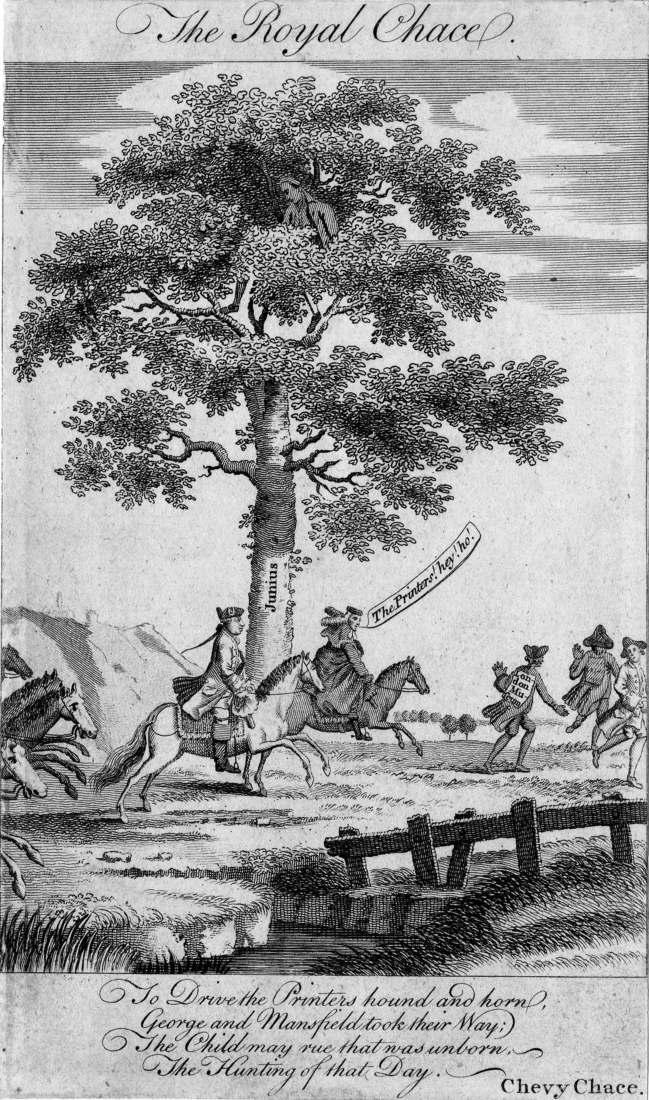
Figure 1. ‘The Royal Chace’ (1770). As the king’s representatives pursue radical printers from horseback, the anonymous satirist ‘Junius’ lurks in an oak tree, watching on as fractures develop in the ground below.
to claim the mantle of stringent ‘opposition’ (not least to the onset of a newly emboldened ‘Toryism’ taking hold at home and abroad) alongside his distinctive brand of cynicism.
This stark divide, between Wordsworth’s retreat from political activity into smaller circles and the renewed commitment, voiced by Shelley if not also by Byron, to political transformation even in the face of its apparent impossibility, cuts to the heart of an abiding predicament.3 Fuller reckoning with these so-called generations of Romantic writing, building upon fuller attention to their reckoning with each other, reveals the complicated interplay between quietistic retreat and revolutionary horizons, the bonds between men (usually men) in small numbers and the commitment to mankind as a whole. The pervasive sense, exemplified in late Romantic texts including Mary Shelley’s The Last Man and the final cantos of Byron’s DonJuan, that political hopes, the human species, and even the planet itself have been exhausted, casts these respective responses to political disillusionment further into relief. In the face of dismantled certainties and impending crises, retreat and rebellion emerge less as opposites embraced by mortal enemies than alternatives embraced by men united in clinging to whatever hopes they can, on a darkling plain and shrinking shoreline. These various movements, between salving quietism and renewed idealism, between the depressed belief that possibilities have been exhausted and the radical hope that spring cannot be far behind, provide paradigms—particularly when considered in their dynamic interplay with each other—for thinking about our own moment of eroding political certainties and deepening planetary despair. ‘There is nothing in disenchantment inimical to art’, E. P. Thompson has maintained, drawing a distinction between the layered disenchanted state and the apostasy he characterizes as ‘self-mutilation and the immoderate reverse of attachments’.4 The ‘withdrawal from the vortex of an unbearable political conflict’ may cause one to clutch at sources of limited optimism, but ‘[t]here must be some objective referent for social hope, and it is one trick of the mind to latch onto an unworthy object in order to sustain such hope’—as much the case, Thompson reminds us, for Mary Wollstonecraft as for Wordsworth.5 These complementary responses to political disappointment are not the subject of this book. Although my discussions of political disenchantment, renewed commitment, and more elusive kinds of disengagement, cynicism, opposition, and
3 The student mentioned above, incidentally, inclined squarely to the latter course: ‘I can appreciate the calmness in Wordsworth’s poetry, I can understand wanting to go into nature, needing to take some time to put yourself back together, to get back on track. I definitely had to do that for a day. But it’s not enough. We can’t retreat like he did, we can’t give up. We just can’t.’
4 ‘Disenchantment or Default? A Lay Sermon’, in The Romantics: England in a Revolutionary Age (New York: Norton, 1997), 37. For Thompson, apostasy involves relapsing into ‘received patterns of thoughts and feelings’ and a psychology that includes that ‘peculiar and vengeful kind of bitterness which a certain kind of man finds for an idealized mistress who has disappointed him’ (62, 68, 63). ‘It is easy enough to make fun of Wordsworth’s apostasy, which was in some senses abject, in his last forty years’, Thompson concedes; ‘less easy is to conceive how he upheld, through all the preceding fifteen years, so great a confidence that “fair seasons yet will come, and hopes as fair.”’ Compare his suspicion about apostasy as a ‘stimulant to the critical faculties’ (including for jaded leftist intellectuals writing in the Partisan Review closer to his own moment) (64).
5 ‘Disenchantment or Default? A Lay Sermon’, 59, 68.
recalcitrance take inspiration from studies of writers animated by the French Revolution or estranged by its failure, this study does not address Wordsworth and his generation of Romantic poets directly, whether critically or sympathetically (except for Robert Southey, the former radical turned Poet Laureate, whom Byron scathingly derided for having turned out ‘Tory at last’). With the crucial exception of Byron, ever an exceptional figure, I do not address Romantic writers animated by the ‘spirit’ of revolution, whether radical politicians like John Thelwall, radical nationalists like Sydney Owenson, or radical outsiders like William Blake. The French Revolution was unprecedented: electrifying and inspiring, galvanizing and terrifying. The subsequent decades transformed the relationships—real and imagined—between political organization, religious practice, public feeling, and literary expression.6 Rather than foregrounding the French Revolution and its fractal refashioning across subsequent decades, this book instead adopts a diagonal course through the long Romantic period that locates these developments within broader contexts and against deeper histories of unrest.7 In the first instance, this means approaching the post-1789 period in relation to the global ‘age of revolutions’ that began several decades earlier; this book pays particular attention to the neglected discontent and unrest within Britain during the decades surrounding
6 These developments and the enduring transformations to which they helped to give rise have attracted extensive attention. See, inter alia, E. P. Thompson, The Making of the English Working Class (New York: Vintage, 1966); John Barrell, The Spirit of Despotism: Invasions of Privacy in the 1790s (Oxford: Oxford University Press, 2006); Georgina Green, The Majesty of the People: Popular Sovereignty and the Role of theWriter in the 1790s (Oxford: Oxford University Press, 2014); Kevin Gilmartin, Print Politics: The Press and Radical Opposition in Early Nineteenth-Century England (Cambridge: Cambridge University Press, 1996); Andrew Franta, Romanticism and the Rise of the Mass Public (Cambridge: Cambridge University Press, 2007); Jon Mee, Romanticism, Enthusiasm, and Regulation: Poetics and the Policing of Culture in the Romantic Period (Oxford: Oxford University Press, 2003); Daniel E. White, Early Romanticism and Religious Dissent (Cambridge: Cambridge University Press, 2006); Mark Canuel, Religion, Toleration, and British Writing, 1790–1830 (Cambridge: Cambridge University Press, 2002); Harriet Guest, Unbounded Attachment: Sentiment and Politics in the Age of the French Revolution (Oxford: Oxford University Press, 2014).
7 Although beyond the scope of this book, the Haitian Revolution presents one—though by no means the only—example of political disaffection in this period that promised to trouble EuroAtlantic society and its constitutive exploitation of unfree racialized labour. Emphasizing the global scope of upheaval in the 1790s, Ashley L. Cohen reminds us that ‘[i]n Ireland, England, India, and Jamaica, the Jacobin crisis was fueled by extreme levels of worker disaffection and resistance to Britain’s imperial-capitalist world order’ and contends that this ‘global Jacobin crisis threw into relief the ease with which processes of exploitation, dispossession, and political and economic oppression subverted boundaries between the domestic and the imperial, free and unfree labor, the East and West Indies.’ ‘Wage Slavery, Oriental Despotism, and Global Labor Management in Maria Edgeworth’s Popular Tales’, The Eighteenth Century: Theory and Interpretation 55 (2014), 195. The West Indian slave plantations obliquely alluded to in Jane Austen’s Mansfield Park and Maria Edgeworth’s The Absentee present an outer limit for this book’s more delimited concerns with disaffected political energies, amplifying the forces that promise to disrupt politics ‘at home’—a designation already fractured by the appendage of Ireland and parallel exclusion of the English working classes from political recognition—with reminders of the wider world in which the domestic polity was inescapably implicated. Given the limited control of Sir Thomas Bertram over Mansfield Park, David Bartine and Eileen Maguire, drawing upon Edward Said’s seminal discussion of the inseparable binds between ‘home’ and overseas imperial activity in Austen’s novel, intriguingly ask whether we must not ‘entertain the possibility of some sort of parallel creeping disintegration and potential rebellion’ at his Antigua slave plantation. ‘Contrapuntal Critical Readings of Jane Austen’s Mansfield Park: Resolving Edward Said’s Paradox’, Interdisciplinary Literary Studies 11 (2010), 47.
the American Revolution. This book similarly locates the 1760–1830 period within histories of partisan contestation that span the long eighteenth century as a whole. In addition to looking ahead to transformed governing practices that accompanied the onset of nineteenth-century liberalism, this book looks backwards: to the tangled legacies bound up with Whig and Tory party labels and increasingly rickety post-1688 political structures.8 The disenchantment, reimagined horizons, and radical contestation (including the rise of a mass public and incipient democratic reforms) following the French Revolution remain crucial to thinking about political estrangement in this period. Yet in giving those developments too much centrality, this book contends, we risk eclipsing the variously distanced, conflicted, antagonistic, and simply confused relationships to politics that I emphasize here—from familiar and mundane kinds of grumbling about ‘politics’, to more subtle challenges to the status quo, to the heterogeneous constituencies that hovered at the margins of political activity and the alternative perspectives these disaffected parties helped make available. Bringing an untidier understanding of the histories shaping political activity together with attention to an expanded period of upheaval, this book accordingly returns a wider array of relationships with politics and understandings of ‘political’ writing to view, arguing in particular for an expanded understanding of the ‘parties’ animating political activity. Disaffected Parties thus examines the often uncertain relationships between disaffected responses to politics of various stripes and the changing terrain of political activity, during a moment in which partisan dynamics were at times fluid (in contrast with the ‘Rage of Parties’ in the early eighteenth century and subsequent instances of partisan deadlock) and when politics more widely was not yet dominated by the regulatory, governmental norms and liberal ideals that took hold in the nineteenth century—and that continue to shape, if not distort, our understanding of politics in the present.
Byron’s own disaffection encompassed his radical detachment from the country of his birth and the trappings of his earlier life; it extended at its furthest, Swiftian extreme to his repudiation of human society as such. This radical estrangement nonetheless coincided with an abiding attachment to his Whig party identity. At a remove both from the remnants of his party and the changing guises of oppositional political activity (he was no fan of the ‘rabble’), his writings show how continuing attachment to partisan identities—even amidst political estrangement and the opening of altogether more radical possibilities—might reveal alternative political horizons, even and perhaps especially as those commitments confronted their own frustration, incoherence, or obsolescence. These competing tendencies are on display in a journal for January 1814, in which Byron noted the ‘sad enmity with the Whigs’ created by a friend’s criticisms of Charles James Fox, the earlier Whig hero, in an article for the Quarterly Review. ‘As for me,’ Byron continued, in a now familiar
8 The terms ‘Whig’ and ‘Tory’ carried wayward legacies. Established as political identities in the later seventeenth century, they were first employed as insults, derived from names for Scottish religious rebels and Irish Catholic highwaymen. See Mark Knights, The Devil in Disguise: Deception, Delusion, and Fanaticism in the Early English Enlightenment (Oxford: Oxford University Press, 2011), 47–8.
statement of cynical attitudes towards politics, ‘by the blessing of indifference, I have simplified my politics into an utter detestation of all existing governments; and, as it is the shortest and most agreeable and summary feeling imaginable, the first moment of an universal republic would convert me into an advocate for single and uncontradicted despotism.’9 Yet even amidst his growing disaffection, which became deepened by further revolutionary failures on the continent, Byron articulated an ongoing—if antagonistic—attachment to the Whigs. ‘I shall adhere to my party,’ he noted in these same remarks, ‘because it would not be honourable to act otherwise’ but, ‘as to opinions,’ he continued, in yet another reversal, ‘I don’t think politics worth an opinion [...] I have no consistency, except in politics; and that probably arises from my indifference on the subject altogether.’
Byron’s estrangement would eventually lead him to other shores. But as closer attention to his writings makes clear, his detachment from England jostled together with a variety of competing impulses, including the increasingly coherent drive to ‘take some part’ back in political activity. These commitments also looked back to an earlier period of political dynamism. Byron’s poem The Vision of Judgment staged a trial of the late George III at the gates of heaven (in which, we learn, the angels ‘all are Tories’). Rather than looking solely to the recent international bloodshed and domestic repression following the French Revolution, however, Byron also looked back to the events of preceding decades, including the American Revolution and the related emergence of a dynamic transatlantic opposition movement. Among the witnesses that appear at the gates of heaven, Byron summoned, in shadowy guise, an anonymous satirist whose incendiary attacks on the political establishment during this period extended to the king himself. ‘Junius’ became a phenomenon in the early 1770s—analogous to the twenty-first-century graffiti artist ‘Banksy’—who remained unidentified even as he galvanized public attention with scabrous, ad hominem letters in the Public Advertiser newspaper deriding the recently crowned monarch and his ministers. In his own poem on the death of the late king, Southey had made the anonymous satirist a figure for the dangerously unshackled, monstrously inchoate mob. In a journal entry a few months prior to his remarks on ‘adher[ing] to my party’, by contrast, Byron had expressed his admiration, describing Junius’s writings as those of a ‘good hater’.10
Aside from his temperamental affinity with Junius’s anger and wit, Byron’s remarks explain his attraction to this earlier moment of political activity as one in which sharp satire could converge with active political commitment and when detachment from the established parties of political activity could coincide with renewed openings by which to take a part in politics. Looking back on recent decades in his Short History of the Opposition During the Last Session of Parliament (1779),
9 Journal entry, 16 January 1814. Byron’s Letters and Journals, ed. Leslie A. Marchand, 12 vols. (Cambridge, MA: Harvard University Press, 1973–82), 3.242.
10 Journal entry, 17 November 1813. Byron’s Letters and Journals, 3.215. The notion of a ‘good hater’, embraced with notorious zeal by William Hazlitt, looked back at least to Samuel Johnson, who applied the phrase—ironically in light of its later adoption by the anti-establishment Hazlitt—to a man he esteemed for his hostility to the Whigs. See Kevin Gilmartin, William Hazlitt: Political Essayist (Oxford: Oxford University Press, 2015), 17.
Preface
James Macpherson had noted that, while the political opposition had always been ‘heterogeneous’, recently ‘the heat of resentment, and rage of disappointment’ had ‘gradually melted them into one mass; and they revived in themselves the name, though little of the principles of Whigs’.11 Junius was both product and representative of this earlier moment, in which both the practical organization and affective contours of political activity were in flux—creating new avatars for political commentary and vehicles for partisan activity. At the same time, Junius acquired a uniquely volatile reputation, at once a political scandal and public spectacle. His letters (supplied in the collected edition with a motto, ‘Stat Nominis Umbra’, alluding to his uniquely shadowy reputation) invoked rage and disdain towards politicians and the wider enterprise of politics but also the more elusive possibilities made available by a changing political landscape. ‘The Royal Chace’ (1770) gave visual expression to the various possibilities that Junius channelled (Figure 1). The print depicts state power, as embodied in the king and his prosecutors, hunting down representatives of the radical press, including those associated with the burgeoning transatlantic opposition cause. Dark divides in the ground beneath suggest growing fissures in the country at large. Above stands Junius, in the archetypally English oak tree, his face cross-hatched by shadow. We do not know whether he is about to spring, throw missiles, or do something worse. In the opacity of his intentions and the ambiguity of his position, Junius presents an apt figure for the writers addressed by this study, neither abstracted into a realm of anonymity nor potentiality but an unassimilated element, off to the side, watching (and waiting). In returning to this spectral, ghostly figure, Byron not only underscored his attachment to an oppositional ‘Whig’ identity, inflected by the unique character of this earlier moment of inchoate unrest. He thereby summoned the potential for authors to re-enter the political arena: to pivot from an uncertain remove and to take a part back in politics. This book asks how the spectral residues of long-standing partisan disputes and the perpetually contested and unfinished nature of political activity more widely animated literary forms. In identifying authors, of various political stripes and levels of engagement, with the disaffected parties of a changing political world, it presents a revised account of English literature and its relationship with politics during this seminal, transitional period. At the same time, in returning to an extended period of unrest, it reveals some of the ways that variously disaffected impulses coincided with the changing parties of political activity. The writers addressed in this book show how estrangement from politics might in turn create new openings from which to return to the fray and may thus speak anew to our own age, in which disaffected energies and the parties of political activity remain in an unfixed, unstable, unpredictable relationship to each other.
11 James Macpherson, A Short History of the Opposition During the Last Session of Parliament (London: 1779), 2–3.
Acknowledgements
Appeals to luck are the first recourse of the privileged. I have received a tremendous amount of support and encouragement, even from my boyish days. At the University of Leeds, Bridget Bennett and Jay Prosser helped me forge pathways from my home town to the United States. A fellowship from the British Association for American Studies took me to the University of Virginia, where Steve Arata, Alison Booth, Alan Howard, Eric Lott, David Morris, Chip Tucker, and Jennifer Wicke were champions. Paul Hunter became an early advocate, taking much of what I would have to say about the eighteenth century on good faith (and providing excellent lunches at King’s Cross). Jerry McGann first drew me into the vale of magical dark mysteries.
I am immensely grateful to Jim Chandler for his immeasurable support and our cloudless friendship. He first steered me towards a project that would draw upon both my British and American training. Any success I have had is thanks to his peerless example. Eric Slauter opened multiple doors for me and has my gratitude for the methodological provocations of his own work and his confidence in my own. At the University of Chicago, Bill Brown, Tim Campbell, Bradin Cormack, Heather Keenleyside, Lisa Ruddick, Josh Scodel, Richard Strier, Robin Valenza, and Chris Warren all made time and space of various kinds available. Elaine Hadley, trailblazing scholar of politics unusual, has been a particular inspiration; I feel fortunate to know her also as a person. Lauren Berlant’s pawprints are all across these pages. Frances Ferguson came on board the project at a crucial stage, suggesting changes that meant everything. I thank them all for making my time at Chicago an especially golden one.
At conferences, I have been able to hop, Mr Spectator-like, between multiple circles, beginning with the welcome faces of James Horowitz and Toni Bowers. Tobias Menely let me take him on a wild goose chase through downtown Los Angeles and has remained a guiding spirit. Helen Deutsch let me drive her to New York (and on a ferry!) and shared love and smarts on Johnson. Claire Connolly saved me from embarrassing mistakes (and nicely assured me I should not be embarrassed). Cindy Wall took bright interest in cynicism in rainy Chicago. Jon Mee clued me into the memorandum discussed in Chapter 1. Kevin Gilmartin, Mark Knights, Trevor Burnard, Gordon Turnbull, Jim Caudle, and Kathleen Wilson are the best at what they do and made my work better. These spirits all make our field a better one, none more so than Sandra Macpherson, master cynic. David Bartine, Ben Bateman, John Cheng, Gerard Cohen-Vrignaud, Bradin Cormack, Jessie Reeder (who also performed her reputed wizardry on the Conclusion), Matthew Sangster, Jordan Stein, and Timothy Stewart-Winter read critical sections of the Introduction at crucial times. Ala Alryyes gently steered me towards a better title. A discussion with Sewell Chan at the New York Times office in London in the dark final days of 2016 inspired the opening contrast between
Acknowledgements
Wordsworthian despair and mental fight. Emily Rohrbach and Nancy Johnson gave me their indispensable perspectives on Austen—and warm encouragement. Andrew Walkling appeared as my eagle-eyed saviour in the final stages. Mike Conlon has been a rare mentor and the steadiest of friends. Stephanie DeGooyer has been a treasured reader—a gem—a jewel!—my Sternean rhapsodies fall short. Ashley Cohen (with Aaron) has been my other pole star: locus of the best work and the best cocktails. Tina Chronopoulos, Kevin Hatch, Jeffrey Kirkwood, Drew Massey, Sean Massey, Paul Schleuse, and Julia Walker have provided a critical mass of quick wit and warm company in upstate New York. Heather Welland, Sean Dunwoody, and Rachel Weil have been such unfailingly great friends I sometimes forget they are such brilliant historians. Aja Martinez was there from the start to the final push and continues to inspire me as a scholar, a writer, and a person. Quite what I have done to deserve trenchant, brilliant, and kind colleagues including Joe Keith, Bob Micklus, Praseeda Gopinath, Marilynn Desmond, Olivia Holmes, John Kuhn, Peter Mileur, Ali Moore, Surya Parekh, Jessie Reeder, Jenny Stoever, Susan Strehle, and Bridget Whearty never ceases to strike me. Lucky John. There are friends who make life possible by showing how to live. Then there are friends who—quite literally—provide material conditions for living. I have been blessed with both. Dan Davis and Adam Haslett have provided refuge in Brooklyn and all parts north; Auden himself could not have hoped for better comradeship. Back West, David Shorter made everything seem so much easier and has remained a steadfast support and fabulous friend. Ben Bateman has been talking me off, around, and onto ledges for well over a decade. He makes the impossible seem possible, and I would not be where I am without him. Michelle Maydanchik made grad school way too much fun and continues to make everything even better. Matt DeLaney-Lavigueur and Tim Grinsell inspired me with their recalcitrance (and kept me out too late). Hannah Dal Pozzo was there from the beginning. From Leeds to London, Charlottesville to Chicago, Los Angeles to New York and back again, Jason Anders, Brad Anderson, A-J Aronstein, Armando Arrieta, Catherine Bates, Ben Caines, the aptly named Frank Cheers, Ryan DeLaney, Adrian Dimanlig, Faye Dimdore and David Miles, J. P. Drury, Andrew Fagal, Jennifer Grace and the entire Bateman clan, Byron Harrison and Brian Klinksiek, Jeff Huening, Hannah Klemm, Patrick Kwan, Michael Moore, Angele Rosenberg, Jordan Stein, Krista (Krispy) Speakman-Brown, TSW, Liam Stack, Rob Stilling, Kristen Taylor, Jeremy Tworek, and above all Ben Steverman have provided me with distraction and inspiration, love and friendship (and, not infrequently, keys). Selga and Hugh, the best brother, have been the most lovings.
Jacqueline Norton has my immense gratitude for her support and attention throughout this process, as does everyone at OUP (plus Chris Bessant and Abi Ward). Parts of Chapter 2 derive from my essay ‘Political Sterne’ in Sterne, Tristram, Yorick: Tercentenary Essays on Laurence Sterne, eds. Peter de Voogd, Judith Hawley, and Melvyn New (Delaware University Press, 2015). An earlier version of the penultimate section of Chapter 6 appears as ‘Byron the Cynic’ in Byron: The Poetry ofPoliticsandthePoliticsofPoetry, eds. Roderick Beaton and Christine Kenyon Jones (Routledge, 2016).
Acknowledgements
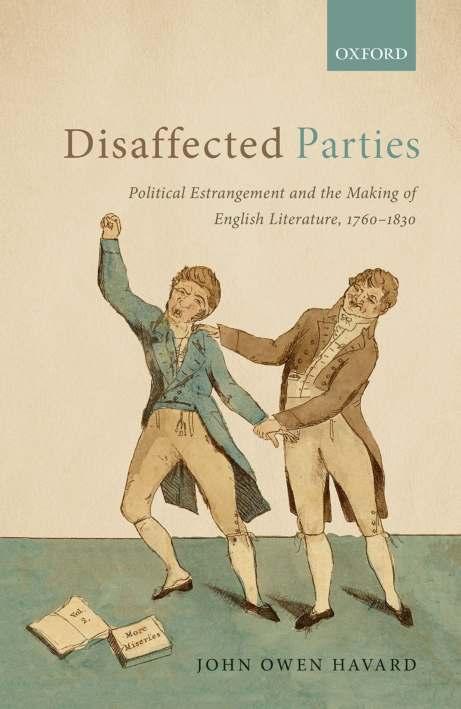
My parents have been an unfailing source of support and care. Although my father Cliff Havard (1954–2010) thought that dedications were corny, I take inspiration from him and his sister Bethan in dedicating this book to my students. This study has taken shape against the onset of a global epidemic of disaffection from the political process and some nasty political shocks. Even amidst creeping despair, I have remained inspired by those committed to fighting tooth-and-nail for the vulnerable and excluded. I dedicate this book—whose cover affirms that cynicism and sentimentalism may coincide, whose contents assert that protests can become parties, and whose archive vindicates being in for the long haul—to the next generation committed to causes in which, to adapt Edmund Burke, they have no party.
Introduction
Sick of Politics
During a 1783 encounter with Samuel Johnson, James Boswell ‘mentioned politicks’. ‘Sir, I’d as soon have a man to break my bones as talk to me of publick affairs, internal or external’, Johnson responded, adding that he had ‘lived to see things all as bad as they can be’.1 In the background to this exchange was the pending dissolution of yet another government ministry, amidst competing demands for greater parliamentary power and strengthened royal prerogative—developments that converged the following year, around debates over corruption in the British Empire, to create a full-blown constitutional crisis. Three decades later, Lord Byron, with a cooler political temperature, confronted a frustrating impasse between monarchy, ministry, and the political opposition. Describing the stalemate in a poetic squib included within an 1813 letter to a member of his Whig circle, Byron noted the imprint partisan deadlock had made upon the wider political mood. ‘’Tis said— Indifference marks the present time’ those lines of verse began.2 ‘No one can be more sick of—or indifferent to politics than I am’, Byron wrote at the outset of the following decade, this time describing the bleak political scene associated with a resurgent ‘Toryism’ at home and the gloom pervading post-Napoleonic Europe.3 At once expressing generalized discontent and hyper-personalized aversion, Johnson and Byron invoked an all-too-familiar condition that Byron captured succinctly in a late canto of Don Juan: ‘I am sick of politics.’4 Encompassing various levels of emotional intensity and a range of mediums (transcribed conversation, personal correspondence, published and unpublished poetry), these statements situated both authors at a pronounced distance from politics. At the same time, they directed commentaries towards the political arena—acerbic, apathetic, and somewhere in between—or claimed further, second-order removes from political discussion (‘’Tis said ’ there is indifference surrounding politics: I wouldn’t know). In professing not to care about politics, Johnson and Byron protested too much. From the almost partisan zeal with which Johnson voiced his objection to hearing
1 James Boswell, Life of Johnson, eds. George Birkbeck Norman Hill and L. F. Powell, 6 vols. (Oxford: Oxford University Press, 1934–64), 4.173.
2 Byron to Lady Melbourne, 21 September 1813. Byron’s Letters and Journals, ed. Leslie A. Marchand, 12 vols. (Cambridge, MA: Harvard University Press, 1973–82), 3.117.
3 Byron to John Murray, 21 February 1820. Byron’s Letters and Journals, 7.44.
4 Don Juan, 12.25, in Lord Byron, The Complete Poetical Works, ed. Jerome J. McGann, 7 vols. (Oxford: Clarendon Press, 1980–93), 5.502.
about ‘politicks’ to the oppositional commitments swirling alongside Byron’s postured indifference (including his indifference about pervasive indifference), these appeals to political disaffection affirmed continuing attachment to political discussion, if not to political activity.
Where Johnson and Byron experienced uniquely personalized fits of pique and periods of malaise—asked whether he had been outside that day, Johnson responded that Boswell ‘may as well ask if I hanged myself to-day’—their works were animated by competing, often contradictory impulses (as was the literary work, Boswell’s Life of Johnson, in which this conversation appeared). No less than these authors’ personal commentaries and public personas, their writings were in often close proximity to politics and inextricable from the passions and attachments, or impassivity and detachment, associated with political discussion. In gathering followers and channelling political feeling, their writings even promised, in some instances, to become ‘parties’ all their own. Determining how we should read the literature of this period in relation to the changing parties of politics and evolving structures of political feeling is the core aim of this book. Those relations were, in the cases of the writers examined here, variously estranged. Commentators and general observers had, at least since the later seventeenth century, adopted stances at a conspicuous distance from politics.5 From the middle of the eighteenth century onwards, the shifting guises of political activity and fluid boundaries of ‘political’ conversation made such an undertaking increasingly difficult. As they grappled with the desirability, or even the possibility, of removing themselves from the political arena, amidst recently amplified uncertainty around where political parties, the political nation, and ‘politics’ as such began and ended, the writers addressed in detail by this study—Laurence Sterne, Samuel Johnson, James Boswell, Maria Edgeworth, Jane Austen, and Lord Byron—effected crucial changes to the shape and status of literary authorship. The case studies of these authors presented in this book reveal how variously distanced relationships with politics and with partisan identities converged with innovations to English literature. Disaffected Parties contends that we cannot understand Sterne’s seemingly haphazard narrative technique, Johnson’s investment in ‘authority’ (and Boswell’s efforts to smooth away its sharper edges), the shapes of individual and collective feeling imagined by Edgeworth and Austen, or the poise and bite of Byron’s late satires without understanding the changing physiognomy of politics during the 1760–1830 period. Beyond merely illuminating these wider developments, these writers’ placement on the political margins enabled them, I propose, to imagine the parties of politics anew and to cultivate unique points of view, including ways of seeing beyond politics altogether. Their works show how stances of apparent removal from politics could be animated by partisan energies and how feelings that would seem to have little to do with politics could be conscripted for political ends. The accounts of
5 Jürgen Habermas identifies the family as the source of a publicity that in turn migrated to the political arena as part of his fuller treatment of the development of domestic and political spheres in The Structural Transformation of the Public Sphere: An Inquiry into a Category of Bourgeois Society, trans. Thomas Burger (Cambridge, MA: MIT Press, [1962] 1991).
these authors presented here require that we rethink the relationship between literary authorship and the political arena—in ways that do not amount, at least in any straightforward fashion, to escape, retreat, or sublimation—while posing broader questions about how we conceive of the lines between politics and aesthetics. Taken together, they allow this book to plot a revised account of the relationship between politics and literary form, in and beyond this seminal period in the history of English literature.
Politics has been everywhere in discussions of the Romantic period and in literary studies more widely. Yet we have risked losing sight of some of the things that ‘politics’ meant and the specific ways that political activity and discussion shaped literary works. Whether or not it is the case, as Jacques Rancière contends, that if everything is political then nothing is,6 approaching politics in the narrower sense emphasized by this book—parliamentary politics, party politics, the kind of ‘politics’ we grumble about and dream of transforming—can help us begin to get a better handle on fundamental questions (not least Rancière’s own provocative ontologies of ‘the political’). The 1760–1830 period witnessed dramatic changes to political structures and widespread political discontent in England, against a backdrop of global transformation. It saw specific moments of crisis and impasse coupled with growing disconnect from the past and unease or uncertainty about the future. Amplifying the partisanship that had been a consistent feature of national political life for a century, the period examined by this book witnessed a dramatic upsurge in attention to political affairs—and a growing emphasis on evading political discussion altogether—bringing ‘politics’ into focus as something from which to seek distance and towards which to adopt militantly critical or moderately disgruntled postures, disdainful or detached stances (even as these gestures also affirmed continuing attachment to supposedly broken political structures). The creeping realization, at once scandalous and banal, that politics could be neither escaped nor overcome effected a scepticism, extending to a bitter cynicism, recognizable as a pervasive feature of modern political life. This mode of political response first acquired some of its familiar contours, this book proposes, between the later eighteenth century and the aftermath of the French Revolution: a period encompassing the heyday of the ‘Johnson Circle’ and of Byron and his circles, the age of sensibility and the Romantic era. (One aim of this book, however, is to challenge and problematize these distinctions: Samuel Johnson and Mary Wollstonecraft once sat down to tea together, after all.) In returning to this period, however, this book does not set out to find a mirror for recent predicaments—nor, for that matter, to supply the hollow reassurance that things were ever thus. These writers confronted at once familiarly broken and freshly uncertain political realities. In returning to this critical period for the making of English literature, this book seeks to remap the literary history of this period in relation to changing partisan and affective structures, and thereby to reorient our ways of thinking about the relationship between literature and politics more widely. This book thus offers a prehistory
6 See Jacques Rancière, Disagreement: Politics and Philosophy, trans. Julie Rose (Minneapolis: University of Minnesota Press, 1999).
for modern political disaffection that underscores literature’s importance as a means of thinking about a diverse array of relationships with politics, in this period and beyond. This Introduction lays out some of the historical frameworks and evolving conceptions of politics—including the meanings of disaffection and the expanded conception of political parties—that organize this book, while looking to the broader questions posed by the disaffected stance and its bearing on the status of the literary (and literary ‘form’).
What ‘politics’ was, during this period, was changing, not least to encompass a broad array of governmental practices, in and beyond Britain. These developments ultimately converged to pave the way for nineteenth-century liberalism and looked ahead to an understanding of politics encompassing the administration of collective life—an at-once rigid and impoverished conflation of the political and the social— and its ‘neoliberal’ afterlives. During the period between 1760 and 1830, these developments converged untidily with (and were for the most part subordinate to) politics in a still relatively contained sense: the parliament-centric conception of political activity on which I focus in this book. The 1688 Revolution and constitutional settlement were doubly pivotal to this more restricted understanding of politics. The events of 1688–9, which put in place the political system that endured more-or-less intact until Reform in the 1830s, also had the unenviable claim, as I discuss in Chapter 1, of initiating widespread complaining about political activity, ranging from (prospectively violent) discontent with the post-revolutionary regime to grumbling about ‘politics’ more widely. The later eighteenth century sent these tendencies into overdrive. As politics came to encompass an expanding and shifting realm of activity, ‘politics’ became the object of inordinate, even obsessive public concern. Deepening a trend set in motion a century earlier, the post-1760 period witnessed the sheer volume (in both senses) of political discussion increase, as the expansion of middle-class print culture converged with the churn of growing political discussion, creating a situation in which politics was everywhere and nowhere all at once.7
The resulting confusion was particularly apparent to Laurence Sterne. A Political Romance (1759), his coterie satire addressing recent events in the York Church, included a lengthy parody of the emerging tendency to read anything and everything in ‘political’ terms. The ‘Key’ Sterne appended to his satire imagined the preceding work being discovered in the street and taken up by members of a
7 For the increases in attention towards political activity and in sceptical attitudes about ‘politics’ during the later eighteenth century, see John Brewer, Party Ideology and Popular Politics at the Accession of George III (Cambridge: Cambridge University Press, 1976). In both Great Britain and Ireland, R. B. McDowell notes, ‘the increasing importance of the newspaper press, the reporting and publication of parliamentary debates, the swelling tide of pamphlets, and the formation of political clubs and societies, all evince a growing political consciousness’ in the decades after 1760. This coupled with an increased appetite to understand the workings of politics (and to keep watch on the activities of politicians) such that the ‘pressure of public opinion on parliament’ dramatically mounted. See ‘Colonial Nationalism and the Winning of Parliamentary Independence, 1760–82’, chap. 8 in A New History of Ireland, vol. 4, Eighteenth-Century Ireland, eds. T. W. Moody and W. E. Vaughn (Oxford: Clarendon Press, 1986), 196–7. See also George Rudé, Revolutionary Europe, 1783–1825 (London: Collins, 1964), 13, 57.
‘Political Club’ who proceed to read this controversy over ecclesiastical preferment (presented, àla Swift’s Taleofa Tub, as a dispute over an old coat) in the light of their own hobby-horsical preoccupations. Sterne thereby gestured towards an overwhelming, confounding increase in political discussion, while pointing to the ways that parliament-centred political activity clashed with a newfound self-consciousness about the differing ways in which (and the varying scales at which) things could be ‘political’—an impulse that contemporary readers, not unlike recent generations of literary critics, were inclined to indulge.8 Following the initial publication of his comic novel The Life and Opinions of Tristram Shandy, Gentleman in 1760, an anonymous pamphlet depicted the fictional patrons of a London coffee-house (one of them tellingly named ‘Mr. Profound ’) proclaim that Sterne’s ostensibly domestic novel comprised ‘one compleat system of modern politics’.9 Sterne was himself attuned to this trend, as A Political Romance attests. Yet for all the ways that recent developments had scrambled the various scales of ‘political’ activity, Sterne also remained sharply attuned to the relationship between his writings and politics. When he supplied Tristram with the same birthdate as the anniversary of the 1688 Revolution, he gestured to an elusively indeterminate yet insistently stated relationship between the ‘Life and Opinions’ of his hero and the origins of modern politics, on the one hand, and the proliferating guises of political discussion and activity, on the other. This book asks what it would mean, following Sterne’s invitation, to read works including Tristram Shandy in proximity to politics and at the same time to hold them at a remove from politics: an apparent contradiction, albeit one we inhabit every day, which this book addresses most directly in its attention to cynicism as a stance (or ‘attitude’) defined by its being at once inside and outside, on the verge of taking a part while defiantly refusing to be taken in.
In attending to the ways that authors like Sterne located their writings at a complex, disaffected remove, this book attends to a broader—or at any rate different— array of responses to politics than those addressed in existing studies of political
8 For Sterne’s wider reflection on the interrelated scales of ‘political’ activity—from the interpersonal or ‘office’ politics of close-knit communities to larger local, national, and geopolitical contexts—see my ‘Only Disconnect? Laurence Sterne, Politics, and the Public’, in Social Networks of the Long Eighteenth Century, ed. Ileana Baird (Newcastle: Cambridge Scholars Press, 2014).
9 Explanatory Remarks on the Life and Opinions of Tristram Shandy; wherein, the Morals and Politics of this Piece are clearly laid open, by Jeremiah Kunastrokius (London, 1760), 44. The Seven Years’ War was one referent for the increased discussion of politics in the Political Romance: some members of the ‘Political Club’ read the allegory of the coat for its relevance to the spoils of that geopolitical conflict. The pamphlet of Explanatory Remarks similarly depicted Tristram encountering debates over that conflict (with ‘Mr Profound’ determined to read the Siege of Namur in Tristram Shandy as depicting the recent defeat of Admiral Byng at Fort St. Philip’s in Minorca and Toby’s wound as ‘the distress the nation was thrown into thereupon’ [45]). As Daniel O’Quinn has emphasized, anxieties around the unprecedented amount of print commentary devoted to recent geopolitical affairs (apparent in the confused, news-obsessed title character of Arthur Murphy’s 1758 play The Upholsterer) became an explicit locus for reflection in the period. See Entertaining Crisis in the Atlantic Imperium, 1770–1790 (Baltimore: Johns Hopkins University Press, 2011), 6–11. See also Keymer, ‘Paper Wars: Literature and/as Conflict during the Seven Years’ War’, in The Culture of the Seven Years’ War: Empire, Identity, and the Arts in the Eighteenth-Century Atlantic World, eds. Frans de Bruyn and Shaun Regan (Toronto: University of Toronto Press, 2014) and Carol Watts, The Cultural Work of Empire: The Seven Years’ War and the Imagining of the Shandean State (Toronto: University of Toronto Press, 2007).