Editedby Alexander Laban Hinton, Nela Navarro, andNatasha Zaretsky
For a list of titles in the series, see the last page of the book.
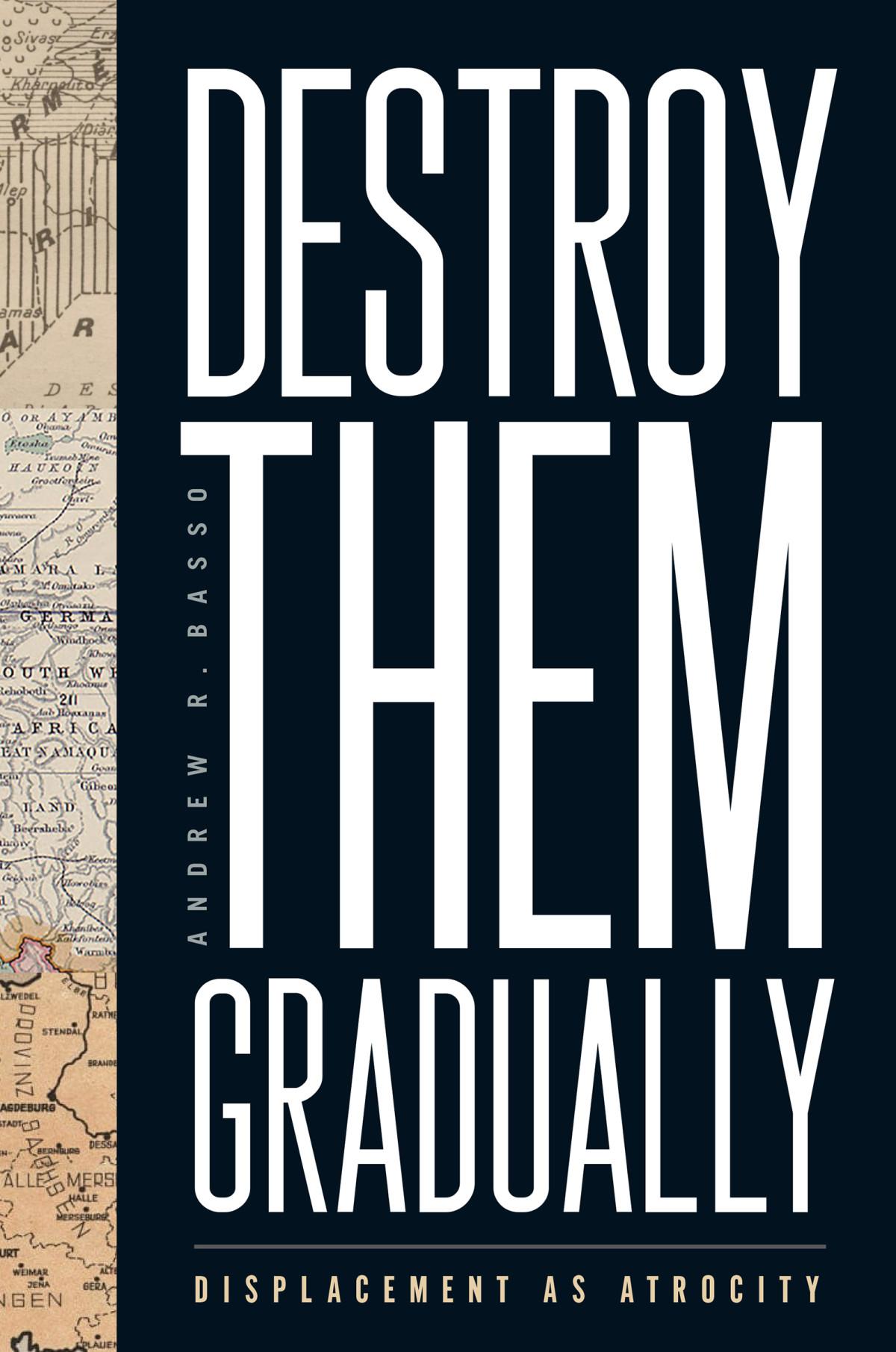
Destroy Them Gradually
Displacement as Atrocity
ANDREW R. BASSO
Rutgers University Press
New Brunswick, Camden, and Newark, New Jersey London and Oxford
Rutgers University Press is a department of Rutgers, The State University of New Jersey, one of the leading public research universities in the nation. By publishing worldwide, it furthers the University’s mission of dedication to excellence in teaching, scholarship, research, and clinical care.
978-1-9788-3129-2 (cloth)
978-1-9788-3128-5 (paper)
978-1-9788-3130-8 (epub)
Cataloging-in-publication data is available from the Library of Congress. LCCN 2023947397
A British Cataloging-in-Publication record for this book is available from the British Library.
No part of this book may be reproduced or utilized in any form or by any means, electronic or mechanical, or by any information storage and retrieval system, without written permission from the publisher. Please contact Rutgers University Press, 106 Somerset Street, New Brunswick, NJ 08901. The only exception to this prohibition is “fair use” as defined by U.S. copyright law.
References to internet websites (URLs) were accurate at the time of writing. Neither the author nor Rutgers University Press is responsible for URLs that may have expired or changed since the manuscript was prepared.
The paper used in this publication meets the requirements of the American National Standard for Information Sciences—Permanence of Paper for Printed Library Materials, ANSI Z39.48-1992. rutgersuniversitypress.org
2 Exposure: A Theory of Displacement Atrocity Crimes
Part II German South-West Africa
3 Trepidation: Colonized Namibia and Violent Horizons (1652–1904)
4 Extermination: Germany’s Genocide of the Herero (1904–1908)
5 Inescapability: Germany’s Genocide of the Nama (1905–1908)
Part III The Ottoman Empire and Turkey
6 Collapse: The Nadir of the Ottoman Empire (1839–1915)
7 Excision: The Ottoman Genocide of Christian Minorities (1914–1925)
8 Neurosis: The Hamidian Massacres (1894–1897)
Part IV Central and Eastern Europe
9 Metamorphosis: A World Made New (Ninth Century–1945)
10 Catharsis: The Expulsion of Germans (1943–1950)
11 Desolation: The Holocaust (1933–1945)
Part V Climate Violence and Conclusions
12
Tragedy: Logics of Displacement Climate Violence in the Twenty-First Century
13 Farce: To Continue to Destroy Them Gradually?
14 Praxis: Seeking Justice and Disrupting Pathways
Acknowledgments
Notes
Bibliography Index
Illustrations Figure
2.1 A Causal Pathway to Displacement Atrocity Crimes
Tables
1.1 A Typology of Displacement Atrocity Crimes
3.1 Land Distribution among Africans in GSWA in 1903
4.1 Major Engagements and Estimated Losses during the Herero Revolts
4.2 Approximations of Herero Displaced into the Omaheke
5.1 Herero Genocide versus Nama Genocide Causal Pathways
5.2 Troop Distribution during the Nama Revolt
6.1 Anatolian Temperature Ranges
6.2 Displacement Distances during DA Crimes
7.1 Years of DA Crimes in the Ottoman Empire
7.2 Places of DA Crimes in the Ottoman Empire
8.1 Ottoman Genocide of Christian Minorities versus Hamidian Massacres Causal Pathways
8.2 Waves of Violence against Armenians in Late 1895
9.1 Displacement Distances during DA Crimes
10.1 Years of DA Crimes in Central and Eastern Europe
11.1 Expulsion of Germans versus the Holocaust and Nazi Atrocities Causal Pathways
12.1 Low-Elevation Coastal Zone Populations
12.2 Statistics on Displaced Persons Compiled by the UNHCR
Destroy Them Gradually
Introduction
No man is an island, entire of itself; every man is a piece of the continent, a part of the main; if a clod be washed away by the sea, Europe is the less, as well as if a promontory were, as well as if a manor of thy friend’s or of thine own were; any man’s death diminishes me, because I am involved in mankind, and therefore never send to know for whom the bell tolls; it tolls for thee.
John Donne, Donne’s
Devotions
All the most widely acknowledged twentieth-century atrocities Indigenous genocide in North America, the Herero genocide, the Ottoman genocide of Christian minorities, the Holodomor, Holocaust and Nazi atrocities, the Cambodian genocide, the Rwandan genocide, and atrocities in former Yugoslavia—incorporated displacement as a key element of the processes of destruction. Perpetrators of mass atrocities have used displacement to transfer victims to killing sites or extermination camps, transfer victims to sites of forced labor and attrition, ethnically homogenize regions by displacing victims out of their homes and lands, and destroy populations.1 Displacement has also been an outcome of atrocities, and in many instances the violation of the right to free movement has been a pillar of perpetrator hegemony over victim populations. However, in much atrocity scholarship and international criminal law, displacement has been treated as a corollary practice to crimes committed, not as a central aspect of their perpetration. This is especially true when considering the general lack of focus on displacement as an annihilatory process in se. The explicit focus on displacement as an annihilatory practice is largely theoretically and conceptually neglected. This book aims to fill this gap by asking and
answering this question: Why do perpetrators use forced displacement to destroy targeted populations?
Displacement atrocity (DA) crimes have been perpetrated on every major inhabited continent across space and time. As a method, DA crimes refer to the unique fusion of forced displacement and systematic deprivation of vital daily needs (food, water, clothing, shelter, and medical care) to create potent killing systems. This book features comparative historical analyses of individual cases of atrocity, which helped create a typology of, and causal pathway to, DA crimes. This theory of DA crimes helps to explain the different manifestations of why displacement and systematic deprivation of vital daily needs are linked to the annihilation of populations.
Perpetrators of DA crimes exploit one of the most sought-after ideals: space. Beautiful countrysides, mountainous terrains, deserts, lush fields, shorelines, and great expanses are turned into killing fields by perpetrators who seek to destroy targeted populations. Perpetrators of DA crimes deliberately create annihilatory systems not only to homogenize regions of targeted populations but also to destroy these populations through the act of movement. Annihilatory displacement remains a primary strategy used to solve demographic “problems,” which are typically socially constructed by perpetrators. How should the general problem of displacement and the specific problem of DA crimes be understood, then? It is first important to recall key terminologies for studying atrocities. Until recently, atrocity scholarship has generally treated displacement and indirect killing methods with cursory or secondary interest. The history of the genocide studies field is rooted in studying the Holocaust, followed by comparison of the three major genocides of the twentieth century (Armenian, Jewish, and Rwandan).2 The field then moved into expanding the number of applicable cases to events such as the Cambodian genocide and the Herero genocide.3 Genocide studies currently incorporates critical approaches and understandings of the meanings and methods of atrocities, and has expanded into cases of colonial crimes against Indigenous peoples.4 Clearly, theoretical advances and case explorations have been increasing over the last fifty years.
While there have been past predispositions to view certain destructive processes as “real” genocide compared to other campaigns of destruction, these social and academic dogmas are slowly retreating. The return to the work of Raphael Lemkin has aided in this shift, bringing conversations back to dynamic and intersectional understandings of biological destruction and cultural destruction (what Lemkin originally termed barbarism and vandalism, respectively) as equally annihilatory and deleterious political processes.5 Lemkin recognized that by losing the biological (barbarism) or cultural (vandalism) contributions of groups, humanity suffers and is weaker. Any attempt at erasure should be considered an attack not only on the targeted population but on the human collectivity itself. According to Lemkin, “In the acts of barbarity, as well as in those of vandalism, the asocial and destructive spirit of the author is made evident. This spirit, by definition, is the opposite of the culture and progress of humanity. It throws the evolution of ideas back to the bleak period of the Middle Ages. Such acts shock the conscience of all humanity, while generating extreme anxiety about the future. For all these reasons, acts of vandalism and barbarity must be regarded as offenses against the law of nations.”6 Lemkin’s insights have markedly influenced recent atrocity scholarship, and while there is usually a division in the target of atrocity campaigns, any campaign seeking the destruction of populations often includes both biologically and culturally destructive elements. DA crimes are no different.
As further explored in chapters 1 and 2, DA crimes can best be understood as indirect killing methods—that is, methods of annihilation that use deprivation to destroy. Indirect killing destroys populations gradually, denying them of vital daily needs in myriad ways. When fused with forced displacement, indirect killing can become extremely potent in a matter of days or weeks. Indirect methods are not lesser in severity than direct methods, like constructing gas chambers or mass execution sites. Rather, and recalling the teachings of Lemkin on the equality of suffering, both direct and indirect methods should be viewed simply as methods of
atrocity deployed in different spaces and times by different perpetrators for a similar goal: annihilation. This book offers theoretical, conceptual, and empirical innovations on annihilatory forced displacement as a concept and a crime, as well as individual cases of atrocity. Broadly, I follow Alexander L. George and Andrew Bennett’s qualitative methodological guidelines to create the DA crime typology.7 George and Bennett broadly define a typology as the theoretical definition of a particular phenomenon with multiple cases as examples.8 Typologies serve an important role in generating new and more detailed understandings of common phenomena with similar causes, processes, and outcomes.9 The use of inductive typological methods allow for the creation of a grounded theory of DA crimes.10 George and Bennett specifically note that researchers should continually “assess, refine, or alter the theoretical framework in which explanation of individual cases are couched and to identify components of a useful typology.”11 The DA crime theory was created by establishing and continuing a symbiotic relationship between empirical work and concept refinement. Case work was completed by using process tracing a powerful form of within-case analysis that allows researchers to uncover variables and variable relationships when examining cases.12 DA crimes have manifested across space and time, and this book incorporates four crucial cases of this type of destructive process, each of which represents a subtype of DA crimes (as explored in later chapters).13 The following crucial cases were selected in accordance with a most different systems analysis and are discussed in parts 2 through 5, respectively:14
• Germany’s genocide of the Herero (1904–1908) in German South-West Africa
• The Ottoman genocide of Christian minorities (1914–1925) in the Ottoman Empire/Turkey
• The expulsion of Germans (1943–1950) from Central and Eastern Europe
• Potential Climate Violence in the twenty-first century
The third chapter of parts 2 through 4 presents a counter-case of violence,15 which used different atrocity methods but took place at approximately the same time and space as the DA crime explored. It could reasonably be expected that perpetration patterns would be similar, yet they were not. By exploring which variables in the DA crime causal pathway were left unfulfilled, it is possible to explain why different crimes can occur in similar times and spaces. These counter-cases provide powerful tests for the DA crime theory and help demonstrate its validity. The three counter-cases are as follows:
• Germany’s genocide of the Nama (1905–1908) in German South-West Africa
• The Hamidian massacres (1894–1897) in the Ottoman Empire
• The Holocaust (1933–1945) in Europe
There is no counter-case for the section on climate violence, as the opportunities for derailing climate-related DA crime practices are explored throughout chapters 13 and 14. The theoretical implications of understanding differing criminal patterns in similar spaces and times has thus far been underdeveloped in human rights and atrocity scholarship and will help open new avenues for understanding diverse destructive processes and why perpetration methods vary.
The book is divided into five distinct parts, each of which illuminates different pieces of the annihilatory forced displacement puzzle. In part 1, readers will be introduced to the DA crime concept, the DA crime typology, how it fits with existing international laws and academic literatures on atrocity crimes, and the causal pathways and variable interactions required for DA crimes. As previously noted, part 2 examines Germany’s genocide of the Herero (1904–1908) and Germany’s genocide of the Nama (1905–1908). Part 3 offers a study of the Ottoman genocide of Christian Minorities (1914–1925) and the Hamidian massacres (1894–1897). Part 4 critically assesses the wartime and postwar expulsion of German minorities from Central and Eastern Europe (1943–1950) and the Holocaust (1933–1945). Parts 2 to 4 comprise three chapters that
blend structural narratives and individual perspectives from targeted populations, perpetrators, and bystanders. For each, the first (pathway) chapter provides important structural and agency-based background information about the case and lays a foundation for understanding why violence was possible. The second (atrocity) chapter focuses on how the DA crime was perpetrated and what the aftermaths of violence were and are. These two empirical chapters are organized using the causal pathways to DA crimes defined in the first two chapters of the book. The third (counter) chapter focuses on a counter-case to the DA crime and examines why different methods of atrocity were used in approximately the same spaces and times. Finally, part 5 offers forward-looking analyses on the structural possibilities for climate change–related violence and offers final thoughts with a chapter reviewing the pursuits for justice in DA crime cases explored; DA crimes as a concept and crime in international law; and knowledge implications for the study of political violence, human rights, and transitional justice.
In response to the revolt of the Herero, Germany sent its vaunted Schutztruppe, commanded by General Adrian Dietrich Lothar von Trotha, to quell the uprising of the colonized against the colonizers. When his plans to annihilate the Herero at Waterberg in August 1904 using machine guns and artillery went awry, von Trotha decided to use DA crime methods against the Herero in the Omaheke (Kalahari) Desert in German South-West Africa. He summarized his annihilatory actions against the Herero in his now-infamous 3 October 1904 Vernichtungsbefehl (extermination order), stating he wanted to “destroy them gradually.”16 Thus, the title of this book reflects the clear perpetrator intent of DA crimes: annihilation of populations through the fusion of forced displacement and systematic deprivation of vital daily needs.
Annihilatory forced displacement has for too long remained a hidden destructive process. This book begins to illuminate these types of violent processes and brings some measure of justice for crimes of the past through discourse about what was done, why, and how to understand pathways to specific forms of political violence. Thus, this study offers original and unique insights into the practices
of annihilatory forced displacement and the possibilities for violence inherent in every process of displacement—a growing concern with the sustained crisis of displacement in the early twenty-first century.
Part 1
Displacement Atrocity Crimes
ramifications. The type of forced displacement chosen—and to what end—though, constitutes a complex and twisted path to violence.
Displacement Atrocity Crimes
The displacement atrocity (DA) crimes concept helps us understand why perpetrators fuse forced displacement and systematic deprivation of vital daily needs (food, water, clothing, shelter, and medical care) to destroy populations. DA crimes are defined as:
a type of killing process employed against a targeted population which uniquely fuses forced population displacement with primarily indirect deaths resulting from dislocation and systematic deprivation of vital daily needs. The killing process exploits various geographies to annihilate populations in whole or in part.2
To understand these crimes, it is necessary to frame annihilatory practices as processes, not events.3 By doing so, it is possible to understand the violent act of displacement as unfolding violent persecutions across space and time. In the context of the DA crime concept, forced displacement is defined as forcible removal from one’s home against one’s will by a perpetrating group. Targeted populations are uprooted and intentionally kept moving to accelerate their deaths using indirect methods. In all cases analyzed in this book, groups were intentionally placed outside “the circle of people with reciprocal obligations to protect each other.”4 Once outside this circle, killing became possible. In these forgotten genocides, to borrow from René Lemarchand,5 indirect killing became just as destructive as direct killing schemes.
The rapid and lethally potent combination of deprivation expedited through movement is immensely destructive. Indirect killing methods, based on systematic deprivation of vital daily needs (food, water, clothing, shelter, and medical care), are particularly brutal. The human body is incredibly fragile and, under the best circumstances of hydration and rest, can potentially survive for thirty to sixty days without food.6 Without potable water, the human body will deteriorate in a matter of a few short days.7 When vital daily
needs are denied and targeted populations are made to march, the number of days the body can survive decreases dramatically due to continual physical exertion compounded with mental anguish. Exposure to extreme weather conditions can also significantly further the destructive potency of indirect killing methods. In effect, movement and exposure accelerate killing rates from processes like exhaustion, dehydration, and starvation, meaning that perpetrators of DA crimes can inflict enormous death rates upon targeted populations.
Despite their destructive outcomes, indirect killing methods have been missing from public memory of atrocities. Scenes of thousands marching to their deaths are horrific but are usually treated as a footnote or corollary to jarring direct killing atrocities with their landscapes of extermination at notorious places like AuschwitzBirkenau.8 Helen Fein identified the use of indirect killing methods in the Warsaw ghetto, Cambodia, and Sudan in a theoretical breakthrough in genocide studies in response to the direct killing paradigm to shed light on overlooked cases and methods of atrocities.9 Fein conceptualizes atrocities perpetrated through “attrition” (indirect) methods as the clear precursors to the DA crime concept. Perpetrators do not use physical tools like gas, blade, or bullet to kill. Instead, perpetrators actively deprive targeted populations of their vital daily needs to destroy them gradually.10 Perpetrators use a variety of methods to indirectly kill populations, some of the most prominent being intentional starvation, dehydration, and infection with diseases.11 The straightforward overexposure to the natural world’s elements—heat, cold, wind, precipitation, and the like—can be enough to cause the human body to deteriorate rapidly.
In DA crime processes, the use of forced displacement is often made possible through the threat of direct killing, with perpetrators often compelling targeted populations to walk to their deaths with little hope of survival. Direct killing can be understood as mass executions using bullets; blunt force trauma or fatal cuts using handheld instruments; and infliction of fatal cruel and unusual punishments, such as electrocution, forced drowning, and
vivisection.12 Direct killing methods are associated with a short time span of killing—perpetrators using these methods kill their targets nearly instantaneously.13 Direct killing requires a clear physical action by perpetrators, which kills targets immediately. All these elements are present in cases of DA crimes but constitute secondary or tertiary killing methods to the primary indirect method of displacement fused with deprivation.
A Typology of Displacement Atrocity Crimes
There are four subtypes of the DA crimes concept, which are visually represented in table 1.1. Perpetrators use land and organize forced displacement of targeted populations in one of two ways: area squared (kettling DA crimes) or linear distance (escorting DA crimes). Additionally, DA crimes are perpetrated with either genocidal (crime of genocide) or non-genocidal (crimes against humanity and war crimes) intent, as defined in international law.
Table 1.1
A Typology of Displacement Atrocity Crimes
Genocidal intent
Kettling displacement atrocity crimes Germany’s genocide of the Herero (1904–1908)
Escorting displacement atrocity crimes
The Ottoman genocide of Christian minorities (1914–1925)
Non-genocidal intent
Potential climate violence in the 21st century
The expulsion of Germans from Central and Eastern Europe (1943–1950)
Area Squared: Kettling Displacement Atrocity Crimes
Kettling DA crimes classify perpetrators’ uses of a political geography in terms of area squared (measured in kilometers squared). Kettling crimes occur when perpetrators displace populations into large geographies and do not allow them to escape from the annihilation zone. This subtype takes its name from the riot police tactic of shepherding protesters into an area and denying their escape.14 In kettling DA crimes, perpetrators create a policy of continual displacement in a geographic zone coupled with systematic
deprivation of vital daily needs to destroy populations. When perpetrators and targets come into contact, direct violence is used to force the displaced back into the cordoned-off annihilation zone and away from escape. Thus, perpetrators and targets infrequently come into contact with each other, typically only when perpetrators drive the displaced farther into the annihilation zone or the displaced attempt to escape or relent. Anyone who tries to escape the cordon is either killed using direct methods or arrested and transferred to annihilation facilities. Sporadic direct killing enforces the cordon around the annihilation zone and compels the displaced to continually exert themselves through movement. The displaced always search for escape routes from the annihilation zone but in many cases are unsuccessful. The hope for escape contributes to the destruction of the group, gradually creating an impossible catch-22: if the displaced remain stationary, they will have no chance of survival or escape; but if they continue to move and try to find an escape, the physical and mental exhaustion from the movement accelerates their destruction. In short, perpetrators of kettling DA crimes use direct force as a threat to continually displace populations. Once the displaced are in the death zone, they are kept there through kettling tactics. Kettling crimes are extremely flexible and can be perpetrated in numerous geographical areas, although they generally require a large land base, like a desert.
Linear Distance: Escorting Displacement Atrocity Crimes
Another subtype is called escorting DA crimes. Perpetrators of escorting DA crimes exploit long linear distances (measured in kilometers) to destroy targeted populations using death marches. This linear distance does not necessarily have to be a straight line on a map but amounts to a meandering annihilation line. Perpetrators marry forced marches over long linear distances with systematic deprivation to create an extremely potent annihilatory practice. Typically, the displaced are escorted by armed perpetrators who use direct violence (actual or implied) to enforce compliance with the creation and sustainment of caravans of annihilation. Direct killing is
used to compel the displaced to keep moving, and attempted escape from or falling behind these caravans is met with immediate force. This at once expedites the speed of the caravan and induces other members to keep moving in the hopes they might survive the death march—though in reality most are marching to their doom. This type of killing requires significantly more sustained perpetrator-target contact, but the primary methods of destruction remain indirect killing. In a way, the escorting subtype is perhaps more mentally destabilizing for perpetrators and targeted populations due to their close contact over the course of the forced march. Bargaining and abuse, sexual exploitation and assault, and a brutal fusion of indirect and direct killing processes over the course of the displacement itself are common. Escorting crimes require vast distances, which can hypothetically be achieved even in smaller countries if the displaced are force-marched in many different directions. Cities and towns may offer refuge to targets of displacements or provide areas for resistance efforts. However, so long as a population is united against targeted populations, there will be no chances for or offers of thirdparty assistance and resistance.
Genocidal Displacement Atrocity Crimes
The United Nations Convention on the Prevention and Punishment of the Crime of Genocide (UNCG, 9 December 1948) and the Rome Statute of the International Criminal Court (17 July 1998) define genocide in the following way:
For the purpose of this Statute, “genocide” means any of the following acts committed with intent to destroy, in whole or in part, a national, ethnical, racial or religious group, as such:
(a) Killing members of the group;
(b) Causing serious bodily or mental harm to members of the group;
(c) Deliberately inflicting on the group conditions of life calculated to bring about its physical destruction in whole or in part;
(d) Imposing measures intended to prevent births within the group;
(e) Forcibly transferring children of the group to another group.15
The UNCG does not necessarily capture the complexities of the genocide crime and concept Lemkin originally hoped for and scholars have since expanded on.16 However, the existing definition has been the standard since 1948, and genocide case law particularly in the 1990s began to clarify some of the outstanding issues with this definition. Some issues of great importance are questions of what constitutes genocidal intent, what groups are protected under the genocide convention, and what methods of atrocity can be considered genocidal given the restrictions of the definition.
One of the most important components of genocide that separates it from other crimes is the dolus specialis of génocidaires.17 The threshold of proving genocidal intent is identifying the intention to destroy individual members of the group (not atomized individuals) and to carry out this destruction of individuals for the purpose of further destroying the group in whole or in part.18 To destroy members of a group is a crime, but to destroy members of a group because of their group membership is genocide. This is the line that separates genocide as the crime of crimes. Genocide is a crime perpetrated against groups by individuals, and a state or government cannot be found guilty of genocide.19 Thus, for DA crimes to be genocidal, there needs to be proof of
1. a targeted population to be defined as a national, ethnical, racial or religious group;
2. a special intent (dolus specialis) to destroy that group in whole or in part;
3. constitutive DA crime actions (actus reus) defined under Article II.
Another key element of the UNCG is the rigid classification of only four protected groups: national, ethnical, racial, and religious. While Lemkin originally offered broad social constructivist definitions of the groups that should be protected, the UNCG is extremely limited, as it excludes social, political, and economic groups. Part of the reason for this is that the UNCG was a minimal political agreement negotiated soon after the Holocaust and the Second World War, and the victorious powers did not want the convention to be turned on them for their own diverse genocidal processes against various groups. Despite its rigid definitions, there is an ongoing debate about the scope of what it means to be a member of a group. Larry May argues that individuals are members of many groups at the same time, that distinctions among groups are often not as clear-cut as the UNCG insinuates, and that groups exist beyond the groups identified in the UNCG ultimately leading him to conclude that the convention should be definitionally revisited in the future.20 In contrast, William Schabas defends the exclusivity of the UNCG and argues that there must be a semblance of uniformity across time in the law.21 Schabas believes that making genocide a simple “group” crime, where any group could be targeted, could lead to situations in which groups that have no real objective existence may assert a victimhood of genocide despite their nonexistence in reality. Overall, Schabas prefers to incorporate tangible groups—that is, those that can be clearly seen.22 While efforts to expand the UNCG should be lauded as tactics of genocide prevention, the current international legal definition protects only the four groups named in the convention, though room for the expansion of protected groups exists.23
Finally, despite Lemkin’s best efforts to have an expansive list of crimes that constitute genocide, the UNCG lists only five constitutive elements of the crime of genocide.24 Any one of the subsections of Article II of the convention is sufficient for an indictment on charges of genocide that is, not all need to be met in order to reach the threshold for a charge of genocide.25 The methods outlined in the convention are based in large part on biological destruction. However, the forcible transfer of children begins to focus on cultural