Deceitful Media
Deceitful Media
Artificial Intelligence and Social Life after
the Turing Test
Simone Natale
Oxford University Press is a department of the University of Oxford. It furthers the University’s objective of excellence in research, scholarship, and education by publishing worldwide. Oxford is a registered trade mark of Oxford University Press in the UK and certain other countries.
Published in the United States of America by Oxford University Press 198 Madison Avenue, New York, NY 10016, United States of America.
© Oxford University Press 2021
All rights reserved. No part of this publication may be reproduced, stored in a retrieval system, or transmitted, in any form or by any means, without the prior permission in writing of Oxford University Press, or as expressly permitted by law, by license, or under terms agreed with the appropriate reproduction rights organization. Inquiries concerning reproduction outside the scope of the above should be sent to the Rights Department, Oxford University Press, at the address above.
You must not circulate this work in any other form and you must impose this same condition on any acquirer.
Library of Congress Cataloging-in-Publication Data
Names: Natale, Simone, 1981– author.
Title: Deceitful media : artificial intelligence and social life after the Turing test / Simone Natale.
Description: New York : Oxford University Press, [2021] | Includes bibliographical references and index.
Identifiers: LCCN 2020039479 (print) | LCCN 2020039480 (ebook) | ISBN 9780190080365 (hardback) | ISBN 9780190080372 (paperback) | ISBN 9780190080396 (epub)
Subjects: LCSH: Artificial intelligence— Social aspects. | Philosophy of mind. Classification: LCC Q335 .N374 2021 (print) | LCC Q335 (ebook) | DDC 303.48/34—dc23
LC record available at https://lccn.loc.gov/2020039479
LC ebook record available at https://lccn.loc.gov/2020039480
DOI: 10.1093/oso/9780190080365.001.0001
9 8 7 6 5 4 3 2 1
Paperback printed by Marquis, Canada
Hardback printed by Bridgeport National Bindery, Inc., United States of America
ACKNOWLEDGMENTS
When I started working on this book, I had an idea about a science fiction story. I might never write it, so I reckon it is just fine to give up its plot here. A woman, Ellen, is awakened by a phone call. It’s her husband. There is something strange in his voice; he sounds worried and somehow out of tune. In the close future in which this story is set, artificial intelligence (AI) has become so efficient that a virtual assistant can make calls on your behalf by reproducing your own voice, and the simulation will be so accurate as to trick even your close family and friends. Ellen and her husband, however, have agreed that they would never use AI to communicate between them. Yet in the husband’s voice that morning there is something that doesn’t sound like him. Later, Ellen discovers that her husband has died that very night, a few hours before the time of their call. The call should have been made by an AI assistant. Dismayed by her loss, she listens to the conversation again and again until she finally picks up some hints to solve the mystery. In fact, this science fiction story I haven’t written is also a crime story. To learn the truth about her husband’s death, Ellen will need to interpret the content of the conversation. In the process, she will also have to establish whether the words came from her husband’s, from the machine that imitated him, or from some combination of the two.
This book is not science fiction, yet like much science fiction, it is also an attempt to make sense of technologies whose implications and meaning we are just starting to understand. I use the history of AI—a surprisingly long one for technologies that are often presented as absolute novelties—as a compass to orient my exploration. I started working on this book in 2016. My initial idea was to write a cultural history of the Turing test, but my explorations brought exciting and unexpected discoveries that made the final project expand much beyond that.
A number of persons read and commented on early drafts of this work. My editor, Sarah Humphreville, not only believed in this project
since the start but also provided crucial advice and punctual suggestions throughout its development. Assistant Editor Emma Hodgon was also exceedingly helpful and scrupulous. Leah Henrickson provided feedback on all the chapters; her intelligence and knowledge made this just a much better book. I am grateful to all who dedicated time and attention to read and comment on different parts of this work: Saul Albert, Gabriele Balbi, Andrea Ballatore, Paolo Bory, Riccardo Fassone, Andrea Guzman, Vincenzo Idone Cassone, Nicoletta Leonardi, Jonathan Lessard, Peppino Ortoleva, Benjamin Peters, Michael Pettit, Thais Sardá, Rein Sikveland, and Cristian Vaccari.
My colleagues at Loughborough University have been a constant source of support, both professionally and personally, during the book’s gestation. I would like especially to thank John Downey for being such a generous mentor at an important and potentially complicated moment of my career, and for teaching me the importance of modesty and integrity in the process. Many other senior staff members at Loughborough were very supportive in many occasions throughout the last few years, and I wish particularly to thank Emily Keightley, Sabina Mihelj, and James Stanyer for their constant help and friendliness. Thanks also to my colleagues and friends Pawas Bisht, Andrew Chadwick, David Deacon, Antonios Kyparissiadis, Line Nyhagen, Alena Pfoser, Marco Pino, Jessica Robles, Paula Saukko, Michael Skey, Elzabeth Stokoe, Vaclav Stetka, Thomas Thurnell-Read, Peter Yeandle, and Dominic Wring, as well as to all other colleagues at Loughborough, for making work easier and more enjoyable.
During the latest stages of this project I was awarded a Visiting Fellowship at ZeMKI, the Center for Media, Communication, and Information Research of the University of Bremen. It was a great opportunity to discuss my work and to have space and time to reflect and write. Conversations with Andreas Hepp and Yannis Theocharis were particularly helpful to clarify and deepen some of my ideas. I thank all the ZeMKI members for their feedback and friendship, especially but not only Stefanie AverbeckLietz, Hendrik Kühn, Kerstin Radde- Antweiler, and Stephanie Seul, as well as the other ZeMKI Fellows whose residence coincided with my stay: Peter Lunt, Ghislain Thibault, and Samuel Van Ransbeeck.
Some portions of this book have been revised from previous publications. In particular, parts of chapter 3 were previously published, in a significantly different version, in the journal New Media and Society, and an earlier version of chapter 6 was featured as a Working Paper in the Communicative
[ viii ] Acknowledgments
Figurations Working Papers series. I thank the reviewers and editors for their generous feedback.
My thanks, finally, go to the many humans who acted as my companions throughout these years, doing it so well that no machine will ever be able to replace them. This book is especially dedicated to three of them: my brother and sister and my partner, Viola.
I remember a visit I made to one of Queen Victoria’s residences, Osborne on the Isle of Wight. . . . Prominent among the works displayed there was a life- size marble sculpture of a large furry dog, a portrait of the Queen’s beloved pet “Noble.” The portrait must have been as faithful as the dog undoubtedly was—but for the lack of color it might have been stuffed. I do not know what impelled me to ask our guide, “May I stroke him?” She answered, “Funny you want to do that; all the visitors who pass stroke him— we have to wash him every week.” Now, I do not think the visitors to Osborne, myself included, are particularly prone to magic beliefs. We did not think the image was real. But if we had not thought it somewhere we would hardly have reacted as we did— that stroking gesture may well have been compounded of irony, playfulness, and a secret wish to reassure ourselves that after all the dog was only of marble.
Ernst
Gombrich, Art and Illusion
Introduction
In May 2018, Google gave a public demonstration of its ongoing project Duplex, an extension of Google Assistant programmed to carry out phone conversations. Google’s CEO, Sundar Pichai, presented the recording of a conversation in which the program mimicked a human voice to book an appointment with a hair salon. Duplex’s synthetic voice featured pauses and hesitation in an effort to sound more credible. The strategy appeared to work: the salon representative believed she was speaking with a real person and accepted the reservation.1
In the following weeks, Duplex’s apparent achievements attracted praise, but also criticism. Commentaries following the demonstration highlighted two problems about the demo. On one side, some contended that Duplex operated “straight up, deliberate deception,”2 opening new ethical questions regarding the capacity of an artificial intelligence (AI) to trick users into believing it is human. On the other side, some expressed doubts about the authenticity of the demo. They pointed to a series of oddities in the recorded conversations: the businesses, for instance, never identified themselves, no background noise could be heard, and the reservation- takers never asked Duplex for a contact number. This suggested that Google might have doctored the demo, faking Duplex’s capacity to pass as human.3
Deceitful Media. Simone Natale, Oxford University Press (2021). © Oxford University Press. DOI: 10.1093/oso/9780190080365.003.0001
The controversy surrounding Duplex reflects a well-established dynamic in the public debate about AI. Since its inception in the 1950s, the achievements of AI have often been discussed in binary terms: either exceptional powers are attributed to it, or it is dismissed as a delusion and a fraud.4 Time after time, the gulf between these contradictory assessments has jeopardized our capacity to recognize that the true impact of AI is more nuanced and oblique than usually acknowledged. The same risk is present today, as commentators appear to believe that the question should be whether or not Duplex is able to pass as a human. However, even if Google’s gadget proved unable to pass as human, we should not believe the illusion to be dispelled. Even in the absence of deliberate misrepresentation, AI technologies entail forms of deception that are perhaps less evident and straightforward but deeply impact societies. We should regard deception not just as a possible way to employ AI but as a constitutive element of these technologies. Deception is as central to AI’s functioning as the circuits, software, and data that make it run.
This book argues that, since the beginning of the computer age, researchers and developers have explored the ways users are led to believe that computers are intelligent. Examining the historical trajectory of AI from its origins to the present day, I show that AI scientists have incorporated knowledge about users into their efforts to build meaningful and effective interactions between humans and machines. I call, therefore, for a recalibration of the relationship between deception and AI that critically questions the ways computing technologies draw on specific aspects of users’ perception and psychology in order to create the illusion of AI.
One of the foundational texts for AI research, Alan Turing’s Computing Machinery and Intelligence (1950), set up deception as a likely outcome of interactions between humans and intelligent computers. In his proposal for what is now commonly known as the Turing test, he suggested evaluating computers on the basis of their capacities to deceive human judges into believing they were human. Although tricking humans was never the main objective of AI, computer scientists adopted Turing’s intuition that whenever communication with humans is involved, the behavior of the human users informs the meaning and impact of AI just as much as the behavior of the machine itself. As new interactive systems that enhanced communications between humans and computers were introduced, AI scientists began more seriously engaging with questions of how humans react to seemingly intelligent machines. The way this
dynamic is now embedded in the development of contemporary AI voice assistants such as Google Assistant, Amazon’s Alexa, and Apple’s Siri signals the emergence of a new kind of interface, which mobilizes deception in order to manage the interactions between users, computing systems, and Internet-based services.
Since Turing’s field- defining proposal, AI has coalesced into a disciplinary field within cognitive science and computer science, producing an impressive range of technologies that are now in public use, from machine translation to the processing of natural language, and from computer vision to the interpretation of medical images. Researchers in this field nurtured the dream— cherished by some scientists while dismissed as unrealistic by others— of reaching “strong” AI, that is, a form of machine intelligence that would be practically indistinguishable from human intelligence. Yet, while debates have largely focused on the possibility that the pursuit of strong AI would lead to forms of consciousness similar or alternative to that of humans, where we have landed might more accurately be described as the creation of a range of technologies that provide an illusion of intelligence— in other words, the creation not of intelligent beings but of technologies that humans perceive as intelligent.
Reflecting broader evolutionary patterns of narratives about technological change, the history of AI and computing has until now been mainly discussed in terms of technological capability.5 Even today, the proliferation of new communicative AI systems is mostly explained as a technical innovation sparked by the rise of neural networks and deep learning.6 While approaches to the emergence of AI usually emphasize evolution in programming and computing technologies, this study focuses on how the development of AI has also built on knowledge about users.7 Taking up this point of view helps one to realize the extent to which tendencies to project agency and humanity onto things makes AI potentially disruptive for social relations and everyday life in contemporary societies. This book, therefore, reformulates the debate on AI on the basis of a new assumption: that what machines are changing is primarily us, humans. “Intelligent” machines might one day revolutionize life; they are already transforming how we understand and carry out social interactions.
Since AI’s emergence as a new field of research, many of its leading researchers have professed to believe that humans are fundamentally similar to machines and, consequently, that it is possible to create a computer that equals or surpasses human intelligence in all aspects and areas. Yet
entertaining a similar tenet does not forcefully contrast with and is often complementary to the idea that existing AI systems provide only the illusion of human intelligence. Throughout the history of AI, many have acknowledged the limitations of present systems and focused their efforts on designing programs that would provide at least the appearance of intelligence; in their view, “real” or “strong” AI would come through further progress, with their own simulation systems representing just a step in that direction.8 Understanding how humans engage in social exchanges, and how they can be led to treat things as social agents, became instrumental to overcoming the limitations of AI technologies. Researchers in AI thus established a direction of research that was based on the designing of technologies that cleverly exploited human perception and expectations to give users the impression of employing or interacting with intelligent systems. This book demonstrates that looking at the development across time of this tradition— which has not yet been studied as such—is essential to understanding contemporary AI systems programmed to engage socially with humans. In order to pursue this agenda, however, the problem of deception and AI needs to be formulated under new terms.
ON HUMANS, MACHINES, AND “BANAL DECEPTION”
When the great art historian Ernst Gombrich started his inquiry into the role of illusion in the history of art, he realized that figurative arts emerge within an interplay between the limits of tradition and the limits of perception. Artists have always incorporated deception into their work, drawing on their knowledge both of convention and of mechanisms of perception to achieve certain effects on the viewer.9 But who would blame a gifted painter for employing deceit by playing with perspective or depth to make a tableau look more convincing and “real” in the eyes of the observer?
While this is easily accepted from an artist, the idea that a software developer employs knowledge about how users are deceived in order to improve human- computer interaction is likely to encounter concern and criticism. In fact, because the term deception is usually associated with malicious endeavors, the AI and computer science communities have proven resistant to discussing their work in terms of deception, or have discussed deception as an unwanted outcome.10 This book, however, contends that deception is a constitutive element of human- computer interactions rooted in AI technologies. We are, so to say, programmed to be deceived, and modern media have emerged within the spaces opened by the limits and affordances of our capacity to fall into illusion. Despite their resistance
to consider deception as such, computer scientists have worked since the early history of their field to exploit the limits and affordances of our perception and intellect.11
Deception, in its broad sense, involves the use of signs or representations to convey a false or misleading impression. A wealth of research in areas such as social psychology, philosophy, and sociology has shown that deception is an inescapable fact of social life with a functional role in social interaction and communication.12 Although situations in which deception is intentional and manifest, such as frauds, scams, and blatant lies, shape popular understandings of deception, scholars have underlined the more disguised, ordinary presence of deception in everyday experience.13 Many forms of deception are not so clear- cut, and in many cases deception is not even understood as such.14
Moving from a phenomenological perspective, philosopher Mark A. Wrathall influentially argued that our capacity to be deceived is an inherent quality of our experience. While deception is commonly understood in binary terms, positing that one might either be or not be deceived, Wrathall contends that such a dichotomy does not account for how people perceive and understand external reality: “it rarely makes sense to say that I perceived either truly or falsely” since the possibility of deception is ingrained in the mechanisms of our perception. If, for instance, I am walking in the woods and believe I see a deer to my side where in fact there is just a bush, I am deceived; yet the same mechanism that made me see a deer where it wasn’t— that is, our tendency and ability to identify patterns in visual information— would have helped me, on another occasion, to identify a potential danger. The fact that our senses have shortcomings, Wrathall points out, represents a resource as much as a limit for human perception and is functional to our ability to navigate the external world.15 From a similar point of view, cognitive psychologist Donald D. Hoffman recently proposed that evolution has shaped our perceptions into useful illusions that help us navigate the physical world but can also be manipulated through technology, advertising, and design.16
Indeed, the institutionalization of psychology in the late nineteenth and early twentieth centuries already signaled the discovery that deception and illusion were integral, physiological aspects of the psychology of perception.17 Understanding deception was important not much or not only in order to study how people misunderstood the world but also to study how they perceived and navigated it.18 During the nineteenth and twentieth centuries, the accumulation of knowledge about how people were deceived informed the development of a wide range of media technologies and practices, whose effectiveness exploited the affordances and limitations
of our senses of seeing, hearing, and touching.19 As I demonstrate in this book, AI developers, in order to produce their outcomes, have continued this tradition of technologies that mobilize our liability to deception. Artificial intelligence scientists have collected information and knowledge about how users react to machines that exhibit the appearance of intelligent behaviors, incorporating this knowledge into the design of software and machines.
One potential objection to this approach is that it dissolves the very concept of deception by equating it with “normal” perception. I contend, however, that rejecting a binary understanding of deception helps one realize that deception involves a wide spectrum of situations that have very different outcomes but also common characteristics. If on one end of the spectrum there are explicit attempts to mislead, commit fraud, and tell lies, on the other end there are forms of deception that are not so clear- cut and that, in many cases, are not understood as such.20 Only by identifying and studying less evident dynamics of deception can we develop a full understanding of more evident and straight-out instances of deception. In pointing to the centrality of deception, therefore, I do not intend to suggest that all forms of AI have hypnotic or manipulative goals. My main goal is not to establish whether AI is “good” or “bad” but to explore a crucial dimension of AI and interrogate how we should proceed in response to this.
Home robots such as Jibo and companion chatbots such as Replika, for example, are designed to appear cute and to awaken sentiments of empathy in their owners. This design choice looks in itself harmless and benevolent: these technologies simply work better if their appearance and behavior stimulate positive feelings in their users.21 The same characteristics, however, will appear less innocent if the companies producing these systems start profiting from these feelings in order to influence users’ political opinions. Home robots and companion chatbots, together with a wide range of AI technologies programmed to enter into communication with humans, structurally incorporate forms of deception: elements such as appearance, a humanlike voice, and the use of specific language expressions are designed to produce specific effects in the user. What makes this less or more acceptable is not the question whether there is or is not deception but what the outcomes and the implications are of the deceptive effects produced by any given AI technology. Broadening the definition of deception, in this sense, can lead to improving our comprehension of the potential risks of AI and related technologies, counteracting the power of the companies that gain from the user’s interactions with these technologies and stimulating broader investigations of whether such interactions pose any potential harm to the user.
To distinguish from straight-out and deliberate deception, I propose the concept of banal deception to describe deceptive mechanisms and practices that are embedded in media technologies and contribute to their integration into everyday life. Banal deception entails mundane, everyday situations in which technologies and devices mobilize specific elements of the user’s perception and psychology— for instance, in the case of AI, the all- too-human tendency to attribute agency to things or personality to voices. The word “banal” describes things that are dismissed as ordinary and unimportant; my use of this word aims to underline that these mechanisms are often taken for granted, despite their significant impact on the uses and appropriations of media technologies, and are deeply embedded in everyday, “ordinary” life.22
Different from approaches to deliberate or straight-out deception, banal deception does not understand users and audiences as passive or naïve. On the contrary, audiences actively exploit their own capacity to fall into deception in sophisticated ways— for example, through the entertainment they enjoy when they fall into the illusions offered by cinema or television. The same mechanism resonates with the case of AI. Studies in human- computer interaction consistently show that users interacting with computers apply norms and behaviors that they would adopt with humans, even if these users perfectly understand the difference between computers and humans.23 At first glance, this seems incongruous, as if users resist and embrace deception simultaneously. The concept of banal deception provides a resolution of this apparent contradiction. I argue that the subtle dynamics of banal deception allow users to embrace deception so that they can better incorporate AI into their everyday lives, making AI more meaningful and useful to them. This does not mean that banal deception is harmless or innocuous. Structures of power often reside in mundane, ordinary things, and banal deception may finally bear deeper consequences for societies than the most manifest and evident attempts to deceive.
Throughout this book, I identify and highlight five key characteristics that distinguish banal deception. The first is its everyday and ordinary character. When researching people’s perceptions of AI voice assistants, Andrea Guzman was surprised by what she sensed was a discontinuity between the usual representations of AI and the responses of her interviewees.24 Artificial intelligence is usually conceived and discussed as extraordinary: a dream or a nightmare that awakens metaphysical questions and challenges the very definition of what means to be human.25 Yet when Guzman approached users of systems such as Siri, the AI voice assistant embedded in iPhones and other Apple devices, she did not find that the users were questioning the boundaries between humans and machines.
Instead, participants were reflecting on themes similar to those that also characterize other media technologies. They were asking whether using the AI assistant made them lazy, or whether it was rude to talk on the phone in the presence of others. As Guzman observes, “neither the technology nor its impact on the self from the perspective of users seemed extraordinary; rather, the self in relation to talking AI seemed, well, ordinary—just like any other technology.”26 This ordinary character of AI is what makes banal deception so imperceptible but at the same time so consequential. It is what prepares for the integration of AI technologies into the fabrics of everyday experience and, as such, into the very core of our identities and selves.27
The second characteristic of banal deception is functionality. Banal deception always has some potential value to the user. Human- computer interaction has regularly employed representations and metaphors to build reassuring and easily comprehensible systems, hiding the complexity of the computing system behind the interface.28 As noted by Michael Black, “manipulating user perception of software systems by strategically misrepresenting their internal operations is often key to producing compelling cultural experiences through software.”29 Using the same logic, communicative AI systems mobilize deception to achieve meaningful effects. The fact that users behave socially when engaging with AI voice assistants, for instance, has an array of pragmatic benefits: it makes it easier for users to integrate these tools into domestic environments and everyday lives, and presents possibilities for playful interaction and emotional reward.30 Being deceived, in this context, is to be seen not as a misinterpretation by the user but as a response to specific affordances coded into the technology itself.
The third characteristic of banal deception is obliviousness: the fact that the deception is not understood as such but taken for granted and unquestioned. The concept of “mindless behavior” has been already used to explain the apparent contradiction, mentioned earlier, of AI users understanding that machines are not human but still to some extent treating them as such.31 Researchers have drawn from cognitive psychology to describe mindlessness as “an overreliance on categories and distinctions drawn in the past and in which the individual is context-dependent and, as such, is oblivious to novel (or simply alternative) aspects of the situation.”32 The problem with this approach is that it implies a rigid distinction between mindfulness and mindlessness whereby only the latter leads to deception. When users interact with AI, however, they also replicate social behaviors and habits in self- conscious and reflective ways. For instance, users carry out playful exchanges with AI voice assistants, although they
know too well the machine will not really get their jokes. They wish them goodnight before going to bed, even if aware that they will not “sleep” in the same sense as humans do.33 This suggests that distinctions between mindful and mindless behaviors fail to capture the complexity of the interaction. In contrast, obliviousness implies that while users do not thematize deception as such, they may engage in social interactions with the machine deliberately as well as unconsciously. Obliviousness also allows the user to maintain at least the illusion of control—this being, in the age of userfriendliness, a key principle of software design.34
The fourth characteristic of banal deception is its low definition. While this term is commonly used to describe formats of video or sound reproduction with lower resolution, in media theory the term has also been employed in reference to media that demand more participation from audiences and users in the construction of sense and meaning.35 For what concerns AI, textual and voice interfaces are low definition because they leave ample space for the user to imagine and attribute characteristics such as gender, race, class, and personality to the disembodied voice or text. For instance, voice assistants do not present at a physical or visual level the appearance of the virtual character (such as “Alexa” or “Siri”), but some cues are embedded in the sounds of their voices, in their names, and in the content of their exchanges. It is for this reason that, as shown in research about people’s perceptions of AI voice assistants, different users imagine AI assistants in different, multiple ways, which also enhances the effect of technology being personalized to each individual.36 In contrast, humanoid robots leave less space for the users’ imagination and projection mechanisms and are therefore not low definition. This is one of the reasons why disembodied AI voice assistants have become much more influential today than humanoid robots: the fact that users can project their own imaginations and meanings makes interactions with these tools much more personal and reassuring, and therefore they are easier to incorporate into our everyday lives than robots.37
The fifth and final defining characteristic of banal deception is that it is not just imposed on users but also is programmed by designers and developers. This is why the word deception is preferable to illusion, since deception implies some form of agency, permitting clearer acknowledgment of the ways developers of AI technologies work toward achieving the desired effects. In order to explore and develop the mechanisms of banal deception, designers need to construct a model or image of the expected user. In actor-network theory, this corresponds to the notion of script, which refers to the work of innovators as “inscribing” visions or predictions about the world and the user in the technical content of the new object and
technology.38 Although this is always an exercise of imagination, it draws on specific efforts to gain knowledge about users, or more generally about “humans.” Recent work in human- computer interaction acknowledges that “perhaps the most difficult aspect of interacting with humans is the need to model the beliefs, desires, intentions preferences, and expectations of the human and situate the interaction in the context of that model.”39 The historical excavation undertaken in this book shows that this work of modeling users is as old as AI itself. As soon as interactive systems were developed, computer scientists and AI researchers explored how human perception and psychology functioned and attempted to use such knowledge to close the gap between computer and user.40
It is important to stress that for us to consider the agency of programmers and developers who design and prepare for use AI systems is perfectly compatible with the recognition that users themselves have agency. As much critical scholarship on digital media shows, in fact, users of digital technologies and systems often subvert and reframe the intentions and expectations of companies and developers.41 This does not imply, however, that the latter do not have an expected outcome in mind. As Taina Bucher recently remarked, “the cultural beliefs and values held by programmers, designers, and creators of software matter”: we should examine and question their intentions despite the many difficulties involved in reconstructing them retrospectively from the technology and its operations.42
Importantly, the fact that banal deception is not to be seen as negative by default does not mean that its dynamics should not be the subject of attentive critical inquiry. One of the key goals of this book is to identify and counteract potentially problematic practices and implications that emerge as a consequence of the incorporation of banal deception into AI. Unveiling the mechanisms of banal deception, in this sense, is also an invitation to interrogate what the “human” means in the discursive debates and practical work that shape the development of AI. As the trajectory described in this book demonstrates, the modeling of the “human” that has been developed throughout the history of AI has in fact been quite limited. Even as computer access has progressively been extended to wider potential publics, developers have often envisioned the expected user as a white, educated man, perpetuating biases that remain inherent in contemporary computer systems.43 Furthermore, studies and assumptions about how users perceive and react to specific representations of gender, race, and class have been implemented in interface design, leading for instance to gendered characterizations of many contemporary AI voice assistants.44
One further issue is the extent to which the mechanisms of banal deception embedded in AI are changing the social conventions and habits that regulate our relationships with both humans and machines. Pierre Bourdieu uses the concept of habitus to characterize the range of dispositions through which individuals perceive and react to the social world.45 Since habitus is based on previous experiences, the availability of increasing opportunities to engage in interactions with computers and AI is likely to feed forward into our social behaviors in the future. The title of this book refers to AI and social life after the Turing test, but even if a computer program able to pass that test is yet to be created, the dynamics of banal deception in AI already represent an inescapable influence on the social life of millions of people around the world. The main objective of this book is to neutralize the opacity of banal deception, bringing its mechanisms to the surface so as to better understand new AI systems that are altering societies and everyday life.
ARTIFICIAL INTELLIGENCE, COMMUNICATION, MEDIA HISTORY
Artificial intelligence is a highly interdisciplinary field, characterized by a range of different approaches, theories, and methods. Some AI-based applications, such as the information-processing algorithms that regulate access to the web, are a constant presence in the everyday lives of masses of people; others, like industrial applications of AI in factories and workshops, are rarely, if ever, encountered.46 This book focuses particularly on communicative AI, that is, AI applications that are designed to enter into communication with human users.47 Communicative AIs include applications involving conversation and speech, such as natural language processing, chatbots, social media bots, and AI voice assistants. The field of robotics makes use of some of the same technologies developed for communicative AI— for instance to have robots communicate through a speech dialogue system—but remains outside the remit of this book. As Andreas Hepp has recently pointed out, in fact, AI is less commonly in use today in the form of embodied physical artifacts than software applications.48 This circumstance, as mentioned earlier, may be explained by the fact that computers do not match one of the key characteristics of banal deception: low definition.
Communicative AI departs from the historical role of media as mere channels of communication, since AI also acts as a producer of communication, with which humans (as well as other machines) exchange messages.49 Yet communicative AI is still a medium of communication, and therefore
inherits many of the dynamics and structures that have characterized mediated communication at least since the emergence of electronic media in the nineteenth century. This is why, to understand new technologies such as AI voice assistants or chatbots, it is vital to contextualize them in the history of media.
As communication technologies, media draw from human psychology and perception, and it is possible to look at media history in terms of how deceitful effects were incorporated in different media technologies. Cinema achieves its effects by exploiting the limits of human perception, such as the impression of movement that can be given through the fast succession of a series of still images.50 Similarly, as Jonathan Sterne has aptly shown, the development of sound media drew from knowledge about the physical and psychological characteristics of human hearing and listening.51 In this sense, the key event of media history since the nineteenth century was not the invention of any new technology such as the telegraph, photography, cinema, television, or the computer. It was instead the emergence of the new human sciences, from physiology and psychology to the social sciences, that provided the knowledge and epistemological framework to adapt modern media to the characteristics of the human sensorium and intellect.
Yet the study of media has often fallen into the same trap as those who believe that deception in AI matters only if it is “deliberate” and “straightup.”52 Deception in media history has mainly been examined as an exceptional circumstance, highlighting the manipulative power of media rather than acknowledging deception’s structural role in modern media. According to an apocryphal but persistent anecdote, for instance, early movie audiences exchanged representation for reality and panicked before the image of an incoming train.53 Similarly, in the story of Orson Welles’s radio broadcast War of the Worlds, which many reportedly interpreted as a report of an actual extraterrestrial invasion, live broadcasting has led people to confuse fiction with reality.54 While such blatant (and often exaggerated) cases of deception have attracted much attention, few have reflected on the fact that deception is a key feature of media technologies’ function— that deception, in other words, is not an incidental but an irremediable characteristic of media technologies.55
To uncover the antecedents of AI and robotics, historians commonly point to automata, self-operating machines mimicking the behavior and movements of humans and animals.56 Notable examples in this lineage include the mechanical duck built by French inventor Jacques de Vaucanson in 1739, which displayed the abilities of eating, digesting, and defecating,
and the Mechanical Turk, which amazed audiences in Europe and America in the late eighteenth and early nineteenth centuries with its proficiency at playing chess.57 In considering the relationship between AI and deception, these automata are certainly a case in point, as their apparent intelligence was the result of manipulation by their creators: the mechanical duck had feces stored in its interior, so that no actual digestion took place, while the Turk was maneuvered by a human player hidden inside the machine.58 I argue, however, that to fully understand the broader relationship between contemporary AI and deception, one needs to delve into a wider historical context that goes beyond the history of automata and programmable machines. This context is the history of deceitful media, that is, of how different media and practices, from painting and theatre to sound recording, television, and cinema, have integrated banal deception as a strategy to achieve particular effects in audiences and users. Following this trajectory shows that some of the dynamics of communicative AI are in a relationship of continuity with the ways audiences and users have projected meaning onto other media and technology.
Examining the history of communicative AI from the proposal of the Turing test in 1950 to the present day, I ground my work in the persuasion that a historical approach to media and technological change helps us comprehend ongoing transformations in the social, cultural, and political spheres. Scholars such as Lisa Gitelman, Erkki Huhtamo, and Jussi Parikka have compellingly shown that what are now called “new media” have a long history, whose study is necessary to understand today’s digital culture. 59 If it is true that history is one of the best tools for comprehending the present, I believe that it is also one of the best instruments, although still an imperfect one, for anticipating the future. In areas of rapid development such as AI, it is extremely difficult to forecast even short- and medium- term development, let alone long- term changes. 60 Looking at longer historical trajectories across several decades helps to identify key trends and trajectories of change that have characterized the field across several decades and might, therefore, continue to shape it in the future. Although it is important to understand how recent innovations like neural networks and deep learning work, a better sense is also needed of the directions through which the field has moved across a longer time frame. Media history, in this sense, is a science of the future: it not only sheds light on the dynamics by which we have arrived where we are today but helps pose new questions and problems through which we may navigate the technical and social challenges ahead. 61
Following Lucy Suchman, I use the terms “interaction” and “communication” interchangeably, since interaction entails the establishment of communication between different entities.62 Early approaches in humancomputer interaction recognized that interaction was always intended as a communicative relationship, and the idea that the computer is both a channel and a producer of communication is much older than often implied.63 Although AI and human- computer interaction are usually framed as separate, considering them as distinct limits historians’ and contemporary communicators’ capacity to understand their development and impact. Since the very origins of their field, AI researchers have reflected on how computational devices could enter into contact and dialogue with human users, bringing the problems and questions relevant to humancomputer interaction to the center of their own investigation. Exploring the intersections between these fields helps one to understand that they are united by a key tenet: that when a user interacts with technology, the responsibility for the outcome of such interaction is shared between the technology and the human.
On a theoretical level, the book is indebted to insights from different disciplinary fields, from action-network theory to social anthropology, from media theory to film studies and art history. I use these diverse frameworks as tools to propose an approach to AI and digital technologies that emphasizes humans’ participation in the construction of meaning. As works in actor-network theory, as well as social anthropologists such as Armin Appadurai and Alfred Gell, have taught us, not only humans but also artifacts can be regarded as social agents in particular social situations.64 People often attribute intentions to objects and machines: for instance, car owners attribute personalities to their cars and children to their dolls. Things, like people, have social lives, and their meaning is continually negotiated and embedded within social relations.65
In media studies, scholars’ examinations of the implications of this discovery have shifted from decades-long reflections on the audiences of media such as radio, cinema, and television to the development of a new focus on the interactive relationships between computers and users. In The Media Equation, a foundational work published in the mid-1990s, Byron Reeves and Clifford Nass argue that we tend to treat media, including but not only computers, in accordance with the rules of social interaction.66 Later studies by Nass, Reeves, and other collaborators have established what is known as the Computers Are Social Actors paradigm, which contends that humans apply social rules and expectations to computers, and have explored the implications of new interfaces that talk and listen
to users, which are becoming increasingly available in computers, cars, call centers, domestic environments, and toys.67 Another crucial contribution to such endeavors is that of Sherry Turkle. Across several decades, her research has explored interactions between humans and AI, emphasizing how their relationship does not follow from the fact that computational objects really have emotions or intelligence but from what they evoke in their users.68
Although the role of deception is rarely acknowledged in discussions of AI, I argue that interrogating the ethical and cultural implications of such dynamics is an urgent task that needs to be approached through interdisciplinary reflection at the crossroads between computer science, cognitive science, social sciences, and the humanities. While the public debate on the future of AI tends to focus on the hypothesis that AI will make computers as intelligent or even more intelligent than people, we also need to consider the cultural and social consequences of deceitful media providing the appearance of intelligence. In this regard, the contemporary obsession with apocalyptic and futuristic visions of AI, such as the singularity, superintelligence, and the robot apocalypse, makes us less aware of the fact that the most significant implications of AI systems are to be seen not in a distant future but in our ongoing interactions with “intelligent” machines.
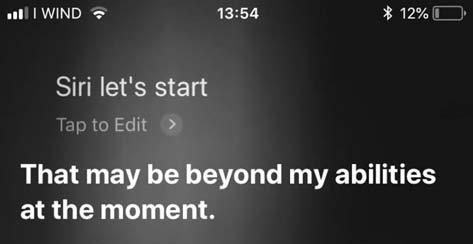
Technology is shaped not only by the agency of scientists, designers, entrepreneurs, users, and policy-makers but also by the kinds of questions we ask about it. This book hopes to inspire readers to ask new questions about the relationship between humans and machines in today’s world. We will have to start searching for answers ourselves, as the “intelligent” machines we are creating can offer no guidance on such matters-as one of those machines admitted when I asked it (I.1).
I.1 Author’s conversation with Siri, 16 January 2020.
CHAPTER 1