The Sustainable Sites Handbook: A Complete Guide to the Principles, Strategies, and Best Practices for Sustainable Landscapes- 1st Edition -2011, Ebook PDF Version
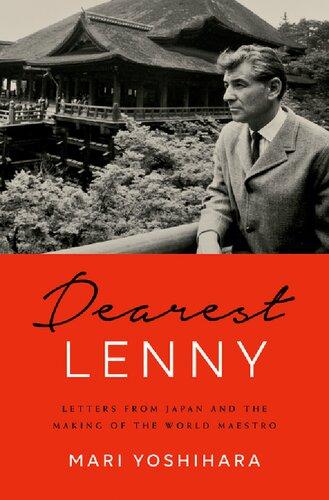
Letters from Japan and the Making of the World Maestro
MARI YOSHIHARA
Oxford University Press is a department of the University of Oxford. It furthers the University’s objective of excellence in research, scholarship, and education by publishing worldwide. Oxford is a registered trade mark of Oxford University Press in the UK and certain other countries.
Published in the United States of America by Oxford University Press 198 Madison Avenue, New York, NY 10016, United States of America.
All rights reserved. No part of this publication may be reproduced, stored in a retrieval system, or transmitted, in any form or by any means, without the prior permission in writing of Oxford University Press, or as expressly permitted by law, by license, or under terms agreed with the appropriate reproduction rights organization. Inquiries concerning reproduction outside the scope of the above should be sent to the Rights Department, Oxford University Press, at the address above.
You must not circulate this work in any other form and you must impose this same condition on any acquirer.
Library of Congress Cataloging-in-Publication Data
Names: Yoshihara, Mari, 1968– author.
Title: Dearest Lenny : letters from Japan and the making of the world maestro / Mari Yoshihara.
Description: New York, NY : Oxford University Press, [2019] | Includes bibliographical references and index.
Identifiers: LCCN 2018054954 (print) | LCCN 2018056310 (ebook) | ISBN 9780190465797 (updf) | ISBN 9780190465803 (epub) | ISBN 9780190465780 (hardcover : alk. paper)
Printed by Sheridan Books, Inc., United States of America
Letters by Kunihiko Hashimoto, Kazuko Amano, and Kikuko Amano are used by their permission.
Writings by Leonard Bernstein and Felicia Montealegre Bernstein are copyrighted and used by permission of The Leonard Bernstein Office, Inc. Correspondence from individuals writing in their capacity as employees of Amberson Enterprises used by permission of The Leonard Bernstein Office, Inc.
Other writings and images that are not in the public domain are used with the permissions of the respective rights holder.
In memory of Steve Dinion
Dearest Lenny
Introduction
LEONARD BERNSTEIN— INDISPUTABLY
ONE of the most iconic figures of twentieth-century American music—was a man with an insatiable thirst for love. His love of music, people, and life overflowed not only in his compositions and writings but also in the form of his dancelike moves on the podium and the tight hugs and wet kisses he bestowed upon men and women, both young and old. He poured his heart and soul into everything he did—composing, conducting, teaching, writing, speaking, organizing, smoking, and drinking.
Bernstein’s overflowing nature is evident not only in his recordings, compositions, books, and lectures but also in the vast archives of his unpublished materials. The Leonard Bernstein Collection at the Library of Congress, still being processed, is comprised of over 1,700 boxes containing around four hundred thousand items, including manuscripts, correspondence, datebooks, and business records. Bernstein was extremely productive in everything he did, and he and his staff seem to have saved just about everything. His personal correspondence was always touching, intriguing, amusing, and enlightening. Bernstein’s mentor Serge Koussevitzky chastised him for insisting on performing his own composition as a guest conductor: “May I ask you: do you think that your composition is worthy of the Boston Symphony Orchestra and the Boston organization? Can it be placed on the same level as Beethoven, Schubert, Brahms, Stravinsky, Prokofieff, Bartok or Copland?”1 Enclosing a check for $1.37 owed from a game of gin rummy, Isaac Stern instructed Bernstein not to spend it rashly, as money doesn’t grow on trees.2 In a holiday greeting card, tenyear-old Yo-Yo Ma reported on the three concerti he learned that year and the joint recital that he and his sister were giving the following month.3
The many and diverse letters Bernstein wrote and received paint a vivid picture of the man and his life.4
While looking through the Leonard Bernstein Collection’s finding aid, I stumbled upon two unfamiliar Japanese names: Kazuko Amano and Kunihiko Hashimoto. I had expected to see Japanese names such as conductor Seiji Ozawa, violinist Midori, composer Toru Takemitsu, or Sony CEOs Akio Morita and Norio Ohga—all of whom had professional relationships with Bernstein—but I had never heard of these two.
The finding aid showed hefty amounts of their correspondences. Those with close personal relationships with Bernstein typically had several folders in a box at most. His wife Felicia’s letters to him comprise three folders, his letters to Felicia another three; Aaron Copland also has three folders. But Amano too was listed with three folders, and Hashimoto with more than two entire boxes. I wondered who these two Japanese people were to the maestro.
Going back to the many biographies of Bernstein did not yield much information. Even the most comprehensive one, by Humphrey Burton, simply described Amano as “a former piano student in Paris who had been writing fan letters to him since 1947.” Hashimoto was briefly mentioned toward the end as “[Bernstein’s] Japanese liaison officer and friend.”5
I requested to see the letters. I started with Hashimoto’s, intrigued by the sheer volume of his correspondence.
What filled the boxes were love letters from a young Japanese man— young enough to be Bernstein’s son.6 The letters were written over the course of eleven years, starting in the summer of 1979, right after Bernstein’s departure from Tokyo, where he was on tour with the New York Philharmonic, and continued until the summer of 1990, a few months before Bernstein’s death. There are over 350 letters, most of which are handwritten on stationery, others on greeting cards with artwork on the cover or postcards from different cities. They are passionate, tender, and sometimes heartbreaking. Hashimoto’s writing is also perceptive and selfreflexive, revealing his intelligence and sensitivity. Together, the many letters tell a moving story of his growing and deepening love for Bernstein.
Kazuko Amano’s correspondence was no less moving and intriguing. Her letters span the course of four decades, from the late 1940s to 1990. They are written in longhand, in beautiful penmanship on carefully selected stationery, in elegant English sometimes mixed with French. Like Hashimoto’s, her writing is at once passionate and articulate. The letters convey the deeply personal meanings Bernstein and his music had for
her throughout various stages of her life. More vividly than many reviews by music critics and journalists, her writing illuminates how Bernstein’s compositions, recordings, and performances touched his audiences. Her letters also reveal the evolving nature of her love for, and relationship with, “Mr. Bernstein,” “Dear Leonard,” and “Beloved Lenny.”
Immersing myself in Amano’s and Hashimoto’s letters, I was quickly drawn into their close and lasting relationships with the maestro. By piecing together clues from their letters, I gradually painted portraits of these two unique individuals in my mind. I also began to trace the stories of their very different but equally special relationships to Bernstein. Further research soon made it clear that Amano and Hashimoto occupied a precious place in Bernstein’s heart and mind as well.
After Bernstein replied to Kazuko’s first letter, the two corresponded a number of times before they met in person for the first time during his first Japan tour in 1961. During his subsequent visits to Japan, Bernstein made sure to spend private time with her and her family amidst his packed schedule. While traveling, he sent her his photographs, programs, and news clippings. Later in life, Bernstein welcomed her to his home in New York, invited her to his seventieth birthday celebration, and treated her as an important guest while touring Japan. Amano described herself as Bernstein’s oldest and most loyal Japanese fan, but he obviously thought of her as much more than that.
Hashimoto’s relationship with Bernstein began much later than Amano’s, yet it was equally, if not more, intense. While the two men did have a physical relationship, they were bonded by far more than sexual intimacy. It was commonly known that Bernstein was attracted to men, and, concurrent with his relationship with Hashimoto, he had many other male lovers, some of whom he surely saw much more frequently. At the same time, it is evident that Hashimoto was not just one of Bernstein’s dalliances. Bernstein took time amidst his jet-setting travels to write or call him, and on two occasions he brought him to Europe to spend time with him. From the mid-1980s, Hashimoto became professionally involved in Bernstein’s work and played a key role in some of the most important projects in the last stage of Bernstein’s career.
There is no denying that Amano and Hashimoto lived in completely different worlds from that of Bernstein. For much of her adult life, Amano was a full-time housewife raising two children in Japan. When Hashimoto first met Bernstein, he was what the Japanese call a “salaryman,” working for an insurance company in Tokyo. Meanwhile, Bernstein was a man of
tremendous fame, fortune, and influence. In addition to having achieved international acclaim as a composer, conductor, pianist, and media personality, he was involved in various political causes such as civil rights and nuclear disarmament. He also had a strong Jewish heritage and worked closely with the Israel Philharmonic Orchestra throughout his career. He had a busy and happy family life. His exceptionally vibrant career and colorful social life were utterly different from Amano’s or Hashimoto’s.
What drove these two Japanese individuals to write, with such passion, diligence, and persistence, to this international celebrity so distant from their everyday reality? What was the nature of their love for, and relationships with, Bernstein? And why did Bernstein cherish these relationships so dearly?
These curiosities about their personal relationships led me to questions about the meaning of Bernstein’s relationship with Japan. Was it purely coincidental that these two individuals were Japanese? Or were there specific factors that brought Bernstein and these Japanese individuals together? Why did one of the last major projects of Bernstein’s career—founding and directing the Pacific Music Festival—take place in Japan?
Beyond Japan, why did Bernstein have such an impact—a deeply personal and life-changing one—on so many around the world? How did Bernstein, a quintessential American in so many ways, become the world maestro who reached and communicated so powerfully across borders?
Amano’s and Hashimoto’s letters to and relationships with Bernstein are moving first and foremost because of the depth of their devotion. Tracing how their love emerged, endured, and evolved takes one on a rich emotional journey. The letters also speak eloquently to the power of music and human will in history and society. Neither Amano’s nor Hashimoto’s relationship with Bernstein was determined by historical, political, and economic conditions, nor did they directly discuss such issues in their letters. They were writing fan letters and love letters, expressing their innermost thoughts and emotions as individuals, not as representatives of their culture, nation, class, gender, or sexual orientation. Nonetheless, trying to understand how these relationships were formed and grew allowed me to see how the personal intersects with the historical, political, economic, and social to make meaning in individual lives.
Since Bernstein’s sensational debut with the New York Philharmonic in 1943, the nature of his stardom changed from that of an American icon in the 1950s to a globally revered maestro in the 1980s. It is widely understood that as Bernstein turned more of his professional energies to
Europe later in his career, he became not merely a world-class conductor but the maestro of the world. Yet that story often tends to be told in terms of Bernstein’s reach across the Atlantic, focusing on his work in Europe as well as Israel. In contrast, Amano’s and Hashimoto’s relationships with Bernstein tell a story of the world maestro that looks east. The period when Bernstein’s relationship with Amano and Hashimoto unfolded was one during which Japan’s place in the world and its relationship to the United States changed dramatically. Those changes shaped Bernstein’s relationship to the world in important ways and were reflected in his relationship to the two individuals. The focus on Japan and these two individuals allows for a broader understanding of the global Bernstein.
In tracing Bernstein’s worldwide reach through the decades, Dearest Lenny looks at many forms of relationships—not only between Bernstein and Amano and Hashimoto but also between art and life, the United States and the world, culture and commerce, artists and the state, the private and the public, conventions and transgressions, dreams and realities. Some of the most difficult challenges Bernstein faced in his life and career lay in these relationships. Yet his greatest achievements as an artist and a human being were also born out of his uncompromising grappling with them. Amano’s and Hashimoto’s stories provide a unique window into these relationships, as well as the deep, intimate bond each of them built with their beloved maestro.
PART I
An American Icon Crosses the Pacific
LEONARD BERNSTEIN’S DRAMATIC debut with the New York Philharmonic conveyed his extraordinary star power. On November 14, 1943, he filled in at the last minute for an ill Bruno Walter and conducted the Philharmonic’s subscription concert without a rehearsal. The concert was also broadcast on CBS radio network. At the age of twenty-five, Bernstein was the youngest man to step onto the podium of Carnegie Hall with the nation’s oldest symphonic orchestra and one of the few US-born conductors to do so.
The morning after the concert, the New York Times reported Bernstein’s sensational debut on the front page. The placement of this news item in the paper shows the global backdrop against which this American star was born. The headline, “Young Aide Leads Philharmonic, Steps In when Bruno Walter Is Ill” was printed in the same size and font as “Japanese Plane Transport Sunk as Our Submarines Bag 7 Ships.” The rest of the front page was filled with reports of war from both the European and Pacific theaters. The top headline of the day was “Berlin Reports Russian Break-Through by 30 Divisions within the Dnieper Bend; Bitter Fighting Checks Allies in Italy.” Other news included the United Nations Relief and Rehabilitation Administration’s plans for postwar relief and rehabilitation programs, reports of the heaviest aerial assault ever inflicted on the Japanese in New Guinea, and a fierce battle between the British defenders and the German invaders on the island of Leros.1
Shortly after his Philharmonic debut, Bernstein achieved major success as a composer for the ballet Fancy Free and the musical On the Town, distinctively American works in both musical and narrative content that premiered in 1944. Bernstein’s music mixed classical and jazz
elements and “high” and “popular” styles, which became a signature of his compositions. Both works depict stories of three sailors who arrive in New York City on shore leave, seeking adventure and female companionship. Despite the benign romantic plot, the performance of these works, especially On the Town, delivered a bold political message in the midst of the war. Dancer Sono Osato, a daughter of a Japanese immigrant father and a white American mother, played the starring role of all-American heroine Ivy Smith; African American Everett Lee served as concertmaster and conductor. Such figures on the stage and in the pit were highly significant in light of Jim Crow segregation and Japanese internment.2
As it became safer to travel overseas after the end of the war, Bernstein made his international debut conducting the Czech Philharmonic in Prague and the European premiere of Fancy Free in London. He made his first trip to Palestine in 1947, then a British protectorate seeking to form an independent Jewish state. During this visit, he gave his first concerts with the Palestine Symphony Orchestra, many of whose members were Holocaust survivors, performing his own Symphony no. 1 Jeremiah, Ravel’s Piano Concerto, and Schumann’s Symphony no. 2. The following spring, Bernstein conducted an orchestra composed of the survivors of sixteen concentration camps in Germany. Later that year, Bernstein arrived in Israel in the midst of the War of Independence and performed forty concerts in sixty days amidst artillery explosions and air raids. These travels—during which he witnessed the aftermath of the Holocaust and the violent process of the establishment of Israel—decidedly shaped Bernstein’s Jewish identity and his worldview. This was the beginning of his lifelong commitment to working with the Palestine Symphony, later renamed the Israel Philharmonic Orchestra, which he would continue to conduct for free for the rest of his career.3
The early career of this American star was thus shaped by his deep interest in the world beyond the United States, his understanding of war, and his dedication to world peace. But it was not only Bernstein’s own political and moral commitment that led to his global reach.
In many ways, Bernstein was an ideal poster child for the American dream: he came from a relatively humble Jewish background; his compositions used uniquely American language, while incorporating elements from diverse cultures, mixing classical and modern idioms; he was both a serious intellectual and a popular entertainer; he was charismatic, charming, and communicative; and perhaps most importantly, he was the first American-born maestro to achieve international recognition.
It was no surprise that the US government actively tried to take advantage of Bernstein’s background, qualities, and success both in its war effort and in postwar public relations.
Even in the 1940s, when the FBI and others suspicious of Bernstein’s leftist political activities were closely monitoring him, he was also being watched by those in the US government seeking to win hearts and minds abroad. Toward the end of the war, the Office of War Information (OWI)— precursor to the United States Information Services, Office of Strategic Services, and the CIA—interviewed Bernstein in one of their radio broadcasts for overseas civilian listeners. Both On the Town and his upcoming performance with the New York Philharmonic were considered effective tools on the cultural front of the war.4
Amidst the rising fervor of the investigations of the House UnAmerican Activities Committee of the postwar years, Bernstein was blacklisted as a Communist, bringing his career to an abrupt halt. In 1953 he went through what he called a “ghastly and humiliating experience” of signing an affidavit disavowing his associations with unpatriotic organizations and denying any Communist affiliations.5 Yet even during this same period, the State Department made numerous requests for Bernstein to participate in events dedicated to cultural exchange, write for foreign publications, appear in foreign broadcasts, and give lectures in cultural centers abroad. The language of such invitations sums up the state interests in cultural diplomacy: “The objective in assigning such persons [as visiting lecturers] is to promote further a better understanding on the part of the people of these countries of United States cultural life and social progress in our country and to acquaint them with the organizations and institutions in the United States which are devoted to such purposes.”6
While Bernstein’s early international endeavors were focused mostly in Europe, Israel, and the Soviet Union, his influence was beginning to reach across the Pacific as well. It was the convergence of Bernstein’s own commitment to peace and the US state objectives during and after World War II that shaped his rising international fame and also created the setting for the making of Japan’s earliest and most loyal fan of Bernstein.
CONSIDERING THE COMPREHENSIVENESS of the Leonard Bernstein Collection, it is curious that the very first letter from his self- proclaimed
most dedicated follower in Japan— sent to wish him a happy birthday on August 25, 1947— is missing from the archives. While the contents of the letter that launched a precious, decades- long friendship are unknown, later letters and other sources illuminate how it came to be written.
Kazuko Ueno was born in January 1929 in Nagoya and raised in Tokyo, where she began studying the piano. When she was six, her father’s appointment as an executive of a major Japanese trading corporation took the family to Paris, where she was enrolled in the Paris Conservatory. Although she continued her musical studies for a while after the Nazi invasion of France, the worsening war conditions forced the Uenos to leave Paris in late 1940. The family traveled through southern France and Spain, sailed across the Atlantic to New York, crossed the continent by rail, and boarded a ship from San Francisco to Japan via Honolulu, arriving in Yokohama in early 1941. Kazuko continued her piano lessons back home after the opening of the war between the United States and Japan and sometimes performed in concerts for soldiers departing for war. Yet Japan’s wartime social climate stifled young Kazuko, who temporarily moved outside of Tokyo with her family to escape the US air raids.
After Japan’s surrender, Kazuko feared that her dreams of a musical career would never be realized. That was when, at age eighteen, she chanced upon Bernstein’s essay “The Essence of Musical Study” while browsing through The Etude magazine at the Civil Information and Education (CIE) Library in Tokyo.
The library was established as part of the cultural policy of the US-led Allied occupation of Japan in 1945–1952. Along with a wide variety of information control and cultural programs—such as rigid press code enforced on the media, sweeping educational reform geared toward democratization, restrictions on culture and the arts, and scholarships for study in the United States—the CIE libraries were a tool for turning the hated enemy into the United States’ junior ally. During the occupation, the CIE set up twenty-three libraries in cities throughout Japan, lending books, journals, pamphlets, records, and musical scores for free, as well as offering film screenings, exhibitions, lectures, workshops, concerts, and English language classes.7 At the CIE libraries, many young Japanese men, especially those in science and engineering, eagerly read the latest English-language academic journals, while many housewives and female students perused American fashion magazines. Those interested in culture and the arts
attended the lectures and performances. For a generation of Japanese who had been forbidden to practice or consume many forms of Western, especially American, culture during the war years, the CIE libraries provided access to knowledge and ideas they had craved.
Kazuko was among those Japanese youths who frequented the CIE library in Tokyo. In 1947, the library was one of the few places where a young woman could satisfy her appetite for music and the arts. As a returned expatriate fluent in French and a diligent student of English, she was also eager to read English-language materials. The library felt like a haven where she could forget the devastation and poverty that filled the city. Browsing through magazines and books, she could let her imagination wander into the world she had known beyond Japan’s borders.
Although Bernstein was quickly climbing the ladder to stardom in 1947, he was not yet an internationally known celebrity. Thus it is all the more remarkable that Kazuko paid attention to the short essay by this emerging artist. She was moved by his belief that a student of music “studies and learns and works and thinks to develop oneself as an intelligent, sensitive, and aware human being; and out of the always-increasing resources of intelligence, sensitivity, and awareness, the human being makes music.”8 His humanistic approach to music particularly resonated with Kazuko, who had felt suffocated by the nationalist teachings of the war years after having been educated in Paris. Having had her musical pursuits cut short, she had her passion reawakened by the acute intellect and ambitious attitude toward music evident in Bernstein’s writing. She looked for his recordings at the CIE library and found a record of Serge Koussevitzky conducting the New York Philharmonic in which Bernstein made a guest appearance. As she listened to it, she was immediately entranced.
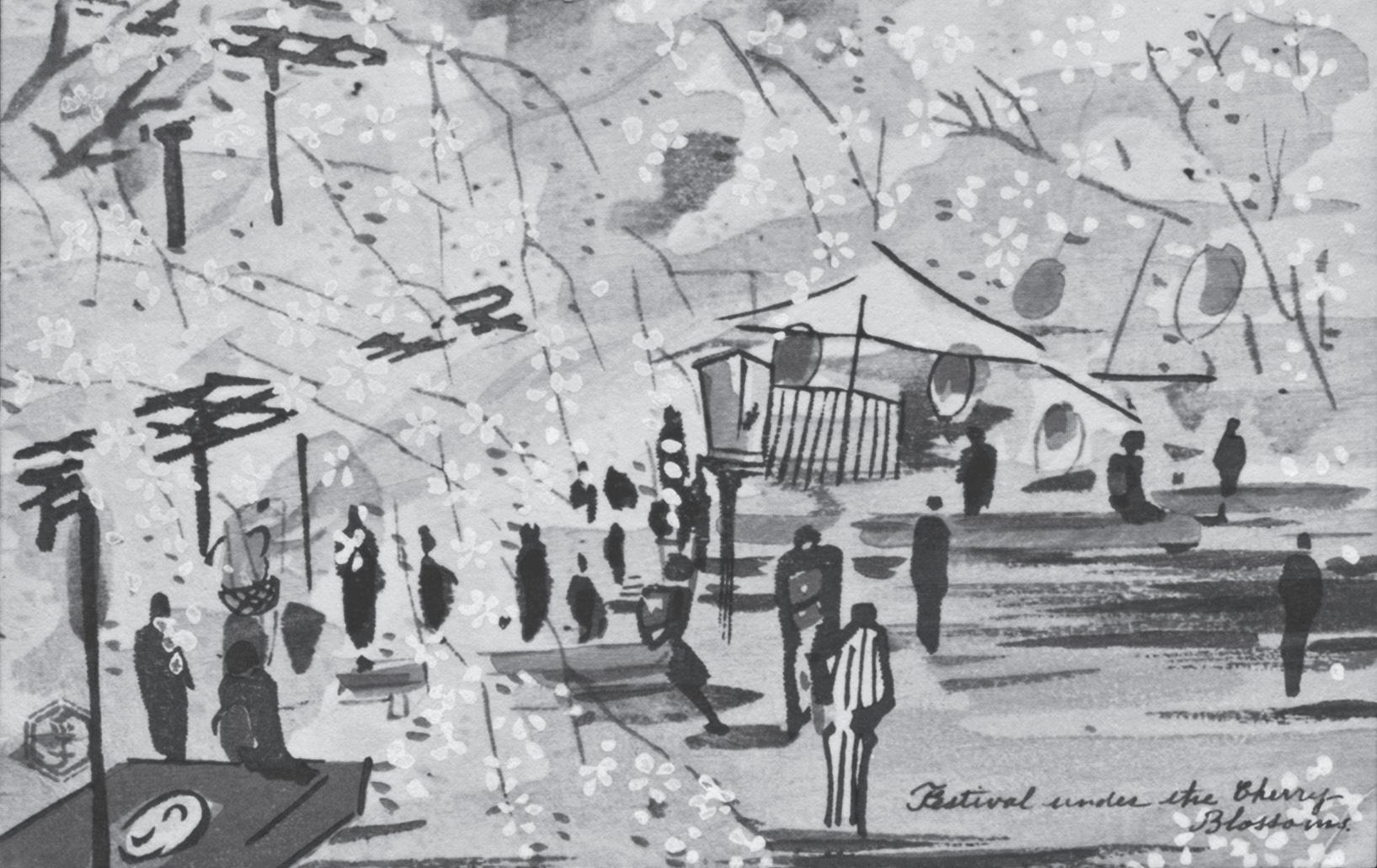
Convinced that this young conductor would go on to become a truly great maestro, she decided to send him a fan letter. She chose a postcard with a handmade woodblock print of the Daimonji Festival in Kyoto. In this annual festival, giant bonfires are lit on mountains to guide the souls of the ancestors making their yearly visit back to heaven. The most symbolic of the bonfires is in the shape of the character dai, meaning “large” or “great.” Kazuko deliberately chose this postcard to convey her admiration for the magnificent, burning spirit that she sensed Bernstein to be.9 She looked up his birthday in a reference book at the library and timed the
sending of the letter for it. Not knowing his address, she sent it to the editor of the Musical America magazine, asking him to forward the letter to the maestro. She was not sure if the editor would do so and certainly never expected to receive a reply.
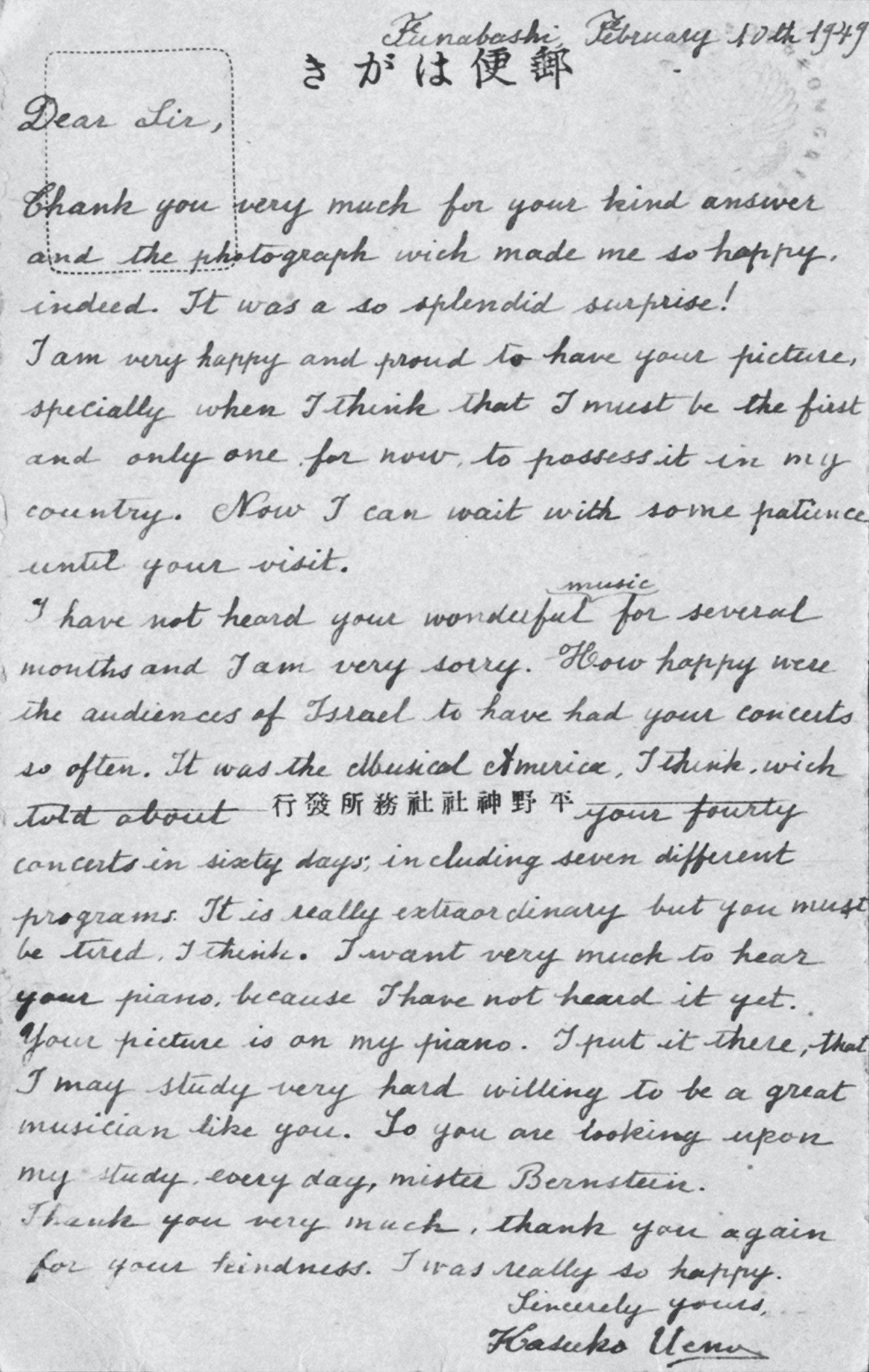
Between the slow sea mail—the standard medium for international mail at the time—and Bernstein’s travels in 1947 and 1948, it probably took several months for her letter to reach Bernstein. To her surprise, he wrote back, likely after his tour of Palestine in October 1948, and enclosed a photo with his autograph.
As a rising star who was receiving many letters from adoring fans from around the world, he could not possibly have written back to everyone. Why, then, did Bernstein bother to send her a reply?
Surely Kazuko’s eloquent and heartfelt words must have touched Bernstein. But it is also likely that his experiences in the preceding years made him especially sensitive to Kazuko’s gesture. Having worked with Sono Osato whose immigrant Japanese father was interned and whose brother joined the famed 442nd Regimental Combat Team of the US army—in On the Town, he must have had some understanding of the complex turmoil of Japanese and Japanese American families during the war.10 Infuriated by the destruction wreaked by the atomic bombs in Hiroshima and Nagasaki, he became an advocate for nuclear disarmament, a cause he
Figures 1.1a & 1.1b Letter from Kazuko Ueno to Leonard Bernstein, February 10, 1949.