
https://ebookmass.com/product/current-developments-inbiotechnology-and-bioengineering-solid-waste-management-1st-


https://ebookmass.com/product/current-developments-inbiotechnology-and-bioengineering-solid-waste-management-1st-
https://ebookmass.com/product/agentes-fisicos-en-rehabilitacion-5thedition-michelle-h-cameron/
ebookmass.com

S.H.Bai UniversityoftheSunshineCoast,MaroochydoreDC,QLD,Australia
S.Balasubramanian InstitutNationaldelaRechercheScienti fique,Institut Armand-Frappier,Laval,QC,Canada
R.Balasubramanian NationalUniversityofSingapore,Singapore
A.Bassi UniversityofWesternOntario,London,ON,Canada
S.K.Benerji UniversityofMissouri,Columbia,MO,UnitedStates
R.Boopathy NichollsStateUniversity,Thibodaux,LA,UnitedStates
W.Charles MurdochUniversity,Perth,Australia
K.Y.Cheng CSIROLandandWater,Floreat,WA,Australia;MurdochUniversity, Murdoch,WA,Australia
W.Daoud CityUniversityofHongKong,HongKong
M.Farrar UniversityoftheSunshineCoast,MaroochydoreDC,QLD,Australia
V.K.Garg CentralUniversityofPunjab,Bathinda,India
X.Y.Gu NanjingAgriculturalUniversity,Nanjing,People’sRepublicofChina
R.Gupta YMCAUniversityofScienceandTechnology,Faridabad,India
G.Ho MurdochUniversity,Perth,Australia
Y.Hu CityUniversityofHongKong,HongKong
S.Joseph UniversityofNewSouthWales,Sydney,NSW,Australia
A.H.Kaksonen CSIROLandandWater,Floreat,WA,Australia;Universityof WesternAustralia,Nedlands,WA,Australia
JonathanW-C.Wong
Dr.JonathanW-C.WongisaprofessorintheDepartment ofBiology,HongKongBaptistUniversity,HongKongSAR. HeisalsoservingasthedirectoroftheSino-ForestApplied ResearchCentreforthePearlRiverDeltaEnvironment,as wellastheHongKongOrganicResourceCentre.He receivedhisM.Phil.fromtheChineseUniversityHong KongandPh.D.fromMurdochUniversity,Australia.He joinedtheHongKongBaptistUniversityin1992andcontinuestoserveinvariouscapacities.ProfessorWongis servingasaVisitingProfessorattheChinaUniversityof Agriculture,NanjingAgriculturalUniversity,and ShangdongUniversity,China.Heconductsresearchin organicwastemanagementandtreatmentwithparticular emphasisoncompostingandbioenergyproduction,strivingtowardzero-wasteorganic wastedisposal.HehaschairedthreeInternationalConferencesonSolidWaste(ICSWHK 2011,2013,and2015).HehasservedandisservingasamemberoftheInternational AdvisoryBoard,ScientificCommittee,andinothercapacitiesforvariousinternational conferences.ProfessorWongwasbestowedtheMedalofHonorbytheGovernmentof HongKongSpecialAdministrativeRegionin2011forhisserviceandcontributiontothe environment.HeisanelectedmemberoftheEuropeanAcademyofSciencesandArts. Heisservingontheeditorialboardsofsixjournals,notablyasregionaleditorof EnvironmentalTechnology andboardmemberof BioresourceTechnology.Professor Wonghasauthoredover500publicationsincludingrefereedjournals,conferenceproceedings,fourpatents,andmorethan100technicalreportsandhasedited12book/ journalvolumesandothers.

Thisbookisapartofthecomprehensiveseries CurrentDevelopmentsinBiotechnologyand Bioengineering (Editor-in-Chief:AshokPandey),comprisingninevolumes,andpresentsa collectionofchaptersdealingwithsolidwastemanagement.AccordingtoaWorldHealth Organizationreport,worldcitiesalonecurrentlygenerateabout1.3billiontonnesofsolid wasteperyear,andthisfigureispredictedtobearound2.2billiontonnesby2025.Tocope withthistremendousamountofwastegeneratedfromourdailylivingisnotjustanissueof handlingandtreatingitproperlywithoutanyimpactonourenvironmentormakingan eyesoreforthepublic.Mostofourwastesarebeinglandfilledwithoutconsideringthelife cycleofthematerials,whichleadstoadeclineinourworld’sresources.Itisamatterof resourceconservationandutilization.Wasterepresentsourfutureresourcesandsowasteis notwasteanymore.Scientistsarefacingachallengingpathaheadtodevelopinnovative technologiestoconvertwastetovaluablebio-products.
Biotechnologyisabroadtermcoveringarangeoffields.TheEuropeanFederationof Biotechnologydefinesbiotechnologyas“theintegrationofnaturalsciencesandengineering inordertoachievetheapplicationoforganisms,cells,partsthereofandmolecularanalogues forproductsandservices.”Since1995,thewasteindustryhaswitnessedbio-basedtechnologiesforwasteconversion.Thetechnologiescanbebroadlyclassifiedintotwocategories: onethatdegradesparticularcompoundsthatareverytoxicinnaturetoprevent/reducetheir environmentalimpactandanotherthatgeneratesavalue-addedproduct,concurrently achievingvolumereductionoreliminatingtheneedforsubsequentdisposal.Biological methodsarealsoappliedtotreattheairemissions.
Biotechnologyapplicationsinthebiofuelandbioenergysectorshavegainedsignificant advancementduemainlytotheincreaseinenergydemand.Forinstance,theglobalenergy consumptionhasbeenestimatedas104,426TWhbytheInternationalEnergyAgency,of which65%oftheneedwillbesuppliedbyfossilfuels.Thesereservesarenearcessation becauseofpeakutilizationratesinthe2010s.Althoughnewmethodsarebeingconstantly developedtoidentifyandextractthefossilsources,thiscannotbeindefinite,astheformation ofsuchfossilfuelstakescenturiesandcannotmeetthehumangreed.Therefore,itisessential todevelopalternatesolutions,andbiofuelproductionfromsolidwasteisgainingmomentum.Previously,energycropswereconsideredasanoptionbutthedebatecontinues overthecompetitionbetweenoilcropsandagriculturalcropsforourpreciousarableland. Thusorganicwastesaresustainableandlow-costoptions/substratesatthisstageandhave triggeredvitalandsignificantresearchinanumberofwastemanagementareassince1995.
Anaerobicdigestion(AD),apotentialwaste-to-energytechnology,wastraditionally appliedtothetreatmentofwastewater.However,currentlytheuseoffoodwasteandother organicwasteshavinghighersolidcontentsassubstratesisincreasing,withmanyindustrialscaleADplantsinoperationwithsuccessfulenergyrecovery.However,like“bettingonthe winninghorse,”oftenthetechnologieswithsignificantoperationalhistoryarepositively consideredduringthedevelopmentofnewplants,whereasnewmethodswithhigherenergy recoveryarestillhavingdifficultyfindingamarket.Therefore,acriticalanalysisthatgives weighttodemonstrationandinnovationinthisareaofresearchmustbeconsidered.Despite
C.P.Rivero1,Y.Hu2,T.H.Kwan2,C.Webb1,C.Theodoropoulos1, W.Daoud2,C.S.K.Lin2, * 1 UNIVERSITYOFMANCHESTER,UNITEDKINGDOM;
Plasticsaresomeofthemostcommonlyusedarticlesontheglobe.Theglobalproductionofplasticshasbeengrowingformorethan50yearsandroseto299milliontons in2013,whichaccountsfora3.9%increasecomparedto2012 [1].Currently,conventionalpetroleum-basedplasticssuchaspolyethylene,polypropylene(PP),andpolyethyleneterephthalate(PET)constitutemorethan95%oftheplasticsmarket.Becauseof theenvironmentaldegradationcausedbypetroleum-basedplasticsandthedepletionof fossilfuelresources,thereis,however,anincreasinginterestinbioplastics.
Bioplasticsareafamilyofplasticmaterialsthatareeitherbio-basedorbiodegradable orpossessbothproperties.Theterm“bio-based”meansthematerialisderivedfrom biomasssuchascorn,sugarcane,andwheatstraw,whereasbiodegradationisa chemicalprocessinwhichmicroorganismspresentinnaturedegradethematerialsinto naturalsubstancessuchaswater,carbondioxide,andcompostwithouttheadditionof artificialadditives [1].Infact,allplasticsmaterials,includingbothbio-andpetroleumbasedplastics,aretheoreticallybiodegradable.Becausemostofthepetroleum-based plasticsdegradeataslowrateinthenaturalenvironment,theyareconsidered nonbiodegradable [2].
Startinginthe1980s,bioplasticswereintroducedtoreducetheuseofpetroleumbasedplastics,becausetheypossessanumberofadvantagesincludinghighresource efficiency,reductionofcarbonfootprintandgreenhousegasemissions,andsavingfossil resources [1].Nowadays,therearenumerousmanufacturersproducingbioplasticsfora widerangeofapplicationsincludingbiomedical,packaging,consumerelectronics, automotive,textiles,andagriculturalfields.Becauseofthegrowingdemandforasustainablebio-economy,theproductioncapacityforbioplasticshasbeenincreasedfrom 1.5milliontonsin2012to1.9milliontonsin2015andisforecastedtoreach6.7milliontonsin2018,accordingtoEuropeanBioplastics [1].However,comparedtoconventionalplastics,bioplasticsaccountedforonlylessthan5%ofthecurrentmarket
*CorrespondingAuthor.
CurrentDevelopmentsinBiotechnologyandBioengineering:SolidWasteManagement http://dx.doi.org/10.1016/B978-0-444-63664-5.00001-0 1 Copyright © 2017ElsevierB.V.Allrightsreserved.
sharebecauseoftheirlimitedmechanicalpropertiesandrelativelyhighproduction costs [3].Therefore,therecentresearchfocusesontheimprovementofbioplastics’ propertiesandutilizingwastematerialsassubstratesforreducingtheproductioncost.
Inthischapter,twotypesofthemostwidelyproducedbioplastics,viz.,polyhydroxybutyrate(PHB)andpoly(lacticacid)(PLA)willbeintroduced.Thehistoryof theirdevelopmentandtheirproperties,synthesis,commercialmarket,andlow-cost substratesthatareidentifiedforproductionwillbediscussed.
1.2.1HistoryofPolyhydroxybutyrate
PHBisthemostextensivelystudiedbiopolymerofthepolyhydroxyalkanoate(PHA) familyanditwasalsoitsfirstandonlymemberforalmost40yearsuntilthreeotherPHA typeswerediscoveredin1974 [4].Todaytherearemorethan150classes.Thepresence ofrefractiveintracellularbodieswasalreadyreportedbyBeijerinckin1888,butitwas theFrenchmicrobiologistMauriceLemoignewhoin1925determinedthattheformula ofthosegranular(etherinsoluble)inclusionsin Bacillusmegaterium was(C4H6O2)n [5]. Healsoprovedthattheycouldbeextractedwithchloroformresultinginproductswith differentmeltingtemperature.In1952,KepesandPeaud-Lenoelfoundthatthefractions isolatedbyLemoignecorrespondedtoautolysissegmentsofalinearpolyesterthat containedacarboxylgroupinoneendandanalcoholgroupintheother [6].
FollowingLemoigne’sstudies,MacraeandWilkinson(1958)investigatedthe biosynthesisofthepolymerandattributedthepresenceofPHBtounbalancednutrient conditions,i.e.,deprivationofsomenutrientsandexcessofcarbon [7].Baptistand Werber(1964)startedconductingfermentationstoproducePHBandevaluatethe feasibilityofitscommercialization [8].Loweryields,expensivesolventrequirementsfor extraction,andabundantimpuritiesinthefinalproductmadethemabandontheir initialinterestinPHBforindustrialapplication.Nonetheless,Baptistgotthefirstpatent forthePHBproductionprocess [9].
Manycompaniespromotedresearchanddevelopmentprogramsinbioplastics technologymotivatedbytheoilcrisisinthe1970sbutonlyafewcompaniesremained afterward:ImperialChemicalIndustries(ICI),PetrochemieDanubia(PCD),andChemie Linz.Whenpetrolpricesstabilized,PHBdidnotofferadvantagesoverPP,asitwasmore fragileandmuchmoreexpensive.Still,ICIcontinuedwiththeresearchanddevelopeda copolymer,namelypoly(3-hydroxybutyrate-co-3-hydroxyvalerate)(PHBV),with improvedproperties,whichboostedinterestinbiodegradableplasticsagain.PHBVwas commercializedunderthenameBiopolin1975andwasusedtomanufacturethefirst shampoobottlemadeofabiodegradableplastic. Ralstoniaeutropha wasthebacterium usedforthebiosynthesis,whichmostlyoccursatthelaststageoffermentation [10].
The1980sweremarkedbytheintroductionofnewPHBproducerstrainsandthe beginningofmetabolicengineeringstudies.ChemieLinzandPCDintroducedanew
strainthatwasabletoaccumulatethepolymerwhengrowinganddeSmet(1983)found that Pseudomonasoleovorans formspoly-b-hydroxybutyricacidusing n-octaneas feedstock [11].In1988thegenesof Alcaligeneseutrophus wereclonedandinsertedinto Escherichiacoli,afast-growingbacterium [12].
Copersucar,incollaborationwithSaoPauloUniversity,openedapilotplantinBrazil in1991.SugarcaneindustryresidueswereutilizedasfeedstockforPHBproductionas wellaspoly(3HB-co-3HV).InteresthadalsostartedrisinginAsia,andKohapLtd.in KoreabuiltapilotplantandboughtthepatentsforPHBproduction.Meanwhilein Europe,thecostofPHBwasstill16timesthatofPP [13].Metabolix,anewcompany focusedonstrainengineeringforthesynthesisofawiderangeofPHAs,appearedin 1992.AftercommercializationinAmericaandplanstoincreasecapacitiesinEurope, BiopolwassoldtoZenecaandthentoMonsanto,whichkeptituntil1998;itstechnology waslateracquiredbyMetabolix [14].
In1994thestrainandpatentofPCDwereboughtbyDr.UrsHanggitobecomethe companyBiomer.Plasticizers,nucleants,andadditivesaremixedwiththebiopolymerto createthreedifferentplasticswithimprovedpropertiesbutmaintainedbiodegradability. In2001,Procter&Gamble(P&G)andKanekaagreedtocommercializelargeamountsof biopolymerofstandardqualitycomparedtoconventionalplastics [15].ThelatestdevelopmentsinthecommercialproductionofPHBanditsderivativesarediscussedfurther.
PHAsareformedbyorganicacids,containingahydroxylgroupatoneendandcharacterizedbyaspecificradicalgroup,whicharelinkedtogetherbyesterbonds.3HydroxybutyricacidisthemonomerforPHBandconsistsofanalkylchainwitha methylradical.ThisrelativelysimplestructureandtheseveralfeasiblesynthesispathwaysmakeitthemostabundantnaturalPHA.Themolecularweight,acriticalcharacteristicforplasticcharacterization,rangingfrom50,000tomorethan1,000,000g/mol, placesPHBamongthecommercialpolymers.Thehighestmolecularweightreportedso farisupto20MDaforPHB,whichwasachievedbyKusakaetal.(1998)usingarecombinant E.coli strain [16].Themicroorganism,cultivationconditionsandcarbon source,fermentationtime,andextractionmethodsareallfactorsaffectingthemolecular weightofthepolymer [17].
However,biodegradabilityisthekeypropertyofPHBandreferstotheruptureofthe PHBmacromoleculeintosmallerunitsbymicrobialenzymesfromfilamentousfungi andbacteria.BecausePHBisproducedbycertainbacteriaascarbonandreducing powerstorage,thesecellscanalsoreversetheprocessanddegradePHBintracellularly; fordoingthat,themacromoleculeisfirstdepolymerizedinto R-b-hydroxybutyricacid, whichisthenoxidizedtoacetoacetate.Anesterificationreactionconvertsthelatterin acetoacetyl-coenzymeA,whichinturndegradestoacetyl-coenzymeA,andthisultimate moleculeoftheprocessentersthecarboxylicacidcycle,andduringcompleteoxidation, itisconvertedintocarbondioxidewiththecorrespondingenergyrelease [18].
Furthermore,someothermicroorganismsarecapableofsegregatingextracellular depolymeraseforbreakingthepolymerintomonomersordimers,whicharesoluble moleculesthatcanenterthecytoplasmofthosecellsandgetconvertedintocarbonor energy,carbondioxideandwaterbeingtheultimateproducts.AnobjectmadeofPHBin natureisdegradedextracellularlybybacteria,fungi,oralgae.Thetimefordegradation dependsontheenvironmentalconditionsandthicknessoftheobject,whichwillboth regulatethenutrientsavailableforthemicroorganismstogrow.Thesame50-mmfilmof PHBVcanbetotallydegradedin1 2weeksinresidualwaterunderanaerobicconditions orin7weeksinaerobicsystems.Itwilltake15weeksforittodegradeinseawateror 10weekstodosoinsoil [19].PHBVdoesnotdegradeinhumidair,whichguaranteesa longshelflifeforpackagingapplications.Microbialattackispronetohappeningin amorphousregionsandtolower-molecular-weightpolymers.
PHBcanalsodegradebyhydrolysisormechanical,thermal,oxidative,orphotochemicaldestruction.Itisthehydrolyticrupturethatenablesitsuseinmedicalapplications.Inaddition,PHBisnontoxic,itdoesnotcauseaninflammatoryresponse,and itsintermediateandultimateproductsarenontoxicandmetabolizedandclearedbythe body [20].ThefactthatPHBdegradesthermallycanlimititsprocessabilityinthemolten state.Additivesaresometimesusedtopreventthat [21].
PHBhassimilarcharacteristicscomparedtoPPregardingmeltingtemperature, crystallinitydegree,glasstransitiontemperature,andtensilestrength(Table1.1) [22]. Nevertheless,PHBisstifferandfragile,partlyowingtothespherulitesformedduringthe coolingofthemoltenform.Itisenantiomericallypureandstereoregular [23];theseoptical propertiesenableitsuseinisomerseparation.Becauseofitswaterinsolubilityandlow permeabilitytooxygenorcarbondioxide,itisanidealcandidateforfoodpackaging material(fivetimeslesspermeabletoCO2 thanPET).Itisalsopiezoelectric(whichisa rarepropertyforaplastic)andhencefindsapplicationinbonescaffoldprostheses [24].
PropertiesofPolypropylene,Polyhydroxybutyrate,and PolyhydroxybutyrateCopolymers
Density(g/cc)0.91 0.941.17 1.251.251.20
Crystallinity6060 7050 60N/A
Tensilestrength(MPa)34.518 2725 4010 20
Elongation(%)4006 172.5 3010 100
Tensilemodulus(GPa)1.4N/A1.2 3.0N/A
Meltingtemperature( C)171 186N/A147 175N/A
Estimatedprice($/m3)10554320N/AN/A
PHB,polyhydroxybutyrate; P(3HB-co-HV),polyhydroxybutyrate-co-hydroxyvalerate; P(3HB-co-HHx),poly(3-hydroxybutyrate-co-3hydroxyhexanoate).
DataadaptedfromS.P.Valappil,S.K.Misra,A.R.Boccaccini,I.Roy,Biomedicalapplicationsofpolyhydroxyalkanoates,anoverviewof animaltestingandinvivoresponses.ExpertReviewofMedicalDevices3(6)(2006)853 868;J.Asrar,K.J.Gruys,Biodegradablepolymer (Biopol ),in:BiopolymersOnline,Wiley-VCHVerlagGmbH&Co.KGaA,2005;G.Griffin,Chemistryandtechnologyofbiodegradable polymers.JournalofChemicalEducation72(3)(1995),A73.doi:10.1021/ed072pA73.10.
CompanyTradeNameProductLocationRawMaterial
Capacity (tons/year)Price(V/kg)
TellesMirelPHB copolymers USACornsugar50,0001.5(2010)
MitsubishiBiogreenP(3HB)JapanMethanol10,0002.5 3.0(2010) GreenBio/DSMGreenBioP(3HB-4HB)ChinaSugar10,000N/A Bio-OnMinervPHBItalyN/A10,000N/A TianAnBiopolymerEnmatPHBVChinaDextrose/glucose20004.1 4.3(2012) KanekaKanekaPHBHJapanVegetableoil1000 PHBIndustrialBiocyclePHBBrazilSugarcane6002.5 3.0(2010) MGHNodaxPHBHUSAN/AN/AN/A BiotechnologyCo.BiomerN/AGermanySucrose503.0 5.0 BiomateraBiomateraPHBVCanadaSugarN/AN/A TianzhuTianzhuPHBHChinaN/AN/AN/A TephaN/AN/AUSAN/AN/AN/A TianjinNorthernFoodN/AN/AChinaN/A10N/A YikemanShandongN/AN/AChinaN/A3N/A ShenzenO’BioerN/AN/AChinaN/AN/AN/A Polyscience,Inc.N/APHBUSAN/AN/AN/A
PHB,polyhydroxybutyrate; P(3HB),poly(3-hydroxybutyrate); P(3HB-4HB) ,poly(3-hydroxybutyrate-4-hydroxybutyrate) PHBV, poly(3-hydroxybutyrate-co-3-hydroxyvalerate); PHBH,poly(3-hydroyxbutyrate-co-3-hydroxyhexanoate).
theactionofareductaseencodedby phaB (NADPH)to3-hydroxybutyl-CoA [35]. Theelongationofthechain(polymerization)isachievedwithasynthaseencoded by phaC.
PHBcanbemobilizedbythecellsunderstressfulconditionsasmentionedearlierin thechapter.PHBdepolymerase(PhaZ)hydrolyzesthepolymertoyield3-hydroxybutyric acid.Thiscanbethenmetabolizedtoobtaincarbonorenergyorexcreted.Formetabolizing3-hydroxybutyrate,itneedstobeconvertedintoacetoacetateoractivatedtoCoA derivativesbyvariousenzymeslikeacyl-CoAsynthetaseorthioesterase.Acetoacetate canbebrokenintotwomoleculesofacetyl-CoAbytheactionof b-ketothiolaseandthese moleculesenterthetricarboxylicacidorglycoxylatecycle.(R)-3-hydroxybutyl-CoAcan immediatelybeepimerizedtothe(S)-isomerandcatabolizedwiththeconsequentenergyreleasethroughthe b-oxidationpathway [36].
Morethan300PHAproducerspecieshavealreadybeendiscovered.Amongthem, gram-negativebacteria,including Cupriavidusnecator, Alcaligeneslatus, Pseudomonas putida, Pseudomonasoleovorans, Azotobactervinelandii,orrecombinant E.coli (operon C.necator)arethemostcommonones.Withinthegram-positivegroup,thegenus Bacillus,withspeciessuchas B.megaterium or B.cereus,isgainingpopularity.The genus Streptomyces hasalsobeenevaluatedasapotentialbiocatalystforthesynthesisof PHB.Thethickwallofgram-positivebacteriaisthoughttocomplicatetheextraction process,thusthelimitednumberofstudies.Ontheotherhand,PHBproducedby
gram-negativeorganismsmightcontainendotoxinsfoundintheoutermembrane lipopolysaccharide,whichputthebiocompatibilityofthepolymeratrisk.Bacteriafrom thegenus Bacillus havedemonstratedpromisingperformance.However,theconditions fortriggeringPHBarethesameasthoseforsporulation,whichcouldlowerthe yields [37].
Almostnoneoftheisolatedstrainsmeetalltherequirementsformassproduction,but theonesthathavebetterchancestosucceedinindustrializationarediscussedlaterinthe chapter. Alcaligeneslatus showshighPHBcontent,exhibitsfastgrowth,andisableto utilizecheapercarbonsources.Thehighestbiomassconcentrationobtainedwas160g/L andnotveryhighoxygendemandwasfoundwhenusing R.eutropha.Azotobacter vinelandii producesanextremelyhighmolecularweightpolymer(1 4millionDa)and doesnotrequiremuchoxygenintheproductionstage.Otherstrainsarenotconsidered potentialcandidatesbecauseoflongerdoublingtimesorloweroptimalgrowing temperatures,whichincreasefermentationcosts [38].
Therelativelowresourcesneededforplantcultivationpushedtheresearchinthe plantkingdomforhostsforPHBproduction.Thegenesof A.eutrophus havebeen introducedintotheplant Arabidopsisthaliana.Otherchallengesirretrievablyappear, suchasthecompartmentalizationofmetabolism,leadingtolessavailableCoAforthe polymersynthesis.Thereisnoindustrial-scaleplantation,butstudiesinmaize,cotton, orsoyhavebeendevelopedbyMetabolixintheUnitedKingdomandMonsantointhe UnitedStates.
GiventhatPHBproductioninbacteriaistriggeredbythelimitationofanessential nutrient(nitrogen,phosphorus,oroxygen,amongothers)andcarbonsurplus,themost commonfermentationstrategyisatwo-stepprocess,inwhichoneofthoseelementsis restrictedonceahigh-densitycultureisobtainedinthefirststage.Thus,forexample,the supplyofNH4OHsolutionforbothpHcontrolandcellproliferationattheearlystageof thefermentationandthelaterreplacementbyanNaOHsolutionthatregulatespHisa popularapproachinfed-batchcultivations.
Afterthefermentation,theintracellularpolymerneedstoberecoveredandpurified. Inthesamemannerastheupstreamoperation,theeconomyinthesestagescanhavea directeffectonthefeasibilityoftheoverallprocess.Otherfactorstoconsiderwhen choosingthedownstreamprocessingaretheenvironmentalimpact,molecularweight, andpurityoftheextractedform.Solventslikechlorinatedhydrocarbons,cycliccarbonates,orlowerchainketonescanextractahighlypurepolymerwithlowtolittle degradationandarealsoabletoremoveendotoxins.Thedownsideisthatunlessagood systemofsolventrecoveryisused,theuseofthistechniquecouldseriouslyaffectthe environmentallyfriendlynatureofPHBsynthesis.
ThealternativetosolubilizingthePHBgranulesistosolubilizethecellbiomass, whichisachievedthroughchemicalorenzymaticdigestion.Sodiumhypochloriteor surfactantsarethenormalchemicalstouse;inevitablythereisatrade-offbetween degradationandpurity.Meanwhile,thepriceofenzymeshampersitsselection.Still, Zenecaemploysproteasesforthisoperationandresearchershaveinvestigatedthe
utilizationofenzymessynthesizedby Microbispora sp.throughoutasecondfermentationwithoutfurthernutrientsupply [39].Althoughcellautolysiscannaturallyoccur, variousmethodscanboosttheruptureofthemembraneliberatingthepolymer,namely high-pressurehomogenization,bedmill,supercriticalfluid,increaseincellfragilityby osmoticpressure,aqueoustwo-phasesystem,or g-irradiation [40].
AcommonapproachistheuseofinexpensiverawmaterialsassubstratesforPHB productionwiththeultimategoalofminimizingfermentationcosts.Industrialbyproductsandagricultural,food,andmunicipalwasteshavetheirpotentialtoactas rawmaterialsinthebio-process.Theirwidevariability,presenceoftoxins,orneedfor pretreatmentstepsisthepricetopayforusingtheselow-costfeedstocks.
Withbiodieselgrowthcomestheincreaseinglycerol,acommonintermediate productincellmetabolismthatcanalsobesuppliedasacarbonsourceforthe fermentationofchemicalsandbiopolymers.Apilot-scalefermentationina42-Lreactor achievedhighPHBproductivitiesandyieldsofapproximately1g/Lhand0.25g/gwhen using Zobellelladenitrificans infed-batchmode;self-flotationofcelldebrisafter extractionwithchloroformservedaspurificationmethod [41].Productivityandmolecularweightarelowerthanthoseobtainedwithglucose.Thebindingofthehydroxybutyratepolymertothesecondaryhydroxylgroupsofglycerolisbelievedtoexplainthe reductioninlengthofthechain.Apartfromthose,thereisnosignificantdifferencein otherpropertiesbetweentheglycerol-basedPHBandtheglucosecounterpart [42]. Technoeconomicstudiesdemonstratedthatglycerol-basedPHBcouldbeproducedat industrialscalewithasellingpriceofUS$2.6/kg [43].
TheversatilityofPHBproducerstometabolizedifferentmoleculesmakeindustrial (brewery,milk,sugar,paper,ethanol)orevenwastewatertreatmentplanteffluents suitablefeedstocks.Agricultural(vegetableoilsandfats,dairywhey,molasses,meat,and bonemeal)andfoodwastes(bakeryresidues,orangepeel,spentcookingoil)canalsobe processedtosynthesizebiodegradableplastic [44].Inthisway,volatilefattyacidsarethe mediumcomponentsaftersugarcanemolassesundergoesacidogenictreatment,but acetate,propionate,orbutyratewillbethePHBprecursorifpalmoilmilleffluentorseed oilfrom Jatropha isusedastherawmaterialinstead.Wheneverlignocellulosicmaterials areemployed(grass,ricestraw,orsugarcanebagasse),amixtureofpentose(xylose, arabinose)andhexosesugars(glucose,sucrose)isusedinthefermentationmedium.
Thedevelopmenthistory,properties,andcommercializationofPLAarepresentedin Sections1.3.1 1.3.4.Theproductionstatusandprocessoflacticacid(LA)andPLA productionareillustratedin Section1.3.5.
Intheearly1800s,PLAwasdiscoveredbyPelouzethroughpolycondensationfromLA [45].Almostacenturylater,in1932,Wallaceetal.inventedanewmethodtoobtainPLA byheatinglactide(thedimerofLA)inavacuum [46].Thismethod,namelyring-opening polymerization(ROP),waslaterpatentedbyDuPontin1954 [47].However,lowpurity andlowmolecularweighthinderedtheupscalingatthattime.
Thefirstsyntheticpolymerderivedfromfossilfuelwasathermosettingphenol formaldehyderesincalledBakelite,inventedin1907byLeoHendrikBaekeland [45]. Massproductionofpetroleum-derivedpolymersledtoseriousenvironmentalproblems, whichpushedresearchdevelopmentofenvironmentallyfriendlypolymersderivedfrom renewablesources.Inthe1990s,acommerciallyviablelactidering-openingreactionwas developedbyCargill,Inc.,topolymerizehigh-molecular-weightPLA [47].Sincethen,as oneofthemostpopularbioplastics,PLAattractsincreasingresearchattention. Fig.1.1 showsthenumberofpublicationsaboutPLAfrom1985to2014,obtainedfromtheWeb ofSciencewithkeywords“poly(lacticacid)”and“polylactide.”Itcanbeseenthat researchonPLAstartedincreasingexponentiallyaroundtheendofthe1990s.
Afterinvestigationforseveraldecades,theresearchdirectionhasshiftedfromsyntheticmethodstooptimizationofthesynthesisprocessandmodificationofPLA [39]. Theoptimizationmainlydemonstratesutilizationoflow-costfeedstockandinventionof high-efficiencyproducingapparatus [48].Renewablefeedstockssuchascornhavebeen usedtoproducemonomerLAbybacterialfermentation [49].Thenewlydeveloped apparatus,atwin-screwedextruder,whichcanconductreactiveextrusion,wasprovento
Number of publications
FIGURE1.1 Numberofpublicationsaboutpoly(lacticacid)from1985to2014.
Table1.4
CopolymerRatioGlassTransition( C)MeltingTemperature( C)
100:0(L /D,L)-PLA63178
95:5(L /D,L)-PLA59164
90:10(L /D,L)-PLA56150
85:15(L /D,L)-PLA56140
80:20(L /D,L)-PLA56125
PLA,poly(lacticacid).
withawiderangeofpropertiesbychangingthemolecularweight,composition,and distributionofstereoisomersofthepolymerchains,i.e.,thependentmethylgroupon the a-carbonatom.Withlowmolecularweight(<50,000Da),PLAisamorphous,witha meltingpointof130 150 C [13].InthecaseofPLLAandPDLA,withhighmolecular weight(>50,000Da),theyaresemicrystallinepolymerswithameltingpointof 170 180 C,andtheglasstransitiontemperatureisalsoincreasedfrom45to58 C [13].Theglasstransitionisthetemperatureatwhichthepolymerchangesfromahard andrelativelybrittlestatetoamoltenstate.Highertransitiontemperatureandmelting pointareindicationsofbetterthermalstabilityofthepolymer.
ForPDLLA,theisotacticandsyndiotacticstereoblocksbuildsemicrystallinepolymers withenhancedphysicalproperties,whereastheatacticandheterotacticstereoblocks, withrandomarrangementof L-and D-units,leadtoamorphousandlow-qualityPLA [58,59]. Table1.4 summarizesthermalpropertiesofPLAcopolymerizedbyPLLAand PDLLAatvariousratios [60].
Accordingly,ahighercontentofPDLLAwouldweakenthethermalstabilityofPLA. However,thesituationisdifferentwhentakinglactideasthecopolymerizationunit. Moonetal.reportedthataracemicmixtureof D-and L-lactideata50:50ratioproduced ahigh-molecular-weightpolymerwithimprovedmeltingpointtoover200 C [61].In contrast,thebarriersfortheapplicationsofPLAareitshydrophilicity,brittleness,and highcrystallinity [62,63].Currently,modificationtechniquessuchasbulkmodification andsurfacemodificationareusuallyappliedtoenhancePLAproperties [64].For instance,poly(lacticacid-co-glycolicacid)hasbeenconsideredtoimprovebiodegradabilityandsolubility.Itwas,therefore,recognizedasthebestbiomaterialindrugrelease application [62].
1.3.2.2BiologicalProperties
PLAiswellknownforitsgoodbiodegradableproperty,whichisenvironmentally friendly.TheEuropeanSocietyforbiomaterialsdefinedbiodegradationastheprocessin whichbiologicalagents(microbesandenzymes)playadominantroleindegradation [65].However,PLAwasteisdegradedbyhydrolyticcleavageofthepolymerbackbone (Fig.1.4),withonlylittleorevennoassistancefromenzymes.Therefore,thedegradation
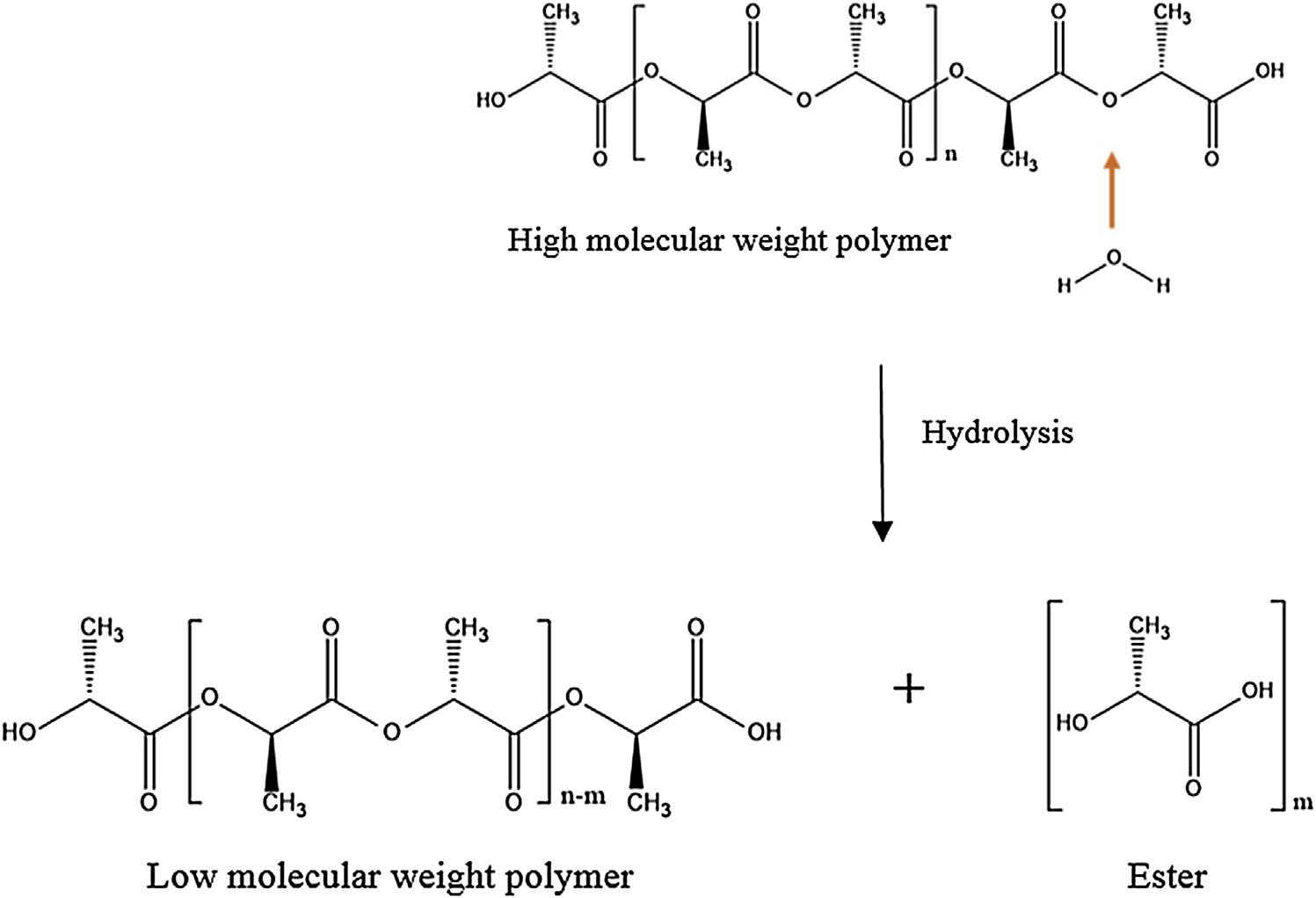
Degradationprocessofpoly(lacticacid).
ofPLAisnotbiodegradationasforotherpolymers,butitiscommonlytermedasa biodegradablematerial.Thedecomposedcomponentsbecomenutrientsinthe biosphere.Forinstance,PLAcouldbehydrolyzedinboilingwaterorbyheatingsteamto LAasarecycledmonomer.Aurasetal.degradedPLLAto L-LAbyhydrolysisat 180 350 Cfor30min [39].Underalkalineconditions,PLAwasobservedtoreleasedimersinthedepolymerizationprocess [66].
Inacompostingenvironment,PLAhasbeenreportedtobedecomposedbyaccelerateddegradationinmanystudies.HeterogeneousPLAmixingwithmicrobialpopulationsfromprecompostedyardwasteinamoist,warm,andaerobicenvironment causeddecompositionintocarbondioxideandwaterwithin90days [67].Toshinorietal. (2002)reporteddecompositionoffoodresidueasthecompostingmaterial,inwhichPLA filmsamples,bandsamples,andropesamplesdecomposedin6weeks [68].
Innature,PLAproductsaretotallydegradedinsoilorcompostinseveralweeksby esterases,proteases,andlipasesreleasedbyfungiorbacteriasuchas Lentzea, Streptoalloteichus,and Amycolatopsis ofthePseudonocardiaceaefamily [69 71].
PLAistheoneofthemostpromisingandpopularbiodegradablepolymersbecauseof someidealproperties:lowweight,lowprocessingtemperature(comparedtometaland glass),noenvironmentalpollution,goodprintability,andeaseofconversioninto