
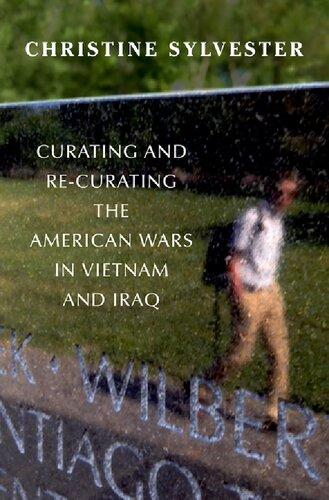
https://ebookmass.com/product/curating-and-re-curating-the-
Instant digital products (PDF, ePub, MOBI) ready for you
Download now and discover formats that fit your needs...
Planning to Fail: The US Wars in Vietnam, Iraq, and Afghanistan Lebovic
https://ebookmass.com/product/planning-to-fail-the-us-wars-in-vietnamiraq-and-afghanistan-lebovic/ ebookmass.com
History Wars: The Enola Gay and Other Battles for the American Past
https://ebookmass.com/product/history-wars-the-enola-gay-and-otherbattles-for-the-american-past/
ebookmass.com
Legal Realisms: The American Novel Under Reconstruction
Christine Holbo
https://ebookmass.com/product/legal-realisms-the-american-novel-underreconstruction-christine-holbo/
ebookmass.com
Analysis and Design of Prestressed Concrete Di Hu
https://ebookmass.com/product/analysis-and-design-of-prestressedconcrete-di-hu/
ebookmass.com

Shapes of Tourism Employment: HRM in the Worlds of Hotels and Air Transport 1st Edition Gwenaelle Grefe
https://ebookmass.com/product/shapes-of-tourism-employment-hrm-in-theworlds-of-hotels-and-air-transport-1st-edition-gwenaelle-grefe/
ebookmass.com
Change Proof: Leveraging the Power of Uncertainty to Build Long-term Resilience Adam Markel
https://ebookmass.com/product/change-proof-leveraging-the-power-ofuncertainty-to-build-long-term-resilience-adam-markel/
ebookmass.com
IB English A: Language and Literature IB English A: Language and Literature Course Book 2nd Edition Brian Chanen
https://ebookmass.com/product/ib-english-a-language-and-literature-ibenglish-a-language-and-literature-course-book-2nd-edition-brianchanen/
ebookmass.com
The Two-Income Trap: Why Parents Are Choosing to Stay Home Venker
https://ebookmass.com/product/the-two-income-trap-why-parents-arechoosing-to-stay-home-venker/
ebookmass.com
eBook Online Access for The Physical Universe 16th Edition, (Ebook PDF)
https://ebookmass.com/product/ebook-online-access-for-the-physicaluniverse-16th-edition-ebook-pdf/
ebookmass.com



Practical Guide to Clinical Data Management 3rd Edition –
Ebook PDF Version
https://ebookmass.com/product/practical-guide-to-clinical-datamanagement-3rd-edition-ebook-pdf-version/
ebookmass.com

Curating and Re-Curating the American Wars in Vietnam and Iraq
Curating and Re-Curating the American Wars in Vietnam and Iraq
Christine s ylvester
Oxford University Press is a department of the University of Oxford. It furthers the University’s objective of excellence in research, scholarship, and education by publishing worldwide. Oxford is a registered trade mark of Oxford University Press in the UK and certain other countries.
Published in the United States of America by Oxford University Press 198 Madison Avenue, New York, NY 10016, United States of America.
© Oxford University Press 2019
All rights reserved. No part of this publication may be reproduced, stored in a retrieval system, or transmitted, in any form or by any means, without the prior permission in writing of Oxford University Press, or as expressly permitted by law, by license, or under terms agreed with the appropriate reproduction rights organization. Inquiries concerning reproduction outside the scope of the above should be sent to the Rights Department, Oxford University Press, at the address above.
You must not circulate this work in any other form and you must impose this same condition on any acquirer.
CIP data is on file at the Library of Congress
ISBN 978–0–19–084055–6
9 8 7 6 5 4 3 2 1
Printed by Sheridan Books, Inc., United States of America
Acknowledgments and Preface vii
Introduction: Whose Wars Are on View? 1
PART I | Commemorating the American Wars in Vietnam and Iraq
1 America’s Wars in Vietnam and Iraq 21
2 Museums, Memorials, and Novels as Sites of War Knowledge 45
PART II | Curating Memory and Knowledge of American Wars in Vietnam and Iraq
3 The Smithsonian Curates America’s Wars in Vietnam and Iraq 73
4 The American Wars in Vietnam and Iraq at a Memorial, Cemetery, and a Traveling Tribute to Veterans 102
5 Bodies of War Curate the American Wars in Vietnam and Iraq 139
6 Remembering, Forgetting, Curating, and Re-Curating War 169
Appendix 183 Notes 185 References 197
Index 211
ACKNOWLEDGMENTS AND PREFACE
This project focusing on two wars and three genres of war displays has taken up most of my time for two years. It would have taken even more time had I not received a one-year faculty fellowship at the University of Connecticut’s Humanities Institute to research and writeup this study. Among many people to thank, the first is Michael Lynch and all staff and fellows of the Institute (and the external reviewers) who encouraged this project. Lynch directs the Humanities Institute, oversees a funded project on Humility and Conviction in Public Life, and has numerous books; my favorite at this moment in America is True to Life: Why Truth Matters (Bradford, 2005). Cathy Schlund-Vials of the Asian and Asian-American Studies program, another valued colleague, read my proposal for the Humanities Institute and offered important suggestions. The go-to person on all things Vietnamese, she is the author of War, Genocide, and Justice: Cambodian American Memory Work (Minnesota, 2012). Huge appreciation to both.
Others to thank at UConn include Micki McElya, a History colleague, for good times during this project (Gaga anyone?) and for ensuring I would not make mistakes in characterizing Arlington Cemetery—she of The Politics of Mourning: Death and Honor in Arlington National Cemetery (Harvard, 2016). Eleni Coundouriotis is in the Department of English, and as soon as I arrived at UConn in 2012, she brought me into her interdisciplinary yearlong program on studying war and asked probing questions on my work. She is the author of The People’s Right to the Novel: War Fiction in the Postcolony (Fordham, 2014). Alexis Boylan, art historian, colleague, friend, and concert co-conspirator with Micki, makes me laugh and keeps
me from going overboard when discussing museum curatorship. Her latest is Ashcan Art, Whiteness, and the Unspectacular Man (Bloomsbury Academic, 2017). Kudos. You are all great colleagues.
I had planned to conduct interviews for this study but abandoned that idea early on for an observational methodology requiring significant time on the ground, watching curators and visitors, assessing designs and layouts, and getting into the experiential and institutional contexts of the research without being intrusive. It turned out to be the right decision and made me work harder to grasp what I was seeing and hearing. Before making that decision I contacted David Allison, Project Director of The Price of Freedom: Americans at War exhibition at the Smithsonian National Museum of American History with a sheet of questions. I thank him for taking time to address points that were not fully formed in my mind yet. I should also say that I deliberately relinquish theory-laden analytics in most of the book, striving instead for accessible expository writing that hopefully conveys both the professional and ordinary curatorial experiences I have witnessed.
Thanks also to Christian Appy, the critical scholar of the Vietnam War, for talking about the war with my graduate class on War, the Humanities, and International Relations and also giving a public lecture on the history of American nuclear strategy; in later correspondence he improved my wording of one of his statements, thankfully. I leaned heavily on all his research including American Reckoning: The Vietnam War and Our National Identity (Penguin, 2015). Peter Molin the former military officer who writes the excellent blog Time Now: The Iraq and Afghanistan Wars in Art, Film, and Literature directed me to blog posts relevant to the literary works in Chapter 5. I appreciate his help and interest—and never fail to read his blog. I also want to thank Viet Thanh Nguyen for spending time at UConn in 2018 discussing his recent works, which I cite throughout the book: The Refugees (Grove Press, 2017), Nothing Ever Dies: Vietnam and the Memory of War (Harvard, 2016), and the Pulitzer Prize–winning novel The Sympathizer (Grove, 2015). James E. Young gets a shout-out for his stimulating Humanities Institute lecture on design and memory issues at war memorials; a jurist for the 9/11 Memorial in New York City, his recent Stages of Memory: Reflections on Memorial Art, Loss, and the Spaces Between (Massachusetts, 2016) has been indispensable. Esteemed and generous colleagues, thanks.
I also want to recognize two UConn PhD students for producing work that I cite here. Timothy Bussey, now working at Kenyon College, completed his doctorate under my supervision in 2018 on the “Lavender Security
Threats: Understanding the Histories of Discrimination Against Gay and Lesbian Persons in the American Military and Intelligence Communities.” It is cutting edge. Dabney Waring wrote an inspiring class paper on the Vietnam Veterans Memorial: “Capturing Surplus Memory: Symbolic Failure and Political Absence.” Both have brilliant careers ahead of them.
Now the more personal thanks. Michael Weil, my wonderful British husband, was (mostly) heroic during this ten-hours-a-day project. His help was invaluable on research trips and at home when my cranky computer acted up. His own interests in the Vietnam War run deep, stimulated by American Studies and the American draft dodgers he knew while living in Sweden during the Vietnam War. Michael’s stash of materials relevant to this research also saved me many trips to the library. Big, big thanks to a cool dude.
To my supporters in Mystic: Bibi, Mary, Lori, Maya, and Maryann, thanks for food, conversation, and friendship. To enduring Flagstaff friends: Hi-fives to Karen, Debra, Dave, and Dmitri, all of whom remain intense political interlocutors, as is Julie in Phoenix.
This has been a homegirl project. The main financial contributors, to whom I am most grateful, were the Humanities Institute, the Humanities Book support award committee, the Scholarship Facilitation Fund, the Department of Political Science, and the program in Women’s, Gender, and Sexualities Studies, all at the University of Connecticut. Most of the images in this book reflect the generosity of the artists and assistance of many people and galleries. Special thanks to the Kehinde Wiley Studio; Catherine Dowman; the National Gallery of Australia and the PollockKrasner Foundation/Artist Rights Society; National Museum of American History (Kay Peterson, Archives Center); and the National Portrait Gallery (Deborah Sisum, Head of New Media and Production).
Cheers all and errors all mine.
Christine Sylvester December 2018
Mystic, Connecticut
Curating and Re-Curating the American Wars in Vietnam and Iraq
Introduction
whose wArs Are on View?
1994,
Canberra
I was not au fait with the collection of the National Gallery of Australia before my initial visit in 1994. I knew the museum was in its infancy relative to encyclopedic art museums of Europe and the United States, yet quickly realized that it possessed an impressive, albeit limited, collection of modernist works from Australia and the world. Rounding the corner of a central exhibition space that first day, I remember entering a somewhat smaller room to the side. There, on the wall straight ahead, was a large colorful abstract painting. I did not know it at first sight as Jackson Pollock’s Blue Poles (1952, see color insert 1). I just saw a picture that stunned me, held me in its gaze, and forced my gaze onto it for longer than a work of art had before. And the painting kept beckoning me back. I spent hours, weeks, with Blue Poles during the years I worked at the then National Center for Development Studies at the Australian National University. I was around it so often I became an object of some curiosity at the National Gallery of Australia.
Initially, the attraction was the mess of colors, the daring and bold paint application and the thundering beat and guitar riffs rolling off it. I recall inspecting every inch of the painting, from left to right and then from right to left, up from down, down from up, as if it held secrets I could decipher. It sure did, and the secrets I learned were actually out in the open. Embedded in Blue Poles was an international war relations that splashed out American energies and aspirations going haywire during the cold war, so haywire that bountiful colors running gorgeously amuck had to be contained by eight painted poles; I interpreted these, unconventionally, as military-grade assault rifles (Sylvester, 1996).
The Australians purchased Blue Poles in 1973, setting off a political brouhaha that helped topple Prime Minister Gough Whitlam. One big issue was the price of the painting—AUD$1.3 million, or USD$2 million, hefty for a modernist work at that time, and paid from public coffers. The timing of the purchase during the waning days of the unpopular American war in Vietnam was also a problem. Australia had fought alongside American forces from 1965 to 1972, even as scores of people at home demanded it pull out. Whitlam admired this painting that broke with tradition, something he hoped to do in Australia throughout his political tenure; but he also remarked, humorously when challenged, that “it was a form of overseas aid, an attempt to redress the adverse state of America’s [Vietnam era] balance of payments” (Barrett, 2001: 2). Whitlam was as quirky and bold as the painting. “No Australian political leader had even cared or dared align themselves so closely, so publicly, with questions of art and aesthetics” (p. 2). His embrace of Blue Poles was also total: he even put the painting’s image on the official prime minister’s Christmas card. The big American splash-out was like a personal logo, Whitlam’s proof of intent to move Australia into the global era and do so with panache. So confident of his judgment was Whitlam that he sent “his” painting off on a countrywide tour six months after its acquisition for the entire nation to appreciate. That did not go well. Many people went to see the famous painting hoping to find something they could identify in it—a figure, a landscape, a portrait. From remarks at the time, it is clear that many wondered if perhaps they were looking at the work of an overexcited child left alone with color tubes. And the distaste was not short-lived. As late as 1994, more than twenty years after the purchase, a middle-class family stood in front of the painting at the National Gallery of Australia and pronounced it to me—who was attending my own business—“repulsive, not worth the money.” Theirs was not an outlier or lagged reaction. Blue Poles was not embraced by the Australian viewing public early on, just as abstract expressionism was unpopular with average Americans when it first came on view. But even years later, this family would not acquiesce to the political decision to purchase Blue Poles; not acquiesce to an aesthetic they disliked. Unconvinced Australian art viewers made it clear that public consent to an official line can be thin or nonexistent, defying the efforts of experts to define “for subordinate groups what is realistic and what is not realistic” (Scott, 1990: 102).1
Meanwhile, I fell deeper into the stories cum aesthetics of the painting and witnessed with some chagrin very experienced museum docents striving to sell the painting’s virtues to a persistently skeptical public.
I overheard enough conversations at the picture in the 1990s to realize that average Australians could not understand why this cultural object from America was a big deal at all, let alone for Australia. Even into the early millennium years I heard docents resorting to parlor international relations to persuade viewers of its worth: “the United States is jealous of us because we are the ones who have this painting.” It was all so audacious: a great American painting hanging in the Australian capital against the backdrop of a bad war in Vietnam that Australia helped Americans shoulder to the end; remarkable public disdain for a work some called a gimmick; and the jumble of vibrant colors with potentially sinister weapons that make up big Blue Poles. That painting was the war object tucked most tightly in my mind as I took up this project.2
Who is an authority on a war, able to truly experience it, represent it, and influence public discourse about it? The Pentagon? Leading politicians? Allies? Academic specialists in war studies? Various branches of the media? Soldiers? Victims of war? Antiwar protesters? Families of those who fight or die? Ordinary people going about their business in and out of war zones? Paintings? Curators of war exhibitions? War novelists? Whose war knowledge is displayed where and how, and with what impact? War is violent, armed politics intended to inflict injury on the bodies and societies of those it engages, whether directly or as “collateral damage” to buildings and bodies nearby (Scarry, 1985; Sylvester, 2013a). War is often studied, however, from a state-centric perspective, as in one country or coalition bringing collective violence to bear on other states. We know from instances of war in the past and present that armed identity groups can wage war against each other, against civilians, and against and with states simultaneously. One need only think today of the ISIS phenomenon that grew out of wars in Iraq and Syria, or Boko Haram in parts of West and North Africa, or the shifting militias that regularly form and re-form in the Democratic Republic of Congo. Although it is tempting to believe that war is an exceptional politics, or war afflicts only some parts of the world, war is transhistorical, transnational, and transcultural. It is a global social institution along with other long-standing institutions such as family, religion, and gender. No location is absent war preparation, war talk, war waging, war denunciation, or war celebration. Yet there are differences between wars of the past and many current wars. Whereas the world wars of the twentieth century were declared, carried out mainly by state militaries, and usually ended in clear victories and peace treaties, it can be difficult
to discern all the forces involved in some of today’s wars, let alone imagine what a “win” would look like in some of them. Wars can go on and on in various forms and with forces and raison d’état changing over time. War is so normalized that it has entered everyday lexicon in the United States: “war” on drugs, war on crime, war on poverty, war on cancer. Some will remember talk about a peace dividend at the end of the cold war. With the demise of the Soviet Union, the post–cold war period would mark a new beginning for diplomacy over conflict. It turned out, however, to be a period full of conflict that carried on relentlessly and leeched into the contemporary moment, putting many societies on edge today. Cynicism is rampant about international institutions established after World War II to promote cooperation, resolve disagreements and assist with emergencies, institutions like the European Union, the United Nations, and the Bretton Woods financial regulators. According to voters in the United Kingdom and the United States in 2016, it is better to go it on one’s own than embrace, for example, the successful EU regional community. In the era of human rights, life is also remarkably cheap. Guns are more readily available around the world than regular sources of nutrition, and they are frequently used to settle disagreements (Overton, 2016); even a head of state who received a Nobel Peace Prize allowed guns to turn on a minority group in Myanmar. War concerns have pumped up military budgets in the United States, Russia, China, and North Korea. Violent militant groups regularly spill across areas of North Africa, the Middle East, and Latin America, as do American special operations involved in so many conflicts that some call this the era of forever war (Filkins, 2009).
A New York Times editorial pleaded in October 2017 “it is time to take stock of how broadly American forces are already committed to far-flung regions and to begin thinking hard about how much of that investment is necessary, how long it should continue and whether there is a strategy beyond just killing terrorists.” By its count, “the United States has been at war continuously since the attacks of 9/11 and now has just over 240,000 active-duty and reserve troops in at least 172 countries and territories.”3
I argue that contemporary wars cannot be apprehended through one perspective, methodology, vantage point, or theory. There is no ultimate cause or center in what Mary Kaldor (1999) called the new wars. Wars might start under one authority or in one location and change as new commanders, social forces, and goals emerge from the crucible of violence. Foucauldians say power begets power. In Iraq, the American shock and awe bombardment of Baghdad that aimed to produce a short, decisive war, produced instead a variety of new power centers that culminated in
ISIS, a war force that did not exist as such in 2003. Vietnam had gone just as badly as shadowy power centers bogged down the United States in a war that neither superior airpower nor plentiful infantry patrols could tame. The pathways along both wars are strewn with dead bodies of soldiers and civilians, ours and theirs and each side’s allies—corpses of two wars the United States chose to start and did not win.
In this book, I look for knowledge of America’s failed wars in Vietnam and Iraq in places that can seem secondary or tangential to the usual locations and kinds of actors accorded authority on war. I look in museums, memorials, a cemetery, and on the pages of war novels and memoirs. Whose experiences and memories of these wars qualify for public viewing and whose war is out of the picture at these sites? What is the arc of politics at each venue of war knowledge? In the field I know best, international relations, people and their prosaic memories, cherished objects of war, and struggles with loss get kicked to the curb for a preferred focus on higher level war causes, war types, war strategies, weapons systems, and other power-laden considerations. The main proposition underlying this project is that unless people, public places of commemoration, and untold “ordinary” war experiences are brought into war studies, in international relations and other social science fields, wars cannot be comprehended in the round as politics and practice, preparation and execution, injury and exhilaration, memory and multicentered knowledge (Sylvester, 2011a, 2011b, 2013a, 2015). The picture of any war will always be massively incomplete when the people who experience war are assigned back-lot positions in a statist drama.
America’s Wars in Vietnam and Iraq
Americans are regularly in wars and have been since World War II and the cold war era that followed. Vietnam was the site of one war that became just as unpopular among the public in the United States as it was in Australia. Americans lost that war ignominiously, their first such defeat. In the aftermath, the military lost its vaunted reputation, a government in Washington fell—in a sense, when Lyndon Johnson announced he would not seek reelection to the presidency—and many Americans snubbed their war veterans when they returned stateside. Over fifteen years that war had produced 58,000-plus dead Americans, upward of 3 million dead Vietnamese, and around a million Cambodian and Laotian casualties. In the end, the Vietnamese communists won the American war in their
country, and the party reigns there today. Yet so many decades later, that unsuccessful, humiliating war fascinates elements of the American public, not least its booming war-memory industry. The Vietnam War is the subject of numerous written and cinematic accounts, as well as object displays in museums, at war memorials and in cemeteries. It is also a conflict many ordinary Americans experienced in some way and can reconstruct in considerable personal detail, as Viet Thanh Nguyen’s works, which appear throughout this book, demonstrate. Children of American military and Vietnamese women, now in their forties, can still seek ways to remember their fathers. Refugees from the war live in vibrant communities in the United States that have erected their own memorials to the war. Generations that remember the war, know family war stories, actually fought with or worked alongside the American military, keep the war memories alive in important prosaic ways that can get lost or minimized in the usual historiographies.
The American war in Iraq began roughly thirty years after the American war in Vietnam ended; it officially finished in late 2011 with the withdrawal of US troops. The United States undertook the war while still attacking Afghanistan for enabling the 9/11 tragedies in New York, Pennsylvania, and Virginia. At that moment, fear and shock across America lent plausibility to the idea that a quick air attack on Baghdad would drive out a regime that survived President George H. W. Bush’s 1991 Desert Storm war to save Kuwait and could turn its ire on the United States. Bush’s son was president in 2003 and claimed Saddam Hussein was harboring weapons of mass destruction to use against the United States in alliance with al-Qaeda. The administration was able to convince the United Nations and a coalition of international forces, Australia among them, to help save the world from Iraq. The war commenced in March 2003. It was still carrying on in various forms in 2017. Neither rationale for it was accurate: to this day, no weapons of mass destruction have been found in Iraq and no government links with al-Qaeda have surfaced. At the time, however, a frightened and angry American public was primed to buy the line that Iraq was an existential threat to the United States and had to be handled immediately. When the administration could not come up with evidence to back up its justifications for war, the Bush administration tried shifting its rationale to the promotion of democracy and liberation of Iraqi women. By 2006, however, polls showed “more than 60% of the public opposed the war” (Appy, 2015: 305), while 72% of “American troops in Iraq said the United States should withdraw within a year” (p. 315). Altogether, the hapless American war in Iraq amassed an American military casualty
count near 5,000 and Iraqi casualties estimated at over 250,000 by late 2016 (www.iraqbodycount.org).
Iraq was not only another war the United States was unable to win (Bolger, 2014; Bailey and Immerman, 2015). It was a war that created many more problems than it solved, paving the way for ISIS and its offshoots operating in West Africa, for terrorist attacks against civilians in the West, and for an unprecedented surge of refugees fleeing expanding war zones. And the war is not over as I write. The Pentagon is still present in Iraq mainly as military “advisers” to the government.4 Efforts of antiwar groups like Iraq Veterans Against the War and Code Pink (Rowe, 2013) notwithstanding, the US public has had less information about that American incursion than it had about daily and even hourly aspects of the war in Vietnam. Silence on the actual conduct of the war, including casualties sustained on both sides, has provided an opportunity for American veterans of the Iraq war to be hailed unquestioningly as exemplary heroes of our time, though few people know anything about their duties in Iraq.
Having lived outside the United States much of my professional life, I find these post-9/11 American rituals cringe-worthy. Many American heroes go unlauded under a current regime of militarist truth, among them cancer researchers and educators who try to protect students from school shooters. When I voice that view, people look at me in amazement. Hallelujahs for the military have reached such a crescendo that those who resist them can be disciplined and punished by fellow citizens. Remain seated as the New York Yankees celebrate the military at their seventh inning stretch and you wind up picking gum out of your hair. If you are a sports star, a public show of even mild disapproval of America’s problem at home with inequality can lead to death threats on social media, unemployment, lost commercial endorsements, and Twitter attacks by the US president.5 The story of America at this time has recycled its war instrumentalities and the themes it likes best of a force for good at home and in the world (Cunningham, 2004). My interest is to ascertain how a range of unacknowledged authorities on the American wars in Vietnam and Iraq curate those two wars today under the bright lights of renewed militarism.
The Backdrop: Militarism in Our Time
This book has been written at a particular moment in American history. It is a time that sees the United States struggling with numerous aftermaths
of its interventions in Afghanistan and Iraq, and a time of covert military operations the American public is often not allowed to know about let alone glimpse. It is a moment when the only regularly feted herocitizens have served the country in one primary way: through the military. America at war is such a sacralized aspect of national life that details of each war have little newsworthiness. I regularly teach courses on the wars of our time to university students at the flagship state university in progressive Connecticut. The students rarely know much about them, claiming, “Our American history classes in high school ended just as we got to the Vietnam War.” They stand and holler for military personnel celebrated at sporting events because “Americans have always done that, haven’t they”; my advice on that view is to talk to a Vietnam War veteran. For many of today’s students, militarism does not have a name. It is just how things are in patriotic America: we have to fight enemies that challenge “us” from many beachheads.
Iraq War veteran Roy Scranton (2016b, SR7) says the latest version of militarism grows out of a long-standing and rejuvenated myth that “war is how we show ourselves that we’re heroes. Whom we’re fighting against or why doesn’t matter as much as the violence itself, our stoic willingness to shed blood, the promise that it will renew the body politic.” He is critical of American militarism, but it is exactly that normalized militarism that some of my students accept without question. Richard Slotkin (1973) earlier traced a strand of warrior America to the early days of a settler country that saw Native Americans and European “tyrants” as threats to its freedom. Today’s version is liberal militarism, which Victoria Basham (2018: 32) finds operating “when military actions and preparedness become meaningful responses to threats posed to the social body, not just the state.” American militarism takes sustenance from the global geopolitical edginess of the times. Partnered with a myth that war refreshes the country, no matter its target or outcome, the result can be a widespread conviction that Americans today have freedom only because some citizens fight for it. The warrior-America formula conveniently leaps over all the threats to American society of our own making—racism, sexism, and economic inequality among them.
Andrew Bacevich (2010, 2013) writes extensively about the military in contemporary American culture and offers two additional factors to account for recent militarism and soldier love. One is the all-volunteer military established late in the American war in Vietnam, which grew a professional organization so shielded from public accountability that the Department of Defense can operate today like a corporation guarding its
business plans and practices from public scrutiny. Richard Nixon ended the draft in some measure to quell raging public sentiment against the American war in Vietnam. Thirty years later, George W. Bush could count on public acquiescence to war against Afghanistan in part because there was no draft and no need to place the economy on a war footing. George W. Bush’s earnest message to America shortly after 9/11 was to trust the professional military to handle the terrorists. As Bacevich retorts, a public that knows little about wars Washington conducts is likely to support any American war as long as the fighting is left to others.6 As for politicians, “as long as they make a show of supporting the troops, they are able to evade accountability” (Bacevich, 2018: 27). Separation from the daily mechanics of war has enabled militarist thinking to drill down so deep that Bacevich calls it America’s civic religion. Certainly it “is a powerful producer of historical narratives, particularly those that serve to justify and legitimize not just the use of violence in global affairs but also the economic and social organization of the polity required to produce the capability for such violence” (Davis and Philpott, 2012: 49).
Not surprisingly, war situations in which American military behave dishonorably, suffer debilitating post-traumatic stress, or die in service can be less visible in today’s militarist time. So are nearly all the people on the other sides of our wars. American civilians carrying on normal activities at home can ignore everything going on “over there” and everyone affected. Issues emerge only with a catastrophic event—American or Russian forces shell an apartment building in Syria or Yemen or target hospital facilities “by mistake.”7 As journalists have been disallowed from independently roaming war zones in Afghanistan and Iraq, as some did in Vietnam, many Americans have no way to conjure the war that local people experience; even the visual images local artists create are often out of sight (Wessels, 2015). Ignored, denied authority, or overdubbed by patriotic phrases with greeting card cadences are many decentralized voices and memories of the war.
A general acceptance of militarism in the United States can be seen in indifferent reactions to disclosures that would have alarmed Americans during the war in Vietnam. In November 2015, then Arizona Senators John McCain and Jeff Flake reported that many patriotic displays staged at major sporting events were clandestinely orchestrated and financed by the Department of Defense as vehicles for military recruitment. The two senators denounced the practice as “paid patriotism” and requested all institutional recipients return taxpayer money used for such performances (Barron-Lopez and Waldron, 2015). Although the incendiary report made the papers and evening news, the public did not react. Americans were
accustomed to such activities by then, including the caveat in George W. Bush’s federal education policy of No Child Left Behind that allowed military recruitment in public high schools (Enloe, 2010). Remarkably, there was little organized parental backlash to the idea that military personnel could appear in school lunchrooms on a regular basis, and they could gather the names of high school seniors and send those names to the Department of Defense. Accustomed to everyday militarism, militarization of civilian spaces would seem par for the course.
It is important to be aware of the current national acceptance of militarism when considering curatorial displays of America’s wars in Vietnam and Iraq. In today’s climate, military failings get wrapped in mantras of war glory and soldier heroism, which is one reason this book looks away from the American state and its military wings to places where militarist war knowledge might not rule.
The Research Sites
Recognizing I would have missed aspects of the American and Australian war in Vietnam had I not entered a museum and noticed Blue Poles, the focus here is on the kinds of knowledge of America’s wars in Vietnam and Iraq that comes through textual and object displays. I entered such spaces not as an art historian, museum professional, war survivor, war historian, or literary analyst. I entered as a student of international relations seeking war knowledge in places my field would reject as nonauthoritative. I have looked to see whether objects and themes that a variety of war curators— professional and ordinary—assemble and display reflect today’s militarist values or send other messages to viewers. As for novels and memoirs, those platforms explicitly foreground war as myriad experiences of violent social interactions that are routinely passed over at other memorial venues.
Museum displays are first in the lineup. I focus on two institutions in the Smithsonian system: the National Museum of American History primarily and, to a lesser extent, the National Air and Space Museum and annex (the Stephen F. Udvar-Hazy Center) near Dulles International Airport. Partly supported by government funds, and laying claim in their titles to the “national,” it would be surprising if military themes did not lead in exhibits there. Nonetheless, Smithsonian curators are museum professionals tasked with arranging displays that can “inspire a broader understanding of our nation and its many peoples . . . [with] exhibitions and programs as accessible as possible to all visitors.”8 To fulfill that mission would seem to require
some attention to diverse views, participants, and moments of national success and failure. Of interest here is how each museum presents aspects of the American wars in Vietnam and Iraq via object displays, design elements, and informational texts, and the assumptions underlying curatorial choices.
A second set of display locations encompasses the Vietnam Veterans Memorial and Arlington National Cemetery. Both sites exist only because war produces military mortalities. The Memorial lists names of the American armed forces who died in Vietnam at a built site where members of communities of war loss and others present objects that individualize the names. The Vietnam Veterans Memorial has been so well received by the public that a facsimile is trucked to towns across America for even more people to see; I observed two of these mobile memorials when they came to West Haven and Preston Connecticut in October and November 2016. Directly across the Potomac River from the Vietnam Veterans Memorial is Arlington National Cemetery, where 430,000 American military, dignitaries, and family members are buried. Section 60 is reserved for military deaths that occurred in Afghanistan and Iraq. There, as at the Vietnam Veterans Memorial, people engage in what I term “ordinary curating” to show memento mori that reflect on a time period, a war, and known individuals laid to rest there; most leavings display elements of everyday people who became American soldiers, ordinary curators having been schooled in experiences of war mortality not war hosannas.
I also read many novels and memoirs of the American wars in Vietnam and Iraq with an eye on how the authors curate small moments of war in experiential terms.9 Memoirs face personal experiences directly while war novels can avoid “the perils of telling” that remembering in exact detail can enkindle.10 In either case, the writer can be thought of as curating miniatures of the wars they imagine or have experienced in part. Their tales slice into and through tropes of patriotism and gallant service to deliver tight shots of deadly practices, dodgy orders followed or refused, ethical dilemmas at every turn, and sights and rationales that disturb or calm the mind. Literary expositions of civilian war experiences present the social relations of war in situ, something social science treatments of war can miss or choose to ignore.
Curating War
Curation is associated with museum practices of collecting, archiving, organizing, and displaying material objects in ways that convey meaning
to viewers. The museum curator is a professional “who enables the knowing of others” and their things (Hooper-Greenhill, 1992: 168). Of course, viewer subjectivities influence how they interpret the knowledge presented to them, which means the visitor takeaway from any exhibition can differ greatly from the intent of professional curators (Pugliese, 2006). Much of the time, however, museum visitors view “fully completed and immaculately presented displays” (Hooper-Greenhill, 1992: 7), having as little knowledge of the decision rules the curators apply as they have, say, of today’s wars. Curators craft displays as expert authorities on a subject. Visitors mostly admire, accept, and imbibe the curator knowledge.
Professionally trained curators are said to bring a “gaze” to their ensembles (Bryson, 1988; Harris, 2001) that guides object selection. A gaze is a way of looking at, placing, and evaluating a work that relies on the authority of usual practice or accumulated expertise. Feminist scholars, for example, talk about a male gaze guiding art history traditions populated with female nudes, nudes of men less so, and with women depicted in passive domestic poses. Those preferences show the normalization of masculine gaze in outlooks, interests, and social privileges transferred to art appreciation (Mulvey, 1989; Kleinfelder, 1993; Broude and Garrard, 1992). Arguably, a kindred war gaze foregrounds men doing war using characteristic objects like rifles, cannons, and grenades. Women, if they appear at all, do so as nurses attending wounded men rather than combatants wounding men through their own war efforts. Jean Bethke Elshtain (1987) presented the gendered gaze on war as a binary of “just warriors” and “beautiful souls.” Jean Gallagher (1998: 3; emphasis in original) says “men ‘see battle’; women, as noncombatants par excellence do not.” Today, women may participate in warring, if they meet the standards set for men. The question this raises is whether and how some curators of war replicate or repudiate the gendered gaze in their displays. It applies equally to writers and object curations that condense panoramic wars into details that do not appear in other kinds of war displays. Whose war gaze orders the curated words?
What curators present as knowledge and students of war learn about America’s wars in Vietnam and Iraq from sites of curation is part of the larger question of war authority. Each display presents opportunities to visualize a war through a curator’s gaze. To ponder how war is displayed where is to consider whether some curations draw viewers into complicity with militarist myths of American wars or challenge conventional wisdom, knowingly or not, through curations that show alternative war knowledge.