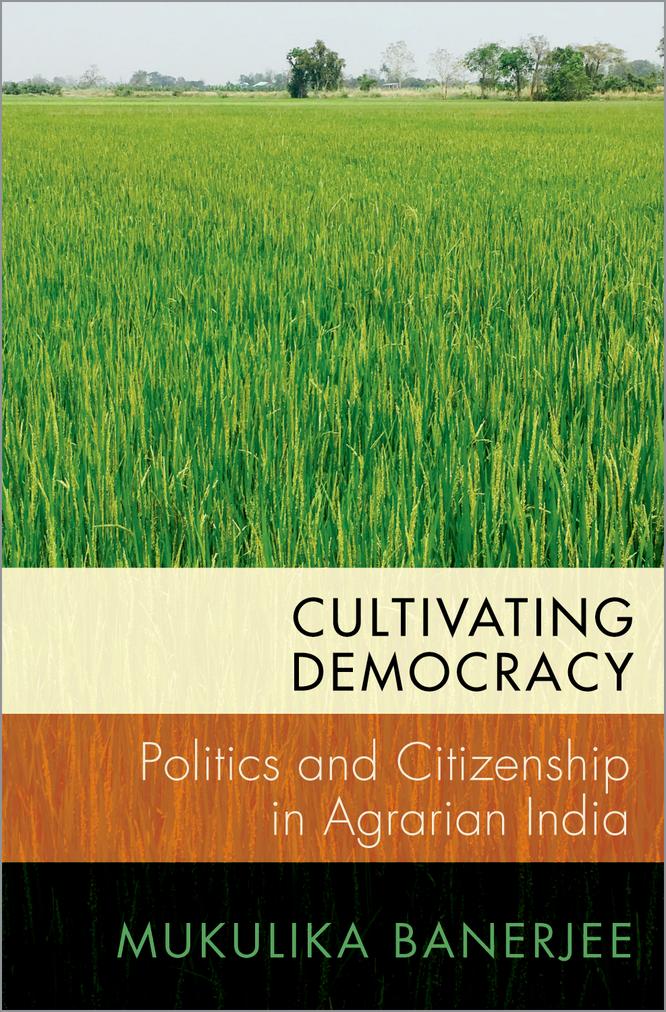
Cultivating Democracy
Politics and Citizenship in Agrarian India
MUKULIKA BANERJEE
Oxford University Press is a department of the University of Oxford. It furthers the University’s objective of excellence in research, scholarship, and education by publishing worldwide. Oxford is a registered trade mark of Oxford University Press in the UK and certain other countries.
Published in the United States of America by Oxford University Press 198 Madison Avenue, New York, NY 10016, United States of America.
© Oxford University Press 2022
All rights reserved. No part of this publication may be reproduced, stored in a retrieval system, or transmitted, in any form or by any means, without the prior permission in writing of Oxford University Press, or as expressly permitted by law, by license, or under terms agreed with the appropriate reproduction rights organization. Inquiries concerning reproduction outside the scope of the above should be sent to the Rights Department, Oxford University Press, at the address above.
You must not circulate this work in any other form and you must impose this same condition on any acquirer.
CIP data is on file at the Library of Congress
ISBN 978–0–19–760187–7 (pbk.)
ISBN 978–0–19–760186–0 (hbk.)
DOI: 10.1093/oso/9780197601860.001.0001
1 3 5 7 9 8 6 4 2
Paperback printed by LSC communications, United States of America Hardback printed by Bridgeport National Bindery, Inc., United States of America
For Julian
Like the sailor, the citizen is a member of a community. Now, sailors have different functions, for one of them is a rower, another a pilot, and a third a lookout man, a fourth is described by some similar term; and while the precise definition of each individual’s virtue applies exclusively to him, there is, at the same time, a common definition applicable to them all. For they have, all of them, a common object which is safety in navigation. Similarly, one citizen differs from another, but the salvation of the community is the common business of them all. This community is the Constitution; the virtue of the citizen must therefore be relative to the constitution of which he is a member.
Aristotle on the “General Notion of the Virtue of Citizen” in Politics
Constitutional morality is not a natural sentiment. It has to be cultivated. We must realize that our people have yet to learn it. Democracy in India is only a top-dressing on an Indian soil which is essentially undemocratic.
B. R. Ambedkar, Constituent Assembly Debates (1948)
There is no single word in the entire history of human speech to and through which more has happened than the word democracy, not even word God, though over an even lengthier time the words for God or gods have proved still harder to translate between the languages of the world. At least in the countries of the West, and probably now across the world as a whole, one salient prerequisite for improving political judgement is to recognize just what has recently happened to and through the still sometimes-charismatic but almost never clarificatory term democracy.
John Dunn, Breaking Democracy’s Spell (2014: 5–6)
Democracy is, in fact, part of the political enchantment of modernity. It introduces a new principle of the political construction of society which leads to exhilarating moment – by making some unprecedented changes possible. But it also leads to despair by making people expect too much, often by turning the conception
of democracy – in some forms of naïve thinking – into a secular equivalent of paradise. . . . Indian democracy is in fact a historical scandal because it defies all the postulated prior conditions . . . . India provides one example of the expansion of democracy in a world within which Europe does not constitute the whole of the continent of democracy, but a province.
Sudipta Kaviraj, The Enchantment of Democracy and India (2011: 1, 13–14, 22)
We produce knowledge in a mode of intimacy with our subjects. Hence ethnography as a genre seems to be a form of knowledge in which I come to acknowledge my own experience within a scene of alterity. After all, it is the nature of everyday life that the significance of events is not given at the moment of their occurrence and it is in the nature of experience that its meaning eludes us . . . In being attentive to the life of others we also give meaning to our lives.
Veena
Das, Between Words and Lives (2015: 404)
2.
3. Scandal: Cultivating Competition
4. Harvest: Cultivating Cooperation
5. Sacrifice: Cultivating Faith
6. Election: Cultivating Citizenship
Preface
This book was completed in the middle of a pandemic that revealed the fragility of held certainties. An invisible virus about which science knew little, took lives across the world forcing a halt in activities that we had come to take for granted such as travel, classroom teaching, and hugging friends. In a few weeks it also became clear that the degree of devastation in each national context depended on its quality of political leadership. Some countries did better than others and discernable patterns emerged. Democracies did not do better, as they had done in the previous century, in managing famines for instance. In fact, the worstperforming countries were all democracies, India among them. This has focused our attention on reexamining whether the twentieth-century certainty that democracy was the best-among-worst solutions of political arrangements still held true. Research and writings produced through the pandemic drew attention to the democratic cultures in a variety of national contexts and showed that formal democratic procedures did not necessarily create what was required in such times, namely a democracy of spirit of civic commitment and trust in government. These had to be cultivated and nurtured alongside the formal structures. The recent turn in formal democracies to polarized opinions and trust in strong men who wasted no time striving for consensus and relied instead on inflammatory and partisan utterances, did not facilitate forging a collective response to such a challenge.1 The democratic spirit was thus constantly under threat and needed to be continually regenerated.
Meanwhile, medical experts pointed out that greater civic engagement was pivotal to a successful public health campaign to manage the virus. The political lesson of the pandemic therefore was that democracies could only succeed in tackling a crisis when its citizens were active and engaged, which is the theme of this book.
As the world’s largest institutional democracy, India requires critical attention especially as it was among the world’s top three countries adversely affected by Covid-19. As the initial panic of the disease ebbed, the lack of investment in public health infrastructure that could be expected from an accountable and responsive elected government was revealed. Instead, what was introduced were a slew of laws and surveillance techniques designed to curb democratic freedoms in the guise of epidemiological measures. The pandemic has been disastrous for democratic freedoms.
The Indian government’s mismanagement of the crisis, also led to an outcome that highlights the need for one of the contributions that I hope this book will make. This outcome was the emergence of the rural as an important place in the public imagination. A sudden lockdown, at four hours’ notice without any safeguards for those who had migrated to cities in search of work, created the largest forced migration in independent India, as workers traveled back to their rural homes from cities. In this mass exodus to the rural, the village emerged as a place of refuge and of humanity, in contrast to their stereotype in the popular imagination as the source of inequity and discrimination—themes that are germane to the pages that follow.
This book covers the period from 1988 to 2013, and in hindsight it seems be a privilege to have studied democracy while it still existed in India, in defensible form at least. During this period, democracy in India functioned in its unique form, continuing to thwart the reservations expressed by many in 1947 when it chose to adopt the democratic form of government. But in recent years there have been three major changes to procedural democracy in India that have shaken the integrity of its democracy. First, the Election Commission of India, a constitutionally mandated independent body that conducts elections in India and had a hard-won reputation as the most respected public institution, has now become much less non-partisan. It no longer enjoys the electorate’s confidence in conducting free and fair elections. Second, campaign finance, which has always defied a proper regulatory framework, has now been made officially opaque. Electoral bonds were introduced in February 2015 without any parliamentary discussion, having been appended to a non-debatable “Finance Bill,” and these new instruments allowed donations to political parties to be made completely anonymously, except to the government and the state-controlled State Bank of India, which managed the transaction. In November 2019, it was revealed (unsurprisingly) that 95 percent of the money from electoral bonds had been donated to the ruling party. Third, Indians no longer vote in an altogether “secret ballot.” With the introduction of electronic voting machines, the tally for each machine per polling booth for about a thousand voters was publicly available. Parties are therefore able to intimidate and victimize areas that did not vote for them in the last election. The Election Commission did commission a machine to electronically mix votes before counting (as used to be done with paper ballot in large drums in the past), but the ruling party and others blocked its introduction. The integrity of elections and procedural democracy in India thus stand thoroughly compromised and it can be defensibly argued that elections in India have become a game to be won at any cost, and may result in the death of democracy through its own institutional forms, conforming to a script outlined by the authors of How Democracies Die (Levitsky and Ziblatt 2018).
These particular changes in procedural democracy have inevitably led to a larger transformation, recently termed the ‘degenerations of democracy’ (Calhoun, Gaonkar, and Taylor 2021). Analyzing this transformation in India, political scientists Christophe Jaffrelot and Gilles Verniers propose that the national elections of 2019 and the comprehensive win by the Bharatiya Janata Party (BJP) brought about not just a new phase in Indian electoral politics but a whole “new political system.” In a special issue of the journal Contemporary South Asia the authors
analyse electoral data and go beyond them to show that over and above changes in the party system, India is experiencing changes in its political system. Merely analysing the results of the last General Election as an outcome of a recent transformation of the party system or as a re-enactment of the previous election, is both insufficient and, to an extent, misleading. Such analysis obfuscates the changes in the BJP’s mobilization strategies and, more importantly, the transformation of India’s political institutions under BJP rule between the two elections but even more so since the May 2019 verdict. Indeed, the 2019 elections may appear retrospectively as the moment when history accelerated. (Jaffrelot and Verniers 2020: 2)
This accelerated history delivered three key changes—and each of these redefined, and threatened, the Indian republic. And each of these was met with protests from citizen groups who wished to re-claim the republic, organizing under the banner of “We, the people of India.” On August 5, 2019, the state of Jammu and Kashmir (the only Muslim majority state in the country) was divided into three parts and turned into Union Territories controlled directly by the central government. Past and current elected representatives of the state assembly were placed under house arrest, and the human rights of the entire population in Kashmir were taken away. Second, in November, the Supreme Court passed a judgement allowing the construction of a temple to Ram on the site where a sixteenth-century mosque used to stand. The mosque had been razed to the ground by thousands of young men on December 6, 1992. These two moves confirmed the Hindu majoritarian agenda of the new government and a political system that was committed to keeping India’s 200-million-strong Muslim population as second-class citizens. This was confirmed by a further comprehensive move in December 2019, when the Indian parliament passed an amendment to the Citizenship Act that gave state functionaries discretionary powers to exclude Muslims from citizenship of India. In the weeks following each of these moves, the country witnessed widespread protests as they violated the basic structure of the Indian constitution which was secular in spirit. The scale and nature of the protests varied across India and overseas but everywhere, remarkably, there
were mass recitations of the Preamble to the Indian constitution, that began with the words “We the People of India, solemnly resolve to give ourselves. . . .” These were the words all Indians dimly remembered from the frontispiece of their government-issue school textbooks and in wishing to give voice to their collective protest against the actions of a democratically elected government, they recalled those foundational words of the Indian constitution.
These seemed especially poignant during my most recent visit to my research site, the villages of Madanpur and Chishti that are the setting for this study, in September 2019 to attend the Islamic festival of Muharram.2 This time, the famous stick-fighting contest of the last day, while robust as ever, was heartbreaking. As always, teams of young men from the neighboring villages gathered in a small clearing in Madanpur to show off their skills in wielding long bamboo poles (lathi khela), and for their team “uniforms” they had chosen imitations of the Indian cricket team’s strip and they sang the song “Sarey jahaan sey achcha Hindustan hamara” (Our country is the best in the world) as their final anthem. The sight of young Muslim men and boys celebrating the nation and their attachment to it at a time when each of them was hopelessly vulnerable to random acts of public lynching and to laws that reduced them to second-class citizenship, was deeply desolate.
And yet, while India’s credibility as a democracy is in jeopardy in the middle of a pandemic, the protests against the Citizenship Amendment Act (CAA) and their afterlife provide small glimmers of hope. For when the anti-CAA protests were abruptly halted by the pandemic, in a display of civic virtue the same citizen groups that had protested to preserve India’s republic seamlessly transformed themselves into groups that untiringly provided food and care for the most vulnerable citizens and migrant workers whom the government appeared to have utterly forgotten while announcing the abrupt lockdown. As Yogendra Yadav has observed ‘mass mobilization and popular resistance outside the electoral arena are going to be prerequisites for any effective reversal of the hegemonic power’ (Yadav 2020: xxxi). These gestures by ordinary Indians serve as a reminder that it is this sense of civic duty performed by citizens and their commitment to the collective good that are essential to the cultivation of democracy. In the pages to follow, we will explore the vital necessity of these republican values in creating a democratic culture in the sovereign, democratic Republic of India.
The Event and Democracy
In April 2019, ahead of the fourteenth national elections in India, a visit to the villages I call Madanpur and Chishti revealed new developments. The Comrade, who had dominated all politics in these villages for decades, had passed away, key actors of the rival Trinamool Congress were missing, and young men rode through the village on motorcycles on which fluttered little red flags that said “Jai Shri Ram” (Victory to Lord Ram). Lord Hanuman was being enthusiastically worshipped after clay idols of this deity had mysteriously appeared under trees and on highways from where they had been retrieved and small shrines had been built for them. The Hindu majoritarian Bhartiya Janata Party (BJP) which, despite its national dominance, had yet to make a significant electoral presence in West Bengal, mobilized support around the fairs and feasts held at these shrines. Traveling across the state of West Bengal, this trend seemed widespread as it became evident that new fissures were opening up, primary among them being the one between generations. Restless and impatient young men, desperate for a new politics that they could call their own, and one that was different from the rivalry of Trinamool and the Left Front that had consumed their parents’ lives, had turned to the masculinized politics of the BJP in the hope that it would fill that void. Many of them were educated but emasculated by the dearth of employment opportunities and in the run up to the elections filled their free time by mobilizing crowds to worship Hanuman and disseminated messages from WhatsApp forwards received on their smartphones. Hanuman was a lesser-known deity in Bengal, but his muscular frame and devotion to the god Rama was familiar and his worship presented the perfect pretext to rally support for “their” party. The BJP had itself first come to dominate national politics through its mobilization of public support for a temple to Lord Ram to be built on the very site where a sixteenth-century mosque had stood. In December 1992, thousands of restless young men, not dissimilar to the ones roaming the Bengal countryside now, had torn down the mosque, aided with not much more than the most basic tools of hammers and ropes. In the tense and febrile atmosphere of the 2019 elections and the dominance of the workers of Trinamool Congress, the slogan “Jai Shri Ram” and Hanuman worship became secret codes for a nascent support base to express their admiration for the Prime Minister Narendra Modi and his Hindu majoritarian agenda. The strategy seemed to work, and in May 2019 the BJP, which had previously won just two out of forty-two national seats in West Bengal, now won
eighteen and captured 40 percent of the vote share to emerge as a top contender for the first time. The state elections for the government in West Bengal in 2021 were only two years away, and victory seemed within reach. Time would reveal that despite their confidence ahead of the elections in April 2021, the BJP did not win and was instead routed by Trinamool Congress and retained power with an overwhelming victory.
The state of West Bengal has always presented something of a conundrum to analysts of Indian electoral politics. It holds the record for the longest elected communist government from 1977 to 2011, which ended after a successful challenge from the new Trinamool Congress party, led by the maverick female politician Mamata Banerjee. Mamata herself defied wider South Asian trends of female political leadership by forging an entirely self-made political career without any male relatives or mentors, unlike all her female peers across the region. But after two terms as chief minister, her own political survival was at stake in 2021 as she faced the challenge of the BJP after its phenomenal performance in the 2019 national elections. The new conundrum is to explain the rise of BJP (which lost the 2021 election but gained seats) and whether its success can be explained by its ability to tap into a nascent Hindu majoritarian opinion as well as lower caste mobilization in the West Bengal electorate—both of which had been held in abeyance by prior political parties.
The analysis presented in this book suggests that big electoral stories such as the kind West Bengal has seen can be truly understood through the study of minute changes on the ground. The period covered in this book is the fifteen years between 1998 and 2013 that saw the routing of the seemingly invincible Left Front by a new political party a decade into the new century. As we will see, understanding a dramatic electoral story comes from a textured study of not simply elections but also the non-electoral temporalities that interleave it. An ordinary village serves as the perfect setting for such a microscopic examination, for it reveals the actions of individuals, the changing alliances of partisanship, the ethical resources that nourish social action, and the ways in which democracy and citizenship are constituted in the everyday.
*
In May 2011, as I alighted at the familiar bus stop by the villages of Madanpur and Chishti ahead of the West Bengal State Assembly elections, a surprise greeted me. Strung across the main village lanes were green and orange posters of the political party Trinamool Congress, unimaginable even a few years ago. The very first time I had visited these two villages in March 1998, and in the years that followed, the dominance of the communist parties had been so overwhelming that even the name of any rival party could only be mentioned in terrified whispers, if at all. To see the flags of the rivals occupying the landscape now made for
an unimaginable sight. Looking at the familiar lands surrounding the villages, I noted how little paddy had been planted that year. The shoots of the swarna paddy should have covered everything in green by now, but instead, brown fields stood empty. A truck laden with bricks rumbled by me and a motorcycle overtook it sharply, nearly knocking me off the narrow lane (although I did receive a cheeky grin and wave of apology from the bearded young man riding it, a face familiar from school homework clubs I used to run some years ago). As I walked into Chishti, I continued past the high walls of the Comrade’s house and stopped at the first house, which belonged to the schoolmaster, Mustafa. His daughter-in-law, with eyes the color of emeralds, opened the door, but unlike the customary printed sari she was now draped in a black hijab that highlighted her unusual Persian eyes even more. It had been just over a year since my last visit, but the imperceptible changes from year to year now felt pronounced. I noted the growing number of pucca houses replacing the old thatched huts that were the norm when I first visited and how the few double-storied houses of the Syeds now stood out less. A significant number of people seemed to be involved in the trade of pilfered coal, poppy, and sand—each an illegal commodity—as agriculture had become less sustainable. People looked more stressed and exhausted despite the additional profits of these new ventures. Some sons had been sent for education to faraway madrasas as local schooling opportunities stagnated, and they returned sporting long beards, white clothes, and hitched-up trousers, the young man who had nearly run me over among them. Living on a different continent, I had missed out on the daily incremental changes, making them stark during annual visits. What had not changed much over the fifteen years, however, were the voter turnout figures, which had held steady for every election at over 85 percent. It was this enthusiasm for elections, despite low adult literacy and a general state of impoverishment, that had first drawn me to these villages. Their enthusiasm for voting, far from being an exception, was representative of India’s vast rural population, which made up two-thirds of India’s electorate at the turn of the century. My project was to understand what people like those who lived in Indian villages like Madanpur and Chishti, with high rates of adult illiteracy and pernicious poverty, thought about democracy and its processes. As an anthropologist, it seemed obvious to me that in order to do this, it was necessary to study not just elections but also the time in between them, to explore a wider habitus within which electoral participation was situated. This book presents the results of this study.
Cultivating Democracy is a study of Indian democracy that pays equal attention to its credentials as a republic. In 1950, India constituted itself not just as an independent nation, but as a sovereign democratic republic. While the choice of democracy indicated the character of the vertical relationship between citizen and state that would exist in the new nation, the term republic outlined the
texture of the horizontal relationship between citizen and citizen. Together, they defined India’s new political identity, in which Indians who had been hitherto subjects of a colonial government would become sovereign citizens with the right to elect their representatives in government, and live in a society in which they would be tied together through bonds of social citizenship and mutuality. The constitution adopted in January 1950 held a promise to create a political democracy of institutions and procedures, alongside a democracy in social life. This was an aspirational vision given the grim reality of caste and inequality in Indian political and social life at the time of independence, but a constitutional commitment to the need for a profound transformation was made. Thus, seventy years later, any assessment of Indian democracy needs to attend to its record both as a political and an institutional democracy, as well as its capacity for creating democracy in society for a republic of fraternity.
A republic is not merely the absence of monarchy but the presence of an active citizen body that through vigorous participation in public affairs safeguards the freedom and security of the individual and also, crucially, of the republic as a whole. Aristotle’s definition of a citizen, presented as an epigraph to this book, states: “One citizen differs from another, but the salvation of the community is the common business of them all.” Such a notion is premised on the idea that citizenship is a collective activity that requires effective and continual engagement by each rights-bearing individual. The term had a long history of usage associated broadly under the concept of “republicanism” and the intellectual trajectory of the term in Europe intertwined with that in India through Ambedkar’s thought and culminated in his proposal as Chair of the constitution drafting committee, on the adoption of the word “republic” to describe independent India. His insistence on including both the words—“democratic” and “republic”—drew attention to the distinction within the role of the citizen across the two concepts. The term democracy indicated the relationship of the citizen to the state and by the middle of the twentieth century had come to represent a procedural form of liberalism which established a legal framework of rules of just and equal treatment of citizens. Within a political democracy, therefore, citizens had rights and could make claims on the state. But such a procedural form of democracy did not emphasize the horizontal relationship a citizen had with other citizens, and it was to this aspect of citizenship that Ambedkar wished to draw attention and institutionalize with the use of the word “republic.”
In the case of India, this was an important delineation because here, procedural democracy had to bear “the burden” of counteracting the everyday order of the caste system and its social inequalities (Mehta 2009). The formal proclamations of political equality in a democracy—“one person, one vote”— would remain meaningless, according to Ambedkar, if they were passively left to the law of procedure. Instead, such a goal of equality could only be achieved
when active and vigilant citizens sought to ensure that “each vote also had equal value.” Without this, there could be no “social democracy” as Ambedkar defined it—that is, a democracy in society too that was based on genuine fraternity within the citizenry. The republican idea of active citizenship that would actively strive toward its creation was therefore essential for a wholesome and genuine democracy in India.
This book examines the relationship of formal political democracy and the cultivation of active citizenship in one particular setting: the villages of Madanpur and Chishti in the state of West Bengal.
On the face of it, the setting chosen here presented some of the worst conditions for its cultivation—it was rural, communist, and mostly Muslim. The village as a site of social action was, from the very start, characterized as a “den of vice” by Ambedkar, and Marx’s view of French peasants as potatoes in a sack—that is, a mere aggregate of isolated entities unsuitable for any solidary action—has remained remarkably persistent.1 In addition, formal communist ideology self-avowedly rejected any form of democratically elected governments as “bourgeois democracy” that concealed the vested interests of the capitalist classes, rather than voters. Beyond that, the concept of the international Muslim community of ummah had always existed in tension with the imagination of a national democracy. Thus, to explore the culture of democracy in a location where these three elements determined the social and political context may seem incongruous.
But as this book will show, a deep anthropological engagement with the people in these villages and a “receptivity to the events in the world,” as Veena Das puts it, to the nature of the village, communism as it existed in reality, and the practices rather than theology of Islam in a South Asian context challenges any pre-existing biases, as each of these elements offered unexpected possibilities (Das 2015: 217). Cultivating Democracy thereby presents an anthropological analysis of the social imaginaries of an agrarian village society and its relationship to democratic values. Forms of life and ideas about how to live together compose the agrarian setting of a village, creating affective solidarities across different regimes of labor, caste, and religious affiliations to sustain and reproduce a community over time. Given intractable social differences, these forms require cultivation as ways of living together have to be continuously created, assessed, revised, and re-created to make social life possible. This process of cultivation, as we shall see, occurs in all aspects of life, whether in work arrangements, religious rituals, neighborliness, and marriage rules and generates the social imaginaries that orient people’s action, creating desirable values for an ethical and meaningful life. The term social imaginaries is borrowed from Charles Taylor as “the ways in which people imagine their social existence—how they fit together with others and how things go on between them and their fellows, the expectations
that are normally met and the deeper normative notions and images that underlie these expectations” (Taylor 2007: 119). These social imaginaries are distinct from formal social theory because they are not the preserve of a small elite but are widely shared by the majority of the people in any society and, unlike social theory, social imaginaries are not always clearly articulated but are nevertheless understood and reproduced by most members in a society.2 They refer to “the ways of understanding of how the world works that orient people in their action” (Calhoun 2012: 161). The term thereby evokes two key ideas—the foundational nature of the social and the role of imagination—and both of these are central to the analysis presented here. The use of “imagination” as foundational to apprehending the texture of ordinary life owes its debt to Arjun Appadurai’s seminal book published in 1996 in which he made the case that new technology in a “postelectronic world” required us to pay much greater attention to the role of imagination. His argument rested on three principal points—first, that imagination was no longer the property of only artists but had “entered the logic of ordinary life”; second, that it was distinct from fantasy as it anticipated action in a “projective sense”; and third, that it could be constituted as a collective form and not just in an individual sense (Appadurai 1996: 5–8). While Appadurai’s theory of imagination is tied to his broader work on the role of a new culture of globalization, it is his re-conceptualization of imagination as a collective, agentive, and everyday aspect of people’s lives that I draw on. In the pages to follow, I show how non-explicit sources of the political, such as agricultural work or religious rituals, fire the imagination to create the values of moral obligations and collective life that are essential for citizenship. Similarly, scandal and gossip have the potential to generate ideas of attentiveness and mutuality that equip individual citizens to become able participants in demos. Calhoun makes an argument for the role of nationalism in providing “an area for public debate and culture making” and for providing “cultural support for structures of social integration” (2007: 157, 172) that are required for democracy; I do something similar with regard to particular social institutions. The argument of this book therefore turns on the idea that the social imaginaries of agrarian life generate values that share an affinity with, and provide a resource for, republican democratic practice in India.
The settings for the book are the adjacent villages of Madanpur and Chishti in Birbhum district in the state of West Bengal from 1998 to 2013. Such an agrarian setting was typical of large parts of India in its basic characteristics. The people of the villages were mostly Muslim and low-caste Hindus, most adults had very little formal education, and they were involved in paddy cultivation and daily wage labor; they also voted assiduously in each election. Three key stories of change—in Islam, in paddy cultivation, and in politics—dominate the period between 1998 and 2013. In 1998 people were devout Muslims yet were relaxed in their religious practices, but by 2013 everyone was more aware of the more
austere and exacting practice of Deobandi Islam that contrasted with their older syncretic forms. In 1998, the state of West Bengal was the highest producer of paddy cultivation, but fifteen years later, relying on agricultural income was no longer economically viable through a combination of market dynamics and environmental change. Finally, the backdrop to these changes in Islam and in paddy cultivation was also one of the most remarkable political stories of contemporary India. In 1998, the Left Front, a coalition of communist parties, had been in power for over twenty years, a feat not achieved by another political party in any other state in India. But by 2013, the Left Front had lost the local panchayat elections in a dramatic defeat to the opposition led by Mamata Banerjee’s newly formed Trinamool Congress, having already lost power in the State Legislative Assembly two years before, in July 2011. The intersections of these three arcs of change in Islam, paddy, and politics form the backdrop to this study. In The Rise of Islam and the Bengal Frontier, 1204–1760, the historian Richard Eaton notes that “the interaction between the delta’s Sanskritic, political, agrarian and Islamic frontiers form one of the great themes of Bengal’s history” (Eaton 1993: xxv). As we will see, this complex interweaving of the evolving nature of Islam, paddy, and politics has remained the theme right up until the present day.
Event: The Manchester School and Beyond
Over the fifteen years of ethnographic investigation, a few key events stand out—a scandal, a harvest, the Islamic ritual of animal sacrifice, and elections. Of these four events, one is explicitly religious and the others not, but as events they share a family resemblance: they occurred periodically, lasted for a finite period of time, they brought people together in unprecedented ways, and they created a realm of experience that stood out from the quotidian. Each of them occurred in the present, containing past inheritances of thought and conduct, and held future possibilities. As a category of time, each held past, present, and future together in its duration and thereby presented a temporal complexity in the moment. And each of these events created a transcendental experience of radical possibilities. An exploration of such “events” or key moments has been a well-established tradition in anthropological writings. In the 1950s and 1960s, the Manchester School, led by Max Gluckman, drew our attention to the value of studying a single event in its complexity to uncover dynamics of history and society normally hidden from view. Gluckman’s essay The Bridge: A Situational Analysis provides an account of the inauguration of a bridge built by the colonial government in South Africa and lays bare the subtleties of race, power, hierarchy, and religion in the colonial context. By unpacking the minutiae of that one single event, Gluckman was able to communicate the intricacy of the colonial
project, race and color hierarchies, and the exercise of power. Gluckman characterized his subject matter as “a series of events as I recorded them in a single day” (Englund 2008). Such a situational analysis—“the in situ examination of social processes and locating those processes within their broader economic, geographical and historical contexts”—has been an especially helpful mechanism to capture the complexities some of the events presented here. A small example of such a situation, when there was a sort of “pause in the general flow of life, when there is a standing back from things” (Keane 2010: 69) was presented in the lighting of a kiln in the villages.
When a brick kiln was ready to be baked, a little ceremony was held to mark the moment. The entire workforce involved in the making of the kiln gathered together in somber silence and a modest offering of fruit, flowers, incense sticks, and some sweets—each of which were rare objects in a poor village—was made to the kiln before lighting it. Everyone watched as an outsider who had been hired, at considerable expense, struck the match and started the fire, and once the fire began to spread across the kiln, the group dispersed and the ceremony ended. This small event can be read as the sort of pause in the everyday when people stood back from the flow of their lives and in the few moments of silence as the match was struck, a few ideas were recognized by those present.
First, building the kiln provided a common purpose for members otherwise divided by social schisms. A kiln relied on a division of resources between capital and labor and these followed caste, class, and gender hierarchies; elite Syed men owned and provided the capital while the lower caste Shekh and Pathan men and women supplied their labor. Most of the daily wage laborers spent eight hours a day on back-breaking work of carrying, molding, baking, and layering bricks under the hot sun while the owner of the kiln and the supervisors kept an eye on the pace of work, coordinated groups, set the schedule, arranged trucks, and kept accounts. But the increases in daily wages and costs of transporting the bricks meant that the kiln owner had smaller profit margins than before and existed with real vulnerabilities of not being able to recover his costs; these conditions allowed a sense of solidarity and mutual dependence to develop between groups. For those providing the labor, work in the brick kilns was an important supplement to agricultural income and enabled people to stay in the village rather than migrate to urban areas for work. In the small ritual just described, when all of them came together physically to mark the firing of the kiln, the varied nature and interdependence of those present was made manifest to all. It was not mandatory to attend the ritual, but I was told that no one missed attending this moment.
Second was the recognition of cooperation and collective action. Building a brick kiln required a variety of skills and the labor of a large number of people, as it was impossible to achieve by a single individual. It took about a month of
everyone’s inputs to complete the process during which sand was mined from the riverbed, carried on tin pans by women and children on their heads, molded into bricks and baked in the sun by men, before being carried to the kiln and arranged into an edifice rising from the ground. Specialists created the flues into which they sprinkled small pieces of pilfered coal supplied by young men trading them from sacks on their cycles. It took constant and noisy activity of nearly a hundred people over a period of several days to construct a large kiln. The kiln was thus a material manifestation of the result of cooperative labor and collective action through which the final product exceeded the aggregate of individual actions.
Third, the ritual was marked by silence and solemnity, which was highly unusual within a village where life was loud and noisy. The silence created an affective state that allowed the group to take a moment to acknowledge that while the village community was marked by hierarchically placed castes, gender divisions, and varying access to capital, there was a need and possibility of collective labor and also to share the collective guilt of setting fire to earth. While the availability of sand and earth in villages was a valuable resource for their survival in enabling a flourishing brick industry that created livelihoods in a context where agriculture was becoming increasingly unviable, their economic needs did not displace their sacred imagination. For them, earth and sand were not mere natural resources to be exploited for their needs, but sacrosanct nature, whose violation people reluctantly participated in and paid an outsider to do. As a result, no brick kiln was ever fired without a prayer and this provided a moment of reconnection with an enchanted universe within which the struggles of daily life continued. This brief example demonstrates that even a small event like the firing of a brick kiln reinforced some of the most profound values of life such as collective action, division of labor, and the value of natural resources. It is by unpacking such small and everyday events over a period of time that it is possible to build a picture of the social imaginaries of village life.
The four events that I have chosen to present in this book combine the techniques of the extended case study method in which the anthropologist is interested in “a sequence of events sometimes over quite a long period, where the same actors are involved in a series of situations in which their structural positions must continually be re-specified and the flow of actors through different positions specified” (Gluckman 2006: 28–29, quoted in Englund 2018). Curiously, such an approach has seen remarkably little application in the study of India. F. G. Bailey was the most prominent and possibly the only member of the Manchester School to have applied its methodology to research in India, and he followed the spirit of the School in connecting the micro with the macro by presenting his study of village-level politics in Bisipara as intertwined with politics at levels beyond the village—namely the block, district, and the state of Orissa (renamed Odisha later).3 His prodigious writings (two trilogies) on
this one setting was faithful to the ambition of his tradition of providing data in excess of what an argument may require to enable future analysis by others. A recent study did just that and included re-visiting his research site and bore out a number of his projections (Otten and Simpson 2016). In this, Bailey met the Manchester School’s commitment of the extended-case method to provide anthropologists with the means “to recover the antecedents of future crises” (Englund 2018). While in agreement of Bailey’s commitment to the study of the village as part of a macro universe, I, however, diverge from his particular portrayal of politics which was in the late Machiavellian vein—namely, a rational and transactional activity that was marked by stratagems and spoils, envy and avarice, poisoned gifts and intrigue. My interest in politics, on the other hand, is as much in its potential to create collaboration as in its cutthroat, competitive nature and is directly the result of observation of how politics works at the village level. As will be evident, for instance, in the analysis of the first of the four events—that of a sexual scandal—political activity encompassed both the fissures caused by scandal itself and the process of repair that followed it. It is this second aspect of political activity that one does not encounter in Bailey, but one does in the early writings of Machiavelli and the Republican tradition in which politics is as much about deliberation and consensus building to effect collective action (Skinner 2010). These values were also the essence of the political in Spencer’s analysis of an election in a Sinhala village, which he presents as moral dramas that revealed fundamental ideas about cooperation, competition, redistribution, and faith (Spencer 2007). In such a tradition, politics is as much about accommodation and cooperation for the sake of the common good—that is, the “whole-sum” (much like the navigation of the vessel for Aristotle’s sailors in the epigraph to this book)—as it is about the zero-sum game of power and status. Bailey’s discussion politics is largely dominated by the latter. It is true that politics in popular perception is invariably associated with dirt, with the unclean. In Bengali, the word used is nongra (filth), a sentiment that is shared by Spencer’s Sri Lankan informants, as indeed many across the world. But Spencer’s caveat to this characterization is worth bearing in mind: “What I think the village interpretation of politics as material self-interest really means was that politics had become the arena of life within which egoistic displays and naked self-interest were not merely expected, they were in a sense also produced” (Spencer 2007: 86). Our task, I suggest, is to take the moral evaluation of politics as “dirty” and test its trajectory against political action outside electoral times to observe if the values of self-interest and competition in electoral politics compete with the opposite and cleaner values of cooperation and civility. I will return to the theme of how to constitute “the political” later in the chapter.
Methodologically, the accounts of the four events presented in this book— a scandal, a harvest, a sacrifice, and an election—combine the techniques of
situational analysis of a single event followed by an extended case study in which we follow the protagonists beyond the single event. Each event has a “social drama” at its heart, the term coined by Victor Turner to characterize the theater of conflict as well as its location in a temporal frame. I present these four events as a combination of situational analysis of a social drama in a single day, followed by an extended case to reconstruct the actions of the actors beyond it. Bruce Kapferer, drawing on the Manchester tradition of which he was a part, has observed that such events are important to study “as a singularity in which critical dimensions can be conceived as opening to new potentialities in the formation of social realities” (2010: 1). A situational analysis of such events thus revealed a substratum of shared understandings and common values formed the bedrock of everyday life and everyday ethics, but were only expressed as desirable in these extraordinary moments. For the anthropologist, these values that existed in everyday agrarian life were not always available for ethnographic observation—but in such events, the unspoken aspirations of social conduct were brought to the surface and made available for study. Consider, for instance, the second event presented, that of the harvest, which was a highly concentrated and somewhat ritualized activity in which the crop was cut, collected, and distributed. It was a complex drama not only because it encoded regimes of work and labor, but it also reacquainted each participant with the vital relationship between individual and collective effort. It was a communal activity par excellence that could never be achieved by a single individual and therefore reinforced the weight of the social. Similarly, the scandal that rocked the two villages over a period of nearly three years showed how seemingly intractable fault lines between groups along loyalties dictated by kinship, caste, and party-political loyalties needed to be repaired to keep the community together. To achieve this, cross-cutting ties of friendship and courage to challenge the status quo had to be found and ethical red lines that could not be crossed had to be identified. Both the scandal and the harvest situations reinforced the power of the collective and the importance of the social.
Thus, events that occurred periodically lent themselves to be analyzed as rituals that stood apart from and outside of the ordinary, allowing their participants to experience transcendental truths that were normally hidden in the everyday life of the transactional social. Victor Turner’s work, also in the Manchester School tradition, is helpful as it brought together Durkheimian approaches in the anthropology of religion to the study of ritual to explore the importance of ritual in generating meaning considered valuable to society. Each ritual was analyzed through its tripartite structural form—separation, liminality, and reincorporation—as also its symbolism. Thickness of ethnographic description was key to truly appreciating the power of symbols evoked in each ritual as their meaning across a variety of contexts also outside the ritual was