

https://ebookmass.com/product/critical-thinking-and-the-
Instant digital products (PDF, ePub, MOBI) ready for you
Download now and discover formats that fit your needs...
Evidence-Based Practice of Critical Care Clifford S. Deutschman
https://ebookmass.com/product/evidence-based-practice-of-criticalcare-clifford-s-deutschman/
ebookmass.com
Evidence-Based Practice of Critical Care 3rd Edition Edition Clifford Deutschman
https://ebookmass.com/product/evidence-based-practice-of-criticalcare-3rd-edition-edition-clifford-deutschman/
ebookmass.com
Nursing Research: Methods and Critical Appraisal for Evidence-Based Practice 10th Edition Geri Lobiondo-Wood
https://ebookmass.com/product/nursing-research-methods-and-criticalappraisal-for-evidence-based-practice-10th-edition-geri-lobiondo-wood/
ebookmass.com
Wicked Revenge: Duet - Book 1 (Grimm River - Dark Twisted Fairytales Series) Heather Beal
https://ebookmass.com/product/wicked-revenge-duet-book-1-grimm-riverdark-twisted-fairytales-series-heather-beal/
ebookmass.com

The Eleventh and Twelfth Books of Giovanni Villani's "New Chronicle" Giovanni Villani
https://ebookmass.com/product/the-eleventh-and-twelfth-books-ofgiovanni-villanis-new-chronicle-giovanni-villani/
ebookmass.com
Schema Therapy: A Practitioner’s Guide 1st Edition

https://ebookmass.com/product/schema-therapy-a-practitionersguide-1st-edition/
ebookmass.com
PTSD and Coping with Trauma Sourcebook: Health Reference Series Angela L. Williams
https://ebookmass.com/product/ptsd-and-coping-with-trauma-sourcebookhealth-reference-series-angela-l-williams/
ebookmass.com
Puppy Love Lucy Gilmore
https://ebookmass.com/product/puppy-love-lucy-gilmore/
ebookmass.com
Farmacovigilancia. Un enfoque práctico (Spanish Edition) Th Doan [Doan
https://ebookmass.com/product/farmacovigilancia-un-enfoque-practicospanish-edition-th-doan-doan/
ebookmass.com


https://ebookmass.com/product/preventing-hospital-infections-realworld-problems-realistic-solutions-2nd-edition-jennifer-meddings/
ebookmass.com
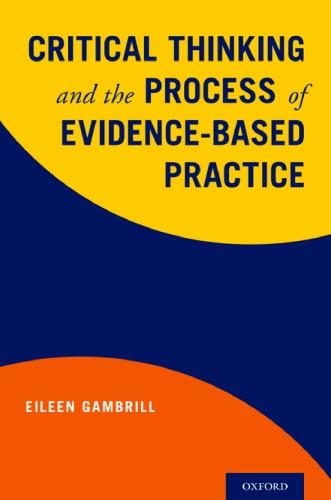
Critical Thinking and the Process of Evidence- Based Practice
i
Critical Thinking and the Process of Evidence-Based Practice
Eileen Gambrill
1
Oxford University Press is a department of the University of Oxford. It furthers the University’s objective of excellence in research, scholarship, and education by publishing worldwide. Oxford is a registered trade mark of Oxford University Press in the UK and certain other countries.
Published in the United States of America by Oxford University Press 198 Madison Avenue, New York, NY 10016, United States of America.
© Oxford University Press 2019
All rights reserved. No part of this publication may be reproduced, stored in a retrieval system, or transmitted, in any form or by any means, without the prior permission in writing of Oxford University Press, or as expressly permitted by law, by license, or under terms agreed with the appropriate reproduction rights organization. Inquiries concerning reproduction outside the scope of the above should be sent to the Rights Department, Oxford University Press, at the address above.
You must not circulate this work in any other form and you must impose this same condition on any acquirer.
Library of Congress Cataloging-in-Publication Data
Names: Gambrill, Eileen D., 1934– author.
Title: Critical thinking and the process of evidence-based practice / Eileen Gambrill.
Description: New York, NY : Oxford University Press, [2019] | Includes bibliographical references and index.
Identifiers: LCCN 2018015258 (print) | LCCN 2018016003 (ebook) | ISBN 9780190463366 (updf) | ISBN 9780190463373 (epub) | ISBN 9780190463359 (pbk. : alk. paper)
Subjects: LCSH: Evidence-based social work. | Evidence-based medicine. | Critical thinking. | Decision making.
Classification: LCC HV10.5 (ebook) | LCC HV10.5 .G36 2019 (print) | DDC 361.3/2—dc23
LC record available at https://lccn.loc.gov/2018015258
9 8 7 6 5 4 3 2 1
Printed by WebCom, Inc., Canada
Contents
1. Thinking about Decisions 1
2. Origins, Characteristics, and Controversies Regarding the Process of Evidence-Based Practice 22
3. Evidence: Sources, Uses, and Controversies 48
4. Steps in the Process of Evidence-Based Practice 85
5. Critically Appraising Research 120
6. Cultivating Expertise in Decision-Making 157
7. Argumentation: Its Central Role in Deliberative Decision-Making 186
8. Avoiding Fallacies 212
9. The Influence of Language and Social-Psychological Persuasion Strategies 228
10. Communication Skills (Continued) 242
11. Challenges and Obstacles to Evidence-Informed Decision-Making 270
12. Being and Becoming an Ethical Professional 284
References 299
Index 327
Critical Thinking and the Process of Evidence- Based Practice
Thinking about Decisions
Decision- making is central in the helping professions. Related literature lies in many different interrelated areas including judgment and decision-making (reasoning), the study of expertise, and critical thinking. Decisions are made about what outcomes to focus on, how to frame concerns, what theories and methods to use, what interventions to recommend (including watchful waiting), how (or if) to evaluate outcome, and whether to involve clients/patients as informed participants. Here are a few examples of decisions.
• Ms. Richards, a child welfare worker, has to make a decision about what parent training program to refer a client to.
• Ms. Reed, a psychologist, has to determine whether Ms. X who started to say to staff “You are a devil,” just as she was about to be released from a mental hospital, is still “mentally ill.”
• Dr. B, an oncologist, must decide whether a pathology report regarding possible cancer is accurate.
• Ms. Garcia must decide whether her dentist’s recommendation that she must get a “deep cleaning of her teeth” (which is quite intrusive) is really needed.
Decisions in the helping professions are characterized by ill-defined goals, ambiguity, missing data, and shifting and competing goals and values. They are influenced by agency policies and practices. They often involve high stakes and multiple players and are made under time pressures. We may feel pressure
to “go-along” with our peers with a decision that may harm others or neglect standards we value (Baron, 1987).
Decisions have life-affecting consequences as in deciding how to discourage another suicide attempt, whether a biopsy shows malignancy, and whether social anxiety should be treated with medication. Questions include, What information do I need to make a sound decision? Do I have this information? If not, is it available and how can I obtain it? What should I do if I cannot get it? Decisions made involve moral and ethical issues in a number of ways including problems/behaviors selected for attention and how they are defined (e.g., as legal, ethical, medical, or moral). Uncertainty is a constant companion highlighting ethical questions about how this is handled. Rarely is all relevant information available. Baron (2008) emphasizes three types of questions as integral to decision-making:
1. “The normative question: How should we evaluate thinking, judgment and decision-making? By what standards?” (p. 3; emphasis in original). Do we behave in such a manner that our goals are met? Do our judgments correspond with the world? (Baron, 2012).
2. “The descriptive question: How do we think? What prevents us from doing better than we do according to normative standards?”
3. “The prescriptive question: What can we do to improve our thinking, judgment and decision-making, both as individuals and society?” (p. 3; emphasis in original).
Baron’s Search- Inference Framework
Forming and evaluating beliefs, selecting goals, and making decisions all involve thinking. Baron (2008) suggests, “We think when we are in doubt about how to act, what to believe or what to desire . . . thinking helps us to resolve our doubts: It is purposive” (p. 6). A decision involves a choice regarding what to do or what to believe. We think about options. Baron (1985, 2008) suggests that in making decisions we search for “possibilities, evidence and goals and [make] inferences from these” (Baron, 2008, p. 7); “the whole point of good thinking is to increase the probability of good outcomes (and true conclusions)” (p. 64). A good outcome is one that decision makers value; it results in valued goals. Good decision makers “do the best they can with what is knowable” (p. 64). Decisions are made to achieve goals and they are based on beliefs about what actions [possibilities] will achieve the goals” (p. 6). Thinking can be defined as “a method of finding and choosing
Thinking
among potential possibilities, that is, possible actions, beliefs, or personal goals” (p. 8). Thus, “thinking is, in a way, like exploration” (p. 7).
Possibilities are possible answers that may remove doubt. “Goals are the criteria by which [we] evaluate possibilities— for ending the thinking process (criteria or standards of evaluation) and evidence consists of any belief that is valuable in determining ‘the extent to which a possibility achieves some goal’ ” (Baron, 2008, p. 8). It changes “the strengths assigned to possibilities, i.e., the thinker’s tendency to adapt them” (Baron, 1985, p. 87). It may be sought or not. “One possibility can serve as evidence against another” (p. 87). Goals determine the way evidence is used and what evidence is sought (p. 87). They may change based on evidence.
We look for other possibilities to make sure that the current favorite is really the best, or to look for ways to modify it to make it better, by taking pieces of other possibilities. The reason we look for counter-evidence is, again, to prevent error and to suggest ways to modify a possibility. More generally, the reason for all of these elements is to increase our [warranted] confidence in whatever possibility we choose in the end. (Baron, 2017, p. 6)
Consider the decision confronting Mrs. Garcia. Her goals include keeping her teeth and avoiding over- or undertreatment. She can take her dentist’s advice and make an appointment with someone to do a “deep cleaning.” She could seek another dentist’s advice first. Or, she could do nothing. If a specialist tells her deep cleaning is not only not necessary but will do more harm than good, this offers evidence against the possibility (option) of getting deep cleaning. Consider Dr. B’s situation. He could accept the lab report that the biopsy shows cancer. He could send the specimen to another laboratory for a check. Dr. B’s goal (as well as the client’s goal) is to obtain the most accurate answer to the question “Is this cancer or not?” If the second report from a pathologist with greater experience with this particular cancer states that the biopsy is not cancer, this is evidence against the possibility of immediately starting very invasive treatment. Inference is used to evaluate the relevance of the evidence to goals drawing on certain rules (see Chapter 7).
Thinking can be described in terms of search and inference. The objects searched for consist of possibilities, evidence (in the form of beliefs) and goals (criteria, values, desires). In decision making, the possibilities are options, and inference is the evaluation of options in the light of evidence and goals. We can also think about beliefs themselves, by evaluating them in
terms of other beliefs. . . . And, similarly, we can evaluate goals in terms of other goals. (Baron, 2017, p. 4)
Thus, Baron (2008) defines thinking as “a method of finding and choosing among potential possibilities (possible actions, beliefs and personal goals)” (p. 8; emphasis in original). “Fairness to possibilities” (Baron, 1985, p. 107) is a key characteristic: “Aside from optimal search, good thinking involves being fair to all possibilities . . . when searching for evidence and using evidence” (p. 107). This requires looking for reasons why you may be wrong. Returning to our examples, maybe an error was made in the second lab. Maybe the expert periodontist Mrs. Richards consulted was wrong. The term judgment refers to “evaluation of one or more possibilities with respect to a specific set of evidence and goals” (Baron, 2008, p. 8). Within Baron’s search-inference framework “our goal is to bring our beliefs into line with the evidence” (p. 12). As Baron notes, our goals may prevail, for example maintaining a belief despite a lack of evidence. And, goals may change in addressing a problem.
Search may be characterized by its objects (evidence, possibilities, or goals), its duration or extent (time, or number of objects sought), and, importantly, its direction. Direction is defined in terms of whether search is directed at whatever favors currently strong possibilities (usually just one) or opposes them. Inferences may also be characterized by direction. For example, evidence may be weighted more heavily as a function of whether it favors or opposes strong possibilities (Baron, 2017, p. 4).
Baron (2008) defines a bias as “a departure from the normative model in a particular direction” (p. 41). Biases result in ignoring counter-evidence related to preferred beliefs encouraged by insufficient search for possibilities and goals and “under- weighing evidence against favored possibilities when it is available” (Baron, 2017, p. 2). Insufficient search for information regarding a decision is common as is confirmation bias (i.e., looking only for data that supports a position) and belief perseverance (i.e., ignoring data against favored views). Richard Paul and his colleagues emphasize the role of both egocentric and sociocentric biases (Paul, 1993; Paul & Elder, 2014) in compromising decisions. The former refers to biases that result from focusing on our own interests. The second refers to biases that result from the particular society in which we live. People differ in their tendency to reflect biases in their thinking (e.g., Stanovich & West, 2008). Epistemic rationality refers to “how well our beliefs map on to the actual structure of the
world” (p. 6). Instrumental rationality refers to how well our beliefs allow us to accomplish our goals.
Discussions about what makes a good thinker are as old as philosophy itself. “Thinking is in its most general sense, a method of choosing among potential possibilities, that is possible beliefs or actions” (Baron, 1985, p. 90). Thouless (1974) suggests that the essence of crooked thinking is not acting when you must act. The term reflection is popular. But, as Brookfield (1995) notes, “Reflection is not by definition critical” (p. 8). Nor is thinking necessarily informed. For example, an expert in an area can draw on a vast knowledge base; a novice cannot (see Chapter 6). Exhibit 1.1 describes examples of critical thinking skills, knowledge, attitudes, and ways of behavior. Active open-minded thinking (AOT) is useful in selecting and achieving goals and providing a guide about what sources to trust. AOT is integral to critical thinking, for example searching for reasons why we may be wrong. Baron (2017) defines AOT as “the disposition to be fair to different conclusions even if they go against one’s initially favored or pet conclusion” (p. 1). These characteristics illustrate the close relationship between AOT and the process of evidence-based practice (see Chapters 2 and 4).
AOT involves the careful examination and evaluation of beliefs and actions to arrive at well-reasoned decisions regarding actions, beliefs, and goals. Here are sample items on the scale of AOT (agreement is indicated on a scale of 1 to 7). (See Baron, Scott, Fincher, & Metz, 2015; Haran, Ritov, & Mellers, 2013). The last four items are coded in reverse.
1. Allowing oneself to be convinced by an opposing argument is a sign of good character.
2. People should take into consideration evidence that goes against their beliefs.
3. People should revise their beliefs in response to new information or evidence.
4. Changing your mind is a sign of weakness.
5. Intuition is the best guide in making decisions.
6. It is important to persevere in your beliefs even when evidence is brought to bear against them.
7. One should disregard evidence that conflicts with one’s established beliefs.
Exhibit 1.1
Examples of Thinking Skills, Knowledge, Attitudes and Ways of Behaving Related to Active Open- Minded Thinking
• Demonstrates fairness to possibilities: Searches for counter-evidence to preferred views; accurately weighs evidence for both preferred and non-preferred views.
• Reviews goals in relation to possibilities/evidence.
• Questions one’s own views and attempts to understand related assumptions and implications.
• Searches for goals and possibilities not obvious.
• Raises vital questions and problems.
• Gathers, assesses, and accurately describes the evidentiary status of relevant information.
• Uses evidence skillfully and impartially.
• Recognizes the fallibility of one’s opinions and the probability of bias in them and the danger of differentially weighing evidence according to personal preferences.
• Listens carefully to other people’s ideas.
• Recognizes that most real- world problems have more than one possible solution and that solutions may differ and be difficult to compare in terms of a single criterion of merit.
• Describes differing views without distortion, exaggeration, or caricaturization.
• Demonstrates understanding of the differences among conclusions, assumptions, and hypotheses.
• Is sensitive to the difference between the validity of a belief and the intensity with which it is held.
• Understands the difference between reasoning and rationalizing.
• Has a sense of the value and cost of information and knows how to seek needed information.
• Looks for unusual approaches to complex problems.
• Tries to anticipate consequences of alternative possibilities before choosing one.
• Makes valuable generalizations of problem-solving techniques to different areas.
• Can learn independently and has an interest in doing so.
• Understands the difference between winning an argument and being right.
• Is aware that understanding is always limited.
• Distinguishes between logically valid and invalid inferences.
• Can structure informally presented problems so that formal techniques (e.g., mathematics) can be used to solve them.
Source: J. Baron, 2008, Thinking and Deciding (4th ed.), New York, NY: Columbia University Press; Baron, 2008; Nickerson, 1986, pp. 29–30; and R. Paul, 1993, Critical Thinking: What Every Person Needs to Survive in a Rapidly Changing World (3rd ed. rev.). Santa Rosa, CA: Foundation for Critical Thinking. www.criticalthinking.org
“The main conceptual contribution of AOT is its concern with direction, as well as extent. This is because AOT is intended as the antidote to myside bias” (Baron, 2017, p. 5). Although one could search too much as well as too little, departures from what is needed to avoid myside bias are more common. Thus, “we call it a virtue when people resist myside bias by looking for reasons why their pet belief or favored option might be wrong” (p. 5). Haran, Ritov, and Mellers (2013) found that AOT has positive associations “with greater persistence in searching for information, higher accuracy of estimates and lower overconfidence” (p. 197).
Paul and Elder (2014) suggest that “critical thinking begins when we think about our thinking with a view to improving it” (p. 366), drawing on relevant knowledge and skills, including metacognitive skills such as questioning favored assumptions. Here is a description of critical thinking by Scriven and Paul (2005) written for the National Council for Excellence in Critical Thinking:
Critical thinking is the intellectually disciplined process of actively and skillfully conceptualizing, applying, analyzing, synthesizing, and/or evaluating information gathered from, or generated by, observation, experience, reflection, reasoning, or communication, as a guide to belief and action. In its exemplary form, it is based on universal intellectual values that transcend subject matter divisions: clarity, accuracy, precision, consistency, relevance, sound evidence, good reasons, depth, breadth, and fairness. It entails proficiency in the examination of those structures or elements of thought implicit in all reasoning: purpose, problem or question-at-issue, assumptions, concepts, empirical grounding, reasoning leading to conclusions, implications and consequences, objections from alternative viewpoints, and frame of reference. Critical thinking—in being responsive to variable subject matter, issues, and purposes—is incorporated in a family of interwoven modes of thinking, among them: scientific thinking, mathematical thinking, historical thinking, anthropological thinking, economic thinking, moral thinking, and philosophical thinking.
Critical thinking involves clearly describing and carefully evaluating claims and arguments, no matter how cherished, and considering alternative views. This means paying attention to the process of reasoning (how we think), not just the product. Critical thinking and intelligence are only modestly associated (Stanovich, 2008; 2010). In weak sense critical thinking, we focus on supporting our own views as in egocentric bias (Paul, 1993); “much of our thinking, left to itself, is biased, distorted, partial, uninformed, or downright prejudiced” (Brookfield, 1995, p. 8). Indeed, Feynman (1974) suggests, “The first principle is that you must not fool
yourself and you are the easiest person to fool” (p. 12). Increasing attention has been focused on our vulnerability to misinformation (Carey, 2017; Lewandowsky, Ecker, Seifert, Schwarz, & Book, 2012) and the play of cognitive biases such as cherry-picking (reporting only data that support a preferred view).
Socratic questioning is integral to critical thinking (AOT), evidence- based practice and science. (See Exhibit 1.2). Critical thinking values, skills, and knowl edge can protect us from being bamboozled and misled by deceptive claims. Consider the examples that follow. Each makes a claim concerning the effectiveness of a practice method. Are they true? What questions would you ask to evaluate the accuracy of these claims? How would you search for related research findings?
• Eye movement desensitization is effective in decreasing anxiety.
• “Four hours a month can keep a kid off drugs forever. Be a mentor” (“Four Hours a Month,” 2002; Partnership for a Drug-Free America [www. drugfreeamerica.org]).
• Anatomically detailed dolls can be used to accurately identify children who have been sexually abused.
• Stents improve longevity.
Paul and his colleagues at the Center for Critical Thinking in Sonoma (Paul, 1993; Paul & Elder, 2014) include four domains in their conceptualization of critical thinking, highlighting the role of Socratic questioning in arriving at well-reasoned decisions. (See Exhibit 1.2). These domains are elements of thought, abilities, affective dimensions (dispositions), and intellectual standards. Related Socratic questions include:
1. What is my purpose or goal? (This may be unrealistic or conflict with other goals.)
2. What is the question I am trying to answer? Is it clear? Is it important?
3. What information do I need to answer my question?
4. What is the most basic concept in the question?
5. What assumptions am I using?
6. What is the point of view with respect to the issue? This may be too narrow, contain contradictions, or be based on false data.
7. What are my fundamental inferences or conclusions?
8. What are the implications of my reasoning (if I am correct)?
A Taxonomy of Socratic Questions
Questions about the Question
What question am I trying to answer?
What kind of question is this?
Why is this question important?
Questions of Clarification
What do you mean by _ ?
What is your main point?
How does _ relate to ?
Could you put that another way?
Let me see if I understand: do you mean _ or _ ?
Questions That Probe
Assumptions
What are you assuming?
What could we assume instead?
Questions that Probe Reasons and Evidence
What information is needed to answer the question?
How can we gather this?
How can we determine if it is accurate? Why do you think that is true?
Is there any evidence for that?
Questions about Viewpoints/Perspectives
What might someone who believed _ think?
Can/did anyone view this in another way?
Questions That Probe Implications and Consequences
What are you implying by that?
What effect would that have?
To answer this question, what questions would we have to answer first? What does this question assume? Is this the same issue as_ ?
• Could you give me an example?
• Would this be an example: _ ?
• Could you explain that further?
• Does _ work for all problems?
You seem to be assuming ? Do I understand you correctly?
Do we need other information? Is there reason to doubt that evidence? Who is in a position to know if that is so?
Are these reasons adequate? How does that apply to this example? What would change your mind?
What would someone who disagrees say? What is an alternative?
Should we consider other implications? What is an alternative?
Source: Adapted from Critical Thinking: What Every Person Needs to Survive in a Rapidly Changing World, by R. Paul, 1993 (3rd ed. rev.), Santa Rosa, CA: Foundation for Critical Thinking. www. criticalthinking.org
Proposed stages in development of critical thinking suggested by Paul, 1993 include:
Stage One: The Unreflective Thinker (we are unaware of significant problems in our thinking).
Stage Two: The Challenged Thinker (we become aware of problems in our thinking).
Stage Three: The Beginning Thinker (we try to improve but without regular practice).
Stage Four: The Practicing Thinker (we recognize the necessity of regular practice).
Stage Five: The Advanced Thinker (we advance in accordance with our practice).
Stage Six: The Master Thinker (skilled and insightful thinking become second nature to us). (www.criticalthinking.org ) Downloaded 11/15/17.
Paul (1993) and Paul and Elder (2014) view critical thinking as a unique kind of purposeful thinking in which we use intellectual standards such as clarity and fairness. It is:
• Clear versus unclear.
• Precise versus imprecise.
• Specific versus vague.
• Accurate versus inaccurate.
• Relevant versus irrelevant.
• Consistent versus inconsistent.
• Logical versus illogical.
• Deep versus shallow.
• Complete versus incomplete.
• Significant versus trivial.
• Adequate (for purpose) versus inadequate
• Fair versus biased or one- sided.
Related Skills and Knowledge
Decisions are made to solve problems. Related skills include searching for information relevant to a decision, accurately weighing the quality of evidence, reviewing resources, and avoiding biases (see Exhibit 1.1; also see discussion of
Baron’s search-inference framework and AOT). Other skills include identifying assumptions and their implications (consequences), suspending judgment in the absence of sufficient evidence to support a claim/decision, understanding the difference between reasoning and rationalizing, and stripping an argument of irrelevancies and phrasing it in terms of its essentials (see Chapter 7). Seeking counter-evidence to preferred views and understanding the difference between the accuracy of a belief and the intensity with which it is held is vital. Critical thinking skills are not a substitute for problem-related knowledge. As Baron (2008) emphasizes, “without knowledge or beliefs that correspond to reality, thinking is an empty shell” (p. 15). However, as he notes, thinking about a problem can contribute to expertise. Specialized knowledge may be needed to evaluate the plausibility of premises related to an argument. Consider the following example:
• Depression always has a psychological cause.
• Mr. Draper is depressed.
• Therefore, the cause of Mr. Draper’s depression is psychological in origin.
Even though the logic of this argument is sound, the conclusion may be false; the cause of Mr. Draper’s depression could be physiological. The greater the content knowledge that is available and needed about a problem to solve it, the more important it is to be familiar with this knowledge (see Chapter 6). Taking advantage of practice-related theory and research is a hallmark of the process of evidence-based practice as described in Chapter 2.
In addition to content knowledge, related performance skills are needed. For example, being aware of common errors in reasoning will not be useful without skills to avoid them and values that encourage their use such as fair-mindedness. Critical thinking encourages us to identify and question assumptions and to consider the possible consequences of different beliefs or actions. It requires clarity rather than vagueness; “one cannot tell truth from falsity, one cannot tell an adequate answer to a problem from an irrelevant one, one cannot tell good ideas from trite ones—unless they are presented with sufficient clarity” (Popper, 1994, p. 71). The term meta- cognitive refers to being aware of and influencing our reasoning process by asking questions such as:
• “Do I understand this point?”
• “What mistakes may I be making?”
• “Is this claim true?”
• “How good is the evidence?”
• “Who presented it as accurate?” “How reliable are these sources?”
• “Are conflicts of interest involved?”
• “Are the facts presented correct?”
• “Have any facts been omitted?”
• “Can an intervention tested and found to be successful in one setting be used with success in other settings?”
Related Values, Attitudes, and Styles: Affective Dimensions
Predispositions and attitudes include recognizing the fallibility of beliefs and the probability of bias in them, valuing the discovery of ignorance as well as knowledge, active open-mindedness (e.g., seeking counter-evidence to preferred views), a desire to be well informed, a tendency to think before acting, and curiosity (Baron, 2000; Ennis, 1987; Paul, & Elder, 2014). AOT “is the disposition to be fair toward different conclusions even if they go against one’s initially favored or pet conclusion” (Baron, 2017, p. 1). (See earlier description of items on the AOT scale.) Related moral values suggested by Paul (1993) include humility (awareness of the limits of knowledge including our own; lack of arrogance), integrity (honoring the same standards of evidence to which we hold others), and persistence (willingness to struggle with confusion and unsettled questions; see Exhibit 1.3).These attitudes highlight the role of affective components, such as empathy for others and a tolerance for ambiguity and differences of opinion. They emphasize the importance of critical doubt (examining beliefs) and open-mindedness (understanding and considering opposing views before judging them; Walton, 1999, p. 71).
To think critically about issues we must be able to consider the strengths and weaknesses of opposing points of view. Since critical thinkers value fairmindedness, they feel that it is especially important that they entertain positions with which they disagree. They realize that it is unfair either to judge the ideas of another until they fully understand them, or act on their own beliefs without giving due consideration to relevant criticisms. The process of considering an opposing point of view aids critical thinkers in recognizing the logical components of their beliefs (e.g., key concepts, assumptions, implications, etc.) and puts them in a better position to amend those beliefs. (Paul, Binker, & Charbonneau, 1986, p. 7)
Critical thinkers are skeptics rather than believers. That is, they are neither gullible (believing anything) or cynical (believing nothing). Cynics have a
Exhibit 1.3
Values and Traits Integral to Critical Thinking
• Fair-mindedness: Adhering to intellectual standards without reference to our own advantage or the advantage of our group.
• Intellectual humility: Recognizing the limits of our own knowledge, including circumstances in which we are likely to deceive ourselves; maintaining a sensitivity to bias, prejudice, and limitations of our viewpoint. Recognizing that we should never claim more knowledge/expertise than we have. Questions include: How much do I really understand/know about _ ? Am I competent to help this client?
• Intellectual courage: Facing and fairly addressing ideas, beliefs, or viewpoints toward which we have strong negative emotions and to which we have not given a serious hearing. This courage is connected with the recognition that ideas considered dangerous or absurd may be reasonable. To determine for ourselves what is accurate, we must not accept what we have “learned” passively and uncritically. Intellectual courage comes into play here, because we will come to see some truth in some ideas strongly held by others. The penalties for nonconformity can be severe.
• Intellectual empathy: Putting ourselves in the place of others to understand them, accurately describing the viewpoints and reasoning of others. It includes remembering occasions when we were wrong despite a conviction that we were right.
• Intellectual integrity: Honoring the same rigorous standards of evidence to which we hold others; practicing what we advocate and admitting discrepancies and inconsistencies in our own thoughts and actions.
• Intellectual perseverance: Pursuing accuracy despite obstacles and relying on rational principles despite the irrational opposition of others; recognizing the need to struggle with confusion and unsettled questions to achieve deeper understanding.
• Confidence in reason: Confidence that, in the long run, our higher interests and those of humankind will be best served by giving the freest play to reason by encouraging others to develop their rational faculties; faith that, with proper encouragement and education, people can learn to think for themselves, form rational views, draw reasonable conclusions, think coherently and logically, persuade each other by reason, and become reasonable persons, despite obstacles to doing so.
• Intellectual autonomy: Being motivated to think for ourselves.
• Intellectual curiosity: An interest in deeply understanding things and learning.
• Intellectual discipline: Thinking guided by intellectual standards such as clarity and relevance.
Source: Adapted from Critical Thinking: What Every Person Needs to Survive in a Rapidly Changing World (3rd ed. rev.), by R. Paul, 1993, Santa Rosa, CA: Foundation for Critical Thinking, pp. 467–472. www. criticalthinking.org
contemptuous distrust of all knowledge. Skeptics (critical thinkers) value truth and seek approximations to it through critical discussion and the testing of theories. Critical thinkers question what others view as self-evident. They ask: Is this claim accurate? Have critical tests been performed? If so, were they relatively free of bias? Have the results been replicated? How representative were the samples used? Are there alternative well-argued points of view? Criticism of all views, including our own, is viewed as essential to forward understanding. Critical thinking discourages arrogance, the assumption that our beliefs should not be subject to critical evaluation. Popper (1992) emphasized, “In our infinite ignorance we are all equal” (p. 50). It prompts questions such as “Could I be wrong?” “Have I considered alternative views?” “Do I have sound reasons to believe that this plan will help this client?”
Critical thinking encourages us to think contextually, to consider the big picture, and to connect personal troubles to social issues. It requires accurate description of alternative views and a candid discussion of controversies and problems with preferred views, including empirical data that contradict them. Both critical thinking and evidence-based practice value transparency (honesty) concerning what is done to what effect, including candid description of lack of knowledge. Stanovich, West, and Toplak (2016) developed CART (Comprehensive Assessment of Rational Thinking) to evaluate rational thinking and characteristics that compromise this. Concepts include:
• Avoiding miserly information processing (override intuition; see Chapter 2).
• Avoiding irrelevant context effects such as framing and anchoring.
• Avoiding myside bias.
• Avoiding overconfidence.
• Avoiding superstitious thinking.
• Avoiding antiscience attitude.
• Being actively open-minded.
• Using deliberative thinking style.
• Considering future consequences.
The Importance of Thinking Critically about Decisions
The history of the helping professions reflects great achievements as well as missed opportunities and avoidable harming in the name of helping. Related literature shows that avoidable errors are common (James, 2013). Avoidable errors
Thinking
may result in (a) failing to offer help that could be provided and is desired by clients, (b) forcing clients to accept practices they do not want, (c) offering help that is not needed, or (d) using procedures that aggravate rather than alleviate client concerns. Errors may occur during assessment by overlooking important data, using invalid measures, or attending to irrelevant data; during intervention by using ineffective methods; and during evaluation by using inaccurate indicators of progress. Reliance on irrelevant or inaccurate sources of data during assessment may result in incorrect and irrelevant accounts of client concerns and recommendation of ineffective or harmful methods. Important factors may not be noticed. For example, a clinician may overlook the role of physiological factors in depression. Failure to consider physical causes may result in inappropriate decisions. Failure to seek information about the evidentiary status of claims may result in use of ineffective methods. Errors may result from reliance on questionable criteria such as anecdotal experience to evaluate the accuracy of claims (see related discussion in Chapter 2). Critical thinking knowledge, skills, and values contribute to minimizing mistakes such as not recognizing a problem, confusing the consequences of a problem for the problem, ignoring promising alternatives, harmful delay in decision-making, and lack of follow-up (Caruth & Handlogten, 2000). Professionals do not necessarily acquire critical thinking skills in their professional education (Heidari & Ebrahimi, 2016). Critical thinking skills, values, and knowledge are integral to the process of evidence-based practice.
Practices and policies include those based on sound evidence in which clients are involved as informed participants, as well as continued use and dissemination of services that have been carefully evaluated and found to be harmful (Hochman, 2014). False beliefs and misinformation are common, encouraged by our tendency to look for support for our beliefs and ignore contradictory information (DiResta, 2017; Gambrill, 2012a; Lewandowsky, Ecker, Seifert, Schwartz, & Cook, 2012). Cognitive errors in decision-making in medicine such as failure to search for contradictory information are common (Croskerry, 2003). Problems may remain unsolved because of reliance on questionable criteria to evaluate claims about what is accurate, such as tradition, popularity, or authority; we may fail to distinguish between evidence and pseudoevidence (see Chapter 2). Consider a claim that recovered memory therapy works. Too often, the questions that should be asked to reveal the evidentiary status of a claim are not asked, such as “The method works for what?” “What kind of research was conducted to test this claim? “Could such research rigorously test the claim?” “Has anyone been harmed by this method?”
Clients may be harmed rather than helped if we do not use AOT in which we search for counter-evidence and arguments against preferred views when considering possibilities, goals, and evidence regarding decisions. Are they well-reasoned?
Are they informed by related research? Have we avoided being bamboozled either by ourselves and/or others into accepting bogus claims about the effectiveness of a method (Gambrill, 2012a)? Have we avoided common errors in reasoning such as premature closure? As Karl Popper (1994) suggests, “there are always many different opinions and conventions concerning any one problem or subject matter. . . . This shows that they are not all true. For if they conflict, then at best only one of them can be true?” (p. 39). Gaps between knowledge available and what was used were a key reason for the development of evidence-based practice and policy (Gray, 2001a). The following findings suggest that clinical decisions can be improved:
• There are wide variations in practices (Wennberg & Thomson, 2011).
• Most services provided are of unknown effectiveness (Frakt, 2013).
• Medical reversals are common (Prasad, 2016; Prasad, Vandross, Toomey, Cheung, Rho, Quinn, Chako . . . Cifu, 2013).
• Clients are often harmed in the name of helping (Scull, 2005; 2015).
• Intervention methods found to be harmful continue to be used (Petrosino, Turpin-Petrosino, & Buehler, 2013).
• Assessment methods shown to be harmful continue to be used (e.g., Lilienfeld, Lynn, & Lohr, 2015; Thyer & Pignotti, 2015).
• Overdiagnosis and overtreatment is common (Hafner & Palmer, 2017; Pathirana, 2017; Welch, Schwartz, & Woloshin, 2011).
• Methods found to be effective are often not offered to clients (e.g., Jacobson, Foxx, & Mulick, 2005).
• There are large gaps between claims of effectiveness and evidence for such claims in the peer-reviewed literature (Ioannidis, 2005, 2016).
• Avoidable errors are common (James, 2013).
• Clients are typically not involved as informed participants regarding the evidentiary status of recommended services and alternatives.
There has been continuing parade of revelations of problems in the peer-reviewed literature including hiding of negative trials and adverse effects of medications, creating bogus categories of illness, overmedicating young children and the elderly with antipsychotics, and related conflicts of interest (Gambrill, 2012a). Consider these quotes from current and former editors-in-chief of major medical journals:
It is simply no longer possible to believe much of the clinical research that is published, or to rely on the judgment of trusted physicians or authoritative medical guidelines. I take no pleasure in this conclusion, which I reached
Thinking about Decisions
slowly and reluctantly over my two decades as an editor of the New England Journal of Medicine. (Angell, 2009, p. 11).
The case against science is straightforward much of the scientific literature, perhaps half, may simply be untrue. Afflicted by studies with small sample sizes, tiny effects, invalid exploratory analyses, and flagrant conflicts of interest, together with an obsession for pursuing fashionable trends of dubious importance, science has taken a turn towards darkness, . . . scientists too often sculpt data to fit their preferred theory of the world. Or they retrofit hypotheses to fit their data—acquiescence to the impact factor fuels an unhealthy competition to win a place in a select few journals. Our love of “significance” pollutes the literature with many a statistical fairytale— Universities are in a perpetual struggle for money and talent, end points that foster reductive metrics, such as high-impact publication. National assessment procedures, such as the Research Excellence Framework, incentivize bad practices. (Horton, 2015, p. 1380)
Ioannidis (2005, 2016) argues that most research findings reported in the biomedical literature are false and that most systematic reviews are misleading, redundant, and conflicted. Hiding well-argued alternative views is common, such as failure to describe anxiety in social situations as a learned reaction created by a unique learning history (Gambrill & Reiman, 2011). Much of the material in peer-reviewed sources has more of the quality of advertisements (e.g., inflated claims based on misleading appeals to statistical significance, hiding negative information) than scholarly discourse (Gambrill, 2012a). Billions of dollars in settlements have been made based on whistle-blowing suits filed under the False Claim Act against drug and device makers (Silverman, 2010). Good intentions do not prevent harming in the name of helping. Consider the blinding of 10,000 children by routine use of oxygen at birth (Silverman, 1980). Scull (2015) illustrates the “orgy of experimentation with somatic treatments for mental disorder” in the 1930s including “surgical evisceration in pursuit of hypothesised septic causes of mental illness: fever therapy . . . barbiturates, injections of insulin, convulsive therapies, lobotomies” (p. 401). Gøtzsche (2015) argues that prescribed psychotropic medication taken by people 65 and over kills more than 500,000 people per year and disables tens of thousands more.
Attending to Context
Decisions are made in an environment that may be known only in part and the part that is knowable may be deliberately obscured or neglected (Oreskes &