“This book is a valuable contribution to the study of early Islamic historiography, viewed through the lens of narratives of conversion to Islam. Ibrahim categorizes these stories into four main groups according to their objectives as narratives and demonstrates how several generations of historians shaped and reshaped these narratives in response to both their own political and theological beliefs, and the political and theological environment in which they worked—whether under the Umayyads, under the ᶜAbbāsids before the miḥna or caliphal inquisition, or under the ᶜAbbāsids after the end of the miḥna. His meticulous examination of the perspectives and biases of individual historians, while focused primarily on the theme of conversion, will make his book also a convenient reference for scholars who consult these medieval authors on other topics. Clearly written and compellingly argued, this work represents a giant step forward in making sense of the early Islamic tradition of historical writing”
—Fred M. Donner (The University of Chicago), author of Narratives of Islamic Origins
“How was conversion to Islam remembered by medieval Muslim scholars? Working at the intersection of history and historiography, Ayman Ibrahim illuminates multilayered discourses on conversion and offers a sensible typology of evolving literary themes and narratives in the source material. In so doing, Ibrahim sheds a fresh light on the memory of one of the most significant social and cultural changes of the formative period of Islam”
—Antoine Borrut (University of Maryland), author of Entre mémoire et pouvoir
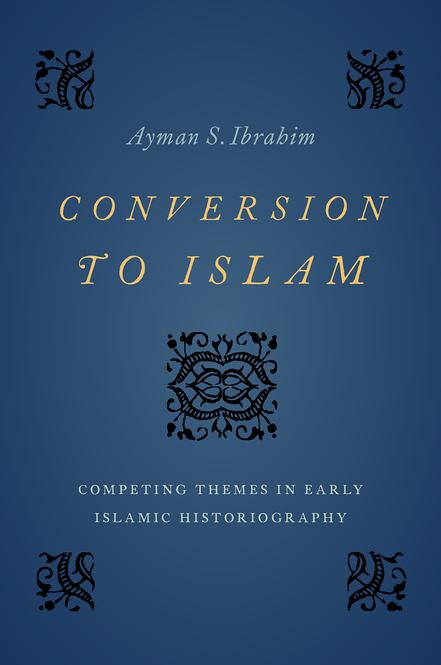
Conversion to Islam
Competing Themes in Early Islamic Historiography
AYMAN S. IBRAHIM
Oxford University Press is a department of the University of Oxford. It furthers the University’s objective of excellence in research, scholarship, and education by publishing worldwide. Oxford is a registered trade mark of Oxford University Press in the UK and certain other countries.
Published in the United States of America by Oxford University Press 198 Madison Avenue, New York, NY 10016, United States of America.
All rights reserved. No part of this publication may be reproduced, stored in a retrieval system, or transmitted, in any form or by any means, without the prior permission in writing of Oxford University Press, or as expressly permitted by law, by license, or under terms agreed with the appropriate reproduction rights organization. Inquiries concerning reproduction outside the scope of the above should be sent to the Rights Department, Oxford University Press, at the address above.
You must not circulate this work in any other form and you must impose this same condition on any acquirer.
Printed by Integrated Books International, United States of America
To the most precious treasure I have, my wife.
1.
3. Establishing Pro-
Naṣr ibn Muzāḥim (d. 212/827)
Ibn Isḥāq (d. 151/761) and Ibn Hishām (d. 218/833)
Abū Muḥammad Ibn ᶜAbd al-Ḥakam al-Miṣrī (d. 214/829) 128
Conversion Themes under the Early ᶜAbbāsids (ca. 133/750–218/833) 130
Conversion of Jews and Christians: Islam’s Supremacy or Insincere Devotion?
Significant Conversions: The Awā’il and the Socially Distinct
Encountering Muhammad and His Message: Affirming Prophethood
Genuine vs. Insincere Conversion: What Kind Is Your Islam?
4. Attempts at Compromise: Conversion Themes in Islamic Historiography in the Aftermath of the Miḥna (218/833–299/911)
the
(d. 230/844)
Ibn Sallām al-Jumaḥī (d. 232/847)
Yaḥyā ibn Maᶜīn (d. 233/847)
Muṣᶜab ibn ᶜAbdullāh al-Zubayrī (d. 236/851)
Khalīfa ibn Khayyāṭ (d. 240/854)
Ibn Ḥabīb al-Baghdādī (d. 245/895)
Al-Zubayr ibn Bakkār (d. 256/870) 186
Abū al-Qāsim ibn ᶜAbd al-Ḥakam (d. 257/871) 187
ᶜUmar ibn Shabba (d. 262/875) 188
Ibn Qutayba al-Dīnawarī (d. 276/889) 189
Yaᶜqūb ibn Sufyān al-Fasawī (d. 277/890)
191
Aḥmad Ibn Yaḥyā al-Balādhurī (d. ca. 279/892) 192
Ibn Abī Khaythama (d. 279/892) 194
Abū Zurᶜa al-Rāzī al-Dimashqī (d. 281/894) 195
Abū Ḥanīfa al-Dīnawarī (d. ca. 282/895) 196
Ibn Wāḍiḥ al-Yaᶜqūbī (d. 284/897 or 292/905) 197
Concluding Remarks on Post-Miḥna Historians 199
Post-Miḥna Conversion Themes 201
Topoi of Significance 201
Topoi of Compromise 206
Topoi of Supremacy and Affirmation 213
Attempts at Compromise: Reconciling Trends and Pro-Umayyad Voices 215
Al-ᶜAbbās ibn ᶜAbd al-Muṭṭalib (d. 32/653) 218
Muᶜāwiya ibn Abī Sufyān (d. 61/680) 223
ᶜAlī ibn Abī Ṭālib (d. 40/661) 227 Conclusion 229
5.
Acknowledgments
This book is based on my second Ph.D., which I completed at the Department of Middle Eastern and Islamic Studies at Haifa University under the supervision of Uriel Simonsohn and Avner Giladi. Both invested tremendously in my work. I am thankful for Giladi’s valuable insights, constant support, and genuine encouragement. Simonsohn, as my direct advisor, has helped me in many ways that I value and appreciate. I have learned something from every conversation I have had with him.
In my time at Haifa University, I became good friends with Yaron Friedman. Our friendship is one of the wonderful highlights of my time there. I have profound gratitude for him and the insightful conversations we had over coffee.
As I prepared this book for publication, Jack Tannous and Christian Sahner were so kind and remarkably generous with their time. I am grateful for their encouragement and valuable observations. In the final stages of publication, Fred Donner and Luke Yarbrough read large portions of the manuscript and offered substantial feedback. I am so thankful for their contribution. Their helpful comments and valuable insights are at the center of anything good in this study.
I am eternally grateful for my wife, who tirelessly walks with me all the way, never complains, and remains always cheerful. Her love for me and belief in my work keep me going with nothing less than maximum gratitude in my heart for her extraordinary role in my life.
Finally, I am indebted to my leaders and colleagues at the Southern Baptist Theological Seminary, as well as to my team at the Jenkins Center for the Christian Understanding of Islam. This is a remarkable community that allows me time and provides me resources to focus on research and writing. I could never ask for a better job.
I am grateful to all of these wonderful supporters in my journey.
To all, shukran, alf shukr.
Note on Transliteration
The transliteration system followed in this project is for the most part the one used by the International Journal of Middle East Studies (IJMES) transliteration guide. I use the English terms known for various Arabic words without transliteration (e.g., jihad, Shahada, Prophet Muhammad, etc.). I do not use Anglicized plurals, but rather the fully transliterated words (aḥādīth instead of ḥadīths). The initial hamza is always dropped, and the Arabic definite article (al-) is lowercase everywhere unless it is the first word in a sentence. The Arabic tā’ marbūṭa is rendered “a” not “ah” (ᶜarabiyya instead of ᶜarabiyyah), except in iḍāfa as -at (e.g., Saqīfat Banī Sāᶜida). The final short vowel is dropped (aslam instead of aslama). The words ibn and bint are not abbreviated as b. and bt. Proper Arabic names are transliterated but not italicized. The short vowels are a for fatḥa, i for kasra, and u for ḍamma. The long vowels are ā for alif, ū for wāw, and ī for yā’. The diphthongs are ay and aw.
Short Biographical Sketch
Ayman S. Ibrahim, Ph.D., was born and raised in Egypt. He has taught in various countries within the Muslim world, and in the West at undergraduate and graduate levels. He completed his second Ph.D. in 2018 at the Department of Middle Eastern and Islamic Studies at the University of Haifa, Mount Carmel. His research examined conversions to Islam in the earliest Muslim period. His first Ph.D. was completed in 2014 at Fuller Graduate Schools (California). It was published as a monograph titled The Stated Motivations for the Early Islamic Expansion (Peter Lang, 2018). He currently serves as Bill and Connie Jenkins Professor of Islamic Studies at Southern Seminary and the director of the Jenkins Center for the Christian Understanding of Islam. His articles on Islam and Muslim-Christian relations appeared in the Washington Post, Religion News Services, Colorado Springs Gazette, Louisville Courier-Journal, First Things, Faith Street, Charisma News, American Thinker, Evangelical Interfaith Dialogue Journal, and Ethics Daily, among others.
Conversion Topoi and Their Subsequent Themes
Conversion Themes
The earliest/first to accept Islam (awā’il, firsts)
Conversion to Islam that is ḥasan (good)
Conversion of the wujahā’ (notables)
Conversion of slaves
Conversion of women
Conversion followed by good deeds, destroying idols
Conversion followed by persecution
Changing name after conversion
Conversion before Muhammad entered Ibn alArqam’s house to preach
Refusing conversion or rejecting the preaching of Islam
Conversion of al-ṭulaqā’
Conversion of al-mu’allafa qulūbuhum
Conversion after the conquest of Mecca
Conversion to save one’s life
Conversion to spare children, wife, and possessions
Collective conversion
Conversion after defeat in battle
Conversion in secret
Reversion from Islam
Conversion of ahl al-kitāb
Conversion of Jews
Conversion of Christians
Conversion as a result of encountering Muhammad
Conversion after hearing the recitation of the Qur’ān
Conversion after hearing the preaching of Islam
Conversion after reading Muhammad’s mention in pre-Islamic scriptures
Conversion due to hearing of Islam from relatives
Topoi
Topoi of Significance
Aim to highlight areas of uniqueness in conversion
Topoi of Compromise
Aim to indicate an insincere conversion for questionable reasons
Topoi of Supremacy
Aim to stress Islam’s hegemony and its superiority over previous religions
Topoi of Affirmation
Aim to prove Muhammad’s prophethood, his excellent qualities, and the eloquence of his Qur’ānic message
Muslim Historians under the ᶜAbbāsids (ca. 133/750–299/911)
ᶜAbbāsid Caliphs
Al-Manṣūr (r. 136/754–158/775)
Al-Mahdī (r. 158/775–169/786)
Al-Hādī (r. 169/786–170/786)
Al-Rashīd (r. 170/786–193/809)
Al-Amīn (r. 193/809–198/813)
Al-Ma’mūn (r. 198/813–218/833)
Al-Muᶜtaṣim (r. 218/833–228/842)
Al-Wāthiq (r. 228/842–233/847)
Al-Mutawakkil (r. 232/847–247/861)
Al-Muntaṣir (r. 247/861–248/862)
Al-Mustaᶜīn (r. 248/862–252/866)
Al-Muᶜtazz (r. 252/866–255/869)
Al-Muhtadī (r. 255/869–256/870)
Al-Muᶜtamid (r. 256/870–279/892)
Al-Muᶜtaḍid (r. 279/892–289/902)
Muslim Historians
Ibn Isḥāq (d. 151/761)
Sayf ibn ᶜUmar (d. 180/796)
Abū Isḥāq al-Fazārī (d. 186/802)
Hishām Ibn al-Kalbī (d. 204/819)
Al-Wāqidī (d. ca. 207/823)
Ibn ᶜAbd al-Ḥakam al-Miṣrī (d. 214/829)
Naṣr ibn Muzāḥim (d. 212/827)
Ibn Hishām (d. 218/833)
Muḥammad ibn Saᶜd (d. 230/844)
Ibn Sallām al-Jumaḥī (d. 232/847)
Yaḥyā ibn Maᶜīn (d. 233/847)
Muṣᶜab ibn ᶜAbdullāh al-Zubayrī (d. 236/851)
Khalīfa ibn Khayyāṭ (d. 240/854)
Ibn Ḥabīb al-Baghdādī (d. 245/895)
Zubayr ibn Bakkār (d. 256/870)
Abū al-Qāsim ibn ᶜAbd al-Ḥakam (d. 257/871)
ᶜUmar ibn Shabba (d. 262/875)
Ibn Qutayba al-Dīnawarī (d. 276/889)
Yaᶜqūb ibn Sufyān al-Fasawī (d. 277/890)
Ibn Abī Khaythama (d. 279/892)
Ibn Yaḥyā al-Balādhurī (d. ca. 279/892)
Abū Zurᶜa al-Rāzī al-Dimashqī (d. 281/894)
Abū Ḥanīfa Dīnawarī (d. ca. 282/895)
Ibn Wāḍiḥ al-Yaᶜqūbī (d. 284/897 or 292/905)
Glossary
ᶜAbbāsids: They overthrew the Umayyads in ca. 133/750. They trace their lineage back to al-ᶜAbbās ibn ᶜAbd al-Muṭṭalib (d. 32/653), the uncle of Muhammad from the other branch of the Hāshim family. The ᶜAbbāsids claimed that the imamate was only in their family, either by wirātha (inheritance) from Muhammad or by waṣiyya (bequest) from ᶜAlī and his grandson Abū Hāshim. Cf. ᶜAlids and Hāshimites.
Ahl al-ḥadīth: The ḥadīth scholars, who were also known as aṣḥāb al-ḥadīth or the ḥadīth party, identifying them as the adherents of Muhammad’s traditions. They revered the ḥadīth and elevated it as the second authority in Islam, second only to the Qur’ān. They grew in power in the early ᶜAbbāsid period and became the major opposition against the caliphal authority during the miḥna. Cf. traditionists, ᶜulamā’, and muḥaddithūn.
Ahl al-kitāb: A Qur’ānic term that refers to the People of the Book, or Scripture People, commonly understood as Christians and Jews.
ᶜAlids: The descendants of ᶜAlī, who claim the imamate in his descendants alone. Today, they represent broad Shīᶜism and include several groups, such as the Imāmīs, Ismāᶜīlīs, and Zaydīs. Cf. Shīᶜism, Saba’iyya, and ᶜAbbāsids.
Anṣār: The locals of Medina known as the supporters of Muhammad. They believed his message and helped him and his followers after their emigration from Mecca. Cf. muhājirūn and hijra.
Early ᶜAbbāsid Period: The period from the ᶜAbbāsid revolution in 132/749 to the death of al-Ma’mūn in 218/833.
Futūḥ: The military conquests conducted by the Arab commanders after Muhammad’s death during the caliphate period. The term also refers to the written traditions (futūḥ literature) that deal with the military expeditions. This Arabic term describes the conquests as acts of “opening” and liberating the conquered lands.
Ḥadīth: A report of a saying, teaching, or deed attributed to a religious figure, particularly the Prophet Muhammad. Its plural form is aḥādīth, which are compiled in sets by various Muslim compilers.
Hāshimites: The Hāshimite family, the wide family of Muhammad, includes both ᶜAlids and ᶜAbbāsids. The Hāshimites claim that the imamate is in all Hāshim descendants, both ᶜAlids and ᶜAbbāsids.
Hijra: The emigration of Muhammad and his followers from Mecca to Medina. It took place in the year 622 in the Julian calendar, which was later adopted by the second Caliph ᶜUmar as the starting year of the Muslim lunar calendar known as Hijri dating.
Imāmīs: They claim that the imamate is not in the ᶜAbbāsid branch of the Hāshim family but only in descendants of the family of ᶜAlī and Fāṭima. They specify the imamate in twelve legitimate imams, thus called the shīᶜa Ithnāᶜashariyya (Twelver Shīᶜites). The imam refers to Muhammad’s successor as political leader and religious authority of the believers. Today, they are the majority among the Shīᶜites and are often representative of the second largest sect in Islam. Cf. Shīᶜism, ᶜAlids, and ᶜAbbāsids.
Maghāzī: The raids, incursions, or expeditions organized, led, or commissioned by Muhammad after he emigrated from Mecca to Medina. The term also refers to Muhammad’s life generally. It was later developed to sīra (biography). The noun maghāzī is the plural of maghzā. Its verbal form is ghazā, which means “to invade.”
Muḥaddithūn (sg. muḥaddith): The transmitters or scholars of ḥadīth; experts in traditions, and thus traditionists.
Muhājirūn: Meccan emigrant Believers, who were the earliest to believe in Muhammad’s message. Under the hostile persecution of the pagan Meccans, they were forced to leave their homes and emigrate with Muhammad to Medina in the event called the hijra
Munāfiqūn (sg. Munāfiq): “Lukewarm Believers” or “uncommitted Muslims,” commonly translated as “hypocrites.”
Mushrikūn (sg. Mushrik): Best translated as “associaters,” those associating partners with Allah. They are commonly understood to be polytheists.
Saba’iyya: A derogatory epithet for an extremist Shīᶜite sect, considered one of the earliest sects in Islam and attributed to a convert from Judaism named ᶜAbdullāh ibn Saba’. Cf. ᶜUthmāniyya and Shīᶜism.
Shīᶜism: A vision within Islam which claims that Muhammad’s family is the only source for political leadership and religious guidance. The religio-political leaders are called Imams. Shīᶜism in the early Islamic period is better understood as a political movement of the supporters of ᶜAlī. The commonly understood religious Shīᶜite veneration— advocating that ahl al-bayt (Muhammad’s Household) is the source of leadership (imamate)—did not develop until later.
Sīra: Biography, especially when linked to Muhammad. Linguistically, the word refers to behavior, deeds, and conduct.
Ṭabaqāt (sg. Ṭabaqa): Classes or generations of the Believers.
Tafsīr: “Explanation,” used to refer to a commentary on the Qur’ān, or more generally the branch of Qur’ānic commentary within the Islamic sciences.
Ta’rīkh: Historiography, which is writing about the past. It is the literary genre that represents what Muslims believe to have happened in their past.
Traditionalists: Usually refers to Muslims adopting a traditional and mostly conservative approach toward Islamic origins. When used in relation to non-Muslim authors, it refers to scholars who are likely to view the sources’ reliability positively.
ᶜUlamā’ (sg. ᶜĀlim): Scholars in various disciplines, particularly religious scholars in this study. They include muḥaddithūn (ḥadīth experts, i.e., traditionists), jurists, theologians, and Qur’ān exegetes.
Umma: The community of Muhammad’s followers, signifying their unity through the ideological bond of their faith.
ᶜUthmāniyya: A movement which encompassed the supporters of the deceased Caliph
ᶜUthmān, seeking revenge for his murder. It insisted on ᶜAlī’s involvement in ᶜUthmān’s murder and served as an anti-ᶜAlid opposition. In some of its claims, Abū Bakr is identified as the most pious Muslim, the most worthy of Muhammad’s succession. As they continued to flourish, they disapproved of both the Umayyads and the ᶜAlids. Sayf ibn ᶜUmar was, thus, ᶜUthmānī, in this particular sense.
1 Introduction
Conversion Themes in Early Islamic Historiography
Muᶜāwiya summoned the reciters and judges of Syria, gave them money, and sent them all over Syria narrating false reports and fabricating historical accounts.
Sulaym ibn Qays (d. 76/695)
I never doubted [Islam] as I did on the day of Ḥudaybiyya.
ᶜUmar ibn al-Khaṭṭāb, according to al-Zuhrī (d. 124/741)
In 1990, Richard W. Bulliet, in his article “Conversion Stories in Early Islam,” noted the scarce information on conversion to Islam “in the abundant medieval Arabic literature devoted to the religious community of Islam.”1 According to him, early Islamic historiographical sources, such as al-Balādhurī’s Futūḥ al-buldān, include only a “slight treatment of religious conversion.”2 His assessment of early Islamic historiography has led him to argue that modern scholars who study the phenomenon of conversion to Islam tend to rely on the “wrong sources.”3 Accordingly, Bulliet has advocated for the use of non-historiographical material, specifically the data from medieval biographic dictionaries that he presented in his famous book, Conversion to Islam in the Medieval Period (1979).4 Indeed, Bulliet has little faith in the usefulness of early Islamic historiography to uncover the history of conversion to Islam.
1 Bulliet, “Conversion Stories,” 123. In this book, bibliographical references are presented in abbreviated form (author and the first few words of the title). See Works Cited for publishers and publication places and dates.
2 Bulliet, “Conversion Stories,” 125. However, contrary to Bulliet’s statement, a thorough reading in Balādhirī’s Futūḥ al-buldān yields at least seventy explicit instances of conversion to Islam. For example, see pp. 37 (Abū Sufyān’s conversion to avoid death), 56–61 (collective tribal conversions), 64 (conversion of Christians), 68–69 and 74–75 (refusing conversion), 80, 85–87 (conversion and reversion), et passim
I concede that drawing straightforward links between historiographical reports and events which may have happened centuries earlier is problematic, especially in the absence of actual documentation.5 However, unlike Bulliet, I believe that early Islamic historiographical sources include an abundance of significant references to religious conversion. These references, I contend, reveal much about conversion, as they describe it as an act of religious, political, and social transition in changing terms and contexts. Early Islamic depictions of conversion not only reflect the diverse nature of the phenomenon and its varied perceptions, but also cast light on the religious debates, social concerns, political orientations, and ideological agendas of early Muslim historians.
This book is concerned with the multifaceted nature of conversion as represented in Islamic historiographical accounts written during the first three centuries of Islam. The goal is to examine the evolving perceptions of conversion by critically analyzing how early Muslim historians—through their different religious, social, and political contexts—depicted the phenomenon. This is a fundamentally historiographical project, aiming to examine how Muslim historians understood and described the process of conversion. My goal is not to analyze actual events, but rather to investigate how Muslim writers described those events. The focus is not “what actually happened” but “what people said had happened.” The analysis will be carried out through an investigation of reoccurring patterns, both thematic and literary, and an examination of the effects of regional affiliation and religio-political inclination on conversion themes. While I rely heavily on Arabic historical accounts, the findings will match the conclusions of recent non-historiographical studies which argue that conversion began slowly, held different meanings, was sought to improve social status, and was achieved in various ways.
5 I will discuss textual and historiographical problems later, in the section “Skepticism toward the Sources”; however, here see Robinson, Empire and Elites , viii, where he rightly argues that our sources provide a “representation rather than record,” as the historians “wrote well after the events they describe.” See Rubin, The Eye of the Beholder , 1– 3, where he treats the Muslim accounts as reflecting “the self- image of medieval Islamic society” (3) and examines these texts “for the sake of the stories recorded in them, not for the sake of the events described in these stories” (1). See Hawting, “Review,” 126– 129, where he argues, “it is difficult to see how anyone could expect to recover real facts about Mu ḥ ammad’s life from the sort of traditions and reports examined here” (127). Andrew Rippin writes, “The actual ‘history’ in the sense of ‘what really happened’ has become totally subsumed within later interpretation and is virtually, if not totally, inextricable from it,” as “The records we have are the existential records of the thought and faith of later generations.” Rippin, “Literary Analysis,” in Approaches , ed. Martin, 156.
Focus of Research and Significance of Time Period
In this section, I will identify the focus of this study, the period under scrutiny, and the importance of both.
The overall objective of this study is to analyze the different portrayals of conversion by Muslim historians during the first three Islamic centuries (until ca. 299/911). The goal is not only to trace the numerous mentions of conversion, but also to examine whether the time of writing (authorship), its religio-political inclination (pro-ᶜAlid, pro-Umayyad, or pro-ᶜAbbāsid), its geographical orientation (Arabia, Iraq, Syria, or Egypt), and other factors played a role in each depiction. Why did non-Muslims reportedly convert to Islam during Muhammad’s life and under his immediate successors? How did Muslim historians portray these conversions? Why did their portrayals differ significantly, especially concerning major Muslim figures, such as ᶜAlī ibn Abī Ṭālib, al-ᶜAbbās ibn ᶜAbd al-Muṭṭalib, Abū Bakr, and Muᶜāwiya ibn Abī Sufyān? To what extent were the historians’ portrayals influenced by their time periods, religious inclinations, and political affiliations? These fundamental questions drive my investigation.
The reason for focusing on the early Islamic period—specifically the first three centuries of Islam—is three-fold. First, this period precedes the compilation of the magnum opus of Ibn Jarīr al-Ṭabarī’s (d. 310/923) Ta’rīkh. This work marked a significant turning point in Muslim historical writing, as it designed a major “historiographical filter” and “a distorting [historical] prism,” which created a historiographical “orthodoxy” during an “intense period of canonization.”6 When describing the impact of al-Ṭabarī’s Ta’rīkh on historical writing, ᶜAbd al-ᶜAzīz al-Dūrī states, “it was al-Ṭabarī who established in final form the ḥadīth scholars’ approach to the writing of history.”7 While many historians of later generations followed his approach as
6 See Borrut, Entre, 103–107, where, speaking of the impact of al-Ṭabarī’s Ta’rīkh, Borrut concludes, “Pratiquement tous les développements suivants offriraient nombre d’interprétations nouvelles, mais le squelette historiographique n’était plus appelé à se transformer . . . peu importait les réinterprétations successives, puisque l’on avait déterminé le cadre d’un passé autorisé dans lequel elles étaient appelées à se couler” (108). See also Muṣṭafā, al-Ta’rīkh al-ᶜarabī wa-l-mu’arrikhūn, 1:253–264, especially 264; Shoshan, Poetics, 61–107; Keaney, “Remembering Rebellion,” 13; Rosenthal, Historiography, 63; Gilliot, Exégèse, 8, 207, 277. On how reliance on al-Ṭabarī’s work distorted the image of the Umayyads, see Judd, Religious, 143ff. See also Donner, Narratives, 127–128.
7 Al-Dūrī, Baḥth fī nash’at ᶜilm al-ta’rīkh, 154; its English translation by Lawrence Conrad, The Rise of Historical Writing among the Arabs, 159. Khalidi, Arabic, 73–74. See Shoshan, Poetics, 109ff., where the author attempts to trace and determine al-Ṭabarī’s methodology and lists various scholarly opinions, including the notion that al-Ṭabarī served as “a bridge between the two sequential genres of Prophetic Tradition (ḥadīth) and historiography (ta’rīkh)” (109).