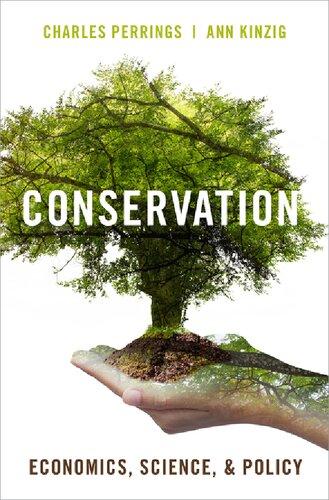
Conservation
Conservation Economics, Science, and Policy
Charles Perrings and Ann Kinzig
Oxford University Press is a department of the University of Oxford. It furthers the University’s objective of excellence in research, scholarship, and education by publishing worldwide. Oxford is a registered trade mark of Oxford University Press in the UK and certain other countries.
Published in the United States of America by Oxford University Press 198 Madison Avenue, New York, NY 10016, United States of America.
© Oxford University Press 2021
All rights reserved. No part of this publication may be reproduced, stored in a retrieval system, or transmitted, in any form or by any means, without the prior permission in writing of Oxford University Press, or as expressly permitted by law, by license, or under terms agreed with the appropriate reproduction rights organization. Inquiries concerning reproduction outside the scope of the above should be sent to the Rights Department, Oxford University Press, at the address above.
You must not circulate this work in any other form and you must impose this same condition on any acquirer.
Library of Congress Cataloging-in-Publication Data
Names: Perrings, Charles, author. | Kinzig, Ann P. (Ann Patricia) author.
Title: Conservation : economics, science, and policy / Charles Perrings and Ann Kinzig, Tempe, Arizona.
Description: New York : Oxford University Press, 2021. | Includes bibliographical references and index.
Identifiers: LCCN 2020046931 (print) | LCCN 2020046932 (ebook) | ISBN 9780190613600 (hardback) | ISBN 9780190613617 (paperback) | ISBN 9780190613631 (epub)
Subjects: LCSH: Conservation of natural resources. | Conservation of natural resources—Decision making.
Classification: LCC S936.P47 2020 (print) | LCC S936 (ebook) | DDC 333.72—dc23
LC record available at https://lccn.loc.gov/2020046931
LC ebook record available at https://lccn.loc.gov/2020046932
DOI: 10.1093/oso/9780190613600.001.0001
1 3 5 7 9 8 6 4 2
Paperback printed by LSC Communications, United States of America
Hardback printed by Bridgeport National Bindery, Inc., United States of America
In memory of Georgina Mace (1953–2020) and Karl-Göran Mäler (1939–2020) two wonderful people whose enduring contributions to science have influenced much of our thinking
PART I THE ECONOMIC THEORY OF CONSERVATION
2
3.6
PART II VALUATION
5
5.4
5.5
5.7
5.8
6 The Valuation of
6.1
6.2 Sustainability
6.3 The
6.4
6.5
6.6
7
7.1
7.2
7.3
7.4
7.5
7.6
7.7
PART III ALIGNING THE PRIVATE AND SOCIAL VALUE OF NATURAL RESOURCES
8
9
8.4
8.5
8.6
9.1
9.2
9.3
9.4
9.5
9.6
9.7
Preface
As we finalize this book, the world economy has been rocked by the emergence and spread of yet another novel zoonotic disease—COVID-19—with origins at the interface between humans, their domesticates, and wildlife. It reminds us that conservation is as much about the control of invasive pests and pathogens as it is about the preservation of endangered wild plants and animals. It also reminds us that every choice we make to promote or degrade life forms involves a social cost. In the COVID-19 case, the costs of our attempts to control the disease have involved major economic dislocation worldwide. The book starts from the premise that the conservation of any resource involves an opportunity cost—the benefits that could have been had by converting that resource to a different use. The conservation of natural resources, like the conservation of works of art, or historic buildings, involves trade-offs.
The book is, first, a study of how people decide to conserve or convert resources. Without worrying about the characteristics of particular resources, we ask when and for how long it may be optimal to conserve resources. In other words, we consider the general principles involved in making conservation decisions.
The book is, second, a study of the conservation of resources of the natural environment. This includes both directly exploited resources such as agricultural soils, minerals, forests, fish stocks, and the like, and the species and ecosystems put at risk when people choose to convert natural habitat, or to discharge waste products to water, land, or air. Conservation is as much about the problem of how much or how little to extract from the environment as it is about how much to leave intact.
The book is, third, a study of the context in which people make conservation decisions. Just as the decisions people make about investment in financial assets are influenced by the tax rules established in different countries, so too decisions about the conservation of natural resources are influenced by property rights, laws, and customs. This includes environmental regulations within countries, and environmental agreements between countries. We consider how conservation relates to environmental governance, and how governance structures have evolved over time.
We have aimed the book at three audiences. The first is graduate students in any of the disciplines bearing on conservation. While the arguments may be most familiar to those studying environmental, resource, or ecological economics, it is intended to be accessible to geographers, ecologists, conservation biologists, political scientists, those studying environmental law, and to those in the comparatively new field of sustainability science. The second audience we have in mind is conservation practitioners, and professionals whose remit includes the management of the natural environment and the use of natural resources. We hope that the book will help those charged with the conservation of the natural environment to think about the trade-offs involved, the better to balance the protection of endangered species and other societal goals, like economic development or poverty alleviation. The third audience we have in mind is the substantial environmentally informed and aware general public who are interested in digging beneath the superficial treatment of conservation often encountered in the media. For people who want to understand the balance that should be struck between preservation and exploitation, between the protection of beneficial species and the control of harmful species, the book offers a set of principles that can be applied in most circumstances.
By including a somewhat formal and fully general theory of conservation, we hope to show what is needed to make rational conservation decisions. By including applications to a range of environmental resource allocation problems, we hope to illustrate the many and varied factors that need to be taken account of in the process. While our discussion of the theory of conservation includes formal mathematical arguments, these are always paralleled by a nonmathematical development of the same arguments. We hope that readers will be able to select the approach that best suits them.
The first draft of the book was largely written while we on sabbatical in Italy and Greece in 2018, and we thank our hosts in Siena and Volos, Simone Borghese and George Halkos, for the opportunity to work in such congenial environments. We also thank our home institution, Arizona State University, for funding and logistical support during the preparation of the book. Our thinking has been influenced over the years by many wonderful people, too numerous to mention here. You know who you are, and we thank you.
Finally, the book is the culmination of many years of work on different aspects of the conservation problem, undertaken with the support of a range of funding agencies. Three projects undertaken with colleagues at a number of institutions have been particularly important: Advancing Conservation in a Social Context, funded by the Macarthur Foundation;
Modeling Anthropogenic Effects in the Spread of Infectious Diseases, funded by the National Institutes of Health (Grant 1R01GM100471); and Risks of Animal and Plant Infectious Diseases through Trade, funded by the National Science Foundation’s Ecology and Evolution of Infectious Diseases program (Grant 1414374).
Charles Perrings and Ann Kinzig, July 2020
1.1
3.1
3.2
3.3
5.6
5.7
6.1 Adjusted net savings rates in different income groups, 1990–2015
6.2 Natural resource rents and agricultural value added as a percentage of GDP by income group, 2015
6.3 Share of land area accounted for by protected areas (panel A) and forest (panel B) across income groups
7.1 Marginal rates of technical substitution between natural and produced capital
7.2 Diminishing marginal rates of technical substitution
7.3 Substitution and output effects, and differences in the private and social cost of natural capital for budget-constrained output maximizers
7.4 Short-run limitations on the substitutability of natural and produced capital
7.5 The production possibility frontier and the rate of product transformation
7.6 Functional similarities between dominant and minor species
7.7 The impact of environmental conditions on production
8.1 The Nash-Cournot reaction curve for the ith individual’s contribution to the public good
8.2 The demand for public goods
8.3 The Great Limpopo Transfrontier Park in Southern Africa
8.4
8.5
8.6
8.7 The incremental cost of increasing supply of local conservation effort
9.1 Externalities of land-based output on capture fisheries via the carrying capacity of marine ecosystems
9.2
9.3
9.4
9.5
9.6
9.7
of
9.8 Taxation of environmentally damaging externalities
9.9 Inducing the socially optimal employment of resources with positive external effects
9.10 Penalties for noncompliance with a regulatory restriction
10.1
10.5 The demographic transition
10.6 Relation between the number of threatened species and per capita income (OLS estimates)
10.7 Quantile and ordinary least squares regression estimates for threatened species (including mean coefficient values and 95% confidence intervals)
10.8 Realized and projected average annual rates of change in the size of the rural population by income group, 1970–2030
11.1 Marine and terrestrial protected areas, 2016
11.2 Area spanned by the Kavango-Zambezi Transfrontier Conservation Area (KAZA), showing the location of national parks, wildlife management areas, and forest reserves in Angola, Botswana, Namibia, Zambia, and Zimbabwe
11.3 Net benefits of protected areas
11.4 Optimal structure of protection in the Rottnest Island Marine Park, Western Australia
12.1 The distribution of protected areas in the United States (panel A), and species of mammals, birds and amphibians (panel B) 281
12.2 Modeled responses of the richness (b) and abundance (c) of local diversity to human pressures in selected sites (a) 283
12.3 Willamette Basin: land-use patterns associated with specific points along the efficiency frontier (A–H) and the current landscape (I)
12.4 Occurrence (A), habitat suitability (B), and potential biocorridors (C) for the Eurasian Lynx in the Czech Republic
12.5 The number of accession to ex situ collections of plant genetic resources worldwide, 1920–2007
12.6 (A) Nitrogen fertilizer consumption, tonnes, 1981–2011; (B) pesticide use per hectare of cropland, 1991–2011
12.7 Freshwater withdrawals as a percentage of internal resources
13.1 Great Barrier Reef Marine Park Zones
13.2 Volume of biodiversity, wetland, and stream credits transacted in the United States 315
13.3 US Conservation Reserve Program county average soil rental rates (2012)
14.1 Parties and range states of the Convention on Migratory Species
14.2 Transboundary river basins
14.3 The Colorado River Basin showing the seven US States (California, Arizona, Nevada, Utah, Wyoming, Colorado, and New Mexico) and two Mexican states (Baja California and Sonora) affected by transboundary management
14.4 Nash equilibria in two-by-two nonrepeated games
14.5 An assurance game in which the benefit to one-sided cooperation equal the benefit to one-side defection 350
14.6 An extensive form of the prisoners’ dilemma without shared pay-offs
14.7 An extensive form of the prisoners’ dilemma with shared pay-offs
14.8 The difference between the noncooperative (Ai) and cooperative (Ai* ) level of conservation where there are n symmetric countries
14.9 Incremental cost
15.1 Measures of human impacts on biodiversity, habitat, and soils relative to pre-existing conditions
15.2 Total sulfur and nitrate deposition
15.3 The proportion of assessed species threatened with extinction
15.4 Trends in the appearance of alien species in North America and South America from 1800 to 2000
15.5 The KOF globalization index for the world, including the overall index, the de facto index, and the de jure index
15.6 Imports of goods and services as a percentage of gross domestic product, by income group
15.7 Exports of goods and services as a percentage of gross domestic product, by income group 375
15.8 Export dependence on agriculture and natural resources
15.9 The KOF globalization index for world trade flows, including the overall index, the de facto index, and the de jure index
15.10 Tourist arrivals 1995–2017
15.11 Numbers of people internally displaced by conflict and natural disasters in 2016
15.12 Foreign direct investment, net inflows 1970–2017, as a percentage of GDP by income group 381
15.13 Foreign direct investment, net inflows 1970–2017, measured in billions of current US$ by income group 381
15.14 The simulated spread of an infectious disease originating in Hong Kong across the air transport network, modeled as the shortest path tree (effective distance) from the origin 385
15.15 Global trend in the state of world marine fish stocks monitored by FAO (1974–2013) 393
1.1 The growth of biodiversity hotspots
5.1 Valuation methods applied to ecosystem services
6.1 SEEA Central Framework environmental assets
9.1 Watershed payments for ecosystem services programs, 2005–2015
13.1 Domestic species delisted under the Endangered Species Act due to recovery
Abbreviations
AAFC Atlantic Africa Fisheries Conference
ABS Access and benefit-sharing
AFTA ASEAN Free Trade Area
APFIC Asia-Pacific Fisheries Commission
ASEAN Association of Southeast Asian Nations
BSE Bovine Spongiform Encephalopathy
CBD Convention on Biological Diversity
CCAMLR Commission for the Conservation of Antarctic Marine Living Resources
CCSBT Commission for the Conservation of Southern Bluefin Tuna
CDC United States Centers for Disease Control
CECAF Fishery Committee for the Eastern Central Atlantic
CFC Chlorofluorocarbon
CGIAR Consultative Group on International Agricultural Research
CGRFA Commission on Genetic Resources for Food and Agriculture
CI Conservation International
CIAT International Center for Tropical Agriculture
CIMMYT Centro Internacional de Mejoramiento de Maíz y Trigo
CITES Convention on International Trade in Endangered Species of Wild Fauna and Flora
CMS Convention on Migratory Species of Wild Animals
CO2 Carbon Dioxide
COREP Regional Fisheries Committee for the Gulf of Guinea
CRP Conservation Reserve Program
CSIRO Commonwealth Scientific & Industrial Research Organization,
CTMFM Joint Technical Commission for the Argentina/Uruguay Maritime Front
CWA Clean Water Act
CWP Coordinating Working Party on Fishery Statistics
ECOWAS Economic Community of West African States
ESA Endangered Species Act
EU European Union
FAO Food and Agriculture Organization of the United Nations
FFA South Pacific Forum Fisheries Agency
GATT General Agreement on Tariffs and Trade
GBA Global Biodiversity Assessment
GCM General Circulation Model
GDP Gross Domestic Product
xxii Abbreviations
GEF Global Environment Facility
GFCM General Fisheries Commission for the Mediterranean
GMO Genetically modified organisms
GNP Gross National Product
HDI Human Development Index
HIV/AIDS Human immunodeficiency virus/Acquired Immune Deficiency Syndrome
IAASTD International Assessment for Agricultural Science, Technology and Development
IATTC Inter-American Tropical Tuna Commission
IBSFC International Baltic Sea Fishery Commission
ICCAT International Commission for the Conservation of Atlantic Tuna
ICES International Council for the Exploration of the Sea
ICRAF International Centre for Research in Agroforestry (now the World Agroforestry Centre)
ICRISAT International Crops Research Institute for the Semi-Arid Tropics
IHR International Health Regulations
IITA International Institute of Tropical Agriculture
ILRI International Livestock Research Institute
IMF International Monetary Fund
IMO International Maritime Organization
INIBAP International Network for the Improvement of Banana and Plantain
IOTC Indian Ocean Tuna Commission
IP Intellectual property
IPBES Intergovernmental Science-Policy Platform on Biodiversity and Ecosystem Services
IPCC Intergovernmental Panel on Climate Change
IPGRI International Plant Genetic Resources Institute
IPHC International Pacific Halibut Commission
IPPC International Plant Protection Convention
IRRI International Rice Research Institute
ITPGRFA International Treaty on Plant Genetic Resources for Food and Agriculture
ITQ Individual Transferable Quota
IUCN International Union for Conservation of Nature
IWC International Whaling Commission
KAZA Kavango-Zambezi Transfrontier Conservation Area
LME Large Marine Ecosystem
MA Millennium Ecosystem Assessment
MDG Millennium Development Goal
MEA Multilateral Environmental Agreement
N Nitrogen
NABRAI National Biodiversity Risk Assessment Index
NAFO Northwest Atlantic Fisheries Organization
NAFTA North American Free Trade Agreement
NAMMCO North Atlantic Marine Mammal Commission
Abbreviations
NASCO North Atlantic Salmon Conservation Organization
NDP Net Domestic Product
NEAFC North-East Atlantic Fisheries Commission
NGO Nongovernmental organization
NNI Net National Income
NNP Net National Product
NPAFC North Pacific Anadromous Fish Commission
OECD Organization for Economic Co-operation and Development
OIE World Animal Health Organization
OLDEPESCA Latin American Organization for the Development of Fisheries
PES Payment for environmental services
PGR Plant Genetic Resources
PICES North Pacific Marine Science Organization
PPS South Pacific Permanent Commission
PSC Pacific Salmon Commission
RECOFI Regional Commission for Fisheries
REDD Reducing Emissions from Deforestation and Forest Degradation
RFMO Regional Fishery Management Organization
SEAFO South East Atlantic Fishery Organization
SNA System of National Accounts
SO2 Sulphur Dioxide
SPC Secretariat of the Pacific Community
SPS Sanitary and Phytosanitary Measures Agreement
SRCF Subregional Commission on Fisheries
SWIOFC South West Indian Ocean Fishery Commission
TBT Agreement on Technical Barriers to Trade
TEEB The Economics of Ecosystems and Biodiversity
TFCA Trans Frontier Conservation Area
TFP Total Factor Productivity
TNC The Nature Conservancy
TRIPS Trade-Related Aspects of Intellectual Property Rights
UK United Kingdom
UN United Nations
UNCCD United Nations Convention to Combat Desertification
UNCED United Nations Conference on Environment and Development
UNCLOS United Nations Convention on the Law of the Sea
UNDP United Nations Development Programme
UNEP United Nations Environment Programme
UNFCCC United Nations Framework Convention on Climate Change
UPOV International Convention for Protection on New Plant Varieties
USA United States of America
USDA United States Department of Agriculture
USEPA
USFDA
United States Environmental Protection Agency
United States Food and Drug Administration
xxiv Abbreviations
USMCA United States-Mexico-Canada Agreement
WCMC World Conservation Monitoring Centre
WCPFC Western and Central Pacific Fisheries Commission
WECAFC Western Central Atlantic Fishery Commission
WHO World Health Organization
WIOTO Western Indian Ocean Tuna Organization
WTA Willingness to accept
WTO World Trade Organization
WTP Willingness to pay
WWF World Wildlife Fund