Asauthorsof thesixteentheditionof abookthat first appearedin1981, weareperforcebelieversinthemaxim that inpoliticssixmonthsisalong timeandfour yearspracticallyalifetime.Eventsof recent yearssurely bear out thiswisdom.Theroller-coaster reversalsof government and politicsrequirefrequent updatesof anytext ontheU.S.Congressthat aimstobebothcurrent andcomprehensive. DonaldTrumpscoredahistoricupset intheNovember 2016presidential election,becomingthefirst President totakeofficewithnoprior experienceingovernmental officeor themilitary.Followingadeeply polarizedelection,Trumpassumedofficewiththelowest approval ratings of anynewpresident sincetheonset of modernopinionpolling.Evenso, TrumpandtheGOP’scongressional leadershipwereeager toseizetheir opportunitytotransform arangeof government policies. Trumpbeginshisterm witharareinstitutional opportunity,unified Republicancontrol of CongressandtheWhiteHouse.Since1980,divided government hasbeenthetypical condition,withopposingparties controllingtheWhiteHouseandat least onechamber of Congressfully 79% of thetime.Likethelast episodeof unifiedgovernment (2009–10), the115thCongress(2017–18) will test thecapacityof today’spolarized partiestodeliver ontheir promises.If recent past isprologue,the opportunityfor major policydepartureswill declineover time.Eachof Trump’sthreeimmediatepredecessors—Bill Clinton,GeorgeW.Bush, andBarackObama—enduredmidterm backlashesthat cost their party control of Congress.After anexceptionallyproductiveCongressunder unifiedgovernment inhisfirst twoyearsof office,Obamareceivedwhat hetermeda“shellacking”inthe2010elections,inwhichRepublicans gainedahistoricsixty-threeseatstoretakecontrol of theHouseof Representatives.Thenin2014Republicanspaddedtheir Housemajority andrecapturedtheSenatemajority.Evenif Trump’sRepublicanmajorities inCongressprovemoredurablethanObama’s,most presidentsseetheir influencewithCongressdiminishover time.After 2011,Obama’s relationswithCongresslurchedfrom crisistocrisis,withimpasses threateningtohalt federal agencyoperationsor sendthegovernment into default.
Theprecariousfortunesof recent presidentsandcongressional majorities areareminder of thepervasivepluralism of theAmericanpolitical system,withitsdiverseviewpointsandinterests.Presidentsand congressional leadersseetheir perceivedmandatescollidewiththe founders’ intricate“auxiliaryprecautions”for preventingmajoritiesfrom winningquickor total victories.Not theleast of thesystem’sattributesis what wecall the“twoCongresses”: Congressisbothaconduit for localizedinterestsandamaker of national policy. Inthisedition,wediscussnewdevelopmentsandfreshresearchonnearly everyaspect of Congress.Whenthefirst editionof thisbookcameout, political scientistswerestill seekingtoexplainthedeclineof partyunity inCongress.Today,thestrengthof partisanshipandpartyleadersisthe most salient realityof Capitol Hill.Congressisavortexof theso-called permanent campaign,inwhichelectioneeringisinterlockedwiththe processandcontent of lawmaking.Werecordshiftsinpartyleaders,the committeesystem,floor procedures,andtheCapitol Hill community. Complex,interdependent relationshipswithpresidents,bureaucrats,and thecourtsput Congressat thecenter of theentirefederal government. Inthemidst of fundamental political change,thereremainunderlying constantsinCongress’scharacter andbehavior.Most important isthedual natureof Congressasacollectionof career-mindedpoliticiansandasa forum for shapingnational policy.Weemploythetwo-Congressestheme toexplainthedetailsof congressional lifeaswell asscholarlyfindings about legislators’ behavior.Colorful personalitiesandinterestingevents arenever inshort supplywhenexaminingCapitol Hill.Westriveto describerecent developmentsandtrends; moreimportant,wetrytoplace them inbroader historical andconceptual context. Thesearetroublingtimesfor thoseof uswhobelieveinrepresentative democracy.True,Congresshas,withvaryinglevelsof success,absorbed astonishingchangesinitsmembership,partisancontrol,structural and procedural arrangements,andpolicyagendas.Yet Congresshasall too oftenretreatedfrom itsconstitutional mandatetoinitiatenational policy andoverseegovernment operations.Itsprerogativesareunder siegefrom executivedecisionmakers,federal judges,andeliteopinionmakers,who constantlybelittleitscapacities,ignoreitsauthority,andevadeits scrutiny.Lawmakersthemselvesaretoblamefor failingtoaddress pressingpolicyproblems,for reinforcingdisdainof theinstitution,andfor
substitutingpartisanallegiancefor independent judgment andcritical thinking.Today’sCongressall toooftenfallsshort of thefounders’ vision asthe“first branchof government”—for reasonsthat thisbookexplains. Thisedition,likeitspredecessors,iswrittenfor general readersseekingan introductiontothemodernCongressaswell asfor collegeor university studentstakingcoursesonthelegislativeprocessor national policy making.Wetrytopresent accurate,timely,andreadableinformation, alongwithinsightsfrom scholarsandpractitioners.Althoughwrapped aroundour coretheme,thebook’schaptersarelongonanalysis.Wemake noapologiesfor this.Lawmakingisanarduous,complicatedbusiness; thosewhowouldunderstandit must master itsdetailsandnuances.At the sametime,wehopetoconveytheenergyandexcitement of theplace. After all,our journalist friendsareright: Capitol Hill isthebest beat in town.
Our deepappreciationfor our families,for their loveandsupport,cannot befullyexpressedinwords.Asameasureof our affection,thisbookis dedicatedtothem.
—Roger H.Davidson Santa Barbara, California
—Walter J.Oleszek Fairfax, Virginia
—FrancesE.Lee Washington, D.C.
—EricSchickler Berkeley, California April 2017
AbouttheAuthors
RogerH.Davidson
isprofessor emeritusof government andpoliticsat theUniversityof Maryland,andhasservedasvisitingprofessor of political scienceat theUniversityof California,SantaBarbara.HeisaSenior Fellowof theNational Academyof PublicAdministration.Duringthe1970s,he servedonthestaffsof reform effortsinboththeHouse(BollingMartinCommittee) andtheSenate(Stevenson-BrockCommittee). For the2001–2002academicyear,heservedastheJohnMarshall Chair inpolitical scienceat theUniversityof Debrecen,Hungary.His booksinclude Remaking Congress: Change and Stability in the 1990s, co-editedwithJamesA.Thurber (1995),and Understanding the Presidency, 7thed.,co-editedwithJamesP.Pfiffner (2013). Davidsonisco-editor withDonaldC.BaconandMortonKeller of The Encyclopedia of the United States Congress (1995).
WalterJ.Oleszek
isasenior specialist inthelegislativeprocessat theCongressional ResearchService.Hehasservedaseither afull-timeprofessional staff aideor consultant toeverymajor HouseandSenate congressional reorganizationeffort beginningwithpassageof the LegislativeReorganizationAct of 1970.In1993heservedasPolicy Director of theJoint CommitteeontheOrganizationof Congress.A longtimeadjunct facultymember at AmericanUniversity,Oleszekis afrequent lecturer tovariousacademic,governmental,andbusiness groups.Heistheauthor or co-author of several books,including Congressional Procedures and the Policy Process, 10thed.(2016), and Congress under Fire: Reform Politics and the Republican Majority, withC.LawrenceEvans(1997).
FrancesE.Lee isprofessor of government andpoliticsat theUniversityof Maryland.ShehasbeenaResearchFellowat theBrookings InstitutionandanAPSACongressional Fellow.Most recently,sheis theauthor of Insecure Majorities: Congress and the Perpetual Campaign (2016).Sheisalsoauthor of Beyond Ideology: Politics, Principles, and Partisanship in the U.S. Senate (2009),which receivedtheRichardF.FennoJr.Prizefor thebest bookonlegislative
politicsin2010andtheD.B.HardemanPrizefor thebest bookon theU.S.Congresspublishedin2009.Sheisco-author,withBruceI. Oppenheimer,of Sizing Up the Senate: The Unequal Consequences of Equal Representation (1999).Her articleshaveappearedinthe American Political Science Review, Journal of Politics, Legislative Studies Quarterly, and American Journal of Political Science, among others.
EricSchickler isJeffrey& AshleyMcDermott Professor of Political Scienceat the Universityof California,Berkeley.Heistheauthor of Disjointed Pluralism: Institutional Innovation and the Development of the U.S. Congress (2001),whichwontheRichardF.FennoJr.Prizefor the best bookonlegislativepoliticsin2002,andof Racial Realignment: The Transformation of American Liberalism, 1932–1965 (2016).Heis alsotheco-author,withDonaldGreenandBradleyPalmquist,of Partisan Hearts and Minds (2002); withGregoryWawro,of Filibuster: Obstruction and Lawmaking in the U.S. Senate (2006), whichwontheFennoPrizein2007; and,withDouglasKriner, Investigating the President: Congressional Checks on Presidential Power (2016).Hisarticleshaveappearedinthe American Political Science Review, American Journal of Political Science, Legislative Studies Quarterly,and Studies in American Political Development, amongothers.
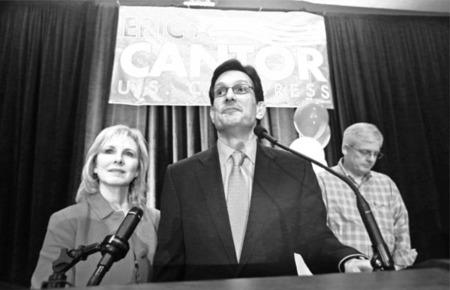
“It’sthebiggest electionupset inthehistoryof theAmericanrepublic,” saidSteveBannon,chief strategist toPresident DonaldJ.Trump.But in thiscase,Bannonwasnot speakingof Trump’sownimprobableelection.1 Hewasreflectingonthe2014defeat of Housemajorityleader EricCantor inaRepublicanprimary.Never beforehadaHousemajorityleader been unseatedinaprimary.
Theoutcomesurprisedalmost everyone.After morethanadecadein Congress,Cantor enjoyedsomeseeminglyunassailableadvantages.A skilledpolitical leader whohadrisenthroughhisparty’sranks,Cantor was likelynext inlinefor Speaker of theHouse.Hisopponent DaveBrat wasa professor inasmall liberal artscollegewhohadnever beforeheldelective office.Cantor wasoneof Capitol Hill’stopfund-raisers,andhiscampaign outspent Brat’sby26to1.Cantor hadspent nearlyasmuchonfundraisingdinnersat steakhousesasBrat hadraisedintotal for hiswhole campaign.2 Inthelead-uptotheelection,everypoll hadshownCantor withasolidlead.3 Nevertheless,intheend,Brat defeatedCantor—andby alopsidedmarginof elevenpercentagepoints.4 Althoughsurprisingand extraordinary,theoutcomeof the2014Brat–Cantor primaryhighlights fundamental truthsabout political representation.Theworkof Congressis conductednot onlyonCapitol Hill but alsoinstatesanddistrictshundreds or thousandsof milesaway.Thereisnoquestionthat Cantor had distinguishedhimself asapower broker andpartyleader inWashington. “He’satier-onetalent,”saidRep.Peter Roskam,R-Ill.“Heuniquely brought ustogether”inleadingHouseRepublicansbacktopower in2010 andrallyingthepartyagainst President Obama’sagenda.5
But Cantor’stiestohisconstituentsbackinVirginiahadfrayed.Thefundraisingexpectedof partyleadersrequiredhim tospendalot of time travelingtomeet withprospectivedonorsall over thecountry.Evenwhen hewasinhisdistrict,Cantor wasn’t “onetoslapbacks,kissbabies,knock ondoors,or worktheroom.”6 Cantor preferredtoholdinvitation-only events.Oneof hisaideswasquotedtellingalocal activist,“EricCantor will never holdatownhall meeting.Over mydeadbody! Youhear me?”7 Over time,Cantor’spopularityamongconstituentshaddeclined.Alocal reporter for the Chesterfield Observer describedthechangingmoodinthe
district: “Youcouldtell wherever youwent that Cantor wasincredibly unpopular,that peoplesawhim asarrogant.”8 “Hewasalot moreintouch whenhefirst ran14yearsago,”remarkedalocal drugstoremanager.9 Brat wasabletotakeadvantageof Cantor’sunderappreciated vulnerabilities.WithCantor’ssupport alreadysoftened,Brat identified issueswithstronglocal appeal inthedistrict.Hefoundpopulist themesto capitalizeonvoter discontent withCongressandWashingtoninsiders.“I am runningagainst Cantor,”hewroteinanop-edaweekbeforethe primary,“becausehedoesnot represent thecitizensof the7thDistrict,but rather largecorporationsseekinginsider deals,cronybailoutsanda constant supplyof low-wageworkers.”10 Thereferenceto“low-wage workers”wasaimedat Cantor’ssupport for someimmigrationreforms. Brat,withconsiderableexaggeration,lambastedCantor as“theleading forceintheHousepushingfor amnestyfor illegal immigrants.”11 The immigrationissuetouchedanerve.It alsoattractednational attentionon talkradioandconservativewebsites,if not inthemainstream press. Bannon,former chairmanof Breitbart News,anultraconservativenews website,said,“Wecoveredthis[campaign] for sixmonths,dayinandday out.”12 Avarietyof conservativemediapersonalitiesembracedBrat and begantopromotehiscampaign,includingLauraIngraham,AnnCoulter, Matt Drudge,andMarkLevin.13 “Every[talkradio] newscast wastalking about [Cantor’s] support for immigration,”observedanational TeaParty activist.“Dollarscan’t buyanadvertisement likethat.”14 TheBrat–Cantor raceillustratescentral themesof thisbook.Nomatter howmuchmembersof Congressdistinguishthemselvesaslawmakersor Beltwayinsiders,theyalsohavetodistinguishthemselvesintheeyesof local constituents.Thereisnoquestionthat Cantor hadanillustriousand accomplishedcareer inCongress,but asuccessful representativecannot rest onlaurelswoninWashington.Ambitiouspotential challengersback inthedistrict arealwayswatchingfor earlysignsof weakness.For this reason,lawmakersmust winandcontinuallyrenewbondsof trust with their constituents.Thesebondsrest onconstituents’ senseof connectionto their representatives.Membersmust maintainpersonal relationshipsand openlinesof communication.Constituentsmaynot alwaysunderstandthe detailsof national policydebates,but theyknowwhom theytrust—and whom theydoubt.