Professor of International Law and Human Rights and Co-Director of the Academy of Academic Law at the European University Institute, Florence
PROFESSOR ANA FILIPA VRDOLJAK
Associate Dean (Research) and Professor of Law at the University of Technology, Sydney
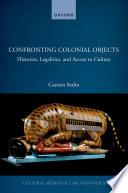
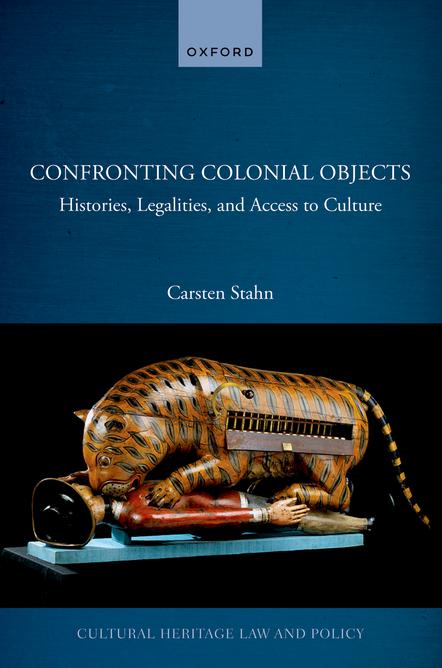
Confronting Colonial Objects
CULTURAL HERITAGE LAW AND POLICY
The aim of this series is to publish significant and original research on and scholarly analysis of all aspects of cultural heritage law through the lens of international law, private international law, and comparative law. The series is wide in scope, traversing disciplines, regions, and viewpoints. Topics given particular prominence are those which, while of interest to academic lawyers, have significant bearing on policy-making and current public discourse on the interaction between art, heritage, and the law.
advisory board
James Nafziger
Kurt Siehr
Ben Boer
Roger O’Keefe
Marc-André Renold
Federico Lenzerini
Keun-Gwan Lee
Confronting Colonial Objects
Histories, Legalities, and Access to Culture
CARSTEN STAHN
Great Clarendon Street, Oxford, OX2 6DP, United Kingdom
Some rights reserved. No part of this publication may be reproduced, stored in a retrieval system, or transmitted, in any form or by any means, for commercial purposes, without the prior permission in writing of Oxford University Press, or as expressly permitted by law, by licence or under terms agreed with the appropriate reprographics rights organization.
This is an open access publication, available online and distributed under the terms of a Creative Commons Attribution – Non Commercial – No Derivatives 4.0
International licence (CC BY-NC-ND 4.0), a copy of which is available at http://creativecommons.org/licenses/by-nc-nd/4.0/.
Enquiries concerning reproduction outside the scope of this licence should be sent to the Rights Department, Oxford University Press, at the address above
Public sector information reproduced under Open Government Licence v3.0 (http://www.nationalarchives.gov.uk/doc/open-government-licence/open-government-licence.htm)
Published in the United States of America by Oxford University Press 198 Madison Avenue, New York, NY 10016, United States of America
British Library Cataloguing in Publication Data
Data available
Library of Congress Control Number: 2023943279
ISBN 978–0–19–286812–1 DOI: 10.1093/oso/9780192868121.001.0001
Printed and bound in the UK by TJ Books Limited
Links to third party websites are provided by Oxford in good faith and for information only. Oxford disclaims any responsibility for the materials contained in any third party website referenced in this work.
Preface and Acknowledgements
The taking and return of cultural artefacts is one of the most discussed topics in the art world and international relations. It is present wherever we go, often on our own doorsteps. Many Western museums are major tourist attractions. They host many objects or human remains, whose colonial histories or ‘ghostly presences’ pose intriguing questions in relation to the past and present or raise painful memories in the eyes of those affected. How should we confront these challenges? These questions are not only at the heart of expert discussions or curatorial policies but go to the core of societal identities. The ethics, institutional practices, and public perceptions surrounding contested objects are shifting. The significance of the moment is captured by the striking words of Bénédicte Savoy on the occasion of the historic French return of twenty-six objects from Dahomey to modern-day Benin: ‘Just as there was a before and after the fall of the Berlin Wall, there will be a before and after the return to Benin of the works looted by the French army in 1892.’1 These returns are the tip of the iceberg of a movement which has gained new traction after many decades of struggle, silence, or delay.
Coloniality was mediated through material things. The life story and transformation of objects provide ample evidence that cultural objects were not only sites of colonial violence, domination, or commodification but also symbols of resistance or agents in their own right, which transformed attitudes in Western societies. Human remains became the incarnation of the body politics of colonialism. Although the debate on restitution and return of stolen or looted cultural objects is as old as humanity, cultural takings in the colonial era have received limited structural attention. Colonial violence has remained in the shadow of the holocaust.
Amadou-Mahtar M’Bow, former Director-General of UNESCO, recalled in 1978 that the return of cultural assets to communities of origin ‘cannot be solved simply by negotiated agreements and spontaneous acts’.2 However, in the process of UN decolonization, the link between history, identity, and access to culture was marginalized, despite calls for restitution. For a long time, return was treated as an issue of cultural diplomacy. Change was mainly driven by developments of indigenous rights and the gradual humanization of cultural heritage law.
Over the past decade, the restitution movement has reached a tipping point. We witness a growing consciousness of the ongoing remnants of colonial injustice,
1 Farah Nayeri and Norimitsu Onishi, ‘Looted Treasures Begin a Long Journey Home from France’ New York Times (28 October 2021).
2 Amadou-Mahtar M’Bow, ‘A Plea for the Return of an Irreplaceable Cultural Heritage to Those Who Created It’ (Paris: UNESCO, 1978).
changing museum ethics, and professional practices, as well as new ways to confront issues of ownership or access to culture. Sustainable Development Goal 16 lists ‘recovery and return of stolen assets’ as an express target. Change is driven by civil society pressure, return claims, professional networks, curators or individual institutions, greater transparency, the establishment of new art institutions in the Global South—often more modern than their Western counterparts, new forms of collaboration between museums and communities in provenance research, governance or display, and new prospects of sharing objects. They provide the building blocks for a new era of engagement.
This book seeks to take stock of these developments and to contribute to the emerging strand of literature on cultural colonial takings and their contemporary significance. One challenge is positionality. Should this be done by a Western author if there is already a diversity gap in contemporary academic publishing? On the one hand, this is an ethical dilemma which must be openly acknowledged. There is a pressing need to diversify scholarship, foreground local knowledge systems, and/ or strengthen the voices of those who have advocated for change, but have received less attention in discourse. On the other hand, it is important to stimulate critical inquiry and memory in Western societies who struggle to re-engage with their own past. As Chimamanda Adichie said at the opening of the Humboldt Forum in Berlin: ‘We cannot change the past but we can change our blindness to the past’.3 The study seeks to heed the call by Open Restitution Africa to ensure more inclusive referencing and engagement with non-Western voices and perspectives.4
The work addresses colonial objects in the broad sense, i.e. colonized cultural objects and bodies. It starts from the premise that the underlying challenges can only be addressed through the interplay of different lenses: justice, ethics, and human rights. It illustrates how colonial agents reinvented social and scientific narratives to justify takings throughout different periods of colonial history and shows synergies with contemporary arguments advanced in the discourse on restitution and return, including the re-construction of identities through restitution processes. It explains the dual role of law, as imperial tool and language, and as instrument of resistance and transformation. It points out blind spots in cultural heritage law and new ways to deal with colonial heritage, drawing on collaborative practices, experiences with successful returns, and synergies with transitional justice concepts. It proposes a relational cultural justice approach to overcome impasses, which have created stalemate and impeded dialectical engagement. It does not portray restitution or return as golden standard for all objects. It rather places
3 Humboldt Forum, Keynote speech by Chimamanda Adichie (22 September 2021) https://www. humboldtforum.org/en/programm/digitales-angebot/digital-en/keynote-spreech-by-chimamandaadichie-32892/
4 Molemo Moiloa, Reclaiming Restitution: Centering and Contextualizing the African Narrative (Open Restitution Africa, 2022) https://openrestitution.africa/wp-content/uploads/2022/09/ANF-Rep ort-Main-Report.pdf
the emphasis on the need to search forms of consent in relation to ownership, presentation, or conservation, based on the nature of objects, structural injustice, and contemporary relations. The core idea of the relational model is to foster new collaborative relationships between holding institutions, countries, or communities of origin and local stakeholders. It argues at the same time that contemporary engagement should not be reduced to issues of return, but identifies strategies and remedies beyond restitution.
A key part of the manuscript is devoted to micro-histories, biographies, or ‘necrographies’ of objects. They often speak for themselves. They illustrate the narratives of takings, unexpected twists and turns in the lives of objects, different ontologies, and forms of encounter. These stories do not only offer fascinating insights about colonial politics, world history, or the branding of art forms, but also offer new ways to understand the ways in which racial science and market forces influenced the shaping of international law.
The study challenges the argument that all takings of cultural objects qualify as looted art or theft. But it also questions the premise that colonial acquisitions were lawful, simply because they involved some type of consent, exchange, or compensation. It relies on the concept of entanglement to recognize these complexities. It argues that legality should be regarded as a spectrum, with different degrees of legality or illegality (‘entangled legalities’), and develops principles of relational justice to disentangle these dichotomies. It illustrates some of the risks and blind spots of current return practices, such as the dominant focus on spectacular objects or continuing double standards in relation to natural history objects.
Major parts of the text were written during the Covid-19 pandemic. They are not only inspired by interdisciplinary scholarly perspectives, but by many virtual seminars, podcasts (e.g. ‘Stuff the British Stole’), and news platforms, such as the invaluable ‘Restitution Matters’ project, open access sources (e.g. Kwame Opoku’s entries on Modern Ghana), and actual and virtual conversations with friends and colleagues. It takes into account developments until March 2023.
I wish to thank Ingrid Samset from Leiden University College for her careful reading and invaluable comments and Charlotte Perez for her critical editorial reading. I also wish to express my gratitude to colleagues from the Leiden Cultural Heritage Centre (Pieter ter Keurs, Evelien Campfens), the Grotius Centre for International Legal Studies, and Queen’s University Belfast, and our students for inspiring discussions and exchange of ideas. Particular thanks are also owed to Francesco Francioni and Ana Filipa Vrdoljak for including this work in the Series on Cultural Heritage Law and Policy, to Nicola Prior for her careful copy-editing, and to colleagues at OUP (Merel Alstein, Robert Cavooris, and Lane Berger) for making this book a reality.
The work is made available open access in order to enable broad engagement by readers and audiences in all parts of the globe. It is not only geared towards experts, but is meant to encourage discussion on the responsibilities and moral choices we
face in our daily actions when we encounter contested objects. I hope it will not be the end or the beginning of the end, but rather the end of the beginning of a more open, equal, and transparent discourse on ways to confront entangled objects, and a means to translate new visions into action. It is dedicated to my mother, who explored the fascination of different heritage traditions in her travels and exposed me to new worlds.
The Hague, March 2023
Preface to Carsten Stahn’s book
Confronting Colonial Objects: Histories, Legalities, and Access to Culture
This book is a timely and important contribution to the current debate on the impact of colonialism and of de-colonization on the legal status of cultural property and on the difficult issue of reparation and restitution of objects obtained by war, colonialism, and coercion from colonized peoples. In the past twenty years this theme has attracted vast and increasing attention on the part of scholars, museums, media, collectors, and experts in provenance research. Important museums of the world have been facing increasing scrutiny from media, academics, and law enforcement officials over the extent to which their collection may include cultural objects looted during the colonial period. This has produced unprecedented reactions at the political level—such as the commitment undertaken in 2017 in a public speech by the French President Macron to inaugurate a policy of gradual return to African countries of cultural objects removed during the colonial period and now part of the collections of national museums. As we know, this political pronouncement has been followed by the influential Rapport Savoy/Sar sur la restitution du patrimoine africaine. This move has been followed by the adoption by important museums in Europe and the United States of plans intended to root out looted artefacts in their collections.
In this climate of changing cultural mores, this book addresses the topic through the lens of three interrelated legal-theoretical contexts: justice, ethics, and human rights. In this multidisciplinary perspective, the author raises the important question of whether the Western legal and social construct that defines the concept of cultural property and its relation to society may be shared, or may even be compatible, with the cultural understandings and legal traditions of the colonized people. The answer is, obviously, a negative one. Hence also a negative evaluation of the role played by international law in legitimizing the mass appropriation of cultural objects by the colonizing powers. But the most important question that remains to be answered concerns the role that international law can play today in remedying past injustices and ensuring the return of cultural objects wrongly removed from colonial territories. Today, international law provides a framework of multilateral instruments designed to facilitate the restitution or return of cultural objects illegally removed from their country of origin. However, as we well know, these instruments—such as the 1970 UNESCO Convention and the 1995 UNIDROIT Convention—are not technically capable of addressing the restitution of colonial
loot because they have no retroactive effect. However, this formal legal obstacle to the application of the above instruments to colonial loot does not relieve us from the duty to remedy past cultural injustices that continue to display their harmful effects in present time. This is what the author of this book successfully attempts to do through the lens of justice, ethics, and human rights.
Francesco Francioni and Ana Filipa Vrdoljak
Table of Cases
Table of Instruments
List of Abbreviations xxxv
1. Confronting Colonial Heritage: Introducing Entanglements, Continuities, and Transformations 1
2. Expanding Empire: Curiosity, Power, and Prestige 61
3. Collecting Mania, Racial Science, and Cultural Conversion through Forcible Expeditions
4. The Scramble for Cultural Colonial Objects: Other Types of Acquisition
5. Collecting Humanity: Commodification, Trophy Hunting, and Bio-colonialism
6. Law’s Complicity in Cultural Takings and Colonial Violence: Double Standards, Discursive Silencing, and Social Transformation
7. Colonial and Post-colonial Continuities in Culture Heritage Protection: Narratives and Counter-narratives 345
8. Acknowledging the Past, Righting the Future: Changing Ethical and Legal Frames
9. Beyond to Return or Not to Return: Towards Relational Cultural Justice
2.2 Corporate colonialism
2.3 Missionary ‘collecting’ and traders and explorers
2.4 Gifts
3 The systematization of collection between the eighteenth and the mid-nineteenth centuries
3.1 Imperial collecting between cultural nationalism and cultural elevation
3.2 The quest for prestige and trophy: Objects acquired through military operations and occupation 91
3.3 Imperial collecting to care and preserve: Semi-public, semi-private acquisition in the service of exploration and civilization
3.4 Gifts
4 Conclusions
3. Collecting Mania, Racial Science, and Cultural Conversion through Forcible Expeditions
1 Introduction
2 The ambivalent use of science
3 The new age of ethnological museums and collections
4 Sociological transformation
5 Acquisition through forcible expeditions: Selected micro-histories
5.1 Looting of the Yuanmingyuan Palace (1860)
5.2 French punitive expedition to Korea (1866)
5.3 The Abyssinian Expedition of 1868 (Maqdala Pillage)
5.4 Punitive expeditions to Kumasi during the Anglo-Asante Wars (1974, 1896, 1900)
5.5 The canoe prow ornament (tangué) of Lock Priso (1884)
5.6 French expedition to Dahomey (1892)
5.7 The Lombok expeditions (1894)
5.8 The acquisition of the male Luba mask during the Belgian Force Publique expedition to Lulu (1896)
5.9 The taking of the Benin bronzes: A hallmark of colonial looting (1897)
5.10 Removal of the Kono boli figure: Looting during the Dakar–Djibouti mission (1931)
5.11 Concluding reflections
4. The Scramble for Cultural Colonial Objects: Other Types of Acquisition
1 Introduction
2 The taking of the Tūranga Meeting House (Te Hau ki Tūranga) (1867)
3 Removal of the Easter Island Moai Hoa Hakananai by the HMS Topaze (1868)
4 Forced migration: The history of the Great Zimbabwe Birds (1889–1891)
4.1 Removal through colonial collecting
4.2 Colonial prejudice and misinterpretation
4.3 Symbols of new national identity
5 Acquisition in the shadow of violence: The Bangwa Queen (1899) and Ngonnso, ‘Mother of the Nso’ (1902)
5.1 The Bangwa Queen
5.2 Ngonnso, ‘Mother of the Nso’
6 The grand canoe from Luf, German New Guinea: Acquisition after destruction (1882/1903)
6.1 Context
6.2 The 1882 punitive expedition and its consequences
6.3 Acquisition by Max Thiel in 1903
7 Converted objects: The power figures (Mikinsi) collected by Father Leo Bittremieux at the Scheut Mission as of 1907
8 Entangled gift: Mandu yenu, throne of King Njoya (1908)
9 The ‘sale’ and return of the Olokun head from Ife (1910)
10 German Elginism: The Bust of Nefertiti (1913)
The partage: legal or moral wrong?
Unjust enrichment?
10.4
11 Removals under occupation or colonial domination: Venus of Cyrene (1913–1915) and Aksum Obelisk (1936)
11.1 Venus of Cyrene (1913–1915)
The Aksum stele
5. Collecting Humanity: Commodification, Trophy Hunting, and Bio-colonialism
1 Introduction
2 Colonial systems of collection
3 Human
4 Human remains as trophies of
4.1 Practices of trophy hunting and mutilation
4.2 The story of the Mkwawa head
5 Systematized collecting for science in a colonial context
5.1 Settler colonial contexts
5.2 The story of Sarah Baartman (‘The Black Venus’)
5.3 Commodification in British/Irish relations: The body politics of Charles Byrne, ‘the Irish Giant’
5.4 Science as accomplice to genocide: the hunt for skulls and remains in German South West Africa
5.5 Bio-colonialism and the collection of fossil remains
6
6. Law’s Complicity in Cultural Takings and Colonial Violence: Double Standards, Discursive Silencing, and Social Transformation
1 Introduction
2 Empire’s tools: Double standards in the recognition of legal personality
2.1 Contradictions in colonial practices
2.2 Counter-narratives
3 Justification and contestation of hybrid legal forms and corporate structures
4 The legitimation of colonial violence
4.1 Specificities of colonial warfare
4.2 Double standards and racial bias in the laws of war
4.3 The silencing of violence in the legitimization of the use of force
4.4 Counter-narratives
5 Colonial law: The making and unmaking of colonial identities
5.1 Roles of colonial law
5.2 Cultural transformation, alienation, or destruction
6 Entangled legalities
6.1 Multi-normative frames of reference
6.2
6.3
7. Colonial and Post-colonial Continuities in Culture Heritage Protection: Narratives and Counter-narratives
2 Silences and continuities in the inter-war period
2.1
3
4 UN decolonization: Law as a fortress
4.1 The battle over retroactivity of the 1970 Convention
4.2
4.3 The UNESCO Intergovernmental committee as political back-up
4.4 Gaps and silences in the 1983 treaty regime on state succession
5 Advances and divides of the UNIDROIT Convention
5.1 Concerns of market countries
5.2 Innovations and drawbacks
5.3 Continuing divides
6 The Emperor’s new clothes
6.1 Conception of cultural objects
6.2 The diversification of cultural heritage law
6.3 The turn to indigenous rights
7 Conclusions
8. Acknowledging the Past, Righting the Future: Changing
2
3
3.1
3.2
3.3
3
3.1
3.2
4
6
7
7.1
7.2
7.3
7.4
Australia
Table of Cases
NATIONAL CASES
High Court of Australia, Mabo and Others v Queensland (No. 2) [1992] HCA 23; (1992) 175 CLR 1
Canada
Federal Court (Canada) Hamlet of Baker Lake v Minister of Indian Affairs and Northern Development, (1979) 107 DLR (3d), 513
Supreme Court, R. v Marshall; R. v Bernard, [2005] 2 S.C.R. 220, 2005 SCC 43 319n.245
Colombia
Republic of Colombia, Constitutional Court, Judgment SU-649/17, 19 October 2017
France
High Court of Paris, Survival International V. Nret-Minet, Tessier & Sarrou, RG No.: 13/52880, 12 April 2013, in (2013) 20 International Journal of Cultural Property 460–465
Germany
Constitutional Court for the State of Baden-Württemberg, Nama Traditional Leaders Association, Order, 1 VB 14/19, 21 February 2019 . . . . . . . 453n.323, 453n.328
Ireland
Supreme Court, Webb v Ireland, 1 January 1988, [1988] I.R. 353
Italy
Council of State (Consiglio di Stato), Case No. 3154, Associazione nazionale Italia Nostra Onlus c. Ministero per i beni e le attività culturali et al., 23 June 2008 .
229n.312, 229n.314
Regional Administrative Tribunal of Lazio, Associazione Nazionale Italia Nostra Onlus v Ministero per i Beni le Attività Culturali et al., No. 3518, 28 February 2007 in (2007) 17 Italian Yearbook of International Law 277–280. 374n.213
Namibia
High Court of Namibia, Bernadus Swartbooi v The Speaker of the National Assembly, Case No. HC-MD-CIV-MOT-REV-2023/00023, Founding Affidavit, 20 January 2023 507n.197
Netherlands
Hague Court of Appeal, Children of executed men in South-Sulawesi v The Netherlands, Case No. 200.243.525/01, 1 October 2019 .
Hague Court of Appeal, Heirs Java torture victim v The Netherlands, Case No. 200.247.634/01, 1 October 2019 462n.386
Supreme Court, Wi Parata v Bishop of Wellington (1877) 3 NZ Jur. (NS) SC 72. 290n.38
Waitangi Tribunal, ‘Turanga Tangata, Turanga Whenua: The Report on the Turanganui a Kiwa Claims’, Vol. II, Chapter 10, ‘Te Hau ki Turanga’ (Wellington 2004) 587–607 .
UK
British Court of Vice-Admiralty at Halifax, ‘The Marquis de Someruelos’, 21 April 1813, in James Stewart, Reports of Cases, Argued and Determined in the Court of Vice-admiralty at Halifax in Nova-Scotia (London: Butterworth and Son, 1814) 482–486
High Court of Justice, Attorney General v Trustees of the British Museum, [2005] EWHC 1089, 27 May 2005 427n.101
Privy Council, Mohegan Indians v Connecticut, Proceedings Before Commission of Review 1743 (1769) 191
Privy Council, Report of the Committee for hearing of Appeals from the Plantations touching ye Mohegan Indians Lands, 21 May 1706, Privy Council Records, Public Records Office 2/81, 204–205
Privy Council, Re Southern Rhodesia, 26 July 1918 (1919) A.C. 211, 221 288–89n.21
US
Commonwealth of Massachusetts Appeals Court, Lanier v President and Fellows of Harvard College, Motion for Direct Appellate Review by Supreme Judicial Court, No. 2021-P-0350, 12 May 2021
Commonwealth of Massachusetts Supreme Judicial Court, No. SJC- 13138, Lanier v Harvard, Amicus Brief, Dan Hicks and David Mirzoeff, 11 October 2021
District Court for Columbia, Deadria Farmer-Paellmann and Restitution Study Group v Smithsonian Institution, Emergency Motion for Temporary Restraining Order and Preliminary Injunction, Civil Case No. 1:22-cv-3048, 7 October 2022
Middlesex County Superior Court, Lanier v President and Fellows of Harvard College, Civil Action No. 1981CV00784, 1 March 2021
Supreme Court, Beecher v Wetherby, 95 U.S. 517 (1877) .
506n.190
505n.184
510n.224
506n.186
290n.33
Supreme Court, Lone Wolf v Hitchcock, 187 U.S. 553 (1903) 290n.32
Supreme Court, United States v Wheeler, 435 U.S. 313 (1978) 293n.60
Supreme Court, Worcester v Georgia 31 U.S. 515 (1832). .
US Court of Appeals, Ninth Circuit, Bonnichsen v United States, 367 F.3d 864 (2004) .
290n.31, 293n.61
380n.260
US Court of Appeals, United States v Kramer, 168 F.3d, 1196 (10th Cir., 1999) . . . . 408n.494
US Court of Claims, Zuni Tribe of N.M. v United States, 12 Cl. Ct. 607 (1987) 408n.498
INTERNATIONAL CASES
African Commission on Human and Peoples’ Rights
Advisory Opinion on the UN Declaration on the Rights of Indigenous Peoples’, 41st Ordinary Session, Accra, Ghana, May 2007 .
Centre for Minority Rights Development (Kenya) and Minority Rights Group International on behalf of Endorois Welfare Council v Kenya, Communication 276/2003, 4 February 2010
Human Rights Committee
Apirana Mahuika et al. v New Zealand, Communication No. 547/1993, UN Doc. CCPR/C/70/D/547/1993 (2000)
Ilmari Lansman et al. v Finland, Communication No 511/1992, UN Doc CCPR/C/52/D/511/1992 (1994)
Inter-American Court of Human Rights
Mayagna (Sumo) Awas Tingni Community v Nicaragua, Judgment, 31 August 2001, (Series C) No. 79 (2001) 398n.415
Yakye Axa Indigenous Community v Paraguay, Judgment of 17 June 2005, (Series C) No 125 (2005) . .
International Court of Justice
Request for Interpretation of the Judgment of 15 June 1962 in the Case Concerning the Temple of Preah Vihear (Cambodia v Thailand), Provisional Measures, Order of 18 July 2011, ICJ Reports 2011, p. 537 .
. 492n.93
Sovereignty over Pedra Branca/Pulau Batu Puteh, Middle Rocks and South Ledge (Malaysia/Singapore), Judgment of 23 May 2008, [2008] ICJ Rep 12 288n.16, 292n.48
Voting Procedure on Questions relating to Reports and Petitions concerning the Territory of South West Africa, Advisory Opinion of 7 June 1955, [1955] ICJ Rep. 67. .
Western Sahara, Advisory Opinion of 16 October 1975, [1975] ICJ Rep 12 . . . .293nn.64–65
Western Sahara, Separate Opinion Judge Dillard [1975] ICJ Rep 116 294n.67
Permanent Court of Arbitration
Island of Palmas (Netherlands v USA) (1928) 2 RIAA 829
Table of Instruments
INTERNATIONAL INSTRUMENTS
African Union, Draft Concept Note for the Continental Consultations on the Restitution of Cultural Property and Heritage, 29 November 2021 35n.205
African Union, Draft Concept Note for the Continental Consultations on the Restitution of Cultural Property and Heritage, 21 December 2021 . .
. 412n.519
Articles of Capitulation of Alexandria, signed by General-in-Chief Menou, Admiral Keith, Lt.General Hely-Hutchinson, Lt.-Col. James Kempt, and the Kapudan Pasha Küçük Hüseyin Pasha, 1801 92
Art. 16 92n.184, 93
Athens Charter for the Restoration of Historic Monuments, adopted at the First International Congress of Architects and Technicians of Historic Monuments, Athens 1931 423
Basic Principles and Guidelines on the Right to a Remedy and Reparation for Victims of Gross Violations of International Human Rights Law and Serious Violations of International Humanitarian Law, 13 April 2005 520
Charter for African Cultural Renaissance, 6th Ordinary Session of the Assembly of the African Union in Khartoum, Sudan, 24 January 2006 35, 411–12
Art. 26 35n.204, 412n.516
Art. 27
412n.517, 504
Charter of Economic Rights and Duties of States, GA Resolution 3281(XXIX), 12 December 1974 359
Art. 7 359n.107
Art. 16 359
Convention Concerning the Protection of the World Cultural and Natural Heritage, 16 November 1972, 1037 UNTS 151 . . . . . 7–8n.37, 371n.195
Preamble 383n.285
Convention for the Protection of Cultural Property in the Event of Armed Conflict, 14 May 1954, 249 UNTS 240 . . . . . . . . . . . . . . 7–8n.37
Art. 4 .
32–33n.186
Convention on the Protection and Promotion of the Diversity of Cultural Expression, 20 October 2005, 2440 UNTS 380–81, 383, 393
Council of Europe Framework Convention on the Value of Cultural Heritage for Society (Faro Convention), 27 October 2005, ETS No 199 383, 389, 391n.346, 526n.315
Art. 1(a) 389n.332
Art. 2(a) . .
Art. 2(b) . .
Art. 4 . . . . . .
389n.333
. 389n.334, 390n.341
. . . 389n.332, 389n.336
Art. 4(1)(a) 527n.321
Art. 4(a) 391n.345
Art. 6 389n.332
Art. 7(b) . .
. 391n.346
Declaration of the Allied Nations Against Acts of Dispossession Committed in Territories Under Enemy Occupation or Control, 5 January 1943, 1943 8 Dept of State Bulletin 21 .
. 355n.63, 461
Declaration on the Granting of Independence to Colonial Countries and Peoples, GA Res. 1514 (XV), 14 December 1960 323n.272, 365
Art. 1 .
Declaration on Principles of International Law concerning Friendly Relations and Co-operation among States, UN GA Res. 2625 (1970), 24 October 1970 .
357n.85
EU, Directive 2014/60/EU of the European Parliament and of the Council, Return of cultural objects unlawfully removed from the territory of a Member State, 15 May 2014 . . . . . . . . . . . . . . 534n.364
European Parliament, Committee on Culture and Education, Salima Yenbou, Draft Report on the role of culture, education, media and sport in the fight against racism (2021/2057(INI)), 2021/2057(INI), 11 November 2021 521n.283
Fourth Conference of Heads of State and Government of Non-Aligned Countries, 5–9 September 1973, Economic Declaration 358n.95
. 323n.272
Declaration on the Importance and Value of Universal Museums, December 2002 33–34, 425–26
Declaration Renouncing the Use, in Time of War, of Explosive Projectiles Under 400 Grammes Weight, Saint Petersburg, 29 November/11 December 1868 312
Draft United Nations Declaration on the Rights of Indigenous Peoples, U.N. Doc. E/CN.4/Sub.2/1994/ 56 ECOWAS, Validation of ECOWAS 2019/2023 action plan for the return of African cultural property to their countries of origin, 12 April 2019 .
Art. 12 .
. . 411–12
. 398n.418
General Act of the Berlin Conference on West Africa, 26 February 1885 . . . . . . . . 43–44, 63, 130, 136, 150–51, 288n.19, 315, 323 Preamble
General Act of the Brussels Conference (1876) which regulated arms transfers to Africa
299n.98
General Act of the Brussels Conference of 1890 or, the Convention Relative to the Slave Trade and Importation into Africa of Firearms, Ammunition, and Spiritous Liquors, 2 July 1890
299n.98
General Assembly Res. 3187 (XXVIII) of 18 December 1973, Restitution of works of art to countries victims of appropriation’ . . . . . . . . 365, 365n.151, 366, 368
General Assembly Resolution 3391 (XXX) of 19 November 1975, ‘Restitution of works of art to countries victims of expropriation’
. 365n.152, 366 Preamble
366n.156
Hague Convention (II) Respecting the Laws and Customs of War on Land, 29 July 1899 27–28, 29n.164, 33n.187, 48, 307, 307n.157, 314, 315, 316, 353, 355–56
Art. 1 .
353n.50
Art. 5 353n.51
Art. 43 223–24, 316n.222
Hague Convention (IV) Respecting the Laws and Customs of War on Land of 1907, 18 October 1907. .
ICOM, Code of Ethics for Natural History Museums, 2013 . . . . . . 284, 425
Art. 1(g) 425
ICOM, Guidelines on Deaccessioning of the International Council of Museums, approved by the Executive Board in September 2019 . . . . .514n.243
ICOM, ‘Study on the principles, conditions and means for the restitution or return of cultural property in view of reconstituting dispersed heritages’ (1979) 31
Museum 62–66 . . . . . . . . . . . . 366n.159
Principle 2 423n.72
Annex 1, para. 38 419n.36
ILA, Conclusions and Recommendation of The Committee on the Rights of Indigenous Peoples (2012), Resolution No. 5/2012 . . . . . . . 394n.381, 397n.408
ILA, Principles for Cooperation in the Mutual Protection and Transfer of Cultural Material, Report of the International Law Association Seventy-second Conference, 2006 391n.346
Principle 4 526n.318
Principle 6 525n.312
ILC, Articles on Responsibility of States for Internationally Wrongful Acts, 2001
Art. 13 457n.355
ILO Convention No. 169 on Indigenous and Tribal peoples, 27 June 1989, 1650 UNTS 383. . . .378–79
Intergovernmental Committee for Promoting the Return of Cultural Property to its Countries of Origin or its Restitution in case of Illicit Appropriation, Guidelines for the use of the ‘Standard Form Concerning Requests for Return or Restitution’, 30 April 1986, CC86/WS/3 32–33, 49, 368–69, 369n.185
Art. 3(2) . . . . . . . . . . .
Art. 4(1) . .
. . . . . . . 369n.187
368n.178
International Bar Association, Contested Histories in Public Spaces: Principles, Processes, Best Practices (London: IBA, 2021). . . . . . . . . . . 525n.307
International Council on Monuments and Sites, Burra Charter: The Australia ICOMOS Charter for Places of Cultural Significance, 31 October 2013 493n.102