Cochrane Handbook for Systematic Reviews of Diagnostic Test Accuracy (Wiley Cochrane Series) (Jul 12, 2023)_(1119756162)_(Wiley-Blackwell) 1st Edition Jonathan J. Deeks
Visual Conversations is a series designed to foster a new model of comparative inquiry in the histories of ancient art. The aim is to create the spirit of a comparative conversation across the different areas of the art history and archaeology of the pre-modern world—across Eurasia, Africa, Australasia, and the Americas—in ways that are academically and theoretically stimulating. The books serve collectively as a public platform to demonstrate by example the possibilities of a comparative exercise of working with objects across cultures and religions within defined, but broad, historical trajectories.
Conditions of Visibility
Edited by RICHARD NEER
Great Clarendon Street, Oxford, OX2 6DP, United Kingdom
The moral rights of the authors have been asserted First Edition published in 2019 Impression: 1
All rights reserved. No part of this publication may be reproduced, stored in a retrieval system, or transmitted, in any form or by any means, without the prior permission in writing of Oxford University Press, or as expressly permitted by law, by licence or under terms agreed with the appropriate reprographics rights organization. Enquiries concerning reproduction outside the scope of the above should be sent to the Rights Department, Oxford University Press, at the address above
You must not circulate this work in any other form and you must impose this same condition on any acquirer
Published in the United States of America by Oxford University Press 198 Madison Avenue, New York, NY 10016, United States of America
British Library Cataloguing in Publication Data Data available
Library of Congress Control Number: 2019936325
ISBN 978–0–19–884556–0
Printed and bound by CPI Group (UK) Ltd, Croydon, CR0 4YY
Links to third party websites are provided by Oxford in good faith and for information only. Oxford disclaims any responsibility for the materials contained in any third party website referenced in this work.
The authors dedicate this book with gratitude to their students and to the attendees at the Global Ancient Art conferences, whose conversation and debate have inspired these essays.
PREFACE
Richard Neer
The Chicago Center for Global Ancient Art was founded in 2009 by members of the Department of Art History at the University of Chicago. Its animating idea is that a new research paradigm is emerging within art history. Antiquity was, of course, one of the original topics of this discipline as it emerged in Europe in the eighteenth century. For many years, however, art history derived its basic research questions and its accepted ways of answering such questions from the study of more recent epochs: the Latin Middle Ages, the European Renaissance, nineteenth-century Paris, 1960s New York. That situation is changing: as the discipline grows and expands, new questions and new ways of answering them start to appear. The Center, in particular, explores two developments in recent scholarship: an increasing tendency amongst art historians to study archaeological corpora, and a corresponding tendency amongst archaeologists to move beyond functionalism into “art historical” topics like beholding, iconography, materials, phenomenology, stylistics, and aesthetics. What happens when these two worlds collide?
We define ancient in procedural terms: wherever it is from, whenever it was made, art is ancient if our knowledge of it derives to a significant degree from archaeological data: stratigraphic, archaeometric, typological/stylistic, even quantitative. Antiquity is, in short, a function of method. Because these methods apply to a broad range of regions and corpora, this definition makes it possible to speak in global, comparative terms—a comparativism, however, not so much of the objects of knowledge as of the ways of producing and ordering them. Scholars of ancient China, Greece, and Mexico may work with radically different materials and possess radically different research skills, yet they all use similar kinds of data, produce facts in similar ways. In a discipline that still partitions itself according to nation, religion, and date (we have sinologists and classicists, modernists and Islamists), these affinities of method provide a new, “horizontal” way to organize research. On offer, in short, is a comparativism of method.
Perhaps the most controversial, even tendentious aspect of this program is the apparently cavalier use of the term art. Art, we are sometimes told, is a quintessentially modern concept that can be applied to older or alien materials only on pain of gross anachronism. We do not pretend to know in advance the compass of this term or the limits of the aesthetic On the contrary, it is only by testing the
methods of art history against the materials and protocols of archaeology that we may be in a position to discover whether our questions are well formed, our answers cogent. Like global and ancient, in short, our use of the term art is procedural, a function of method—a usage that, in its turn, enables comparison across cultures, times, and places.
Each volume in this series examines and compares a basic concept or category of art historical and archaeological inquiry. Unlike the widely available handbooks or companions to standing fields of inquiry, these books do not codify or survey well-defined bodies of knowledge. They are, instead, exploratory: at once primers for students seeking to expand their research horizons and provocations to specialists. They offer, in short, theory from the ground up: an apt description, we hope, of a truly archaeological history of art.
List of Illustrations xi
List of Contributors xv
Introduction 1
Richard Neer
1. Three Types of Invisibility: The Acropolis of Athens 7
Richard Neer
2. What Lies Beneath: Car ving on the Underside of Aztec Sculpture 43
Claudia Brittenham
3. Concealment and Revelation: The Pola Casket and the V isuality of Early Christian Relics 74
Jas Elsner
4. The Archaeology of Passage: Reading Invisibility in Chinese Tombs 111
Wu Hung Index 147
LIST OF ILLUSTRATIONS
1.1. Athens, Acropolis, view from the Pnyx. 8
1.2. Rogier van der Weyden, The Vision of the Magi, c.1445–8. Oil on panel. Berlin, Gemäldegalerie der Staatlichen Museen. 9
1.3. Athens, sanctuar y of Athena Nike, parapet relief: Nike unclasping sandal. Marble, c.416 bce. Athens, Acropolis Museum. 10
1.4. Kore from the “Kore Pit” on the Athenian Acropolis. Marble, c.520–500 bce. Athens, Acropolis Museum 671. 12
1.5. Athens, Acropolis, Parthenon, east pediment: Figure D (Dionysos), front view. Marble, 447–432 bce. London: British Museum, inv. 1816,0610.93. 17
1.6. Athens, Acropolis, Parthenon, east pediment: Figure D (Dionysos), back view. Marble, 447–432 bce. London: British Museum, inv. 1816,0610.93. 18
1.7. Athens, Acropolis, Parthenon, north frieze, Block II: Figure 4 (youth with heifer). Marble, 447–432 bce. Athens, Acropolis Museum. 19
1.8. Athens, Acropolis, Parthenon: angles for viewing frieze. 20
1.9. Athens, Acropolis, Parthenon, east porch: exposed clamp. 22
1.10. Athens, Acropolis, temple of Athena Polias (Erechtheum), with modern restorations: view from southeast. 421–406 bce 25
1.11. Athens, Acropolis, temple of Athena Nike and bastion: view from northwest. Late 430s–420s bce 29
1.12. Athens, Acropolis, bastion of the temple of Athena Nike: polygonal gap in the cladding of the bastion, revealing Mycenaean masonry. Late 430s bce.
1.13. Delphi, sanctuar y of Apollo: polygonal masonry of sanctuary wall. Sixth century bce
1.14. Olympia: Nike of Paionios, commemorating the Messenian and Naupaktian contribution to the victor y of the Athenians and their allies over the Spartans at Sphakteria in 425 bce. Marble, c.425–420 bce Olympia, Museum.
30
31
34
1.15. Athens, Acropolis, Parthenon, south frieze, Block XLIII (youth restraining heifer). Marble, 447–432 bce. London, British Museum. 35
1.17. Athens, Acropolis, temple of Athena Polias (Erechtheum): caryatid. Marble, 421–406 bce. London, British Museum 1816,0610.128.
37
2.1. Coiled serpent, Mexica/Aztec, c.1480–1519. British Museum Am1849,0629.1. 44
2.2. Hackmack Box, Mexica/Aztec, 1503. Museum fur Volkerkunde, Hamburg, B 3767. 48
2.3. Coatlicue, Mexica/Aztec, c.1480–1510, Museo Nacional de Antropologia, Mexico. 50
2.4. Xiuhmolpilli or “bundle of years”, Mexica/Aztec. Museo Nacional de Antropologia, Mexico. 56
2.5. Coiled and knotted rattlesnake, Aztec. Museo Nacional de Antropologia, Mexico. 56
2.6. Coiled Xiuhcoatl, Mexica/Aztec, 1507. Dumbar ton Oaks Research Library and Collection PC.B.069. 58
2.7. Altars with maize cobs, Mexica/Aztec. Museo Nacional de Antropologia and Ethnologisches Museum, Berlin. 59
2.8. Stone cactii with images of Tenoch on the underside, Mexica/Aztec c.1400–1520. Museo Nacional de Antropología, Mexico. 61
2.9. Feathered Serpent and Flowering Tree mural, probably from Techinantitla apartment compound, Teotihuacan, c.100–550 ce Fine Arts Museums of San Francisco 185.104.1a–b. 62
2.10. Coiled serpent, Teotihuacan. First–sixth century ce. Museo de Sitio de Teotihuacan. 62
2.11. Feathered serpent with Tlaltecuhtli underneath, Mexica/Aztec, c.1400–1519. Museum der Kulturen Basel IVb 1359. 63
2.12. Of fering vessel (cuauhxicalli), Mexica/Aztec, c.1400–1519. Staatliche Museen zu Berlin, Ethnologisches Museum, Preussischer Kulturbesitz, IV Ca 1. 66
3.1. Marble statue of Flavius Palmatus from Aphrodisias in Asia Minor, early sixth century ce. Aphrodisias Museum. 75
3.2. Bronze head of Augustus, from Meroe, Sudan, c.30 bce. British Museum. 76
3.3. Silver-gilt so-called Projecta casket from the Esquiline Treasure found in Rome, c.350–80 ce. British Museum. 77
3.4. Silver objects from the Traprain Law hoard, containing mainly ‘hack-silver’ (cut up and ready for the melting pot) found in Edinburgh, fourth–fifth century ce. National Museums of Scotland. 78
3.5. Silver missorium of Theodosius, folded and perhaps intended for the melting pot, from near Merida in Spain, c.388 ce. Real Academia de la Historia, Madrid. 79
3.6. Gold and niello pectoral cross from Pliska, Bulgaria, ninth century ce. National Museum, Sofia. 80
3.7. The Pola casket, from the front and right. Ivory plaques and silver brackets at the corners, as well as a silver lock and hinges, over a wooden core. Found near Pola in Istria, early to mid-fifth century. Museo Archeologico Nazionale, Venice. 81
3.8. The Pola casket, from the front, with the Hetoimasia and Lamb between apostles. Venice. 82
3.9. The Pola casket, back, showing a church interior (perhaps Old St Peter’s) with worshippers. 83
3.10. The Pola casket, from the left, showing a church interior with closed door and approaching devotees. 84
3.11. The Pola casket, fr om the right, showing a church interior with devotees. 85
3.12. The Pola casket, lid, with Christ between Peter and Paul, palm trees, and lambs. 86
3.13. The Pola casket, lid, conjectural restoration. 87
3.14. Stone container and lid in which the Pola casket was found, from the Church of St Hermagoras, Samagher, Istria. 88
3.15. The Basilica of St Maria Maggiore, triumphal arch mosaic with empty throne, 432–40 ce. Rome. 88
3.16. Marble spiral columns (probably second century ce) reused for the shrine of St Peter in the Vatican, first half of the fourth century ce, and reused again in the Reniassance Basilica of St Peter’s. 90
3.17. Mosaic of Theodora and her entourage, from the Presbytery of the Church of San Vitale, c.545–9 ce. Ravenna. 94
4.1. Cross-section and plan of Mawangdui Tomb 1 at Changsha, Hunan. Western Han, early second century bce 113
4.2. Plan of Leigudun Tomb 1 at Suixian, Hubei. Early Warring States period, fifth century bce. 115
4.3. Marquis Yi’s outer coffin from Leigudun Tomb 1. 116
4.4. Marquis Yi’s inner coffin from Leigudun Tomb 1. 117
4.5. Drawing of a detail of the lacquer painting on Marquis Yi’s inner coffin. 118
4.6. Potter y coffin for a child from Zhengzhou, Henan, Yanshao culture. Neolithic, fifth millennium bce 119
4.8. The “jade body” of Prince Liu Sheng of the Zhongshan principality, from Mancheng Tomb 1, Hebei. Western Han, 113 bce 125
4.9. Detail of Dou Wan’s “jade body” from Mancheng Tomb 2, Hebei. Western Han, 104 bce. 125
4.10. The “jade head” of Prince Liu Yan of the Zhongshan principality, excavated in Dingzhou, Hebei. Eastern Han, first century ce 126
4.11. Lacquer painting on the front side of a coffin from Shazitang, Changsha, Hunan. Western Han, 157 bce (?). 128
4.12. Mawangdui Tomb 1: (a) top view, (b) cross section. Located at Changsha, Hunan. Western Han, second century bce 129
4.13. Bi-disk placed on the front top of the innermost coffin in Mawangdui Tomb 1. 130
4.14. Drawing of the silk painting from Mawangdui Tomb 1. Arrows indicate three “ground levels” which devide the painting into four sections. 131
4.15. Detail of the silk painting from Mawangdui Tomb 1. 132
4.16. Drawing of the lacquer painting on the “red” coffin from Mawangdui Tomb 1: (a) a narrow side, (b) a long side. 133
4.17. A diagram showing the relationship between the bi-disk and the two dragons in the silk painting from Mawangdui Tomb 1. 134
4.18. A miniature screen from Mawangdui Tomb 1: (a) front side, (b) back side. 136
4.19. A mural in Zhang Shiqing’s tomb (Tomb 1) at Xuanhua, Hebei. Liao dynasty, 1116 ce. 142
4.20. Drawing of a mural in Houshiguo Tomb 1 at Mixian, Henan. Eastern Han, mid-second century ce 142
Whilst ever y effort has been made to secure permission to reproduce the illustrations, we may have failed in a few cases to trace the copyright holders. If contacted, the publisher will be pleased to rectify any omissions at the earliest opportunity.
LIST OF CONTRIBUTORS
Claudia Brittenham is Associate Professor of Art History and the College at the University of Chicago. Her research focuses on the art of Mesoamerica, especially Central Mexico and the Maya area, with particular interests in the materiality of art and the politics of style. She is the author of The Murals of Cacaxtla: The Power of Painting in Ancient Central Mexico (University of Texas Press, 2015), The Spectacle of the Late Maya Court: Reflections on the Murals of Bonampak (University of Texas Press, 2013; co-authored with Mary Miller), and Veiled Brightness: A History of Ancient Maya Color (University of Texas Press, 2009; co-authored with Stephen Houston, Cassandra Mesick, Alexandre Tokovinine, and Christina Warinner).
Jas Elsner is Professor of Late Antique Art at the University of Oxford and Humfry Payne Senior Research Fellow in Classical Archaeology and Art at Corpus Christi College, Oxford. He has been a Visiting Professor in Art History at the University of Chicago since 2003, and also at the Divinity School since 2014, and was Senior Research Keeper in the Empires of Faith Project on art and religion in late antiquity at the British Museum from 2013 to 2018. Since 2009 he has been an Honorary Foreign Member of the American Academy of Arts and Sciences and in 2017 he was elected a Fellow of the British Academy. He works on art and its many receptions (including ritual, religion, pilgrimage, viewing, description, collecting) in antiquity and Byzantium, including into modernity, with strong interests in comparativism, global art history, and the critical historiography of the discipline.
Richard Neer is Barbara E. and Richard J. Franke Distinguished Service Professor in Art History, Cinema & Media Studies and the College at the University of Chicago, where is also Director of the Franke Institute for the Humanities. From 2010 to 2018 he was the Executive Editor of the journal Critical Inquiry , where he continues to serve as co-editor. He has published widely on Greek art, early modern French painting, stylistics, and mid-20th century cinema. His most recent books are; Art and Archaeology of the Greek World: A New History, 2500–100 bce (Thames & Hudson, second, expanded edition, 2018); Davidson and His Interlocutors, co-edited with Daniele Lorenzini (special issue of Critical Inquiry, Winter 2019); and Pindar, Song, and Space: Towards a Lyric Archaeology, co-authored with Leslie Kurke (Johns Hopkins, 2019).
Wu Hung is Harrie A. Vanderstappen Distinguished Service Professor of Art History and the College at the University of Chicago, and also Director of the
Center for the Art of East Asia and Consulting Curator of the Smart Museum of Art. He is an elected member of the American Academy of Arts and Sciences and the American Philosophical Society, and sits on the boards and advisory committees of many research institutes and museums in both the United States and China. He has published widely on both traditional and contemporary Chinese art, experimenting with different ways to integrate these conventionally separate phases into new kinds of art historical narratives, as exemplified by two of his most recent books, A Story of Ruins: Presence and Absence in Chinese Art and Visual Culture (Princeton University Press, 2012) and Zooming In: Histories of Photography in China (University of Chicago Press, 2016). Several of his ongoing projects follow this direction to explore the interrelation between art medium, pictorial image, and architectural space, the dialectical relationship between absence and presence in Chinese art and visual culture, and the relationship between art discourse and practice.
The contributors to this volume are the founding members of the Center for Global Ancient Art at the University of Chicago.
Introduction
Richard Neer
What conditions must be met, what has to be in place, for an artifact or a work of art to be visible as such? At some level the answer is simple: the lights must be on. Quickly, however, the issues become more complex and turn out to vary from discipline to discipline. Not everything is visible at every time, which means that not every research program can see the same things. Material conditions are certainly important, but so are perceptual capacities, technologies of visualization, protocols of classification, and a great deal more.
Archaeology is, among other things, the science of making things visible. It does so by digging them out of the ground; what time has hidden, the archaeologist reveals. The discipline is, as a result, keenly attuned to the material conditions under which such visibility becomes possible. Those conditions can be institutional, practical, and technological—funding, permits, and tools, be they picks and shovels or ground penetrating radar. But the conditions that archaeology investigates can also be historical, in the sense that, even in the distant past, visibility was neither uniform nor given. Historical agents, no less than time, may do the work of concealment: burying things, hiding them, rendering them variously obscure. It follows that archaeologists excavate more than artifacts. Equally, they excavate the conditions of each artifact’s potential visibility: the material conditions under which entities in a past world could be conspicuous and obtrusive, or recede into an unremarkable background. In short, they excavate relations no less than things—hence, by extension, a potential stratification in who saw what and at what time.
Art history, on the other hand, tends to take visibility for granted. Integral to the discipline is a vast infrastructure of imaging and autopsy, from ArtSTOR to high-quality printing to travel grants—all committed to what Michael Fried has called “the primordial convention” that pictures and sculptures are meant to be beheld.1 This commitment exceeds the requirements of empirical research: even
1 Fried 1998, 33. For discussion of this phrase, see Melville 1996, 178–80.
the most thorough technical documentation and the most meticulous description will, by broad consensus, be no substitute for seeing the object with one’s own eyes. Procedurally, archaeologists can use type-specimens to stand in for large classes of object, but art historians typically attend to each and every instance and its specific look (even mechanical prints and photographs come in editions and impressions). It is as though there were something about the object of study that required beholding, in the sense of autopsy. This “to-be-seen-ness” may seem an essential, definitional criterion of the art historical object, but Fried’s insight is that the visibility in question counts as essential only within specific historical circumstances. Attending to the ways in which such works articulate a relation to beholders helps us “to historicize essence,” that is, to produce “a narrative of the shifting depths over time of the need for one or more basic conventions within a pictorial or sculptural tradition.”2 Beholding—hence visibility in an extended sense, the very interface of sensibility and comportment—is not a presupposition but an object of art historical research.
The present volume documents four recent experiments in the historicization of essence, under the aegis of the Center for Global Ancient Art in the Department of Art History at the University of Chicago. Such experiments are, in themselves, nothing new; the historical determination of the visible has been one of art history’s major preoccupations since the days of Aloïs Riegl and Erwin Panofsky and goes back ultimately to the Aesthetics of Hegel.3 New, however, is the way that these experiments situate themselves at the intersection of the two modes of visibility outlined above: the archaeological and the art historical. The relation of disciplinary conditions of visibility to historical ones is, in each case, a specific topic of reflection.4 Such reflection is, arguably, only possible within a mongrel subdiscipline like archaeological art history, which might be defined as the application of art historical research questions to corpora formed by stratigraphic and archaeometric analysis. Constitutively interdisciplinary—or, better, constitutively undisciplined—this subfield cuts across the traditional ethnic, religious, and chronological categories that segregate the history of art into pagan and Christian, Chinese and Roman, Maya and Greek. United around shared problems of method, this second-order reflection is cheerfully parasitic on
2 Fried 1998, 33. Italics original.
3 For Panofsky and the historicization of the senses, see Wood 1991. For Riegl, see Olin 1992. For an analysis of the Hegelian legacy in recent art history, see Pippin 2013. A particularly good recent treatment of the historicization of the senses in art historical discourse is Davis 2011.
4 A pioneering work in this regard is Alpers 1983, on how new technologies of viewing (notably, microscopes) produced new ways of construing truthfulness in early modern painting. Joel Snyder’s account of how the apparatus of photography produced new kinds of visual fact is also extremely germane: see e.g. Snyder 1980; 2002. Outside art history proper, see the discussion of scientific illustration in Galison and Daston 2010. Bringing these topics into art criticism, see Bourdieu 1984; Rancière 2000.
(hence, respectful of) traditional, corpus-building scholarship, even as it aspires to a new formation. The goal is nothing less than a triple comparativism: between the academic present and the historical past; between the protocols of art history and those of archaeology; and between the various area-studies subfields that define cur rent research.
This concern with the conditions under which a picture, a glyph, a coffin, or a building is “to-be-seen” produces a series of essays that address the interface of revelation and concealment. The question of invisibility—of artifacts coming to light and receding into obscurity—turns out to be no less important than visibility itself. For Claudia Brittenham, the question turns on the carved undersides of certain Aztec sculpture: glyphs and other texts set where no eyes could see them. Brittenham discusses such works in light of recent literature on absconding, that is, the intentional concealment of images.5 But she also adduces Aztec poetry as an analogy to sculptural practice. This literature can represent concepts and things by elaborate circumlocutions or kennings, which often have a binary structure: a couplet pairing two terms that, in tandem, represent a larger conceptual whole. For the phrase to be meaningful it necessarily combines the two kennings in a regular, rule-bound manner. Brittenham argues that Aztec sculpture works the same way: visible and hidden combine like a couplet, in an interplay of seeing and knowing, of what the eye apprehends and what the mind understands to be invisible and yet present all the same. The field of the visible is not just informed but structured by all that passes stipulatively unseen; there is no “to-beseen-ness” without a concomitant “to-be-unseen-ness.”
Jas Elsner is likewise concerned with absconding, but in a very different context: a specific object and its unique conditions of discovery. The object is a late antique box of wood, ivory, and silver found beneath the altar of a church near Pola in Istria. As so often in the archaeological disciplines, the very circumstance that requires excavation also denudes the artifact of secondary documentation. Although the Pola casket was deliberately interred as a reliquary, we do not know whether this role represents its primary function or was an adventitious, secondary reuse. The casket, in any event, is a hidden box that contains hidden relics; Elsner describes its figural décor in a tour de force of close reading, a semiology of absence that shows how the casket both narrates and performs the apophasis of deity. Such close reading is arguably more common in the archaeological wings of art history than it is in the study of later, better documented epochs; the absence of secondary documentation means that scholars rely especially heavily on the object as a source of data. Perhaps the boldest wager of Elsner’s paper is that the distinction of primary versus secondary use really does not matter very much; whether originally intended to do so or not, the Pola casket did provide a
5 Wu, Hay, and Pellizzi 2009.
theologically inflected commentary on both relics and reliquaries. That is, the casket’s thematic of visibility and apophasis may be entirely circumstantial, entirely dependent upon the ritual and material conditions of its deposition—and no less grounded in iconographic and stylistic detail for all that. In this way, the casket’s own conditions of visibility turn out to be as religiously significant as they are archaeologically, forensically determinative.
For the present author (Neer), the issue is less theology than power and access. The conditions of visibility are material and social. Who gets to see? The case study here is the most public, conspicuous monument of Classical Athenian democracy: the Acropolis. Only in the crudest, most literal sense does the question of visibility turn on literal occlusion or hiding from view, as in the case of a pit in which certain recognizable statues were reverently buried after a Persian army looted the sanctuary in 480 bce. More often it is a matter of privileged or impoverished views, as in the case of the sculpted frieze of the Parthenon—a costly addition that nobody could see from ground level. That the frieze contains a wealth of finicky iconographic detail can be explained with the pious suggestion that its intended audience is the goddess Athena, but de facto visibility must have been restricted to the overseers and functionaries who supervised the project. The result was a differential in the visible, which turns out to extend even to monuments in plain sight. There is good evidence to suggest that the iconography of Athenian public art was incomprehensible to most Athenians; the commons could not recognize, could not see, the gods and goddesses that adorned their monuments. In this way, the very capacity to see was effectively rationed, not by any calculating ideologue, but by the material conditions of production and consumption. The sanctuary of Athena Nike (the Victorious) at the entry to the Acropolis is a virtual allegory of this social rationing of visibility. A Bronze Age bastion sheathed in a veil of marble that opens to reveal the rock within, adorned with sculpted figures that wear the most diaphanous drapery in the Classical canon, it stages its own “to-beseen-ness” simultaneously as erotic access and martial power.
Lastly, Wu Hung asks how it is that an absence can become conspicuous in the first place. How can you see a nothing? The question arises in a discussion of Chinese tombs of the first millennium bce, which Wu finds to be staging grounds for what he calls “constructed emptiness.” Starting with the Late Eastern Zhou and working his way to the famous Mawangdui tombs of the Western Han, Wu traces an archaeology of passages in which conspicuous voids, perforations, and channels made way for the peregrinations of a soul after death. If the earlier tombs consist of elaborate architectural ensembles within which conspicuous voids chart the movement of an invisible soul, later ones distill this dialectic into circular disks known as bi, each perforated with a large central hole to facilitate the soul’s movement. The bi-disk effects a play of materiality and pure absence in mutual implication: the disc exists for the soul but constitutes emptiness as
such by its own per foration. From the semiology of absconding and the pragmatics of visibility, in short, we move with Wu’s exegesis to a pure dialectic whereby the portable disk amounts to something like a roving nonsite, a no-place for a no-thing. Crucially, for present purposes, it is only in the archaeological context of the excavated tomb, and by means of the archaeological methods of typology and diachronic comparison, that this dialectic becomes visible in the present. In this way, the reconstitution of early Chinese metaphysical contemplation coincides with the canons of empirical research.
Each of the essays, then, reflects on the imbrication of visibility and invisibility under specific historical and disciplinary conditions. The explanatory terms are varied: ritual and poetry (Brittenham), theology (Elsner), power (Neer), and a seriation of archaeological typologies and mortuary customs (Wu). Uniting them all, however, is an ambition to probe the specific limitations and opportunities that archaeological excavation affords to the close study of specific monuments. On the one hand, the general absence of direct textual documentation (no Vasari, no Bellori, no Diderot) returns attention to the objects themselves and the material circumstances of their deposition and display; on the other, the vast data sets of archaeological research tend to thicken descriptions and to draw attention from specific artifacts to larger assemblages and contexts. The results cannot be called postdisciplinary, insofar as they rely overtly on the most traditional forms of philological, stylistic, and stratigraphic evidence. But they do point the way to a new disciplinary cosmopolitanism.
One of the great challenges of recent years has been to produce a truly global art history.6 This goal has proved elusive; it has, perhaps, been easier to retrofit the old area-studies model in terms of diffusion and networking or simply to shift faculty lines from “depleted” subfields to ones that promise growth. There are very good reasons for this drag on diversification: for example, insofar as linguistic competence is a sine qua non of serious historical research, it is very difficult even for scholars (let alone graduate students) to acquire the requisite expertise in multiple subfields. Truly to globalize the discipline requires globalizing the skill sets of researchers, and that is no mean feat. More feasible, perhaps, is a comparativism of methods and research programs. That is what Chicago’s Center for Global Ancient Art undertakes and what these papers exemplify: a triple comparativism as a way to produce an art history that is cosmopolitan in method and global in scope, to establish new ways of seeing—new conditions of visibility for—shared objects of study. It is by such attention to the basic methods and concepts of the discipline that new research questions may arise—and new ways of answering them.
6 See e.g. Summers 2003; Elkins 2007; Mitter 2008; Ching, Jarzombek, and Prakash 2011; Casid and D’Souza 2014; Necipoǧlu and Payne 2016.
REFERENCES
A lpers , s (1983), The art of describing: Dutch art in the seventeenth century (Chicago: University of Chicago Press).
b ourdieu , p. (1984), “Outline of a sociological theory of art perception,” in The field of cultural production: essays on art and literature (New York: Columbia University Press), 215–37.
c A sid , J. and d ’ s ouz A , A., eds (2014), Art history in the wake of the global turn (Williamstown: Sterling and Francine Clark Art Institute).
c hing , F. d . K., J A rzombe K , m ., and p r AKA sh , V. (2011), A global history of architecture, 2nd edn (Hoboken: Wiley).
d AV is , W. (2011), A general theory of visual culture (Princeton: Princeton University Press).
e l K ins , J., ed. (2007), Is art history global? (New York: Taylor and Francis).
F ried , m (1998), Art and objecthood: essays and reviews (Chicago: University of Chicago Press).
g A lison , p and d A ston , L. (2010), Objectivity (New York: Zone Books).
m el V ille , s (1996), Seams: art as a philosophical context (New York: Routledge).
m itter , p. (2008), “Decentering modernism: art history and avant-garde from the periphery,” The Art Bulletin 90, 531–48.
n ecipo ǧ lu , g and p A yne , A., eds (2016), Histories of ornament: from global to local (Princeton: Princeton University Press).
o lin , m . (1992), Forms of representation in Alois Riegl’s theory of art (University Park: Pennsylvania State University Press).
p ippin , r (2013), After the beautiful: Hegel and the philosophy of pictorial modernism (Chicago: University of Chicago Press).
r A ncière , J. (2000), Le partage du sensible: ésthetique et politique (Paris: Le Fabrique).
s nyder , J. (1980), “Picturing vision,” Critical Inquiry 6, 499–526.
s nyder , J. (2002), “Enabling confusion,” History of Photography 26, 154–60.
s ummers , d . (2003), Real spaces: world art history and the rise of Western modernism (London: Phaidon).
W u h ung , h A y , J., and p ellizzi , F., eds (2009), “Absconding,” special issue of RES 55/56.
W ood , c . s . (1991), Introduction to E. Panofsky, Perspective as symbolic form, trans. C. S. Wood (New York: Zone Books), 7–24.
Three Types of Invisibility
The Acropolis of Athens
Richard Neer
Classical Greek monuments were meant to be seen. The poet Pindar often refers to the conspicuousness of architecture: “When a work is begun,” he declares, “it is necessary to make its façade far-beaming” (Olympian 6.3–4), and a sacred precinct can be te lephantos, “shining from afar” (fr. 5 SM).1 According to Plato, the works of Pheidias were made “conspicuously” (periphano s), literally, “so as to seen round about,” a term that can also be used to distinguish freestanding sculpture from relief ( Meno 91d). 2 The philosopher may have been thinking of Pheidias’ great bronze Athena on the Acropolis of Athens, the spear and helmet of which, we are told, were visible to ships at sea.3
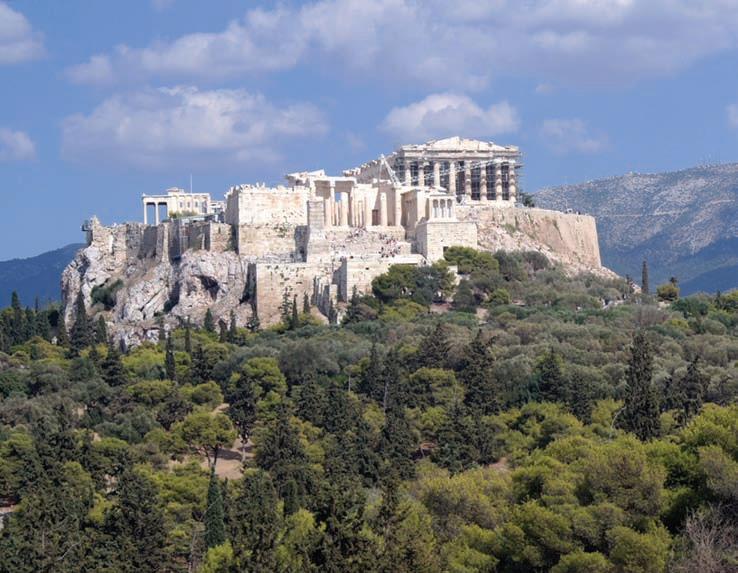
The conspicuousness of Greek architecture was integral to its function. The Acropolis itself, for instance, was the supreme monument of the most powerful and long-lived democracy of Classical antiquity (Fig. 1.1).4 Soaring over Athens, its great buildings—the temple of Athena Nike, the Parthenon, the Erechtheum— were statements of the official ideology of the Athenian empire and testaments to its glory. Clustered around them were numerous private and public dedications: statues, objets d’art, and inscriptions on stone. Today these monuments are landmarks of art history and magnets for tourism.
Curiously, however, many of the Acropolis monuments were more or less invisible in the 400s bce. Visibility was circumstantial and contingent, in ways that
I would like to thank Claudia Brittenham, Jas Elsner, Wu Hung, and audiences in Chicago, Palo Alto, and Williamstown for advice and debate.
1 Pindar uses te lephantos also of the island of Delos, as part of an elaborate conceit in which he imagines the island as a giant, temple-like structure resting atop columns (fr. 33 SM). On Pindar and conspicuous monuments, see Neer and Kurke 2019.
2 Pausanias (2.12.5) uses this same term of grave monuments atop a hill.
3 Pausanias 5.25.12. On the Promachos, see Davison 2009, 277–96.
4 For over view, see Hurwit 1999.
I shall elaborate below. From this starting point flow two questions: what does it mean for a democracy that its most glorious public monuments should be, to a greater or lesser degree, unseen? And what are the consequences for art history?
THREE TYPES OF INVISIBILITY
The Acropolis monuments were subject to at least three distinct types of invisibility. First, literal invisibility, in the sense of occlusion or concealment. In this case, any light that strikes the object does not bounce back and hit an observer’s eye. Were one to bury a statue in a hole, it would be occluded in this sense; the statue would be, literally, invisible. When H. G. Wells spoke of an Invisible Man, this is what he had in mind. Such literal invisibility shares with the other modes the capacity to be either conspicuous or circumspect. One can trumpet the fact of invisibility, advertise that something is hidden from view, or one can give no signs at all so that what is out of sight truly is out of mind as well.
F ig . 1.1. Athens, Acropolis, view from the Pnyx.
Photo: Mirjanamimi, Wikimedia Commons.
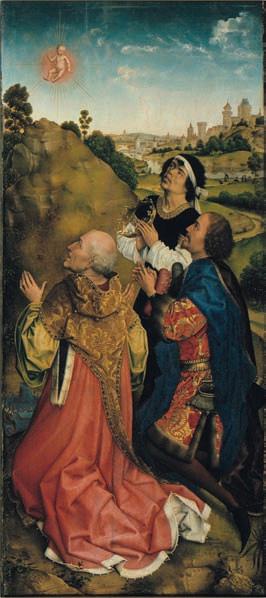
Second, practical invisibility, invisibility for all intents and purposes. In this case, the light might reach your eye, but either you do not notice the image or do not know what to make of it; you fail to recognize it in some way, hence properly to see it at all. When Ralph Ellison spoke of an Invisible Man, this is what he had in mind. Sometimes practical invisibility is just a matter of the extreme circumspection of certain entities in the visual field: the way that, due to habituation or habitus, they pass unseen. At other times it is a matter of access to information, in a word, iconography. To use Panofsky’s famous example, there is a difference between seeing the baby in Figure 1.2 as a miraculous vision of the Messiah appearing to the Magi and seeing it as an unfortunate tot who has been hurled into the air from a catapult.5 Iconographic information determines what can and cannot be seen: to one unacquainted with Renaissance altarpieces, the Messiah simply is not to be seen at all, either as vision or as flesh; to one inculcated in the historically specific way of seeing, by contrast, it is perverse to see anything else. The third type is what I shall call diaphanous invisibility (e.g. Fig. 1.3). In Greek as in English, one can speak of things that one does not literally see as though one did see them. If someone were to ask, with reference to Figure 1.2, if we can
F ig . 1.2. Rogier van der Weyden, The Vision of the Magi, c.1445–8. Oil on panel. Berlin, Gemäldegalerie der Staatlichen Museen.