Obviously, a manÊs judgment cannot be beer than the information on whi he has based it.
Arthur Hays Sulzberger
Publisher of The New York Times from 1935 to 1961
Knowing a great deal is not the same as being smart; intelligence is not information alone but also judgment, the manner in whi information is collected and used.
All rights reserved. No part of this publication may be reproduced, stored in a retrieval system, or transmied, in any form or by any means, electronic, meanical, photocopying, recording, or otherwise, except for the inclusion of brief quotations in a review, without prior permission in writing from the publisher.
Library of Congress Cataloging-in-Publication Data
Names: Lanning, Sco, author.
Title: Concise guide to information literacy / Sco Lanning.
Description: Second edition | Santa Barbara, California: Libraries Unlimited, an
imprint of ABC-CLIO, LLC, [2017] | Includes bibliographical references and index.
FIGURE 9.6. In-Text Citations and Bibliography with Zotero
FIGURE 9.7. Citation Worksheet Example
FIGURE 9.8. Citation Worksheet
FIGURE 10.1. oting from an Article
FIGURE 10.2. Paraphrasing from an Article
FIGURE 10.3. Summary of an Article
FIGURE 10.4. Pathways Information Seeking Model Part 2
FIGURE 10.5. otation Worksheet Example
FIGURE 10.6. otation Worksheet
FIGURE 11.1. Typical Resear Paper Outline
FIGURE 11.2. Basic Outline
FIGURE 11.3. Grammar Errors
FIGURE 11.4. Pathways Model Example
FIGURE 11.5. Pathways Information Seeking Model
FIGURE 11.6. Resear Reflection Worksheet Example
FIGURE 11.7. Resear Reflection Worksheet
Chapter 1 Information and Information Literacy
In is Chapter
You will learn:
■ What this book is about
■ What literate means
■ What information is
■ What information literacy is
■ Why information literacy is important
Jargon and the Study of Disciplines
is book is full of jargon. Jargon is the language of a discipline. In this case, the jargon in this book concerns information literacy. Every discipline has its own vocabulary, its jargon. e jargon of biology is different from that of emistry, sociology, psyology, math, and history. Understanding the language will help you understand the discipline.
is book will give you an understanding of the special language of information literacy and try to tea you some of the fundamental concepts of the discipline with the intent of giving you enough skills to participate successfully in the information world, and enjoy all the benefits that being information literate entails in the world at large and as your information skills continue to grow.
What Does It Mean to Be Literate?
We all have a basic understanding of what it means to be literate. When we say someone is literate, we usually mean that that person can read and write If someone is illiterate, he or she is laing in one or both of those skills. is is indeed one of the meanings of literate. However, there is a mu broader and older definition of literate. According to the Oxford English Dictionary, a literate person is an educated person ("Literate" 2016). is meaning of literate dates to about A.D. 1475. So what does it mean to be educated? In A.D. 1475, it meant being able to read and write. What does it mean to be educated, today? We have more information, more tenology, and more ways to communicate it than anyone from the Middle Ages could have dreamed. We need to know more than just how to read and write to be literate
What Are Some of the Literacies?
We need a wide range of discipline-specific literacies to be educated. We need:
Visual literacy
Digital literacy
Financial literacy
Geographic literacy
Cultural literacy
Media literacy
Scientific literacy
Digital life literacy
Health literacy
Computer literacy
Historical literacy
STEM literacy
Data literacy
Metaliteracy
Civic literacy
Economic literacy
Multicultural literacy
Global literacy
Critical literacy
Information literacy
Don't be intimidated by this partial list of literacies. You don't need to be an economist to be economically literate. You need to know enough about economics to understand the impact local, national, and world economic issues have on you and others.
You need to understand that some of these literacies overlap ea other For example, being economically literate will help you with your global literacy. However, the concept of global literacy encompasses mu more than just economics, including civics, sociology, labor, and the environment among other topics.
e focus of this book is information literacy, and it includes aspects of data, digital, civic, media, visual, and other literacies. We will get to all of these in one form or another in this book, but right now, we need to start with the basics.
What Is Information?
We looked at literacy. Now we will examine information. Information is defined as:
Data whi has been recorded, classified, organized, related, or interpreted within a framework so that meaning emerges ("Information" 2003)
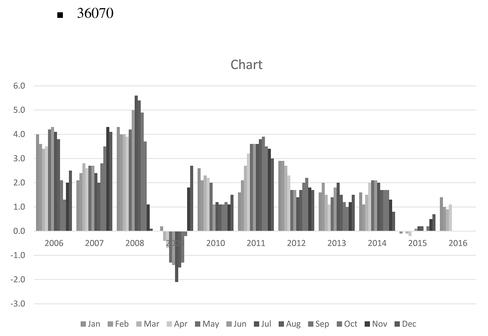
Information can take many forms. It can be words on a page, arts, tables, graphs (Figure 1.1), pictures, audio, and video. Is the following information?
Figure 1.1: Undefined Chart
No. Neither of these is information. ey are data. ey need some kind of context for their meaning to be discerned. In the first case, we have a number and no idea what it means beyond its numerical value. We can rewrite the number as 36,070 . Now we know it is a measure of something. If we place this measurement in the Pacific Ocean, then you would be right in saying this is the depth of the Mariana Tren ("Mariana Tren" 2016).
In the case of the art, if we add more information to it to give it a context from whi it can be understood, it would look like this (Figure 1 2)
Now our art makes more sense. It is the rate of inflation in the United States for the past 10+ years by month ("Bureau of Labor Statistics Data" 2016). Now both of these are examples of information.
Not only are there many forms that information can take, but there are also many sources of information. Information can come from traditional sources like news outlets, whi may be a television broadcast, a Website, or a magazine. Information can be discovered, and uncovered. e scientists at CERN who discover new subatomic particles, and pass that information on to us, have created new information. e researer who finds a medicinal use for a plant from the South American rain forests,
Exploring the Variety of Random Documents with Different Content
there is no more marrying and giving in marriage, you're landing on Car Nicobar as his lawful, or unlawful, wife."
CHAPTER XVII
Robinson Crusoe had had, as yet, little time to do more than leave his footprints on the stretch of white sand sliding into the summer seas of Car Nicobar, and the tide washed those out very quickly. Wilder, lovelier, more brilliant were these islands than the Andamans, while the Andamanese and the Nicobarese proved to be separate races indeed, having no connection with one another.
Their very huts and canoes were secular in design. The Nicobarese names, marking the different islands on the map, fascinated Ferlie. Chowra, Teressa, Bompoka, Trinkat and Katehal of the Central Group, and Great and Little Nicobar, with their satellites, Kondul and Pulo Milo in the south, varied as to dialect in a language so primitive that, as the Reverend Gabriel Jellybrand mournfully complained, there seemed no words to express either "gratitude" or "forgiveness." Which abstract nouns once eliminated from the Christian religion, his sermons became uphill work.
For some years he had toiled in seclusion among this semi-civilized yellowish flock, of whom it was said that, until Christianity came to their territory, never one had been known to steal or lie.
Originally acknowledged to be of Indo-Chinese extraction, they were Malayan-Mongolian in type; often above average height, well-made, simple, lazy and cowardly, but very good-natured and polite to strangers.
This, then, was the people among whom Ferlie and Cyprian came, with their respective sons, to reflect upon the sequel to Eden's story and decide what parts they would play in it themselves.
Gabriel Jellybrand accepted their arrival as a direct answer to prayer, for he had been sick of a fever lately and very lonely. His weak green eyes, rounded like marbles behind an enormous pair of sun-glasses, protruded so unusually that Ferlie expected them to pop out and hit her when she made clear her ambition to choose the quietest corner of the quietest island and erect a row of Nicobarese huts.
The padre invariably fought a losing battle with the letter "w."
"But there is no need to do that," he persisted. "The little bungalow wwhich the forest officer uses on inspection is standing empty. There w-won't be enough beds, but if you say you've brought hammocks—a most original idea!"
He led the way to the Settlement, clad in a cotton cassock, tied round with a black cord which swung out and scourged anybody who ventured too near him when he held up the garment to leap from rock to rock, revealing an expanse of white cotton sock below a short tussore trouser-leg.
From time to time he would lose his topee, and then a faithful bodyguard of Baptismal Candidates, palpably prepared for total immersion at any moment, would hasten to hand him a large khaki umbrella, lined with green, which they took it by turns to carry again after the topee had been recovered from the puddle or overhanging branch which had claimed it.
"You might have warned us that he was a Comic Turn," Cyprian told Haddock reproachfully.
"Describe him to me again at our next meeting," said the Colonel, for whom Jellybrand betrayed a pathetically guileless admiration.
"Uncle Ricky has always had a number of the queerest friends," Ferlie whispered. "Generally they are lame dogs who would have perished in some one of the world's ditches but for him. This one, at any rate, seems too nearly an imbecile to take any interest in the obstruse riddles of our existence."
The jungle road, strewn with bamboo leaves, twisted them out on to a cleared space among the coco-nut trees, where a tiny church, which would have lost itself in an ordinary-sized drawing-room, stood on stilts, as indeed, did everything in the form of a building, so that, to reach the platforms on which they were built, it was necessary to run up a short stepladder.
The interior of the church was fraught with the pathos of primitive endeavour. There was a crucifix, smothered in fading hibiscus heads; a great many common candles, some of which were, nakedly, two shortened corpses stuck one on top of the other to attain the regulation length; a canopy of bamboo and coloured paper, enshrining a Madonna with a broken nose imperfectly mended by means of hot wax, which gave her a somewhat rakish appearance; the crudest of moral-enforcing missionary prints; a framed St. Paul (after whom the building was named) so literally "in the pink" as to impress one instantaneously with his possible value in a football scrum, and—Oh, lift up your heads!—a small shiny harmonium on which the little padre had, in the course of a year, just learnt to accompany his flock with one finger, though he had not yet given up hope of bringing the other nine into requisition somewhen. For the rest, they relied upon a catechist with a concertina, who knew seven hymns which he performed in strict rotation.
"But now that you have come..." said Jellybrand, eyeing Ferlie with eager expectancy. And she had not the heart to erect a barrier of doctrinal differences, for her protection, between his hungry enthusiasm and the harmonium stool.
"I see you have started a shop," said Colonel Maddock emerging from a thatched fastness, wherein lay heaped up some yards of calico, red flannel, a few tin pots and pans, coloured prints, packets of tea, pounds of sugar and several bright glass necklaces.
"Oh, dear me, yes. W-would you believe it? Mr. Pell, here—w-where are you, Mr. Pell?—a most unselfish person, w-who always acts on the excellent principle that it is more blessed to give than to receive, w-was left in charge of the shop w-when I w-was over at Nankauri, visiting. And—wwould you believe it?—he gave every single thing away w-without taking
any coco-nuts in payment! Of course, the people are ready now to let the Government start any number of shops...."
Mr. Pell, hitching up the nether garments which were the outward and visible sign of his inward state of grace, beamed urbanely upon the newcomers.
"This," said Jellybrand, indicating a gentleman with a string of cowrie shells about his middle and a battered English straw upon his head, "is Friend-of-England, the chief of the village. He is not yet a member of my little community though he w-wishes us w-well, I am sure.
"A long w-while ago, he had forty devils extracted from him by the menluana, or w-witch doctors, and it is hardly surprising that, under their conscientious exorcism, he nearly died. All the men in the village sat round him in a circle and on anyone's perceiving a devil he pounced on it, wwrapped it in a leaf, and put it in the corner of the house.
"Every year, the Chief Commissioner, w-when he inspects us from Port Blair, presents him w-with a suit of clothes in virtue of his position; but he reserves them for festivals and always puts them away w-when it rains.
"The two beside him are Mr. Corney Grain and Mr. Don Juan. The traders coming to the islands give them those names in fun, but I hope to baptize them soon and then they w-will be Peter and Paul—much more suitable."
Ferlie wondered why.
A man with enormous calves supporting a very small body approached the speaker confidentially and, presently, Jellybrand interpreted.
"This is James Snook. He and Friend-of-England have both, as you see, got elephantiasis. A lot of them suffer from it—most unfortunate. He wwishes to show you his new house."
Encouraged to proceed, James waved the party towards a thatched beehive supported on four rickety poles, seeming not to possess, at first
sight, either door or window. However, a ladder discovered underneath the contraption vanished into a yawning hole, and Cyprian and Ferlie braved this first, to fall gasping on to a palm-plaited floor which bounded like a spring mattress beneath them. They could not stand upright and there was a thick warmth of atmosphere and almost total darkness until Mr. Snook removed a loose lump of thatch from the wall.
In one corner of the room lay his cooking utensils opposite the rag bundle on which he slept nightly, after blocking out all oxygen.
The walls were covered with works of art cut from any ancient illustrated paper which had happened to fall into his hands from the padre's stock. They were hung, for the most part, upside down, and thus Pavlova waved mocking legs at a Mission print of Christ crucified, into the Figure of which the enlightened James had brilliantly bethought himself to hammer real nails.
Above, glared a garish painting on talc of a Hindu deity with six arms.
Truly, Gabriel Jellybrand stood in need of that optimism which accompanies the faith of all Heaven's "little children."
The steam-yacht pushed off again with the evening tide, leaving Cyprian and Ferlie wandering back from the shore, the coco-nut trees chattering above their heads in the falling breeze. Occasionally she picked up Thu Daw whose legs were not, as yet, quite to be trusted, and would carry him away to the left or to the right, down slight inclines into some cave of dark foliage.
"And is this Heaven?" asked John, following out some private train of thought connected with Jellybrand and the concertina, the owner of which could be heard practising in the distance.
"'Over the fields of glory,' you know, Mother, and 'over the jasper sea'!"