the chicago foucault project Arnold I. Davidson, Henri-Paul Fruchaud, and Daniele Lorenzini, series editors
The wide-ranging and groundbreaking works of Michel Foucault (1926–84) have transformed our understanding of the human sciences and shaped contemporary thought in philosophy, history, critical theory, and more. In recent years, the publication of his lectures, seminars, and public discussions has made it possible not only to understand the trajectory of his work, but also to clarify his central ideas and to provide a better overall perspective on his thought. The aim of the Chicago Foucault Project is to contribute to this enterprise by publishing definitive English-language editions of these texts and fostering an ongoing appreciation of the lasting value of Foucault’s oeuvre in the Englishspeaking world.
Madness, Language, Literature
Edited by Henri-Paul Fruchaud, Daniele Lorenzini, and Judith Revel
Translated by Robert Bononno
Speaking the Truth about Oneself:
Lectures at Victoria University, Toronto, 1982
Edited by Henri-Paul Fruchaud and Daniele Lorenzini
English edition established by Daniel Louis Wyche
“Discourse and Truth” and “Parrēsia”
Edited by Henri-Paul Fruchaud and Daniele Lorenzini
Introduction by Frédéric Gros
English edition established by Nancy Luxon
About the Beginning of the Hermeneutics of the Self: Lectures at Dartmouth College, 1980
Edited by Henri-Paul Fruchaud and Daniele Lorenzini
Introduction and critical apparatus by Laura Cremonesi, Arnold I. Davidson, Orazio Irrera, Daniele Lorenzini, and Martina Tazzioli
Translated by Graham Burchell
Michel Foucault
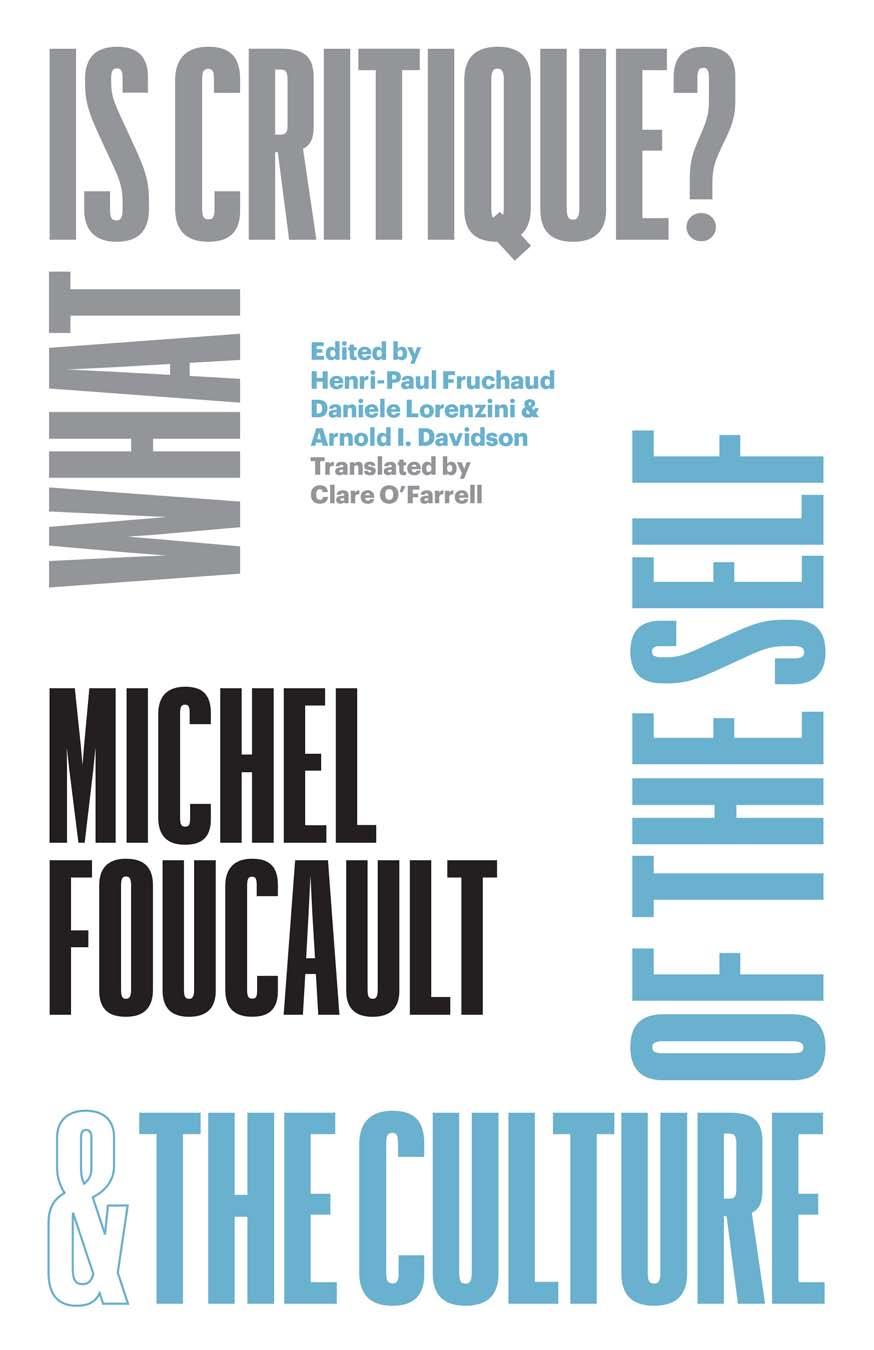
What Is Critique? and The Culture of the Self
Edited by Henri- Paul Fruchaud, Daniele Lorenzini, and Arnold I. Davidson
Translated by Clare O’Farrell
The University of Chicago Press Chicago and London
All rights reserved. No part of this book may be used or reproduced in any manner whatsoever without written permission, except in the case of brief quotations in critical articles and reviews. For more information, contact the University of Chicago Press, 1427 E. 60th St., Chicago, IL 60637. Published 2024
Printed in the United States of America
33 32 31 30 29 28 27 26 25 24 1 2 3 4 5
ISBN-13: 978-0-226-38344-6 (cloth)
ISBN-13: 978-0-226-38358-3 (e-book)
DOI : https://doi.org/10.7208/chicago/9780226383583.001.0001
Title: “What is critique?” and “The culture of the self” / Michel Foucault ; edited by Henri-Paul Fruchaud, Daniele Lorenzini, and Arnold I. Davidson ; translated by Clare O’Farrel.
Other titles: Lectures. Selections (2024). English
Description: Chicago : The University of Chicago Press, 2024. | Series: Chicago Foucault project | Includes bibliographical references and index.
Identifiers: LCCN 2023016772 | ISBN 9780226383446 (cloth) | ISBN 9780226383583 (ebook)
Classification: LCC B 2430.F722 E 5 2024 | DDC 126—dc23/eng/20230424
LC record available at https://lccn.loc.gov/2023016772
♾ This paper meets the requirements of ANSI /NISO Z 39.48-1992 (Permanence of Paper).
Contents
Editors’ Note vii
Translator’s Note ix
Abbreviations of Works by Michel Foucault xi
Introduction 1
Daniele Lorenzini and Arnold I. Davidson
What Is Critique? 19
Lecture to the Société française de Philosophie | May 27, 1978
Michel Foucault
The Culture of the Self 63
Lecture at the University of California, Berkeley | April 12, 1983
Michel Foucault
Discussion with the Department of Philosophy 83
Discussion with the Department of History 95
Discussion with the Department of French 117
Notes 149 Index 193
Editors’ Note
This volume presents two lectures by Michel Foucault: (1) a lecture delivered in French at the Sorbonne to the Société française de Philosophie on May 27, 1978, and published in 1990 under the title “Qu’est-ce que la critique? (Critique et Aufklärung)” and (2) a lecture delivered in English on April 12, 1983, at the University of California, Berkeley, titled “The Culture of the Self.”
In the days following this second lecture, Foucault took part in three discussions at Berkeley organized respectively by the departments of philosophy, history, and French. Transcriptions of these discussions—the first two in English and the third in French—can be found after the lecture in this volume. Five years separate these two lectures, a period during which Foucault’s thought underwent significant evolution. Nonetheless, we thought it would be interesting to publish these two texts together. A few months prior to his lecture in April 1983, Foucault began his course at the Collège of France on The Government of Self and Others, with a long discussion on the Aufklärung, echoing the theme of his lecture to the Société française de Philosophie in May 1978.
The texts were prepared as follows:
For the 1978 lecture we consulted the transcript published in the Bulletin de la Société française de Philosophie 84, no. 2
[ viii ] editors’ note (April–June 1990): 35–63. A number of changes were made to this transcript after viewing the manuscript held by the Bibliothèque nationale in France. These changes include (1) passages omitted by Foucault in his oral presentation and (2) variants from a first version of the transcript sent to Foucault for proofreading (a version that does not include his handwritten corrections).
For the lecture delivered at Berkeley on April 12, 1983, and for the three discussions that followed it, we consulted the recordings held by the University of California, Berkeley, and the Institut Mémoires de l’Édition Contemporaine (IMEC).
Davey K. Tomlinson assisted with the English transcriptions. We were also able to consult the manuscript of the lecture at the Bibliothèque nationale in France.
The texts have been rendered as literally as possible. We have omitted some repetitions and hesitations when Foucault was searching for words, and we have corrected some incorrect sentences in the debates in English when it was essential. We have also taken the liberty of summarizing the questions in the debates and omitting certain exchanges that were off track. Editorial interventions are indicated with square brackets throughout the text. When the text of the spoken lectures differs significantly from Foucault’s written manuscripts, the alternate text is provided in a footnote.
We would particularly like to thank the Bibliothèque nationale in France for their invaluable help and allowing us to consult documents in the Foucault collection that are not yet available to the public. We also thank the Société française de Philosophie for kindly authorizing the republication of the discussion which followed Michel Foucault’s lecture on May 27, 1978.
Henri-Paul Fruchaud and Daniele Lorenzini
Translator’s Note
I have provided references to existing English translations of works cited in the French edition. For references to works by Foucault that are collected in Dits et Écrits, I have included in parentheses the numeration used by these volumes to assist readers in cases where multiple English translations exist and for readers working in languages other than English. For items that have not been translated into English, I have provided the volume number and page from Dits et Écrits.
I have followed translation practices in other works by Foucault and translated Foucault’s own words in his references to classical Greek and Roman literature. Passages of such literature in quotation marks in the lectures are usually paraphrases by Foucault, and any direct citations are to French translations or Foucault’s own translations, which are sometimes quite different from the English translations of classical literature. I have consulted the digital Loeb Classical Library and a number of more recent English translations from the Greek and Latin for this English edition.
Clare O’Farrell
Abbreviations of Works by Michel
Foucault
AB Abnormal: Lectures at the Collège de France, 1974–1975, ed. V. Marchetti and A. Salomoni, trans. Graham Burchell, English series ed. Arnold I. Davidson (New York: Picador, 2003).
ABHS About the Beginning of the Hermeneutics of the Self: Lectures at Dartmouth College, 1980, ed. Henri-Paul Fruchaud and Daniele Lorenzini, trans. Graham Burchell (Chicago: University of Chicago Press, 2016).
AK The Archaeology of Knowledge, 2nd ed., trans. A. M. Sheridan Smith (London: Routledge, 2002).
CS The Care of the Self, vol. 3 of The History of Sexuality, trans. Robert Hurley (London: Penguin, 1990).
CT The Courage of Truth: Lectures at the Collège de France, 1983–1984, ed. Frédéric Gros, trans. Graham Burchell, English series ed. Arnold I. Davidson (New York and Basingstoke: Palgrave Macmillan, 2010).
DE I Dits et Écrits I, 1954–1975, ed. Daniel Defert and François Ewald with the collaboration of Jacques Lagrange (Paris: Gallimard, 2001).
DE II Dits et Écrits II, 1976–1988, ed. Daniel Defert and François Ewald with the collaboration of Jacques Lagrange (Paris: Gallimard, 2001).
DP Discipline and Punish: The Birth of the Prison, trans. Alan Sheridan (London: Penguin, 1991).
[ xii ] abbreviations
EW 1 The Essential Works of Foucault, 1954–1984, vol. 1, Ethics: Subjectivity and Truth, ed. Paul Rabinow (New York: New Press, 1997).
EW 2 The Essential Works of Foucault, 1954–1984, vol. 2, Aesthetics, Method, and Epistemology, ed. James D. Faubion (New York: New Press, 1998).
EW 3 The Essential Works of Foucault, 1954–1984, vol. 3, Power, ed. James D. Faubion (New York: New Press, 2000).
FL Foucault Live: Collected Interviews, 1961–1984, ed. Sylvère Lotringer, trans. Lysa Hochroth and John Johnston (New York: Semiotext(e), 1996).
GL On the Government of the Living: Lectures at the Collège de France, 1979–1980, ed. Michel Senellart, trans. Graham Burchell, English series ed. Arnold I. Davidson (New York and Basingstoke: Palgrave Macmillan, 2014).
GSO The Government of Self and Others: Lectures at the Collège de France, 1982–1983, ed. Frédéric Gros, trans. Graham Burchell, English series ed. Arnold I. Davidson (New York and Basingstoke: Palgrave Macmillan, 2010).
HIST The History of Sexuality, vol. 1, An Introduction, trans. Robert Hurley (New York: Random House, 1978).
HS The Hermeneutics of the Subject: Lectures at the Collège de France, 1981–1982, ed. Frédéric Gros, trans. Graham Burchell, English series ed. Arnold I. Davidson (New York and Basingstoke: Palgrave Macmillan, 2005).
PP Psychiatric Power: Lectures at the Collège de France, 1973–1974, ed. Jacques Lagrange, trans. Graham Burchell, English series ed. Arnold I. Davidson (New York and Basingstoke: Palgrave Macmillan, 2010).
ST Subjectivity and Truth: Lectures at the Collège de France, 1980–1981. ed. Frédéric Gros, trans. Graham Burchell, English series ed. Arnold I. Davidson (New York and Basingstoke: Palgrave Macmillan, 2017).
STP Security, Territory, Population: Lectures at the Collège de France, 1977–1978, ed. Michel Senellart, trans. Graham Burchell,
English series ed. Arnold I. Davidson (New York and Basingstoke: Palgrave Macmillan, 2007).
UP The Use of Pleasure, vol. 2 of The History of Sexuality, trans. Robert Hurley (London: Penguin, 1985).
WDTT Wrong-Doing, Truth-Telling: The Function of Avowal in Justice, ed. Fabienne Brion and Bernard E. Harcourt, trans. Stephen W. Sawyer (Chicago: University of Chicago Press, 2014).
Introduction
Michel Foucault’s thought underwent a series of transformations, but it always had the same recognizable style. The problem is how to capture both the modifications and this very particular philosophical style. Five years separate the two apparently distinct lectures that make up the heart of this volume. But there is at least one fundamental point of contact between them—namely, Foucault’s engagement with Kant’s text “Was ist Aufklärung?”1 In both lectures, Foucault takes the opportunity to reflect on the scope of the Kantian critical enterprise while redefining it radically for his own purposes.
References to Kant’s text recur in many of Foucault’s writings between 1978 and 1984,2 but they are usually brief, almost sporadic, without systematic analysis. There are two brief periods that are exceptions to this. First, in 1978, Foucault referred to Kant’s text and the question of the Enlightenment, or Aufklärung, in his introduction to the American translation of Georges Canguilhem’s The Normal and the Pathological .3 Foucault then went on to deal with the Aufklärung at length in his lecture to the Société française de Philosophie. We are presenting the critical edition of this lecture here for the first time. Second, in 1983, Foucault dedicated the inaugural lecture
[ 2 ] introduction of his course at the Collège de France The Government of Self and Others to Kant’s text.4 An extract from this lecture was published as an article in 1984.5 Foucault then also published another essay on the topic in the United States that same year.6 And in the lecture he delivered as part of the Regent’s Lectures at the University of California, Berkeley, on April 12, 1983, Foucault also began with a brief discussion of Kant’s text on the Enlightenment. His aim he says there was “to explain why I am interested in the theme of the culture of the self as a philosophical and historical question.”7 We are publishing this lecture here for the first time.
The two lectures we are presenting here, “What Is Critique?” and “The Culture of the Self,” form two poles making it possible to examine the evolution of Foucault’s thought between 1978 and 1983. They enable us to reflect on his different readings of “Was ist Aufklärung?” (a veritable toolbox in his hands) and also on the continuities that allow him to link his own historico-philosophical perspective and present and past work to the question of the “critique” introduced by Kant in his text on the Enlightenment. But, according to Foucault, this perspective cannot and should not be identified with Kant’s own celebrated critical enterprise. Although the reference to Kant is pivotal for Foucault from the outset of his career in his supplementary thesis on The Anthropology,8 Foucault highlights another Kant, or at the very least an alternative to the “Kantian” path of the Critiques, in an attempt to retrace the genealogy of his own philosophical practice.
An Indecent Title, or Kant versus Kant
The year 1978 was crucial in Foucault’s intellectual trajectory. He introduced the theme of governmentality in his course
at the Collège de France Security, Territory, Population.9 This theme, in the form of the problem of the “government of oneself and others,” was to make up the core of Foucault’s research until 1984. In this course, while retracing the history of the idea and practice of government, Foucault alighted on what he termed “pastoral power” and offered a detailed study and analysis of five “pastoral counter-conducts” in the Middle Ages.10 In addition, in January 1978,11 in the introduction to the American translation of Canguilhem’s The Normal and the Pathological, Foucault mentioned (albeit briefly) Kant’s text on the Aufklärung for the first time. He emphasized the fundamental role played by Kant’s work in postwar French thought, pondering the reasons for such a profound link between this type of reflection and the present. He argued that the history of science in France formed the context for the reactivation of the question of the Enlightenment as a way of examining “a reason whose autonomy of structures carries within itself the history of dogmatisms and despotisms.”12 The Enlightenment raised the question not just of the nature and basis of rational thought but also of its history and its geography, its past and its present existence. Thus, it was in first situating Canguilhem’s work in the context of this kind of reflection that Foucault was able to describe the inauguration of a “philosophical journalism” at the end of the eighteenth century.13 In proposing an analysis of the “present moment,” this “philosophical journalism” opened up “a whole historico-critical dimension” to philosophy. Cavaillès, Koyré, Bachelard, and Canguilhem (as well as the philosophers of the Frankfurt School) all operated within this tradition.14
At the beginning of April 1978, Foucault left for a long trip to Japan.15 During his stay he gave a series of important lectures,16 and shortly after his return to France, on May 27,
4 ] introduction 1978, he delivered a lecture to the Société française de Philosophie. Several circumstances make this talk a real unicum in Foucault’s intellectual production, beginning with the title. Indeed, Foucault begins by apologizing for not giving his lecture a title, explaining that the question he wanted to address was, What is critique? (This eventually did become the title when the text was published in the Bulletin de la Société française de Philosophie in 1990). However, Foucault admitted that there was a title that “haunted” him but that ultimately he didn’t want, or even dare, to choose because it would have been “indecent.”17 This indecent title was of course “What Is Aufklärung?”—a title Foucault would no longer hesitate to use in 1984.18 This leads one to wonder about the reasons for this hesitation, and the “game” that Foucault proposes to the members of the Société française de Philosophie.19 It probably has to do with the “torsion” that Foucault subjects the Kantian question of (transcendental) critique to, redirecting it toward what he describes as a “critical attitude.” In fact, according to Foucault, if Kant did indeed transport the critical attitude and the question of the Aufklärung into the question of epistemological-transcendental critique, one now needs to go “down this route [. . .] in the opposite direction.” This can be done by raising the question of the relation between knowledge and domination in terms of “a certain decisive will not to be governed.”20 In other words, just as in 1969 the seemingly classic question, What is an author? had been the pretext for making a (scandalous) shift from the authorsubject to the author-function,21 in 1978 the question, What is critique? opened up the possibility of making another (indecent) shift for Foucault. The epistemologico-transcendental question, What can I know? becomes here a “question of attitude,”22 and critique is redefined as “the movement that allows
the subject to take up the right to question the truth on its effects of power and to question power about its discourses of truth.” The goal is “desubjectification in the play of [. . .] the politics of truth.”23 It is still in Kant, but in another Kant—the Kant of a “minor” and marginal text like “Was ist Aufklärung?”24—that Foucault finds the means to effect this shift. Now we can better understand perhaps what was so indecent about this gesture in a gathering of philosophers.
The Art of Not Being Governed Quite So Much
It should be noted, however, that it is not through a commentary on Kant’s text on the Enlightenment that Foucault puts forward his definition of the critical attitude in 1978. This is why we must absolutely resist the temptation to read this lecture in the light of the 1983–84 texts. To do so would be to risk missing its threefold specificity.
First, the lecture to the Société française de Philosophie begins as an extension of Foucault’s reflections in his course Security, Territory, Population rather than as a detailed analysis of “Was ist Aufklärung?” Foucault sets out to identify the emergence of a certain way of thinking, speaking, and acting that can be likened to a virtue he labels the “critical attitude.” In his eyes, this emergence is linked to a historical phenomenon specific to the modern West—namely, the proliferation of the arts of governing from the fifteenth to sixteenth centuries onwards. This phenomenon testifies to the expansion into civil society of a form of power developed by the Catholic Church in its “pastoral” activity conducting the daily conduct of individuals.25 So here Foucault is reworking more generally the analyses of “pastoral governmentality” he proposed three months earlier at the Collège de France.26 But he puts
forward a new thesis in “What Is Critique?”—namely, that the “governmentalization” that characterizes modern Western societies from the fifteenth to sixteenth centuries onwards cannot be dissociated from the question of “how not to be governed like this, by these people, in the name of these principles, in view of these particular goals and by means of these particular processes.” The critical attitude thus receives its first definition without invoking Kant. A “general cultural form,” a “moral and political attitude,” a “way of thinking,” it is both the companion and the adversary of the arts of governing—it is “the art of not being governed quite so much.”27
At the Collège de France, Foucault focused on the points of resistance that had arisen within the Christian pastorate and offered a definition of “counter-conducts” in the Middle Ages. These were attitudes that demonstrated the will “to be conducted differently, by other leaders [conducteurs ] and other shepherds, toward other objectives and forms of salvation and through other procedures and methods.” 28 The proximity of this concept to the critical attitude as “the will not to be governed like this, by them, at this price” is obvious.29 The “counter” and the “like this” testify to the always local and strategic dimension of these forms of resistance.30 In fact, at the Société française de Philosophie, Foucault explicitly presents the study of pastoral counterconducts as a stage in the genealogy of the critical attitude.31 The first “historical anchor” he mentions is the “return to scripture,”32 and in the discussion after the lecture, he claims that the historical origin of the critical attitude should be sought precisely in the religious struggles of the second half of the Middle Ages.33
The second unique feature of “What Is Critique?” is Foucault’s interpretation of the Aufklärung. Even if he situates the critical attitude within a history that is broader than just
the “Kantian moment,” rendering it “something other than the legacy of a particular stream of philosophical thought,”34 he claims his definition of the critical attitude corresponds to the one Kant offered in 1784. This definition saw the Aufklärung as a courageous attempt to emerge from a state of minority imposed by an outside authority on humanity, rendering it unable to use its own understanding outside of a relationship of direction. In Foucault’s reading, the Aufklärung becomes a practical attitude of resistance to a governmental power of direction. This exists within the field of relations between the subject, power, and truth—what Foucault calls the “source of critique,”35—and attempts to challenge, undo, or overthrow these relations. So, very clearly and much more explicitly than in his subsequent work,36 Foucault pits the Aufklärung against epistemological critique, which is conceived by Kant as “prolegomena to all Aufklärung of the present and future.” According to Kant, “it’s less about what we undertake with more or less courage, than the idea we have of our knowledge [connaissance] and its limits and the implications for our freedom.”37 In other words, for Kant, the “courage in knowing” invoked by the Aufklärung consists in recognizing the limits of knowledge and gaining an autonomy that is not opposed to obedience, but on the contrary, constitutes its true foundation. Foucault goes on to assert that this critical enterprise that exists at a distance or “stands back” from the “courage of the Aufklärung” continued on into the nineteenth and twentieth centuries, in the form of the denunciation of the excesses of power that reason itself was historically responsible for.38 Here, Foucault seems to want to distinguish himself clearly from this path, while still recognizing common points of interest with the Frankfurt School.39
The third feature that makes this lecture to the Société
française de Philosophie unique is the long methodological reflection in the final section.40 Foucault returns here to the themes he dealt with a week earlier in a roundtable with historians,41 and also to certain concepts he developed in the second half of the 1960s. He describes a “historico-philosophical” practice that seeks to explore the relationships between “the structures of rationality articulating true discourse and the mechanisms of subjugation linked to it.” This practice entertains a special relationship with the Aufklärung, attempting to ascertain the conditions under which we can apply this “question of the Aufklärung—that is, the question of power relations, truth, and the subject—to any moment in history.”42 Redefined in this way, the question of the Aufklärung becomes the perspective Foucault uses to conduct his analyses and to rethink all his work.43 The Aufklärung thus becomes a “trans-historical” question,44 not just present in modern times (in the problem of the relation between reason and madness, illness and health, crime and law, etc.), but also within early Christianity and in Greco-Roman antiquity.45
But how precisely is this historico-philosophical analysis to be conducted? Foucault proposes a political approach to this question as a starting point in opposition to what he describes as an “investigation into the legitimacy of historical modes of knowing” that asks the question of the Aufklärung in terms of knowledge. He begins with the problem of power, advancing by using a “test by eventalization.” On the one hand, it is a matter of avoiding the general question of truth and legitimacy as much as possible by substituting the terms “knowledge” (savoir) and “power” ( pouvoir) for “fields of knowledge” (connaissance) and “domination” (with all their fixed limits).46 The focus needs to be on “nexuses of knowledge-power” that are always specific and determined. Indeed, it is only by
analyzing these nexuses, where the elements of power and the elements of knowledge are never dissociated, that it becomes possible to effect the passage from the empirical observability of a group of elements (the systems of mental illness, penality, delinquency, sexuality, etc.) to its historical acceptance. This is what Foucault describes as the archaeological level.47
On the other hand, it needs to be demonstrated that these groups are not self-evident or necessary and are not enrolled in any transcendental a priori. This means analyzing these groups as “pure singularities,” which must be seen as so many effects, without reducing them to “a unitary primary cause.”
Here we are at the genealogical level, which tries to restore “the conditions of the appearance of a singularity from multiple determining elements.” It does this without ever operating a principle of closure, as the relations which make it possible to account for a singular effect display varying margins of uncertainty and a perpetual mobility. This is why this analysis is strategic in addition to being archaeological and genealogical.48
Approaching the question of the Aufklärung in this way (namely, in terms of the problem of the relationships between power, truth, and subject) means that power is not made to work as a fundamental datum or single principle of explanation. Instead, power is always considered “as a relation in a field of interactions” and associated “with a field of possibility and as such the subject of reversibility and possible reversal.”49
For Foucault, in other words, revisiting the question of the Aufklärung does not mean trying to understand how knowledge can form the right idea of itself, but rather highlighting the ethico-political value of an individual and collective attitude that consists in no longer wanting to be governed in a particular way. In 1978 (and in 1983–84) the analysis of Kant’s
text on the Enlightenment was therefore a way for Foucault to take stock of his own intellectual journey and assess the unique character of his work and its positioning in the field of contemporary philosophy.
The Aufklärung and the Historical Ontology of Ourselves
The question of critique and the Aufklärung appeared in several talks and texts in the following years without ever being the central focus. It then reemerged in a significant way in 1983, with Foucault deciding to devote the first lecture of his Collège de France course The Government of Self and Others to the discussion of “Was ist Aufklärung?” and, more concisely, of the second dissertation in The Contest of the Faculties (1798), where Kant asks the question, “What is the [French] Revolution?”50 According to Foucault, these two texts testify to a specific way of philosophizing involving the interrogation of contemporary reality, an approach he argues was more or less inaugurated by Kant. Foucault does not emphasize this theme in his presentation to the Société française de Philosophie, but it is the most consistent element in his later series of texts and talks addressing Kant’s article on the Enlightenment.51 This is also the case in Foucault’s lecture at the University of California, Berkeley, on April 12, 1983. Here, to explain why he is so interested in the theme of “the culture of the self,” he begins by commenting on “Was ist Aufklärung?” emphasing that it was a “philosophical interrogation of the present,” formulated in terms of a “very specific achievement” in the “general history of the way we use our reason.” Foucault claims that Kant’s text introduced “a new kind of question” into philosophy: it is not the ques-
tion of how not to be governed in a particular way but of the historico-philosophical significance “of the precise moment when the philosopher is writing and of which he himself is a part.”52
So in 1983, Foucault does not explicitly identify the question of Aufklärung with the critical attitude but with a different “historico-critical” question: What are we now? If he still locates a certain gap between “Was ist Aufklärung?” and the Kantian critical enterprise proper, he describes this gap in a new way. In this version, Kant inaugurated two irreducible philosophical traditions, even if these are linked in his own works. On the one hand, there is the tradition of the “formal ontology of truth” or the “critical analysis of knowledge” (What is truth? How is it possible to know the truth?). On the other, there is the tradition of “the historical ontology of ourselves” or “the critical history of thought” (What is our present reality? What are we as part of this present reality?).53 Here, Foucault revisits the structure he had proposed a few months earlier at the Collège de France. This structure linked Kant’s critical work to the tradition of “the analytic of truth,” and his texts on the Aufklärung and the Revolution to a contrary critical tradition that raised the question of the “present field of possible experiences.” Foucault called this “an ontology of the present, of present reality, an ontology of modernity, an ontology of ourselves.”54
By asserting at Berkeley that he belongs to the second tradition, Foucault claims that “any ontological history of ourselves must analyze three sets of relations: our relations to truth, our relations to obligation, our relations to ourselves and others.”55 We recognize here the “source of critique” as Foucault defined it in 1978—namely, the relationships woven between subject, power, and truth.56 In 1983, Foucault goes