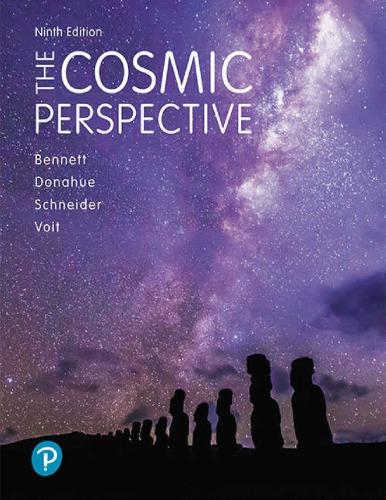
TheCosmic Perspective
Ninth Edition
Jeffrey Bennett
UniversityofColoradoatBoulder
Megan Donahue
MichiganStateUniversity
Nicholas Schneider
UniversityofColoradoatBoulder
Mark Voit
MichiganStateUniversity
DirectorPhysicalSciencePortfolio:JeanneZalesky
Physics&AstronomyPortfolioAnalyst:IanDesrosiers
ContentProducer:MaryTindle
ManagingProducer:KristenFlathman
ProductPortfolioEditorialAssistant:FrancesLai
RichMediaContentProducer:AliCandlin
Full-ServiceVendor:Liflandetal.,Bookmakers
Copyeditor:Liflandetal.,Bookmakers
Compositor:PearsonCSC
DesignManager:MariaGuglielmo
InteriorandCoverDesigner:TamaraNewnam
Illustrators:RolinGraphics;TrouttVisuals
Rights&PermissionsProjectManager:BenFerrini
Rights&PermissionsManagement:MatthewPerry
PhotoResearcher:MatthewPerry
ManufacturingBuyer:StaceyWeinberger
DirectorofFieldMarketing:TimGalligan
DirectorofProductMarketing:AllisonRona
FieldMarketingManager:YezAlayan
ProductMarketingManager:ElizabethBell
CoverPhotoCredits:
MainEdition: MilkyWayoverAhuTongariki—AnneDirkse/Getty Images
TheSolarSystem: BenjaminVanDerSpek/EyeEm/GettyImages
Stars,Galaxies,andCosmology: Orion/Alma—BabakTafreshi/Getty Images
Copyright©2020,2017,2014,2010,2008,2006.PearsonEducation,Inc.
221RiverStreet,Hoboken,NJ07030.AllRightsReserved.Printedinthe UnitedStatesofAmerica.Thispublicationisprotectedbycopyright,and permissionshouldbeobtainedfromthepublisherpriortoanyprohibited reproduction,storageinaretrievalsystem,ortransmissioninanyformor byanymeans,electronic,mechanical,photocopying,recording,or otherwise.Forinformationregardingpermissions,requestformsandthe appropriatecontactswithinthePearsonEducationGlobalRights& Permissionsdepartment.
Attributionsofthirdpartycontentappear onpages C-1 , C-2 , C-3 , C4 ,whichconstituteanextensionofthiscopyrightpage.
PEARSON,ALWAYSLEARNINGandMastering™Astronomyare exclusivetrademarksintheU.S.and/orothercountries,ownedby PearsonEducation,Inc.oritsaffiliates.
Unlessotherwiseindicatedherein,anythird-partytrademarksthatmay appearinthisworkarethepropertyoftheirrespectiveownersandany referencestothird-partytrademarks,logos,orothertradedressarefor demonstrativeordescriptivepurposesonly.Suchreferencesarenot intendedtoimplyanysponsorship,endorsement,authorization,or promotionofPearson'sproductsbytheownersofsuchmarks,orany relationshipbetweentheownerandPearsonEducation,Inc.orits affiliates,authors,licensees,ordistributors.
Library ofCongressCataloguing-in-Publication Data
Names:Bennett,JeffreyO.,author.|Donahue,M.(Megan),1962author.|
Schneider,Nicholas,author.|Voit,Mark,author. Title:Thecosmicperspective/JeffreyBennett(UniversityofColoradoat
Boulder),MeganDonahue(MichiganStateUniversity),Nicholas Schneider (UniversityofColoradoatBoulder),MarkVoit(MichiganState University).
Description:Ninthedition.|NewYork,NY:Pearson,[2020]|Includes index.
Identifiers:LCCN2018048551|ISBN9780134874364
Subjects:LCSH:Astronomy—Textbooks.
Classification:LCCQB43.3.C682020|DDC520—dc23 LCrecordavailableat https://lccn.loc.gov/2018048551
ISBN10:0-134-87436-6;ISBN13:978-0-134-87436-4(Studentedition)
ISBN10:0-134-99077-3;ISBN13:978-0-134-99077-4(TheSolarSystem)
ISBN10:0-134-99078-1;ISBN13:978-0-134-99078-1(Stars,Galaxies, andCosmology)
www.pearson.com
Dedication
Toallwhohaveeverwonderedaboutthemysteriesoftheuniverse.Wehope thisbookwillanswersomeofyourquestions—andthatitwillalsoraisenew questionsinyourmindthatwillkeepyoucuriousandinterestedintheongoing humanadventureofastronomy.And,especially,toMichaela,Emily,Sebastian, Grant,Nathan,Brooke,andAngela.Thestudyoftheuniversebeginsatbirth, andwehopethatyouwillgrowupinaworldwithfarlesspoverty,hatred,and warsothatallpeoplewillhavetheopportunitytocontemplatethemysteriesof theuniverseintowhichtheyareborn.
Preface
Wehumanshavegazedintotheskyforcountlessgenerations.Wehave wonderedhowourlivesareconnectedtotheSun,Moon,planets,and starsthatadorntheheavens.Today,throughthescienceofastronomy, weknowthattheseconnectionsgofardeeperthanourancestorsever imagined.Thisbooktellsthestoryofmodernastronomyandthenew perspective, TheCosmicPerspective,thatastronomygivesusonourselves andourplanet.
Who Is This Book For?
TheCosmicPerspective providesacomprehensivesurveyofmodern astronomysuitableforanyonewhoiscuriousabouttheuniverse, regardlessofpriorbackgroundinastronomyorphysics.However,itis designedprimarilytoserveasatextbookforcollegecoursesin introductoryastronomy. TheCosmicPerspective containsenoughmaterial forafull-yearintroductoryastronomysequencebutcanbeflexiblyused forshortercoursesaswell.
Instructorsofshortercoursesmayalsowishtoconsiderseveralavailable variationsofthistextbook.Weoffertwovolumescontainingselected chaptersfromthisbook: TheSolarSystem,whichconsistsof Chapters 1 , 2 , 3 , 4 , 5 , 6 , 7 , 8 , 9 , 10 , 11 , 12 , 13 , 14 (including S1 )and 24 ,and Stars,Galaxies,andCosmology,whichconsistsof Chapters 1 , 2 , 3 , 4 , 5 , 6 (including S1 ), S2 , S3 , S4 ,and 14 , 15 , 16 , 17 , 18 , 19 , 20 , 21 , 22 , 23 , 24 .Those teachingone-termgeneralsurveycoursesmaywishtoconsider The EssentialCosmicPerspective,whichcoversasmallersetoftopicsandis tailoredtomeettheneedsofcomprehensiveone-termsurveycoursesin astronomy,and TheCosmicPerspectiveFundamentals,whichiseven shorterandcoversonlythemostfundamentaltopicsinastronomy.Allof theseoptionsarealsoavailablewithMastering™Astronomy.
New to This Edition
Theunderlyingphilosophy,goals,andstructureof TheCosmicPerspective remainthesameasinpasteditions,butwehavethoroughlyupdatedthe textandmadeanumberofotherimprovements.Here,briefly,isalistof thesignificantchangesyou’llfindintheninthedition:
Major Chapter-Level Changes: Wehavemadenumeroussignificant changestobothupdatethescienceandimprovethepedagogicalflow inthisedition.Thefulllististoolongtoputhere,butmajorchanges includethefollowing:
In Chapter 2 ,wehavereworkedthesectiononeclipseswitha newsetofartpiecesandrevisedpedagogytoreflectthefactthat manystudentsheardaboutorwitnessedthe2017eclipse.
Chapter 5 hasanewCommonMisconceptionboxon“Light Paths,Lasers,andShadows.”
In Chapter 6 ,wehavemadethreesignificantupdates:afocus onmajornewandplannedobservatories,includingtheJames WebbSpaceTelescope;anewsubsectionontheroleof“bigdata” inastronomy,usingLSSTasanexample;andanexpanded discussionofmulti-messengerastronomy,suchasthe gravitational-waveobservatoryLIGO.
Chapter 9 hasnumerousscientificupdatesbasedonrecent planetarymissions,especiallyin Section 9.4 onMars,wherewe discusshowrecentevidencefromthe Curiosity roverisproviding anewviewofpastperiodsofliquidwateronMars.Wealso discussrecentreanalysisofthecauseofdarkstreaksandgullies oncraterwalls.
Chapter 10 hassimilarupdatesfornewdata,includingthe additionofanewLearningGoalin Section 10.4 onMars,to reflectadeeperdiscussionofthehistoryoftheMartianclimate.
Section 10.6 onglobalwarminghasalsobeensignificantly updated,withgreateremphasisonexpectedconsequencesofthe warming.
In Chapter 11 ,wehaverevampedthediscussionofJupiter’s weathertoincludenewresultsfromthe Juno mission.Wehave alsomadeimportantscientificupdatestotheinformationon Saturn’smoonsandringsbasedonresultsfromthefinalstagesof the Cassini mission.
Chapter 12 includesupdateddataandimagesfromthe Dawn, Rosetta,and NewHorizons missions,alongwithdiscussionofthe possibilityofanundiscovered“Planet9”andanewSpecialTopic boxon’Oumuamua,thefirstconfirmedobjectwithoriginbeyond oursolarsystemtopassthroughoursolarsystem.
Chapter 13 coversthefast-evolvingtopicofextrasolarplanets andhencehasnumerousscientificupdatesandnewfigures.
In Chapter S3 ,wehaverewrittenthesectionongravitational wavestoincludetheirrecentdirectdetection.
Chapter 14 includesnewdiscussionandanewfigureaboutthe Sun’sinfluenceonEarth’sclimate,andhowwecanruleouta changingSunasacauseofrecentglobalwarming.
In Chapter 18 ,wehavealmostcompletelyrewritten Section 18.4 —changingfromthetwolearninggoalsintheprioredition tothreelearninggoals—toincludethedetectionofgravitational wavesfromneutronstarandblackholemergers.
Chapters 20 and 21 havebeenupdatedinlightofnew researchongalacticevolution,someofwhichisbasedonthe workoftwooftheauthorsofthisbook(DonahueandVoit).
Chapter 20 alsoincorporatesupdatesindescribingthecosmic distancescale,includinghonoringHenriettaLevittbyreferringto herperiod-luminosityrelationas Leavitt’slaw
In Chapter 24 ,thefirstsectionhassignificantchangesto incorporatenewlydiscoveredevidenceforearlylifeonEarth.The secondsectionhasbeenreworkedtoupdatethediscussionof searchingforlifeonMars,anditssecondlearninggoalhasbeen reworkedtocovermorethanjustthemoonsofJupiterand Saturn.
Fully Updated Science: Astronomyisafast-movingfield,and numerousnewdevelopmentshaveoccurredsincetheprioredition waspublished.Inadditiontothemajorchapter-levelchanges describedabove,wehavemademanyotherscientificupdatesto
reflectthelatestresultsfrombothground-basedandspace-based observatoriesandfromspacecraftmissionswithinthesolarsystem.
RevampedExercise Sets: Wehavereorganizedtheend-of-chapter exercisesetsinordertoplacegreateremphasisonquestions designedtopromotediscussionandgroupwork.
New Feature—Inclusive Astronomy: Theastronomicalcommunityis engagedinbroadandwide-rangingconversationsaboutinclusion andthepersistentlackofdiversityinthefieldsofastronomyand othersciences.Toprovidesampleopeningsfordiscussionsof inclusionintheclassroom,wehave(1)addedanewsetofexercises ineverychapterundertheheading“InclusiveAstronomy,”writtento initiatestudentdiscussionsabouttopicscenteredoninclusivenessin astronomy;(2)addedasimilarsetofadditionalexercisesthatyoucan findinthesetofGroupActivitiesavailableintheStudyAreaof MasteringAstronomy;and(3)replacedmanyofthechapter-opening epigraphsinordertoincludeamorediversegroupofindividuals.
New Content inMastering Astronomy: TheCosmicPerspective is muchmorethanatextbook;itisacomplete“learningpackage”that combinesthetextbookwithdeeplyintegrated,interactivemedia developedtosupporteverychapterofourbook.Wecontinually updatethematerialontheMasteringAstronomywebsite,andforthis editionwecallyourattentiontonearly100new“prelecturevideos,” allwrittenby(andmostnarratedby)theauthors,designedtohelp studentsunderstandkeyconcepts.Studentscanwatchthevideosat anytimeintheStudyArea,whileinstructorscanfindassignable tutorialsbasedonthevideosintheinstructor-accessibleItemLibrary. Inadditiontothenewvideosandtheircorrespondingtutorials,you willfindmanyothernewtutorialsintheItemLibrary,aswellasa fullyupdatedsetofreading,concept,andvisualquizzesforeach chapter,availableinboththeStudyAreaandtheassignableItem Library.Theseresourcesshouldbeespeciallyvaluabletoinstructors whowishtoofferassignmentsdesignedtoensurethatstudentsare
preparedbeforeclassandtothoseusing“flippedclassroom” strategies.
The Pedagogical Approach of The CosmicPerspective
TheCosmicPerspective offersabroadsurveyofmodernunderstandingof thecosmosandofhowwehavebuiltthatunderstanding.Suchasurvey canbepresentedinanumberofdifferentways.Wehavechosentobuild
TheCosmicPerspective aroundasetofkeythemesdesignedtoengage studentinterestandasetofpedagogicalprinciplesdesignedtoensure thatallmaterialcomesacrossasclearlyaspossibletostudents.
Themes
Moststudentsenrolledinintroductoryastronomycourseshavelittle connectiontoastronomywhentheircoursebegins,andmanyhavelittle understandingofhowscienceactuallyworks.Thesuccessofthese studentsthereforedependsongettingthemengagedinthesubject matter.Tohelpachievethis,wehavechosentofocusonthe following fivethemes,whichareinterwoventhroughoutthebook.
Theme1:Weareapartoftheuniverseandcanthereforelearnaboutourorigins bystudyingtheuniverse.Thisistheoverarchingthemeof TheCosmic Perspective,aswecontinuallyemphasizethatlearningabouttheuniverse helpsusunderstandourselves.Studyingtheintimateconnections betweenhumanlifeandthecosmosgivesstudentsareasontocareabout astronomyandalsodeepenstheirappreciationoftheuniqueandfragile natureofourplanetanditslife.
Theme2:Theuniverseiscomprehensiblethroughscientificprinciplesthat anyonecanunderstand.Theuniverseiscomprehensiblebecausethesame
physicallawsappeartobeatworkineveryaspect,oneveryscale,andin everyageoftheuniverse.Moreover,whileprofessionalscientists generallyhavediscoveredthelaws,anyonecanunderstandtheir fundamentalfeatures.Studentscanlearnenoughinoneortwotermsof astronomytocomprehendthebasicreasonsformanyphenomenathat theyseearoundthem—phenomenarangingfromseasonalchangesand phasesoftheMoontothemostesotericastronomicalimagesthatappear inthenews.
Theme3:Scienceisnotabodyoffactsbutratheraprocessthroughwhichwe seektounderstandtheworldaroundus.Manystudentsassumethatscience isjustalaundrylistoffacts.Thelonghistoryofastronomycanshow themthatscienceisaprocessthroughwhichwelearnaboutouruniverse —aprocessthatisnotalwaysastraightlinetothetruth.Thatiswhyour ideasaboutthecosmossometimeschangeaswelearnmore,astheydid dramaticallywhenwefirstrecognizedthatEarthisaplanetgoingaround theSunratherthanthecenteroftheuniverse.Inthisbook,we continuallyemphasizethenatureofsciencesothatstudentscan understandhow andwhymoderntheorieshavegainedacceptanceand whythesetheoriesmaychangeinthefuture.
Theme4:Astronomybelongstoeveryone.Astronomyhasplayedasignificant rolethroughouthistoryinvirtuallyeveryculture,andthemodernscience ofastronomyowesadebttotheseearlyandlargelyunsungastronomers. Wethereforestrivethroughoutthebooktomakesurethatstudents understandthatastronomicalknowledgebelongstoeveryone,that peopleofallbackgroundshavemadeandcontinuetomakecontributions toastronomicalunderstanding,andthateveryoneshouldhavethe opportunitytostudyastronomy.Moreover,weseektomotivatestudents enoughtoensurethattheywillremainengagedintheongoinghuman adventureofastronomicaldiscoverythroughouttheirlives,nomatter
whethertheychoosetodothatonlybyfollowingthenewsmediaorby enteringcareersrelatingtoastronomy.
Theme5:Astronomyaffectseachofuspersonallywiththenewperspectivesit offers.Weallconductthedailybusinessofourliveswithreferenceto some“worldview”—asetofpersonalbeliefsaboutourplaceandpurpose intheuniverse,whichwehavedevelopedthroughacombinationof schooling,religioustraining,andpersonalthought.Thisworldview shapesourbeliefsandmanyofouractions.Althoughastronomydoesnot mandateaparticularsetofbeliefs,itdoesprovideperspectivesonthe architectureoftheuniversethatcaninfluencehowweviewourselvesand ourworld,andtheseperspectivescanpotentiallyaffectourbehavior.For example,someonewhobelievesEarthtobeatthecenteroftheuniverse mighttreatourplanetquitedifferentlyfromsomeonewhoviewsitasa tinyandfragileworldinthevastcosmos.Inmanyrespects,theroleof astronomyinshapingworldviewsmayrepresentthedeepestconnection betweentheuniverseandtheeverydaylivesofhumans.
Pedagogical Principles
Nomatterhowanastronomycourseistaught,itisveryimportantto presentmaterialaccordingtowell-establishedpedagogicalprinciples. Thefollowinglistbrieflysummarizesthemajorpedagogicalprinciples thatweapplythroughoutthisbook.
Stayfocusedonthebigpicture.Astronomyisfilledwithinterestingfacts anddetails,buttheyaremeaninglessunlesstheyfitintoabig-picture viewoftheuniverse.Wethereforetakecaretostayfocusedonthe bigpicture(essentiallythethemesdiscussedabove)atalltimes.A majorbenefitofthisapproachisthatalthoughstudentsmayforget individualfactsanddetailsafterthecourseisover,thebig-picture frameworkshouldstaywiththemforlife.
Alwaysprovidecontextfirst.Wealllearnnewmaterialmoreeasily whenweunderstandwhywearelearningit.Inessence,thisissimply theideathatitiseasiertogetsomewherewhenyouknowwhereyou aregoing.Wethereforebeginthebook(Chapter 1 )withabroad overviewofmodernunderstandingofthecosmos,sothatstudents knowwhattheywillbestudyingintherestofthebook.Wemaintain this“contextfirst”approachthroughoutthebookbyalwaystelling studentswhattheywillbelearning,andwhy,beforedivingintothe details.
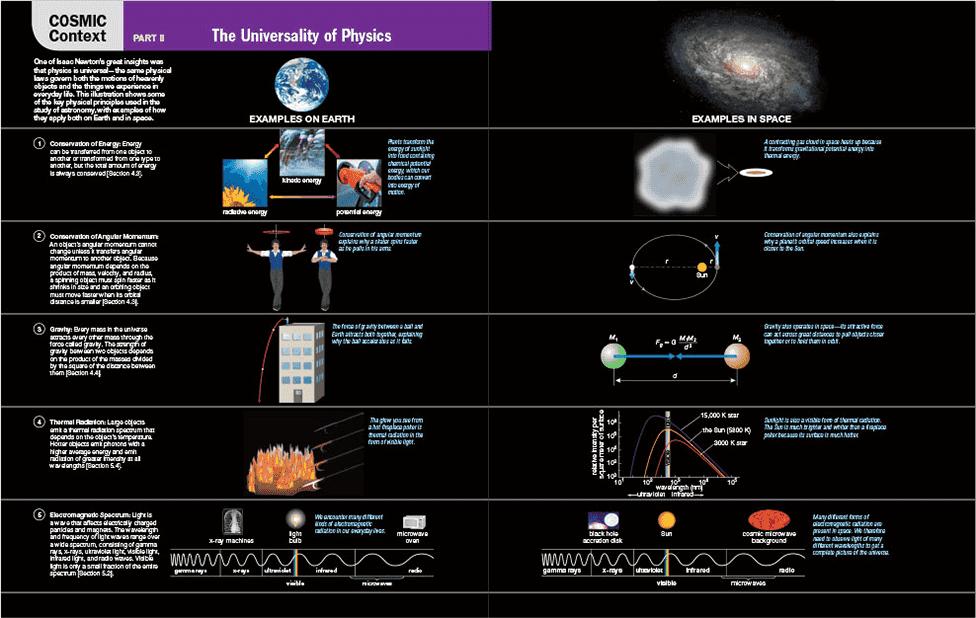
Makethematerialrelevant.It’shumannaturetobemoreinterestedin subjectsthatseemrelevanttoourlives.Fortunately,astronomyis filledwithideasthattoucheachofuspersonally.Forexample,the studyofoursolarsystemhelpsusbetterunderstandandappreciate ourplanetEarth,andthestudyofstarsandgalaxieshelpsuslearn howwehavecometoexist.Byemphasizingourpersonal connectionstothecosmos,wemakethematerialmoremeaningful, inspiringstudentstoputintheeffortnecessarytolearnit. Emphasizeconceptualunderstandingover“stampcollecting”offacts.Ifwe arenotcareful,astronomycanappeartobeanoverwhelming collectionoffactsthatareeasilyforgottenwhenthecourseends.We thereforeemphasizeafewkeyconceptualideas,whichweuseover andoveragain.Forexample,thelawsofconservationofenergyand conservationofangularmomentum(introducedin Section 4.3 ) reappearthroughoutthebook,andthewidevarietyoffeaturesfound ontheterrestrialplanetsaredescribedintermsofjustafewbasic geologicalprocesses.Researchshowsthat,longafterthecourseis over,studentsarefarmorelikelytoretainsuchconceptuallearning thanindividualfactsordetails.
Proceedfromthemorefamiliarandconcretetothelessfamiliarand abstract.It’swellknownthatchildrenlearnbestbystartingwith concreteideasandthengeneralizingtoabstractionslater.Thesame istrueformanyadults.Wethereforealwaystryto“buildbridgesto
thefamiliar”—thatis,tobeginwithconcreteorfamiliarideasand thengraduallydrawmoregeneralprinciplesfromthem. Useplainlanguage.Surveyshavefoundthatthenumberofnewterms inmanyintroductoryastronomybooksislargerthanthenumberof wordstaughtinmanyfirst-yearcoursesonaforeignlanguage.In essence,thismeansthebooksareteachingastronomyinwhatlooks tostudentslikeaforeignlanguage!Clearly,itismucheasierfor studentstounderstandkeyastronomicalconceptsiftheyare explainedinplainEnglishwithoutresortingtounnecessaryjargon. Wehavegonetogreatlengthstoeliminatejargonor,atminimum,to replacestandardjargonwithtermsthatareeasiertorememberinthe contextofthesubjectmatter.
Recognizeandaddressstudentmisconceptions.Studentsdonotarriveas blankslates.Moststudentsenterourcoursesnotonlylackingthe knowledgewehopetoteachbutalsoholdingmisconceptionsabout astronomicalideas.Therefore,toteachcorrectideas,wemusthelp studentsrecognizetheparadoxesintheirpriormisconceptions.We addressthisissueinanumberofways,themostobviousbeingthe presenceofmanyCommonMisconceptionsboxes.These summarize commonlyheldmisconceptionsandexplainwhytheycannotbe correct.
The Organizational Structure of The CosmicPerspective
TheCosmicPerspective isorganizedintosevenbroadtopicalareas(the sevenpartsinthetableofcontents),eachcorrespondingtoasetof chaptersalongwithrelatedcontentinMasteringAstronomy.Notethat theabovethemesandpedagogicalprinciplesarewovenintothis structureateverylevel.
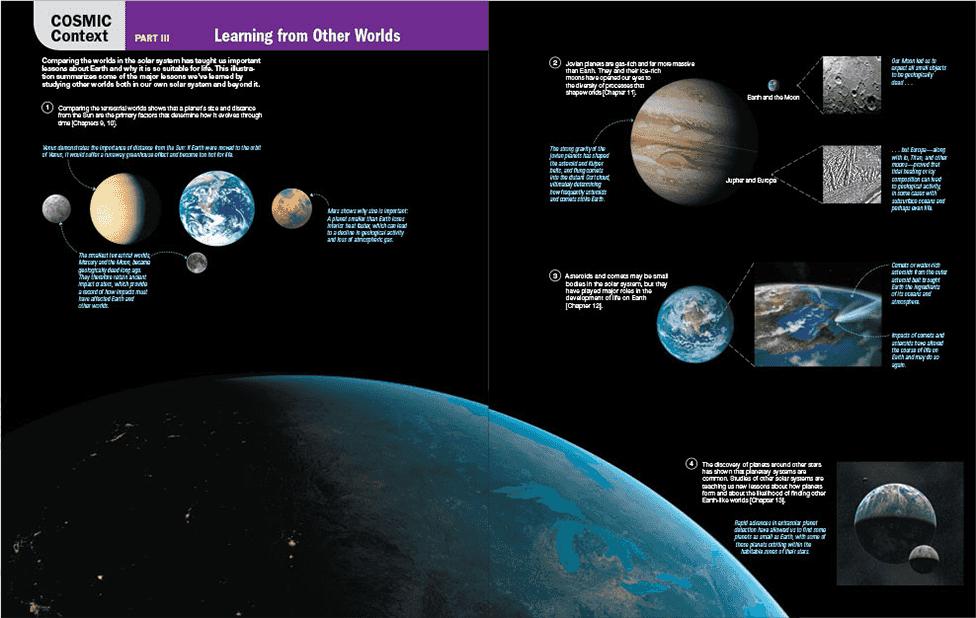
Part III: Learning from Other Worlds (Chapters 7
, 8 , 9 , 10 , 11 , 12 , 13 )
GuidingPhilosophy:Welearnaboutourownworldandexistencebystudying aboutotherplanetsinoursolarsystemandbeyond.
Note: Part III isessentiallyindependentof Parts IV through VII and canbecoveredeitherbeforeorafterthem.
TheCosmicContext figurefor Part III appearsonpp. 400-401.
Thissetofchaptersbeginsin Chapter 7 withabroadoverviewofthe solarsystem,includingan11-pagetourthathighlightssomeofthemost importantandinterestingfeaturesoftheSunandeachoftheplanetsin oursolarsystem.Intheremainingchaptersofthispart,weseekto explainthesefeaturesthroughatrue comparativeplanetology approach,in whichthediscussionemphasizesthe processes thatshapetheplanets ratherthanthe“stampcollecting”offactsaboutthem. Chapter 8 uses theconcretefeaturesofthesolarsystempresentedin Chapter 7 tobuild studentunderstandingofthecurrenttheoryofsolarsystemformation. Chapters 9 and 10 focusontheterrestrialplanets,coveringkeyideas ofgeologyandatmospheres,respectively.Inbothchapters,westartwith examplesfromourownplanetEarthtohelpstudentsunderstandthe typesoffeaturesthatarefoundthroughouttheterrestrialworldsandthe
fundamentalprocessesthatexplainhowthesefeaturescametobe.We thencompleteeachofthesechaptersbysummarizinghowthevarious processeshaveplayedoutoneachindividualworld. Chapter 11 covers thejovianplanetsandtheirmoonsandrings. Chapter 12 discusses smallbodiesinthesolarsystem,includingasteroids,comets,anddwarf planets.Italsocoverscosmiccollisions,includingtheimpactlinkedtothe extinctionofthedinosaursandviewsonhowseriouslyweshouldtake theongoingimpactthreat.Finally, Chapter 13 turnstotheexcitingtopic ofotherplanetarysystems.
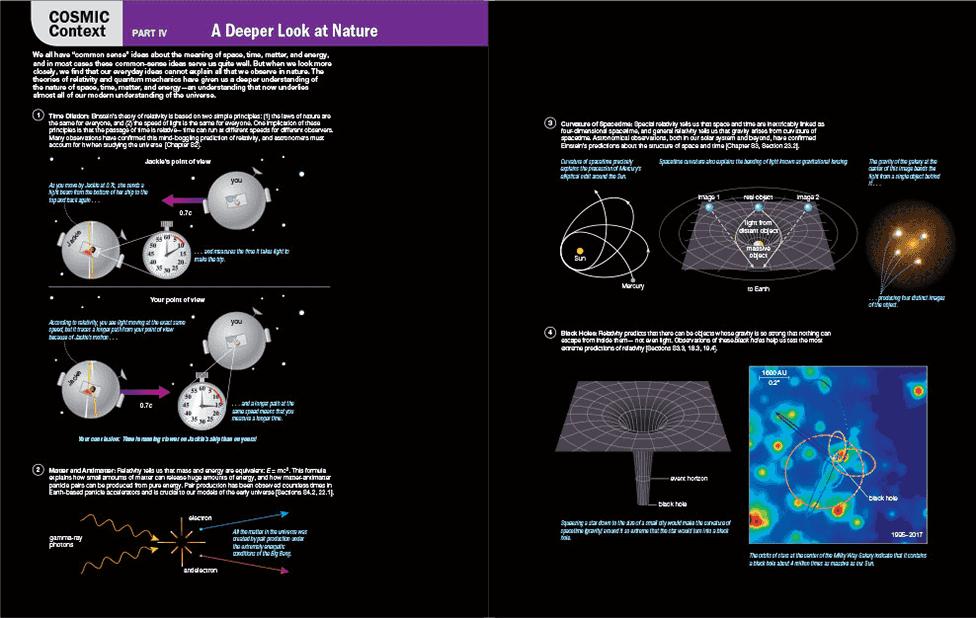
Part IV: A Deeper Look at Nature (Chapters S2 , S3 , S4 )
GuidingPhilosophy:Ideasofrelativityandquantummechanicsareaccessible toanyone.
Note: Thesechaptersarelabeled“supplementary”becausecoverageof themisoptional.Coveringthemwillgiveyourstudentsadeeper understandingofthetopicsthatfollowonstars,galaxies,andcosmology, butthelaterchaptersareself-containedsothattheymaybestudied withouthavingread Part IV atall.
TheCosmicContext figurefor Part IV appearson pp. 466-467.
Nearlyallstudentshaveatleastheardofthingsliketheprohibitionon faster-than-lighttravel,curvatureofspacetime,andtheuncertainty principle.Butfew(ifany)studentsenteranintroductoryastronomy coursewithanyideaofwhatthesethingsmean,andtheyarenaturally curiousaboutthem.Moreover,abasicunderstandingoftheideasof relativityandquantummechanicsmakesitpossibletogainamuch deeperappreciationofmanyofthemostimportantandinterestingtopics inmodernastronomy,includingblackholes,gravitationallensing,and theoverallgeometryoftheuniverse.Thethreechaptersof Part IV coverspecialrelativity(Chapter S2 ),generalrelativity(Chapter S3 ),
andkeyastronomicalideasofquantummechanics(Chapter S4 ).The mainthrustthroughoutistodemystifyrelativityandquantummechanics byconvincingstudentsthattheyarecapableofunderstandingthekey ideasdespitethereputationofthesesubjectsforbeinghardor counterintuitive.