in Conflict ■ Dealing with Another Person’s Anger in Conflict ■ Fair Fighting ■
Individual Approaches to Dealing with Conflict ■ Communication Approaches to Managing Conflict ■ Assertive Communication ■ Negotiation ■ Arbitration ■
Litigation ■ Mediation ■ The Role of Culture in Conflict
Criticism
The Role of Culture in Criticism
Apologizing
The Role of Culture in Apologizing In Conclusion
Learn by Doing Key Terms
The Interview
The Interview and the Role of the Participants
Role of the Interviewer ■ Role of the Interviewee
Types of Interviews
Employment Interview ■ Types of Employment Interviews ■ Information-Gathering Interview ■ Oral History Interview ■ Problem-Solving Interview ■ Counseling
Interview ■ Persuasive Interview ■ Appraisal Interview ■ Reprimanding Interview ■ Interrogation Interview ■ Media Interviews In Conclusion
Learn by Doing Key Terms
The Concepts of Groups Groups Defined
Group Versus Individual Actions
Advantages of Groups ■ Disadvantages of Groups
Types of Groups
Work Teams ■ Study Groups ■ Support Groups ■ Committees ■ Focus Groups ■ The Family as a Group ■ Public Meetings ■ Town Meetings
Group Operations
Group Forming ■ Group Norming ■ Group Storming ■ Group Conforming ■ Group Performing ■ Group Adjourning
Making Group Decisions
Formulating an Agenda ■ Voting
Decision-Making Techniques
Six-Step Standard Agenda for Decision Making ■ Nominal Group Technique for Decision Making
Group Setting
Seating Choice ■ Table Configuration ■ Effect of the Physical Environment
Mediated Meetings
Types of Mediated Meetings ■ Positive and Negative Aspects of Mediated Meetings
In Conclusion
Learn by Doing
Key Terms
Participating in Groups
Cultural Differences in Groups
Cultures and Groups ■ Contrasts in Cultural Group Decision Making ■ Cultural Contrasts in the Role of Information for Groups ■ Male and Female Roles in Groups
The Group Participant
Responsibilities of Group Members ■ Communicating as a Group Member ■ Dealing with Manipulative Group Members
The Group Leader and Group Leadership
Types of Leaders ■ Patterns of Leader/Leadership Emergence ■ Why People Desire to Be Leaders ■ Leader/Leadership: Communicative Perspective ■ Effective Leader
Questioning ■ Responsibilities of Leaders
In Conclusion
Learn by Doing
Key Terms
Public Speaking: Planning the Message
The Listenable Speech
Preparing a Speech: An Overview
Parameters of Public Speaking
Ethics of Public Speaking
Plagiarism■ Fabrication
Analyzing the Parameters of Speeches
Prior to the Speech Analysis ■ Process of Speech Analysis ■ Post-Speech Analysis
Modes of Presentation
Impromptu or Ad Lib Mode ■ Extemporaneous Mode ■ Manuscript Mode ■ Memorized Mode
Theory of Field-Related Standards ■ Group-NormStandards ■ Individual Norm
Standards
Persuasive Strategies
Role of Influence In Persuasion
Classical Components of the Persuasive Message
Speaker Credibility
Logical Arguments
Structure of Logical Arguments ■ Persuasive Evidence ■ Reasoning Fallacies
The Role of Emotions in Persuasion
Psychological Appeals
Appeals to Satisfy Basic Needs ■ Appeals to Motivate Listeners
Structure of the Persuasive Message
Problem–Solution Method of Development ■ Monroe’s Motivated Sequence
Introduction
Body
Conclusion
Culture and Persuasion
The Persuasive Process In Action
In Conclusion
Learn by Doing
Key Terms
Public Speaking: Presenting the Message
Speaking with Confidence
Aspects of Oral and Physical Speech Presentation
Vocal Delivery ■ Physical Elements ■ Using a Script or Outline
Public Speaking Anxiety/Stage Fright
Conquering Public Speaking Anxiety
Presenting Visuals in a Speech
Using YouTube and Computer Downloads ■ Using Presentation Graphics
Rehearsing the Speech
Dealing with Difficulties During a Speech
The Role of Culture on Speech Presentation
In Conclusion
Learn by Doing
Key Terms
Appendix
Informative Speech Topics
Persuasive Speech Topics
Glossary
Notes
Index
Photo Credits
Answers to Chapters 2 and 5 Questionnaires
PREFACE
Welcome to this, the twelfth edition of Communicating: A Social, Career and Cultural Focus. Little did we expect in the Fall of 1977, when our experimental text was published, that more than thirty years later the book would not only still be in print, but would be one of the best-selling texts in the field. Communicating has been a forerunner. It was ahead of its time, being one of the first speech texts to combine the areas of public speaking and intrapersonal and interpersonal communication in a single volume, laying the foundation for what has become known as the “hybrid” communication course. Even before the academic world was sensitized to cultural awareness, we insisted on using gender-neutral language, photos, and illustrations that portrayed many cultures and persons of differences.
What’s New in this Edition?
The major new addition to this edition is Dr. Joan E. Aitken, as our co-author. A Professor of Communication at Park University, Joan has authored eight textbooks, five instructor’s manuals, has done Web development for four publishers, and has developed more than 50 book chapters, articles, and reports. As a former editor of the National Communication Association’s The Communication Teacher and editorial board member of NCA’s Communication Education, Joan’s ongoing focus has been communication education, including work with students with exceptionalities and students who are English language learners. For 30 years, Joan has studied communication technology, and her scholarly research was recently recognized when she received Park University’s “Distinguished Faculty Scholar” of the year. Joan has taught internationally in Jamaica and the People’s Republic of China.
New emphasis on electronically mediated communication (EMC). EMC not only has its own section in Chapter 6 (and is now part of the chapter title), but it has been incorporated into all chapters. There are also numerous new boxes which discuss the impact of EMC on our daily communication and interactions with others, including exploring the influence of Facebook and social networking, using electronic interviewing techniques, and incorporating new software programs into public speaking presentations.
COMMUNICATING
Facebook May Help Shy People Open Up
Socially
Josh Chiles is shy. In a gathering of unfamiliar people, he often waits for someone, anyone, to ask hima question or make small talk. At a party, bar or restaurant, “I just sit there, hoping someone will talk to me,” he said.
But on Facebook, he is Mr. Personality. He constantly refreshes his status; comments on others’ updates, posts pictures, makes jokes and registers his likes. He states, “There is no doubt Facebook has changed my life.”
Astudy published in the journal CyberPsychology, Behavior and Social Networking, showed that the Internet and social networks helped the lonely fill “critical needs of social interactions, self-disclosure, and identity exploration.” As a result, another study shows, “shy people are spending more time on Facebook than more socially confident people.”
REFLECT ON THIS: Though Facebook and other social media sites may help the shy, some experts consider these sources a crutch to avoid human contact. Do you agree with the findings noted about the positive effects, or side with those who think social media sources are a crutch?
Reexamination and expansion of key topic areas. There is an added emphasis on and expanded discussions of topics such as perception, conflict management, leadership principles, and digital communication. New boxes explore these topic areas as well.
Significantly expanded and updated research base. More than a hundred NEW scholarly journal article and conference paper citations have been added, thus expanding the contemporary research base in communication studies and related fields. American Psychological Association (APA) reference style is used throughout, thus modeling that format for students. Research-based sources have been added in the footnotes so students can further investigate updated text content.
Digital communication has been integrated into each chapter. We have included theoretical information about digital communication, as well as specific guidelines on how to communicate more effectively using electronic communication. Digital public speaking presentation applications and software references have been updated, and the overall digital database has been expanded and updated.
Reorganization of public speaking chapters. In response to reviewers’ requests, the public speaking chapters have been reorganized to separate preparation techniques from presentation techniques, with discussion of delivery and presentation skills now concluding the public speaking section.
Streamlined coverage. While continuing to capture the ever-changing field of communication, the text has nonetheless been streamlined throughout to eliminate outdated or redundant information and to make the text more concise without losing the readability, research, and engaging examples and anecdotes.
Numerous new examples, boxes, figures, and cartoons throughout. New material reflects current events that have lasting significance such as media influence on the 2011 uprisings in the Middle East and offers fresh and sometimes provocative perspectives such as how Facebook helps shy people to open up or whether we are becoming “an uncivil society.”
COMMUNICATING
The Haka Race of Taipei, Taiwan’s View of Listening
Culturally
When you listen, you use your ears, eyes, and heart to determine the meaning. The eyes are actually more important than the ears. You have to learn to listen to the content, but you have to know what people mean.
What do you think the authors mean by “listen with your heart” as it relates to the meaning of messages you receive?
What do you think is meant by “but you have to know what people mean”?
COMMUNICATING
The Power of the Internet
Socially
Bill Clinton wandered into the University of South Carolina Student Center around midnight and found a single student on a computer. The student said, “give me a minute,” and within 10 minutes, a flash crowd of 300 students had arrived to hear the former president give an impromptu speech.
Source: From S. Schifferes, Internet, key to Obama victories, BBC News, November 10, 2008, http://news.bbc.co.uk/l/hi/technology/7412045.stm
REFLECT ON THIS:
2. 1.
In 2011, the social media was credited with getting flash crowds in Egypt to take a stand for Democracy and overthrow the govern-
Distinctive Features of our Book
We are not resting on our laurels. Long-time users will note changes in this new edition, yet will feel comfortable that we have continued to produce a book that is well-researched, interesting to read, pragmatic, and continues to showcase features that have come to be recognized as hallmarks of our book such as the numerous examples and anecdotes, the concern about skills and application of the material, the inclusion of self-assessments and questionnaires, and the custom-drawn cartoons, done by a former communication student. In addition:
Longstanding emphasis on diversity and intercultural communication. The eleventh edition brought forth a new subtitle for the book which included “cultural.” Although we added this to the title, the concept was not new. We have always included references to inclusiveness, gender, ethnicity, sexual orientation, age, and nationality. Through the editions, the emphasis on diversity and intercultural communication has increased.
■
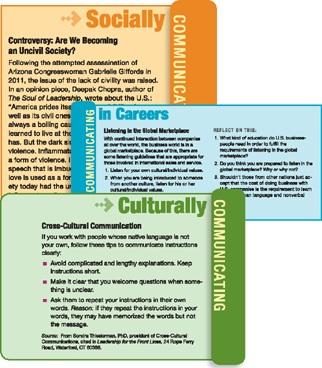
In keeping with our three-pronged approach, “ASocial, Career and Cultural Focus,” the book includes three types of thematic boxes to highlight the social, career, and cultural aspects of communication.
“Socially Communicating” boxes offer guidelines and skills for communicating in relationships and other interpersonal contexts.
“Communicating in Careers” boxes provide insight into workplace communication with tips on how to communicate more effectively at work and in your career.
“Culturally Communicating” boxes focus on different cultural communication norms and expectations and how to adapt one’s communication in an increasingly diverse world.
Self-Assessment Questionnaires, a valued feature of past editions, allow the reader to find and assess a variety of skills or issues, fromlistening ability to communication apprehension.
Personal Report of Intercultural Communication Apprehension (PRICA)
This measure was developed to address communication apprehension in the intercultural context.
DIRECTIONS: The 14 statements below are comments frequently made by people with regard to communication with people fromother cultures. Please indicate how much you agree with these statements by marking a number representing your response to each statement using the following choices: Strongly Disagree = 1; Disagree = 2; Neutral = 3; Agree = 4; Strongly Agree = 5
Generally, I amcomfortable interacting with a group of people fromdifferent cultures.
I amtense and nervous while interacting with people fromdifferent cultures. I like to get involved in group discussions with others who are fromdifferent cultures.
While conversing with a person froma different culture, I feel very relaxed.
I amafraid to speak up in conversations with a person froma different culture. I face the prospect of interacting with people fromdifferent cultures with confidence.
My thoughts become confused and jumbled when interacting with people from different cultures.
Communicating with people fromdifferent cultures makes me feel uncomfortable.
Scoring: To compute the PRICAscore, complete the following steps:
Step 1. Add the scores for the following items: 1, 3, 5, 7, 9, 10, and 12
LEARN BYDOING
Identify an experience in which your attempt to communicate was a failure. Use the classification of sources of noise given in the text to label the type of interference you encountered. Why did this happen? What, if anything, could you have done to correct the interference problem?
Describe a context in which you find it difficult to communicate. Describe a context in which you find it easy to communicate. Why did you select each one? What implications for communication are involved in your choices?
Describe the systemof communication by which your family operates (or operated) by investigating the patterns of communication and the rules
b.
You have just finished eating in a restaurant. You check the bill and realize that the waiter has made a $10 error in your favor. The waiter sees your reaction and asks if anything is wrong. How do you respond?
Numerous pedagogical aids include chapter objectives and summaries, valuable “Learn by Doing” skill-building activities, boldfaced key terms, sample speeches and outlines, and extensive examples, many of which have been updated.
Acomprehensive Glossary, expanded and updated in this edition, defines key terms which are boldfaced throughout the text, as well as words which are italicized in the text which we think are important for the reader to acknowledge.
Anew design for this edition continues the tradition of making the book accessible and attractive for students.
AMessage to Students
As you undertake the study of communication, you might be asking yourself, “Why do I need to study this? I’ve been talking and listening all of my life.” Research indicates that although you may have been participating in the act of communication your whole life, if you are fairly typical, your skills may not be extremely good.
One of the most important skills you need in your career, in your social life, or in relating to people of various cultures is to be an effective communicator. Research shows:
■ You are taking a public speaking course. The instructor requires three quoted references in the speech that you are to present in five minutes. You had a week to get ready but did not do the necessary research. Would you make up three references, not give the speech and get a failing grade, give the speech without the references and hope for the best, or take some other action? If you would take another action, what would it be?
“All students, including those at the graduate level, need to learn to communicate orally, interpersonally, in small groups and teams, and in public. Interestingly, students also need to learn to communicate effectively outside the classroomwith other students and with teachers.”1
Communication competency is indispensable for successful participation in careers. Interested in getting a job? The number-one requirement for job attainment and accomplishment is communication skills.
The ability to communicate is central to a person’s self-development and contribution to society, as well as to one’s educational and career success.2
Relationships with friends and family depend on your listening and responding to each other.
As the world becomes “flatter,” where communication takes place globally, the ability to understand not only your own culture but that of others becomes imperative.
■ The purpose of this text is to give you the opportunities to attain communication competency and not only to gain an understanding of the communication process but also to improve the skills that you will possess for the rest of your life.
AMessage to Instructors
This text is developed centering on the 3 Cs: Conciseness, Comprehensiveness, and Creativity.
Conciseness: Communication is an ever-expanding field. As new editions of basic course texts are published, the trend has been for books to get longer and longer, making it difficult for instructors to cover all the material in the time allotted for a course. With this in mind, we have concentrated on stemming this tide. This edition, although it continues to include up-to-date research and approaches to contemporary and emerging communication issues, reinforces the conciseness established in previous editions.
Comprehensiveness: We continue to cover the full range of basic communication principles and relevant theory and research. We have updated examples, discussions, and the research base.
Creativity: Historically, students and faculty alike have praised the writing style of the book. As has been the case with previous editions, we have again given special attention to making this book readable, student centered, and practical. We have provided examples of enlightened and entertaining value and have also included custom-drawn cartoons. The cartoonist, a former communication student, not only is creative but also knows the field of communication.
Acknowledgments
As he has done in previous editions, Tony Zupancic of Notre Dame College, South Euclid, Ohio, added insight and information to the public speaking chapters and made himself continuously available as a resource person.
We are indebted to those professors who have been loyal users of this book through its first eleven editions. We hope that you will continue to use the text and to provide us with insightful and helpful comments for future editions.
Appreciation to our professional colleagues who read and critiqued the manuscript through its development: Kathleen Czech, Point Loma Nazarene University; Dr. Terry Trafton, Coastal Carolina Community College; Dr. Nadia Ramoutar, Art Institute of Jacksonville; Stephen Yungbluth, Northern Kentucky University; Isabel Del Pino-Allen, Miami Dade College; Jennifer Lehtinen, SUNY Orange; Nancy Petersen, Los Medanos College; and Jeffrey S. Hillard, College of Mount St. Joseph.
Kudos to Hilary Jackson, Developmental Editor, for her editorial assistance and advice, and to Karon Bowers of Pearson, our Editor-in-Chief, for her patience and unwavering support.
ASpecial Thanks
For the last six editions of COMMUNICATING a special feature has been the creative and relevant cartoons of Bob Vojtko, which he created specifically for our book. Bob, a nationally known cartoonist, is a former communication student of one of your authors. He was a special student in class, and he has a great understanding of the field. We appreciate Bob’s efforts and hope our long and pleasant collaboration continues for many more editions!
In Conclusion
COMMUNICATE COMPETENTLY!
Roy , Andy, Darlyn, and Joan
Notes
1Morreale, S & Pearson, J (2008) Why communication education is important: The centrality of the discipline in the 21st century. Communication Education, 57 (2), 224–240.
2Morreale, S. & Pearson, J. (2008) Why communication education is important: The centrality of the discipline in the 21st century Communication Education, 57 (2), 224–240
CHAPTER
1
The Human Communication Process
the communication process • cultural and communication • first amendment speech • ethical communication
After reading this chapter, you should be able to
List and explain the components of human communication
Explain the effects of perceptions on the human communication process
Identify, define, and give examples of the noise factors that affect the human communication process
Illustrate, define, and give examples of the linear, interactional, and transactional models of communication
Describe the concept of communication as a system
Explain the role of the media as a communicator
Give evidence of the relationship between communication and culture
Define and explain ethnocentrism
Give an example of the role of First Amendment speech as a rhetorical tool
Explain the role of the ethical value systemin communication
Analyze the basis for ethical communication
When confronted with the requirement of taking a communication course, students sometimes ask, “Why do I need that? I know how to talk.” Communication, though, is more than talking. When you answer a question in class, receive a compliment, challenge another person’s ideas, interact with a family member, touch someone, participate in a job interview, take part in a group meeting, listen to a classroom lecture, do a victorious high-five, select clothing to wear, or go through the process of buying a car, you are involved in acts of communicating! Significant friendships, successful family relationships, academic and occupational success, and understanding others from various cultures depend on communication abilities. Communication encompasses not only face-to-face and public communication, but also the ability to navigate Twitter, MySpace, and Facebook.1
“Communication skills are essential to personal, academic, and professional success.”2 A recent study indicated that employers want colleges to produce graduates with these learning outcomes: the ability to communicate effectively, critical thinking and analytical reasoning skills, ability to connect choices and actions to ethical decisions, teamwork skills and ability to collaborate with others in diverse group settings, and understand the role of cultural diversity in the United States and other countries. The study went on to state that employers want employees to “possess knowledge of and facility with navigating the world of social media and to know how to create polished communicative messages that have an impact in cyberspace.”3 Also important is “intercultural awareness and facility in communicating successfully in a richly diverse world and workplace.”4
Another study also stressed that “communication instruction is critical to students’ future personal and professional success.”5 This was further stressed in a recruitment and talent management study which revealed that there were “soft” skills that could land a recruit a job. Included were: leadership/teambuilding and being an excellent communicator.6
Scholars outside the communication discipline recognize the importance of oral communication training. For example, the American Institute of Certified Public Accountants stated, “Individuals entering the accounting profession should have the skills necessary to exchange information with a meaningful context and with appropriate delivery.”7
“When the Harvard Medical School surveyed more than 2000 patients about their office visits, poor communication emerged as the most important factor affecting patients’ trust in their doctors.”8 “Communication skills are as essential to the legal profession as they are to the medical profession.”9
Communication competency is crucial to more than the workplace and the classroom. We also need speaking and listening skills to function at the personal level. Relationships depend on listening and responding to each other. The business of life is a communication interaction whether it is with the doctor, the college registrar, the repair-person, your best friend, or the 911 operator.
Communication skills are essential to personal, academic, and professional success.
in Careers
Why Good Communication Is Good Business
Flatter organizations, a more diverse employee base and greater use of teams have all made communication essential to organizational success. Flatter organizations mean managers must communicate with many people over whomthey may have no formal control. Even with their own employees, the days when a manager can just order people around are finished. The autocratic management model of past generations is increasingly being replaced by participatory management in which communication is the key to build trust, promote understanding and empower and motivate others.
Because the domestic workforce is growing more diverse, an organization can no longer assume its employee constituencies are homogenous. Employees reflect difference in age, ethnic heritage, race, physical abilities, gender and sexual orientation. Diversity is not just a matter of social responsibility; it is also an economic issue. Companies are realizing the advantage of making full use of the creativity, talents, experiences and perspectives of a diverse employee base.
Teams are the modus operandi in the 21st century workplace. In a recent survey of
Fortune 1000 companies, 83 percent reported that their firms use teams; teams are all about communication. The collaboration that allows organizations to capitalize on the creative potential of a diverse workforce depends on communication.
Source: “Why Good Communication Is Good Business” by Marty Blalock, from Wisconsin Business Alumni Update Reprinted with permission of Update and the University of Wisconsin School of Business.
REFLECT ON THIS:
Do you think all college students who are majoring in business should be required to take a course in communication?
Do you think diversity makes for a more complicated work environment? How does working in a teamdiffer fromworking individually?
“Direct contact with culturally different people in our neighborhoods, community, schools and workplaces is an inescapable part of life.”10 As the world becomes flatter, where communication takes place internationally, the ability to understand not only your own culture, but that of others, becomes imperative. As the method of communicating with others transfers from one-on-one communication to a flat world platform where there is a convergence of the personal computer, fiber-optic cable, and work flow software (which enables individuals all over the world to collaborate regardless of the distance between them), the knowledge of world cultures and their communication patterns is critical.11
As you read through this text and study the field of communication, hopefully you will gain both an understanding and gain the skills to be a competent communicator.
Communication Defined
Communication is a conscious or unconscious, intentional or unintentional process in which feelings and ideas are expressed as verbal and/or nonverbal messages that are sent, received, and comprehended. This process can be accidental (having no intent), expressive (resulting from the emotional state of the person), or rhetorical (resulting from specific goals of the communicator).
Human communication occurs on intrapersonal, interpersonal, and public levels. Intrapersonal communication, also referred to as personal communication, is communicating with yourself. It encompasses such activities as thought processing, personal decision making, listening, and determining self-concept. Interpersonal communication refers to communication that takes place between two or more persons who establish a communicative relationship. Forms of interpersonal communication include face-to-face or mediated conversations, interviews, and small-group discussions. Public communication is characterized by a speaker sending a message to an audience. It may be direct, such as a faceto-face message delivered by a speaker to an audience, or indirect, such as a message relayed over radio or television.
Communication is dynamic because as the attitudes, expectations, feelings, and emotions of persons change the nature of their communication changes as well.
Communication is dynamic, continuous, irreversible, interactive, and contextual.12
Communication is dynamic because the process is constantly in a state of change. As the attitudes, expectations, feelings, and emotions of persons who are communicating change, the nature of their communication changes as well.
Communication is continuous because it never stops. Whether asleep or awake, we are always processing ideas and information through our dreams, thoughts, and expressions. Our brains remain active; we are communicating.
Communication is irreversible. Once we send a message, we cannot undo it. Once we make a slip of the tongue, give a meaningful glance, send an angry e-mail, or generate an emotional outburst, we cannot erase it. Our apologies or denials cannot completely eradicate what has taken place.
We sometimes find ourselves in situations where stress causes us to send messages
Communication is interactive. We react to our own speech and actions, and then we react to those reactions, and others react to our speech and actions. Thus, a cycle of action and reaction becomes the basis for our communication.
Communication is contextual. The complexity of communication dictates that we develop the awareness and the skills to function effectively as communicators and to adapt to the setting (both where it is taking place and the attitudes of those who are in the environment), the people who are present, and the purpose of the communication. A word-processing advertisement summarized this well: “You don’t talk to your mother the same way you talk to your buddies. (Better not, for your sake.) That nice polite talk is perfect for Sunday dinners. Or when you’re asking for money. That’s why you’ve got Street talk. Small talk. Back talk. Coffee talk. Baby talk. And even when you’re not saying a word Body talk, which has absolutely no regard for syntax and grammar. Customlanguages made to order.”13
To be an effective communicator, you need to understand how the communication process operates as a system, how you send and process information, how you reason your way to conclusions and evaluate the ideas that others send, and the relationship between communication and culture. In addition, good communicators know what ethical standards they use in making their decisions.
The Components of Human Communication
As human beings, we are capable of selective communication. That is, from the wide repertory available to us, we can choose the symbol we believe best represents the idea or concept we wish to express. We can think in abstractions, plan events in the future, and store
and recall information. Selective communication allows us to combine sounds into complicated sentences and therefore describe feelings, thoughts, events, and objects. This ability to selectively communicate also allows us to decide how to send intentional messages to others.
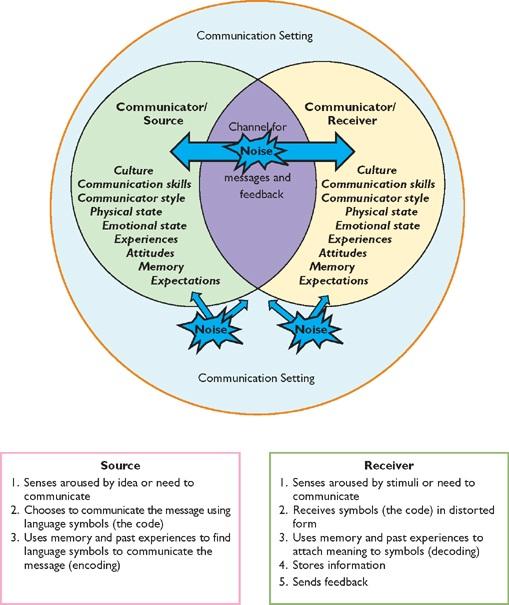
Figure 1.1 illustrates how the components of the communication process work. The circles representing the source (the originator of the message) and the receiver (the recipient of the message) overlap as each person sends messages (communication) and feedback (response to a message) to the other through a frame of reference (a perceptual screen) communication noise (the potential for communication disruption). The overlapping circles suggest that communication is possible only when each communicator understands the other’s message. The variables that affect the frame of reference make up the perceptual screen through which verbal and nonverbal messages are communicated.
Communicator Perceptions
Your perceptions the way you view the world affect your interpretation of a communication stimulus. Many factors make up your perceptual filter. These factors, listed in Figure 1.1, include your culture (the background worldview you hold), communication skills (developed fromexperience and training), physical and emotional states (how you feel at this particular time), experiences (your cultural background), attitudes (negative and positive predispositions to respond to any particular stimulus), memory (ability to store and recall information), and expectations (what you anticipate will occur). Because of perceptual differences, two people reporting on an incident they have both seen may report their observations differently.
FIGURE 1.1
The Components of Communication
Source
Senses aroused by idea or need to communicate
Chooses to communicate the message using language symbols (the code)
Uses memory and past experiences to find language symbols to communicate the message (encoding)
Receiver
Senses aroused by stimuli or need to communicate
Receives symbols (the code) in distorted form
Uses memory and past experiences to attach meaning to symbols (decoding)
Stores information
Sends feedback
You encode and decode messages through your perceptual filters. These perceptual filters establish expectations for the outcome of the communication, and expectations guide your interpretation of the communicator’s message. A person who expects to hear bad news, for instance, probably will interpret what the boss says in a performance review as negative even if the focus of the review highlights many of the positive aspects of the individual’s work.
The Communication Process
When we communicate, we encode (take ideas and put them into message form), send the ideas through a channel composed of our primary signal system (the senses: seeing, hearing, tasting, smelling, and touching) to someone who receives them via her or his primary signal system, and decodes (translates) the received messages. We express our reactions to what we have sensed by both verbal and nonverbal signs. You might say, “I heard the bell” or, “It feels soft.” These are examples of verbal communication that are responses to what your senses have received. You also can respond on a nonverbal level. You frown, feel your body tighten up, and wiggle in your chair as you listen to your psychology instructor detail all the homework you have to finish before you can leave for spring vacation. Your frowning, tensing, and wiggling are nonverbal responses of stress that your body is sending to you and to anyone else who is observing you.
FIGURE
1.2
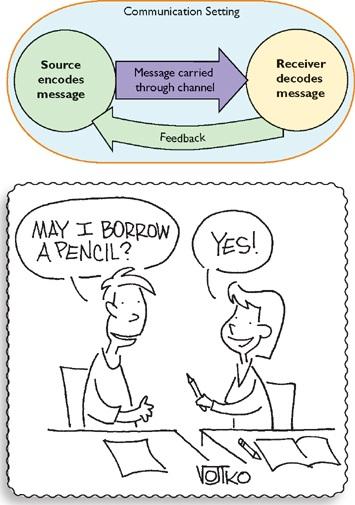
Effective Encoding and Decoding without Noise
In any communication process, the degree to which the communication is effective depends on the communicators’ mutual understanding of the signals being used. Suppose you are about to take an examination and suddenly realize you forgot to bring a pencil to class. You ask one of your friends, “May I please borrow a pencil?” She says, “Yes” and gives you a pencil. You have just participated in an effective communication transaction. You (communicator A) encoded a message (“May I please borrow a pencil?”) and sent it out over a channel (vocal tones carried on sound waves) to your friend (communicator B). Your friend received the message (by using sensory agents, ears) and decoded it (understood that you wanted a pencil). Your friend’s feedback (the word yes and handing the pencil to you) indicated that the message was successfully received and decoded. (This is illustrated in Figure 1.2.)
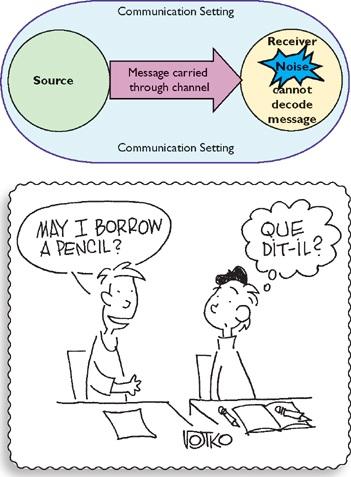
Now suppose that the person sitting next to you is from France and speaks no English. The symbol that he uses for pencil is crayon. Unless both of you communicate in French, he will be unable to decode your message, so no successful communication takes place. (See Figure 1.3.)
Remember that the act of speech is not itself communication. Speech is a biological act: the utterance of sounds, possibly of vocal symbols of language. Communication is vastly more complex. It involves the development of a relationship among people in which there is shared meaning among the participants. That is, the intent of the message received is basically the same as the intent of the message sent.
1.3
FIGURE
Encoding with Inappropriate Semantics Can Cause Decoding Problems
The Source and the Message
The communication process begins when the source is consciously or unconsciously stimulated by some event, object, or idea. This need to send a message is then followed by a memory search to find the appropriate language (verbal or nonverbal or both) in which to encode the message.
The Channel
During a communicative act, the encoded message is carried through a channel or channels. If the communication occurs face-to-face, these channels may be some or all of the five senses. Typically, we rely on sight and sound as channels in speaking and listening. Instead of communicating face-to-face, however, we may choose an electronic channel that uses sound (e.g., the telephone) or seeing and hearing (e.g., television). In some instances, we may elect to send a message to someone by means of physical contact, such as by tapping the person on the shoulder. In this case, we use the touch channel.
The Receiver and the Message
After receiving verbal and nonverbal signals through the senses, the receiver must decode the message before communication can be accomplished. When gaining verbal and nonverbal signals, the receiver processes them through a memory search so that the signals are translated into the receiver’s language system. This decoded message is not identical to the one encoded by the source because each person’s symbol systemis shaped by a unique set of perceptions. A Euro American professor who says, “Assignments should be turned in on time,” might be surprised when a student from a culture that has a flexible time system, such as Mexico, attempts to turn in his homework the day after the assignment was due.
Feedback
Once the receiver assigns meaning to the received message, he is in a position to respond. This response, feedback, can be a verbal or a nonverbal reaction to the message, or both. Feedback indicates whether the receiver understands (e.g., by nodding), misunderstands (e.g., by shrugging the shoulders and saying, “I don’t understand”), encourages the source to continue (e.g., by leaning forward and saying, “Yes”), or disagrees (e.g., by pulling back and saying, “No way!”). The act of responding, by which the receiver sends feedback to the source, actually shifts the role of the receiver to that of the source.