MOTHS and BUTTERFLIES,
Though unacquainted with the Manner how,
It is judged proper to lay down the following
D I R E C T I O N S .
PROVIDE yourself with a Net made of Muschetto Gause, and in Shape like a Bat-fowling Net; let its Length be one Ell, the Width at Bottom three Quarters of a Yard, at Top half a Yard, and cut circular; this must be sewed to a Tape or Ferret, that it may be fastened to a couple of Hasle or other Sticks five Feet long each, the upper Part whereof should be bent circular to fit your Net.
You must likewise have a Stick of Hasle, or any other Wood, about five or six Feet in Length, wherewith to put the Flies and Moths on the Wing, by beating the Boughs, Hedges, Shrubs, or other Growths you are near, so that you may be better able to see and take them.
Furnish yourself likewise with Boxes of such Sizes as will go into your Pocket, let them be lined at the Top and Bottom with Cork; be also provided with a Pin-cushion, well stock’d with different Sorts of Pins.
These Things being in readiness, go into the Woods and Fields thereto adjacent (always placing yourself where the Sun has most Power, and the Wind the least) also into Chalk-pits, rough Grounds,
Lanes, &c. In all which Places, if it is a fine Day, and a proper Season of the Year, you’ll find Plenty of Sport.
When you have taken a Fly in your Net, lay the Net flat on the Ground, which will prevent the Flyfrom fluttering, then put the Fore Finger of your Left Hand under the Fly, and with the same Finger of your Right Hand give it a squeeze on the Back or Chest, and that will kill it; be careful, however, not to press too hard, least you damage the Fly. This done take a Pin and run it through the Body, betwixt the Wings, letting that Side be uppermost which is most beautiful; then stick it in your Box, and look for more Sport.
Having collected such a Number of Flies as you think proper, and being returned home, look into your Boxes, and observe which of them are fit to set: such as you find dead and not stiff are so.
Then (having prepared before-hand two or three Boards covered with Cork, of about ten Inches by sixteen in Size, or as you find most convenient to place your Flies in order on and extend their Wings in the best manner: by the Assistance of little Braces made by cutting a Card into Lengths or Slips, with a small Pin thrust through the End of each) proceed to manage them as follows:
Take a Fly out of your Box: see if the Pin be run through it perpendicularly: if so, stick it on one of your setting Boards, and with the Point of a Needle (which must be fixt into a small Stick, or what else you like best) extend one Wing leisurely, till such Time as the Point thereof is even with the Nose of the Flyyou are setting. That done, fix one of your Card Braces gently on that Wing, to prevent its giving way; serve the other Wing in the same manner, and your Fly will appear extended as in the Paintings. Let the Braces remain on the Wings of Butterflies a Fortnight, on those of great Moths a Month. Take Notice, however, that a great Number of small Moths must be set in your Boxes in the Field, otherwise your labour will be lost; you’ll presently know which these are, by observing them to be dead and almost stiff; so that it is proper to carry always about you a little Box of Card Braces for this Purpose.
TheWaytopreserveyourFlies,afteryouhavetakenthemfrom yourSettingBoard.
If you put them in Drawers, Boxes, or Frames with Glasses before them, its proper to get some Camphire, which inclose in small Muslin Bags, and fasten it to those Places where your Flies are; by this Means you will destroy those Insects that would otherwise injure your Flies; and by renewing now and then this Method, I am convinced your Fliesmay be preserved several Years. The Months in England that produce the greatest Variety of Flies, are April, May, June, July, and August, especially of the Butterfly Kind; and for Moths, I am of Opinion, that there are many different Species produced all the Year round. The best Time to take the greatest Variety of Moths, is for one Hour after Sun-set, and the properest Places are in and by the Sides of Woods, Gardens, Green Lanes, &c. where with your Net you’l seldom fail of Sport. Thus much seemed necessary to say in Respect to taking Insects in the Fly State, and more would be superfluous.
ButasitmaybeagreeabletosometobreedtheFlies themselves fromtheCaterpillars,IshalllikewisegivethebestInstructionsIam ableforthatPurpose.
IN the Spring and Autumn Season you may collect great Variety of Caterpillars, by spreading a Sheet under Oak-Trees: then beating the Boughs, many Caterpillars will fall, which if taken Care of, will produce scarce and valuable Moths; you may also obtain by the same Means Caterpillars from the Black-Thorn, White-Thorn, Bramble, Chickweed, Willow, and many other Growths.
When you have collected a Number of Caterpillars, and remark’d the Food you found them on, put them into Boxes, which prepare as follows: Take a Deal or Wainscot Box, cut a large Square out of the Top and Bottom, cover the Place cut out with a Piece of Crape Hatband, glewing the same all round to prevent any Escape. This done, put your Caterpillarsinto the Box, with some of the same Food you found them on, giving them, if you can, fresh every Day. Here you’ll find them feed and thrive; and after changing their Skins
(some five and some six Times) they will go into the Aurelia State, and there remain for a certain Time, some much longer than others; but in about fourteen Days from this last change you may look into your Boxes, to see if you have any Fliesbred; remembring that out of such as are produced in this manner, much more perfect Flies may be chosen, than any that can be caught; and as several Sorts of Caterpillars go down into the Earth, and there change to Chrysalis, some Earth must be put into the Boxes for that Purpose, at least two or three Inches deep. Never take the Chrysalides out of the Earth, nor disturb them till the Fliesare bred.
There is yet another Thing proper to be known, in order to compleat your Collection. A great Number of Caterpillarsgo into the Earth, and there change to Aureliæ, whose Moths are seldom upon the Wing till Night; these Aureliæare to be got by digging with such a Trowel as the Bricklayers use, about the Roots of Trees, such as Oaks, Elms, Limes, Poplars, Willows, &c. also by the Sides of Walls and Pales. The usual Time to dig for them is from September to March.
When you have obtain’d a Number of Aureliæ by digging, you must provide for them thus: Get some Earth and scowering Sand, mix them well together, and put the Mixture into some large Garden Pots; lay your Aureliæthereon, covering them with Moss; then sew a Piece of Crape Hatband round a small Hoop, and put such a Cover on each Pot, in order to receive the Flies when bred, which will usually be in the Months of March, April, May, and June. I have always kept my Pots of Aureliæ out in the open Air, and the Flies have been produced with great Success; however it may be proper to place a Piece of Board over each Pot, to prevent unforeseen Accidents.
Those who think proper to put these Directions in Practice, will, I am convinced, in a short Time, be possessed of a great Number of valuable Flies. What Food the Caterpillarsmentioned in this Work chuse to feed on, the Time when they change into Aureliæ, and when they issue forth
in the FlyState, may be seen in the Description of each Plate.
ERRATA.
Page. Num. Read. Instead of 8 XVII Chrysalis Chrysalisis 11 VI nigra alba
18 II Cl. 3. S. A. 2. Cl. 3. S. E. 1. 20 VII form from 23 XIII to o
49 I Sect. a.
51 V Cl. 2. S. a. 5. Cl. 2. S. a. 2.
52 I 4 The Great } Fox-tail Grass.}
53 IV Cl. 2. S. b. 4. Cl. 2. S. a. 4.
62 III Cl. 1. S. a. 3. Cl. 2. S. a. 4.
63 of Butterflies of Caterpillars On the Plates.
38 I Cl. 1. S. b. 1. Cl. 1. S. a. 1.
38 II Cl. 1. S. b. 2. Cl. 1. S. a. 2.
42 I Cl. 2. S. a. 1. Cl. 2. S. 1. b. 1.
42 II L. I. Ch. III. L. I. Ch. II.
62 II Cl. 1. S. a. 2. Cl. 1. S. a. 1.
A Synoptical T A B L E of the Moths and Butterflies contained in this Work.
C A T E R P I L L A R S . Producing Moths.
Having circular Rings or Joints. Naked.
Without Protuberances.
T H E great yellow Underwing. The Wild Arrach. The Angle Shades. The Pease Blossom. The small green Oak Moth. The small Ermine Moth. The Broom Moth. The sallow Moth. The Codling Moth. The Province Rose Moth. The Scallop-wing’d Oak Moth. The Black-thorn Moth. The green Moth with silver Lines. The Ranunculus Moth. The Water-Betony Moth. The small Elephant Moth. The Gold-spot Moth. The Sword-grass Moth.
With Horns on the Tail.
The Jessamine-Hawk Moth. The Unicorn, or Bindweed-Hawk Moth. The Privet-Hawk. The Olive-shades, or Lime-Hawk. The Eyed Willow-Hawk. The Poplar-Hawk. The Ladies Bedstraw, or Elephant Moth.
With one Protuberance on the Rump.
The Ealing’s Glory.
With two or more Protuber.
The Ozier, or Pebble Moth. With Shoulders rising into an Angle.
The Puss Moth. The Wild Rose Moth. Having little Hair.
Without Protuberances.
The Goat Moth. The Emperor Moth. The Plumb-Tree Moth.
With Protuberances.
The Willow Red-Underwing. Having much Hair. Without Protuberances.
The Great Tyger. The Cream-Spot Tyger. The Scarlet Tyger. The Black Arches. The Great Ermine Moth. The Spotted Buff Moth. The Gipsey Moth. The Buff Tip. The White Satin Moth.
The Lacquey. The Great Egger. The Grass Egger. The December Moth. The Spotted Red and White Underwing. The Wood Tyger. The Mother of Pearl Moth. The Yellow July Oak Moth. The small Egger. The Fox-coloured Moth. Having Rings of different Colours.
The Cinnabar Moth. Having indented Marks. The Bramble Moth. Having fleshy Protuberances on the Head, Back, or Tail.
The Lappit-Moth. The Drinker. The Yellow Tail. The Dagger Moth. The Wild Pine Tree Lappit-Moth. Having many Tufts of Hair.
The Black Tussock. The Yellow Tussock. The Red Spot Tussock. The Orange Tussock. The Nut-Tree Tussock. The Sycamore Tussock.
Half Loopers.
Having 8 Feet, 2 Holders, 6 Claws, and with Protuberances. The Crimson Underwing. Having 4 Feet, 2 Holders, 6 Claws. Hairy.
The Silver Y Moth.
Loopers. Naked.
Without Protuberances.
The Brindled Beauty. The July Arrach Moth. The Mottled Umber. The July Sallow Moth. The Buff Argus. The Green Broom Moth. The Lime Moss Moth. With Protuberances.
The Spotted Elm Moth. The Swallow-Tail Moth. The October Moth. The Brimstone Moth. The Scallop-winged Moth. The Richmond Beauty. The Hawthorn Moth. Hairy.
Without Protuberances.
The large Magpye, or Curran Moth. The Gooseberry Moth. Having Tufts of Hair.
The Brindle Moth. Shaped like Wood-lice.
Small Oak Egger-Moth. Producing Moths whose Generation is unknown. Glory of Kent. Cleifden Nonpareil. Producing Flies between the Moth and Butterfly.
The Burnet Moth.
Producing Butterflies. Smooth.
Without Protuberances.
Swallow-Tail Butterfly. Brimstone Butterfly. Having little Hair.
Producing round-winged Butterflies.
White Butterfly with black Veins. Large white Garden Butterfly. Small white Garden Butterfly. White Butterfly with green Veins. Orange Tip, or Lady of the Woods.
Producing scallop-wing’d Butterflies.
The Marmoris, or Marble Butterfly. The Meadow Brown. The Great Argus, and Wood Argus.
Producing Butterflies with large Heads and Bodies.
The Grizzled Butterfly.
Armed with Spikes.
Whose Chrysalis hangs by the Tail.
The Admirable Butterfly. The Peacock Butterfly. The painted Lady. The great Tortoise-shell. The Comma-Butterfly. The Great Fritillary. The Plantain Fritillary. The Heath Fritillary. The Willow Butterfly. The small Fritillary. The great Fritillary, with silver Spots.
Shaped like Wood-lice.
The Purple Hair-streak Butterfly. The Brown Hair-streak. The green Butterfly.
Producing Butterflies whose Generation is yet unknown.
The Blue Argus Butterfly. The Purple High-Flyer, or Emperor of the Woods.
T H E
NAMES of the Subscribers to, and Encouragers of,
Mr. W I L K E S ’s Attempt towards a
N A T U R A L H I S T O R Y of English M O T H S and
B U T T E R F L I E S .
HIS Grace the Duke of Argyle.
His Grace the Duke of Athol.
William Adams, Esq;
The Aurelian Society.
Mr. Stephen Austin.
A.
B.
The Right Honourable the Earl of Bute.
Miss Jane Banister.
Richard Lovell Badcock, Esq;
William Berton, Esq;
John Browning, Esq;
William Bunberry, Esq; Buckley, Esq;
Mr. Henry Baker.
Mr. Ephraim Bell.
Mr. Elias Brownsword.
Mr. Walter Blackett.
Mr. Brindly.
The Right Honourable the Lord James Cavendish.
The Right Honourable the Lord Charles Cavendish.
The Honourable Alexander Hume Campbell, Esq;
Mr. Peter Collinson.
Mr. Philip Constable, Junior.
Mrs. Chandler.
Mr. Clements.
Mr. Chapple.
Mr. Chadwell. D.
Richard Dashwood, Esq;
Peter Delme, Esq;
Mrs. Dellaval.
Mr. Davis.
Mr. Joseph Dandridge.
Mr. Dodesly, 4 books.
C.
Mrs. Susanna Eaton.
Mrs. Edwards.
F.
The Right Honourable the Lady Viscountess Fitz-Williams.
The Right Honourable the Lady Featherstone.
William Farington, Esq;
Mrs. Farmer, at Birmingham.
His Grace the Duke of Gordon.
The Right Honourable the Lady Betty Germain.
John Gale, Esq;
Charles Godwin, Fellow of Balliol College in Oxford.
Captain John Godwin.
Mr. Thomas Grace.
H.
The Right Honourable the Lord Howard.
The Most Reverend Father in God Thomas, Lord Archbishop of Canterbury.
James Horne, Esq;
Henry Le Noy Hunter, Esq;
Mrs. Mary Vere-Hunt.
Mr. Samuel Hartley.
Mr. Hodges, 3 Books.
G.
Mr. Johnson.
Mr. Jackson in St. James’s Street, 3 Books.
K.
Mr. Thomas Knowlton.
L.
The Right Honourable the Earl of Londonderry, 2 Books.
William Lock, Esq;
Mr. James Lemon.
Mr. Samuel Lee.
His Grace the Duke of Montagu.
Dr. Mead.
The Reverend Mr. Thomas Manningham.
Mr. Mauduit.
Mr. Daniel Marshal.
Mr. Miller.
N.
Her Grace the Duchess of Norfolk.
John Nicoll, Esq; of Coney-Hatch.
Miss Nicoll, at Southgate.
The Reverend Mr. John Newton, at Gloucester.
O.
Nathaniel Oldham, Esq;
Mr. Edmund Overall.
P.
Her Grace the Duchess of Portland.
Miss Phillips, Grosvenor-Street.
R.
Her Grace the Duchess of Richmond.
The Right Honourable the Lord Rolle.
The Royal Society of London.
S.
The Right Honourable the Countess of Shaftsbury.
The Right Honourable the Countess of Stamford.
The Right Honourable the Lady Diana Spencer.
The Right Honourable the Lady Elizabeth Spencer.
The Right Honourable the Lady Smithson.
Sir Francis St. John, Baronet.
Sir Hans Sloane, Baronet.
John Archer Shish, Esq; Mrs. Smith, at Oxford.
T.
The Right Honourable the Lord Trevor.
The Honourable Mrs. Trevor.
James Theobald, Esq;
Doctor Christopher Jacob Trew, at Norimburg.
The Honourable Mr. Talbot.
James Tilson, Esq;
Miss Tasburgh. W.
The Honourable Mrs. Walter.
Ralph Willett, Esq;
Taylor White, Esq;
Francis Whithead, Esq;
Horace Walpole Esq; of Arlington-Street.
Mr. William Wells.
Mr. Wollaston.
Mr. Woodhouse.
Mr. Whittle.
Mr. Ware.
The Honourable Mr. Yelverton, 3 Books.
Y.
B O O K I.
P A R T I.
The C A T E R P I L L A R S , described in this Book, are such as produce Moths;ofwhich,as there isagreatVariety, ’twasthoughtproper torangethemunderthefollowingHeadsorChapters.
C H A P. I.
T H E CATERPILLARS belonging to this Chapter have six Hooks or Claws before, eight Feet in the middle, and some have, and some have not two Holders behind. Their Bodies are composed of twelve circular Joints, or Rings, conjoined by a common Membrane, which they are capable of contracting or expanding. When they would move along, they dilate the muscular Skin that separates the first Ring from the next; they advance the first Ring to a certain Distance, and then, by contracting and expanding the Skin of that Part, they move the second Ring: the same Method moves the Third, and so the whole Body marches in Succession: the Motion of their Feet and Claws corresponding with and assisting the progressive Motion of the Rings. VideSpectacledelaNature,Dial. I.
The CATERPILLARS under this Head may likewise be divided into three Classes:
I. NAKED or without HAIR.
II. Having little HAIR.
III. Having much HAIR.
TheFirstCLASS, orthe NAKED andwithoutHAIR, maybesubdivided inthefollowingManner.
1. CH. 1.
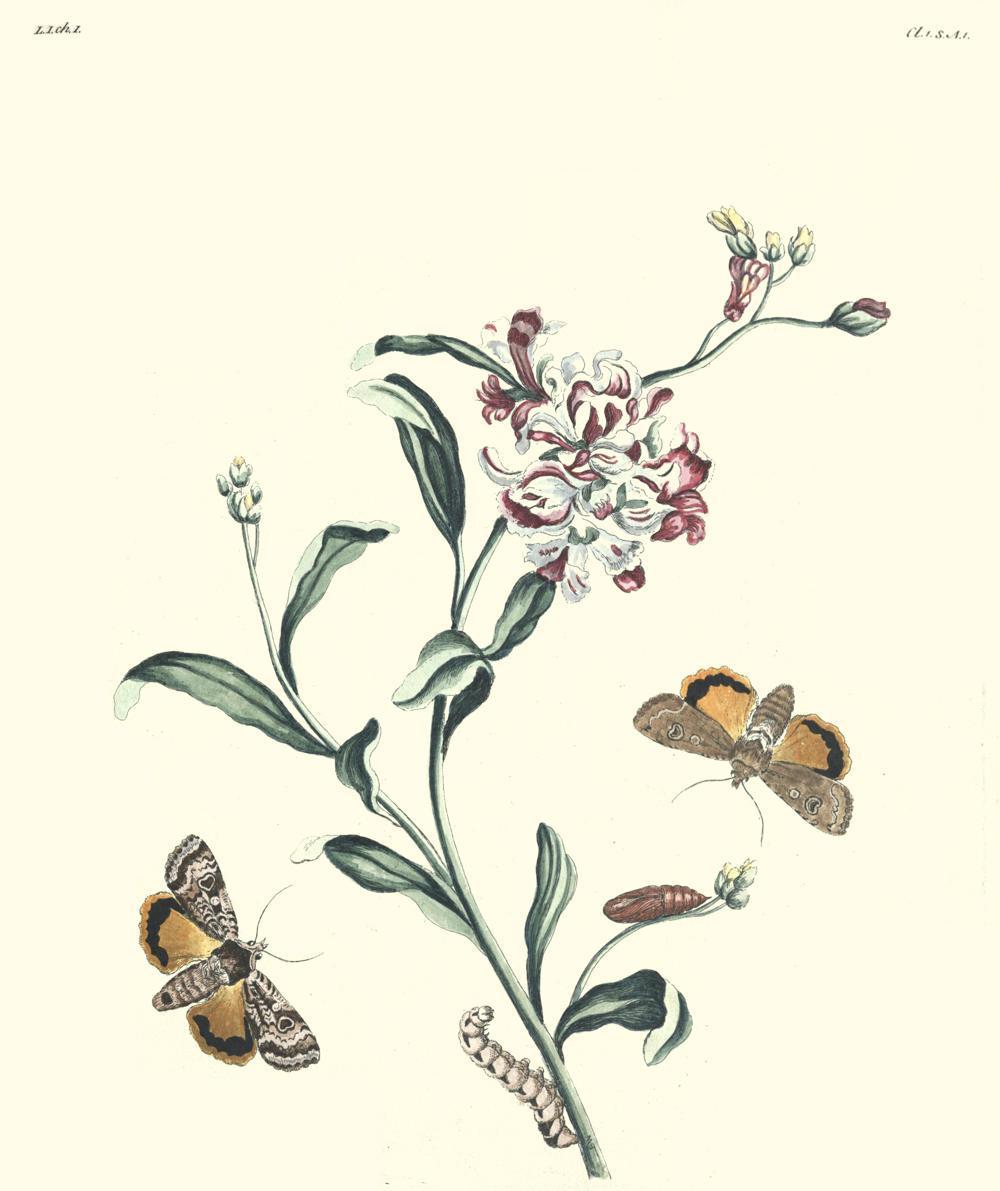
THE GREAT YELLOW-UNDERWING MOTH.
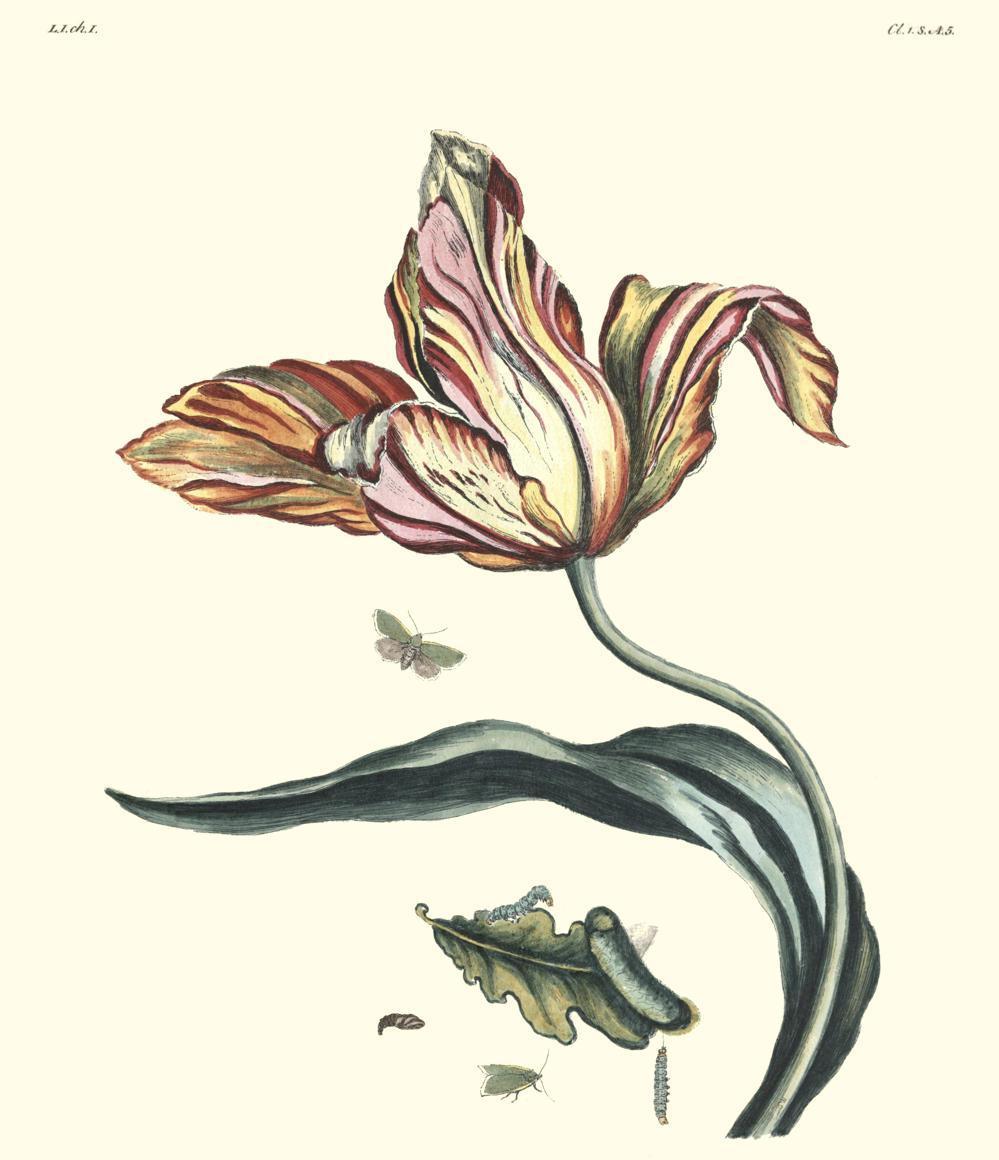
The CATERPILLAR of this MOTH lives through the Winter, and comes to its full Growth in May: It is found in Gardens, and other Places, and usually feeds in the Night, as many other of the NAKED CATERPILLARS do. Indeed, were they to do otherwise, they would soon be devoured by the Birds, which are much fonder of these SMOOTH CATERPILLARS than of the HAIRY ones. In the Day, they hide themselves within the Earth, and in other secret Recesses. They feed on the Leaves of the StockJuly and other Flowers, as also on Grass, &c. They put on the ChrysalisForm, within the Earth, in May, and the Mothsare bred in June. Great Plenty of this Moth, and other Species of the YELLOWUNDERWING, were taken feeding on the Honey Dew, on the Limes and other Trees, in the Gardens of JohnPhilips, Esq; at Laytonin Essex; they were discovered, by the Help of a Candle and Lanthorn, from Twelve o’Clock at Night till Two in the Morning; and were so fearless, that they would suffer one to take them with the Hand. At the same Time the ANGLE-SHADE and several other Mothswere taken.
See Listeron Godartius,P . 52.N.41.Albin,P . 72.Reaumur, Pl. 14. Pag. 342. vol. 1.
The Double Stock July-Flower.
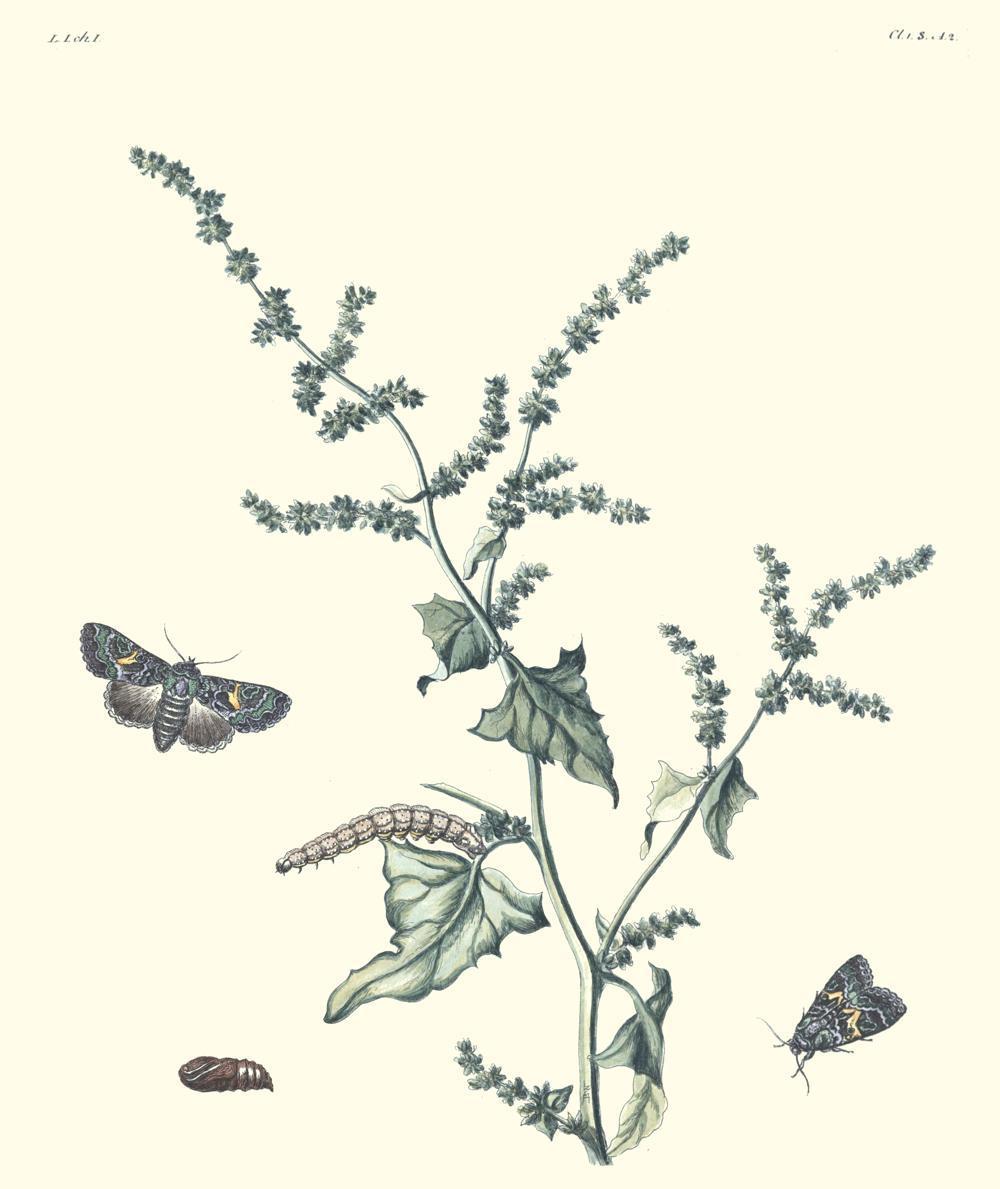
THE WILD ARRACH MOTH, Mr. Rosel says, The Caterpillar feeds on the WILD ARRACH; that it changes to a Chrysalis, within the
L. I. ch. I.
Cl. 1. S. A. 1.
Leucoiumincanum,majus,variegatum,florepleno. C. B. Pin. 201.
L. 1. CH. 1.
CL. 1. S. A.2.
Earth, in September, and that the Moth appears at the End of May following. I once took some of these Caterpillars feeding on the Arrach in September, but had not the good Fortune to breed any Flies from them. See Rosel, Cl. 2. Tab. 32.
L. I. ch. I.
Cl. 1. S. A. 2.
The Wild Arrach in Flower. Atriplexfoliodeltoide.Petiv. Herb.
III.
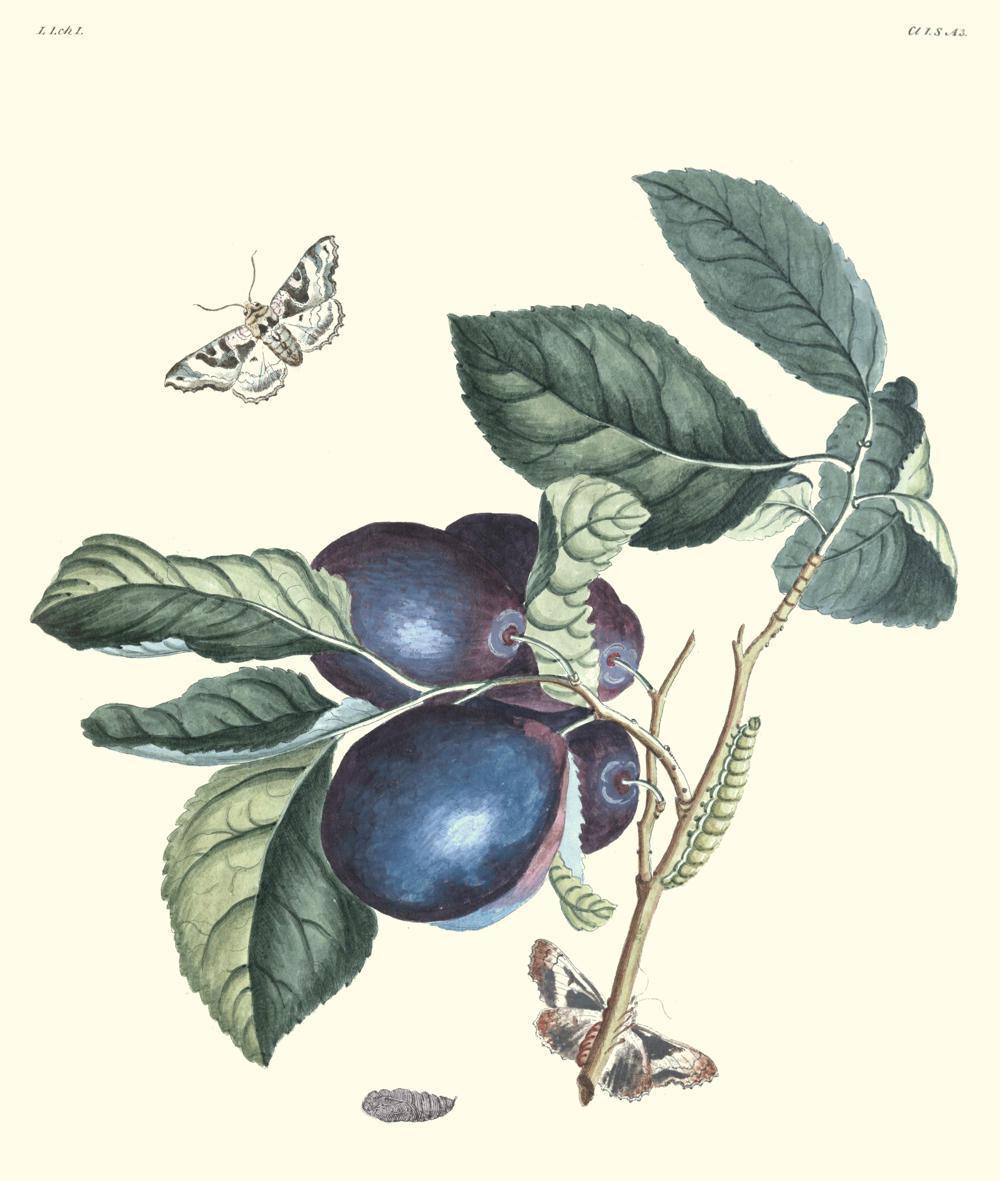
THE ANGLE-SHADES, a Moth. It is advisable to look for the Caterpillar of this Fly on Nettles, altho’ some feed on Fruit Trees, Bramble Bushes, &c. It goes into the Chrysalis State at the End of June, in a Web mixed with Earth, which it forms upon the Ground; and thus it remains till the Beginning of September, when the Moth is produced. There is an early Breed of this Moth in May, but, as I have not had the Caterpillar in the Spring, I cannot relate its Progression. The Fly may be taken in the Evenings, in Gardens, feeding on the Flowers; but I have not met with them very frequent.
See Godartius, Part 1. Tab. 56. Lister on Godartius P. 54. N. 44. Albin, Pl. 13. Reaumur, Pl. 8. P. 258. Pl. 14. P. 342. Vol. 1.
The Great Mogul Plum.
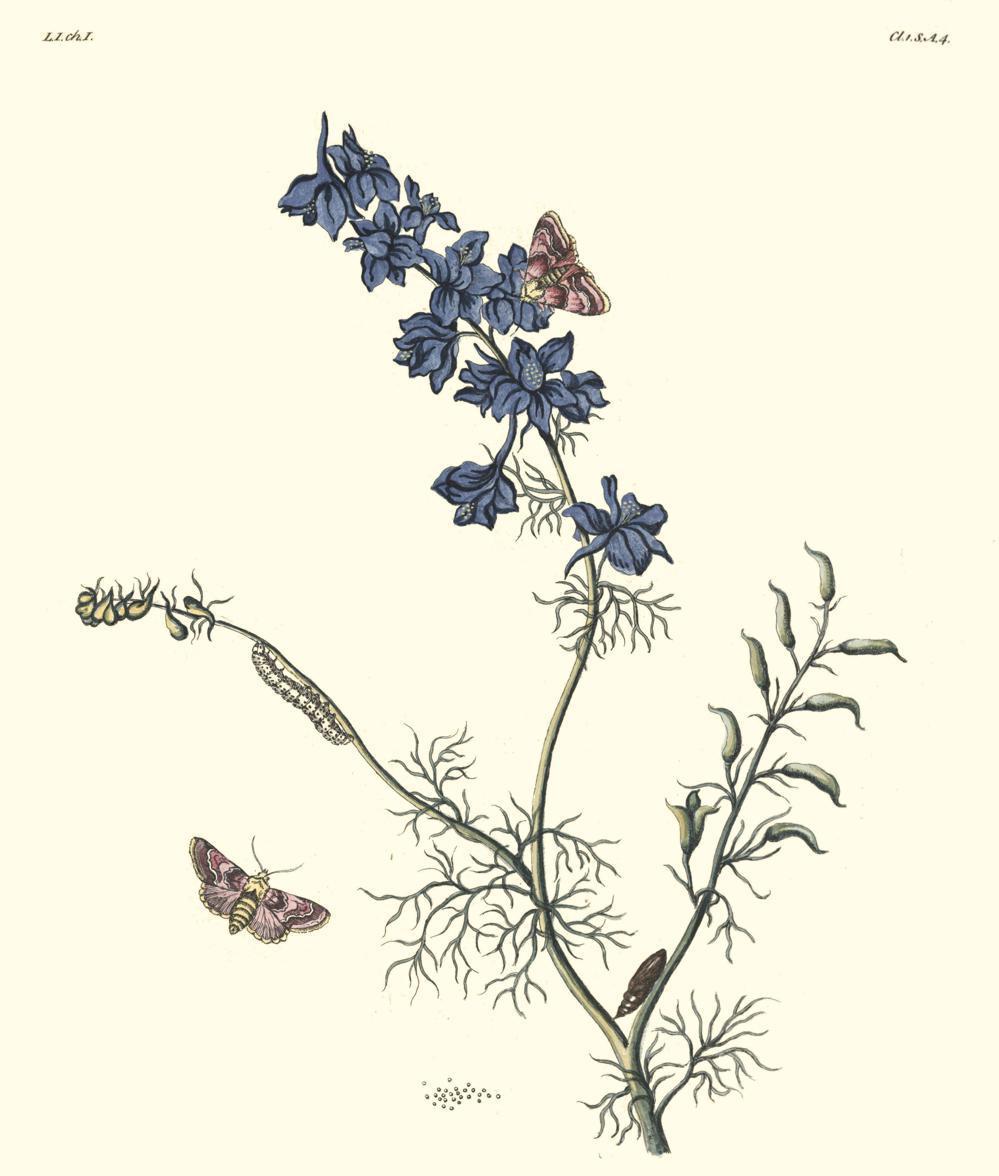
THE PEASE-BLOSSOM, a Moth. Its Caterpillars are reported by Merian, and Rosel, to feed upon the wild Lark-Spur that grows
L. I. ch. I.
Cl. 1. S. A. 3.
Prunusfructumagnoovatorubente.Tourn.
L. 1. CH. 1. IV.
CL. 1. S. A.4.
amongst Corn. They are full fed at the Beginning of August, when they change to the Chrysalis, but appear not in the Moth State till the June following. This Fly has been bred in England by the Honourable Mrs. Walters, and by Nathaniel Oldham, Esq; but, at present, is very rare.
See Merian, Vol. 1. Ch. 40. Rosel, Cl. 2. Tab. 12.
L. I. ch. I.
Cl. 1. S. A. 4.
The Lark-Spur.
Delphinium,hortense,floremajore&multiplicicœruleo. Tourn.