OXFORD STUDIES IN LATE ANTIQUITY
Series Editor
Ralph Mathisen
Late Antiquity has unified what in the past were disparate disciplinary, chronological, and geographical areas of study. Welcoming a wide array of methodological approaches, this book series provides a venue for the finest new scholarship on the period, ranging from the later Roman Empire to the Byzantine, Sasanid, early Islamic, and early Carolingian worlds.
Disciplining Christians
Correction and Community in Augustine’s Letters
Jennifer V. Ebbeler
History and Identity in the Late Antique Near East
Edited by Philip Wood
Explaining the Cosmos
Creation and Cultural Interaction in Late-Antique Gaza
Michael W. Champion
Universal Salvation in Late Antiquity
Porphyry of Tyre and the Pagan-Christian Debate in Late Antiquity
Michael Bland Simmons
The Poetics of Late Antique Literature
Edited by Jas Elsner and Jesus Hernandez-Lobato
Rome’s Holy Mountain
The Capitoline Hill in Late Antiquity
Jason Moralee
The Qur'an and Late Antiquity
A Shared Heritage
Angelika Neuwirth
Columbanus and the Peoples of Post-Roman Europe
Edited by Alexander O’Hara
Jonas of Bobbio and the Legacy of Columbanus
Sanctity and Community in the Seventh Century
Alexander O’Hara
Sacred Stimulus
Jerusalem in the Visual Christianization of Rome
Galit Noga-Banai
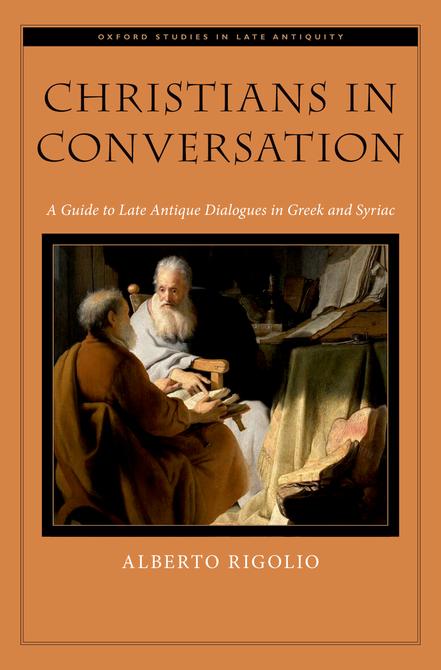
Christians in Conversation
A Guide to Late Antique Dialogues in Greek and Syriac
Alberto Rigolio
Christians in Conversation
A Guide to Late Antique Dialogues in Greek and Syriac
Alberto Rigolio
Oxford University Press is a department of the University of Oxford. It furthers the University’s objective of excellence in research, scholarship, and education by publishing worldwide. Oxford is a registered trade mark of Oxford University Press in the UK and certain other countries.
Published in the United States of America by Oxford University Press 198 Madison Avenue, New York, NY 10016, United States of America.
© Oxford University Press 2019
All rights reserved. No part of this publication may be reproduced, stored in a retrieval system, or transmitted, in any form or by any means, without the prior permission in writing of Oxford University Press, or as expressly permitted by law, by license, or under terms agreed with the appropriate reproduction rights organization. Inquiries concerning reproduction outside the scope of the above should be sent to the Rights Department, Oxford University Press, at the address above.
You must not circulate this work in any other form and you must impose this same condition on any acquirer.
CIP data is on file at the Library of Congress ISBN 978–0–19–091545–2 1 3 5 7 9 8 6 4 2
Printed by Sheridan Books, Inc., United States of America
Contents
Acknowledgments ix
List of Abbreviations xi
Introduction 1
Structure of the Work 2
Dialogue and Christianity 8
Dialogues and Late Antiquity 12
The Dialogue Form and Rhetorical Training 16
The Dialogue Form and Erotapokriseis 22
Toward a Comprehensive Approach? 24
A Formal Typology 32
Conclusion 37
Guide to the Dialogues 39
1. ?Aristo of Pella, Disputatio Iasonis et Papisci 39
2. Justin Martyr, Dialogue with Trypho 43
3. Gaius Romanus, Dialogue against Proclus 48
4. ?Hippolytus, Chapters against Gaius 49
5. Philip Bardaisanite, The Book of the Laws of the Countries and Bardaisan’s Lost Dialogues 51
6. Anonymous, Erostrophus 57
7. Origen, Dialogue with Heraclides and Lost Dialogues 60
8. Gregory the Wonderworker, To Theopompus, on the Impassibility and Passibility of God 65
9. Gregory the Wonderworker, Dialogue with Gelian 68
10. Anonymous, Anti-Jewish Dialogue 69
11. Methodius, On Free Will 70
12. Methodius, On Leprosy 74
13. Methodius, Symposium 77
14. Methodius, Aglaophon or On the Resurrection 82
15. Methodius, Xeno or On Things Created 86
16. ?Hegemonius, Acta Archelai 88
17. Anonymous, Dialogue with Adamantius 92
18. Diodorus of Tarsus, Two Dialogues 96
19. Gregory of Nyssa, Dialogue on the Soul and the Resurrection 98
20. Gregory of Nyssa, Against Fate 102
21. Macarius Magnes, Apocriticus 105
22. Apollinarius of Laodicea, Dialogi and Quod Deus in carne Christus 110
23. Didymus the Blind, Disputation with a Heretic 114
24. Ps.-Athanasius, Disputatio contra Arium 115
25. Anonymous, Two Macedonian Dialogues 118
26. John Chrysostom, On the Priesthood 120
27. Anonymous, Dialexis Montanistae et Orthodoxi 125
28. Ps.-Athanasius, Five Dialogues on the Trinity 127
29. Ps.-Athanasius, Dialogus Athanasii et Zacchaei 131
30. Ps.-Athanasius, Two Dialogues against the Macedonians 134
31. Palladius, Dialogue on the Life of John Chrysostom 137
32. Cyril of Alexandria, On Adoration and Worship in Spirit and Truth 141
33. Cyril of Alexandria, Seven Dialogues on the Trinity 144
34. Cyril of Alexandria, On the Incarnation of the Only-Begotten 146
35. Cyril of Alexandria, On the Unity of Christ 148
36. Ps.-Cyril of Alexandria, Dialogue with Nestorius 150
37. Theodotus of Ancyra, Contra Nestorium 151
38. Nestorius, Adversus Theopaschitas 153
39. Nestorius, Dialogue in the Bazaar of Heracleides 154
40. Mark the Monk, Disputatio cum Causidico 158
41. John of Apamea, Six Dialogues with Thomas 160
42. John of Apamea, Four Dialogues with Eusebius and Eutropius 162
43. John of Apamea, Dialogue on the Mystery of Baptism 165
44. Theodoret of Cyrrhus, Eranistes 167
45. Anonymous, Actus Silvestri 172
46. Aeneas of Gaza, Theophrastus 177
47. Zacharias of Mytilene, Ammonius 180
48. Zacharias of Mytilene, Life of Severus 186
49. Anonymous or Menas, On Political Science 188
50. Leontius of Byzantium, Dialogus contra Aphthartodocetas 192
51. Leontius of Byzantium, Solutions to the Arguments Proposed by Severus 195
52. Basil of Cilicia, Against John of Scythopolis 197
53. Paul the Persian, Disputatio cum Manichaeo 199
54. John bar Aphthonia, Conversation with the Syrian Orthodox under Justinian 203
55. John the Grammarian of Caesarea, Disputatio cum Manichaeo 206
56. Anonymous, Dialogus cum Iudaeis 209
57. Anonymous, Dialogue of Timothy and Aquila 212
58. Paul of Nisibis, Conversation with Caesar 219
59. Anonymous, Religious Conversation at the Sasanian Court 222
60. Anastasius of Antioch, Dialogue between an Orthodox and a Tritheite 229
General Bibliography 233
Index of Dialogues, Erotapokriseis, and Related Texts 265
General Index 269
Acknowledgments
The work for the present book originates from my involvement in the Leverhulme Research Project The Dialogue Form in Early Christianity and Byzantium during the academic years 2011–13. The project, based at the University of Oxford and under the leadership of Averil Cameron, gave me the opportunity to begin a systematic inquiry into Christian dialogues composed from their origins in the second century until the end of the sixth century CE. My surprise at the richness of this strand of literature and the important questions that it raises for the cultural history of late antiquity only intensified as I kept on reading more and more dialogues, a fact that made me realize the need of a tool that would help further research of this understudied material by providing a critical and comprehensive overview of this rich field in all of its complexity. As I progressed, I kept in mind the interests of different bodies of scholars working in history, literature, and religion, and, given the preliminary state of research on several texts, I opted for a comprehensive coverage of the field, at the same time suggesting what I see as potential avenues for future research.
The work reached the present shape over several years, with very many debts incurred along the way, especially at Oxford, where the 2014 workshop Dialogues and Debates from Late Antiquity to Late Byzantium at Keble College provided the venue for fruitful conversations, and at Princeton, where the Society of Fellows in the Liberal Arts offered the necessary respite to draft the manuscript, as well as the access to a wide range of bibliographical resources and an exceptionally supportive academic community. The very warm welcome by my new colleagues at Durham University accompanied me as I followed the last stages in the preparation of the manuscript. Several scholars and friends kindly answered my questions, shared their ongoing work and forthcoming publications, and provided helpful feedback and criticism, while all remaining shortcomings and omissions are my responsibility. They include Patrick Andrist, Marina Bazzani, Adam Becker, Emmanuel Bourbouhakis, Peter Brown, Pauline Bringel, Tony Burke, Beatrice Daskas, Anna
x Acknowledgments
Dolganov, Mark Edwards, Scott Johnson, Christopher Jones, Anna Jouravel, Chloë Kitzinger, Charlie Kuper, Dawn LaValle, Yannis Papadogiannakis, Antonio Rigo, Jeremy Schott, Agostino Soldati, Yumi Suzuki, Sébastien Morlet, Alberto Quiroga Puertas, Susan Stewart, Peter Van Nuffelen, Matthijs Wibier, and the anonymous reviewers for Oxford University Press. It was a great pleasure to work with Stefan Vranka, Emily Zogbi, and the capable staff at the Press; and thanks also go to James Disley, Rajesh Kathamuthu, and Leslie Safford for their painstaking editorial work, and to Pam Scholefield for the compilation of the general index. My greatest debt is to Averil Cameron, without whom this project would have never seen the light; she believed in it from its inception and offered help and inspiration with a degree of dedication that has been truly extraordinary. The book is dedicated to you, Luigina, Alessandro, Claudio, Filippo, and Alice, for your encouragement, support, and inspiration over the years; your passion and enthusiasm have taught me more than words can express.
Abbreviations
ACO Schwartz, E., ed. Acta Conciliorum Oecumenicorum. Berlin 1914–40.
BHG Socii Bollandiani, eds. Bibliotheca Hagiographica Graeca 3 vols. Brussels 1957.
BHL Socii Bollandiani, eds. Bibliotheca Hagiographica Latina Antiquae et Mediae Aetatis. 2 vols. Brussels 1949.
BHO Socii Bollandiani, eds. Bibliotheca Hagiographica Orientalis Brussels 1910.
CPG Geraard, M. ed. Clavis Patrum Graecorum. 6 vols. Turnhout 1974–98.
CPL Dekkers, E., and Gaar, E., eds. Clavis Patrum Latinorum Turnhout 1995.
CSCO Corpus Christianorum Scriptorum Orientalium. Di Berardino Di Berardino, A. Patrology: The Eastern Fathers from the Council of Chalcedon (451) to John of Damascus (750). English translation by A. Walford. Cambridge 2006.
DSp Viller, M., Cavallera, F., and De Guibert, J., eds. Dictionnaire de spiritualité ascétique et mystique, doctrine et histoire. 17 vols. Paris 1937–95.
GAL Bardenhewer, O. Geschichte der altkirchlichen Literatur. 5 vols. Freiburg 1913–32.
Lampe Lampe, G.W.H. A Patristic Greek Lexicon. Oxford 1961.
Moreschini Moreschini, C., and Norelli, E. Early Christian Greek and Latin Literature: A Literary History. Translated by M.J. O’Connell. Peabody, MA 2005.
OBD Kazhdan, A.P., ed. The Oxford Dictionary of Byzantium. 3 vols. Oxford 1991.
xii Abbreviations
PLRE Jones, A.H.M., Martindale, J.R., and Morris, J. et al., eds. The Prosopography of the Later Roman Empire. 3 vols. Cambridge 1971–92.
P.Oxy. The Oxyrhynchus Papyri. Quasten Quasten, J., and di Berardino, A. Patrology. 4 vols. Utrecht 1953–86.
RAC
Klauser, T., Dassmann, E., and Schöllgen, G., eds. Reallexikon für Antike und Christentum. Stuttgart 1950–SC Sources Chrétiennes.
Schreckenberg Schreckenberg, H. Die christlichen Adversus-Judaeos-Texte und ihr literarisches und historisches Umfeld (1.–11. Jh.). Frankfurt 1999.
Introduction
Instances of dialogue are common in early Christian literature. We have dialogues embedded within different literary genres, such as hagiography, historiography, or fictional narratives;1 dialogue poems (and dispute poems), especially common in Syriac literature;2 and texts written in the form of questions and answers, also known as erotapokriseis. 3 Yet we also have a conspicuous corpus of self-standing texts written in prose that claim to report, or to simulate, real-life conversations between two or more speakers, primarily about religious, philosophical, or biographical subjects, and often placed within an elaborate historical or fictitious setting. Christian dialogues address themes such as the nature of the soul, the resurrection of the body, and the function of fate in relation to free will, as well as various Christological and exegetical subjects. The role of these texts in the study of the culture of late antiquity, particularly on issues such as religious debate, rhetorical culture, and literate education more broadly, is only gradually being recognized. The most commonly known Christian dialogues include Justin Martyr’s Dialogue with Trypho, Methodius’ Symposium, and Gregory of Nyssa’s Dialogue on the Soul and the Resurrection, while many more remain still unfamiliar to the most.
1. Remarkable examples of dialogues embedded in other literary works are found in Ps.-Clementine literature, in the Acts of Philip, and in the Syriac History of Mar Qardagh, for which see Walker 2006. Instances of dialogue are common in martyr acts, in which the most dramatic parts often take the form of dialogue; some of the simpler martyr acts may even be mostly made up by exchanges among speakers, such as the Latin Martyrdom of Justin. Dialogues can also be used as introduction to other works, as in Theophylact Simocatta’s History: see Ieraci Bio 2006:32–35 and Whitby and Whitby 1986:3–5.
2. For Syriac dispute poems, which some distinguish from dialogue poems, see the fundamental work of Brock 1991 (with recent discussion in Mengozzi 2015), who provides an overview of their form and contents, and traces the links with Ancient Mesopotamian literature and Biblical themes. For these texts, see also Krueger 2003, Frank 2005, Harvey 2005, Mengozzi and Ricossa 2013, Brock 2016, and Butts 2017; while Ruani 2016 is now fundamental for the literature of controversy in Syriac. For a discussion of the links between dialogue poems and prose dialogues, see Brock 1983 and 2016, Cameron 1991a, and Frenkel 2016.
3. More on the links between erotapokriseis and prose dialogues follows below. Notable examples of erotapokriseis include Eusebius of Caesarea’s Gospel Questions and Solutions (Zamagni 2008 and 2016) and Ps.-Caesarius’ Quaestiones et responsiones (mid-sixth century; Papadogiannakis 2008, 2011, and 2013a). For the most recent work see Bussières 2004 and 2013, Efthymiadis 2017, Papadogiannakis 2006 and 2013a, Zamagni 2004, and, especially helpful for Syriac, Ter Haar Romeny 2004.
Occasionally Christian dialogues reveal familiarity with Plato’s dialogues or with the Socratic tradition more broadly, as instantiated in Methodius of Olympus, Gregory of Nyssa, or Aeneas of Gaza.4 The endurance of the Platonic tradition is, however, by no means a characteristic feature of all Christian dialogues and was far from being the norm. For instance, Basil of Caesarea made explicit reference to the tradition of Platonic and Aristotelian dialogues in an attempt to interpret the dialogue form employed by Christian authors, and put forward Plato’s Laws as a suitable model for Christian writers; conversely, another Christian author, Theodoret of Cyrrhus, declared his intention to depart from the learned dialogue form used by classical Greek authors. Both Basil and Theodoret, however, appear as isolated examples, and explicit references to classical dialogues are somewhat rare in this body of literature.5
Regrettably, most dialogues composed in the late antique period are still little studied, and often in isolation from one another.6 Several of them have been the subject of excellent scholarship only in the last two decades, but there is no systematic overview of these texts, and we still lack a comprehensive study of the dialogue form throughout the period. Dialogues featuring a Christian and a Jew as the main speakers have attracted most scholarly attention, particularly in relation to other instances of adversus Iudaeos literature, but they nonetheless await to be related to the broader developments of the dialogue form among Christians. Similarly, Syriac literature offers some of the earliest instances of Christian dialogues and shows the pervasiveness of the dialogue form in late antiquity beyond the language boundary; yet these texts need to be put in relation to the contemporary developments in Greek and in Latin. To the eyes of the cultural historian, Christian dialogues reveal their authors’ awareness of a wide spectrum of religious opinions, they vividly evoke the religious debates of the time, they embody the cultural conventions and refinements that late antique men and women expected from such events, and they propagated the fundamental view that religious differences could be solved in the context of a public debate. Not only does the extraordinary flourishing of the dialogue form attest to the transformations of ancient literary and rhetorical traditions, but it also helps us understand the functioning and the complexities of a lively society that thrived on religious debate.
Structure of the Work
The present study is structured as a comprehensive guide to Christian dialogues composed in Greek and in Syriac from the earliest examples in the second
4. A full discussion can be found in each relevant entry.
5. See entries 18 and 44.
6. The classic work, now outdated, is Hirzel 1895. Books that partially cover the field are Hoffmann 1966, Voss 1970, and, more recently, Hösle 2012 (a translation of Hösle 2006). See now Cameron and Gaul 2014, and for the discussion of other recent scholarship see the below.
century until c. 600 CE, arranged in chronological order so as to emphasize changes and transformations over time. The chronological and linguistic coverage, which excludes Latin and closes with the end of the sixth century, has been limited in scope for editorial purposes, but these boundaries are not meant to overemphasize conventional divides. The guide opens with the Disputatio Iasonis et Papisci, written in the mid-second century CE, and closes with Anastasius of Antioch, who wrote his Dialogue between an Orthodox and a Tritheite in the late sixth century. The developments of dialogue literature from the turn of the seventh century onward, such as the further technicization and formalization of the argumentation (as attested in Eulogius of Alexandria), and, most noticeably, the appearance of Christian-Muslim dialogues, were taken as the working limit to circumscribe the present analysis.7 It is hoped that the present volume will help study the prehistory of Christian dialogues as well as, the developments of religious debate from the seventh century onward.
The focus of the volume is on Greek and Syriac, but composition of literature in dialogue form was not a phenomenon limited to these languages and was almost as common in Latin literature, where it was represented by Minucius Felix, Jerome, Augustine, Sulpicius Severus, and Boethius, among other authors. While Latin dialogues have been the subject of some initial overviews, Greek and Syriac dialogues have attracted increasing academic attention in the last decade and still remain in greater need of systematic work.8 The present guide thus focuses on dialogues composed in Greek and in Syriac, including those surviving only in Latin, Syriac, Armenian, or Old Slavonic translations. Dialogues written in Syriac shed light on the earliest stages of dialogue writing by Christian authors and can therefore contribute to our understanding of the developments of Greek dialogues as well. Among the earliest instances of Christian dialogues on doctrinal matters are the Syriac dialogues against Marcion by Bardaisan of Edessa (now lost), and the Syriac dialogue The Book of the Laws of the Countries by a pupil of Bardaisan, which opens by addressing a Marcionite objection to mainstream Christianity.9 (Unfortunately very little survives by the Syrian Simeon of Beth Arsham [d. before 548], who made a name for himself as a debater and may have written texts
7. For Eulogius of Alexandria, see Roosen 2015. Major questions concerning the composition of dialogues after the sixth century touch upon the developments of the Byzantine dialogue (the dialogues by Theophylact Simocatta and Germanus I of Constantinople are not treated in the present work) and the issue of the relationship between late antique dialogues and Islamic kalām, for which see Cook 1980 and Daiber 2012. For later dialogues, see Cameron 1996, Cameron and Hoyland 2011, Cameron 2016a, and Cameron and Gaul 2017. For the Syriac, see Tannous 2008 and Roggema 2016. For the dialogue form in the early Islamic period, see Bertaina 2011.
8. A comprehensive overview of the Latin dialogues can be found in Schmidt 1977, who lists forty-three Latin dialogues composed before the beginning of the seventh century (sixteen of them authored by Augustine, with several others misattributed to him); see also Cooper and Dal Santo 2008, Whelan 2017, and Kuper 2017. For Latin dialogues from the thirteenth and fourteenth centuries, see Cardelle de Hartmann 2007. For the surge of interest in Greek dialogues during the last decade, see, for instance, the publications by Andrist, Cameron, LaValle, and Morlet, as well as Bracht 2017, Dubel and Gotteland 2015, Föllinger and Müller 2013, and Goldhill 2008a.
9. See entry 5.
in dialogue form; nor do we have, despite the flourishing of religious debate in the Sasanian empire during the sixth century, any Eastern Syriac dialogue composed before the turn of the seventh century).10 Overall, Syriac offers an extremely rich, and little explored, corpus of controversial and apologetic literature in various forms that needs to be related to its Greek and Latin counterparts and to be effectively integrated into the cultural history of the late antique world.11
Because of the preliminary state of research on this strand of literature, I have addressed the dialogues in systematic fashion and structured each entry into standardized headings (author, full title, original language, date of composition, modern editions, modern translations, summary, discussion of scholarship, and a selected bibliography for further study). Dialogues that survive only in part or in abridged form, but that still provide enough information about the original text, have been treated as autonomous entries—these include Aristo of Pella’s Disputatio Iasonis et Papisci and Gaius Romanus’ Dialogue against Proclus Conversely, lost dialogues by known authors are mentioned within the full entries of other surviving dialogues by the same author, as in the case of Origen; in order to help navigate the material, an index of dialogues and related literature, arranged alphabetically by author, is found in the end of the book. In a few instances, given the complexity of the textual tradition or the fragmentary state of particular dialogues, I have followed past scholarship by incorporating different texts into one entry, as in the cases of Apollinarius of Laodicea’s lost dialogues, the anonymous Two Macedonian Dialogues, and Ps.-Athanasius’ Five Dialogues on the Trinity. I have made an effort to make the list as comprehensive as possible; but in light of the pervasiveness of dialogue writing in the period in question, the possibility that additional dialogues will be found cannot be excluded.12
A few texts that display important similarities with our dialogues have not been included for reasons of form, in that they cannot be considered dialogues, or chronology, in that they are later than the end of the sixth century. Even though the author reported some of the exchanges among the speakers, Theodore of Mopsuestia’s Disputatio cum Macedonianis (CPG 3857; surviving only in Syriac
10. For Simeon, see the entry in Brock et al. 2011, and Walker 2006:175–77; for Babai the Great, see Brock 2011:215–17; and for the debating culture in the Sasanian empire, see Walker 2006. In his Catalogue of Ecclesiastical Writers (ed. Assemani 1728), ῾Abdīšō῾ Bar Brīkā of Nisibis made reference to some of the texts written (presumably in dialogue form) by East Syriac authors from the fifth century onward and against religious opponents such as Jews, Manichaeans, Zoroastrian, and other Christian groups. Although it remains uncertain whether all these were structured as prose dialogues, the titles include Mari the Persian (fl. mid-fifth century), Against the Magi in Nisibis; Īšō῾yahb I of Arzon (d. 595), Disputation against a Heretic Bishop; and Nathaniel of Širzor (d. 618), Disputations against the Severians, Manichaeans, Cantāye, and Māndrāye. See Walker 2006:169–70, and Griffith 1981:170 for the use of the dialogue form within religious controversy according to the witness of the East Syrian bishop Bar Bahlūl (tenth century).
11. Ruani 2016.
12. For instance, further analysis is needed of the Syriac manuscripts BL Add. 7199 (= Rosen and Forshall 1838:lviii.4 and 6, with Wright 1870:appendix A), which contains a Dialogue on Calamities Sent by God and a Dialogue on the Resurrection, and BL Add. 14533 (= Wright 1870:dccclix.55), which contains a Dialogue on Heresies, but see Ter Haar Romeny 2004:160–63.
translation) is structured as the narrative account of a debate rather than as a dialogue proper.13 A letter by Isidore of Pelusium (c. 360–c. 440) also takes the form of an imaginary dialogue of Isidore with himself as to whether reproach makes people better or makes them more obstinate in wrongdoing.14 A letter by Severus of Antioch (d. 538) records excerpts from a conversation that he had with John of Claudiopolis on Chalcedonian Christology.15 The religious debate between a Christian and a Zoroastrian in the History of Mar Qardagh, an earlyseventh-century Syriac hagiographical narrative, is an instance of embedded dialogue (rather than a self-standing dialogue) that contains important traces of a long-standing tradition of debate on religious matters in sixth-century Persia.16 Last but not least, it remains unclear whether or not Manichaean literature made use of the dialogue form as such, since very little of it has survived;17 Faustus of Mileve’s Capitula (CPL 726), a Manichaean handbook for actual debates, is usually understood as an instance of question-and-answer literature, or, as it came to be known, erotapokriseis. 18
Twenty-first-century work on textual transmission, chronology, and authorship has been instrumental in putting together a comprehensive list of dialogues. In addition to showing the fluidity of several texts (especially anonymous ones) and the reuse of existing literature in the composition of new dialogues,19 it is
13. The text is edited and translated into French in Nau 1913:633–67; see Voss 1970:17n20; the question should be asked, however, about the possible intervention of the translator.
14. Isidore of Pelusium, Ep. 3.397 (PG 78.1036; CPG 5557); Isidore argues that it is best to mix moderation and reproach. I owe this reference to Christopher Jones.
15. Severus of Antioch, Ep. 6.1 (ed. Brooks 1902:1.1.3–12; English trans. Brooks 1902:2.1.3–11; CPG 7070).
16. Walker 2006, which contains an English translation; Payne 2016.
17. The Cologne Mani Codex (ed. and trans. Cameron and Dewey 1979, 80.6–93.23) contains extracts of dialogic exchanges between Mani and senior Elcesaites, including passages from a “synod of presbyters” that had been set up against him (89.6–7); see Lim 1995:70–108. Payne 2016:219 links Mani’s Šābuhragān, the account of Manichaean religion and cosmology that Mani dedicated to Shapur I, with the practice of disputation on religious matters within the Sasanian court. However, even though the cosmological account in the Šābuhragān includes some dialogic exchanges among Xradešahr (standing for Christ), the “sinners,” and the “religious ones,” the text itself does not take the dialogue form and has not been included here (for the surviving text, originally written in middle Persian, see the edition and English translation in MacKenzie 1979 and 1980; see also the Encyclopaedia Iranica, s.v.).
18. Van Gaans 2013 for an overview; BeDuhn 2009; ed. Monceaux 1924.
19. Notable examples of textual reuse are the anonymous Dialogue with Adamantius, which makes use of Methodius’ On Free Will and Aglaophon or On the Resurrection, the Ps.-Athanasian Two Dialogues against the Macedonians, which reuse one of the authentically Macedonian Two Macedonian Dialogues, and the inclusion of material perhaps derived from Aristo of Pella’s Disputatio Iasonis et Papisci in the composition of Ps.-Athanasius’ Dialogus Athanasii et Zacchaei, the Dialogue of Timothy and Aquila, and the Latin Dialogue of Simon and Theophilus (attributed to Evagrius; the text and English translation can be found in Varner 2004). Important overlaps in format and language have also been found between the Dialogus Athanasii et Zacchaei and a number of Ps.-Athanasian dialogues, but in these cases the degree of similarity is not enough to prove direct textual dependence beyond their originating in similar cultural milieux (Andrist 2005:106–21; the Ps.-Athanasian dialogues that shows overlaps with the Dialogus Athanasii et Zacchaei are the Disputatio contra Arium, the Five Dialogues on the Trinity, and the Two Dialogues against the Macedonians, to which can be added the anonymous Dialexis Montanistae et Orthodoxi). Other dialogues appear to make use of literature that was not originally written in dialogue form, such as Hegemonius’ Acta Archelai (which makes use of authentic Manichaean literature) and Macarius Magnes’ Apocriticus (which possibly depends on Porphyry’s Against Christians). Others, such as Gregory of Nyssa’s Dialogue on the Soul and the Resurrection and Against Fate, and the anonymous Dialogue of Timothy and Aquila, suggest a link with other literary genres such as hagiography, epistolography, or catechetical literature, as is discussed in each entry.
now possible to rely on a firmer chronology for several texts than might have been only few years ago, as is discussed in the relevant entries, while it has also become clear that some dialogues of uncertain chronology are now unlikely to fit the time frame of the present work. These are the anonymous Dialogica polymorpha antiiudaica (CPG 7796; previously known as Dialogus Papisci et Philonis Iudaeorum cum Monacho), whose most ancient nucleus dates to the second half of the seventh century and was expanded during the following decades, as shown by a remarkably fluid textual tradition;20 the fragmentary Dialogus de S. Trinitate inter Judaeum et Christianum by Jerome of Jerusalem (CPG 7815), for which Patrick Andrist suggests a chronology between the end of the seventh and the beginning of the eighth centuries;21 the Dialogue of the Monk and Recluse Moschos Concerning the Holy Icons (of dubious chronology but likely later than the sixth century);22 and Ps.-Gregentius’ Dialexis (CPG 7009), for which both the seventh century and the tenth century were suggested.23
The Greek and Syriac dialogues treated in the present work are thus the following ones (the question mark indicates dubious authorship):24
1. ?Aristo of Pella, Disputatio Iasonis et Papisci (CPG 1101)
2. Justin Martyr, Dialogue with Trypho (CPG 1071)
3. Gaius Romanus, Dialogue against Proclus (CPG 1330; fragments)
4. ?Hippolytus, Chapters against Gaius (CPG 1891; fragments)
5. Philip Bardaisanite, The Book of the Laws of the Countries (Syriac) and Bardaisan’s lost dialogues
6. Anon., Erostrophus (lost; survives in Syriac)
7. Origen, Dialogue with Heraclides (CPG 1481) and lost dialogues
8. Gregory the Wonderworker, To Theopompus, on the Impassibility and Passibility of God (CPG 1767)
9. Gregory the Wonderworker, Dialogue with Gelian (lost)
10. Anon., Anti-Jewish Dialogue in P.Oxy. 2070 (fragment)
11. Methodius, On Free Will (CPG 1811; incomplete; survives in Old Slavonic)
12. Methodius, On Leprosy (CPG 1815; fragmentary; survives in Old Slavonic)
13. Methodius, Symposium (CPG 1810)
14. Methodius, Aglaophon or On the Resurrection (CPG 1812; fragmentary; survives in Old Slavonic)
20. Andrist et al. 2013; Aulisa and Schiano 2005:310–26, which contains edition and Italian translation.
21. The surviving text can be found in PG 40:848–60 and 865 (the latter fragment is also edited in Kotter 1969:3: 194 III 125); see Andrist 2017 and Fields 2012.
22. Editio princeps and English translation in Alexakis 1998. While the editor opts for the second third of the fifth century (Alexakis 1998:210), a later chronology is suggested in Brubaker and Haldon 2011:143n269.
23. Cameron 2014:51–54 for a seventh-century chronology very possibly with later expansions; Berger 2006:100–9, which includes edition and English translation, for the tenth century.
24. Instead of proposing new titles, I refer to the dialogues as they are commonly referred to in modern scholarship, whether in Latin or in English. Similarly, for the names of the authors, I use the form that is more commonly found in contemporary scholarship, despite the inconsistencies, for instance “Diodorus of Tarsus,” but “Theodore of Mopsuestia.”
15. Methodius, Xeno or On Things Created (CPG 1817; fragmentary)
16. ?Hegemonius, Acta Archelai (CPG 3570; lost, survives in Latin)
17. Anon., Dialogue with Adamantius (CPG 1726)
18. Diodorus of Tarsus, Two Dialogues (lost)
19. Gregory of Nyssa, Dialogue on the Soul and the Resurrection (CPG 3149)
20. Gregory of Nyssa, Against Fate (CPG 3152)
21. Macarius Magnes, Apocriticus (CPG 6115)
22. Apollinarius of Laodicea, Dialogi and Quod Deus in carne Christus (CPG 3663 and 3664; fragments)
23. Didymus the Blind, Disputation with a Heretic (CPG 2565; fragment)
24. Ps.-Athanasius, Disputatio contra Arium (CPG 2250)
25. Anon., Two Macedonian Dialogues (fragments)
26. John Chrysostom, On the Priesthood (CPG 3416)
27. Anon., Dialexis Montanistae et Orthodoxi (CPG 2572)
28. Ps.-Athanasius, Five Dialogues on the Trinity (CPG 2284)
29. Ps.-Athanasius, Dialogus Athanasii et Zacchaei (CPG 2301)
30. Ps.-Athanasius, Two Dialogues against the Macedonians (CPG 2285)
31. Palladius, Dialogue on the Life of John Chrysostom (CPG 6037)
32. Cyril of Alexandria, On Adoration and Worship in Spirit and in Truth (CPG 5200)
33. Cyril of Alexandria, Seven Dialogues on the Trinity (CPG 5216)
34. Cyril of Alexandria, On the Incarnation of the Only-Begotten (CPG 5227)
35. Cyril of Alexandria, On the Unity of Christ (CPG 5228)
36. Ps.-Cyril of Alexandria, Dialogue with Nestorius (CPG 5438)
37. Theodotus of Ancyra, Contra Nestorium (CPG 6131)
38. Nestorius, Adversus Theopaschitas (CPG 5752; fragments)
39. Nestorius, Dialogue in the Bazaar of Heracleides (CPG 5751)
40. Mark the Monk, Disputatio cum Causidico (CPG 6097)
41. John of Apamea, Six Dialogues with Thomas (Syriac)
42. John of Apamea, Four Dialogues with Eusebius and Eutropius (Syriac)
43. John of Apamea, Dialogue on the Mystery of Baptism (Syriac)
44. Theodoret of Cyrrhus, Eranistes (CPG 6217)
45. Anon., Actus Silvestri (BHG 1628–34; BHL 7725–43; Latin; the origin of the legend is Syro-Palestinian)
46. Aeneas of Gaza, Theophrastus (CPG 7450)
47. Zacharias of Mytilene, Ammonius (CPG 6996)
48. Zacharias of Mytilene, Life of Severus (CPG 6999)
49. Anon. or Menas, On Political Science
50. Leontius of Byzantium, Dialogus contra Aphthartodocetas (CPG 6813)
51. Leontius of Byzantium, Solutions to the Arguments Proposed by Severus (CPG 6815)
52. Basil of Cilicia, Against John of Scythopolis (lost)
53. Paul the Persian, Disputatio cum Manichaeo (CPG 7010)
54. John bar Aphthonia, Conversation with the Syrian Orthodox under Justinian (CPG 7486; Syriac)
55. John the Grammarian of Caesarea, Disputatio cum Manichaeo (CPG 6862)
56. Anon., Dialogus cum Iudaeis (CPG 7803)
57. Anon., Dialogue of Timothy and Aquila (CPG 7794)
58. Paul of Nisibis, Conversation with Caesar (CPG 6897)
59. Anon., Religious Conversation at the Sasanian Court (CPG 6968)
60. Anastasius of Antioch, Dialogue between an Orthodox and a Tritheite (CPG 6958)
Dialogue and Christianity
The question presents itself whether, and, if so, in what ways, the extensive use of the dialogue form by Christian authors should inform our understanding of the historical transformations of debate on matters of religion and philosophy in late antique society. In particular, a central issue of discussion among scholars has been whether early Christians engaged in genuine dialogue on religious and philosophical issues, and how their practices differed from their non-Christian contemporaries and predecessors. Was there room for discussion and disagreement in matters of Christian faith? Did the search for Christian orthodoxy bring about the end of open dialogue on religious and philosophical matters? In what respects did debate in late antiquity differ from debate in classical antiquity? Whereas Socratic dialogues developed in conjunction with Athenian democracy, where dialogue was a crucial part of the political process, Christian dialogues were often written by Christian authors who became notorious for their censorious attitudes toward opposing views on matters of faith. Christian dialogues have been used to answer some of these questions.25
An influential view was that of Rudolf Hirzel, who in his 1895 classic work on ancient and modern dialogue argued that the rise of Christianity entailed the demise of the ancient dialogue as a literary form. Hirzel put forward an oppositional understanding of classical dialogues and Christian dialogues; he implied that the intellectual openness of dialogue in ancient Greece, as is reflected in the classical dialogue form, should provide the benchmark for measuring dialogue and debate in other societies. In this respect, early Christianity appeared to fall short of the openness of dialogue in classical Athens. Nonetheless, one problematic aspect of Hirzel’s account (as shown by Sandrine Dubel) was Hirzel’s debt to Diogenes Laertius in his understanding of classical dialogue (see especially D.L. 3.48), and, in particular, to Diogenes’ view of Plato as the author who brought the dialogue form to perfection. By centering on Plato, Hirzel’s work ended up downplaying the overall diversity of the dialogue form already in antiquity and tended
25. Lim 1995 and 1995a; an overview on the issue can be found in Van Nuffelen 2014.
to appraise dialogues exclusively in relation to Platonic models; conversely, the diversity of ancient dialogues is now being increasingly appreciated thanks to a renewed scholarly interest in their various forms in antiquity, and a case was made to understand ancient dialogue as a genre polymorphe. 26
To set up an opposition between Platonic and Christian dialogues appears more and more as an artificial exercise that does not reflect the fluidity of the dialogue form already in antiquity, an obstacle that hinders the possibility of writing a sophisticated historical profile of this form over the centuries. Yet, following Hirzel, subsequent scholarship often contrasted Christian dialogues with Platonic examples, while much less has been done to study the variety of both ancient and late ancient models that were available to Christian authors. More than half a century after Hirzel, in his 1966 study of Christian dialogues (which regrettably ended with the fourth century), Manfred Hoffmann attempted to trace the development of the dialogue form among Christian authors, but also argued that the genuine search for truth underpinning classical dialogue was replaced in Christian dialogues by the teaching of the revealed Christian message. In his view, Christian religious teaching was to be understood as the primary aim in the dialogue form used by Christian authors; Christian dialogues did not express an effort to establish the truth, but rather intended to indicate and teach the way to achieve salvation.27
Hoffmann also pointed out that several among the most influential Christian authors of dialogues were trained in rhetoric and philosophy and must have been familiar with classical dialogues, but the didactic and catechetic drive that characterized their written work ultimately overcame the genuinely dialogic element inherited from the classical tradition (these authors included Justin Martyr, Gregory the Wonderworker, Gregory of Nyssa, and Augustine). As will be discussed later, a didactic element is indeed a feature of several among late antique dialogues; yet their instructional drive does not preclude the possibility of understanding these texts within the religious and rhetorical culture of the period. In addition, since Christian dialogues display remarkable fluidity in both form and subject matters, Hoffmann proposed a classification of these texts that was to prove particularly influential, and described them as “apologetic” (e.g., Aristo of Pella and Justin Martyr), “dogmatic-polemic” (e.g., Gaius Romanus’ Dialogue against Proclus and Methodius’ Aglaophon or On the Resurrection), or “Christianphilosophic” (e.g., The Book of the Laws of the Countries and Gregory of Nyssa’s Dialogue on the Soul and the Resurrection), but without addressing the question of how dialogue became the form of choice for so many Christian authors.28
26. Hirzel 1895:2.380 with Lim 2008:151–52; Dubel 2015. Studies emphasizing the various forms that dialogue took in antiquity are found in Föllinger and Müller 2013, and Dubel and Gotteland 2015; for the dialogue as a genre polymorphe see Dubel 2015:12.
27. Hoffmann 1966.
28. Hoffmann 1966:160–62; Bardy 1957 divides Christian dialogues into apologetic, theological, biographic, and Biblical.
A contrastive approach with classical dialogues again underpinned the work of Bernd Reiner Voss, the author of the most comprehensive book on Christian dialogues published to date (1970), which similarly closes with the beginning of the fifth century. Voss follows Hoffman in arguing that the purpose of the Christian dialogue form can rarely be identified with an open-ended search for truth and thus regards Christian dialogues as inferior in quality to Platonic antecedents (despite some notable exceptions, such as Aeneas of Gaza’s Theophrastus).29 Underlying Voss’ reconstruction, however, is his belief in the substantial incompatibility of philosophy (which makes use of dialogue) and religion (which is ultimately irreconcilable with an authentically dialogic form)—another dichotomy whose strict applicability to our period is under increasing academic scrutiny and refinement.30 Voss identifies the acceptance of the authority of Scripture as the fundamental feature common to all Christian dialogues, and he understands Christian dialogue as gradually morphing into a non-artistic form (“unkünstlerisch,” or “nonliterary”), a transformation that provides the chronological limit to his analysis (the early fifth century). In his view, a tendency toward a lack of organic structuring (in contrast with classical predecessors) and the reuse of existing literature to the detriment of genuinely dialogic exchanges became more and more common in Christian dialogues.
From a historical perspective, however, “non-artistic” features of Christian dialogues, such as the reuse of existing literature, the inclusion of quotations from Scripture or patristic florilegia, or the adoption of unrealistic dialogue settings that do not attempt to reproduce plausible conversations, can be taken as precious historical indicators of different circumstances in the composition, purposes, and circulation of these texts, as well as of the development of the dialogue from as a whole. Voss does not discuss the question of whether dialogues may not simply be reflections of historical debates on the ground, but might also have been themselves designed, at a different level, as culturally contingent tools of opinion formation within the society that produced them. For instance, in his analysis Voss misses the chance of seeing, in Christian dialogues, the beginnings of a broader process of cultural transformation, namely an increasing formalism and a gradual technicization of theological argumentation that, from the midfifth century onward, made larger use of patristic florilegia and legalistic proofs, as is well attested in patristic literature and conciliar acts.31 Regrettably, dialogues as such are still tangential to the 2007 monograph, by Maijastina Kahlos, on dialogue and debate between the fourth and fifth centuries CE; similarly, the
29. Voss 1970:39, 364, and passim; Voss 1970:351 for the Theophrastus.
30. Among recent publications on this issue see, for instance, Gerson 2000a, Zachhuber 2019, and the forthcoming volume by Slaveva-Griffin and Ramelli, which proposes to see the study of philosophy and the study of religion in late antiquity as two ends of a spectrum, each being the byproduct of specialized interests. See also Hadot 1995 for ancient philosophy as a way of life.
31. See Cameron 2014:47–48, 2013, and 1994.
abundance of Christian dialogues throughout our period should at least prompt a new discussion of Richard Lim’s argument for an end of genuine debate in matters of religion from the turn of the fifth century.32
The issue of whether the rise of Christianity resulted in the demise of ancient dialogue as a literary form was posed again in 2008 by Simon Goldhill, who makes use of Christian dialogues to describe Christianity moving toward hierarchy and the repression of difference and dissent. In his view, this shift was instantiated by the rarity of Christian dialogues and by the lack of a genuinely dialogic element within extant examples; yet the issues of openness of extant dialogues, and, more broadly, of “the dialogic” in ancient literature, are related but distinct questions, and not limited to self-standing prose dialogues.33 Goldhill’s argument is further discussed by Lim in a chapter from the same volume, in which he writes of the inherent elitism of the classical dialogue, and argues that its implicit idea of community defined by the common possession of paideia made it less suitable for Christian authors, who were often inclined to opt for tools of mass communication. The status-coded forms of speech and elite sociability that underpinned classical dialogue were alien to the general Christian population, and, in Lim’s view, this fact determined a lack of investment in the classical dialogue form by Christians. Lim also argues that Christians dialogued in late antiquity as never before, but made use of diverse literary forms and techniques that seem to have “as little in common with Plato’s Symposium as modern Internet chat-room conversations resemble an early-modern Humanist dialogue.” Dialogue among Christians does indeed appear as a fluid and diverse form that was not confined to the literary and philosophical dialogue.34
Lim’s work shows us the necessity, and the untapped potential, of understanding Christian dialogues within their historical, cultural, and literary contexts, and not exclusively in relation to classical models. There is much room for the study of the transformations of the dialogue form in its own right within their late antique context, which was characterized by an increased emphasis on religion and by a new relation with the Scriptures. In this respect, instances of dialogue within Rabbinic literature have been studied in their late antique context and have raised important questions: the Talmud reports exchanges between rabbis and non-rabbinic figures, such as the so-called “heretics” and “idolaters,” magicians, philosophers, Roman and Persian officials, and gentile women among others. The contrast between the apparent inward-looking orientation of Rabbinic texts and the use of the dialogue form for engagement with outsiders, in addition to the formal complexities of the dialogue form that this literature takes, have been the subject of a burgeoning strand of scholarship. For
32. Cameron 2014; Kahlos 2007; Lim 1995:106.
33. For an overview see Efthymiadis 2017.
34. Goldhill 2008:5–8; Lim 2008, and 2008:156–57 on the rarity of Christian dialogues during late antiquity.
example, instances of dialogue in the Talmud have been explained in the context of the rabbis’ competition with other elites in late antiquity (these dialogues assured the rabbinic readers that the rabbis would be able to face challenges from the outside), or as reflecting the rabbis’ very own anxieties by displacing problematic internal opinions onto the voices of fictional “others;” or, again, as the rabbis’ imaginary attempts to participate in broader conversations taking place outside their doors, such as the religious debates of Christians.35 At the same time, however, such and similar concerns for identity and authority in the Talmud have not precluded its study under the lens of literary criticism, an aspect that is increasingly being the subject of scholarly analysis; indebted to Mikhail Bakhtin, Daniel Boyarin proposes approaching the Talmud in terms of intertextuality and as an example of Menippean literature.36
Dialogues and Late Antiquity
When studied in their historical context, the surviving Christian dialogues add to the picture of a society that thrived on religious debate and invested conspicuously in the search for, and articulation of, religious orthodoxy.37 Several Christian authors adopted and transformed the dialogue form to suit the new needs of religious debate and, as the present work shows, the vast majority of Christian dialogues are best understood as designed as tools of persuasion in the context of historical religious controversies and theological debates. Several influential Christian authors (in addition to several minor and anonymous ones) did indeed write dialogues, and chose the dialogue form as the primary vehicle for argument and apologetic on issues they saw as crucial. Notable examples include Diodorus of Tarsus, who, in all likelihood, wrote his dialogues (presumably against Arian doctrine) on occasion of his exile to Armenia under the Arian persecution by Valens, and John Chrysostom, who chose the dialogue form to rebuff accusations about his refusal to be ordained as well as a canon to appraise, and possibly accuse, particular members of the clergy in Antioch. In the context of the Nestorian controversy, Cyril of Alexandria wrote dialogues to attack and
35. Respectively Kalmin 1994, Hayes 1998, and Bar-Asher Siegal 2018; Kattan Gribetz and Vidas 2012; Boyarin 2008.
36. Boyarin 2009; Labendz 2013; the 2012 issues 19.2 and 19.3 of the Jewish Studies Quarterly contain a rich selection of articles on instances of dialogue in the Talmud.
37. Cameron 2014, 1991, and 1991a; Cameron and Hoyland 2011; Déroche 2012:537–38; Lim 2001, 1995, and 1995a; Van Nuffelen 2014; Tannous 2013 for the seventh century; Bertaina 2011 for the Middle East in the early Islamic period; McLynn 1992 on the fourth century for a diminution of earlier views on the role of violence in religious controversy; see, for instance, the first imperial edict confirming the Council of Chalcedon (promulgated in 452; ACO 2.2.113–14 and 2.1.479–80, trans. Price and Gaddis 2005:3.128–30, esp. 128n82) and included in the Codex Justinianus (1.1.4, ed. and trans. Frier et al. 2016:1.18–19) that forbade any “clergyman or member of the imperial service, or any person of any status, [. . .] to lecture on the Christian faith before crowds assembled to listen [. . .]. For whoever strives to revisit and publicly discuss questions already decided and correctly settled, insults the judgment of the Most Holy Synod [. . .]. If a clergyman, therefore, dares to discuss religion in public, he shall be expelled from the community of the clergy [. . .].”
refute the Christological doctrine attributed to Nestorius; similarly, Nestorius wrote dialogues against Cyrillian theology; and Theodoret of Cyrrhus wrote a dialogue against miaphysitism with the aim of defending himself in the context of the accusations that Dioscorus of Alexandria was leveling against him. In Syriac, Bardaisan wrote dialogues against Marcionites, while Latin authors who wrote dialogues as apologetic tools within religious controversies include Jerome, Augustine, and Sulpicius Severus. The practice of writing in dialogue form was pervasive in early Christian literature, and (as pointed out by Peter Van Nuffelen) the challenge will be how to best use these dialogues in the study of modes of public argumentation and cultural and religious interaction during late antiquity.38
A preliminary question to answer when placing this material in its historical context is how to understand the link between surviving texts and actual conversations on the ground. Some dialogues do indeed record historical debates, such as Origen’s Dialogue with Heraclides, John bar Aphthonia’s Conversation, and Paul of Nisibis’ Conversation with Caesar. Yet, are these dialogues “real”? Do they record conversations as they truly happened? These are natural questions for the modern (as well as the ancient) reader, given that most dialogues purport to record actual exchanges, despite notable exceptions such as Theodoret’s Eranistes and Nestorius’ dialogue included in the Bazaar of Heracleides. However, these questions can at times be misguided, given how rarely there exists historical evidence validating the conversations recorded. On some occasions the nature of the textual support, in particular if this was papyrus, has been used to argue that a dialogue should be understood as the stenographic account of a real debate. Such was the case for Origen’s Dialogue with Heraclides and Didymus the Blind’s Disputation with a Heretic. 39 On other occasions the apparently flawed or unsystematic arrangement of a particular dialogue has been taken as an indication that the text could be the record of an actual conversation, given that a work conceived on paper would presumably have been more effectively and soundly structured. This last consideration has been applied to the anonymous Dialexis Montanistae et Orthodoxi and the third of the five Ps.-Athanasian Dialogues on the Trinity, and may be extended to the second of the two Ps.-Athanasian Dialogues against the Macedonians 40
A degree of caution, however, should be exerted for understanding surviving dialogues as records of real conversations or debates. Besides the lack of corroborating evidence, the danger of taking surviving dialogues as “real” is exemplified by the conflicting accounts of the historical debate between miaphysite and Chalcedonian bishops sponsored by the emperor Justinian, an actual
38. Van Nuffelen 2016 and 2014; Cameron 2014, esp. 36–38.
39. See the discussion in Morlet 2013:40.
40. See the relevant entries.