On Being and Becoming: An Existentialist Approach to Life
Jennifer Anna Gosetti-Ferencei
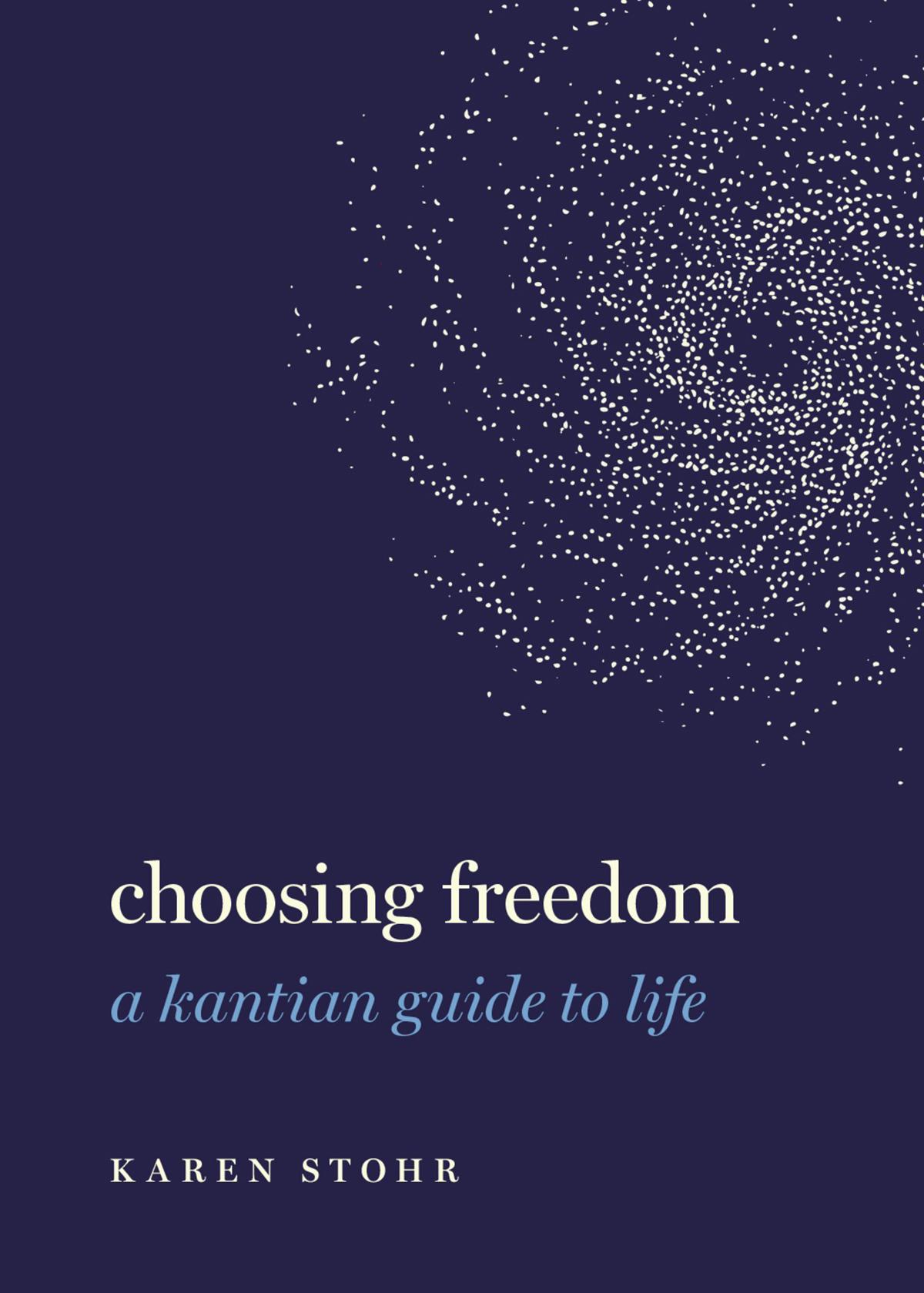
Choosing Freedom: A Kantian Guide to Life
Karen Stohr
CHOOSING FREEDOM
A Kantian Guide to Life
Karen Stohr
Oxford University Press is a department of the University of Oxford. It furthers the University’s objective of excellence in research, scholarship, and education by publishing worldwide. Oxford is a registered trade mark of Oxford University Press in the UK and certain other countries.
Published in the United States of America by Oxford University Press 198 Madison Avenue, New York, NY 10016, United States of America.
All rights reserved. No part of this publication may be reproduced, stored in a retrieval system, or transmitted, in any form or by any means, without the prior permission in writing of Oxford University Press, or as expressly permitted by law, by license, or under terms agreed with the appropriate reproduction rights organization. Inquiries concerning reproduction outside the scope of the above should be sent to the Rights Department, Oxford University Press, at the address above.
You must not circulate this work in any other form and you must impose this same condition on any acquirer
CIP data is on file at the Library of Congress
ISBN 978–0–19–753781–7
eISBN 978–0–19–753783–1
DOI: 10.1093/oso/9780197537817.001.0001
For Julia and Kate, who make me laugh and give me hope for the future
TABLE OF CONTENTS
Series Editor’s Foreword
Preface
Acknowledgments
Part 1: Kantian Basics
1. Getting to Know Kant
2. Freedom
3. Human Nature
4. Moral Commitment
5. The Categorical Imperative: Equality
6. The Categorical Imperative: Dignity
7. The Categorical Imperative: Community
8. Love and Respect
9. Kantian Duties
Part II: Moral Assessment
10. Knowing Ourselves
11. Judging Ourselves
12. Judging Others
Part III: Vices
13. Servility: Acting Like a Doormat
14. Arrogance: Being Full of Ourselves
15. Contempt: Looking Down on People
16. Defamation: Spreading Gossip
17. Mockery: Making Fun of Others
18. Deceitfulness: Bending the Truth
19. Drunkenness: Losing Our Grip on Reason
Part IV: Life Goals
20. Personal Development: Making Something of Ourselves
21. Stoic Cheerfulness: Learning to Grin and Bear It
22. Judicious Reserve: Knowing When to Shut Up
23. Useful Beneficence: Lending a Genuinely Helpful Hand
24. Heartfelt Gratitude: Acknowledging Our Debts
Part V: Socializing
25. Friends and Frenemies
26. A Kantian Love Life
27. Good Manners
28. Dinner Parties without Drama
Part VI: Looking Forward
29. Staying Hopeful
30. Kant as a Guide to Life
NOTES
BIBLIOGRAPHY INDEX
SERIES EDITOR’S FOREWORD
Several ancient philosophers held that the point of studying ethics was not just to learn about ethics—as one might learn about chemistry, astronomy, or history—but to become a better human being. They also recognized that this was not easy to do. In order for thinking about ethics to make a difference in our lives, our habits and inclinations needed to be educated right alongside our minds. They therefore claimed that what mattered to living well was not just what we thought but how we thought, and not just how we thought but how we emotionally responded to the world and to other people.
The books in this series highlight some of the transformative ideas that philosophers have had about these topics—about the good life, and the practices and ways of life that help us to pursue it. They tell us what various philosophers and traditions have taken to be most important in life, and what they have taken to be less important. They offer philosophical guidance about how to approach broad questions, such as how to structure our days, how to train our attention, and how to die with dignity. They also offer guidance about how to deal with the sort of everyday questions that are often neglected by scholars, but that make up the texture of our lives, such as how to deal with relationships gone wrong, family disruptions, unexpected success, persistent anxiety, and an environment at risk.
Because the books are written by philosophers, they draw attention to the reasons and arguments that underlie these various claims—the particular visions of the world and of human nature that are at the root of these stances. The claims made in these books can therefore be contested, argued with, and found to be more or less plausible. While some answers will clearly compete with one another, other views will likely appear complementary. Thus a Confucian might well find that a particular practice or insight of, say, Nietzsche’s helps to shed light on his or her way of living in the
world, and vice versa. On the whole, the idea is that these great philosophers and traditions all have something to teach us about how to be more fully human, and more fully happy.
Above all, the series is dedicated to the idea that philosophy can be more than just an academic discipline—that it can be, as it was for hundreds of years in the ancient world, a way of life. The hope is also that philosophy can enhance the ways of life we already feel pulled toward, and help us to engage with them more authentically and fully.
Stephen R. Grimm Professor of Philosophy Fordham University
PREFACE
Presumably you picked up this book because something sparked your interest in Immanuel Kant. Perhaps you studied him in a philosophy class years ago. Perhaps you’re in college studying him now. Or perhaps you’re a fan of The Good Place and are wondering why Chidi gets so excited whenever he talks about Kant. Or maybe you’ve only vaguely heard of Kant, but you’re interested in what he said about how to live well. You may know that he is a philosophical giant of Western history If you’ve ever encountered Kant’s work, you will be aware that he wrote extremely complicated books about highly abstract topics. In any case, you may be at least a little bit skeptical about whether Kant has anything to teach you about how to live your life.
My aim in this book is to show you that Kant’s ethical outlook is as relevant and useful as it was in the eighteenth century. Maybe even more so. Kant’s arguments for the value of living in accordance with rational principles have appealed to many people over the past several hundred years. To others, however, Kant’s theory has seemed overly abstract and perhaps even cold in its emphasis on rationality rather than emotion. This concern is understandable. It’s also based on a mischaracterization of Kant, one that has been sadly common even among philosophers. In this book, I will be seeking to remedy that mischaracterization and introduce you to a different Kant, one you may not have met before.
Kant was a systematic philosopher, arguably the greatest systematic philosopher in Western philosophical history. By calling him a systematic philosopher I mean that he aimed at developing a comprehensive, coherent system of philosophical thought, one that would link together ideas about reality, knowledge, religion, art, politics, and of course, ethics. Whether or not Kant succeeded in this project is a matter of considerable debate, but even his most fervent
critics acknowledge that Kant’s attempts at systematic philosophy are the work of a genius.
This image of Kant as a genius, toiling quietly but brilliantly away in his little house in Konigsberg, is not wrong. But it also fails to reflect the full picture of the man, both as a philosopher and as a human being. You probably know the expression, “You can’t see the forest for the trees.” Usually when someone says this, they mean that we should stop focusing on the trees because that will prevent us from seeing the (more important) forest. At the same time, however, focusing entirely on the forest can mean that we miss out on some really interesting trees. The “forests” of Kant’s thought are so impressive and so challenging to work through that one could spend a lifetime just trying to make them out. But we should also attend to the “trees” that make up that Kantian forest, particularly when it comes to his ethics.
The chapters in this book reflect a wide variety of concrete, practical ethical concerns. Kant had something to say about every single one of them. This often surprises people because it can be hard to believe that this philosophical giant would have bothered to write about dinner parties and gossip. But he did. He actually took such matters quite seriously, and what he has to say about them is fascinating. Kant’s remarks on specific ethical topics, like lying, gratitude, sympathy, and friendship, are worth reading in their own right for the insights they contain. They also shed some light on his larger ethical theory. It turns out that the dense, abstract forest of Kant’s moral system becomes clearer when we stop to look at some of the individual trees.
This book will begin with a trip to Kant’s forest, by which I mean his systematic ethical theory. There’s no real way to understand Kant without it. I will, however, keep our sojourn to the forest relatively short so that we have time to examine the trees. After many years of studying and teaching Kant’s ethics, I’ve come to think that his highly formal ethical framework makes the most sense when you can also see how he meant it to work in practice. Kant did not regard ethics as a philosophical parlor game. His theory is supposed to help us figure out how to live our lives and become better people.
I suspect that the reason Kant is so often misunderstood is that people standardly learn about him through his most famous book on ethics, the Groundwork for the Metaphysics of Morals. In the Groundwork (as we will call it for short), Kant deliberately abstracts away from the actual conditions of human life, focusing entirely on our rational natures. He does this so that we can fully appreciate the basis of morality in rationality itself. Unfortunately, many people treat the Groundwork as if it represents all that Kant had to say about ethics. This could not be further from the truth.
In fact, twelve years after the Groundwork, Kant published another major book on ethics, The Metaphysics of Morals. Based on the titles alone, we might guess that he saw the Groundwork as laying the foundations for his later work. The Metaphysics of Morals is intended to show us what Kant’s ethical framework looks like when it is applied to actual human beings. Unlike the Groundwork, the Metaphysics of Morals incorporates Kant’s ideas about human nature. He identifies vices to which we tend to fall victim and tells us how we should cultivate the virtue necessary to fight those vices. He lays out specific duties that we owe to ourselves and to other people. He talks about friendship and social life, and he emphasizes the fact that we live in communities with other people. In the Metaphysics of Morals, we see hints of Kant’s personal struggles and failings, as well as his sensitivity to nuance and social context.
You won’t see this Kant if you read only the Groundwork. But this Kant shows up in lots of places, not just the Metaphysics of Morals. He shows up in the Lectures on Ethics (compilations of lecture notes taken by his students, but standardly taken to be accurate representations of his ideas). He also shows up in the Anthropology from a Pragmatic Point of View and the Religion within the Limits of Reason Alone. Because my aim is to introduce you to the wider picture of Kant’s ethical thought, you’ll find these and other, less familiar works mentioned throughout this book.
One especially interesting thing about Kant is that while he has a fairly pessimistic view about human nature, he is also deeply optimistic about our moral possibilities. In so many ways, humanity is a hot mess. As individuals, we are prone to all kinds of moral flaws and failings, compounded by our propensities toward rationalization
and self-deception. Our political and social communities are often ugly, divisive, and violent. Kant acknowledged all of this. Crucially, though, he also believed we are capable of a great deal more. It is within our power, as individuals and as communities, to choose a better way of life. That better way is a life in which we are guided by reason. True to his Enlightenment roots, Kant had great hope in the power of reason to move us forward into a brighter future, one that represents freedom and progress. This is a message that still has profound appeal in the contemporary world.
Kant did not set out to write a moral handbook or become an ethical guru. Even if he had, it’s not clear that he would have been a good one. He was not especially adept at giving moral advice and sometimes failed miserably. Kant also held some deeply objectionable views, particularly concerning gender and race. Indeed, despite the fact that his own theory provides a straightforward and powerful argument against slavery, Kant himself did not appear to see the moral problem with it until toward the end of his life. Suffice to say that Kant’s theoretical brilliance surpassed his personal ethical capacities.
I mention all this because I want to emphasize that the goal of this book is not to help you become more like Kant. It is not even to help you adopt a “What would Kant say?” approach to leading your life. (As you’ll learn in Chapter 11, Kant himself would have disapproved of this method of self-improvement.) Rather, the goal here is to use Kant’s insights to illuminate dimensions of our moral life that can otherwise be difficult to see. This is not a guide for living by Kant’s standards. It is a Kantian guide for living by your own.
A Kantian way of life is both realistic about human nature and hopeful about our capacities and possibilities. It offers us freedom, even as it requires us to exercise constraints on our behaviors, inclinations, and desires. It demands that we see ourselves and others as profoundly and equally valuable, and to organize our individual relationships and our moral and political communities around that fact. A Kantian way of life is a challenging one, perhaps now more than ever. And yet Kant believed that it represents our best hope for the future, both for us as individuals and for humanity as a whole. If you are feeling gloomy about the state of the world and
are looking for ray of optimism, Kant may just well be the philosopher you need.
ACKNOWLEDGMENTS
Kant calls gratitude a sacred duty. That adds to the pressure of writing acknowledgments, especially because the list of people from whom I have learned important things about Kant is very long. I have been fortunate enough to participate in some wonderful workshops and conferences that have deepened my knowledge of Kant and shaped my ideas. I am indebted to fellow participants and audience members at those conferences, as well as the audiences at lectures that I’ve given over the years. This is a partial list of the people to whom I owe gratitude for helping me work through various themes in this book: Anne Margaret Baxley, Macalester Bell, Cheshire Calhoun, Erin Cline, Brad Cokelet, David Cummiskey, Adam Cureton, Richard Dean, Kyla Ebels-Duggan, Jon Garthoff, Rafeeq Hasan, Sarah Holtman, Tom Hill, Violetta Igneski, Jennifer Lockhart, Huaping Lu-Adler, Michelle Mason, Todd May, Corinna Mieth, Amy Olberding, Terry Pinkard, Karen Rice, Ryan Preston-Roedder, Carol Rovane, Nanette Ryan, Paul Schofield, Oliver Sensen, Cindy Stark, Charles Starkey, Martin Sticker, Krista Thomason, Helga Varden, Alice Pinheiro Walla, Garrath Williams, and Ariel Zylberman.
I am especially grateful to Krista and Huaping for their comments on draft chapters of this book, and to Helga and Kyla for their comments on the proposal (and in Kyla’s case, the whole darned manuscript!) as reviewers for Oxford University Press. All four of them take seriously Kant’s belief that one should correct mistakes without demolishing the self-respect of the one making the mistakes. This book is much better for their assistance. Needless to say, the remaining errors are all my own. I am also permanently in the debt of Tom Hill for instilling in me both a sound appreciation for Kant and the tools with which to study him. My gratitude for his mentorship, his wisdom, and his friendship runs very deep indeed.
I have truly wonderful colleagues at Georgetown. In so many ways, my department resembles a Kantian kingdom of ends. Every academic should be so lucky. I am also grateful for my university’s financial and moral support for my research. The Ryan Family chair, which I am fortunate to hold, has made a crucial difference in this book getting finished more or less on time during a pandemic. I am particularly grateful to my graduate research assistant, Emma Nagler. Emma’s nuanced appreciation of Kant and helpful philosophical insights improved this book in many ways, as did her sharp eye for small details.
My students here at Georgetown have served as my real and imaginary audience for this book. Years of teaching introductory ethics to undergraduates has encouraged me to think creatively about how to make Kant engaging and relevant to their lives. Graduate students have pushed me to deepen my understanding of the text and defend my interpretations. I could not have written this book without first having tried to teach it over and over. So, students, thank you for sitting through many first drafts. Your questions, puzzles, and challenges have improved every inch of text in this book.
Few things are as important to writing as a good editorial team. I have now been lucky enough to collaborate with Lucy Randall and Hannah Doyle on multiple projects, and I know how much my work benefits from their own. I am grateful for everything they do behind the scenes. It has been especially fun for me to work with Stephen Grimm on this book and on the Guides to the Good Life series as a whole. It would not have occurred to me to write this book if he had not suggested it. I’m indebted to him both for the opportunity and for many helpful comments, suggestions, and insights along the way.
Writing books is hard on authors, but it is probably even harder on their families. I am beyond grateful to my husband, Bob Nonnenkamp, for his untiring support, both emotional and practical. Whether it’s driving kids around, keeping a couple of energetic dogs occupied, serving as instant technical support, or making dinner magically appear, he has it under cheerful control. His endless patience is both a marvel and mystery to me. I am so very lucky to have been married to him for twenty-four years and counting.
This book is dedicated to my daughters, Julia and Kate Nonnenkamp. Over the years they have perfected the skill of appearing interested while their mother goes off on some long tangent about Kant. In spite of the many unbidden philosophy lectures they have endured at dinner or in the car, they bring fresh perspective, Gen Z humor, Spotify playlists, technical expertise, and delicious baked goods into my life. Girls, the two of you light up my world. I love you more than I know how to say.
Part 1 Kantian Basics
1 | GETTING TO KNOW KANT
If you’re looking for a model for how to live your life, the eighteenthcentury Prussian philosopher Immanuel Kant may not seem like an obvious choice. He lived his entire seventy-nine years quietly and uneventfully in the university town of Konigsberg. The son of a harness maker, Kant worked his way up to the intellectual heights of a professorship. His days were spent reading, giving lectures, engaging in (mostly) friendly philosophical discussions, and writing what is often nearly impenetrable prose. And yet this seemingly ordinary man shook up the Western philosophical world in ways that few others have managed to do. With exceptional intelligence and creativity, Kant built a strikingly original philosophical system. Central to that system is his understanding of what it means to live a morally good life.
For Kant, a morally good life is a life lived according to reason. On his view, such a life is difficult to achieve, but it is a profoundly worthwhile undertaking. To live according to reason is, for Kant, to live in accordance with our fundamental natures as free, rational beings. Kant’s emphasis on rationality is both essential to his theory and distinctive of it. Other moral theorists writing at the time believed that morality had its source in our feelings, or in what was often thought of as our innate moral sense. Kant is skeptical that our natural feelings, emotions, and intuitions could ever serve as a firm enough foundation for morality. His own theory reflects both that skepticism and his confidence that reason should be our ultimate guide when we’re seeking to lead a good life.
Although Kant has tremendous faith in human rationality, he is not under the illusion that our rational powers are limitless. Reason, however powerful it might be, cannot tell us everything we might want or need to know. For instance, Kant does not believe that we can know whether we have free will, or whether there’s a God. (He does, however, argue that we can rationally act as though we have free will, and that we can have rational hope in God’s existence.
More on that later.) He also realizes that human beings do not always do what reason directs us to do. We waste hours on social media, we eat more sugar than is good for us, we buy things we can’t afford, we get irritated at inanimate objects. We do all kinds of irrational things on a regular basis.
And yet, we’re capable of something more. Often, it’s perfectly obvious to me that I’m spending too much time on Instagram or eating too much sugar. I know that what I’m doing is bad for me, and that a more rational, self-controlled version of myself would be settling down to work with a bowl of edamame, not scrolling through Instagram eating Cap’n Crunch. It’s true that I’m not being that more disciplined person right now, but for Kant, the key point is that it’s in my power to be that person. We are always able to do what our reason tells us to do, even when we’re choosing to ignore its voice.
It’s crucial to Kant’s theory that the voice of morality comes from within us, and not from outside forces, like society or religion. Kant is not interested in preaching to people about morality. He does not see morality as a matter of coming up with a bunch of rules, and his ethical works are not reference books for looking up answers to moral dilemmas. In fact, Kant is adamant that we do not need outside guides that will tell us how to live. (He might even have been skeptical about your decision to buy this book.) Not only are we each capable of understanding morality for ourselves but basing our moral decisions on someone else’s set of rules would be a major mistake. Morality is something we have to determine for ourselves, much as Dorothy in the Wizard of Oz had to figure out for herself how to get home to Kansas.
Now this does not mean that Kant is a moral relativist, or someone who thinks that there is nothing more to morality than each person’s opinion. He is actually about as far from a moral relativist as you can get. Not only does he believe in moral truths, but he believes that moral principles are principles of rationality, and that they are objective, universal, and unchanging. On Kant’s view, denying that killing innocent people is wrong is not all that different from denying that 2+2 = 4.1 If someone were to insist that 2+2 = 5, we’d regard them as irrational and perhaps in need of some medical help. As we’ll see, Kant holds that all rational beings, thinking
rationally, will converge on the same fundamental moral principle. That principle serves as the basis for all of morality. This is an ambitious position to take, and possibly a surprising one, given that it flies in the face of our ordinary experience. People have very deep moral disagreements on a variety of topics, and it doesn’t seem that we can easily settle them by way of appealing to a single moral principle.
Kant recognizes that working out moral disagreements is much more challenging than working out disagreements about obvious mathematical claims like 2+2 = 4. Of course, most mathematical claims aren’t that obvious, but that doesn’t mean the rest of math is just a matter of opinion. Math is based in reason, although the rationality of a given theorem may not be evident to the untrained eye. For Kant, morality is also based in reason. We don’t need to spend years in school to understand it, but we do have to be willing to stop and engage in rational reflection about what morality is and what it requires of us. If we do, then we can use reason to figure out how to be a good person, just as we can use it to calculate the area of a triangle.
So, a good life in Kantian terms will be a life lived in accordance with rational moral principles. There’s a catch, though. To say that a reason-driven life is a good life doesn’t necessarily mean that it will be a happy life in the usual sense. As we all know, some deeply immoral people seem to do pretty well for themselves, particularly if they can avoid getting caught. Kant is not suggesting that being a good person will get you everything that you want. He does, however, think that being a good person will make you deserving of happiness. That may not seem very satisfying to anyone hoping that moral virtue might come with material rewards. Shouldn’t being a good person also get you a good life?
It would certainly be nice if virtue always paid off in terms of helping us achieve our life goals. Kant is just skeptical that this actually happens. We can see from our own experience that being a good person sometimes means you have to sacrifice things you want, and that bad people sometimes get away with murder—literally and figuratively. As far as Kant is concerned, the only one in a position to fix this mess is God, which is why we have reason to
hope that God exists. On our own, we have no way of ensuring that virtue is rewarded with happiness. The best we can do is to try to make ourselves worthy of whatever happiness might come our way.
As Kant sees things, guiding your life according to rational moral principles isn’t going to make you rich or famous. But there are other kinds of reasons why we might want to try out a Kantian way of life and why we might find it worthwhile. When we act on rational moral principles, we are choosing how to live. We are not simply allowing ourselves to be dragged around by things like Instagram’s algorithms. Kant sees tremendous value in living according to principles that we have chosen, rather than just going along with what other people are doing or permitting ourselves to be ruled by outside forces. Now you may be thinking, “Well, don’t we sometimes choose bad principles for ourselves?” That is certainly true, and we’ll be returning to this issue later. The key point here is that if my life is going to go well in Kantian terms, I have to be behind the wheel, directing my own actions and choices and taking ownership of them. And I will chart a smoother course for myself if I use my reason as my GPS.
This emphasis on the importance of rationality and individual freedom is one of the hallmarks of the Enlightenment, the name given to the intellectual period in seventeenth- and eighteenthcentury Europe during which Kant lived and wrote. Indeed, Kant is one of the central philosophical figures of the Enlightenment, and his work has had a profound impact (both positive and negative) on the course of European and American history. This is quite a legacy for the son of a harness maker in a small Prussian town. To see how Kant’s ideas took shape, let’s take a brief look at his own story. No one writes in a vacuum, not even a brilliant philosopher like Kant. If we’re going to understand him, we must know something about the place and time in which he lived, and the forces and ideas that shaped his philosophical outlook. ***
Kant was born on April 22, 1724, into what we probably would now describe as a working-class family. His parents and grandparents were tradespeople, not scholars, and likely never expected a world-
famous philosopher to emerge from their ranks. But they believed in education and Kant benefited from their efforts to ensure that he had access to a good one. As members of a guild, his parents were never truly poor. They did, however, face financial struggles. Kant’s mother died when he was thirteen, and his father when he was twenty-two, leaving behind Kant and four siblings. As the oldest son, Kant took on great deal of responsibility for helping support his brother and sisters. He also received help from others, most notably an uncle who contributed financially to his education. As we’ll see in later chapters, Kant has some subtle points to make about the moral complexities of beneficence and gratitude. He may well have been speaking from his own experiences as someone who was both a giver of charitable aid and a recipient of it.
Kant was devoted to his parents, especially his mother, and he clearly had tremendous respect for their commitment to hard work and their principled moral behavior. He saw his parents as having lived honorably and done their very best for their children, despite the hardships they faced. No doubt Kant’s parents were very much in his mind as he developed his view of morality, particularly his conviction that each of us has it within us to be a good person. He believed strongly that no one needs a fancy education to know what’s right. His own parents, with their limited opportunity for formal schooling, served as his proof. Good moral principles are available to anyone who cares enough to think through what morality requires from us.
Kant’s upbringing was also profoundly influenced by the religious atmosphere in which it took place. His parents were devout adherents of Pietism, a movement within Lutheranism that focused on personal faith and a lived commitment to Christian principles. Kant spent a large part of his youth in a very strict Pietist school. Although Kant fully appreciated the positive effects that religious devotion can have on a person’s moral character, he was also keenly aware of its darker, more pernicious elements. Kant did not care for the methods of religious education he experienced at school, believing them to be at odds with the essential task of cultivating individual rationality. Eventually, he largely rejected the Pietist tenets of his youth, but the existence and nature of his own
religious commitments are not easy to sort out. No one would describe Kant as a religious man, and yet it isn’t quite right to regard him as an atheist or agnostic either. Let’s just say that his relationship with religion is complicated. In that sense, he fits right in with many of us in the twenty-first century.
After he finished school, Kant earned his keep mostly through tutoring and giving lectures at the university, for which he was paid on a by-the-student basis. Because he most definitely didn’t have a trust fund, it was lucky for Kant that he proved to be an immensely popular lecturer On top of his other duties, he lectured up to twentytwo hours a week on a range of different subjects. Although he probably found the schedule exhausting, he was never short on students, who lined up early just to get a seat in his classroom. Despite his growing philosophical reputation, it wasn’t until 1770 that he received a full professorship in philosophy at the university where he had spent his entire academic life. From then on, Kant was able to lead a relatively comfortable life, one that enabled him to produce his most famous works.
Kant is often portrayed as a bit of a curmudgeon, particularly for his habit of keeping to an extremely strict schedule. This isn’t false, but it’s a more accurate representation of the older man, worried about his health and rather set in his ways. The younger Kant was a sought-after dinner guest and companion, known for his conversational skill and his facility with a wide range of subjects. He never married and discussions of his romantic life do not rise much above the level of rumor. He did, however, have many friends and admirers, and he certainly had the respect of his colleagues and students. Kant didn’t shy away from conflict or controversy, but he understood the importance of being a good citizen of his university and his city. He was also a dutiful brother and uncle, continuing to provide financial support to his sisters and their families throughout his life. And by the time he died in 1804, at the age of seventy-nine, he had solidified his place as one of the greatest intellects that Western Europe had ever produced.
Of course, Kant was far from perfect. He could be rather caustic in his criticisms of other scholars, and occasionally behaved unpardonably toward people who deserved better from him. (Here’s
one example: Kant conducted a philosophical correspondence with an intelligent and perceptive young woman named Maria von Herbert, who wrote to ask his advice on whether she needed to reveal her past relationships to her current suitor. Although Kant started out the correspondence well enough, he seems to have been unable to cope with her pointed challenges to his philosophical worldview. Eventually, he stopped responding to her and instead started using her letters as a warning to other young women about the moral dangers of romantic entanglements.) Kant did appear to hold a number of women in relatively high regard and he generally saw women as rational beings. He did not, however, use his considerable skill and influence to improve their situation or argue for women’s political rights. Although it’s possible to derive plenty of feminist conclusions from Kant’s ethical theory, Kant himself failed to see them and indeed, said quite a few things that conflict with them.
Perhaps even more troubling are Kant’s repugnant views about race, views that unfortunately outlived him by many decades. Here especially, Kant’s own methods failed him. When it came to understanding people of different races, he relied too heavily on bad sources and engaged in lousy reasoning. The moral theory he developed so carefully over the years clearly points to the wrongness of slavery, and yet Kant himself condoned it until the very end of his life. By his own lights, he should have been open-minded and optimistic about the rational capacities of people of other races, and he should also have seen their oppression and enslavement as a violation of their most basic dignity. Unfortunately, he did not. That a person as smart as Kant was subject to such a profound moral error tells us something about the power of racism and the difficulty of disentangling ourselves from convenient and self-serving world views. As I hope we’ll see, Kant’s work can help us avoid making at least some of the mistakes that Kant himself made.
For a man who led a fairly ordinary life, Kant managed to have an extraordinary influence on Western philosophy His analytical prowess, combined with his (usually!) insightful observations of human nature and social life, make him a figure of nearly unparalleled importance in the history of ethics. But Kant’s importance is not merely historical. The ethical insights of this