Introduction
It was late afternoon when Rimbink Pato, Papua New Guinea’s foreign minister, heard a loud commotion outside his door. Seconds later, four Chinese diplomats burst uninvited into his office, demanding last-minute changes to the communiqué of the 2018 Asia-Pacific Economic Cooperation summit, the Pacific’s most important economic and political forum.
For Papua New Guinea to have even hosted a meeting of APEC, whose members represent around 60 percent of the world’s GDP, was a feat in itself. The sprawling archipelagic nation in the middle of the South Pacific has a population of just 8.6 million people and is among the poorest on earth. With 850 languages and more than 600 islands, it was difficult to govern at the best of times. The capital Port Moresby had a reputation for violence, prompting the country’s southern neighbor and former colonial overlord Australia to provide security for the event by stationing a warship in the harbor.
China had been meticulously building its influence in the resourcerich nation for years, ramping up investment and building infrastructure. Chinese loans had funded hospitals, schools, and hydropower stations across the country. By the time the summit took place in November 2018, the nation owed a quarter of its external debt to Beijing.1 Further afield, China was promising more than $100 billion to finance infrastructure projects across the Pacific and Eurasia under its Belt and Road Initiative.2
It looked like the event would be an easy win for Xi Jinping, the president of China and head of the ruling Communist Party. President Donald Trump skipped the meeting, sending Mike Pence, the vice president, instead. Pence spent little time on the ground, instead stationing himself in nearby Cairns inland from Australia’s Great Barrier Reef because of concerns about violence.
Xi was the first foreign leader to land in Port Moresby. Ahead of his arrival, local newspapers carried an op-ed in his name, which hailed the “rapid growth” in ties as the “epitome of China’s overall relations with Pacific island countries.”3
Xi made a grand entrance. His motorcade, which included two Hongqi (“red flag”) limousines air-lifted from China, sped from the airport to the hotel along a Chinese-funded highway past the fluttering flags of both countries. Xi drove past crowds of cheering high school students and billboards of himself shaking hands with the country’s prime minister. His hotel was decorated with red lanterns and an elaborate Chinese gate.4
At the summit, Xi delivered his standard speech on the importance of open markets and globalization. He’d used public appearances since Trump’s surprise election victory in November 2016 to contrast China’s approach to the “America first” protectionism espoused by his American counterpart, and APEC was no exception. The audience of global executives and political elites applauded when he told them, without naming names, that implementing tariffs and breaking up supply chains was “short-sighted” and “doomed to failure.”5
This public display was largely under China’s control. The ongoing behindthe-scenes wrangling over the summit’s communiqué, however, was not. In a last-minute push to influence wording about “unfair trade practices” that they believed targeted Beijing, Chinese diplomats took matters into their own hands by requesting a sit-down with Papua New Guinea’s foreign minister. He refused, arguing that bilateral negotiations with an individual delegation might jeopardize the country’s neutrality as host. The Chinese tried again but were once more rebuffed.
Undeterred, four Chinese diplomats decided to push their way into the foreign minister’s office, calling out that they just needed two minutes of his time. Security guards then asked the Chinese officials to leave and police were later posted outside the door. Publicly, Papua New Guinea’s foreign minister sought to downplay the incident, telling reporters it was “not an issue.” Privately, the country’s officials described China’s behavior throughout the negotiations as “bullying.”6 China’s foreign ministry denied that the incident ever occurred, calling it “a rumor spread by some people with a hidden agenda.”7
As reporters waited for the outcome of the summit, Canadian prime minister Justin Trudeau eventually confirmed that negotiations over the communiqué had collapsed. “There are differing visions on particular elements,” he said with understatement. For the first time since leaders began attending the annual summit in 1993, no joint statement was issued.8
The APEC summit should have been an opportunity for China to boost its reputation. Trump had spent the two years leading up to the Port Moresby
meeting undoing much of the goodwill the United States had developed in the region. Within days of his January 2017 inauguration, he had withdrawn from the Trans-Pacific Partnership, a twelve-nation trade deal that aimed to help America compete with China’s engagement in Asia. He’d gone on to launch a trade war with China, forcing Pacific nations to choose between two powers they could not afford to offend. The president had also personally insulted America’s partners across the region, hanging up halfway through a January 2017 phone call with Australian prime minister Malcolm Turnbull and branding Canada’s Trudeau “very dishonest” and “weak.” But instead of taking advantage of the opportunity, China emerged from APEC looking ever-more like a bully. Its diplomats—the very people who should have been most concerned about their country’s reputation—only seemed to be making matters worse.
The APEC debacle was just one of a series of setbacks for Chinese diplomacy in the months before and after the summit. Two months earlier, at the Pacific Islands Forum in the Micronesian microstate of Nauru, China’s envoy had walked out of a meeting when the host refused to let him speak ahead of another nation’s prime minister. The president of Nauru described the Chinese diplomat as “very insolent” and a “bully.”9
In the months after the Papua New Guinea incident, China’s ambassador to Canada publicly accused his hosts of “white supremacy.” China’s chief emissary in South Africa declared that Donald Trump’s policies were making the United States the “enemy of the whole world.” Its representative in Sweden, Gui Congyou, labeled the country’s police “inhumane” and blasted its “so-called freedom of expression.” In the space of just two years, Gui was summoned by Sweden’s foreign ministry more than forty times while three of the country’s political parties called for him to be expelled. Unabashed, he told Swedish public radio, “we treat our friends with fine wine, but for our enemies we have shotguns.”10
While these aggressive displays won plaudits at home, they compromised China’s efforts to cast itself as a peaceful power. The foreign media began to brand this new confrontational approach “wolf warrior diplomacy” after a series of Chinese action movies that depicted Rambo-like heroes battling China’s enemies at home and abroad. The second in the series, Wolf Warrior 2, told the story of a group of People’s Liberation Army soldiers sent to rescue stranded Chinese civilians in a war-torn African nation. The 2017 movie was a huge success for China’s film industry, making more than $854 million at the domestic box office.11 Its tagline read, “Even though a thousand
miles away, anyone who affronts China will pay.”12 The moniker captured the intimidating and sometimes bewildering nature of Chinese diplomacy as seen by the outside world, and it stuck.
The behavior of Chinese diplomats grew even more combative as Covid19 spread around the world in early 2020. Beijing’s envoys hit back hard at suggestions China was to blame for the spread of the virus. Some did so on Twitter: “You speak in such a way that you look like part of the virus and you will be eradicated just like virus. Shame on you,” Zha Liyou, China’s consul-general in Kolkata, India, tweeted at one user who criticized China.13 Others vented their frustration through embassy websites: an anonymously authored text posted on the website of the Chinese embassy in France falsely accused French retirement home staff of leaving old people to die, sparking public anger in France and a rebuke from the country’s foreign ministry.14 Most provocatively of all, Zhao Lijian, a recently appointed foreign ministry spokesman, suggested that the virus might have been spread deliberately by the US Army, prompting fury in Donald Trump’s Oval Office and worldwide alarm about Beijing’s role in spreading disinformation.15
The behavior of Chinese diplomats helped fuel a global backlash against Beijing. Reinhard Buetikofer, a German lawmaker who chairs the European Parliament’s delegation for relations with China, said the foreign ministry’s “extremely aggressive” behavior combined with the Communist Party’s “hard line propaganda” had helped turn European opinion against the Asian nation. Its conduct, he said, spoke to the “pervasiveness of an attitude that does not purvey the will to create partnerships, but the will to tell people what to do.”16 A global poll released in October 2020 showed that negative perceptions of China hit record highs in the United States and eight other developed economies including Germany, Britain, South Korea, Australia, and Canada.17
These setbacks matter. As global politics is increasingly defined by SinoAmerican rivalry, the ability to compete diplomatically will help shape the history of the twenty-first century. Taken together with economic, military, technological, and ideological prowess, diplomacy is a key part of what makes any power great. American strategists have long defined it as a core element of any nation’s power: diplomatic, informational, military, and economic capabilities are often reduced to the acronym “DIME.”18
Chinese diplomats play an outsized role in representing the country abroad. The Communist Party’s top leaders speak to the world through a blend of empty-sounding platitudes about “win-win” cooperation or Marxist
slogans that fall flat with foreign audiences, while China’s civil society is too tightly constrained to present its own alternative. NGOs are closely regulated, while the country’s media and cultural industries are heavily censored, and its business leaders studiously avoid politics. While the foreign ministry is widely seen as a weak bureaucratic player at home, on many crucial global issues, its diplomats are the face of the Chinese state to the world.
China knows diplomacy is important and it’s spending big to compete. Between 2012 and 2017, Beijing nearly doubled its spending on diplomacy to $7.8 billion, even as the United States slashed funding for the State Department.19 In 2019, its diplomatic network overtook that of the United States, with 276 embassies and consulates around the world. Just three years earlier it had ranked third behind America and France.20 Still, instead of winning friends, its “wolf warrior” diplomats have become symbols of the threat posed by a rising China.
To understand what’s going wrong, we need to step into the shoes of the country’s diplomats. Chinese envoys are behaving so undiplomatically because they are unable to extricate themselves from the constraints of a secretive, paranoid political system which rewards unquestioning loyalty and ideological conviction. While their actions can sometimes seem aggressive— even bizarre—from the outside, they make perfect sense when seen from a domestic perspective. Understanding why involves looking at how China’s political system has shaped the behavior of its diplomats since the earliest days of the People’s Republic.
In 1949, Mao Zedong established Communist China after decades of bitter political struggle with Nationalist Party (Kuomintang) rivals. The Communists had spent much of this time living secretive, underground lives in fear of capture and persecution. After being nearly obliterated in 1934, they were forced into a humiliating retreat across China’s remote heartlands before rebuilding their revolutionary movement and eventually seizing on Japan’s 1937 invasion to stage a comeback. Despite the Communist Party’s eventual victory in 1949, the new regime feared that its rule could be undermined by class enemies at home. What’s more, it faced the threat of invasion by the Kuomintang, which had established a new capital on the island of Taiwan, and an increasingly hostile, anti-communist United States.
Still, Mao’s new regime badly needed to build bridges with the outside world. Establishing ties with capitalist nations would strengthen its claim
to be the sole legitimate government of China, a status contested by the Kuomintang on Taiwan. Strong diplomatic ties with the communist world could bring military protection for the new regime, as well as access to the crucial foreign technologies and expertise needed to modernize the country. Communist China’s approach to diplomacy was forged by this imperative to establish relationships around the world while jealously guarding the Party’s hard-won victory.
The man charged with squaring this circle was Zhou Enlai, one of the Communist Party’s most experienced revolutionaries and the founding father of modern Chinese diplomacy. The task was especially daunting given that the new government had no diplomats to speak of. Acting on Mao’s instructions, Zhou cast aside any Kuomintang diplomats who had opted to remain in mainland China, and instead set about creating a diplomatic corps from scratch. Other than a small group of Party officials who had experience dealing with foreigners, the bulk of Zhou’s diplomatic corps would be made up of fresh college graduates, ex-soldiers, and hardened peasant revolutionaries. Most spoke no foreign languages and some had never even met a foreigner.
Zhou’s task was doubly daunting because, domestically, diplomacy had often been associated with weakness and capitulation to foreign powers. Beginning in the mid-nineteenth century, Chinese envoys had represented the crumbling Qing Dynasty by signing agreements that gave foreign powers preferential access to the Chinese market, extra-legal privileges on Chinese soil, and even control over portions of the country’s territory such as Hong Kong. The imperial capital of Beijing itself had been sacked on more than one occasion. The Communists came to power promising to end bullying at the hands of foreign imperialists and declaring that China had “stood up.” In order to distance the new regime from this humiliating legacy, the diplomacy of the People’s Republic would need to win the respect of other nations while never allowing its own diplomats to show weakness.
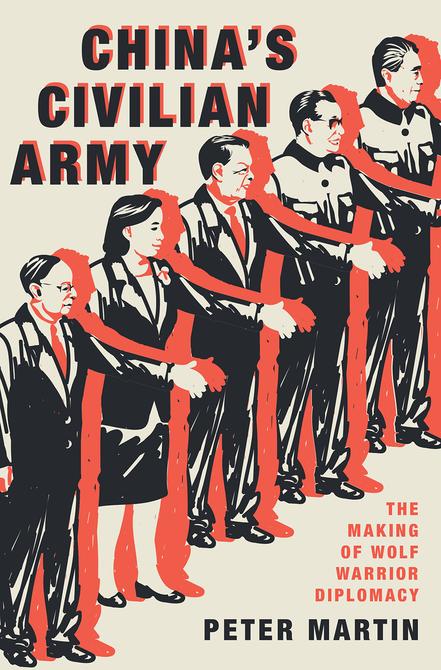
Zhou’s solution was to model Chinese diplomacy on the military force that had propelled the Communists to power: the People’s Liberation Army. He told the new recruits to think and act like “the People’s Liberation Army in civilian clothing.” They would be combative when needed and disciplined to a fault. They would instinctively observe hierarchy and report to their superiors on everything they did. When necessary, they would report on each other. Most important, the idea of working as a “civilian army” underscored the fact that the first loyalty of Chinese diplomats would always be to the
Communist Party. As every good Communist knew, when Chairman Mao declared that “political power grows out of the barrel of a gun,” he had added that “the Party commands the gun, and the gun must never be allowed to command the Party.”21
The idea of a “civilian army” proved a potent and lasting metaphor for Chinese diplomacy. It provided Zhou’s ragtag group with a way to feel proud of what they were doing and some sense of how to do it. A little like the “mission statement” pinned to the wall of a tech startup, it gave them a way to scale their organization quickly while conveniently ignoring the fact that they didn’t really know what they were doing.
“They applied the same discipline to the foreign ministry that they applied to the military,” explained Gao Zhikai, a former foreign ministry interpreter. “The discipline applied to the organization and also to every individual. The pressure is huge: everyone is watching everyone else to make sure no one is fooling around.”22
Using this rubric, the Communists found a way to communicate with the outside world while minimizing the risks of doing so. Zhou encouraged a style among his diplomats that one cadre aptly described as “controlled openness.”23 Chinese diplomats were expected to adhere to a rule that forbade them from meeting alone with foreign counterparts. Instead, they worked in pairs to ensure that if anyone deviated too far from the Party line, or shared sensitive information, the person next to them was there to report it. Diplomats were instructed to ask permission before they acted, even on the most trivial matters, and to always report what they said, did, and heard to their superiors. They were banned from dating or marrying foreigners. They were told to stick rigidly to pre-approved talking points, even when they knew these often failed to resonate with foreign audiences.
Born of necessity more than seventy years ago, these rules and practices are still in place today. Zhou’s approach has survived and evolved through revolution, famine, capitalist reforms, and the rise of China as a global power. “We’re very different from other ministries,” one diplomat said. “We’re unusual in that we’ve had a strong culture that’s lasted since 1949.”24 Even within the secretive world of the Chinese bureaucracy, foreign ministry officials have a reputation for being unusually uptight and somehow more difficult to relate to than their peers in other ministries. Officials in the Ministry of Commerce sometimes jokingly refer to the Ministry of Foreign Affairs as the “Ministry of Magic” (mofa bu), a play on words in Chinese from the acronym MOFA.
The core of China’s distinctive approach to diplomacy is the enduring martial ethos established by Zhou. “Our diplomatic corps is a civilian army,” wrote one former ambassador in 1997. “It was trained and developed through education from the Party and under the care of Zhou Enlai.”25 In 2019, while touring the new military museum in Beijing, foreign ministry spokesperson Hua Chunying reminded her People’s Liberation Army host of the ministry’s roots as a “civilian army.”26 Today, as Chinese diplomats square up to the United States in an increasingly intense global rivalry, they still work off assumptions forged in the bloody revolutionary struggles of the twentieth century.
There are real strengths to China’s approach. Its diplomats bring unrivaled discipline to the pursuit of their goals. “They can be very charming and professional,” one European diplomat said. “Dealing with them can be exhausting because they won’t deviate from the official line for even a second.”27 As a result, foreign interlocutors are never left in any doubt about China’s stance on the country’s core interests such as Taiwan, Hong Kong, and Tibet. What’s more, China’s disciplined approach to these kinds of issues extends all across its central government agencies, hiding most inter-agency conflicts from the world and enhancing China’s ability to present a united front in negotiations. It’s a powerful combination in a world beset by disruption and uncertainty.
At times, Chinese diplomacy has performed impressively. In the 1950s, China undertook a charm offensive that won it friends in the developing world and helped build support for the Communist Party as the internationally recognized government of China. In the period after the 1989 Tiananmen Square massacre, Chinese diplomats helped rehabilitate their country in the eyes of the world, kickstarting a nearly two-decade run of successes that culminated in China’s hosting of the Summer Olympic Games in 2008.
Yet the system also has major weaknesses. China’s approach to diplomacy makes its envoys effective at formulating demands, but poorly equipped to win hearts and minds. Their fear of looking weak in front of Party leaders and the Chinese public makes them focus excessively on small tactical wins at the expense of strategic victories; their constant repetition of official talking points is unpersuasive at best and, at worst, looks like bullying; and their limited space to improvise, show flexibility, or take the initiative leaves them unable to tailor their approach to different audiences.
These constraints matter because they cut to the heart of what it means to conduct diplomacy. Daniele Varè, an early twentieth-century Italian
diplomat, described it as “the art of letting someone else have your way.” Chas Freeman, a veteran American diplomat, elaborated on the point: “Diplomacy is a political performing art that informs and determines the decisions of other states and peoples. It shapes their perceptions and calculations so that they do what we want them to do because they come to see doing so as in their own best interest.”28
Judged by these standards, China’s political system sets severe limits on the performance of its diplomats. Ultimately, it’s a system that’s better at silencing critics than persuading others to share its point of view, a system that leaves the Party with tremendous international influence but few true friends. This is true for China on a state-to-state level—the closest thing it has to an alliance is with North Korea; its closest relationship is with Pakistan. It’s also true on a personal level: “You know, I don’t think I ever really got to know anyone well,” another senior European official said at the end of a four-decade career dealing with Chinese diplomats. “I played tennis with a couple of people in the 1990s, but I wasn’t able to sustain those relationships. There’s no one I could really call a friend.”
The system performs particularly badly at times of political tension in Beijing, when Chinese diplomats find themselves more concerned with avoiding charges of disloyalty than improving their country’s reputation. These periods of political uncertainty at home have often been accompanied by the forceful assertion of domestic ideologies on the global stage— regardless of the reputational consequences for China. This impulse played out most dramatically during the 1966–1976 Cultural Revolution. As diplomats watched Mao push Chinese politics in an ever more radical direction, they followed his lead in their interactions with foreigners by barking slogans and handing out copies of the Chairman’s “Little Red Book.” Eventually, the tight discipline of the foreign ministry broke down so completely that junior diplomats locked ambassadors in cellars, forced them to clean toilets, and beat them until they coughed up blood.
Today, as Xi Jinping pushes China in a more authoritarian direction at home and promotes a new, more assertive, role for the country abroad, many of the forces that previously held back China’s diplomatic progress are once again resurfacing. Unlike Mao, Xi favors domestic order over radical rebellion. Above all, he seeks political security for himself and a state apparatus that is responsive to his needs. In October 2016, the Communist Party declared Xi its “core leader,” a title that had eluded his predecessor, Hu Jintao, and signaled the demise of collective leadership in the Party. In March 2018,
it abolished term limits for the presidency, clearing the way for Xi to remain in power for life. These changes mean that any ambitious diplomat must appear to be on the right side of Xi’s political agenda, as there is little prospect of waiting him out.
The costs of getting on the wrong side of Xi have also become ever more apparent. Under Xi, Chinese politics has become an increasingly repressive and frightening place. Since 2012, as part of an anti-graft campaign that treats political disloyalty as a form of corruption, more than 1.5 million officials have been punished. That’s around four times the population of Iceland. Diplomats have had to sit through “self-criticism” sessions in the foreign ministry and “inspection tours” that test their loyalty to the Party and willingness to follow orders.29 As such, the impulse for Chinese diplomats to follow Xi’s lead is rooted in fear as well as ambition.
The easiest way for diplomats to work toward Xi’s wishes is to assert Chinese interests forcefully on the world stage. Even before Xi became president, he used a February 2009 trip to Mexico to complain about “foreigners with full bellies who have nothing better to do than point the finger” at China’s human rights record.30 One of his first acts after becoming leader of the Communist Party in November 2012 was to lay out an agenda for “the great rejuvenation of the Chinese nation,” signaling his ambitions for the country to retake its rightful place in the world. Since then, he has repeatedly instructed diplomats to stand up for China more aggressively than they did in the past, even crafting handwritten notes instructing them to show more “fighting spirit.”31
As a result, the country’s envoys have taken a more assertive and even belligerent tone to prove their loyalty to the leadership. They have handed out copies of books about “Xi Jinping Thought” at diplomatic events, echoing the way their predecessors behaved with Mao’s “Little Red Book” more than four decades earlier; they have waxed lyrical about Xi’s leadership in meetings with foreign counterparts; and they have shouted at and insulted foreign politicians rather than risk looking weak. “Beijing rewards diplomats that are aggressive advocates of China’s views and scorns those that it perceives as overly timid,” explains Ryan Hass, who served as a China expert on President Barack Obama’s National Security Council. “We seem to be watching China’s diplomats matching the mood of the moment in Beijing.”
The trend has become even more pronounced as the world increasingly questions American leadership. In the space of less than two decades, the United States’ authority has been dented by foreign policy mistakes in the
Middle East, an indecisive response to the Global Financial Crisis, paralyzing political gridlock at home, the “America first” populism of Donald Trump, and its fumbling response to the Covid-19 pandemic. At the same time, China’s economy boomed and the country faced down the global pandemic more successfully than most Western nations. Many Chinese diplomats began to feel that their political system and development model were superior to those of the West, a belief reinforced by domestic propaganda. In May 2020, foreign ministry spokesperson Hua Chunying responded to State Department criticisms of China’s crackdown in Hong Kong by simply invoking the final words of George Floyd as he lay pinned down by Minneapolis police: “I can’t breathe.”32
***
Given all this, you might expect Chinese diplomats to relish the “wolf warrior” label. They don’t. To many, it’s just the latest example of foreigners refusing to treat China fairly in the court of international opinion. “We think it’s really unfair,” said one foreign ministry official. “We work so hard to improve China’s image and explain our policies, but it doesn’t matter what we say. Whatever we do, America and its allies will criticize us.”33 Le Yucheng, the foreign ministry’s top vice minister, called the term a “discourse trap that aims to prevent us from fighting back” in a December 2020 speech. “I suspect these people have not awoken from their dreams 100 years ago,” he said.34
This frustration is understandable. In terms of credentials, today’s Chinese diplomats are up there with the best of their international counterparts. Many hold advanced degrees from Georgetown University or the London School of Economics, and have spent years mastering foreign languages ranging from Czech to Bahasa. They have invested much of their lives studying the countries to which they are posted and often care deeply about China’s reputation. On a personal level, they can be suave, sophisticated, and even funny.
Quietly, many understand that their behavior is contributing to a global backlash against China. Yuan Nansheng, China’s former consul general in San Francisco, voiced the concerns of many inside China’s foreign ministry in September 2020 when he warned that “if we let populism and extreme nationalism flourish freely in China, the international community could misinterpret this as Beijing pursuing ‘China First’,” referring to Trump’s “America First” policy. Yuan called for a return to the low-key approach to diplomacy the country had followed in the 1990s and early 2000s. “Chinese diplomacy needs to be stronger, not just tougher,” he said.35
It was this contrast between the impressive abilities of many Chinese diplomats and the stilted way they behave in press appearances and official meetings that first drew me to this topic in early 2017. My curiosity only grew as the behavior of some Chinese envoys became ever more brash and aggressive. How could such a sophisticated and well-informed group of people so consistently act in ways that clearly undermined their country’s reputation? Why was this emerging superpower struggling to take advantage of the diplomatic opportunities presented to it at an unprecedented moment of global change?
In many ways, Chinese diplomats seemed like a microcosm of their country’s broader inability to communicate. The more I explored the topic, the more convinced I became that it was the Chinese system, not the shortcomings of any particular individual or group of individuals, that was holding the country back. I decided that I’d try to understand what it feels like to work as a Chinese diplomat, and to think about what—on an individual level—was making Chinese envoys behave so strangely. In a word, I hoped to put a face on Chinese diplomacy.36
This book is a result of that effort. It is based on my experiences as a reporter in China, as well as dozens of interviews with current and former diplomats in Beijing, Washington, and London. Just as important, it draws on research that uncovered a wealth of sources in Chinese government bookstores and on the websites of secondhand booksellers: the memoirs of retired Chinese diplomats. I started out with the books of major figures in Chinese diplomacy such as former foreign ministers Li Zhaoxing and Tang Jiaxuan, but quickly discovered more than one hundred such titles by both senior and junior diplomats. The most useful books were published between the mid-1990s and the mid-2000s, a period of relative political openness, and many have—to my knowledge—never been used before in studies of China’s foreign relations. Even when these books have been used, they’ve usually served to tell a story about the grand sweep of China’s foreign policy without pausing to look at the inner worlds of those who implement it.37
The books aren’t much fun, I concede. Published under the watchful gaze of Chinese censors, some of them written under pseudonyms, the books are cautious and often dull. But hidden among accounts of long meetings, travel logistics, and even family vacations, they contain small moments that paint a rich portrait of China’s struggle. Many contain personal stories that mirror China’s own trajectory from abject poverty to power and status. Some bear the inscriptions of authors to friends or colleagues who have since sold them
to secondhand bookstores or whose children may have done so after their deaths. Others have stamps from the libraries of Chinese embassies around the world. Some even have chunks of text crossed out by readers or faces scratched out from pictures.
Taken together, the books and interviews reveal deep-seated feelings of inferiority and frustration at the difficulties of making China’s case to the world. They provide glimpses of diplomats’ fears as China’s revolution turned on its external representatives and their awkward embarrassment at being forced to lie to foreign counterparts or defend policies they themselves believed indefensible. Above all, they help put a human face on the interactions between a closed society and a more open outside world. Arrogant but brittle, entitled but insecure, Chinese diplomats are in many ways a microcosm of the kind of power China is set to become.
The Founder
When he took the stage in China’s new foreign ministry on the evening of November 8, 1949, Zhou Enlai knew he had a problem.1
He had just become foreign minister and premier of a new revolutionary state whose future looked uncertain. The Chinese Communist Party had established a new government in Beijing, but a rival regime on the island of Taiwan made up of members of the defeated Nationalist Party (Kuomintang) was still seen as the legitimate government of China by all but a handful of nations. Worse, the Nationalists were cultivating American support to invade the mainland and dislodge the Communists. America itself, which had long seen itself as a kind of benevolent tutor to China, was immersed in angry recriminations about who had “lost” the country to Soviet influence.
A handsome man with bushy eyebrows and a good command of English and French, Zhou had spent time in Japan, Britain, France, and Germany by his mid-twenties. Cultured, sophisticated, and quietly confident, Zhou was a natural diplomat. The same was not true of the ragtag group of recruits seated in front of him that night.
At small tables arranged in a semi-circle in the auditorium were some 170 fresh college graduates, local administrators, and hardened peasant revolutionaries. Most of the group had never been overseas and many spoke no foreign languages. They would soon be joined by a cohort of generals and officers from the People’s Liberation Army who knew even less about the outside world.
The recruits cut a stark contrast with the elegant white building the Communists had commandeered for their foreign ministry. Erected in the late nineteenth century by Qing Dynasty officials to host visiting German dignitaries, the building’s entrance was decorated with two traditional Chinese stone lions in front of European-style neoclassical pillars. It had later served as the foreign ministry of a subsequent republican government in Beijing.
Still, the group was all Zhou had as he prepared to win the new government a place in the world. Addressing the recruits from a makeshift speaker’s
table with a portrait of Chairman Mao looking down over his shoulder, Zhou was honest about the scale of the challenge ahead. “Most of you are fresh graduates,” he said. “We had some contact with foreigners in the past, but before we were engaged in guerrilla warfare. This is diplomacy. It’s different.”
The recruits were new to diplomacy, but in a sense that didn’t matter: Just as the revolutionary state sought to remake Chinese society at home, its diplomacy would represent a radical break with China’s past.
Raising his voice, Zhou told the group that “China’s last hundred years of diplomatic history is the history of humiliation, of reactionary governments kneeling on the floor to conduct diplomacy.” The Communists wanted nothing to do with this legacy. To them, their predecessors had all been some combination of capitalists, traitors, or cowards. The “new China,” as they called it, would do things differently. It would cast aside the work of its predecessors and build a diplomatic corps from scratch.
Zhou’s desire to start anew served the interests of the regime at home. By portraying his predecessors as traitorous cowards, he could present the Communists as the nation’s savior. Instead of looking to the past, the Communists would conduct diplomacy by drawing on strengths that secured them victory in China’s long Civil War. “Armed struggle and diplomatic struggle are similar,” Zhou told the group. “Diplomatic personnel are the People’s Liberation Army in civilian clothing” (wenzhuang jiefangjun).2
For Zhou, this was much more than mere propaganda. It reflected a genuine and widespread sense of despair about the state of China and its place in the world. During Zhou’s lifetime, the once powerful Qing Dynasty had collapsed, the country had plunged into decades of civil war, and China had been forced to cede territory to foreign powers. After reeling from an invasion in which Japanese soldiers were instructed to “kill all, burn all, and loot all,” China found itself engulfed in the Civil War from which the Communists had emerged victorious. China’s GNP per capita was just $50, compared with $60 in India, and its average life expectancy was just thirty-six years.3
Zhou was motivated by a powerful desire to transform the condition of China through the revolutionary potential of the communist state. This would mean a push to industrialize China’s economy through a program of socialist modernization and the imposition of a one-Party dictatorship, which would in theory rule on behalf of the Chinese people. It would also mean a complete rethink of Chinese foreign policy and Chinese diplomacy. As part of that effort, Zhou established a diplomatic corps based on the idea
of a “civilian army”—a culture that still endures today, more than seventy years after the founding of the People’s Republic.
Just as J. Edgar Hoover molded the modern FBI, Zhou’s personality and policy choices continue to shape how China’s foreign ministry interacts with the outside world today. One diplomat’s memoirs described Zhou as “the great helmsman” of Chinese diplomacy, an honorific usually reserved for Mao himself.4 Zhou is still revered today. “In the foreign ministry, you can criticize Mao Zedong, but you cannot criticize Zhou Enlai,” said one diplomat.5
Zhou Enlai was born in 1898 to a struggling but genteel family in a oncegreat empire. The ruling Qing Dynasty had been reduced to signing a string of humiliating “unequal treaties” that granted the British and other imperial powers extensive trading rights in China and legal extraterritoriality on Chinese soil, beginning with the Opium War of 1839–1842. Just three years before his birth, China had signed what many regard as the most humiliating of all these agreements: the 1895 Treaty of Shimonoseki, which ceded control of Taiwan to Japan. A string of internal rebellions left tens of millions dead and many more destitute.
The Zhou family home was in the city of Huai’an on the fertile central plains of coastal Jiangsu province. Zhou was raised by a loving and doting aunt whose husband had died before the couple could conceive. They lived in the family’s ancestral home, together with Zhou’s biological parents. 6
The aunt had great aspirations for her nephew. She enforced a strict routine, teaching him to read at three and waking him every morning at dawn to practice. She read him fairy tales, stories about Chinese history, and Tang dynasty poetry. Zhou quickly developed a relentless curiosity that would stay with him his whole life.
It wasn’t an easy childhood. By the time Zhou was ten, his aunt had died of tuberculosis and his biological mother of cancer. His father left to seek work in faraway Hubei only to lose his job, leaving the family deeply in debt.
Zhou quickly took on family burdens far beyond his age. He cared for two younger brothers; put food on the table; and met with creditors, pawning his late mother’s belongings to keep them at bay. He was left to remember family birthdays and the anniversaries of deaths, coordinating gifts for these occasions.
In 1910, Zhou’s uncle—an official in the industrial city of Shenyang (then Fengtian) in Northeast China—invited the boy to live with him. Zhou, now aged twelve, found himself in the land then known as Manchuria, a nearly 900-mile journey north of the temperate plains of Jiangsu. To the north was Siberia; to the south, the snow-capped Changbai mountains bordering Korea. Zhou’s uncle enrolled him at the best school in the area, the newly opened Yingang Academy.
Zhou’s strong southern accent immediately marked him out as different and he found himself targeted by bullies. “I had to come up with my own strategies,” he later remembered. “These essentially consisted of efforts to befriend whomever I could and employ my new allies in my counterattacks.”
Zhou’s childhood experiences left him with an impressive ability to forge connections with almost anyone he met. A 1974 CIA profile described him as an “urbane pragmatist” who could communicate “reasonableness to his hearers” and “exude an air of charm while working under great stress.”7 Even the famously cantankerous Soviet leader Nikita Khrushchev had a soft spot for Zhou. “We all considered him a bright, flexible, and up-to-date man with whom we could talk sensibly,” he later wrote.8 Others, though, felt there was something a little too slick about Zhou: some in the Kuomintang referred to him as “Budaoweng,” a weighted toy that always lands upright.9 Peng Dehuai, a talented and outspoken Red Army general, would later tell Zhou to his face that he was “too sophisticated, too smooth.”10
As a young man, Zhou also developed the personality traits that would help define his later style of leadership: an engaging and polished but always carefully controlled manner, combined with unrelenting fastidiousness and an uncanny ability to absorb information.11 As foreign minister and premier, Zhou worked extraordinarily long hours, often finishing for the day as late as three or even four the next morning.12 When he grew tired, he would place a wet cloth on his face, paste tiger balm on his temples, and even tug at his own hair to keep himself alert.13 Zhou would go on to mold China’s diplomatic corps in this image. Those around him were forced to keep similar hours as they tried to keep up.14 (This hasn’t changed. A 2015 survey by the Chinese ride-hailing app, Didi Chuxing Technology Co., showed that foreign ministry employees worked among the longest hours of any central government ministry.)15
On a personal level, Zhou was a study in self-control. Even at the height of the Beijing summer, he always fastened all his shirt buttons and made sure to wear socks with his sandals to avoid the impression of scruffiness, one of