1
Oxford University Press is a department of the University of Oxford. It furthers the University’s objective of excellence in research, scholarship, and education by publishing worldwide. Oxford is a registered trademark of Oxford University Press in the UK and in certain other countries.
Published in India by Oxford University Press 22 Workspace, 2nd Floor, 1/22 Asaf Ali Road, New Delhi 110 002, India
© Oxford University Press 2021
The moral rights of the authors have been asserted.
First Edition published in 2021
All rights reserved. No part of this publication may be reproduced, stored in a retrieval system, or transmitted, in any form or by any means, without the prior permission in writing of Oxford University Press, or as expressly permitted by law, by licence, or under terms agreed with the appropriate reprographics rights organization. Enquiries concerning reproduction outside the scope of the above should be sent to the Rights Department, Oxford University Press, at the address above.
You must not circulate this work in any other form and you must impose this same condition on any acquirer.
ISBN-13 (print edition): 978-0-19-012973-6
ISBN-10 (print edition): 0-19-012973-5
ISBN-13 (eBook): 978-0-19-099267-5
ISBN-10 (eBook): 0-19-099267-0
Typeset in ScalaPro 10/13
by The Graphics Solution, New Delhi 110 092 Printed in India by Rakmo Press, New Delhi 110 020
I.1 Big-city capitalism following the ceasefire: A Toyota showroom near North Angami Colony
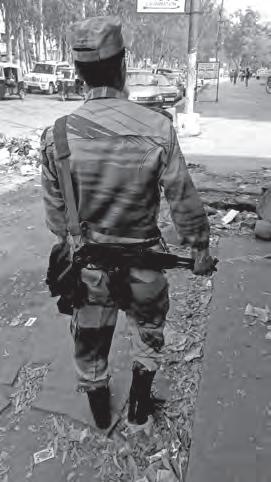
I.2 A post-conflict city and an occupied city: Indian Reserve
cadre patrolling the Super Market
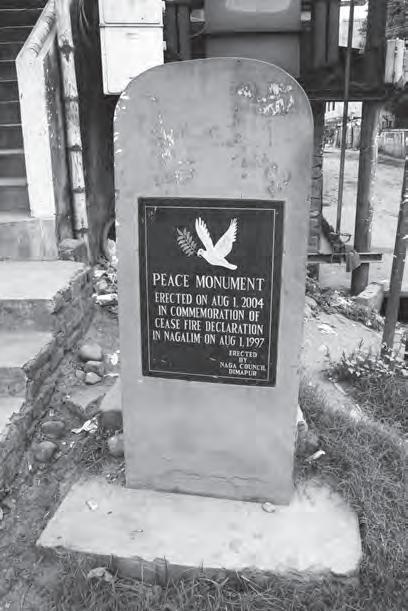
I.3 Peace monument at the Police Colony
I.4 Dr Sheikh: Kiosk wall in front of Hotel Acacia
I.5 Isak Swu’s birth anniversary celebration at Camp Hebron (ceasefire camp)
I.6
I.7 Do-it-yourself extensions using cement and bamboo at Supply Colony
I.8 Grand residence in Dimapur’s ‘Beverly Hills’, Sovima
1.1 Kuki Baptist Church, Half Nagarjan
1.2 Yimchungrü Baptist Church, Half Nagarjan
1.3 Ao Baptist Arogo, Half Nagarjan
1.4 Construction in progress for the neighbourhood church for the Phom community, Supply Colony
1.5
2.1
2.3
2.6 Community infrastructure I: Bamboo garbage platforms, Duncan Bosti
2.7 Community infrastructure II: Patching up the pavement, Dhobinala Road
2.8 The Dimapur Municipal Council promoting urban sensibilities, MP Road
3.1 Jam Studio 11, Diphupar
3.2 Kevi at The Jam Tree—Root in Branch Out
3.3 Alobo Naga at Musik-A
4.1
4.2 ‘Stop Wildlife Crime’, near North Angami Colony Gate
4.3 Community feast as an urban experience
4.4 Local meat for sale in the open air in Duncan Bosti
5.1 Mourners await Khodao Yanthan’s coffin at Camp Hebron
5.2 Coffin draped in NSCN-IM flag, Camp Hebron
5.3 Overcrowded Naga cemetery
5.4 Khekiho Memorial Park, Sovima
5.5 Coffin making in the area around the Super Market
E.1 Ruins of the collapsed bridge looking up at Naga United Colony from the dry riverbed
E.2 Marooned over the river with a temporary footbridge in the background, Naga United Colony
E.3 Anti-corruption signs, 4th Mile bank of the river 215
E.4 Self-made map on the way to Unification Ceasefire Camp
Acknowledgements
Dimapur is no longer an obscure place. It is my good fortune that I witnessed a town turn into a city, but it is even more exciting that I wrote a book about this exceptional city. I want to thank my co-author Duncan McDuie-Ra for taking this adventurous journey with me to explore and wander through Dimapur. Thank you for your courage to dream with me and write this book together. Your friendship, commitment, and wisdom to collaborate and write about a city where desires, dreams, death, and danger surround its residents have profoundly shaped my understanding about frontier urbanism. I am deeply indebted to your intellectual generosity and fellowship. I was born in Dimapur and grew up absorbing the magic of this place. This book was made possible because of the love and faith of the city’s extraordinary residents. Their lives, despite the everyday hardship, inspired me to complete this project. As an anthropologist, I traced the accounts of ordinary citizens who navigate a ceasefire city like Dimapur. I am grateful to Anungla Zoe Longkumer, Tali Angh, Alobo Naga, and Kevi Kiso for helping me connect with the social life of music in the city. I also owe my gratitude to Senti Toy who fostered my intellectual curiosity about the transformation of music in Naga society. Her music, writings, and friendship made me reflect upon the concepts of audibility and musical sensibilities. A community of elders and hunters from Dimapur shared their wisdom and accounts of hunting, and opened up my world to an enchanting yet complex world of urban hunting. The wit, terror, and violence involved in hunting, I hope, will initiate conversations about animals and humans who cohabit in frontier urban spaces like Dimapur. I would also like to thank Abraham Lotha for his generosity and friendship over the last decade during
x
Acknowledgements
which we shared notes about Naga nationalism and anthropology. His role in documenting the life of our Naga leader Late Khodao Yanthan helped me gain an important insight about the politics of belonging and homeland. I am extremely grateful to the team at Home Trust Shop, a coffin store. They are responsible for showing me the everyday experience of living and dying in a ceasefire city.
I also want to thank Nchumbeni Merry for her generosity and time during my fieldwork in Dimapur. She fed me and made sure I had a home to rest. Mhademo Kikon helped me with the logistics of fieldwork; Azung and James offered their hospitality, food, and wonderful friendship; and Susan Lotha took me for a lovely walk around the ADC Court colony and shared her experiences of the city. Akum Longchari and the Morung Express team have always inspired me to embrace Dimapur and engage with the city and its residents. I deeply treasure their friendship and affection. I am grateful to the tribal associations in Dimapur who allowed me to attend their community meetings, picnics, and cultural events.
Finally, I would like to thank my family for being my greatest supporters. The affection of my sisters Julie and Rosemary goes beyond any academic writing project. My mother Mhalo Kikon raised me as a single mother in Dimapur. This book is for your irresistible tribal spirit of survival and living life with courage. My father-inlaw Bijoy Barbora and my sister-in-law Moushumi are my biggest cheerleaders, and it is impossible for me to put it in words how dearly I hold them in my heart. Mhademo, Longshibeni, Kimiro, Samantha, Ishaanee, Chichano, and Tuki: all of you allow me to dream about a meaningful future. And my gratitude to Sanjay (Xonzoi) Barbora, my beloved partner who has supported me throughout the course of this project. Thank you, as always, for your patience and wisdom. To the readers ready to flip through the pages of this book, thank you because you will never ever ask me again, ‘So, where is Dimapur?’
—Dolly Kikon
I would like to thank my co-author and dear friend Dolly Kikon, my friends and family, and the multitude of people in Dimapur who helped with this research.
—Duncan
McDuie-Ra
Introduction
In academic research, the challenge for researchers is to convince their peers and audience that the research is significant, that it is worthwhile. During our research in Dimapur, a far greater challenge was convincing the city’s residents, the people who know the city— or at least patches of it—intimately, that the city itself is even worth talking about. This project began as an exploration of tribal masculinity in 2015. In the course of that research, it became clear that Dimapur was becoming the arena where masculinity plays out, where it is challenged, re-asserted, and fragmented. It is where anxieties over migration, poverty, wealth, corruption, and gender have produced urban crises. These crises happened during the life of this project, and this is the point from where the city took over as our focus. Soon it was clear that Dimapur is not simply an arena or stage for the performance of gender and identity politics or for experiments in different forms of governance; rather, the city is both an arena and a performer. Amin and Thrift (2017: 3) task us with thinking about the ‘overlapping sociotechnical systems’ that undergird cities. Socio-technical systems are not just the material backdrop to a city, the infrastructure upon which life is performed, but also attain relevance in the way in which they ‘insatiate and sustain life’ by ‘allocating resource and reward, enabling collective action, shaping social dispositions and affects, marking time, space and map, maintaining order and discipline, sustaining transactions, moulding the environmental footprint’ (Amin and Thrift 2017: 3). This is an invitation to think of the urban landscape not just as an arena or stage but as a machine. If Dimapur is a machine then the metaphor can be reworked in many ways: a broken machine, certainly, but also a machine that hums away, with half of its parts
Ceasefire City. Dolly Kikon and Duncan McDuie-Ra, Oxford University Press (2021). © Oxford University Press.
DOI: 10.1093/oso/9780190129736.003.0001.
missing or dangling off the sides. The machine keeps going, more parts get added, it sucks in more energy. People fight over it; they are repulsed by it. It breaks down often, and people want to fix it. Yet, those charged with fixing it disagree on what is to be done and even on the nature of the breakdown itself. Some even struggle to see the machine they are to fix.
We encountered this all the time. Once we started to put the city at the centre of the project, the relationship between the city and its residents began to emerge, and it usually emerged when we first broached the topic. Whenever we told respondents, friends, and acquaintances that we were writing a book about Dimapur, their usual response was confusion: Were we really writing a book about the city? This city? Such a response was not a surprise, as we will discuss later in the book, Dimapur remains ‘off the map’ for most people, even its residents. This response would be unlikely if we were writing about Mumbai or Chennai or even a medium-sized city like Amritsar. These are cities with glorious pasts, alternative lives and circulations in literature and film, and arenas where events of consequence to mainstream India have taken place. They are on the map. Dimapur is not. Despite this, we must point out here that Dimapur has been embroiled in the everyday militarization and violence of Asia’s longest-running separatist conflict—the Indo-Naga armed conflict. Along with numerous security camps of the Indian Armed Forces, two designated ceasefire camps of the Naga insurgents—the National Socialist Council of Nagaland Isak-Muivah (NSCN-IM) and the National Socialist Council of Nagaland-Unification (NSCN-U)—in the peri-urban areas make Dimapur an exceptional city.
Upon clarifying to our respondents that we were indeed writing about the city, our conversations would go either of the two ways: One, the person in question would try to redirect us to more legible and legitimate themes of social and political significance. They might suggest customary law, corruption, in-migration, state neglect, and erosion of Naga culture as things that deserve scholarly attention. We would try to explain to them that all of this can be witnessed in Dimapur. Sometimes this worked, but even when it did, the person in question would try to convince us to focus on another place, a ‘better’ place, such as Kohima, the state capital, or one of the district headquarters that are ‘more Naga’. It was as if even though the respondents could accept
that we were studying things that mattered, we were trying to study them in a place that did not really matter. Two, the person in question would remain doubtful that such an endeavour is even possible and, more commonly, worthwhile. Dimapur is difficult to grasp spatially and socially, and even more so politically and economically. This is not only true for researchers and new arrivals but for residents as well. Even if we were able to pin down aspects of the city’s spatial politics and the ways in which residents and transients experience the city, what would it prove? Who really cares about Dimapur? We begin our book with this question firmly in mind.
Who Cares about Dimapur?
The rapid urbanization of India’s Northeast frontier is one of the most crucial transformations the region has witnessed, yet it remains relatively understudied. In the Northeast states, the land being classified as ‘urban’ is expanding, creating new opportunities for developers and capitalists from within the region and beyond, and existing urban areas are becoming denser, more diverse, and more ‘developed’ (McDuie-Ra and Lai 2019). Development in urban areas is material, driven by state and private finance, and ideational in the continued imagining and re-imagining of urban modernity among planners, consultants, and citizens. This is significant anywhere, but in a region where vast tracts of territory and entire communities have been categorized as ‘backward’ for well over a century—a status now coveted and defended by those subject to it—imaginations of urban life and an urban future are in constant circulation.
For us, Dimapur is a fascinating manifestation of urbanization in the Northeast, and, we argue, epitomizes the social, political, and economic changes taking place in the region (and to the region) and the continuities from a past of violence, brutality, exploitation, and resistance to these incursions. Dimapur is a window into contemporary tribal life. It is a place of dreams and nightmares, pride and shame, refuge and insecurity, soldiers and insurgents, priests and politicians, emigration and return, potholes and flyovers, and ruin and rejuvenation. These are not contradictory dynamics; they are routine to the rhythm of the city and to the everyday lives of its inhabitants. Dimapur is, like other militarized landscapes, a
landscape ‘of contact, tension and negotiation between civilians and the military, soldiers and the environment, and between humans and non-humans’ (Pearson 2012: 126). These encounters are not simply between inhabitants of diverse ethnic and racial backgrounds, but between people from all sides and factions in a long-running armed conflict followed by a period of peace and reconciliation. These are not just encounters between people but among different technologies, infrastructures, and socio-legal regimes. Analysing contemporary Dimapur is a window into how a society heals, or tries to, after a long conflict, where those affected are in close proximity to one another, to those who inflicted wounds directly and indirectly. Though not all wounds were inflicted in Dimapur itself, it is a place where many of the wounded and their descendants end up. Furthermore, Dimapur gives insights into governance in a post-conflict setting, a setting located in an economically dependent frontier state with specific constitutional provisions for tribal communities. Although Kohima is the state capital and administrative centre, Dimapur is where the spoils of political life are transformed into mansions, buildings, and businesses. Indeed, Dimapur was the epicentre of an unprecedented political crisis in 2017, a crisis that laid bare the contentious politics between customary and municipal orders, politics that is unlikely to wither in Dimapur or in other tribal cities in the frontier.
There are many cities and sites in South Asia, and even in the Northeast, where the cliché of ‘needing no introduction’ is true. Dimapur is the inverse of such places. It needs an introduction, a sense of the fabric of urban space. And there are precious few existing accounts that we can defer to and build upon. Even residents joke about not knowing the city: partly owing to the migrant flows from the hills and plains to settle in for short and long periods; partly to the village nature of urban space—few spend a lot of time outside their localities except to go to the commercial heart or to their workplaces; and partly as a legacy of decades of violence and insecurity that prevented residents from roaming and wandering around the city
Dimapur is a spectator to the contemporary knowledge of Nagaland. It rarely features in travel writings on Nagaland, despite the lavish attention given to the state by domestic and global travel writers, filmmakers, and guidebook series. If knowing Nagaland means knowing its festivals and exotica, Dimapur is excluded from
knowledge production and circulation about Nagaland and its peoples. Furthermore, it has rarely featured in literature—though this is changing—or films, aside from a few local features, and barely has an online presence. Given this deficit, one of the primary aims of this book is to produce and analyse knowledge of the city, and in turn, the elements of the present conjuncture interwoven into the material and social fabric of Dimapur (Image I.1).
Dimapur is the largest city in Nagaland by population and the third-largest city in the region after Guwahati (Assam) and Agartala (Tripura). It has a population of somewhere between 378,811 (Census of India 2011) and 450,000. The fluctuations really depend upon whether one considers the entire ‘urban agglomeration’, the district, or just adds tens of thousands of people onto official figures to account for the rapid growth since the last Census and the challenges of capturing the city’s floating population. The city is the largest among the hill states of the region that hug the border between India and Myanmar to the east, Bangladesh to the southwest, and China to the
Image I.1 Big-city capitalism following the ceasefire: A Toyota showroom near North Angami Colony
Source: Duncan McDuie-Ra
north. Dimapur is not situated in the hills and, thus, has had more room for growth, though sharing a border with Assam has halted this in parts of the city. It is the largest city in a tribal state, though the city itself is not located in the tribal heartland.
Dimapur presents an urban form that is particular, shaped by decades of conflict followed by 20 years of (partial) peace on the one hand, and instructive of urban dynamics in other parts of Northeast India, on the other. Yet exploring Dimapur is more than a story about growth. It is a story of militarism, capitalism, and urbanism, the three themes that we unravel throughout this book and the themes we believe are integral to understanding contemporary Northeast India, frontier urbanization elsewhere in Asia, and the feasibility of India’s urban fixation in its border areas.
Frontier Urbanism
In this book, we focus on frontier urbanism to tell a story of the present. The social and political changes in the last two decades, starting with the Indo-Naga ceasefire agreement in 1997, led to the rise of numerous peace processes, development programmes, and economic programmes oriented towards propagating ‘progress and development’ across Northeast India. Yet, the last two decades have also recorded increasing unemployment, land alienation, and out-migration from Nagaland and its neighbouring states. At the same time, business deals and contracts primarily centred on mega construction projects, such as new malls, housing projects, and highways, have proliferated. Images of shopping malls and concrete structures are signs of progress and a return to normalcy from decades of armed conflict. We explore the lives and experiences of people within tropes of infrastructure and development discourse, a more conventional approach, and we also present frontier urbanism as a relationship that people create with their surroundings through sound (music), movement (hunting), and loss (dying).
We move away from describing the ongoing developments in the region such as the construction boom, militarization, and the experiences of unemployment as contradictory or distinct historical moments. Rather, we assert that these processes constitute the logic of frontier urbanism. To consider the urban sensibilities and activities
in cities like Dimapur as solely founded on the figure of the Naga insurgent or the Indian security forces is to reject new political and social engagements. In addition, frontier urbanism also helps us to move beyond the dominant framework of studying tribal societies in India. For instance, dominant literature on Naga society is focused on the past or on traditions on the verge of disappearing. While we acknowledge the importance of these conversations, in this book, we focus on the experiences of people who live in the present and deal with the complexities of changes and transformation as urban dwellers. We trace how residents in Dimapur mobilize and ascribe values, and find new ways of defining the meaning of community, identity, and aspirations.
Our aim is to focus on the processes of urbanization and open up new ways of thinking about the city and the complexity of urban life (Brash 2006). By presenting an ethnography of Dimapur, we adopt an analytical lens that interrogates the boundaries that construct Northeast India as an underdeveloped and backward region. In this book, we explore how a distinctive form of urban process comes alive through social relations, networks, and mobility. We refer to this as frontier urbanism. This allows us to examine contemporary lives and how people’s mobility and aspirations shape new relations (musicians as new communities), political imaginations (urban hunting and the dog meat debate), and public spaces (the overflowing graves of Dimapur and anxieties of being buried in a foreign land).
We are firm in our view that urbanization in the Northeast is an essential and under-studied phenomenon that needs to be explored in order to better understand the frontier, its past, and visions for its future. Cities in the hill states of the Northeast do not have a celebrated or even noted urban history, unlike many settlements in the valley areas complete with attention from state archaeologists and archivists. Cities in the hill areas can be considered emerging urban forms that dissolve the urban–rural distinction, particularly when analysed alongside changes in rural areas. This is particularly true of Dimapur where many of the localities outside the commercial centre are still governed as villages and maintain strong connections to ‘home villages’ in the various districts of Nagaland. If we can accept that urban areas in the Northeast are important sites for research into the frontier, change, and continuity, then what makes Dimapur itself
worthy of this level of attention? Why Dimapur? We argue that there are six reasons for focusing on Dimapur, and these also undergird our arguments in the book. We will expand on these in depth here and return to them at various points throughout the book and in the epilogue that concludes the book.
First, as mentioned earlier, Dimapur is the largest city in a tribalmajority state. It is a rapidly urbanizing space in a rapidly urbanizing region. The Census notes a 22 per cent growth rate in Dimapur’s population between 2001 and 2011, a figure for the entire district. The district is divided into eight circles, only three of which are considered urban (and not in their entirety): Dimapur Sadar, Chumukedima, and Medziphema. The population growth rate in these circles over the same period was 72.66 per cent. The population in rural circles declined in the same period ( 6.3 per cent), with dramatic declines in Niuland ( 62.27 per cent) and Nihokhu ( 36.84 per cent). These figures have several issues. The degree of land reclassification and misclassification (as either urban or rural) is difficult to determine in this data, though it has some interesting effects on the ground in the city where several areas outside the municipal boundaries are urban in form. Furthermore, and most significantly, there has been controversy over the 1991 and 2001 censuses in Nagaland. The censuses were marred by suggestions that the population figures were inflated to boost numbers of certain communities, a suspicion highlighted following an overall population decrease in the 2011 Census (see Agrawal and Kumar 2012; Jeermison 2011). Indeed, Chief Minister Neiphiu Rio publicly refuted the data from the 2001 Census in 2011 (Nagaland Post 2011). If inflated, the 2001 figures would mask the pace of urban growth even further, assuming 2011 is more rigorous. Going back further, the first Census record of Dimapur’s population was 5,753 in the 1961 Census, before Nagaland had been officially created; 12,426 in 1971; and 32,315 in 1981, though these predate the formation of the Dimapur District in 1997 (Census of India 2011). Perhaps the most useful figure to draw out from all this is that between 1981 and 2011 the population increased by a factor of ten. Despite limitations, it is possible to conclude at the very least that urban Dimapur is growing rapidly and the rural areas on the fringes are shrinking. And if the 2011 figure is to be trusted, it is the third biggest city in the Northeast and the biggest in a tribal majority state
This brings us to our second point. Dimapur is the epitome of an emerging urban form and thus gives us the opportunity to frame, albeit tentatively, frontier urbanism as a research agenda in India. The transformations taking place in the frontier are largely urban, with consequences for rural areas to be sure, yet the relationship between the two is constitutive. As Verstappen and Rutten (2015: 232) demonstrate in their study of Anand in Gujarat, towns and small cities function as ‘node(s) of interconnection between rural urban and local global mobility’. Dimapur functions in a similar way, yet it also draws migrants from other parts of India and across international borders; migrants instrumental in shaping the city through its infancy. In McDuie-Ra’s (2016) book on Imphal, a centuries-old city and the capital of neighbouring Manipur, the city is analysed as the site of several projects aimed at recalibrating the city through exogenous and endogenous imaginations of connectivity. Imphal’s location close to the border with Myanmar and to infrastructure connecting it with other parts of India (via Dimapur) is instrumental in reimagining the city as a gateway, a corridor of dual connectivity linking India to Southeast Asia, and in the process, linking the frontier to India. At the same time, the city is the site of intensive and often violent politics of belonging and exclusion between Manipur’s ethnic communities and ‘outsiders’, culminating in vociferous demands to implement the restrictive Inner Line Permit system. Thus, the city is simultaneously viewed as a transnational hub and an exclusive domain. Dimapur, by contrast, is a kind of blueprint to be emulated.
Dimapur is located in a tribal majority state protected by various constitutional provisions, yet it is a migrant city, attracting people from across the Northeast, from other parts of India, and from across international borders, drawn to its opportunities and peculiar cosmopolitanism. We believe that Dimapur is indicative of the kinds of urban futures that will shape the region in the coming decades. Baruah (2015: 1) alludes to this when discussing the anxiety over migration in Dimapur and suggests that
What worries so many Naga activists and politicians about Dimapur are exactly the things that serious thinkers about northeast India’s economic future find promising. The region’s future prosperity, they believe, lies in the ability to create more Dimapur-like open economic spaces in the hill states of the region.
Whether one agrees that this will be beneficial or not, as successive Indian governments look for ways to integrate the frontier into the nation beyond (but not instead of) military occupation, market expansion is crucial and the development of urban areas is a vital mechanism to accumulate capital and assuage the highly protective land regimes in tribal areas. Dimapur is perhaps the ideal urban environment: it is situated in a tribal state but somehow separate, a zone of ethnic, legal, and political pluralism. However, as two urban crises demonstrate, the first in 2015 following a public lynching (discussed in Chapter 1) and the second in 2017 over proposed changes to municipal governance (discussed in Chapter 2), there is delicacy here too.
This brings us to our third point: Dimapur is more than just a city. As a zone between the hills and plains, between tribal and nontribal space, between shifting cultivation and settled agriculture, between civilization and savagery, Dimapur is a spatial experiment. Kar (2009: 60) proposes that the British Inner Line Permit System, which separated hills and plains into different administrative regimes and has persisted into postcolonial India, is ‘a line in time’. He adds that the ‘advance of the Line on map was read as the progress from pre-capital to capital, from the time of “no law” to the time of “law”’ (Kar 2009: 60). If we keep the metaphor of the line in mind, then Dimapur is a squiggle in that line: a dip, a loop, or perhaps an inkblot. It is situated in the foothills that are subject to territorial claims by the Indian state, the federal state governments of Assam and Nagaland, and various non-state actors (see Kikon 2019), yet in Dimapur, these claims are tempered. This does not mean such claims are absent, and, as we will discuss in later chapters, the borders and edges of the city are in a constant flux through expansion, contraction, and transgression. Furthermore, the city can be cut off from other parts of the frontier by blockades, protests, and bandhs emanating from these claims.
Our point here is that Dimapur is an experimental territorial form. It is an in-between zone, an enclave carved out of Assam to connect the newly formed state of Nagaland to India in the process of an ongoing armed conflict. It is a swathe of terrain straddling Nagaland and Assam, hills and plains, tribal land and non-tribal land, simultaneously remote and connected, parochial and cosmopolitan,
and for our purposes, knowing Dimapur grounds the politics and past of the frontier in lived urban space. We regard the city itself as a frontier of sorts, echoing what Eilenberg (2014) refers to as a ‘frontier constellation’. In discussing agrarian expansion in the Indonesia–Malaysian borderlands, Eilenberg uses ‘frontier constellation’ to analyse ‘the multiple meanings and notions associated with regions where resource frontiers and national borders interlock’ (Eilenberg 2014: 159). By exploring militarism, capitalism, and urbanism in Dimapur, we analyse the meanings produced and affixed to this in-between space, the territorial units it rubs up against, and the flows that pass through it. In doing so, we argue that Dimapur reveals what Rasmussen and Lund (2018: 389) call ‘the vernacular political forms that constitute emergent institutions and struggles over legitimate rule’. We are interested in attempts by a raft of state, non-state, and state-like actors to exert spatial control in Dimapur, the places where it succeeds, breaks down, is resisted and contested, and where no one seems to bother. These attempts, we argue, reveal dynamics of territory, rule, and rupture that are commonly abstracted in studies of the region, taken at face value from the claims of key actors, or unravelled through discussions of identity politics and ethnonationalist movements. We explore them on the ground in a city, an enclave, where they converge.
Fourth, despite the booming commercial veneer and the ceasefire agreement between the NSCN-IM and the Indian government in 1997, Dimapur is a city governed under extraordinary laws with a substantial military presence. As noted earlier, Dimapur not only hosts the Indian military and paramilitary, but it is also home to the ceasefire camps for the NSCN-IM and the NSCN-U—a veritable city within the city—known as Camp Hebron and Camp Vihokhu. Both ‘sides’ in the decades-long conflict now cohabit the city in their various fortifications with the civilian population strewn in between. The city is simultaneously a post-conflict city and an occupied city, suggesting the limits, and perhaps the nature, of demilitarization in the Northeast and its coexistence with market expansion (Image I.2).
Fifth, Dimapur has been a city of conflict but also a city of refuge for people escaping the direct impact of conflict in Nagaland, in neighbouring polities, and the ecological and economic ruin of militarization. It is, as Debbarma (2017) points out in the case of
Image I.2 A post-conflict city and an occupied city: Indian Reserve Battalion cadre patrolling the Super Market
Source: Duncan McDuie-Ra
Agartala in nearby Tripura, a kind of ‘colonial settler town’, yet the colonizers in Dimapur, as in Agartala, are not always obvious. At the same time, this conflict brought migrants to the city from other directions seeking opportunities that had accelerated after the ceasefire. It is a city of migrants, of settlement and resettlement, owing to its geography, topography, and its place—or non-place—in the political and cultural imagination of communities of the frontier. Despite its size and commercial significance, Dimapur is ‘off the map’. The map here refers to the political and cultural map of Nagaland, furthering the notion of an enclave, a zone, a constellation of undeclared exception from the authorities that govern the territories surrounding it; except, of course, the laws protecting the armed forces. Given this diversity and this history, Dimapur is a city where the ‘recovery of the everyday’, the coming to terms with ‘the fragility of the normal’ (Mehta and Chatterji 2001: 202), is being ‘refashioned’ after decades of extreme violence and brutality. Much of the population is in a perpetual attempt to recover the everyday; an everyday that is itself unstable in urban space lived among barracks and under extraordinary laws (Image I.3). Finally, Dimapur allows the opportunity to begin an account of the Northeast, and Nagaland in particular, from a position of modernity. Wouters and Heneise (2017: 8) posit that the richness of ethnographic writing on Nagaland in the colonial period is not matched by the post-colonial, creating ‘a decades-wide ethnographic void’. Indeed, studies of tribal communities in the Northeast rarely begin with modern subjectivities, instead locating modern subjectivities (if at all)
Source: Duncan McDuie-Ra
as antagonisms for traditional practices and worldviews, temptations responsible for inter-generational schisms, or the teleology of social change. Taking tribal communities seriously as active (rather than passive) modern subjects continues the work that we have started elsewhere, exploring migration, work, and race (Kikon and Karlsson 2019; McDuie-Ra 2012a, 2015a). It also builds upon the work of scholars exploring the formation of class in the Northeast and Nagaland in particular (Küchle 2019); sacral worlds, their politics, and their global connections (Joshi 2007; Mepfhü-o 2016; Pongen 2016; Thomas 2015); religious revivals (Longkumer 2016); engagement with Indian politics and consumer cultures (Longkumer 2019; Wouters
Image I.3 Peace monument at the Police Colony
2015); and emerging film, photography, art, literature, and material cultures (Baishya 2018; Kaisii 2017; Kuotsu 2013; Pachuau and van Schendel 2015; Toy 2010; von Stockhausen 2014).
As Mbembé and Nuttall (2004: 352) have argued in their work on African cities, attention to urban spaces serves ‘to identify sites within the continent, entry and exit points not usually dwelt upon in research and public discourse, that defamiliarize common-sense readings of Africa’. They add, ‘such sites would throw people off their routine readings and deciphering of African spaces. Identifying such sites entails working with new archives—or even with old archives in new ways. One such archive, as we explore in detail in this issue as a whole, is the metropolis itself’ (Mbembé and Nuttall 2004: 352). This mirrors our intention to approach contemporary tribal worlds, and those who dwell in them, through a study of the largest city in a tribal state.
Starting with Dimapur enables us to begin the process of ‘defamiliarization’ in a multi-ethnic, mostly non-agrarian, consumerdriven, densely populated space, where the daily tactics, aspirations, and activities of urban dwellers narrate a very different Northeast, a very different Nagaland, and a very different tribal society than depicted in studies that have dominated the field in the past. We hope this will also destabilize ‘routine readings’ of Nagaland and Northeast India more broadly.
Militarism, Capitalism, and Urbanism
Dimapur’s present conjuncture is poised between order and crisis. It is a pivotal moment, and one that is instructive for other parts of the frontier. We characterize Dimapur’s conjuncture through three themes: militarism, capitalism, and urbanism; themes that we analyse through a set of linked concepts discussed here. ‘Conjuncture’ is a concept with a long history in Gramscian thought and varies in different disciplinary traditions (see Hall 1986; Jessop 2005; Kipfer and Hart 2012). It disappears and reappears, and these trajectories are complex and beyond the scope of what we are trying to achieve in this work. For our purposes, we take a fairly loose definition of conjuncture as a ‘complex formation of an historical moment’ (Koivisto and Lahtinen 2012: 276). It is not the ‘conceptual dictator’
but an analytical tool to identify the ‘many determinants of concrete reality, and thus open up new possibilities for political interventions’ (Koivisto and Lahtinen 2012: 276). Crucial for us is Hall’s well-known imploration to see things ‘not as you’d like them to be, not as you think they were ten years ago, not as they’re written about in sacred texts, but as they really are: the contradictory, stony ground of present conjuncture’ (Hall 1989: 151). This is essential both for our research on Dimapur and for research on the Northeast in general, which can be characterized by dated assumptions and predetermined arguments rather than attention to circumstances. Focusing on conjuncture asks us to analyse continuity and change, the material and social, as constitutive of the present, the stony ground.
In short, we are interested in the forces that have shaped contemporary Dimapur (even if we cannot fully explain them), the ways they manifest in the city, and the ways people navigate these in their everyday lives. We have grouped them into three loose themes: militarism, capitalism, and urbanism. Capitalism captures the history of Dimapur as a supply outpost, a frontier between hills and plains bound up in resource extraction, infrastructure expansion, and the expansion of the conflict economy. Following the ceasefire in 1997, capital has expanded rapidly and has transformed urban space: former insurgents have turned to business; migrants send remittances back to families in Dimapur to start ventures; money from resource extraction on tribal lands is ploughed into property and business ventures; the ‘easy money’ culture buoyed by transfers from the Indian government takes material form in similar ways; and Dimapur is an integral node in the recalibration of the Northeast from a frontier to a market for everything from consumer goods to personal finance.
Militarism traces the centrality of the Indian Armed Forces in the development of the city materially and the lived experience of the city socially. The military is not just a presence, it is an active agent in shaping the city and the lives of those who live in it and move through it. Military infrastructure (‘developed’, technologically advanced, and gated) is juxtaposed with civilian infrastructure (broken, uneven, and impractical) and community infrastructure (improvised, pragmatic, and exclusive). The size and scale of military infrastructure in Dimapur is astounding and has extended the city in various directions
as the land in between military barracks and housing is gradually filled with new settlements. These ‘encampments’, to use Pieris’s phrase in reference to military barracks in Colombo and Jaffna, serve to normalize military presence as part of the fabric of the city and also serve as a ‘concealer’ of violence (Pieris 2014: 395).
Dimapur is militarized outside the barracks too. Any space is open to the armed forces. They are mobile throughout the city and, under the extraordinary provisions of the Armed Forces Special Powers Act 1958 (AFSPA), can go wherever they please: public and private, street and house, and market and pathway. The AFSPA gives legal protection to the Indian military and paramilitary for any acts committed against the civilian population in ‘disturbed’ areas (see Mathur 2012). It also grants the armed forces the right to enter any premises, arrest and detain civilians suspected of committing or of being ‘about to commit’ any ‘cognizable’ offence indefinitely, and prevents the gathering of more than five people. The presence of other armed forces under local command adds another layer of militarism, one with a local face and local ties. These overlapping authorities have given rise to a ‘culture of impunity’, a term Kikon uses to describe the rise in domestic and sexual violence in Naga society during the time of the ceasefire (Kikon 2016). Outside Dimapur, soldiers of the NSCN-IM are housed in Camp Hebron and the NSCN-U cadres live in Camp Vihokhu, sites that function as both settlements and offices of these parallel governments. Hebron and Vihokhu loom over the city; taxation and other payments made by city businesses to the insurgent organizations are processed in these camps, but these sites are more than that. Based on how the ceasefire talks have progressed in the 2010s, decisions made in the ceasefire camps around Dimapur (and beyond) could have a major impact on the city depending on the nature of sovereignty agreed upon and the reactions of excluded NSCN factions and neighbouring states, especially Manipur (see Chasie and Hazarika 2009; Kolås 2011; Misra 2003; Shimray 2004). As with the armed forces, former insurgents and their kin groups including clan members and families exist throughout the city and shape the urban environment as members of communities, activists, politicians, and capitalists. Some thrive, some struggle. The point here is that all ‘sides’ in a long-running conflict live in the city, making claims and
counterclaims on urban space, on symbols of sovereignty, and on who does what, when, where, and at what cost.
We use ‘urbanism’ as an umbrella term for the near and far processes of making Dimapur look and function ‘like a city’. An urban focus at the national level has redirected development towards urban development through various schemes and institutional restructuring, discussed in Chapter 2. At the same time, the dismantling of the Planning Commission in 2015, which was replaced with National Institution for Transforming India (NITI) Aayog (see Patnaik 2016), has major implications for the Northeast as it was the main source of annual budget for a Special Category 1 state like Nagaland. This has given new impetus to states to gain funds for urban development by making urban areas in the frontier more ‘city-like’. Obviously, this has major consequences for a city the size and importance of Dimapur. There are also local drivers of urbanism, including the revised Nagaland Municipal Act 2001, reviving a formerly weak form of governance in India (Denis et al. 2012), one that created incentives for classifying areas as rural rather than urban in the past. This is shifting. However, the revised Nagaland Municipal Act 2001 has been a source of tension in Nagaland.
Most areas of the city that lie away from the commercial centre operate as villages despite being urban in form, and are governed by village authorities under customary law. Governing neighbourhoods as villages in the city can be highly effective in some areas and ineffective in others. The locality goanbura or the ‘headman’ is the go-to person for all kinds of works, ranging from attesting documents and getting proof of residence to resolving disputes between neighbours. However, sanitation work, such as garbage collection or maintaining sewage, falls outside the control of a customary authority like the headman. The municipal authority takes up these matters, yet fails to connect localities and the infrastructure needed to extend and maintain pipes, roads, wires, and so on across the city. Irrespective of these complex and overlapping authorities, attempts to change the existing structure are emotive as some groups see them as a threat to customary law, as shown in the political crisis of 2017, a theme we discuss later in the book. Urbanism is not solely about governance: it is about making order by policing space; marking boundaries within the city and on its edges; creating
showpiece developments, such as the Eiffel-esque City Tower and the neo-traditional market space known as Urban Haat; and it is about the ways in which Dimapur’s residents respond, resist, and make place and mark it ‘from below’.
The task we undertake in this book is to explore the present conjuncture in Dimapur. Militarism, capitalism, and urbanism have shaped the present order, and have the city poised between becoming a model for urban development in the region and descending into crisis. Picking apart these elements through reading the material and social worlds of the city is the main task of Part I of this book. We then focus on narratives of people, places, and objects that reveal the ways people (and some animals) navigate the city, its order, and its conjuncture and disjuncture. As Li (2014) demonstrates in her recent work on capitalist relations in upland Sulawesi, ethnographic approaches animate conjunctures by unravelling the ways in which people experience a particular conjuncture and the ways it shapes their subjectivities and their agency. Indeed, in Dimapur, the conjuncture is not simply the result of things being done to the frontier (by India, and before that, by the British), but things that happen in the frontier caused by an array of subjects with varied forms of agency.
Approaching Dimapur
This book is a collaboration between two scholars whose primary research field is Northeast India and primary method is ethnographic. We have worked together previously, and this book developed out of conversations during our regular trips to the Northeast with friends and peers. From 2015 to 2019, we worked closely to portray the images of everyday lives in Dimapur, a city we started visiting together. Without making a spectacle of the militarized lives and the distressing stories about loss, migration, poverty, and corruption that we heard during our visits, we began to reflect on the ways of surviving and living in this city. These stories were connected to people across the city who became our friends and interlocutors, granting us access to their dreams and aspirations of making it in Dimapur. Collaborative ethnography holds many possibilities for capturing and harnessing the craziness of Dimapur. Collaborative ethnographies can offer us improvised ‘ethnographic technique and analysis’ (Bourgois and