Sanjoy Chakravorty, Devesh Kapur, and Nirvikar Singh
Social Justice through Inclusion
Francesca R. Jensenius
Dispossession without Development
Michael Levien
The Man Who Remade India
Vinay Sitapati
Business and Politics in India
Edited by Christophe Jaffrelot, Atul Kohli, and Kanta Murali
Clients and Constituents
Jennifer Bussell
Gambling with Violence
Yelena Biberman
Mobilizing the Marginalized
Amit Ahuja
The Absent Dialogue
Anit Mukherjee
When Nehru Looked East
Francine Frankel
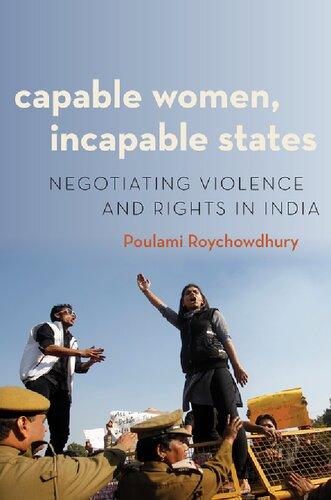
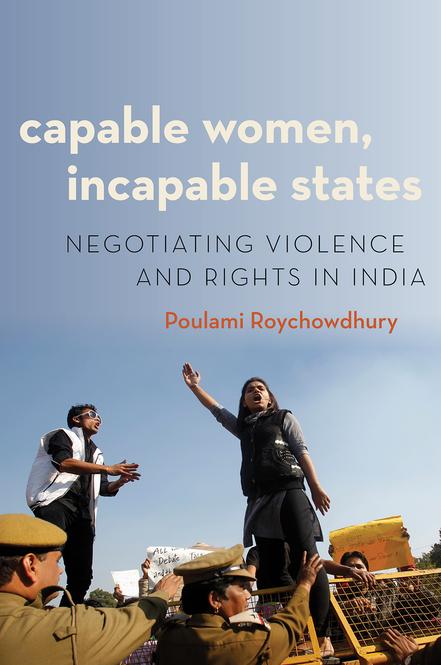
Capable Women, Incapable States
Poulami Roychowdhury
Capable Women, Incapable States
Negotiating Violence and Rights in India
POULAMI ROYCHOWDHURY
1
Oxford University Press is a department of the University of Oxford. It furthers the University’s objective of excellence in research, scholarship, and education by publishing worldwide. Oxford is a registered trade mark of Oxford University Press in the UK and certain other countries.
Published in the United States of America by Oxford University Press 198 Madison Avenue, New York, NY 10016, United States of America.
All rights reserved. No part of this publication may be reproduced, stored in a retrieval system, or transmitted, in any form or by any means, without the prior permission in writing of Oxford University Press, or as expressly permitted by law, by license, or under terms agreed with the appropriate reproduction rights organization. Inquiries concerning reproduction outside the scope of the above should be sent to the Rights Department, Oxford University Press, at the address above.
You must not circulate this work in any other form and you must impose this same condition on any acquirer.
Library of Congress Cataloging-in-Publication Data
Names: Roychowdhury, Poulami, author.
Title: Capable women, incapable states : negotiating violence and rights in India / Poulami Roychowdhury.
Description: New York, NY : Oxford University Press, [2021] | Series: Modern South Asia series | Includes bibliographical references and index.
Identifiers: LCCN 2020016073 (print) | LCCN 2020016074 (ebook) | ISBN 9780190881894 (hardback) | ISBN 9780190881900 (paperback) | ISBN 9780190881924 (epub)
LC record available at https://lccn.loc.gov/2020016073 LC ebook record available at https://lccn.loc.gov/2020016074
1 3 5 7 9 8 6 4 2
Paperback printed by Marquis, Canada
Hardback printed by Bridgeport National Bindery, Inc., United States of America
for Anita & Ashis Roychowdhury my Ma and Bapi
Acknowledgments ix
List of Abbreviations xiii
CONTENTS
SECTION I OPENING
1. Introduction: Endeavor 3
2. Stalled: The Landscape of Domestic Violence 22
SECTION II NEGOTIATIONS
3. Running a Family: Women’s Reasons for Reconciliation 39
4. The Business of Mediation: Why Organized Actors Intervene 53
5. Incentivizing the Law: How Organized Actors Change Women’s Preferences 68
6. Under Pressure: Law Enforcement’s Sense of Victimization 82
7. Avoid and Delegate: Law Enforcement’s Responses to Women’s Claims 92
SECTION III CITIZENS
8. Running a Case: The Praxis of Law 109
9. Aspirational and Strategic: The Subjectivity of Law 127
10. Justice by Another Name: What Women Gained from Running Cases 140
11. The Allure and Costs of Capability 151
12. Conclusion: Capability Without Rights 165
SECTION IV APPENDICES
Appendix A Methodological Discussion 181
Appendix B Key Legal Reforms 191
Appendix C First Information Report 195
Appendix D Domestic Incident Report 197
Notes 203 References 207 Index 221
ACKNOWLEDGMENTS
Books can be long, lonely affairs. I could not have written this book without financial support or without the generosity of others. And I would not have wished to write it without the company of family and friends. First: financial support. The department of Sociology at New York University accepted me, gave me a degree, and paid me to read, learn, and run around the world for five years. When those five years proved to be insufficient, the department provided further support through the Georgette Bennett dissertation writing fellowship. The National Science Foundation and Fulbright saw promise in what in hindsight appear to be relatively unpromising research proposals. I hope this book testifies to the value of funding long-term qualitative research, research that may not be easily quantifiable or have simple policy solutions attached to it but which seeks to expand the reader’s emotional and intellectual horizons.
After I returned from India, the Consortium for Faculty Diversity allowed me to spend a blissful year writing in residence at Smith College, where the Department of Sociology provided a cozy office and collegial atmosphere. Once I became an assistant professor at McGill University, the Canadian federal government and Quebec’s provincial government understood the value of qualitative work in international settings. I am thankful to the generous funding provided by the Social Sciences & Humanities Research Council of Canada and the Fonds de Recherche du Québec.
Second: generosity. Countless people occupy the pages of this book. They cannot be named, but without their time and attention, I could not have completed this research. They invited me into their homes and places of work, talked to me openly about experiences that are difficult to talk about, and put up with my inquisitive and at times overbearing presence as they went about their daily lives. I am indebted to them and sincerely hope to have translated their lives honestly and sympathetically.
Another set of hidden actors made this book possible. They do not show up on these pages, even under pseudonyms. But they helped craft the intellectual currents that allowed me to write. Without them, this book would make much less sense. First and foremost, my advisor Lynne Haney: my academic role model and someone I enjoy having drinks with. I always feel smarter and more energetic after seeing you. Judith Stacey, Sally Merry, Steven Lukes: you were all active and substantive members of my dissertation committee. I think about gender, social inequality, and law differently because of you. Ann Orloff: you ceaselessly organize reclusive academics, encouraging us to support each other and think about the direction of the field. You do not have to provide all this effort and care, but you do it anyway. Shelley Clark, my mentor at McGill: you set an example of unwavering commitment to research, honesty, and warmth. Raka Ray: you took an NYU student under your wing and provided advice from afar. Patrick Heller: you took the time to meet an unknown graduate student so many years ago and believed in this book. Ashutosh Varshney: thanks for publishing the book. Harsh Mander, Pratiksha Baxi, Radhika Govindrajan, Madhav Khosla: thank you for reading an early manuscript and providing insightful and kind comments. Blair Peruniak: the index would have been a complete mess without you. Martin Chandler: you deserve full credit for the lovely maps.
Third: friends and family. This is a blurry category, which significantly overlaps with those who helped mold my intellect. Dwai Banerjee, Nishaant Choksi, Misha Chowdhury, Sandipto Dasgupta, Durba Mitra, Debashree Mukherjee, Matt Murrill, Jyoti Natarajan, Francesca Refsum Jensenius, Andrew Rumbach, Neelanjan Sircar, Pavithra Suryanarayan, Nishita Trisal, Anand Vaidya: conducting research and writing about it would have been much less enjoyable, not to mention feasible, without you. You sustain me with humor, advice, and adda. Issa Kohler-Haussman, Alison McKim, Daniel Aldana Cohen, Ashley Mears, Abigail Weitzman, Madhavi Cherien, Nadda Matta, Max Besbris, Anna Skarpelis, and all the members of my cohort: you made NYU a respite from the occasional indifference of the city. Mike Levien, Smitha Radhakrishnan, Gowri Vijayakumar: you enliven the sociology of South Asia, and I am glad to have you as comrades in the discipline. Abigail Andrews, Savina Balasubramanian, Marie Berry, Jennifer Carlson, Anna Korteweg, Jordana Matlon, Rhacel Parrenas, Celene Reynolds, Leslie Salzinger, Evren Savci, Nazanin Shahrokhni, Laurel Westbrook: your contributions to the sociology of gender and your company at our annual gender meetings sustain me. Michelle Cho, Merve Emre, Shanon Fitzpatrick: our writing club was short-lived but crucial. I miss those of you who moved away and will physically bar those who have not from leaving.
Trying to summarize my thanks to my parents, Ashis and Anita, in a few short sentences seems a slightly pointless exercise. But I will say this: thank you for always putting my education first and for setting an unattainable standard of kindness. It was through your example that I came to wonder and care about the
lives of others. I am not necessarily the kind of doctor you wanted me to be, but hopefully you are amused that instead of saving people’s lives, I can engage them in detailed intellectual debates. Finally, my best friends and dearest loves. Sohel, I wrote this book despite your efforts to make me into a sleep-deprived zombie. But you are still the best thing that ever happened to me. Brandon, thanks for reading what I write and providing substantive feedback. I am sorry I have no idea what you are doing at that computer of yours, though I have a sense you are helping people access affordable healthcare. I am a lucky lady indeed, getting to end and begin each day with you.
LIST OF ABBREVIATIONS
ADM additional district magistrate
CPI(M) Communist Party of India (Marxist)
DIR Domestic Incident Report
DM district magistrate
DSP district superintendent of police
FIR First Incident Report
GD General Diary Report
IC inspector in charge
IPC Indian Penal Code
mahila samiti women’s association
OC officer in charge
panchayat elected village council
PO protection officer
PWDVA Protection of Women from Domestic Violence Act, 2005
shalishi community-based arbitration
SP superintendent of police
TMC Trinamul Congress Party
125, CrPC Section 125 of the Code of Criminal Procedure, 1973 498A, IPC Section 498A of the Indian Penal Code, 1983
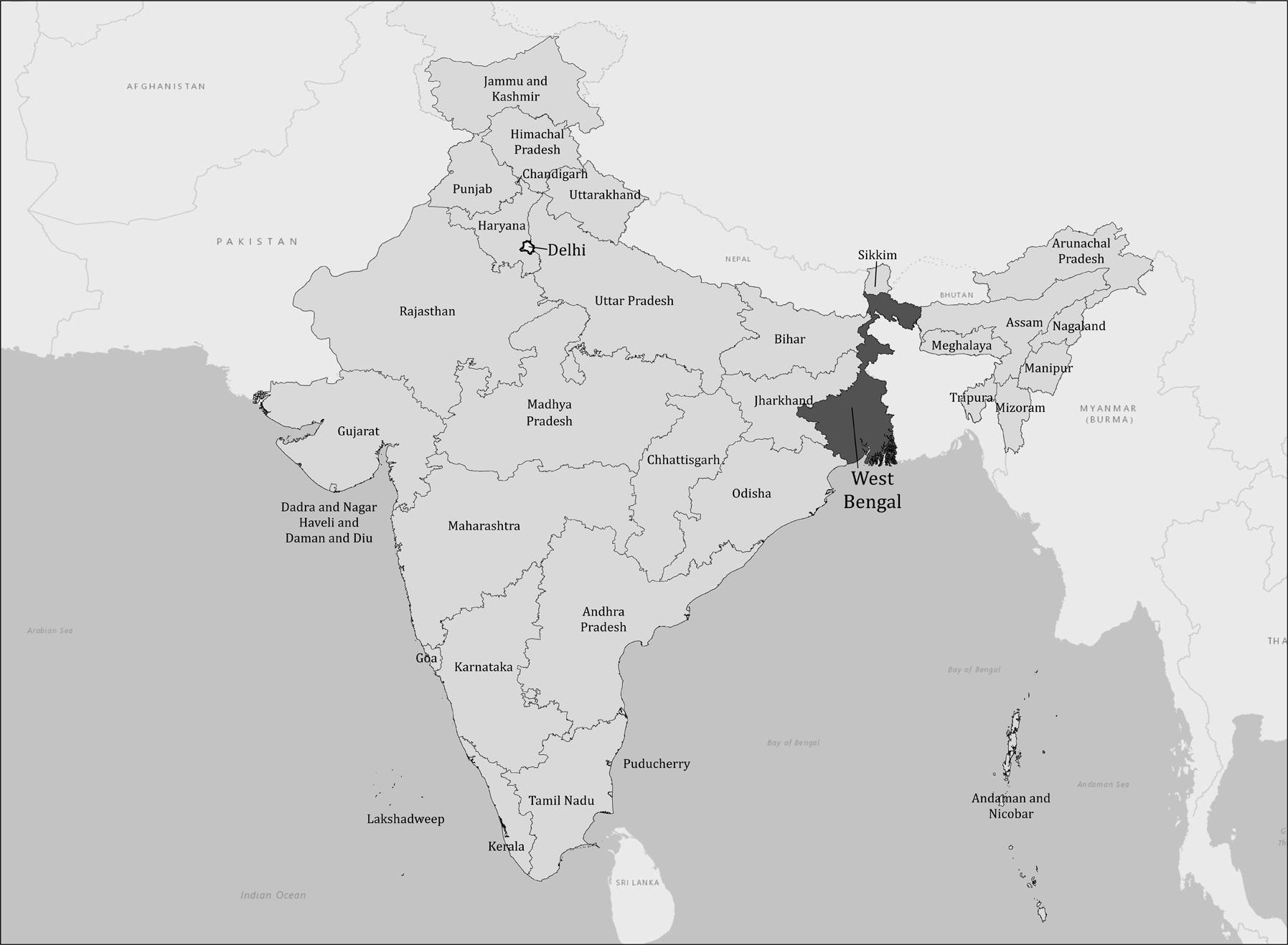
States of India map. Scale [ca. 1:27,290,000]. Data layers: Vijay Meena: GIS file of India State, District and Tehsil Boundaries; Esri, HERE, Garmin, OpenStreetMap, and the GIS User Community: World Light Gray Canvas Base [computer files]. McGill University, Montreal, QC: Generated by Martin Chandler, April 3, 2020. Using: ArcGIS Pro [GIS]. Version 2.4.2. Redlands, CA: Esri, 2019.
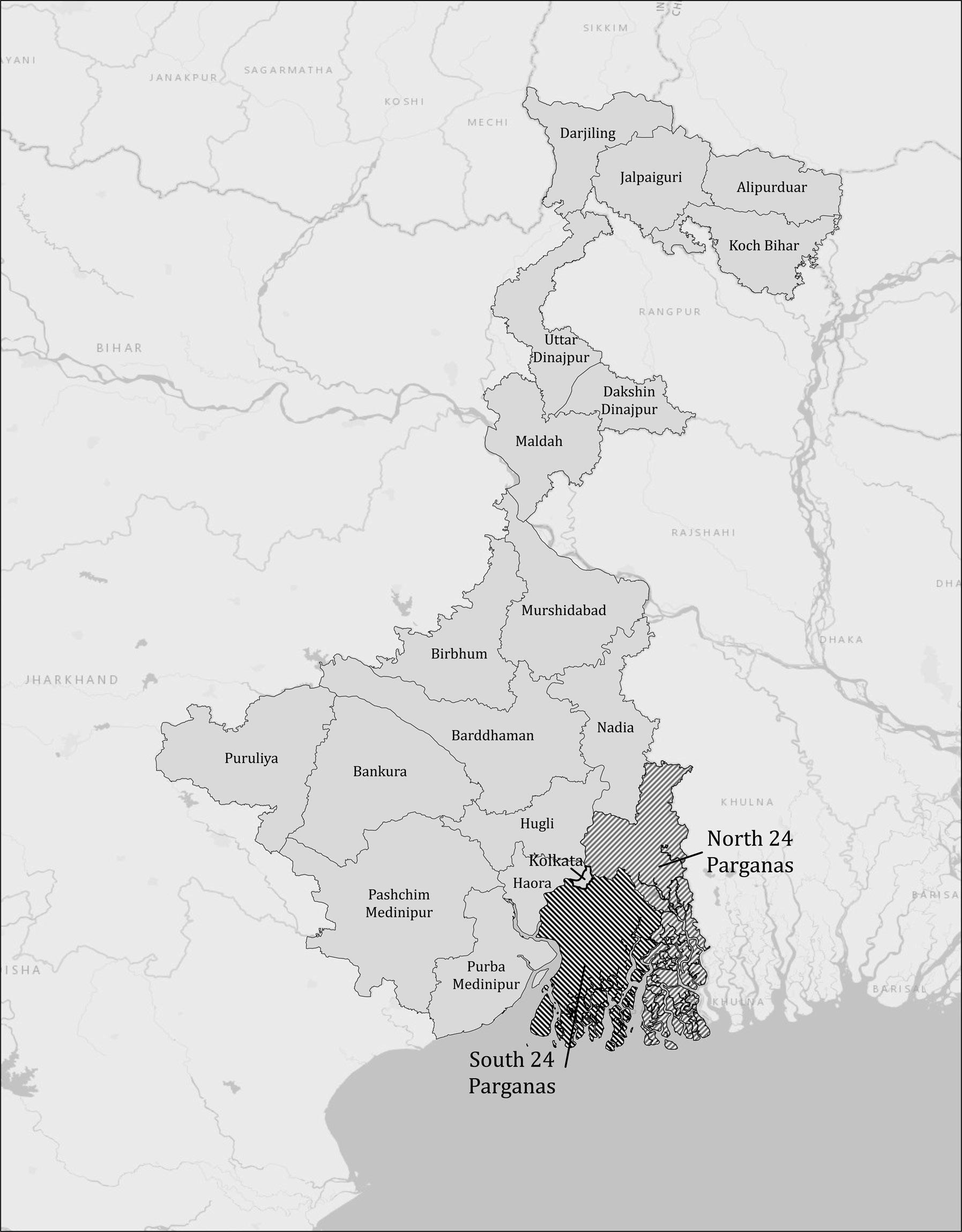
Districts of West Bengal map.
Scale [ca. 1:1,750,000]. Data layers: Vijay Meena: GIS file of India State, District and Tehsil Boundaries; Esri, HERE, Garmin, OpenStreetMap, and the GIS User Community: World Light Gray Canvas Base [computer files]. McGill University, Montreal, QC: Generated by Martin Chandler, April 6, 2020. Using: ArcGIS Pro [GIS]. Version 2.4.2. Redlands, CA: Esri, 2019.
SECTION I OPENING
1 Introduction
Endeavor
By eleven o’clock in the morning, the courthouse was already running behind schedule. Located in the neighborhood of Alipore in Kolkata, the South-24 Parganas District Magistrate’s Court resembled a postcolonial rendition of Dickens. The plaza in front of the main building buzzed with lawyers, typists, and vendors doing a brisk business in luchi (fried bread) and ghoogni (split pea curry). The atmosphere inside the courthouse was decidedly less festive. Bundles of yellowed, brittle paper lined each cube-shaped room: tangible reminders of all the legal suits that had been filed and forgotten. Frustrated litigants clogged the hallways. They shuffled up and down struggling to follow their lawyers’ legal jargon and coalesced in small groups in doorways and staircases, seeking solidarity against the endless indifference.
Navigating past the constable who manned the front door, I made my way to the courthouse’s top floor. Rupa was waiting for me, zealously guarding a seat on a broken bench. Despite its missing legs, the bench was favorably positioned below a ceiling fan that provided respite from the heat. We had entered May, one of the least benign months on the Indian calendar. A hundred years back, the British would flee the city at this time, driving pell-mell for the hills to escape the burning plains. But far from running away, Rupa had traveled to the city from her village. Inhaling exhaust and braving two hours of traffic, she endeavored to make progress on her domestic violence case. And so she waited, perched precariously on a sloping bench.
In her early thirties, Rupa had the appearance of someone older. Fine lines creased her forehead. Her eyes evidenced an exhaustion her energetic movements seemed calculated to defy. She had a penchant for bright colors and dark lipstick. But for her days in court, she aimed to look more conservative. Wearing carefully pressed tunics, her long hair neatly confined in a ponytail, she moved and spoke slowly and tried not to raise her voice. Outside the courthouse, she proudly recounted her rebellious nature. Born into a poor, lowercaste family and educated until the sixth grade, Rupa’s rebellion started at the
age of fourteen when she defied her parents and ran away with her boyfriend. By her mid-twenties, she found herself on her own with a young son to take care of, her husband having abandoned her after years of sexual abuse.
Knowing little about her rights and lacking the language to articulate her experiences as violence, Rupa unintentionally moved toward a legal claim. One of her neighbors, an older woman with political connections, introduced her to a panchayat (village council) representative known to work on women’s behalf. The panchayat representative pointed her to a mahila samiti (women’s association). The mahila samiti referred her to a women’s nongovernmental organization (NGO). The NGO provided rights education and legal counseling for women experiencing various forms of gender-based violence. Soon after Rupa entered the NGO, she found herself registering a case under Section 498A of the Indian Penal Code, the criminal law against domestic violence.
By the time I met her, Rupa’s case was in its tenth year. On that particular morning, she was in court because her ex-husband had filed an appeal. The original court decision had been in Rupa’s favor. He claimed to have unearthed new evidence to prove his innocence. Rupa worried about the time, money, and emotional costs her case had exacted. Yet, despite such burdens, Rupa continued to believe in the promise of rights and insisted that things were changing for women.
What was changing was sometimes unclear to her. But in her own words, she claimed “I have capabilities in the palm of my hand.” She understood she had been abused and deserved compensation. She was friendly with powerful people, could navigate government offices, and knew how to work the system. At the NGO that supervised her case, she had trained to be a caseworker. She now made a living helping other women claim rights against violence. Through her casework, she had become something of a person of consequence in her village. And the very act of doing what she referred to as “running a case” (case calano) felt empowering. Her exertions produced a sensation of personal influence over the legal process. And at the end of it all, like the horizon that always receded, there lay the dream of legal redress: the more enchanting for its perpetual unattainability. It was all rather seductive.
Unfulfilled Promises
Rupa arrived at the courtroom that morning by braving hours of exhaust and traffic. But her journey into the rooms of the Indian criminal justice system mapped a longer history of women’s struggle. Fifty years back, she would not have been sitting on that bench because India did not recognize domestic violence as a crime. Now, she was technically entitled to protection and
compensation for the harms she had suffered. But it was unclear when, and if, she would attain those promises.
States ostensibly guarantee rights in exchange for obligations, such as paying taxes and voting (Bloemraad et al. 2008). Rights, however, have historically faced a discrepancy. You can have them on paper but not in practice. The discrepancy between rights on paper and rights in practice plagues women experiencing gender-based violence today. As I write these words, at least 144 countries have passed laws against domestic violence (UN Women 2019). Yet, law enforcement personnel implement rights unevenly, and women who claim rights face retaliation, ill health, and social isolation (Choo 2013; World Health Organization 2013).1
India provides a key example of this more general disjuncture. Legislators have passed both criminal and civil reforms. Section 498A of the Indian Penal Code criminalizes “physical and emotional cruelty” within marriage.2 The Protection of Women from Domestic Violence Act (PWDVA) provides civil remedies to women in a range of domestic relationships. Sadly, legal reforms are poorly administered.3 Law enforcement routinely suppress charges, refuse to initiate mandatory procedures, leave investigations pending, and fail to enforce verdicts (Burton et al. 2000; Mahapatra 2014). By 2018, Section 498A had the lowest conviction rate of all crimes prosecuted under the Indian Penal Code, and 10.9 percent of tried cases were illegally “compromised” out of court. Meanwhile, PWDVA cases had a higher chance of leading to a court order than 498A cases. But a mere 616 PWDVA cases were registered countrywide (National Crime Records Bureau 2018).
Noting the deadly consequences of this enforcement void, women’s rights organizations have gotten involved in the nitty-gritty of case processing. Activists and caseworkers accompany women to court, pressure law enforcement to register complaints, and form alliances with other civil society groups to advocate on women’s behalf. Routine intervention at the level of individual complaints has made domestic violence an increasingly politicized issue not just at the legislative level but at the level of local criminal justice institutions. As was the case for Rupa, diverse organizations with multiple and at times contradictory agendas weigh in on individual complaints.
This book is about women like Rupa, women who approach the Indian criminal justice system for rights against domestic violence. It examines the aftermath of legal reforms, asking how they have altered women’s lives and relationships to the state. And through this in-depth analysis of the Indian case, the book poses a larger question about the possibilities and pitfalls of rights in vast areas of the world: places where gendered violence is a political issue, yet criminal justice institutions remain incapable and unwilling to enforce legal mandates. How do women claim rights within these conditions, and what happens to them when
they do? How do law enforcement respond to their claims, and why? What kinds of governmental regimes and gendered citizens emerge in these contexts?
Collective Claims, Official Failures, and Extralegal Gains
For two years, I ethnographically tracked seventy women who were experiencing domestic abuse. I also conducted in-depth interviews with law enforcement personnel and a range of civil society actors who provided legal assistance. This research generated three key findings. First, women rarely claimed rights on their own. They distrusted law enforcement and feared they would either be ignored or further violated if they directly appealed to the criminal justice system. Instead of seeking rights as individuals, women systematically approached the state through organized groups: NGOs, mahila samiti, political parties, criminal networks.
Second, very few women received formal legal remedies in the process of claiming rights. Of the seventy women I tracked, only ten secured some kind of criminal or civil remedy and did so only after interminable waits. My qualitative findings mirrored country-level trends in case disposition, conviction, and enforcement. Since the 1990s, domestic violence cases have remained pending for longer periods of time, conviction rates have fallen, and fewer court orders are enforced. I found that these official failures structured the daily lives of the women I met.
Third, women who tried to access legal rights made notable extralegal gains. By approaching law enforcement through organized channels, they learned how to be financially independent and became knowledgeable about the public sphere and, at times, physically aggressive. They negotiated financial settlements, forcibly repossessed children and jewelry from abusive husbands, accessed paid employment, expanded their social networks, built women’s groups, and became involved in politics. And they made sense of their transformations through a gendered discourse of self-transformation and empowerment.
How did all of this happen? Initially, the women I met wished to avoid a legal case. Lacking concrete definitions of “domestic violence,” they nonetheless felt aggrieved. Most of them responded to their aggrievement by hoping their abusers would reform so that they could “run a family”: continue to share a household with their abusers and jointly take care of children and aging parents. They looked to various local authorities for mediation and conflict resolution: neighbors, family, friends, political party members who lived in their area. They hoped these people would scold their husbands and fix their relationships.
They also believed that their gender entitled them to financial care and physical protection from people around them.
But the best-laid plans of mice and men often go awry. The very people who were supposed to help women “run a family” connected them to a range of organizations and actors who pushed them in a different direction: toward the law and toward “running a case.” The organizations that transformed women’s grievances into legal cases included women’s NGOs, mahila samiti, political parties, and criminal gangs. Women’s rights mobilizations against domestic violence had spawned a wider organizational field where all sorts of civil society groups weighed in on women’s complaints. These organizations did not all promote women’s rights, nor did they all believe that women were oppressed. What they shared was a strategic orientation toward women’s legal engagements, where they brokered disputes for their own political and organizational purposes.
Women who had the kinds of complaints that served institutional interests were taken up and pushed forward by organizational personnel. Thus, despite their initial efforts to avoid the law, women ended up engaging with legal concepts and interacting with law enforcement personnel in some fashion or other. Their brokers helped articulate their grievances as instances of domestic violence. And these same brokers incentivized legal engagements by attaching material and social rewards to the law: providing medical care and financial help, job training, new social networks, and therapy. Brokers also provided the organizational resources and social networks women needed to become visible to law enforcement bent on ignoring them. Brokers helped women negotiate with criminal justice institutions, threatening and cajoling law enforcement to be somewhat responsive.
As a result, when women approached the criminal justice system, they did not interact with law enforcement as individuals with individual complaints. They brought collective claims visibly embedded in complex, unpredictable, and threatening organizational alliances. Law enforcement personnel who were only too happy to suppress individual women’s complaints sang a different tune when women arrived with organized backing. They feared organized women might disrupt daily operations, threaten their job security, or unleash violence on their physical person.
Feeling disempowered, law enforcement adopted the path of least resistance. They did not complete the tasks necessary for case processing, but neither did they suppress charges. Instead, they “incorporated” organized women and their supporters into the regulation of violence. Law enforcement “incorporated” women in two ways: by reassigning casework and by telling them to replace a formal complaint with “parallel claim.” They reassigned casework by telling women to complete paperwork, unearth evidence, and secure witnesses. At other times they told women to run “parallel claims,” by threatening their
perpetrators, extracting extralegal concessions, and carrying out extra-judicial punishments.
“Incorporation” resembles other forms of neoliberal governance where states govern from a distance, minimizing risk and work by encouraging civilians to manage social problems (Ferguson and Gupta 2002; Rose 2000). But “incorporation” is also specifically gendered. It is devised by state actors who are misogynist but feel compelled to appear minimally responsive when their authority is challenged. And it relies on the gendered notion that certain women are threatening and can fend for themselves.
In the process of becoming “incorporated” by the state, women learned to practice the art of “capability.” Women with diverse complaints dreamed of acquiring money, political power, social influence, and independence by participating in the legal process. Instead of withdrawing, they remained embroiled in cases that dragged on for absurdly long periods. Like Rupa, many of them made a career out of helping other women get involved in a similar, seemingly never-ending dispute process. They remained engaged because legal ventures simultaneously helped them access otherwise inaccessible resources and produced a sensation of empowerment. They learned how to navigate the public sphere, negotiate with powerful state officials, forge social networks, access employment, threaten abusive husbands, and extract extralegal concessions.
Alongside these benefits, “capability” also entailed hard work, exposing women to the possibility of retaliatory violence, and sometimes leaving them socially isolated. Women found themselves struggling to complete many of the tasks law enforcement refused to perform. They were asked to confront the very people who had abused them. And many of them took these steps with very few financial resources and little by way of family support. As a result, not all women were able to be capable. Those who were lucky enough to have social, political, and financial capital had a significant leg up in the capability game, as did those who by dint of personality were fast learners and more courageous. Others fell behind, occasionally blaming themselves for their setbacks, arguing that if they had been more “capable” things would have turned out differently.
Moving Beyond State Protection and Victimhood
I did not anticipate finding what I found because the vast literature on gender, violence, and states had trained me to expect something else. Gender and legal scholars who analyze the effects of legal rights overwhelmingly argue that rights create protectionist governance regimes where state officials selectively award entitlements to “good victims”: women who are docile, are passive, and fit hegemonic definitions of femininity (Bumiller 1987; Minow 1992). At the heart of
these arguments lies a theory about how rights are or are not translated into practice: members of the criminal justice system decide how rights are realized, and they base their decisions on social bias. In the case of women, law enforcement personnel use gendered norms linked to class, race, sexuality, and other social categories to determine what kind of woman is actually recognized as a rightsbearing citizen (Collins 1998; Crenshaw 1991; Incite! 2007; Razack 1995).
This basic argument spans work on both post-welfare states like the United States and postcolonial, developing countries like India. In the post-welfare context, legal scholars highlight how state officials have co-opted women’s rights in a broader project of expanding a “culture of control” and promoting carceral solutions (Bernstein 2012; Bumiller 2008; Garland 2012; Gelsthorpe 2004; Halley et al. 2006). In the realm of domestic violence, mandatory policies allow law enforcement personnel to prosecute cases without the consent of the victim and use protection orders to physically separate abusive men (Buzawa and Buzawa 2003; Coker 2001; Connelly and Cavanagh 2007; Corsilles 1994; Dixon 2008; Suk 2006). Culturally prevalent notions of women’s vulnerability undergird this logic of masculinist protection: the notion that the state needs to protect certain kinds of women—read white, middle-class, straight, chaste—from certain kinds of men—read black, working-class, sexually perverse (Hollander 2001; Young 2003).
Scholars of India argue that, if anything, the dynamics of state protection and victimhood are heightened within the Indian criminal justice system. Protectionist legal measures span back to the colonial era. British responses to sati (widow immolation) and child marriage presupposed that Indian women needed to be protected from violent Indian men (Mani 1998; Sangari and Vaid 1999; Spivak 1988). After India gained independence, protectionist policies cropped up in numerous arenas related to violence against women: from skirmishes with Pakistan over “abducted women” to internal battles over minority rights within family law (Das 1996; Menon and Bhasin 2011; Pathak and Sunder Rajan 1989). This state of affairs has led some to argue that even the stories of infamous women outlaws, such as Phoolan Devi, who overpower and threaten law enforcement highlight the hegemonic gendered features of state power and the extent to which the Indian state is framed around “protecting” virtuous women (Sunder Rajan 2003).
Those who focus on domestic violence argue that the broader discourse of victimhood finds traction among activists, policy makers, and law enforcement. Many women’s rights activists feel they have to establish their nationalist credentials by promoting an image of Indian women’s exceptional innocence and vulnerability to violence (Kapur 2012). Similarly, legislators promote the language of victimhood, positioning themselves as guardians of women’s modesty and virtue (Agnes 2005; Jaising 2005). Judges and police officers exhibit a