Fichte’s 1804 Wissenschaftslehre
Essays on the “Science of Knowing”
Edited by
Benjamin D. Crowe and Gabriel Gottlieb
Published by State University of New York Press, Albany
© 2024 State University of New York
All rights reserved
Printed in the United States of America
No part of this book may be used or reproduced in any manner whatsoever without written permission. No part of this book may be stored in a retrieval system or transmitted in any form or by any means including electronic, electrostatic, magnetic tape, mechanical, photocopying, recording, or otherwise without the prior permission in writing of the publisher.
For information, contact State University of New York Press, Albany, NY www.sunypress.edu
Library of Congress Cataloging-in-Publication Data
Names: Crowe, Benjamin D., 1976– editor. | Gottlieb, Gabriel, editor.
Title: Fichte’s 1804 Wissenschaftslehre : essays on the “Science of knowing” / edited by Benjamin Crowe and Gabriel Gottlieb.
Description: Albany : State University of New York Press, [2024] | Series: SUNY series in contemporary continental philosophy | Includes bibliographical references.
Identifiers: LCCN 2023015638 | ISBN 9781438495958 (hardcover : alk. paper) | ISBN 9781438495965 (ebook)
Subjects: LCSH: Fichte, Johann Gottlieb, 1762–1814. Wissenschaftslehre 1804 (1st version) | Fichte, Johann Gottlieb, 1762–1814. Wissenschaftslehre 1804 (2nd version) | Philosophy, German—19th century.
Classification: LCC B2848 .F565 2024 | DDC 193—dc23/eng/20231108 LC record available at https://lccn.loc.gov/2023015638 10 9 8 7 6 5 4 3 2 1
Acknowledgments ix
Abbreviations xi
Introduction 1
Gabriel Gottlieb and Benjamin D. Crowe
Chapter 1
Part 1. The Continuity Question
The Absolute and the 1804 Wissenschaftslehre 11
C. Jeffery Kinlaw
Chapter 2
“You Can’t Get There from Here”: Fichte’s (Unwritten) 1799 Review (nach der Principien der Wissenschaftslehre) of the 1804 Wissenschaftslehre 33
Daniel Breazeale
Chapter 3
The First Principle in the Later Fichte: The (Not) “Surprising Insight” in the Fifteenth Lecture of the 1804 Wissenschaftslehre 61
Michael Lewin
Chapter 4
Fichte’s Reader and the Autopoiesis of the Wissenschaftslehre, 1794–1804 79
Andrew J. Mitchell
Chapter 5
Part 2. Key Concepts
Into Death’s Lair: Truth, Appearance, and the Irrational Gap in Fichte’s 1804 Wissenschaftslehre 97
Matthew Nini
Chapter 6
Nothing Remains: Notes on Fichte’s “Irrational Gap” in the 1804 119 Wissenschaftslehre
F. Scott Scribner
Chapter 7
Pure Light and the Promethean Self of Fichte’s 1804 Wissenschaftslehre 131
Kit Slover
Chapter 8
The Odyssey of the “Through” (das Durch) 145
M. Jorge de Carvalho
Chapter 9
The “We” of Speculative Philosophy 173
Benjamin D. Crowe
Chapter 10
Part 3. System and Idealism
The Quintuple Quintuplicity of Forms of (Self-)Consciousness in Fichte’s 1804 Wissenschaftslehre 193
Emiliano Acosta
Chapter 11
Immanent Thinking and the Activity of Philosophizing in Fichte’s 1804 Wissenschaftslehre 215
Angelica Nuzzo
Chapter 12
Fichte’s 1804 Wissenschaftslehre: A Possible Reply to Schelling’s Bruno 235
Michael Vater
Chapter 13
Fichte contra Idealism in the 1804 Wissenschaftslehre
Chapter 14 The Self-Justification of Fichte’s Philosophy
Jacinto Rivera de Rosales†
Chapter 15 Blockchain as Fichtean Problem
Chapter 16 Is Fichte a Kantian, a German Idealist, Both, or Neither?
Acknowledgments
This volume collects papers presented by an international group of scholars at the Fourteenth Biennial Meeting of the North American Fichte Society (May 22–25, 2019), which was dedicated to “The Wissenschaftslehre of 1804” and held at Xavier University in Cincinnati, Ohio. Approximately a year after the conference, while we were still at the beginning stages of putting this volume together, COVID-19 hit, and our lives, the lives of the contributors, and the lives of practically every Earthling were radically changed. Both of us were also raising newborns and toddlers during the pandemic, which challenged us in unexpected ways. Due to these circumstances, the volume took much longer than expected to organize and edit. We are truly grateful to our contributors as well as Michael Rinella and our collaborators at SUNY Press for their patience and support during these years.
We’d especially like to thank Dan Breazeale and Tom Rockmore for passing the torch to us as co-positors of the North American Fichte Society. We’d like to thank both Elizabeth Millán Brusslan for her support of this project and the anonymous reviewers who provided detailed and invaluable feedback on the manuscript. We are also grateful for the support of our wives (Kristen and Kristin) and our children who kindly put up with our Fichte fanaticism.
We dedicate this volume to the life and memory of Jacinto Rivera de Rosales, poet, philosopher, teacher, translator, muscian, and friend of Fichteans everywhere. Jacinto passed away October 15, 2021, and while he is greatly missed by the community of Fichteans worldwide, we will forever be indebted to his essential contributions. May his memory be a blessing.
Abbreviations
Throughout the volume we use the title 1804 Wissenschaftslehre to refer to the second series of lectures on the Wissenschaftslehre delivered between April 16 and June 8, 1804. These lectures are collected in J. G. Fichte-Gesamtausgabe der Bayerischen Akademie der Wissenschaften, Reihe II, Band 8, and translated by Walter E. Wright as The Science of Knowing: J. G. Fichte’s 1804 Lectures on the Wissenschaftslehre. This translation is used throughout, except where noted. We use superscripts to distinguish citations to the three-lecture series (18041, 18042, 18043), but the title 1804 Wissenschaftslehre, for the purposes of this volume, is only used to refer to the 18042 series of lectures.
18042 The Science of Knowing: J. G. Fichte’s 1804 Lectures on the Wissenschaftslehre, trans. Walter E. Wright (Albany: State University of New York Press, 2005).
AA Immanuel Kant, Gesammelte Schriften (Berlin: de Gruyter, 1902ff).
EPW Fichte: Early Philosophical Writings, ed. and trans. Daniel Breazeale (Ithaca, NY: Cornell University Press, 1988).
FNR Fichte, Foundations of Natural Right, ed. Frederick Neuhouser, trans. Michael Baur (Cambridge: Cambridge University Press, 2000).
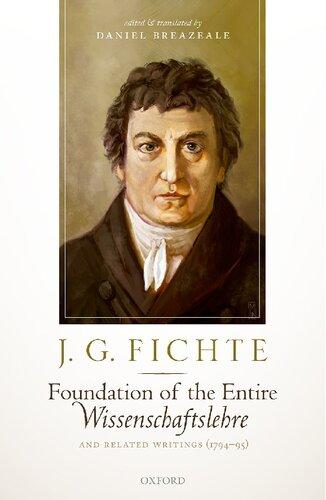
FEW Fichte, J. G. Fichte: Foundations of the Entire Wissenschaftslehre and Other Writings (1794–1795), ed. and trans. Daniel Breazeale (Oxford: Oxford University Press, 2021).
FTP Fichte: Foundations of Transcendental Philosophy (Wissenschaftslehre) nova methodo, ed. and trans. Daniel Breazeale (Ithaca, NY: Cornell University Press, 1992).
GA J. G. Fichte-Gesamtausgabe der Bayerischen Akademie der Wissenschaften, ed. Erich Fuchs, Reinhard Lauth†, and Hans Gliwitzky† (Stuttgart-Bad Cannstatt: Frommann-Holzboog, 1964–2012).
GWL Fichte, Grundlage der gesammten Wissenschaftslehre (1794/1795).
IWL Fichte, Introductions to the Wissenschaftslehre and Other Writings, ed. and trans. Daniel Breazeale (Indianapolis, IN: Hackett, 1994).
SE Fichte, System of Ethics, ed. and trans. Daniel Breazeale and Günter Zöller (Cambridge: Cambridge University Press, 2005).
SK Science of Knowledge, trans. Peter Heath and John Lachs (Cambridge: Cambridge University Press, 1970).
SS Fichte, System der Sittenlehre (1798).
SW Johann Gottlieb Fichtes sämmtliche Werke, ed. I. H. Fichte, 8 vols. (Berlin: Viet & Co., 1845–1846); rpt., along with the three vols. of Johann Gottlieb Fichtes nachgelassene Werke (Bonn: Adolphus-Marcus, 1834–1835), as Fichtes Werke (Berlin: de Gruyter, 1971).
WLnm[H] Fichte, Wissenschaftslehre nova methodo (“Halle Nachshrift,” 1796/1797).
WLnm[K] Fichte, Wissenschaftslehre nova methodo (“Krause Nachschrift,” 1798/1799).
Introduction
Gabriel Gottlieb and Benjamin Crowe
There is little doubt that Fichte’s reputation as a philosopher is largely built upon the published writings of what is known as his Jena period, roughly 1793–1799. These were incredibly productive years for him, even if one cites only the three major works published while he was teaching and living in Jena: Foundation of the Entire Wissenschaftslehre (1794/1795), Foundations of Natural Right (1796/1797), and The System of Ethics (1798). When one considers his essays, lectures, and, particularly, his attempt to revise the Wissenschaftslehre according to a new method (the Wissenschaftslehre nova methodo), his time in Jena looks to be his most philosophically potent period, especially since it is these works that were available to students and his contemporaries and that shaped his reception during much of the nineteenth and twentieth centuries.
It is not surprising, then, to find that much of the scholarship on Fichte’s philosophy, especially in the Anglo-American tradition, has focused on his Jena writings. Such a narrow focus is, however, unfortunate. After fleeing Jena due to the Atheism Controversy, Fichte did not stop expanding and revising the Wissenschaftslehre once he arrived in Berlin.1 In fact, his productivity continued with the publication of “popular” philosophical works that stem from his time in Berlin: The Characteristics of the Present Age (1806), The Way towards the Blessed Life, or on the Doctrine of Religion (1806), and Addresses to the German Nation (1808). These works are not systematic elements of the Wissenschaftslehre, but they do, in their own unique ways, take for granted core elements of the Wissenschaftslehre. Yet, by the time these works were initially conceived and finally published, Fichte had
| Gabriel Gottlieb and Benjamin D. Crowe
reoriented his Wissenschaftslehre away from the idea that the entire science must be grounded in the self-activity of the pure I and toward a model of the Wissenschaftslehre where absolute being or oneness (rather than the absolute I) takes on a more prominent role.
Fichte’s 1804 lectures on the Wissenschaftslehre, delivered in three different series, amount to one of his most thorough and radical reformulations of his philosophical system. The second series of lectures are the best known and were first translated into English as the Science of Knowing by Walter E. Wright in 2005. It is this series of lectures that serves as the primary work under investigation in the present volume.
The “Aphorisms on the Essence of Philosophy as a Science” (1804), a short unpublished piece of writing summarizing this second series of lectures he delivered between April 16 and June 8, 1804, the set of lectures examined herein, furnish a valuable perspective for understanding the lectures as a whole. Fichte explains that “the system” he names Wissenschaftslehre, what he also calls here logologia or simply “reason,” proceeds by presenting the “primordial oneness of being and consciousness.”2 Traditionally, philosophers take being, he notes, as the relevant object of study. The aim is to address how knowledge of being’s multiple determinations is possible. This is the case for classical philosophical doctrines, including Plato’s forms, Descartes’s thinking thing, or Spinoza’s substance. Yet being, Fichte insists, arises only within consciousness and consciousness arises only with being, a point previous philosophers, except for Kant, failed to appreciate. The object of study for philosophy, then, ought to be not simply being or consciousness but their unity, or oneness. The task of philosophy, as Fichte notes, is to trace multiplicity back to absolute oneness, which is, at the same time, to present “the absolute.”3
This second series of lectures (hereafter, the 1804 Wissenschaftslehre) consists of two related parts: the First through Sixteenth Lectures provide an ascending analysis and construction of being, eventually arriving at the “fundamental principle”: “Being is entirely a self-enclosed singularity of immediately living being that can never go outside itself.”4 The goal, in presenting the absolute, is to present an absolute devoid of any disjunction, or a set of terms opposed to each other that are not resolved by some higher dialectical synthesis that discharges the disjunction in favor of oneness. The Seventeenth through Twenty-Eighth Lectures offer a construction of the appearing of being in its multiplicity. The difference between the multiplicity in the first half and the second is that the former is a factical multiplicity; once multiplicity is constructed as appearance or image, it has, in virtue of its construction from the absolute, shed its status as merely factical. In return, multiplicity is
genetically constructed and grounded, rather merely given. Put differently, one might say that the given is conceived, once the ascent from absolute oneness is achieved (if it ever is), not as an assumed given that draws on what we might take to be obvious facts about the nature of experience but as a justified given required for the intelligibility of knowing itself.
Fichte delivered these lectures four times a week between April 16 and June 8, 1804. His audience included prominent members of the reformist administration that was in power in Prussia at that time. Men such as Altenstein, minister of education; Hardenburg, foreign minister and minister of finance; and Beyme, justice minister who eventually played a crucial role in the founding of Berlin’s first university in 1809, all took a lively interest in Fichte and in his thought by conscientiously attending these and other lectures during this period. Fichte’s audience also included around fifteen female attendees, including his wife Johanna and Henriette Herz (1764–1847), a prominent member of Berlin’s Jewish cultural elite and the convener of a famous salon frequented by the likes of the Schlegel and Humboldt brothers, Schleiermacher, and other literati. On Sundays, Fichte convened “Conversatoria” for interested parties who wished to query him in a less formal setting about key concepts and arguments in the lectures. Despite his lack of a formal academic post, Fichte still called upon a devoted coterie of brilliant students.
Fichte’s absolute oneness as presented in the 1804 Wissenschaftslehre is an attempt, as listeners would have fully appreciated, to present a form of absolute idealism that responds to Schelling’s identity philosophy, a transition in Schelling’s philosophy that initiated a break or rupture between Fichte and Schelling; it additionally addresses Hegel’s charge of subjectivism in his Differenzschrift. 5 Schelling was familiar with Fichte’s absolute idealism as first developed in the 1804 lectures, but, it seems, primarily in the popular form they take in the Blessed Life, a work Schelling critically examines in his Statement on the True Relationship of the Philosophy of Nature to the Revised Fichtean Doctrine. 6 Hegel, however, appears largely indifferent to the postJena developments of Fichte’s philosophy, as he continues throughout his career to take Fichte’s Jena writings as the paradigmatic representation of Fichte’s Wissenschaftslehre
The 1804 Wissenschaftslehre was not actually published until 1834 as part of the unpublished works included in the collected works (the Sämmtlichen Werke) edited by Fichte’s son Immanuel Herman. Both Fichte’s original manuscript, and the “clean copy” he prepared (as was his custom) following the conclusion of the lectures, are now lost. In the early twentieth century, a librarian in the city archives of Halle (which had boasted a reformist university
Gabriel Gottlieb and Benjamin D. Crowe
until Prussia’s defeat by Napoleon in 1806–1807) discovered a “copia” of the lectures in a hand other than Fichte’s. The critical edition of Fichte’s works reproduces both I. H. Fichte’s version and the copia on facing pages, making it clear that (despite divergences) these derive from the same source (most likely Fichte’s own copy). Since its publication, these lectures have increasingly influenced Fichte’s European reception and, since their translation by Walter E. Wright as The Science of Knowing, his Anglo-American reception.
Since Fichte’s 1804 Wissenschaftslehre was not published during his lifetime, its influence was not immediate. One historically consequential engagement with these lectures is found in Emil Lask’s Fichtes Idealismus und die Geschichte (1902), which examines and employs Fichte’s neologism “facticity.” Lask’s engagement with Fichte importantly influenced Lukács and Heidegger, with the latter transforming the concept of facticity for the purpose of characterizing the thrownness of Dasein, a move that made the concept essential to phenomenology and continental philosophy more generally.7 There is, it should be noted, an ever-growing literature in German on Fichte’s 1804 Wissenschaftslehre 8 As scholarship in English explores Fichte’s Berlin writings with greater attention, Fichte’s 1804 lectures will prove essential to making sense of novel directions his work pursues. Walter Wright, the translator of The Science of Knowing, has rightly called Fichte’s 1804 lectures “one of the masterworks in the European philosophical tradition,” which represents the “pinnacle of Fichte’s efforts to present his fundamental philosophical system.”9 After reading these essays in this volume, we hope you might find yourself agreeing with Wright’s perhaps controversial claim.
This volume is organized, roughly, into three categories: (1) chapters that in one way or another address the relationship of the 1804 Wissenschaftslehre to Fichte’s Jena presentations of the Wissenschaftslehre, (2) chapters that focus on a key concept or set of concepts from the 1804 Wissenschaftslehre, and (3) chapters that examine issues related to Fichte’s conception of system and idealism. We recognize that some could fit easily in one or another category, but our hope is that this categorization will provide the reader with some general guidance regarding the central themes of each chapter.
In part 1, “The Continuity Question,” fall the papers of C. Jeffrey Kinlaw, Daniel Breazeale, Andrew J. Mitchell, and Michael Lewin. Kinlaw’s chapter nicely sets out the terms of the debate: Fichte’s focus on absolute being or oneness looks to commit him not to the transcendental philosophy of his Jena writings but to a form of transcendent dogmatism. While Kinlaw is hesitant to provide a full-throated defense of the continuity view, the view that the absolute of the 1804 Wissenschaftslehre is continuous with the absolute I of his Jena project, Kinlaw sketches one line of attack in
support of the continuity view. In contrast, Daniel Breazeale, in what one might consider a work of creative nonfiction, imagines a review, composed by Fichte himself in 1799, of a recently discovered manuscript from 1804 (somehow it found its way back in time) that presents a new version of the Wissenschaftslehre. Here we have Fichte, in a sense, unwittingly reviewing his own work. On Breazeale’s imaginative interpretation of Fichte’s reading of the 1804 Wissenschaftslehre, we see the ways in which the latter work departs from or is discontinuous with the Jena project. Michael Lewin offers a reading that bypasses the continuity view (absolute being is a version of the absolute I) and a version of the discontinuity view (the absolute is essentially God), the latter of which results in a form of transcendent dogmatism. Relying on the didactic resources of analogical thinking, Lewin offers a reading that accounts for Fichte’s surprising identification in the Fifteenth Lecture of “being” with “absolute I.” Finally, Andrew J. Mitchell also sees in the 1804 Wissenschaftslehre a departure from Fichte’s earlier writings, but here the lack of continuity is more narrowly circumscribed: the reader or listener is meant to enact the content of the Wissenschaftslehre, according to the Jena writings, while in the 1804 lectures she is meant to “host” the Wissenschaftslehre, thereby taking on at key moments a more passive position, one in which freedom is not a prerequisite for the construction of the Wissenschaftslehre.
Part 2 addresses “Key Concepts” developed in the 1804 Wissenschaftslehre. Two chapters address what Fichte calls the “irrational gap,” a gap that opens up between the absolute and appearance, or the movement from the absolute to the multiplicity of consciousness. Matthew Nini’s interpretation of the 1804 Wissenschaftslehre argues that the irrational gap is resolved by what he calls the “singularity thesis”—the absolute and consciousness are a singularity, outside of which nothing properly is, and the doctrine of appearances is developed on the basis of the singularity thesis, thereby allowing a move from singularity to a phenomenology of life. F. Scott Scribner, in contrast, takes a more skeptical approach to Fichte’s attempts to address the problem of the irrational gap, as he sees each attempt to resolve the gap as arriving at a supplement that threatens to undermine the project of the Wissenschaftslehre. Kit Slover’s chapter provides an interpretation of the structure and meaning of “pure light,” M. Jorge de Carvalho addresses the meaning and role of Fichte’s nominalization of the preposition durch as das Durch, and Benjamin D. Crowe takes Fichte’s conception of the “We” as his primary object of study.
Part 3, “System and Idealism,” includes essays that examine methodological themes and issues related to systematicity and Fichte’s idealism. Emiliano Acosta examines Fichte’s quintuplicity of quintuplicities or, as Fichte
Gabriel Gottlieb and Benjamin D. Crowe
puts it: “[The] twenty-five main moments and fundamental determinations of knowledge in its origin,” which the 1804 Wissenschaftslehre establishes as a result of the five-fold synthesis. Angelica Nuzzo investigates methodological considerations relevant to thinking’s performative immanence in the 1804 Wissenschaftslehre and in Hegel’s Phenomenology of Spirit. Michael Vater’s analysis of Fichte’s system of idealism and realism as developed in the 1804 Wissenschaftslehre contrasts it to Schelling’s contemporaneous identity philosophy and, in particular, his dialogue Bruno. Michael Steinberg similarly considers the relationship of idealism and realism in Fichte’s 1804 system. He argues, contrary to what many might assume, that Fichte’s Wissenschaftslehre offers a thorough defense of realism; additionally, the 1804 Wissenschaftslehre’s critical stance toward idealism is not a repudiation of the Jena writings but a completion of that very project. Jacinto Rivera de Rosales provides an interpretation of the final lectures of the 1804 Wissenschaftslehre where the system itself is justified in virtue of a self-justification. Adam Hankins reflects on the emergent technology of the blockchain in order to reconceptualize the problem of multiplicity, oneness, and certainty in Fichte’s 1804 Wissenschaftslehre for the purpose of revealing the ways in which a blockchain system offers a way to reconsider faith, trust, and certainty in theological contexts. Tom Rockmore offers an account of Fichte’s position within the long history of idealism—is he, after all, really a German idealist? Appropriately, Rockmore concludes his essay with some reflections on the continuity question.
In his biography of Fichte, Manfred Kühn remarks that “it cannot be doubted that the [1804 Wissenschaftslehre] is much clearer than the Grundlage and the Wissenschaftslehre nova methodo, even though Fichte does not make it easy for his listeners here either.”10 We can certainly agree that Fichte does not make matters easy for his listeners; however, there is good reason to believe that, at least many students of Fichte’s work who have cut their teeth on the Jena presentations of the Wissenschaftslehre, will find the 1804 Wissenschaftslehre quite challenging, and perhaps, at times, impenetrable. Our hope is that the present volume will shine some “pure light” on Fichte’s lectures and contribute to deepening our understanding of it by bridging the hiatus between impenetrability and intelligibility.
Notes
1. For an introduction and a collection of the relevant writings by Fichte and others, see Yolanda Estes and Curtis Bowman, J. G. Fichte and the Atheism Dispute (1798–1800) (New York: Routledge, 2016).
2. 18042, 205; GA, III/5, 246.
3. 18042, 24–25; GA, II/8, 9.
4. 18042, 121; GA, II/8, 242.
5. Fichte mentions “subjectivism” and offers critical remarks on Schelling’s identify philosophy at the beginning of the Fourteenth Lecture. For Hegel’s critique of Fichte see, Hegel’s The Difference Between Fichte and Schelling’s System of Philosophy, trans. H. S. Harris and Walter Cerf (Albany: State University of New York Press, 1977); for an account of Schelling’s “identity philosophy,” see Schelling, Presentation of My System of Philosophy in The Philosophical Rupture between Fichte and Schelling: Selected Texts and Correspondence (1800–1802), eds. and trans. David W. Wood and Michael Vater (Albany: State University of New York Press, 2012).
6. Schelling, Statement on the True Relationship of the Philosophy of Nature to the Revised Fichtean Doctrine, trans. Dale E. Snow (Albany: State University of New York Press, 2018).
7. On the role of “facticity” in Fichte’s Berlin writings, see G. Anthony Bruno, “Facticity and Genesis: Tracking Fichte’s Method in the Berlin Wissenschaftslehre,” in The Enigma of Fichte’s First Principles (Brill, 2021), 177–97. For the connection to Lukács, see Tom Rockmore, “Fichte, Lask, and Lukács’s Hegelian Marxism,” Journal of the History of Philosophy 30, no. 4 (1992): 557–77. The Heidegger and Fichte connection, as mediated by Lask, has been explored much more. See, for instance, Theodore Kiesel, “Heidegger–Lask–Fichte,” in Heidegger, German Idealism, and Neo-Kantianism, ed. Tom Rockmore (New York: Humanity Books, 2000); Alfred Denker, “The Young Heidegger and Fichte,” in Heidegger, German Idealism, and Neo-Kantianism; M. Jorge de Carvalho, “Fichte, Heidegger, and the Concept of Facticity” in Fichte and the Phenomenological Tradition, eds. Violetta L. Waibel, Daniel Breazeale, and Tom Rockmore (New York: Walter de Gruyter, 2010); G. Anthony Bruno, “Hiatus Irrationalis: Lask’s Fateful Misreading of Fichte,” European Journal of Philosophy 30.3 (2022): 977–95.
8. For more recent German literature on Fichte’s 1804 Wissenschaftslehre, see Ulrich Schlösser, Das Erfassen des Einleuchtens: Fichtes Wissenschaftslehre von 1804 als Kritik an der Annahme entzogener Voraussetzungen unseres Wissens und als Phiosophie des Gewißseins (Berlin: Phil-Verlag, 2001); Christian Danz, “Die Duplizität des Absoluten in der Wissenschaftslehre von 1804: Fichtes Auseinandersetzung mit Schellings identitätsphilosophischer Schrift ‘Darstellung meines Systems,’ ” FichteStudien 12 (1997); Ludwig Siep, “Hegels Fichtekritik und die Wissenschaftslehre von 1804” (Freiburg: Alber, 1970).
9. Walter E. Wright, “Introduction,” in The Science of Knowing: J.G. Fichte’s 1804 Lectures on the Wissenschaftslehre, 4.
10. Manfred Kühn, Johann Gottlieb Fichte: Ein deutscher Philosoph, 1762–1814 (C. H. Beck, 2012), 458.