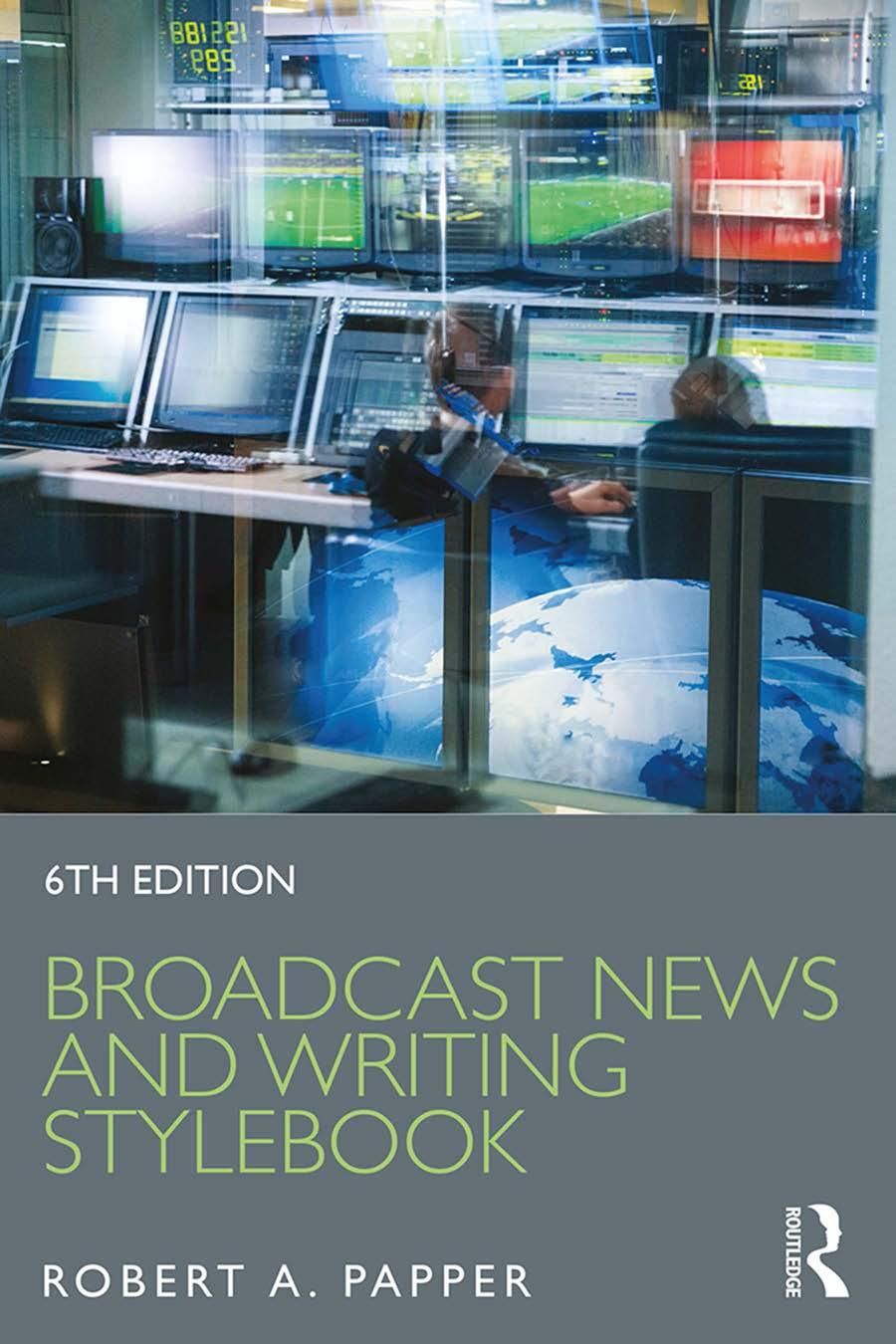
Broadcast News and Writing Stylebook
Robert A. Papper
First published 2017 by Routledge
711 Third Avenue, New York, NY 10017
and by Routledge
2 Park Square, Milton Park, Abingdon, Oxon, OX14 4RN
Routledge is an imprint of the Taylor & Francis Group, an informa business. © 2017 Taylor & Francis
The right of Robert A. Papper to be identified as author of this work has been asserted by him in accordance with sections 77 and 78 of the Copyright, Designs and Patents Act 1988.
All rights reserved. No part of this book may be reprinted or reproduced or utilized in any form or by any electronic, mechanical, or other means, now known or hereafter invented, including photocopying and recording, or in any information storage or retrieval system, without permission in writing from the publishers.
Trademark notice: Product or corporate names may be trademarks or registered trademarks, and are used only for identification and explanation without intent to infringe.
Library of Congress Cataloging-in-Publication Data
Names: Papper, Robert A., 1947– author.
Title: Broadcast news and writing stylebook / Robert A. Papper.
Other titles: Broadcast news writing stylebook
Description: New York, NY : Routledge, 2017.
Identifiers: LCCN 2016037050 | ISBN 9781138682603 (hardback) | ISBN 9781138682610 (pbk.)
Subjects: LCSH: Broadcast journalism—Authorship. | Journalism—Style manuals. | Report writing.
Classification: LCC PN4784.B75 P36 2017 | DDC 808.06/607—dc23 LC record available at https://lccn.loc.gov/2016037050
ISBN: 978-1-138-68260-3 (hbk)
ISBN: 978-1-138-68261-0 (pbk)
ISBN: 978-1-315-54502-8 (ebk)
Typeset in Utopia by Apex CoVantage, LLC
For Sol, Renee, Dana, Cristian, Daisy, Matt, Bria, Zack, Jen, Xavier, Sloane, Kate and especially Carole.
1 Ethics, Legality and the RTDNA Code of Ethics and Professional Conduct 1
1
6 The Radio-Television Digital News Association (RTDNA) Code of Ethics and Professional Conduct 7
10 2 News 11 What Is News? 11
News Values 13
of Stories 13
Story Ideas Come From 17 The Assignment Desk 19 Morning and Afternoon Meetings 19
the News 20
21
Words & Phrases 21
8 Phrases and Phrasing 94
Podcasts 201
Hyperlocal News 202
Multimedia 202
Data Journalism 203
Summary 204
Key Words & Phrases 204
Exercises 204
16 Social Media and News 206
Social Networking 206
Social Media, Branding and the Reporter Workday 209
Facebook 209
Twitter 210
MMJ, Backpack Journalists and One-Man-Bands 211
Beyond Facebook and Twitter 213
Mobile 215
Apps 216
NewsON 216
The Bottom Line 217
Summary 217
Key Words & Phrases 217
Exercises 217
The Radio-Television Digital News Association (RTDNA)
Social Media and Blogging Guidelines 218
17 News, Weather and Sports 223
Why News, Weather and Sports? 223
Reporting Weather 224
Defining Weather Terms 225
Reporting Sports 230
Sports and Teams 232
18 Reporting: Seasonal Coverage and the Calendar 237
Seasonal Reporting 237
Solar and Lunar and the World’s Major Religions 237
Calendar Holidays 238
State Holidays 243
Acknowledgments
Broadcast News and Writing Stylebook was first published in 1986— more than 30 years ago. The first book of its kind, it was initially designed for professionals, and the Ethics and Excellence in Journalism Foundation in Oklahoma enabled the book to be distributed to every TV station and radio newsroom in the country. I am forever grateful to the Foundation for its support.
I am also indebted to so many friends and colleagues who have read (and reread) this book and offered so many valuable suggestions. My thanks to active and past practitioners, faculty members, former students and friends: Laird Anderson, Dave Arnold, Mary Baer, Ken Barcus, Andy Barth, Alex Batres, Steve Bell, Jackie Benson, Amanda Billings, Ed Bliss, Merv Block, Justin Burton, Tim Calahan, Mark Christian, Dane Claussen, Liz Claman, Aubrey Clerkin, Ron Comings, Bob Conley, Evan Cornog, Carol Costello, Christine Davidson, Sue Drucker, Camilla Gant, John Doolittle, Bob Dotson, Emily Edwards, Irving Fang, Mike Ferring, Kelly Fincham, Brad Fitch, Carol Fletcher, Kymberly Fox, Wayne Freedman, Eric Galvan, Jeff Gillan, Peter Goodman, Tom Grimes, Jessica Harrington, Steve Hartman, Craig Helfant, Dave Hickcox, Chris James, Kelli Johnson, Steve Johnson, Phil Jurey, Laura Kaufmann, Mike Kiernan, Eric Knecht, Bill Knowles, Nick Kotz, John Larson, Bill Louthan, Carol Luper, Jim Mancari, Mark Masse, Christine Caswell McCarron, Jack McWethy, Mel Mencher, Nick Mills, Joe Misiewicz, Beth Montagno, Mackie Morris, Mike Murrie, Chad Myers, Mark Neerman, Jacki Ochoa, Nathan O’Neal, Stacie Osadchaya, Charles Osgood, Jenn Palilonis, Bill Payer (who developed much of the guide to super usage), Ian Pearson, Jeff Porche, Deborah Potter, Lou Prato, Andy Rooney, Crosby Shaterian, Robert Siegel, Marc Silverstein, Gregg Smith, Mary Spillman, Susan Stamberg, Leeza Starks, Alan Thompson, Carl Twentier, Dan Van Benthuysen, Sara Vesser, Lafe Williams, Maria Williams-Hawkins and many others at Hofstra University, WSYX-TV, KPIX-TV, KRNV-TV, KSNV-TV, KERO-TV, WTOV-TV, WWJ and other stations across the country.
My thanks to Ross Wagenhofer and Nicole Salazar at Routledge, and to the following reviewers, who made valuable suggestions for this latest effort: Barbara Nevins Taylor, Emily Corio, Elena Jarvis, and Cassandra Clayton.
Most of all, I want to thank my wife, Carole. Along with putting up with me and this book generally, she read and critiqued so much of this material . . . through so many drafts and so many editions. The English teacher in her did its best not to let me get away with abusing our language too much. She tried.
Bob Papper
Distinguished Professor Emeritus Hofstra University
1
Ethics, Legality and the RTDNA Code of Ethics and Professional Conduct
Ethics
Proper ethical decision-making shouldn’t be tough. After all, it’s just doing what’s right, isn’t it? Yes, but apparently that’s harder to do—or perhaps harder to stick to—than it sounds.
Inventing quotes and interviews, stealing (plagiarizing) columns, inadequate fact-checking, running PR-supplied video or stories as if they’re news . . . the list of print and broadcast news failures has been widely reported.
The toll on the public’s perception of journalism is incalculable. The notion that it might be necessary to tell people not to cheat or invent or plagiarize seems absurd. Surely some things should go without saying. Apparently not.
Broadcast appears to have less of a problem with invented quotes and stories, but it’s probably just the nature of the beast. Television must have pictures, and it’s hard to fake that, although one network did use its “green screen” to make it look like their reporters were outside on location rather than inside a studio. Broadcast also relies heavily on bites which it either has or it doesn’t. Since broadcast journalists seldom ever quote (other than running bites), making them up would most often be a meaningless exercise.
There are still plenty of potential failings available. Getting the bites right doesn’t prevent them from being taken out of context. And editing one part of a bite to another could well change the meaning of what someone said.
Where broadcasters can and too often do go wrong:
Stations periodically run video that they get from public relations or government sources without identifying the source of the video. A few stations were embarrassingly burned when it turned out
that they ran PR-supplied video complete with a PR-supplied “reporter”—again, without identifying the source of the video.
At least one station has run what looked like a news interview program without identifying that the people interviewed had paid to be on the program. The station justified the practice by arguing that active news people didn’t produce or host the show. But a more relevant question is what the audience thought.
Electronic altering of images is now so easy that it’s not hard for the unscrupulous or thoughtless to change backgrounds, signs or other visual elements. Of course, this is also a danger in print.
There are probably two bigger threats to journalistic credibility and integrity. Not unique to broadcast, to be sure, but problematic.
1. Advertiser influence. Is a station willing to take on an advertiser if that advertiser has done something wrong? Think about how often you’ve seen news reports—print or broadcast—critical of a local car dealer. Hardly ever.
2. Sensationalizing and the consequent cheapening of the news. It’s probably worse in promos and teases than the news stories themselves, but that’s not a distinction the audience is going to make or care about. Every time journalists say a word, every time a picture airs, media credibility is on the line. It’s infinitely easier to damage a reputation than regain one.
A useful guideline: If you wouldn’t tell the audience everything you did to gather and report the story, then don’t do it.
Advocacy journalism (like that practiced by Michael Moore in Sicko and Capitalism: A Love Story) has its place and a long history in this country. But it’s not what we do day in and day out. The news audience shouldn’t be able to determine where a reporter stands politically based on what’s supposed to be an impartial report. At the same time, allowing a politician to make a blatantly false claim—without challenging that assertion—misleads and disserves the audience. It’s all in how you handle the material.
While charges of bias get more attention, journalism is probably more at risk from the sheer volume of mistakes made every day. Talk to anyone who has been touched by journalists, and they’ll complain about how a reporter confused dates, misspelled the name of the street or town or people, misstated the number of something. The list goes on and on. Death by a thousand cuts. There will always be issues of interpretation or emphasis. Someone may feel that a journalist didn’t emphasize a particular point enough or left a subtle misimpression. That’s a different and debatable issue. Not open to interpretation or debate is getting the facts right.
Journalism is neither rocket science nor brain surgery, but everyone needs to remember that people’s lives, livelihoods and reputations are at stake in virtually every story.
Consider this a plea for more care and attention to detail to help preserve your reputation, the reputation of the news outlet you work for and, most importantly, the reputation of the people whose lives you touch.
Ethics isn’t simply a topic handled in one chapter of a book. You’ll find issues involving ethical decision-making and ethical behavior in almost every chapter.
Ethical Decision-Making Starts at the Top
Ethical decision-making is easier if it’s clear that the news organization you work for cares and values that approach. Having a written code of ethics or guiding principles is a good start. You’ll find the RTDNA Code of Ethics and Professional Conduct at the end of this chapter. Other organizations, like the Society of Professional Journalists, offer equally meaningful guidance. A good organization should subscribe to one of these codes or have developed their own. Critically, they should reinforce that code through their actions.
Writing for the RTDNA Daily Communicator, News Director Treena Wood at CKWX-AM in Vancouver, British Columbia, noted that her station had been successful by adhering to internally developed guiding principles. Number 1:
First, we get it right. Nothing goes to air or online before it’s independently confirmed. We wait, make phone calls, put out the emails, gather the evidence, and get our facts straight before rushing to get something out there, no matter what everyone else in the media is doing. No one remembers who got it first, but everyone remembers who got it wrong.
Issues in Media Law
A few words about media law in a chapter on ethics is not a substitute for a media law course. Still, a few words seem appropriate. We are still guided and most often sheltered by the First Amendment to the Constitution:
Congress shall make no law respecting an establishment of religion, or prohibiting the free exercise thereof; or abridging the freedom of
speech, or of the press; or the right of the people peaceably to assemble, and to petition the Government for a redress of grievances.
We may consider the First Amendment to be a bedrock of our society— and it certainly is as far as the news media is concerned, but it has always been controversial. If it wasn’t controversial, it wouldn’t have been required as an amendment to the Constitution; it would have been included in the original. And it remains controversial.
A recent (2015) study by the Pew Research Center found that 40% of Millennials (ages 18–34) said that government should be able to limit statements offensive to minority groups. All other (older) age groups ran from 12% to 27% agreeing that government should be able to limit speech offensive to minority groups. The example tested in this survey may be among the most difficult to judge, but isn’t that how you judge whether we have free speech for all—or just for some? Or for just some viewpoints?
Note that we’re talking about the first amendment—the first individual liberty stipulated by the founding fathers is designed to restrict federal or state limitations on individual liberties.
Without freedom of speech and freedom of the press, there is the real potential of converting journalism into someone’s or some group’s version of public relations.
As it is, freedom of speech and freedom of the press are not without limitations or consequences. Freedom of speech does not include the right to yell “Fire!” in a crowded theater—one of the classic examples of limitations. You also cannot incite people to riot.
In addition, the U.S. Supreme Court has found that broadcasters (unlike print journalists) may be regulated based on a scarcity of channels (licenses for radio and television stations), and that scarcity allows for content-neutral regulation of radio and TV. As an example, tobacco companies have always been free to advertise cigarettes in newspapers and magazines, but Congress banned cigarette advertising on radio and TV starting in 1971.
Clearly, different technologies are treated differently. While the Supreme Court has upheld regulations and restrictions on broadcasting, the Court has recognized full Constitutional protections for the internet since 1997.
It’s also critical to understand that the media possess no rights beyond those afforded to every American. The freedom to speak and publish views is no greater for CBS or your local hometown newspaper than it is for you.
But expressing those thoughts can still have consequences. That’s true for both individuals and for the media. The three legal areas where the media are most likely to get into trouble include libel, entrapment and invasion of privacy.
There appears to be a widespread belief that these are potential problems most often of concern in investigative reporting. That’s
probably not the case. When the news media spend a lot of time on investigative work, part of that time frequently includes meeting with lawyers to go over scripts and documentation to ensure that the station is on solid ground. That doesn’t preclude lawsuits; anyone with money can file a lawsuit regardless of the merits or lack thereof. The point is that the material is typically thoroughly vetted. Stations probably more often get into potential trouble in the day-to-day reporting when oversight might not be as carefully provided.
The distinction between libel and slander is in the delivery. Libel involves written material, (published or broadcast) and slander involves spoken (but not including broadcast). In either case, it generally includes the false or malicious publication of material that damages someone’s reputation or relationships with family, friends, coworkers or neighbors. Obviously, including someone’s name is a form of identifying an accused individual, but identification can also be done by picture or a description that may single out a particular individual.
Truth is the best and, most often, an absolute defense against libel. In journalism, there’s never a good substitute for being right and being able to prove that you’re right. That’s the gold standard, and that’s what you should be prepared to argue based on the journalistic work you do. The one place where truth may not be enough of a defense is if someone can show malice. In other words, a statement may be true, but if the person can show that you, as a reporter, were out to get someone for personal gain, then truth may not be an adequate defense.
Opinion may be used as a defense against libel. That’s most often the case in things like critical movie or restaurant reviews. This defense is also known as fair comment. There is a clear line that’s drawn. In a restaurant review, for instance, saying that you thought the beef burgundy was bland or overcooked is fine. That’s opinion. Saying that the kitchen is dirty, and the place is a breeding ground for mice is only okay if you can prove the truth of that statement.
Privilege is another defense against libel. The issue there is that statements made by people testifying in court or speaking at a government public hearing, for example, would be okay as long as you, the reporter, don’t take sides in the case.
Consent may be a defense—where the person who feels injured in fact agreed to the publication of the material.
Public officials have a harder time arguing that they have been libeled. They must argue that not only was the material false, but that the reporter or news organization either knew it was false and broadcast it anyway or exhibited a “reckless disregard” for the truth. Public officials include not just politicians but also actors, sports figures, celebrities, and so on. The issue of publishing or republishing, reposting and linking have also raised new issues associated with developing and evolving notions of defamation liability.
Entrapment is another potential area of legal trouble. In arguing entrapment, the injured party is arguing that the libelous behavior only happened because the reporter or news organization induced the person to do something he or she would not have otherwise done. For instance, if you simply walked up to people and asked them to do something that would be considered libelous—like a crime or performing an embarrassing act—that could well be considered as entrapping the person. Don’t do that.
Invasion of privacy can be pretty complicated. Let’s say you’re on public property—a public sidewalk for instance—and you see an accident on the street. You can take pictures of that scene, and you’re not invading anyone’s privacy. There is no reasonable expectation of privacy on a public street. What if something happens in someone’s front yard? Can you take and use pictures of that from the public sidewalk? Yes. Still no expectation of privacy. What if you’re on that sidewalk and see something happening inside a house? No good. Just because the curtains may not have been closed doesn’t mean that the people inside still don’t have a reasonable expectation of privacy. Generally, if you’re on public property, anything you shoot that’s outside or also on public property is fair game, and you’re not invading someone’s privacy.
Related to all this, if you walk up to someone on the street, camera or notebook in hand, and ask a question, you do not need a signed release in order to use that material. You have what is called implied consent. They see the notebook or camera and spoke with you. They have, in effect, given their consent.
If you have any concerns about the legality of any action, check with competent and appropriate legal counsel.
Drones
What about the use of drones? Be careful here. New FAA rules, in effect as of the end of August 2016, clarify and change a number of rules about how stations can use drones.
The new rules prohibit flights directly over people not involved in drone operation. That’s actually a loosening of restrictions. Drone operation must be done by someone with a drone-specific pilot’s license. Operation still must be done within visual line of sight. Stations can apply for waivers of certain conditions.
There are record-keeping requirements, and plenty of other restrictions still in force. The bottom line is you better know the rules before attempting to shoot video of something with a drone.
The use of ever more powerful technologies has added to privacy concerns. Telephoto lenses, parabolic microphones, camera-equipped
drones and “public” online places have all raised increasing questions about public spaces and expectations of privacy.
The Radio-Television Digital News Association (RTDNA) Code of Ethics and Professional Conduct*
Guiding Principles:
Journalism’s obligation is to the public. Journalism places the public’s interests ahead of commercial, political and personal interests. Journalism empowers viewers, listeners and readers to make more informed decisions for themselves; it does not tell people what to believe or how to feel.
Ethical decision-making should occur at every step of the journalistic process, including story selection, news-gathering, production, presentation and delivery. Practitioners of ethical journalism seek diverse and even opposing opinions in order to reach better conclusions that can be clearly explained and effectively defended or, when appropriate, revisited and revised.
Ethical decision-making—like writing, photography, design or anchoring—requires skills that improve with study, diligence and practice.
The RTDNA Code of Ethics does not dictate what journalists should do in every ethical predicament; rather it offers resources to help journalists make better ethical decisions—on and off the job—for themselves and for the communities they serve.
Journalism is distinguished from other forms of content by these guiding principles:
Truth and accuracy above all
The facts should get in the way of a good story. Journalism requires more than merely reporting remarks, claims or comments. Journalism verifies, provides relevant context, tells the rest of the story and acknowledges the absence of important additional information.
For every story of significance, there are always more than two sides. While they may not all fit into every account, responsible reporting is clear about what it omits, as well as what it includes. Scarce resources, deadline pressure and relentless competition do not excuse cutting corners factually or oversimplifying complex issues.
“Trending,” “going viral” or “exploding on social media” may increase urgency, but these phenomena only heighten the need for strict standards of accuracy.
Facts change over time. Responsible reporting includes updating stories and amending archival versions to make them more accurate and to avoid misinforming those who, through search, stumble upon outdated material.
Deception in newsgathering, including surreptitious recording, conflicts with journalism’s commitment to truth. Similarly, anonymity of sources deprives the audience of important, relevant information. Staging, dramatization and other alterations—even when labeled as such—can confuse or fool viewers, listeners and readers. These tactics are justified only when stories of great significance cannot be adequately told without distortion, and when any creative liberties taken are clearly explained.
Journalism challenges assumptions, rejects stereotypes and illuminates—even where it cannot eliminate—ignorance.
Ethical journalism resists false dichotomies—either/or, always/ never, black/white thinking—and considers a range of alternatives between the extremes.
Independence and transparency
Editorial independence may be a more ambitious goal today than ever before. Media companies, even if not-for-profit, have commercial, competitive and other interests—both internal and external— from which the journalists they employ cannot be entirely shielded. Still, independence from influences that conflict with public interest remains an essential ideal of journalism. Transparency provides the public with the means to assess credibility and to determine who deserves trust.
Acknowledging sponsor-provided content, commercial concerns or political relationships is essential, but transparency alone is not adequate. It does not entitle journalists to lower their standards of fairness or truth.
Disclosure, while critical, does not justify the exclusion of perspectives and information that are important to the audience’s understanding of issues.
Journalism’s proud tradition of holding the powerful accountable provides no exception for powerful journalists or the powerful organizations that employ them. To profit from reporting on the activities of others while operating in secrecy is hypocrisy. Effectively explaining editorial decisions and processes does not mean making excuses. Transparency requires reflection, reconsideration and honest openness to the possibility that an action, however well intended, was wrong.
Ethical journalism requires owning errors, correcting them promptly and giving corrections as much prominence as the error itself had.
Commercial endorsements are incompatible with journalism because they compromise credibility. In journalism, content is gathered, selected and produced in the best interests of viewers, listeners and readers—not in the interests of somebody who paid to have a product or position promoted and associated with a familiar face, voice or name.
Similarly, political activity and active advocacy can undercut the real or perceived independence of those who practice journalism. Journalists do not give up the rights of citizenship, but their public exercise of those rights can call into question their impartiality.
The acceptance of gifts or special treatment of any kind not available to the general public creates conflicts of interest and erodes independence. This does not include the access to events or areas traditionally granted to working journalists in order to facilitate their coverage. It does include “professional courtesy” admission, discounts and “freebies” provided to journalists by those who might someday be the subject of coverage. Such goods and services are often offered as enticements to report favorably on the giver or rewards for doing so; even where that is not the intent, it is the reasonable perception of a justifiably suspicious public.
Commercial and political activities, as well as the acceptance of gifts or special treatment, cause harm even when the journalists involved are “off duty” or “on their own time.”
Attribution is essential. It adds important information that helps the audience evaluate content and it acknowledges those who contribute to coverage. Using someone else’s work without attribution or permission is plagiarism.
Accountability for consequences
Journalism accepts responsibility, articulates its reasons and opens its processes to public scrutiny.
Journalism provides enormous benefits to self-governing societies. In the process, it can create inconvenience, discomfort and even distress. Minimizing harm, particularly to vulnerable individuals, should be a consideration in every editorial and ethical decision. Responsible reporting means considering the consequences of both the newsgathering—even if the information is never made public—and of the material’s potential dissemination. Certain stakeholders deserve special consideration; these include children, victims, vulnerable adults and others inexperienced with American media.
Preserving privacy and protecting the right to a fair trial are not the primary mission of journalism; still, these critical concerns deserve consideration and to be balanced against the importance or urgency of reporting.
The right to broadcast, publish or otherwise share information does not mean it is always right to do so. However, journalism’s obligation is to pursue truth and report, not withhold it. Shying away from difficult cases is not necessarily more ethical than taking on the challenge of reporting them. Leaving tough or sensitive stories to non-journalists can be a disservice to the public.
A growing collection of coverage guidelines for use on a range of ethical issues is available on the RTDNA website—www.rtdna.org.
Revised Code of Ethics, adopted June 11, 2015 Reprinted with permission.
Summary
Get the facts right, and behave like a responsible and caring human being.