Financial Sector Development in Ghana: Exploring Bank Stability, Financing Models, and Development Challenges for Sustainable Financial Markets James Atta Peprah
Patient-Centric Healthcare: Through Institutional Regulation [a chapter from "Healers or predators?: healthcare corruption in India"] Meeta Rajivlochan
Great Clarendon Street, Oxford, ox2 6dp United Kingdom
Oxford University Press is a department of the University of Oxford. It furthers the University’s objective of excellence in research, scholarship, and education by publishing worldwide. Oxford is a registered trade mark of Oxford University Press in the UK and in certain other countries
All rights reserved. No part of this publication may be reproduced, stored in a retrieval system, or transmitted, in any form or by any means, without the prior permission in writing of Oxford University Press, or as expressly permitted by law, by licence or under terms agreed with the appropriate reprographics rights organization. Enquiries concerning reproduction outside the scope of the above should be sent to the Rights Department, Oxford University Press, at the address above
You must not circulate this book in any other form and you must impose the same condition on any acquirer
Published in the United States of America by Oxford University Press 198 Madison Avenue, New York, NY 10016, United States of America
British Library Cataloguing in Publication Data
Data available
Library of Congress Control Number: 2020945333
ISBN 978–0–19–885162–2
Typeset by Sparks—www.sparkspublishing.com
Printed in Great Britain by Bell & Bain Ltd., Glasgow
Links to third party websites are provided by Oxford in good faith and for information only. Oxford disclaims any responsibility for the materials contained in any third party website referenced in this work.
In memory of Pierre-Roland Giot and for Patrick Galliou
PREFACE
At one level this book is a simple narrative: a history of Brittany from early prehistoric times to the beginning of the twentieth century. Its real purpose, however, is to explore the fascinating subject of identity: how a people living in a remote peninsula of Europe, to distinguish themselves from their neighbours, created and fought to maintain a distinctive culture. The sea played an important role in protecting them, but it also enabled a close relationship to be built up between the Bretons and the Britons, forming a bond that has developed over the years. Today increasingly large numbers of people travel on Brittany Ferries between the ports of Plymouth and Roscoff and Saint-Malo and Portsmouth to spend time in each other’s countries, their journeys echoing those that began in prehistoric times and have continued ever since.
While Breton identity and the relationship between Bretons and Britons are the main themes of this narrative, underlying it all is a desire to pay homage to a country and a people I have come to know and admire over the last sixty years. In 1960, when an undergraduate at Cambridge, I attended a lecture given by Pierre-Roland Giot, doyen of Breton archaeology, and later sent him a photograph of a Bronze Age arm-ring of Breton type that had recently been found in west Sussex. It began a correspondence that continued over the years, accompanied by a deluge of offprints of scientific papers that he and his colleagues had published. A few years later, after I took up a post at Southampton University, we became neighbours separated only by the sea, and contact was more frequent. Giot was a generous colleague who loved sharing his country with his friends. In doing so he ensured that Brittany featured large in the European narrative.
Patrick Galliou is another Breton scholar who has always seen Brittany as part of the wider world. We shared interests in the Roman period and it was when we were discussing late Roman coastal defences that he suggested we might co-direct an excavation at the site of Le Yaudet, a fortified promontory at the mouth of the river Léguer
occupied in the Late Iron Age and throughout the Roman period. It was evidently a key site in understanding cross-Channel interactions. Excavations began in 1991 and were to last for twelve happy seasons, involving Breton, British, and Spanish students. During this time we were made welcome by the local community, enjoying both their hospitality and their enthusiasm. Those friendships have continued and have grown. Returning now, several times a year, to the little settlement of Pont Roux in the shadow of Le Yaudet is like coming home.
This book, then, is a labour of love written to celebrate the forces that have bound our two countries, and in profound appreciation of the ever-fascinating Breton countryside. Above all, it is a tribute to the remarkable resilience of the Breton people.
B.C. Oxford and Pont Roux August 2020
1
2 Claiming the Land, 6000–2700
3 The Metal-Rich West, 2700–600 bc
4 Facing the Expanding World, 600–50 bc
5 The Roman Interlude, 50 bc – ad 400
6 From Armorica to Brittany, 400–751
7 Conflicting Identities, 751–1148
8 Our Nation of Brittany, 1148–1532
9 Four Rebellions and a Revolution, 1532–1802
P ROLOGU E
This book is about the people who have lived on the peninsula we now call Brittany, a slab of land on the edge of Europe jutting into the fierce Atlantic. To the land-bound French the western extremity of the continent has long been known as Finistère, ‘the end of the earth’. But to the inhabitants their peninsula was the centre of the world: it was the rest of Europe that was peripheral.
Remote places like peninsulas and islands have a particular fascination because, to distinguish themselves from outsiders, their communities spend much effort in defining and protecting their cultural identity. Islanders find it easier because they are surrounded by the sea, which gives them a degree of control over the acceptance or rejection of external influences, but those who inhabit peninsulas are less fortunate. While the sea offers welcome protection on many approaches, there is always a land border making the territory vulnerable to intrusion. They may try to fortify it, creating a marcher zone, but more often the border is vague and porous, allowing easy access to outsiders. This is why peninsular people have to work hard, not only to safeguard their culture but to intensify their differences with their land neighbours, the better to distinguish themselves from the alien ‘other’. As one social anthropologist put it, remote places are ‘the very crucibles of the creation of identity’.
The sea is all-important. It provides a barrier to unwanted outside interference while at the same time it allows maritime networks to develop, offering connectivity. By embracing overseas neighbours and becoming part of a broader maritime community peninsula dwellers can further enhance the distinctiveness of their culture in contrast to their continental neighbours. The sea also binds maritime people together.
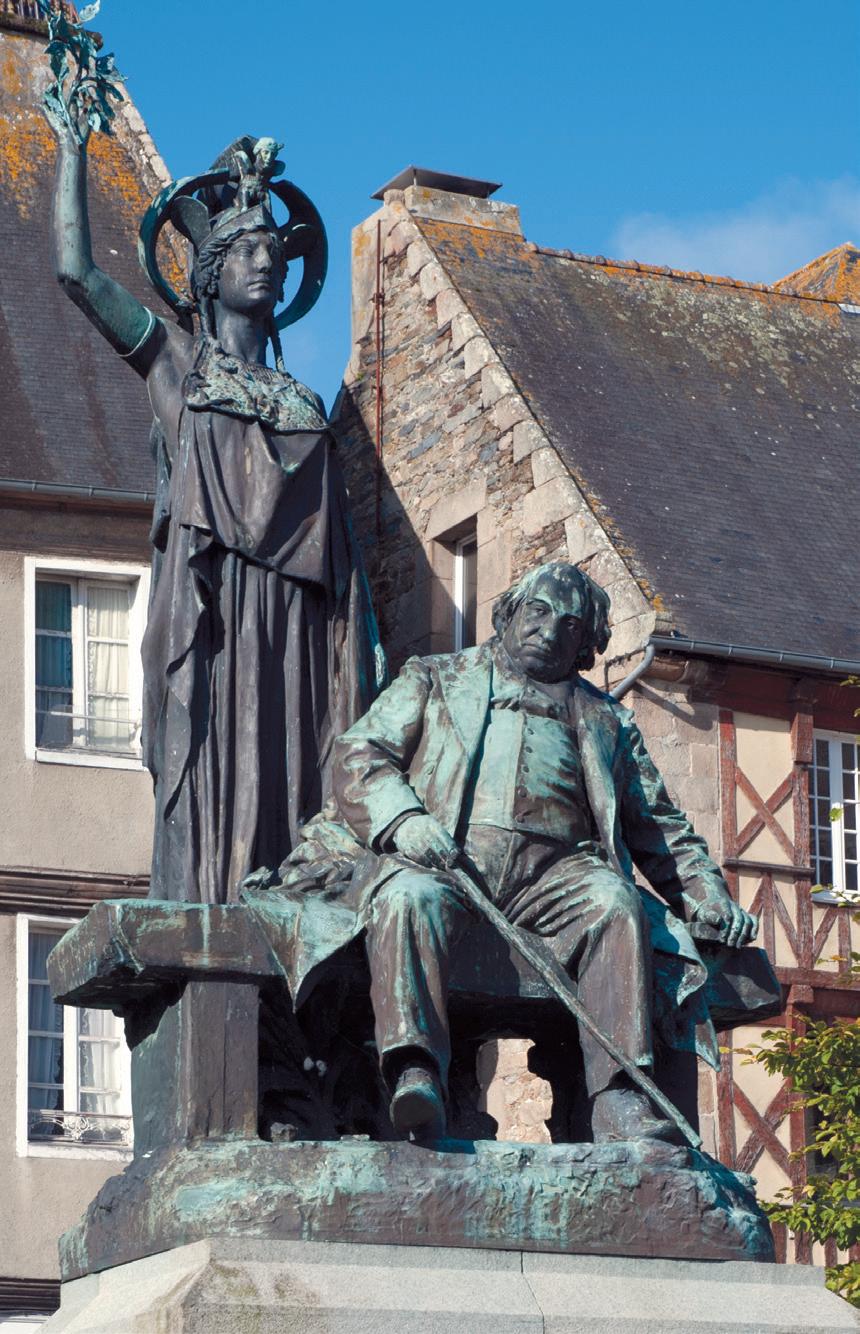
0.1 Ernest Renan (1823–92) was born in Tréguier in Brittany. His father and grandfather were fishermen. He was educated in the local seminary until the age of 15 and went on to become a scholar of international reputation: historian, philologist, philosopher, and critic. The statue, erected in Tréguier in 1903, caused much controversy. It shows Athena, pagan goddess of wisdom, applauding the seated Renan, who stares critically across the square at the cathedral.
The narrowing strip of the Atlantic which we call the English Channel or La Manche separates the Breton peninsula from the parallel coast of southern Britain, itself ending in a peninsula comprising Devon and Cornwall. The narrowness of the Channel seaway has allowed close contact to develop between communities living along confronting coastlines. These links began to be forged seven thousand years ago and have continued to develop ever since. Many generations of Bretons have looked to their British neighbours as compatriots whose values they shared, while the neighbouring French were considered to be a threat to their culture and their being.
Remote places are, by definition, on the edge of the familiar world. When viewed from the centre, they are distant and peripheral: irrational places where reality fades into fantasy. In the popular imagination Brittany has been seen as a land where ranks of warriors were turned into rows of stone. It was a place of enchanted forests with magic fountains providing a haunt for Druids and later the magician Merlin of the Arthurian romances: it was a twilight zone where anything was possible. Remote islands, too, were steeped in mystery. The Greek writer Strabo described several islands off the coast of Brittany where strange rites were enacted, and when some Roman soldiers were shipwrecked on the British shore sometime before the Roman occupation of the island, they reported monsters, half-man and halfbeast, lurking in the persistent mists. These far-western fragments of land, washed by the ocean, were in the thrall of irrational powers and their magic.
In the minds of the romantic, remoteness takes with it a wistful nostalgia. In such places live primitive people untouched by the corrupting grasp of civilization. These are ‘noble savages’ whose simplicity is to be envied. They are the product of their landscape and their isolation. In the mid-nineteenth century this romantic ideal was at its height, especially in writing dealing with the Celtic-speaking people of the west. It is nowhere more clearly expressed than by the Breton priest and scholar Ernest Renan (1823–92). In an emotive and somewhat over-indulgent passage, he introduces his beloved Breton countrymen, beginning by
detailing the change in landscape experienced by a traveller passing from Normandy into the Breton peninsula:
A cold wind arises full of a vague sadness, and carries the soul to other thoughts; the tree-tops are bare and twisted; the heath with its monotony of tint stretches away into the distance; at every step the granite protrudes from a soil too scanty to cover it; a sea that is almost always sombre girdles the horizon with eternal moaning. The same contrast is manifest in the people: to Norman vulgarity, to a plump and prosperous population, happy to live, full of its own interests, egoistical as are all those who make a habit of enjoyment, succeeds a timid and reserved race living altogether within itself, heavy in appearance but capable of profound feeling, and of an adorable delicacy in its religious instincts.
The Poetry of the Celtic Races (1854; translation by W. G. Hutchinson)
Here, then, the stern purity of the Bretons, moulded by the harsh landscape, is contrasted with the lush life of the self-indulgent Normans. In this striking antithesis the Bretons are given their identity. Renan was writing at a time when Brittany was desperately trying to hold onto its own distinctive language and culture in the face of intrusion from outside: crushing French bureaucracy and an increasing flood of tourists. But thus it has always been. Remote peoples suffer from two opposed forces: attempts to incorporate them in the wider world and the corrosive effects of those who come to be amused by the exotic. By actively resisting such forces through the ages the inhabitants of Brittany have forged a distinctive otherness. This book attempts to trace their remarkable story.
1
THE LAND AND THE SEA
Many writers who have tried to explain the distinctiveness of the Bretons and their culture have seen the harshness of the Breton landscape as one of the determining forces. The point is most strikingly made by Ernest Renan, writing in 1854 (above, pp. 2–3), but it was already apparent earlier in the writing of the folklorist Émile Souvestre (1806–54), in particular in his Les Derniers Bretons, published between 1835 and 1837, and recurs as echoes in the work of novelists like Gustave Flaubert and Guy de Maupassant, who both made extensive tours of Brittany (below, pp. 374–5). Geographical determinism can be taken too far, but landscape does affect people and their culture. A glance at any map, particularly a geological map, shows that the Armorican peninsula has a dominant east–west grain caused by its geological formation. Communication from north to south is difficult, except where the rivers Rance and Vilaine and the Blavet and Trieux create routes across the peninsula. This tends to separate the interior from the coastal regions and to give a much greater prominence to the sea as a means of communication. But while coastal traffic along the north and south coasts was not difficult, to sail from one to the other around the dangerous Pointe du Raz and past Ouessant, particularly in the face of westerlies, was a journey needing particular skills, not to be embarked upon without a pressing reason. Geography, then, tended to affect both perception and reality. The communities living on the north and south coasts formed two separate groups, the sea giving each a degree of cohesion, while the interior, always more sparsely populated, remained largely isolated. There was also the east–west gradient. The distance across the neck of the peninsula where, as it were, peninsular Brittany joined the mainland of France is about 140
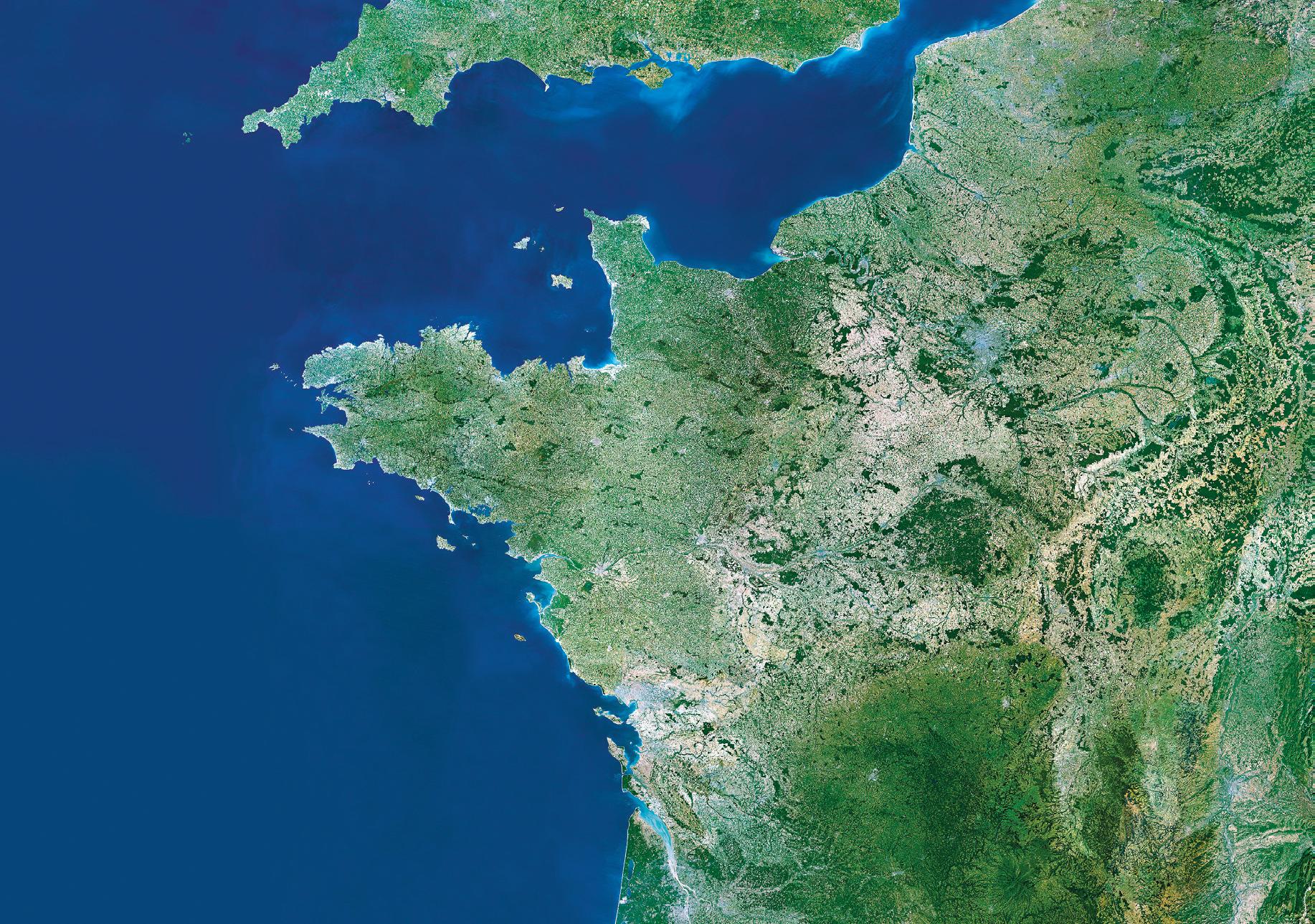
1.1 The sea-girt promontory of Armorica (Brittany), thrusting far into the Atlantic, provides a focus for the maritime networks connecting the peoples of the Atlantic façade. Occupying this extremity of Europe, the Armoricans were able to play a significant part in trade while maintaining a distinctive identity.
kilometres measured between the Baie du Mont-Saint-Michel and the Loire estuary. It provided a broad interface across which cultural influences and invading forces could pass with comparative ease. The two principal towns, Nantes and Rennes, both in existence by Roman times, became centres where the culture of the east and west met, but once across the rivers Vilaine, Ille, and Couesnon, eastern influences decreased and the peninsular culture became increasingly strong. In more recent times it has become conventional to divide Brittany into two broad regions: Basse-Bretagne (Lower Brittany) in the west and Haute-Bretagne (Upper Brittany) in the east, Basse-Bretagne being the region in which the culture of the Breton people has retained its distinctive quality and where the language is still spoken.
The Land and the Sea
In the Beginning
The westernmost peninsulas of Europe that now thrust into the Atlantic Ocean are, for the most part, composed of old hard rocks: heavily folded and metamorphosed sediments with periodic intrusions of crystalline granites and volcanic rocks. The Breton peninsula is the western extremity of such a region. Known as the Armorican Massif, it extends eastwards into Basse-Normandie as far as the valleys of the Sarthe and Orne and south into the Vendée to the northern edge of the Sèvre valley. The Armorican Massif is part of a sinuous zone, zigzagging across Europe, comprising the Ardennes, Vosges, Morvan, and Massif Central to the east and north and the Atlantic zone of the Iberian Peninsula to the south-west. It owes its origin to plate tectonics: the movement of parts of the earth’s crust on the surface of its viscous core. When two of the earth’s plates collided, a zone of metamorphosed rocks was created, further compressions causing the edges to ruck up, forming mountain ridges. Along this zone of instability volcanoes spread ash and lava, and molten rocks welled up, creating the granite masses so evident in Brittany and south-western Britain.
There were two main phases of intense mountain building. The first, known as the Cadomian orogeny, took place between 650 and 550 million years ago. During this time the mudstones, siltstones, and sandstone of the region that was to become Brittany were forced up into mountain ranges, metamorphosed by the extreme pressure and heat, and penetrated by intrusive masses of granite. Then followed a long period of erosion and the deposition of more sedimentary rocks before the second phase of mountain building, known as the Hercynian (or Variscan) orogeny, created new mountain ranges about 380–280 million years ago, accompanied by further granite intrusions and volcanic activity. Since then the mountains have been gradually eroded until now they have been reduced to an undulating peneplain mostly between 100 and 300 metres above present-day sea-level. These episodes of mountain building and erosion have given rise to the very distinct east–west grain so evident in the Breton landscape, the harder rocks created by the compression, standing out as narrow ridges.
Thus the big story, but recent detailed geological work has added some intriguing details. About thirty million years ago what is now north-western France and Britain comprised three different plates, Armorica, Avalonia (England and Wales), and Laurentia (Scotland), all moving in relation to each other and colliding. The Armorican plate first pushed up against the Avalonian plate and then the two pulled apart, shearing along the line later to become the English Channel, leaving a small sliver of the Armorican plate—now Cornwall and south Devon—stuck to the Avalonian
SEDIMENTARY ROCKS
Recent deposits
Pliocene and Miocene
Carboniferous
Devonian
Silurian and Ordovician
Cambrian
Pre-Cambrian
METAMORPHIC AND IGNEOUS ROCKS
Metamorphic rocks
Igneous rocks
Fault
1.2 The complex geology of Brittany was the result of two phases of mountain building, one 650–550, the other 380–250 million years ago, each followed by a period of intensive erosion. The mountain-building episodes, when the land was forced up by lateral pressures, created the ridges and faults which give the peninsula its predominantly east–west grain. At various stages molten masses intruded into the crust from below, cooling to become igneous rocks like granite.
plate. This explains why the southern part of the south-western peninsula of Britain is so similar to Brittany.
In more recent geological times, during the Ice Ages (470,000–12,000 years ago), Brittany escaped glaciation, though for long periods of time, together with southern Britain, the region became a cold, bleak tundra. During the last phase of the glaciation, bitterly cold winds blowing across the tundra from the north carried very fine particles of dust, which were deposited over parts of southern Britain, the Channel Islands, and northern Brittany, creating a blanket of fine clayey soil called loëss (limon in French), which covered the eroded surface of the old hard rocks to a depth of up to a metre. Today’s highly productive vegetable-growing region along the north coast owes its fertility to the loëss.
Pte du Château
Île de Batz
Île d’Ouessant
Pte de St-Mathieu
Mer d’Iroise
Île de Sein
Pte du Raz
Baie de Douarnenez
Baie d’Audierne
Pte de Penmarc’h
Île de Groix
Belle-Île
Île de Bréhat
Golfe de St-Malo
Cap Fréhel
Baie de St-Brieuc
Îles Chausey
Baie du Mt-St-Michel
Baie de Quiberon
Île d’Houat
Île de Hoëdic
Pte de l’Herbaudière
Île de Noirmoutier
1.3 Intensive erosion following the last mountain-building episode has left Brittany as a fairly level peneplain mostly between 50 and 300 metres above sea-level. The highest point, in the Monts d’Arrée, is only 384 metres. The river system has cut through the east–west ridges, creating routes from north to south.
1.4 Brittany is part of the Armorican Massif, one of the earth’s plates which, in the distant past, collided with each other. When Armorica bumped up against Avalonia, the two plates stuck together. Later, they pulled away from each other, leaving part of Armorica, now south Devon and Cornwall, attached to Avalonia.
Armorican Massif
Massif Central
Iberian Massif
The Land and the Sea
1.5 During the Last Glaciation, when the ice covered most of Britain southwards to the midlands, southern Britain and Brittany were tundra. Wind blowing from the ice cap carried fine sediment, which was deposited over parts of southern Britain and Brittany as a loamy clay known as loëss. The loëss deposits remaining in northern Brittany have created a highly fertile soil.
At the end of the last Ice Age, about 12,000 years ago, the water locked up in the ice caps began to melt, causing the sea-levels to rise. Before this, at the height of the last glaciation, when the sea was 100 metres below its present level, the English Channel was an area of lowland crossed by innumerable rivers flowing into one main channel, which gradually widened into an estuary as it reached the sea somewhere between western Cornwall and the north-west corner of Brittany. The rising sea inundated this lowland zone. At first the rise was rapid. Between about 9000 and 7000 bc the sea rose from −50 metres to −16 metres. Thereafter the rate slowed so that by 4500 bc it had reached about −3 metres, since when the rise has been even more gradual.
By 9000 bc the sea had reached nearly to the cliffs of northern Brittany westwards of the Trégor, but further to the east the gulf of Saint-Malo, including the Channel
Pte de St-Gildas
Baie d’Audierne
Baie de St-Brieuc
Pte du Raz
Pte de Barfleur
Cap de la Hague
Aulne
Scorff Blavet Ellé
Trieux
Alderney Herm Sark Guernsey
Loëss
limit of loëss in the Bronze Age
1.6 Following the retreat of the ice sheet at the end of the last glacial period, the sea-level began to rise, rapidly at first and then more slowly. Many attempts have been made to plot the change. The Lambeck curve, shown here, calculated in 1997, shows the main trend. The shaded area on either side of the line represents the range of variation assuming a 3-metre tidal range.
Islands, was still land. It was not until 5500 bc that the sea was high enough to isolate the Channel Islands, though there were still large expanses of low-lying land off the western coast of the department of Manche. But by this time the Breton peninsula had taken on its familiar shape.
The Land
The Gaulish word Aremorica, after which geologists have named the Armorican Massif, means ‘the land facing the sea’ and, like the geological term, was used to include much of north-western Gaul between the Loire and the Seine. The peninsula, therefore, is part of a more extensive geological region. The Bretons have traditionally distinguished between the ocean-facing Armor and the forested inland regions, the Argoat. This is far more than just nomenclature: it goes deep into the soul of the
people, reflecting very different values and ways of life. The point is well made by the Breton writer Pierre-Jakez Hélias, who, in his description of early twentieth-century life, stressed the stark divide between those who looked to the sea for their livelihood and those living only a few kilometres inland, who relied on the land to sustain them and firmly turned their backs on the sea.
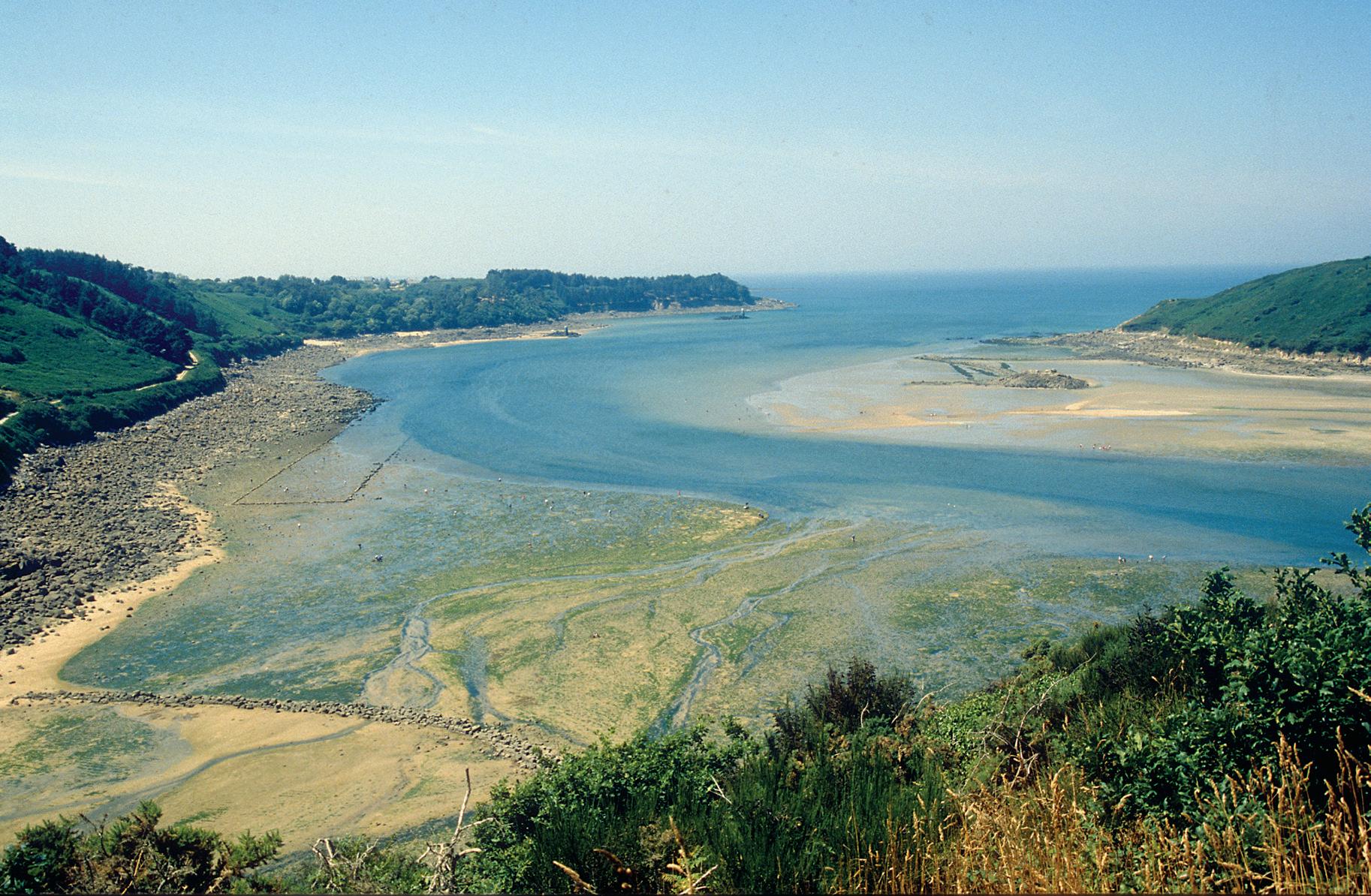
The coastal regions of Brittany, the Armor, were favoured environments. Those who worked the land along the northern coasts had the advantage of the fertile, welldrained loëss soils, which they could enrich with seaweed collected from the extensive intertidal zones, while the more acid soils could be treated with the shell sands readily available around the heads of the bays. The littoral zone itself was rich in resources: molluscs, crustaceans, fish, seabirds’ eggs, and edible seaweeds. All could be harvested for much of the year, with little effort, to supplement the diet of cereals, milk, and occasional meat. Cropping the coastal resources has left many physical traces: engineered trackways across the intertidal zones for the carts collecting seaweed, stonebuilt fish traps in the estuaries to capture fish on the falling tide, and barriers across narrow inlets which could trap the sea to power tidal mills, at the same time making it easy to net fish as the seawater flowed out through sluices. Those living close to the littoral were indeed fortunate. In contrast, those who lived inland had little to fall back on in times of crop failure or when their livestock suffered from disease or decreased fertility.
Given the richness of the maritime resource, it is no surprise that through time people favoured the coastal region for settlement. This is evident by looking at the distribution of Neolithic settlements, passage graves, and artefacts, all of which cluster along the coast with particular emphasis on the southern coastal region, encouraged perhaps by a more favourable, warmer climate. In later prehistoric periods, as the population increased, the inland regions were more widely colonized, but the draw of the sea is still evident in the Roman period, when, apart from two towns, Vorgium (Carhaix) and Condate (Rennes), most of the rest of the nucleated settlements were within 40 kilometres of the coast. The Armor–Argoat divide was even more evident in the medieval period. Records of tax returns in the period 1426–43 allow the population densities of each commune to be plotted. The entire north coast and selected enclaves along the south coast had densities of more than six households per square kilometre, while in much of the inland region, except around Rennes, there were fewer than four households. This disparity has continued, and indeed has been intensified since then by internal migration. Statistics for the period 1831 to 1954 show a steady flow of population from the inland areas to the major towns, which, with the exception of Rennes and Carhaix, all lie in the coastal zone.
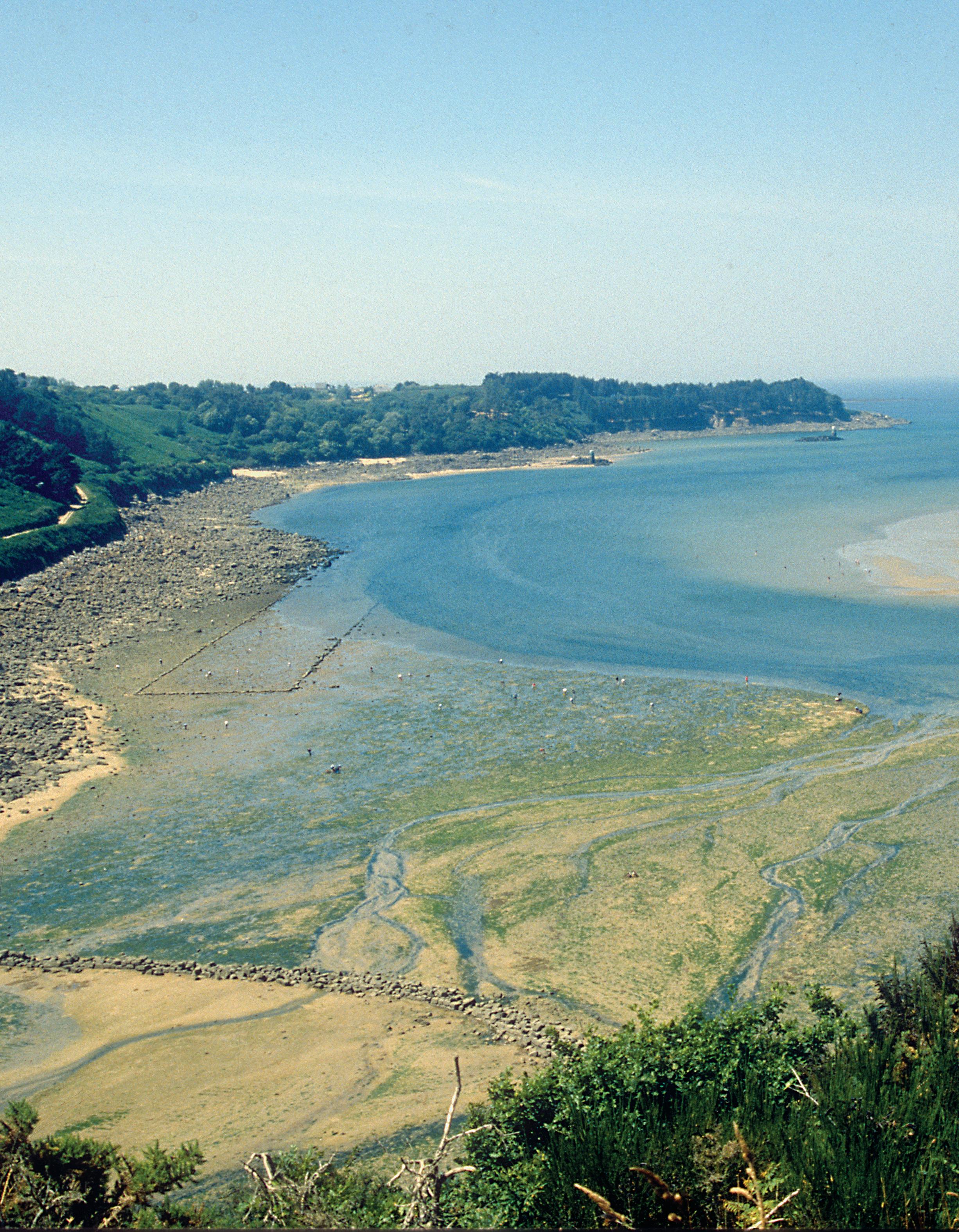
1.7 The coasts of Brittany, because of the large tidal variation, are productive of a wide range of seafood— molluscs, fish, crustaceans—as well as seaweed and shell sand collected and spread on the land as a fertilizer. The image shows the estuary of the river Léguer, from the promontory of Le Yaudet, at low tide. The estuary has been a rich food resource for the local inhabitants from the prehistoric period to the present day.
The interior of the Breton peninsula is altogether different, for long dominated by the landes: uncultivated tracts including moorland, heath, marsh, and other waste, and great expanses of forest. Surveys undertaken in 1733 showed that about 46 per cent of the land area of Brittany was uncultivated. By the time of the Napoleonic survey in 1807, the departments of Finistère and the Morbihan in the west and south were still 40 per cent wasteland, though in the northern departments of Côtes-d’Armor and Ille-et-Vilaine the waste had been reduced to 20 per cent. A vivid, if perhaps somewhat jaundiced, view of Brittany is given by the English agronomist Arthur Young, who travelled around the peninsula on his second journey to France in 1788 (below, pp. 347–8). He was not impressed by ‘all the wastes, the deserts, the heath, ling, firz, broom and bog’ he had crossed on his three-hundred-mile journey. At Montauban he wrote, ‘One third of what I have seen of this province seems uncultivated, and nearly
all of it in misery.’ At Châteaulin, which is more hilly, he found the soil to be good, though ‘one-third waste . . . no exertions, nor any marks of intelligence’. Young’s lively observations confirm the extent of the landes given in the surveys of 1733 and 1807. That so much land was uncultivated he was content to assign to the indolence and ignorance of the people rather than to the poverty of the soil.
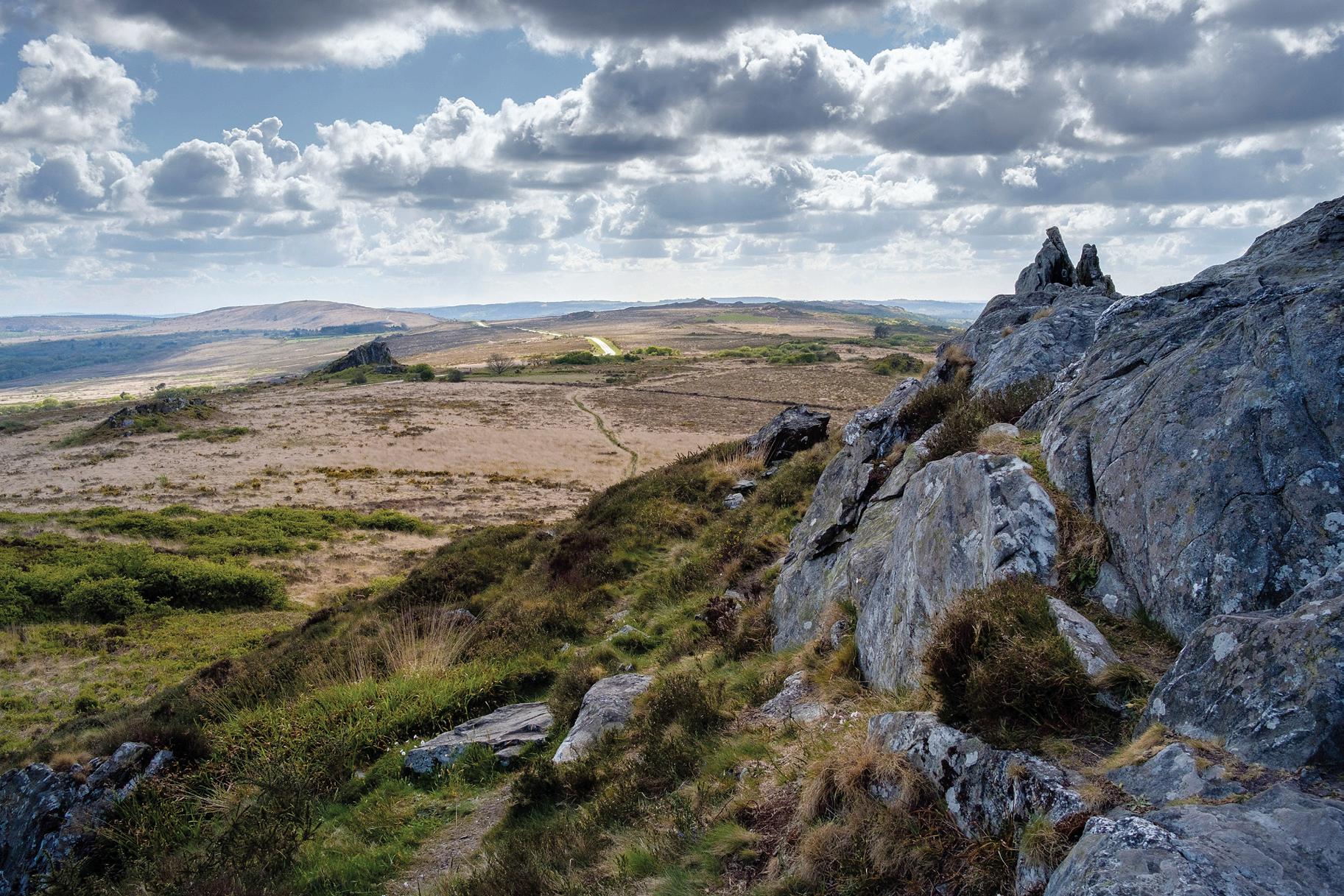
The most extreme tracts of lande now surviving lie towards the western end of the peninsula where the land rises to two ranges of hills, the Monts d’Arrée and the Montagnes Noires, separated by the Châteaulin basin. Neither range includes a true mountain, the highest point being Roc’h Trevezel in the Monts d’Arrée, which rises to a mere 384 metres, but their dominance is accentuated by the general flatness of the land about. It is from the Montagne Saint-Michel in the Monts d’Arrée that the barren moorland and the lakes and marshes are seen at their most impressive.
In the past much of the centre of Brittany was covered by a great swath of forest known as the forest of Brocéliande, which gave way in the west to the heathlands of the Monts d’Arrée and the Montagnes Noires. The eastern edge of the dense forest together with the marshes of Dol in the north and La Grande Brière in the south presented a significant barrier to those approaching the peninsula from the east.
Baie de Douarnenez
Baie de St-Brieuc
Île de Bréhat
de Batz
Île de Sein
Île d’Ouessant
The Argoat is, by definition, a forested area (Breton: ar, ‘next to’; koad, ‘forest’) and there can be little doubt that much of the interior of Brittany was once extensively wooded, the density of the tree cover varying with the underlying soils. The most famous woodland in the early Middle Ages was the forest of Brocéliande, in tales current at the time, home to Arthur, Merlin, and the other personalities peopling the Arthurian romances. Originally the great forest extended west of Rennes for a distance of 140 kilometres. All that now remains is the forest of Paimpont, reduced to some 7,000 hectares. To the west of Brocéliande is another forest remnant: the forest of Loudéac north-east of Pontivy. Further west again lies the forest of Quénécan. The forests were a major resource not only for the deer and wild boar hunted by the elite but also to provide pannage (the right to pasture pigs) and leaf fodder for cattle. In 1419 pannage was paid on 1,497 pigs and 1,409 cattle fattened in Brocéliande, and
1.9 The Monts d’Arrée (Menezioù Are, in Breton), once a great mountain range belonging to the Armorican Massif, have been eroded over millions of years to form an upland plateau below 400 metres. It offers a barren landscape of moors and crags lying at the heart of Basse-Bretagne.