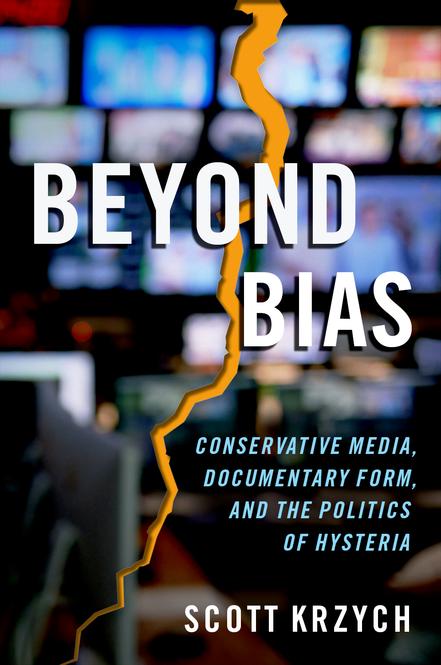
Beyond Bias
Conservative Media, Documentary Form, and the Politics of Hysteria
SCOTT KRZYCH
3
Oxford University Press is a department of the University of Oxford. It furthers the University’s objective of excellence in research, scholarship, and education by publishing worldwide. Oxford is a registered trade mark of Oxford University Press in the UK and certain other countries.
Published in the United States of America by Oxford University Press 198 Madison Avenue, New York, NY 10016, United States of America.
© Oxford University Press 2021
All rights reserved. No part of this publication may be reproduced, stored in a retrieval system, or transmitted, in any form or by any means, without the prior permission in writing of Oxford University Press, or as expressly permitted by law, by license, or under terms agreed with the appropriate reproduction rights organization. Inquiries concerning reproduction outside the scope of the above should be sent to the Rights Department, Oxford University Press, at the address above.
You must not circulate this work in any other form and you must impose this same condition on any acquirer.
Library of Congress Cataloging-in-Publication Data
Names: Krzych, Scott, author.
Title: Beyond bias : conservative media, documentary form, and the politics of hysteria / Scott Krzych.
Description: New York : Oxford University Press, [2021] | Includes bibliographical references and index.
Identifiers: LCCN 2020040184 (print) | LCCN 2020040185 (ebook) | ISBN 9780197551219 (hardback) | ISBN 9780197551226 (paperback) | ISBN 9780197551240 (epub)
Subjects: LCSH: Motion pictures—Political aspects—United States. | Conservatism in motion pictures—United States. | Documentary films—United States—History and criticism. | Communication in politics—United States. Classification: LCC PN1995.9.P6 K79 2021 (print) | LCC PN1995.9.P6 (ebook) | DDC 302.23/0973—dc23
LC record available at https://lccn.loc.gov/2020040184
LC ebook record available at https://lccn.loc.gov/2020040185
DOI: 10.1093/oso/9780197551219.001.0001
1 3 5 7 9 8 6 4 2
Paperback printed by Marquis, Canada Hardback printed by Bridgeport National Bindery, Inc., United States of America
For Kala
2. Biased Beliefs: Common Sense, Creativity, and Creationism
3. Policing with Noise: Lacan, Rancière, and Documentary Participation
4. Economies of Inattention: Privacy, Publicity, and the Interests of Observation
5. Paradigmatic Politics: Stock Footage and the Hysterical Archive
Acknowledgments
Writing an acknowledgments section is not a genre that comes easily to me. The difficulty offering these acknowledgments is not due to a lack of emotional or intellectual support; on the contrary, I am deeply grateful to the names that follow for their many contributions to my personal and professional life over the past decade or so in which I worked on this book. It may be the case, though, that some of the people I mention may be surprised to see themselves identified here, perhaps not immediately recognizing how or when they contributed to the writing of this book, but contribute they did, in ways small and large.
I presented an early draft of my chapter on anti-Obama documentaries at the University of Toronto, at the joint invitation of the Cinema Studies Institute and the Department of Visual Studies. I am deeply grateful to Brian Price and Meghan Sutherland for arranging this visit, as well as to the graduate students there for their insightful comments and questions.
I first began to write about and present on hysterical discourse and conservative political media at the World Picture conference (then at Oklahoma State University). In many ways, the rigorous and rewarding milieu of the annual World Picture conference has been my intellectual home. Many thanks to Brian Price, John David Rhodes, and Meghan Sutherland for maintaining the conference and its associated journal over the years. Thanks also to many of the World Picture “regulars” whose work and collegiality has proven to be inspirational for me—at the conference, in the journal, and beyond— including Scott Durham, Eugenie Brinkema, Kal Heck, Adam Cottrel, Alessandra Raengo, Scott Richmond, and James Cahill. And though this book has no direct connection to my dissertation, many of my initial questions about conservative media emerged first on my horizon while I completed my doctorate at Oklahoma State University, where, in addition to my dissertation committee, I benefited deeply from relevant seminars and conversations with Robert Mayer, Edward Jones, and Carol Mason.
Recently, and more specific to my interests in psychoanalytic theory, I have found another intellectual home at the LACK conference. Many thanks to the “central committee” of Jennifer Friedlander, Henry Krips, Hilary Neroni, and
Todd McGowan for welcoming me into the fold, especially their willingness to share with me the responsibility for co-organizing the first two iterations of the conference in Colorado Springs. Among many others at LACK whose work has informed my own, directly or indirectly, special thanks to Hugh Manon, Jason Landrum, Anna Kornbluh, Brian Wall, Matthew Flisfeder, Tad Delay, Russell Sbriglia, Joseph Scalia, and Derek Hook.
The entirety of this book was written at my home institution of Colorado College. Undoubtedly, I have found it challenging, at times, to persist in research and writing while also balancing the teaching and advising load associated with a residential liberal arts college, not to mention our unusually intense teaching style on the “block plan.” Nevertheless, I am grateful to so many colleagues at the College, across many different departments and disciplines. Susan Ashley, Barry Sarchett, Kathy Guiffre, and the faculty members of the Psychoanalytic Minor and psychoanalytic salon (Marcia Dobson, John Riker, Jonathan Lee) have been welcome mentors. Conversations over coffee (or the occasional whiskey) with Bill Davis, Ryan Bañagale, Jared Richman, Corina McKendry, Ryan Platt, Heidi R. Lewis, Naomi Wood, Jessie Dubreuil, Corinne Scheiner, Christian Sorace, and Steve Hayward have been enlivening. And heartfelt thanks to the faculty and staff of the Film and Media Studies Program—Dylan Nelson, Baran Germen, Ji Soo Yim, Robert Mahaffie, Sophie Capp, and Kai Cintorino—who make it a pleasure to walk into the Cornerstone Arts Center on any given day.
Though his name has already appeared above, I simply would not be where I am today without the sustained support, friendship, and inspiration that comes from knowing Brian Price.
My parents, John and Debbie, perhaps contributed to this book in more ways than any of us would care to admit (though I believe I just did admit it). Rex and Vicki likewise provide a perfect counter-narrative to the negative stereotypes about in-laws (and Rex is perhaps even more enthusiastic to see this book in print than I am). Thanks also to Trent Lewis and Eric Stolp, who each have listened to more comments of mine about psychoanalytic theory and conservative media than they ever intended or asked to hear.
Cooper, Ireland, Channing, and Madi keep me in hysterics, in the best possible sense of the term.
I would be lost without Kala, who knows better than anyone else how much beauty, love, and care can be generated from the messiest of circumstances. This book is humbly dedicated to her. Here’s to many more interrupted mornings, afternoons, and evenings; we never seem able to complete a single
conversation, but perhaps that only provides further reason to carry on indefinitely.
Chapter 5 first appeared in an earlier form as “Beyond Bias: Stock Imagery and Paradigmatic Politics in Citizens United Documentaries,” Jump Cut 57 (Fall 2016), and my warm appreciation to the late Chuck Kleinhans (as well as the other Jump Cut editors) for his enthusiastic support of this project in general. Thanks also to Zahi Zalloua for including my first attempt to consider the hysterical reactions to Michael Moore (see Chapter 3) in a special issue of The Compartist on psychoanalysis and enjoyment: “The Price of Knowledge: Hysterical Dicourse in Anti-Michael Moore Documentaries,” The Comparatist 39 (2015): 80-100. Finally, and though it tackles different theoretical concerns, my first consideration of fundamentalism and creationist documentaries (Chapter 2) appeared in World Picture: “Kino Ex Nihilo,” World Picture 2 (Autumn 2008).
Introduction
Political Hysteria and the Traumatic Insights of Conservative Media
Conservative media is confusing. Especially for those individuals who do not share the ideological assumptions or ideals common to contemporary political conservativism, it may appear immediately bewildering, beyond our capacity for comprehension, to imagine that anyone could believe or take seriously the specious claims that regularly circulate and go unchallenged in conservative media. But when I say that conservative media is confusing, I actually have a different claim in mind. Even when taken on its own terms, the presentational style of conservative media appears at odds with comprehension. Indeed, I will claim that not only does much of contemporary political conservatism and conservative rhetoric in the United States demonstrate a resistance to the careful or coherent elaboration of its own privileged terms and concepts; more perversely, the guiding political imaginary of conservative media, and the rhetoric it so often employs, requires incomprehension in order to maintain and perpetuate itself. Hysterical political discourse, as I will term it, invites its intended audience into a perpetual state of confusion, deploying the incomprehensible scenes it regularly stages to perpetuate fear, anxiety, and a general sense of discomfort about democracy as such.
Consider, for instance, how it felt for many viewers to watch Donald Trump share a debate stage with Hilary Clinton in 2016. Here was a relatively unsuccessful businessman, whose riches were mostly the product of inheritance, who had repeatedly declared bankruptcy over the past decades and thus struggled to acquire investment loans from domestic banks, and who was nevertheless rebranded as an unmatched business expert and real estate tycoon on The Apprentice, thereby becoming a household name for many Americans under the notoriously false pretenses of reality TV, while also gaining favor among politically conservative audiences when he promoted racist birther conspiracies about Barack Obama on Fox News and other outlets. Despite all of this, nevertheless, here he was, sharing a stage
Beyond Bias. Scott Krzych, Oxford University Press (2021). © Oxford University Press.
DOI: 10.1093/oso/9780197551219.003.0001
with a former US senator and secretary of state. Even if we did not necessarily share Clinton’s politics, and even if some would have preferred to see Bernie Sanders as the Democratic nominee, the juxtaposition of Clinton and Trump—intelligence and experience, on the one hand, versus bluster and bravado, on the other—was a tableau difficult to comprehend. For many viewers, not to mention journalists and historians who would attempt to make sense of Trump’s eventual electoral victory after the fact, the scene did not square with existing frameworks of political common sense. It wasn’t just confusing; it was incomprehensible. Keeping in mind this peculiar mise en scène, as well as the epistemological rupture it produced for many viewers, this is precisely the kind of affective turmoil that I have in mind when I point to the confusion incited by conservative political media.
On a day-to-day basis, through numerous outlets and platforms, conservative political media seeks to produce a similar sense of disbelief and anxiety-laden incomprehension among its viewers. But in contrast to the relatively unprecedented case of Trump and the epistemic breakdown that his election engendered for many on the Left, conservative media manages to produce its brand of political bewilderment in response to the existence of virtually every political opponent, every progressive policy proposal, and almost any piece of information or “alternative fact” that might begin to challenge or contradict its prized ideological assumptions.
As I will explain through my examination of conservative media— specifically through close readings and case studies of feature-length conservative documentaries—there exists a common set of rhetorical conceits, spectacular gestures, modes and movements of displacement, and other tropes on which conservative speakers, spin doctors, and filmmakers regularly rely in order to serve their ideological ends and reproduce the kind of perpetual confusion I have begun to identify. Indeed, a common set of aesthetic gestures appear consistently across the wide range of media objects I consider. This includes a reliance on moralistic provocations, which offer pop-psychological speculations about the hidden motivations behind the agendas of their political opponents, thereby reducing complex political issues into seemingly simple decisions between good or evil, at least if their claims are to be believed; presentational aesthetics, or what I also refer to as presentation without representation, in which conservative speakers offer so many opinionated voices, excuses, justifications, tangents, “alternative facts,” and, most importantly, the formal mimicry of their opponents’ expressive styles, thereby performing what appear to be timely engagements
in the political topics of the day, but in a manner that, through such excessive presentations, subtracts from the exchange almost all relevant, substantive, political content; and, finally, an economy of inattention in which, like an aesthetic correlative of neoliberalism, the entire political performance presumes a frictionless world of exchange in which conservative political talking points circulate in the “marketplace” of ideas and achieve their truth effects, not based on any demonstrable relation between the talking points and the historical world, but rather on their capacity to maintain brand loyalty among their intended political consumers.
For instance, the feature-length film Generation Zero (2010), directed by former Trump advisor and executive chairman for Breitbart.com, Steven Bannon, offers a novel explanation for the 2008 financial collapse. Along the way, the documentary manages to exemplify each of the rhetorical categories I have introduced. The documentary makes almost no mention of the historical causes of the crisis (i.e., subprime mortgages, complex derivatives, credit default swaps, deregulation of the financial markets, etc.). Rather, Bannon’s film makes a more abstract and moralistic suggestion: that bankers on Wall Street were the inheritors of the 1960s and the decade’s “debased” values, including an unfettered reliance on “big government” or the “nanny State,” which prompted bankers eventually to take excessive risks in the early twenty-first century because they believed that that they would be bailed out for any of their substantive mistakes. The film’s suggestions, as I term them, are not exactly arguments. Indeed, if its central claims sound unlikely—if not impossible to prove—then this is exactly the formal gesture of hysterical discourse that I find to be predominant across a wide range of related documentaries and other conservative media examined in Beyond Bias. In this particular case, by revamping the Right’s long-standing contempt for the sociopolitical ruptures marked by the 1960s, Generation Zero draws upon an existing set of grievances. These grievances provide the necessary justification for the documentary to reproduce archival footage that depicts a predictable assortment of antagonists (including hippies, the Black Panthers, and feminists marching in the streets) collected and repackaged for a new situation. Faced with an economic crisis in 2008 that might otherwise invalidate, or at least raise doubts about, the Right’s wholesale commitment to neoliberalism and “free market” capitalism, Generation Zero responds by displacing the economic and political issues at hand. Even on its own terms, the supposed links suggested between 1968 and 2008 are difficult to comprehend precisely because the suggestions offered by the film never amount to an actual argument—something went
wrong in the 1960s and produced the crisis in 2008, and the documentary leaves it mostly to the viewer’s imagination to fill in the rather sizeable gap in the historical timeline, a gap whose inexplicability provides the very means by which Generation Zero presumes to suggest a nefarious, but always amorphous and ambiguous, explanation for the global financial collapse. More important than the confusing historical timeline on which it relies, however, is the recourse the documentary makes to the 1960s, a “historicizing” gesture which provides an aesthetic alibi for the archival images it culls from the decade, providing Generation Zero with the “look” or the “feel” of a conventional compilation documentary, despite the vacuous quality of its claims and the irrelevance, ultimately, of the archival footage it collects. Thus, the 2008 recession and the complex succession of events leading to the crisis are portrayed as matters reducible to moral abstraction, pop-psychological speculation, and a dichotomy of “us versus them” (the moralist provocation); the absence of detailed historiography in favor of talking points already familiar to conservative audiences leaves those audiences grossly misinformed about the subject matter while simultaneously recycling a laundry list of preferred villains for further mockery (economy of inattention); and the culminating media object traverses seamlessly through scenes of talking-head interviews and archival footage, thereby providing Generation Wealth with the semblance of sober documentary form (presentational aesthetics).
From an outsider’s perspective, many of these rhetorical maneuvers will appear to be highly manipulative and mendacious, often relying on “evidence” and so-called expertise that is, in fact, fabricated out of thin air, indicative of what we could rightly deem as propaganda in its purest form. However, it is perhaps worth noting, immediately, that I prefer to avoid the label of propaganda throughout the majority of this book. On the contrary, as I will claim, conservative hysterical discourse, at its most effective, presents to its audiences—puts its audience in touch with—the traumatic underbelly of democratic antagonism, and in this manner hysterical discourse uses the bare facts and (often) accurate realities of political difference for manipulative ends. Simply put, there is almost always a significant and substantive element of truth locatable within even the most outlandish claims offered throughout the conservative films and videos I survey. Oftentimes, such traumatic insights manifest in the documentaries, in some manner or another, as an emphasis on the stark reality of political difference—namely, that there are political antagonists whose values are at odds with conservative ideals, that such groups or individuals are vying for democratic power, and
that these opponents could very well succeed in their pursuits. Accordingly, many of the most basic claims and assumptions on which conservative media rely share much in common—difficult as it may be to admit—with the political ontologies of some of the academic Left’s most prominent contemporary thinkers. Beyond Bias takes seriously the aesthetic gestures of conservative media, rather than dismissing such media out of hand or labeling it as mere propaganda. Indeed, through close and serious attention to the aestheticpolitical forms of conservative media, we may recognize more clearly the affective dimension of democratic antagonism such media works to engage, foment, and weaponize for its particular ideological ends. In the following section, I consider briefly some of the affinities between conservative political discourse and certain key concepts in political theory.
Democratic Paradoxes
Consider, for instance, Chantal Mouffe’s explanation of what she terms the democratic paradox. Liberal democracies coordinate an inevitable intersection of two irreconcilable paradigms: liberalism and democratic rule. As Mouffe writes, “On one side we have the liberal tradition constituted by the rule of law, the defense of human rights and the respect of individual liberty; on the other the democratic tradition whose main ideas are those of equality, identity between governing and governed and popular sovereignty.”1 At its antagonistic core, then, liberal democracy manifests a conception of politics and society that privileges the rights, not to mention the preferences, of the individual, while it also submits to the intermittent political decisions of the majority, which may very well infringe upon an individual’s particular desires or proclivities. In many instances, this conflict may not necessarily take the explicit form of a paradox or of an event in which the conflict between my desire and the desires of others reaches an impasse of traumatic, anxiety-inducing proportions. Sometimes my preferred political candidate loses an election; sometimes our elected officials pass legislation based upon sociopolitical ideals at odds with my own; and sometimes, oftentimes, I can accept these momentary losses as a regrettable, but not unassimilable, feature of my participation in a democratic society. On other occasions, however, the conflict between individual ideals and democratic rule produces a more distressing outcome, and the democratic paradox, as Mouffe conceives it, becomes more immediately palpable. Consider, for instance, the topic of
abortion. Many conservatives honestly and strenuously believe that, from the moment of conception, a fetus should be treated no differently than a fully grown human being and its rights, accordingly, should therefore take precedence and priority over a woman’s own agency. For anti-abortionists, the United States has engaged in what they describe as a sustained genocide of the unborn since Roe vs. Wade; such individuals find themselves identified as citizens of a State whose majority democratic opinion and governing laws are therefore radically at odds with their deeply held beliefs. Indeed, the ideological conflict over abortion, for many on the Right, rises to an existential crisis of such dire proportions as to justify, at times, violence by “pro-lifers” against abortion providers, and, more recently, the passage of draconian laws in conservative legislatures that render abortion effectively inaccessible in many states, even while the Supreme Court (at least as of the writing of this book) decision in support of abortion rights remains settled law.2 And just as anti-abortionists cannot abide the contradiction of their shared citizenship with those who support a woman’s right to choose, many on the Left cannot fathom the ideological priorities of “pro-lifers” who nevertheless support capital punishment, endless international wars, the caging of migrant children, and so on. To Mouffe’s point, such particular examples of political impasse merely demonstrate, in the heightened fervor of the intransigent moral positions staked out by both sides, a more basic and fundamental feature of liberal democracy; namely, that such conflicts are an inevitable outcome of political difference. Indeed, in Mouffe’s strong argument, such “difference is a precondition for the existence of any identity.”3
The task of democratic debate, for Mouffe, “is not to eliminate passions or to relegate them to the private sphere in order to establish a rational consensus in the public sphere. Rather, it is to ‘sublimate’ those passions by mobilizing them toward democratic designs, by creating collective forms of identification around democratic objectives.”4 And it is precisely on this ground, I claim, that conservative media stakes its positions, in a manner directly at odds with Mouffe’s own counsel that we translate the inevitable passions of political difference into productive forms of democratic disagreement. Conservative hysterical discourse inhibits political sublimation at all costs, as we will see. Indeed, the particular cases of conservative political media addressed in Beyond Bias concern examples where reactionary rhetoric is deployed in a fashion to invite and sustain cases of political impasse similar to the intransigent debate over abortion and to use such ideological deadlocks as a means to forestall substantive debate or political change.
Put otherwise, political impasse, rather than an occasional or inevitable byproduct of democratic antagonism, functions as a privileged barricade erected by conservative political discourse as a means to forestall change or progress, to reduce political disagreement to endless and fruitless arguments (for argument’s sake), and ultimately to transform the political realm into a sphere composed of an endless array of talking heads and opinionated voices who speak not in service of a concrete or coherent agenda but rather to drown out all other voices.
In this light, we may notice how the moral provocations deployed by conservative media amplify the inevitable antagonisms at the core of liberal democracy, not in order to win a debate or to identify enemies that must be vanquished, but rather to depoliticize contingent political issues, transforming virtually any democratic exchange into a sign of irreconcilable moral differences. Thus, when conservative filmmakers denigrate the films of Michael Moore as the product of Moore’s hubris and his desire for fame and fortune (Chapter 3), or when conservative filmmakers similarly claim that Barack Obama’s “anti-American” policies demonstrate his unconscious allegiance to his father’s anti-colonialist attitudes (Chapter 4), such speculations rely on a hermeneutics of suspicion that simplifies the specific agendas of particular political opponents, transforming their opponents’ arguments into signifiers of generic, but nevertheless threatening, difference or otherness. In the process, conservative hysteria avoids taking a decisive position on any of the particular ideas or policies pursued by their opponents. Instead, the particularity of the others’ political position is reduced to further “proof” of irreconcilable difference—Hollywood elites out of touch with the values of “real America,” radical socialists intent to undo the “free market,” and so on. In other words, even in areas where we might anticipate the possibility of agreement or compromise—as in the collective responses necessary to deal with global warming or global pandemics—conservative hysterical discourse remains intent to “expose” the signs of a democratic paradox lying underneath, even where we may least expect to find it.
The morally provocative speculations and taunts typical of contemporary right-wing media not only reduce virtually all contingent cases of democratic disagreement into matters of binary difference. The spectacular aesthetics on which such media regularly rely tends to privilege quantity (of its opinionated voices) over quality (of their particular claims). Thus, the rhetorical appeals and formal aesthetics of conservative hysterical discourse likewise share affinities with what Jodi Dean has described more generally
as communicative capitalism the denigration of symbolic authority and the proliferation of opinionated voices in the era of neoliberalism and digital media. For Dean, the proliferation of opinions expressed on a seemingly endless number of online and cable outlets inhibits our capacity for democratic debate:
Contestations today rarely employ common terms, points of reference, or demarcated frontiers. In our highly mediated communications environments we confront instead a multiplication of resistances and assertions so extensive as to hinder the formation of strong counterhegemonies. The proliferation, distribution, acceleration, and intensification of communicative access and opportunity result in a deadlocked democracy incapable of serving as a form for political change.5
Given the structural form of “our highly mediated communications environments” and its allowance for an almost exponential increase in the array of opinions and voices who participate in acts of political expression, we risk becoming collectively lost in the morass—so much political entertainment, easy enough to consume in the convenience of our homes, but at the cost of substantive political engagement. For Dean, neoliberalism refashions politics and political representation in the guises of consumer advertising and brand loyalty, perpetuating the logics of marketing and public relations that divide political constituencies into so many niche groups who share no common points of reference and who likewise express their democratic “opinions,” so called, through private acts of commodity consumption. Moreover, by flooding the political “marketplace” with so many divergent and competing voices, it becomes all the more difficult for populist countermovements to organize or emerge as a result.6
But it is here that Beyond Bias carves out an area of concern distinct from the one addressed by Dean. For instance, Dean is at pains to demonstrate that we have by no means entered a postpolitical era. As she notes, the organized Right in the United States proactively pursues a wide range of political strategies, including the pursuit of numerous fronts in the “culture war” in which “every issue is made to stand for something beyond itself, an indication of weakness or resolve, a sign of support for us or them,” as in the case of the annual “War on Christmas” fought vigorously by Fox News pundits from the comfort of their soundstages, which I discuss more later.7 By contrast, this book concerns an alternative mode of conservative political discourse,
one that is profoundly depoliticizing in the manner by which it provides a deflective screen—or deflecting shield—against any and all calls for progressive political change. Thus, Beyond Bias addresses another side of the conservative “echo chamber” different from the one identified by Dean. While the more proactive side of the contemporary Republican Party and right-wing networks work vigorously to purse their agenda (i.e., destroying the social safety net, increasing military budgets, limiting access to abortion, undoing environmental regulations, etc.), another side of conservative media deploys a depoliticizing mode of hysterical discourse, which defends against progressive ideals and claims through its contagious spread of noise and confusion, producing in combination a highly efficient political resonance machine resistant to change or compromise.
Thus, even when well-meaning journalists, historians, or cultural critics attempt to debunk the false claims that circulate in the conservative “echo chamber,” or when media watchdogs archive the seemingly endless arrays of lies and mischaracterizations offered on conservative platforms on a daily basis, such critical reactions risk falling into a fundamental trap: they apply standards of judgment or common sense that are simply irrelevant to the political ends that such spectacular political speech is intended to achieve. One of the most pervasive strategies demonstrated by conservative political media, then, is the effective use it makes of incoherence, along with a seemingly endless cacophony of contradictory opinions, which arise to drown out the voices of political opponents, or what I will describe as policing the political with noise. Here, of course, I have in mind Jacques Rancière’s account of political aesthetics. For Rancière, the “police” describes not the particular, uniformed officers employed by the State to maintain law and order—though there is certainly a family resemblance, a structural affinity, between such individuals and the act of aesthetic policing Rancière has in mind. Rather, the act of aesthetic policing works in such a way as to maintain the sociopolitical status quo; the police respond in a depoliticizing manner to claims that allege a political wrong or which argue on behalf of change; the response of the police, then, is to assert that such claims have no viable place, no need to be heard, and are nothing more than the incoherent noise of those who do not deserve to speak (“the part who have no part”). Examples of aestheticpolitical policing, as Rancière originally intends the term, are easy enough to identify on both sides of the political spectrum.8 Rancière conceives of noise, then, as what remains or becomes of political expression when it is effectively prevented from gaining a foothold in “proper” precincts of democratic