You will notice a reference throughout this version of Beginning Hip-Hop Dance to a web resource. This resource is available to supplement your ebook. The web resource includes video clips of hip-hop dance techniques, learning activities, assignments, interactive quizzes, and more. We are certain you will enjoy this unique online learning experience.
Follow these steps to purchase access to the web resource:
1. Visit www.tinyurl.com/BeginHipHopDanWR.
2. Click the Add to Cart button and complete the purchase process.
3. After you have successfully completed your purchase, visit the book’s website at www.HumanKinetics.com/BeginningHipHopDance.
4. Click the first edition link next to the corresponding first edition book cover.
5. Click the Sign In link on the left or top of the page and enter the email address and password that you used during the purchase process. Once you sign in, your online product will appear in the Ancillary Items box. Click on the title of the web resource to access it.
6. Once purchased, a link to your product will permanently appear in the menu on the left. All you need to do to access your web resource on subsequent visits is sign in to www.HumanKinetics.com/BeginningHipHopDance and follow the link!
Click the Need Help? button on the book’s website if you need assistance along the way.
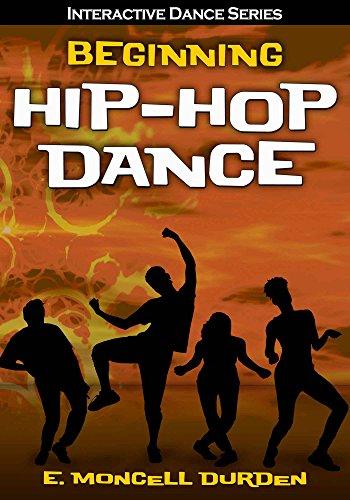
Beginning Hip-Hop Dance
Interactive Dance Series
E. Moncell Durden
University of Southern California
Names: Durden, E Moncell
Title: Beginning hip-hop dance / E Moncell Durden, University of Southern California
Description: Champaign, IL : Human Kinetics, [2019] | Series: Interactive dance series | Includes bibliographical references and index |
Identifiers: LCCN 2018003363 (print) | LCCN 2018005443 (ebook) | ISBN 9781492544463 (e-book) | ISBN 9781492544456 (print)
All rights reserved Except for use in a review, the reproduction or utilization of this work in any form or by any electronic, mechanical, or other means, now known or hereafter invented, including xerography, photocopying, and recording, and in any information storage and retrieval system, is forbidden without the written permission of the publisher.
Portions of chapters 1 through 3 are adapted from M. Giguere, 2014, Beginning modern dance (Champaign, IL: Human Kinetics); J. Robey, 2016, Beginning jazz dance (Champaign, IL: Human Kinetics).
The web addresses cited in this text were current as of February 2018, unless otherwise noted.
We thank the Glorya Kaufman School of Dance at the University of Southern California in Los Angeles for assistance in providing the location for the photo and video shoot
The video contents of this product are licensed for educational public performance for viewing by a traditional (live) audience, via closed circuit television, or via computerized local area networks within a single building or geographically unified campus To request a license to broadcast these contents to a wider audience for example, throughout a school district or state, or on a television station please contact your sales representative (www.HumanKinetics.com/SalesRepresentatives).
Printed in the United States of America
10 9 8 7 6 5 4 3 2 1
The paper in this book is certified under a sustainable forestry program.
Human Kinetics
P.O. Box 5076
Champaign, IL 61825-5076
Website: www HumanKinetics com
In the United States, email info@hkusa com or call 800-747-4457
In Canada, email info@hkcanada com
In the United Kingdom/Europe, email hk@hkeurope com
For information about Human Kinetics’ coverage in other areas of the world, please visit our website: www.HumanKinetics.com
E6942
Contents
Preface
How to Use the Web Resource
Acknowledgments
Chapter 1: Introduction to Hip-Hop Dance
Defining Hip-Hop Dance
Benefits of Studying Hip-Hop Dance
Basics of Hip-Hop Dance
Expectations and Etiquette for Students
Evaluation of Your Class Performance
Structure of the Hip-Hop Class
Summary
Chapter 2: Preparing for Class
Dressing for Class
Carrying Dance Gear
Preparing Yourself Mentally and Physically
Summary
Chapter 3: Safety and Health
Studio Safety
Personal Safety
Basic Anatomy
Basic Kinesiology
Preventing Common Dance Injuries
Treating Common Dance Injuries
Warming Up
Understanding Fitness
Nutrition, Hydration, and Rest
Summary
Chapter 4: Basics of Hip-Hop Technique
BEATS Approach
Alignment and Stance
Isolation Grooves
Across the Floor
Performance
Directions
Summary
Chapter 5: Basic Hip-Hop Dance Steps
Dances From the 1980s
Dances From the 1990s
Dances From the Early 2000s
Summary
Chapter 6: History of Hip-Hop Dance
Origins of Hip-Hop Dance
Appropriation and Approximation of Hip-Hop
Commercialization of Hip-Hop Dance
Summary
Chapter 7: Hip-Hop Dance Forms
Locking
Waacking
Electric Boogaloos and Popping
House
Summary
Glossary
References
Suggested Resources
About the Author
Preface
I define the term dance acronymically as “Discovering the Autobiographical self by Negotiating Creativity and Expression.” More specifically, we are in constant discovery of our autobiographical self, our narrative, and we are negotiating our bodies, ideals, voice, expression space, emotions, and so on; our creativity is the production of the feelings, and expression is the space in which we allow ourselves to be vulnerable to share those feelings with others. Hip-hop dance is an ever-changing multicultural expression of individuality, innovation, and communication. Even though hip-hop is an ever-growing movement, hip-hop culture still consists of basic elements: rapping, deejaying, graffiti art, beatboxing, and the dance forms of b-boying (breaking) and hip-hop social dances.
Beginning Hip-Hop Dance takes you on a personal journey into the essence of hip-hop and its dance forms. The book gives you a platform on which to build a working knowledge of hip-hop dance by participating in hip-hop exercises; learning movement vocabulary and dance technique; and developing hip-hop literacy by exploring its history, lineage, and dance forms.
The book’s chapter divisions offer structure for what can seem to be an improvisational dance genre. Chapter 1 briefly overviews hip-hop dance and examines what to expect in a hip-hop dance class. Chapter 2 addresses how to prepare for class both mentally and physically, including the best footwear choices for this style of dance and the proper clothing to wear during class. Chapter 3 covers personal and studio safety, basic anatomy and kinesiology, nutrition and hydration, and injury prevention and treatment.
Chapter 4 shifts the focus to the dancing itself by addressing the basics of hip-hop dance; it also explains the BEATS method (which focuses on body, emotion, action, time, and space) for learning hip-hop. Chapter 5 follows up by introducing you to basic hip-hop dances. Chapter 6 explores the development and lineage of hip-hop dance; along the way, it highlights cultural phenomena that help construct and characterize hip-hop movement
practices, as well as their aesthetic values. Finally, chapter 7 gives you insight into six major forms of hip-hop dance: locking, waacking, breaking or bboying, popping and boogaloo, hip-hop, and house.
Beginning Hip-Hop Dance intertwines the visual, auditory, and kinesthetic modes of learning. It guides you along your hip-hop journey and gives you a platform for beginning to investigate your own ideals; it also enables you to develop the technique and knowledge to build on the movements presented here. You can find more information about technique, as well as video clips of each hip-hop movement presented in the book, in the online web resource. This web resource will be your companion during your journey of selfdiscovery through hip-hop dance. It includes chapter-by-chapter learning experiences, quizzes, and glossary terms, which are presented both with and without their definitions so that you can self-test your knowledge.
Thus Beginning Hip-Hop Dance gives you the tools you need in order to get started in the exciting and fulfilling world of hip-hop dance. However, in order to fully understand and develop the nuances, self-confidence, and attitudes that characterize this dance form, you must also take part in relevant social interactions, which can be found in club settings, at dance jams, and at practice jam sessions. Remember, this is your journey of self-discovery through hip-hop dance. Learning any new dance genre or form requires patience, so take your time, indulge in the information presented here, and find your own dance expression. Congratulations on taking your first steps!
How to Use the Web Resource
In a hip-hop dance class, steps and combinations can occur quickly. They can contain a large number of new movements or small additions to movements you have already learned. But you have an added advantage! Your personal tutor is just a few clicks away and is always available to help you remember and practice the exercises and steps executed in class. You can study between class meetings or when doing mental practice to memorize exercises or movement. Check out the web resource that accompanies the book online.
The web resource is an interactive tool that you can use to enhance your understanding of beginning hip-hop dance technique, review what you studied in class, or prepare for performance testing. It includes information about selected positions or movements, including instructions for correct performance; and video clips of hip-hop dance techniques. Also included are interactive quizzes for each chapter of the Beginning Hip-Hop Dance text, which let you test your knowledge of concepts, hip-hop dance basics, terminology, and more.
In a beginning hip-hop dance class, students learn about hip-hop technique, hip-hop dance as an art form, and themselves. The Supplementary Materials section of the web resource contains the following additional components for each chapter of the Beginning Hip-Hop Dance text. These components support both learning in the hip-hop dance class and exploring more about the world of hip-hop dance.
Glossary terms from the text are presented so that you can check your knowledge of the translated meaning of the term as well as a description of the term.
Web links give you a starting place to learn more about hip-hop dance techniques, or styles.
Chapters include e-journaling prompts that will help you think more deeply about beginning hip-hop dance class. Other assignments include specific activities to apply concepts and ideas about hip-hop dance.
This web resource helps you individualize your learning experience so that you can connect to, expand, and apply your learning of beginning hip-hop dance, enhancing your success and enjoyment in the study of this dance form.
Acknowledgments
This book is dedicated to the hip hop dance community worldwide. Special acknowledgment goes to Rebecca A. White, Raymond G. White, Mary E. Brooks, E. Moncell Durden Jr., and Celine Kiner.
Chapter 1 Introduction to Hip-Hop Dance
Now one of the most popular forms of dance in the world, hip-hop arose in the Bronx in the early 1970s in the form of b- boying. It began to attract mainstream attention from both American and global audiences when it was featured in the 1983 film Flashdance (Simpson, Bruckheimer, & Lyne, 1983). In particular, one scene that focused on breaking inspired young people around the world to investigate this dance form. The solo dances (also referred to as social or party dances) of the 1980s continued to gain global popularity through rap concerts and music videos featured on the television series Yo ! MTV Raps. Breaking was the first dance to represent the emerging cultural expression of hip-hop, those elements included but not limited to the following elements:
Graffiti art, the visual language of the hip-hop community
Deejaying, which represents the sounds and memories of the community
Beatboxing, a form of vocal percussion that primarily mimics a beatbox drum machine
Emceeing, which involves the voices and storytellers of the community
B-boying, a form of “street” dance that originated with Puerto Rican and African American youth in the early 1970s and has been defined by one dance historian as “physical graffiti” (Banes, 1981)
As the dance form that accompanied this new culture, breaking was performed primarily to the break section of any record with a funky beat. This new and unique dance form required particular skills that not everyone had or was even physically capable of developing. In the mid-1980s, however, the rise of hip-hop music led to a new movement including party dances that could be easily enjoyed by everyone. These new dances became known simply as hip-hop because that was the style of music to which they were performed.
Defining Hip-Hop Dance
Hip-hop is characterized by a high level of playfulness and exploration through “move-meant” concepts and techniques that is, moves that hold meaning and value, informed by personal, social, cultural, and environmental experiences. Hip-hop social dances feature multiple rhythms, as well as movement that generates and expands from multiple centers; in other words, it is polyrhythmic and polycentric.
Hip-hop dance does not use movement practices from modern, ballet, or Broadway- or Hollywood-style jazz dance. Rather, like African, authentic jazz, and other African-diasporic dance forms (such as Afro-Cuban, Brazilian, and Haitian), hip-hop employs a curved spine, bent knees, and an orientation to the earth. It is percussive, improvisational, and communal for example, using call-and-response. It also uses pantomime and isolations, and it deeply engages the full body neck, shoulders, arms, torso, rear end, hips, legs, knees, and feet. It is fluid, and the feet are flexed, not pointed.
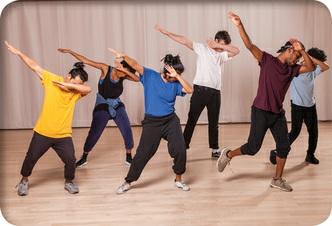
The technique and structure of hip-hop are rooted in cultural concepts and traditions associated with behavioral characteristics of African dance heritage. New hip-hop dances are created all the time, and some recent popular forms include the Milly Rock, the Dab, Hit Dem Folks, the Drop, the Nae Nae, and the Whip, just to name a few. These dances engage and communicate African American cultural values such as the exhibition of cool, ideals of style, use of multiple rhythms, musical and spatial awareness, gesturing, attitude, fashion, spirituality, and individuality. These dance practices do not simply retain African American values; they enact philosophical theories as people place ancestral roots in new soil.
Black vernacular dance practices are usually defined by the music to which they are danced; thus jazz dance goes with jazz music, house dance with house music, and hip-hop dance with hip-hop music. More specifically, hiphop dance is defined by two forms: b-boying, which is danced to breaks or breakbeat music, and hip-hop social dances, which are danced to rap music.
The use of a break in songs originated in soul music and involves sampling or repetition of an instrumental section. A break is usually characterized by all elements dropping out except for the drummer, and it can be established at the beginning, middle, or end of a record. For example, in the James Brown song “Funky Drummer,” the break occurs at 5:22. A break can also come from any style of music. For instance, the first 18 seconds of the Beatles’ “Sgt. Pepper’s Lonely Hearts Club Band” constitute a break, as do the first four bars of Aerosmith’s “Walk This Way.” Perhaps the most concise definition of a break was offered by Afrika Bambaataa, who is considered the godfather of hip-hop: The break “is the part of the record everyone waits to dance to” (personal communication, 2007).
In the beginning of hip-hop, emcees and deejays used music samples from soul, funk, electronic, and rock records. Emcees would rhyme over the break, and breakers and solo dancers would dance. However, the commercialization and exploitation of breaking in the mid-1980s along with the growing production of danceable rap records led to a shift away from breaking and toward a new style of hip-hop dance. This new style included many solo dances, such as Happy Feet, the Roger Rabbit, the Biz Markie, the Running Man, and the Skate. (These steps and more are described in chapter 5.)
Benefits of Studying Hip-Hop Dance
Hip-hop dance helps you identify and explore your individual characteristics, your personal preferences, and your own style; it also provides a physical outlet for your emotions. Hip-hop is not, however, only about performance and presentation. It also involves communication, collaboration, community building, critical and creative thinking, innovation, and problem solving. In addition, it builds stronger motor skills, focus, memory, coordination, and fitness. In other words, it gives you a way to illuminate personal and cultural dynamics of ethnicity and diversity while also providing you with a vast and powerful repertoire for self-expression.
Basics of Hip-Hop Dance
Dance can be used to express ideas through gesticulations that correspond visually with certain concepts. In hip-hop, those concepts begin with three key ingredients: the music, the environment, and you. The relationships between the music, your sociocultural experience, and your body in motion exist in a type of nonverbal conversation about feelings that are in conversation with each other at the same time.
Music is the guide; it tells you when to start, jump, turn, drop, spin, and stop. Movement ideas, however, can come from anywhere for example, from games that children play, the ways in which your friends walk or gesture when they talk with each other, moves used by people playing basketball in the park, or movements exhibited by skateboarders. In hip-hop dance, these movements and movement concepts are reconfigured and presented in various forms, such as bouncing, rocking, grooving, isolations, polyrhythms, polycentrism, pausing, improvisation, and innovation. These movements and concepts are not indigenous to hip-hop but date back hundreds of years. The expression is based on one’s current life experience, but many of the gestures are connected to and relate back to nonverbal communication practices that exist in one’s community or culture. It is like the saying, “There is nothing new under the sun,” but what is new is you; you bring new expressive approaches.
Dance Environment
Your dance class may take place in a dedicated dance space or in a room that serves many purposes. It may occur, for instance, in a fairly large room with metal or wooden railings, called barres, that help ballet students maintain their balance during certain exercises. Dance studios also tend to have wooden or vinyl floors with “sprung” flooring underneath that gives when you jump or land. In addition, the room may have mirrors lining one wall in order to help your instructor see everyone in the room and to help both you and your instructor see your form and alignment. Although mirrors may
seem intimidating at first, you will quickly become accustomed to using them as a way to learn.
In contrast, some dance classes take place in a gym or auditorium with no barres or mirrors. A lack of mirrors is not necessarily a bad thing in hip-hop dance. Although hip-hop does feature some specific head, arm, leg, and foot positions, it ultimately focuses more on how you feel than on how you look when dancing. Therefore, the use of a mirror can be an inhibiting factor as the teacher works to encourage you to build and rely on your own kinesthetic awareness. In this approach, you learn to know by feeling rather than by seeing.
Moreover, social dances such as hip-hop are born out of a specific community’s sociocultural concepts of nonverbal communication. As a result, these dances are not always learned in a studio. Instead, they can be learned in public spaces and events in the community (such as dance halls, social clubs, house parties, and playgrounds) and other nonstudio practice locations (such as sidewalks, shopping malls, and train and subway stations; any place a dancer feels like practicing). These dances constitute forms of expression that hold particular value in their community. Therefore, learning social hip-hop dances requires more than developing technical acuity; it also involves learning the who, what, when, where, why, and how of a cultural practice. The dances are inspired by the music, the music comes from the people, and the thought processes of the people are informed by their sociocultural experiences.
Role of the Teacher
Your teacher is your personal guide to the music, movement, language, history, and culture of hip-hop. He or she imparts knowledge through systematic methods to help you draw out or develop your own dancing.
Every dance teacher is different, and each brings his or her own perspective to the class. Some teachers take a choreographic approach, in which you learn a routine to a specific song or section of a song. This type of class is sometimes referred to as commercial hip-hop or choreo. Other teachers take a more fundamental approach, which teaches students key technical aspects
Exploring the Variety of Random Documents with Different Content
will: he is the sheer miraculous birth of gayety from the frustrate desert of Cervantes’ life.
To Sancho, the “phenomenal” world, the world of facts is everything. Since he conceives no other, and since his master continuously lives within another of his own conceiving, Sancho is held busy translating into factual terms the entire adventure which he rides with Don Quixote.
A vertiginous effort it is, and it ends by making Sancho more nearly mad than his knight. He believes factually in his Island. He believes himself its governor, though he has crossed no water to attain it. The maid who is to wed Don Quixote after he has gone to Africa to slay her foe is factually to him the Princess Micomacoma. This enchantment must be a fact, like the one which befell Dulcinea, turning her into the wench Aldonza. Sancho vacillates forever between the credulity and the skepticism of the literal mind: ignorance is so clearly the matrix of his sanity that the delusions of his master become wise by contrast. There are no dimensions to his thinking. Don Quixote is mad—or he is a true knight-errant: the adventure is wild,—or there will be a veritable island.
His dominant impulse, either way, is greed. Greed makes him doubt: greed makes him trust his master. Yet underneath, there works subtly upon Sancho a sweeter influence: his indefeasible respect for Don Quixote. Howsoever he argue, howsoever clear he see, howsoever he sicken from constant thumpings and sparse earnings, howsoever wry are the pleasures of his Island, Sancho cannot altogether free himself from the dominion of an idealizing will which he can never understand. In a directer way (since he is no intellectual) than that of Sansón Carrasco, he is held and haunted by Don Quixote. When he is absent from his master he is lost. When, in a scene more touching than the pathos of two quarreling lovers, Don Quixote gives him leave to depart homeward, promising him reward for his past service, Sancho bursts into tears and vows that he cannot forsake him.
He loves his master. Not greed alone, or if so, the greed of devotion to an ungrasped grandeur, holds him astride his dappled ass to follow Don Quixote to the sea. And yet, he despises him; and he betrays him. He judges him, and he exploits him. He makes sure of his reward in Don Quixote’s will, and he gives up the comfort of his wife to follow him through ridiculous dangers. He is this sensual, lusty, greedy oaf of the soil. And yet
in the love that masters him he is Cervantes, himself: Cervantes who created Don Quixote to laugh and to mock—and who remained to worship.
For this is the crux of the matter. Cervantes needed Sancho to keep Don Quixote in the perspective for laughter. “Common-sense” rides along with the “madman,” and constantly shows him up. But here is Sancho, shown up himself! Here is Cervantes, shown up! For Cervantes accepts Don Quixote. And that is why we accept him. Cervantes builds up these countless reasons for rejecting him: the havoc wrought by his acts, the shoddy stuff of his dream, the addled way of his brain. It avails naught. Cervantes ends with love. And we—the more humbly in that we have mocked and roared— avow our veneration.
Of such stuff is made the holiness of Don Quixote: mildewed notions, slapstick downfalls. We laugh at his unfitness to impose his dream upon a stubborn world: we see well enough that Rocinante is a nag and the knight himself, helmeted with a dish, a mangy addled fellow. And we accept, in order that he may live this nonsense, the disruption of inns, the discomfiture of pilgrims, the routing of funerals, the breaking of bones!
Cervantes strives hard to snuff out the aspiring hunger of his soul. For this, Don Quixote is bemuddied and deformed. But Don Quixote lives: and his chief enemy—Cervantes—gives him his blood and his passion, in order that he may triumph.
c. The Book of the Hero
Don Quixote is written in a prose majestical, dense, warm, lucid, still. It is the fulfillment of the Castilian music which Rojas’ La Celestina promised a century before. The tempo is slow. More correctly, the organic movement of the prose is slow; and the facet movements are swift and nervous. The Cervantine prose is a portrait of the soul of Spain whose cadences of desire and will resolve into an immobile whole.
The accentual music of this prose had already become the innate quality of Castilian. Cervantes heightened his inheritance. The natural genius of the language was already, in the mystics and novelists before him, one that made for a muscular, slow yet sharply surfaced prose. In Don Quixote, the music has as its base an almost cosmic beat, within which as in a firmament, the swifter, brighter, more fleeting qualities stand forth. Cervantes makes good use of the agglutinated verb and pronoun, of the
syncopations within the general prose rhythm. Above all, he makes use of the loamy expressions of the people, transfiguring them, however, into a tonal design not remotely naturalistic and more akin to the prose of the religious writers than of the pícaro novelists who also helped themselves to the vernacular of the soil.
In the great novel of Rojas there is a like marriage of pungent and ironical stuffs in an exalted orchestration. The difference is one of quality and quantity. Cervantes’ instruments are more varied; his themes and the materials that build them are more numerous, even if no one is richer than the central form of La Celestina. Indeed, the earlier work is the intenser; its colors are more hot. There is in Cervantes a strain of the north which the Jew Rojas lacked; and which made his æsthetic action longer and slower. The art of the Semite is more lyrical, less architectonic. La Celestina is a bomb-like organ; a piston-strong machine driving hard and singly. It is the tale, moreover, of a city where life is vertical and packed. Its form is true to its theme. But Don Quixote is the story of a journey—of three journeys rather—over the plains and mountains of La Mancha, Aragon, Catalonia. Its basal movement is panoramic, horizontal. Its loftier dimensions are attained by the associative power of its hero who, riding the roads of Spain, touches incessantly the spiritual realms of a people, of an age, of a soul. The formal values of La Celestina are more manifest. Very consciously, an intellectual, nervously coördinated man bound together the counterpoint of his design, so that each element partakes immediately of the whole. This is not the case in Don Quixote. The materials of the book—persons of the road, interpolated stories, situations—stand end to end, flat for the most part and quite episodic. The knight enters them organically. He transfigures them as a new element in a chemical solution. He enacts a continuous catalysis upon the parts of Spain which he encounters. The result of this is two-fold. There is created for the entire book a surface of action and a line of action. These hold the attention of the reader: these, indeed, caused the book’s popularity when it first appeared. The surface of action in the large is the Spain to which the Spanish people through the picaresque novel had been accustomed for over fifty years. The line of action is the pilgrimage of Quixote and Sancho.
But each of these two actions is complex. In consequence, their organic synthesis is often subtle and hidden. This synthesis gives to the work its unity: and one can enjoy Don Quixote without awareness of it. Indeed, the
synthesis may take place in the reader’s mind, long after he has absorbed its elements and put the book aside.
Consciousness of the organic greatness of La Celestina must come at once; since that greatness is the result of a design preconceived and implicit in the book’s several scenes. Consciousness of the greatness of Don Quixote came late even to its author and not to Spain until a whole century had passed. For its parts have an immediate life of their own; only after they have become lost and merged in one another does the book’s unity, as a synthesis of all these parts, dawn on the reader.
The knight himself is not so much an organ in this ultimate synthesis as a dimension. The synthesis is not articulate in him alone, any more than in the episodes. But it is articulate in the book’s language. And the rare individual who understood the æsthetic nature of prose might tell from the first page that Don Quixote was a stupendously formal work of art.
This prose is a becoming prose. It is heavy and pregnant. It is the antithesis of the immediate prose of Santa Teresa or of the lapidic absoluteness of the verse of Luis de Góngora. It is attuned at every moment to the whole of the book. It lacks swiftness and often sharpness. It is frequently clumsy in the projecting of little scenes. The book abounds in episodes that Quevedo would have fleshed more brightly or the author of Lazarillo pointed to more effect.
Cervantes is forever after deeper game. If, for instance, he describes the cozy dinner at which Quixote and Sancho shared the meat and acorns of six goatherds, the prose is not fundamentally focused upon the genre: but upon the tragic implications of Don Quixote’s presence and upon the irony of the attitude of the goatherds.
But Cervantes never states these deeper implications. His prose creates them. And creates them, by the immanent and abstract nature of its music. This immanence runs throughout the work, and thereby Cervantes is permanently saved the unæsthetic makeshift of statement. His direct attention goes unhindered to the presentment of the action. The action’s significance, one might say its soul, is implicit as is the significance of life implicit and unasserted in material substance and in specific action.
But as in all great art, this deep effect is won at sacrifice of a lesser. Analogously, El Greco maintains the larger anatomy of his vision
throughout the details of his paintings, although he loses thereby the grace and accuracy of the anatomy of his subjects.
There are still cavilers at El Greco’s drawing; and there have always been depreciators of Cervantes’ prose. Lope de Vega whose prosody was an immediate lyric flow of two dimensions, was perhaps sincere in his denigration of Cervantes. And even today Miguel de Unamuno, for all his adoration of Don Quixote, decries the language of Cervantes, for a similar reason: Unamuno’s lyric mood can not span the parabolas in which the figure of Don Quixote is limned.
These parabolas are the lines of the prose: and they are not, like simpler curves, to be plotted in the segment of any specific action in the book. But they are to be felt in every page. That is why the first chapter of Don Quixote announces the inscrutable tragi-comedy, although Cervantes when he wrote it had no knowledge of his undertaking. The music of his prose is the mother of his book. It is the beginning of the book’s significance, and it is the conclusion. Nor can it be translated.
A work of art in whose making significant forces have not played is inconceivable. The veriest trash, the most incompetent effort must in some wise have issued from a man’s life, from a people’s will, from an epoch’s spirit. What lies between such work and work significant in itself is not difference of material, but form. The poor work is one in which the elements of life are inchoate and, failing to achieve a unity of form, cannot be said to achieve life itself. The real work of art is that in which these elements achieve a body: is that of which these elements are the body. But the bodies of men and age whence its elements of life have sprung will rot away. Other men and other ages will succeed; and these in their will to know essential union with all men and all ages preserve the true work of art. For in it only, do those moldered lives of other men and ages touch them. The real work of art, builded of the substances of time, therefore alone does not exist in time. And a consideration of the work of art, whose basis is not equally beyond time—is not metaphysical or religious—is inadequate to art’s function in the world of time.
Before all else, Don Quixote is in form the life of Cervantes.
Toward the end of his last adventure, on the way to Barcelona, Don Quixote with Sancho attempts to hold the road against a herd of bulls. But