Introduction
This book’s key premise is that the notion that there was such a thing as ‘classical political economy’ is a distorting myth. The fact that this myth plays a central role in our histories of economic thought suggests that we have a poor understanding of the thought of the past and of the historical process by which economics came to assert itself so forcefully in the modern world. What follows, therefore, is an attempt at revision: to use contextual intellectual history to expose the shortcomings in our existing knowledge and to then establish a more reliable account of what Malthus, Ricardo, and their peers thought they were doing when they wrote texts of political economy.
Malthus and Ricardo form the focus because they are central to all accounts of classical political economy and because they played leading roles in the longterm process by which economic reason came to assert itself in British political life. More specifically, Malthus and Ricardo were the first self-styled ‘theorists’ who explicitly attacked their ‘practical’ opponents for being untheoretical in matters of political economy. This strategy was tremendously successful. Above all, it spurred the emergence of Tory political economists who claimed theoretical equality with their Whig rivals, thus helping political economists in general to achieve the institutional traction that they needed to reform the British state, most visible in changes to the Poor Laws (1834), Bank of England (1819, 1844), and Corn Laws (1846). The presumption of political economists to prospect such reforms to their societies outside of any institutional office has been an aspect of our (Anglo-American) politics ever since. But it is nearly impossible to grasp this fact when the category ‘classical political economy’ organizes the historical materials, not least because it usually does so in service to a polemic regarding the competing merits of neoclassical, Marxist, and post-Keynesian economics in the present.
This book must therefore confront the enduring presence of anachronism in the history of economic thought. The primary cause is that practitioners are willing to approach the past through the categories and controversies of the present. Traditionally, this practice has been defended by specifying the proper aim of research as recovering the ‘analytical system’ of a past thinker,1 or the ‘history
1 George J. Stigler, ‘Does Economics Have a Useful Past?’, History of Political Economy 1/2 (1969), 217–30, at 220.
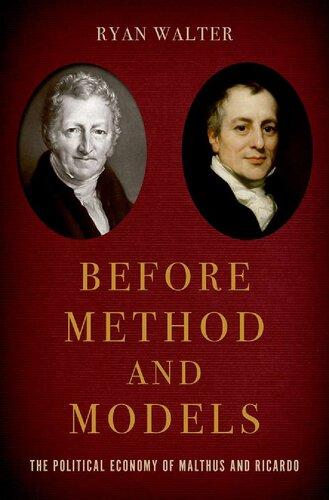
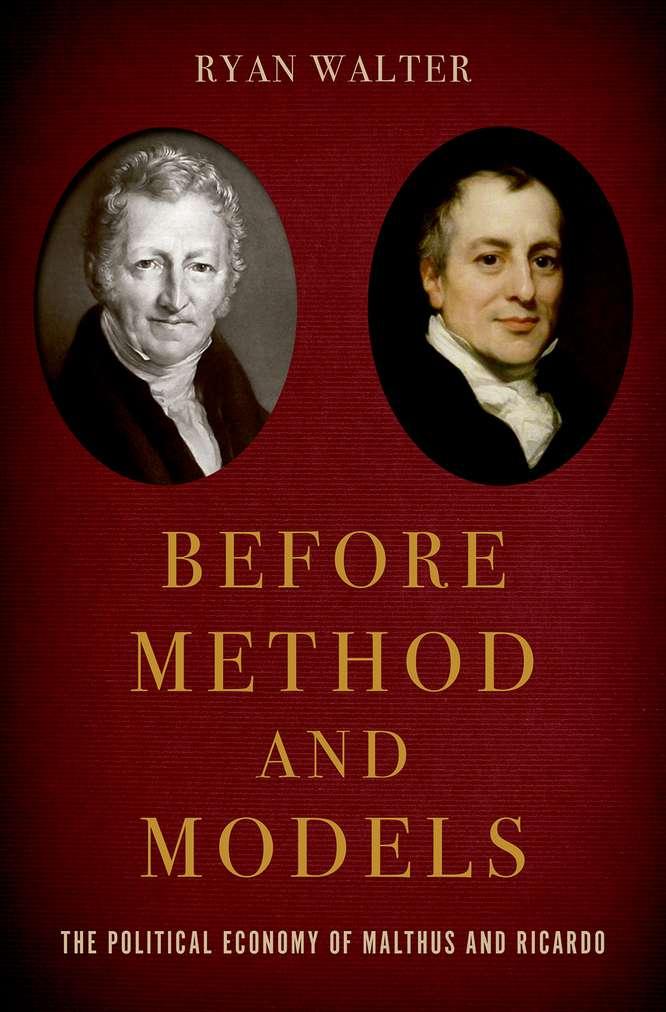
Before Method and Models. Ryan Walter, Oxford University Press. © Oxford University Press 2021. DOI: 10.1093/oso/9780197603055.003.0001
of economic analysis’ as distinct from the ‘history of economic thought’,2 or as providing a ‘rational reconstruction’ in contrast to a ‘historical reconstruction’,3 often in conjunction with Imre Lakatos’s distinction between ‘internal’ and ‘external’ history.4 At times these justifications have been intended to facilitate the recovery of lost ideas that are serviceable in the present.5 More generally, however, these justifications for anachronism have been driven by the need to secure a place for history in the economics curriculum, which explains the field’s anxiety to demonstrate that studying the past might be good for an economist’s intellectual formation.6
This anxiety has been exacerbated by historiographical competition as the history of economic thought has migrated outside of economics departments since the 1970s and been taken up by scholars of different stripes, including English scholars, historians of science, and, above all, by professional intellectual historians. Whatever private beliefs historians may hold regarding the edifying potential of history for economists, they do not typically do their teaching in economics departments.7 Thus unburdened by the obligation to sell their wares, intellectual historians have been free to push the history of economic thought into genuinely historical directions, dispensing with the self-serving distinctions noted earlier that presume to sort wheat from chaff. Instead, once it is simply taken for granted that history is a worthwhile pursuit, the guiding distinction is not between rational and historical reconstruction but between ‘myth-making and historiography’.8 As this alternative opposition implies, some of the results
2 Joseph A. Schumpeter, History of Economic Analysis (Oxford: Oxford University Press, 1994 [1954]), 38–43.
3 See, for example, Mark Blaug, ‘On the Historiography of Economics’, Journal of the History of Economic Thought 12/1 (1990), 27–37.
4 See, for example, A. M. C. Waterman ‘Mathematical Modelling as an Exegetical Tool: Rational Reconstruction’, in Warren J. Samuels, Jeff E. Biddle, and John B. Davis, eds., A Companion to the History of Economic Thought (Malden: Blackwell Publishing, 2003), 553–70.
5 See, for example, the essays; Marcella Corsi, Jan Kregel, and Carlo D’Ippoliti, eds., Classical Economics Today: Essays in Honor of Alessandro Roncaglia (London: Anthem Press, 2018); and Steven Kates, Classical Economic Theory and the Modern Economy (Cheltenham: Edward Elgar, 2020).
6 See, for example, Ivan Moscati’s figuring of historians as commentators who tell the story of the ‘game’ of economics for the ‘players’—economists who do not have either the time or interest to tell its story but who might benefit from a fair recounting nevertheless: Ivan Moscati, ‘More Economics, Please: We’re Historians of Economics’, Journal of the History of Economic Thought 30/ 1 (2008), 85–92, at 88. A shopping list of reasons is provided by Steven Kates, who was moved to write when the European Research Council attempted to remove the history of economic thought from the list of subfields in economics: Steven Kates, Defending the History of Economic Thought (Cheltenham: Edward Elgar, 2013), 21.
7 The late Donald Winch was a rare example of someone who was trained in economics but transitioned to being a professional intellectual historian. The specialist nature of intellectual history and the closure of economics to humanist scholarship now makes a trajectory such as Winch’s difficult to follow. See Keith Tribe, ‘Donald Winch 1935–2017’, The European Journal of the History of Economic Thought 25/1 (2018), 196–201, at 196.
8 Conal Condren, Argument and Authority in Early Modern England: The Presupposition of Oaths and Offices (Cambridge: Cambridge University Press, 2006), 229.
are destructive for received accounts since one of the routine effects of contextual intellectual history is to reveal the tendency for academic disciplines to project imaginary auto-histories onto the past.9 In this respect, this book is indebted to the pioneering work of Keith Tribe and Donald Winch, who have led the attempt to produce genuinely historical accounts of economic thought.10
If intellectual history does not deal with phantoms, then the question becomes one of determining what can be identified as a valid object of historical analysis. For intellectual historians, the short answer is texts, understood to include written records of wide variety, including philosophical treatises, government reports, the popular press, and much else besides. Unlike the conjectural nature of an analytical system that silently moves an author’s thoughts behind their back or an economic analysis existing independently of the texts and contexts from which it is divined, positing historical texts as a thing in the world does not need to be underwritten by either teleology or metaphysics. That is, one can point to texts as physical objects, examine their literal contents and organization, and often identify their publication histories, none of which can be done to an analytical system or other hypothetical objects. The intellectual historian’s confidence regarding the existence of texts as their object of study comes at a cost, however, for the historiographical horizon must be lowered to allow the messy, contextual features of the composition and reception of texts in historical time to come into view.
While shifting to the study of texts allows historians to ground their work in textual evidence, it does create a set of issues regarding the tools that should be used to sift that evidence. Indeed, some of the best historians in the world have been working through this question for decades without reaching a consensus. It should therefore be acknowledged that the approach adopted here draws on the so-called Cambridge school of intellectual history, associated most closely with the names of J. G. A. Pocock and Quentin Skinner.11 In terms of their technical approach, Pocock and Skinner have both emphasized the need to attend to linguistic evidence when attempting to determine what a text might have meant to the society or milieu in which it was produced.
9 For a classic exposé of the ‘mythologies’ that typically underwrite rational reconstruction, see Quentin Skinner, ‘Meaning and Understanding in the History of Ideas’, History and Theory 8/ 1 (1969), 3–53. Reprinted as Quentin Skinner, Visions of Politics, 3 vols. (Cambridge: Cambridge University Press, 2002), 1: chapter 4.
10 In particular, Keith Tribe, Land, Labour and Economic Discourse (London: Routledge and Kegan Paul, 1978) and Keith Tribe, The Economy of the Word: Language, History, and Economics (Oxford: Oxford University Press, 2015); Donald Winch, Adam Smith’s Politics: An Essay in Historiographic Revision (Cambridge: Cambridge University Press, 1978) and Donald Winch, Riches and Poverty: An Intellectual History of Political Economy in Britain, 1750–1834 (Cambridge: Cambridge University Press, 1996).
11 For programmatic statements, see Skinner, Visions of Politics, vol. 1 and J. G. A. Pocock, Political Thought and History: Essays on Theory and Method (Cambridge: Cambridge University Press, 2009).
For Pocock, the key task has been to ascertain the political language or idiom that an author mobilized. From here it becomes possible to determine if the author altered this language and, if so, if the alteration endured. By contrast, Skinner has typically identified a smaller target than languages: key terms and the accepted conventions for deploying them in a given milieu. This allows specific instances of word use, or an author’s ‘speech acts’, to be assessed in terms of their conventionality or originality. A great deal has been said regarding the relative appeal of these competing principles and how they should be mobilized in practice.12 When the issue is reduced to its core claim, however, the injunction is clear enough: examine which words are used in a text, what they may have been intended to mean by the person who wrote them, and what they may have meant to the people who read them, with openness to the possibility that the answers to these questions may not be the same.
What does all this mean for the history of economic thought in general? It means that if historians of economic thought redescribe the texts under study with a present-day vocabulary then they doctor the (linguistic) evidence.13 Or, to put the same point the other way around, such doctoring is essential to the project of rational reconstruction, or a history of economic analysis as it has also been called, since the historian only knows what counts as economic analysis from the point of view of their proficiency with a contemporary vocabulary. For contextual intellectual history, by contrast, contextualized linguistic evidence must lie at the core of any interpretation of what a text meant to its author and readers in a given time and place, and this requires that the language of a text must be handled with great care and clearly distinguished from the historian’s present-day vocabulary. To be plain, this does not mean that today’s historian must write like their dead subjects, but it does mean that they must acquire the languages of the dead as best they can, explain how they worked, and signal to the reader when they need to switch between the
12 The most thoughtful (if challenging) commentary comes from Conal Condren, The Status and Appraisal of Classic Texts (Princeton: Princeton University Press, 1985); Conal Condren, The Language of Politics in Seventeenth-Century England (New York: Palgrave Macmillan, 1994). A great deal has also been written by those who refuse the discipline of identifying historical contexts before reading texts, and this rejection of context by philosophers and historians of rival persuasions has ghosted its career from the beginning. On this point, see the indispensable account in Ian Hunter, ‘The Contest over Context in Intellectual History’, History & Theory 58/2 (2019), 185–209.
13 What has been termed the ‘Piltdown effect’. See Condren, The Language of Politics in Seventeenth-Century England, 13. In short, our conceptual vocabulary is first dug into the evidence to be studied, such that when we then claim to have made a discovery, it is on the basis of doctored evidence; we have no ancestor with a human cranium and the jaw of an ape, but a fabricated skull of this type was dug into the Piltdown earth and then ‘discovered’ (Stephen Jay Gould, ‘Piltdown Revisited’, in The Panda’s Thumb: More Reflections in Natural History (New York: W. W. Norton and Company, 1980), 108–24).
voices of past and present in the course of making texts intelligible in historical terms.14
What do these precepts mean for the study of Malthus and Ricardo in particular? They direct attention to the language that is used in their texts and to the language that is used by economists today, with a standing suspicion that when the latter is substituted for the former the consequence will be to compromise historical understanding in favour of transforming past texts into participants in today’s debates. As anyone familiar with the history of economic thought will know, such substitution is routine. As regards the ambition at work in this book, to acquire historical knowledge of Malthus and Ricardo, the consequences of language substitution are greatest in relation to three linked terms: classical political economy, model, and method. This claim can be substantiated with reference to some influential examples of the history of economic thought in its reconstructive mode.
Let us begin with the term ‘classical political economy’. It has been known for some time that this category tends to unify the authors who are grouped within its boundaries without historical warrant.15 Its origins seem to lie in Karl Marx’s jaundiced reading of political economy, with the term coined in the context of Marx making a polemical assessment of his predecessors. The closest that one comes to finding an explicit definition of classical political economy in Marx’s corpus is two consecutive footnotes towards the end of chapter 1 of the first volume of Capital (1867), in Marx’s discussion of commodity fetishism. Marx’s general point was that although Smith and Ricardo deserved credit for making scientific advances in relation to the role of labour in creating value, their categories and modes of thought were bourgeois. This is said to appear most clearly in Ricardo’s treatment of the commodity-form as natural when in fact it was reliant on the capitalist mode of production and thus specific to a particular historical stage. This is the context in which Marx wrote that value was ‘the weak point of the classical school of Political Economy’.16 A similar point is made regarding ‘classical economy’ in the second note, following which Marx clarified his usage:
by classical Political Economy, I understand that economy which, since the time of W. Petty, has investigated real relations of production in bourgeois
14 On the notion that the historian’s procedure involves distinguishing their own ‘historical standpoint’ from that occupied by those about whom they write, see W. B. Gallie, Philosophy and the Historical Understanding (London: Chatto and Windus, 1964), 120.
15 As observed in Winch, Riches and Poverty, 8–9, 15.
16 Karl Marx, Capital: A Critique of Political Economy, ed. Frederick Engels, trans. from the Third German Edition, vol. 1 (Moscow: Progress Publishers, 1954), 84 n1. The quotation corresponds to note 27 on page 41 in the first German edition, and here, as in the other cases, Marx is using ‘klassische politische Oekonomie’: Karl Marx, Das Kapital: Kritik der politischen Oekonomie (Hamburg, 1867).
society, in contradistinction to vulgar economy, which deals with appearances only, ruminates without ceasing on the materials long since provided by scientific economy, and there seeks plausible explanations of the most obtrusive phenomena, for bourgeois daily use.17
So clarified, Marx’s meaning is plain: classical political economy is whatever economic thinking has scientific value, as judged from the vantage point of Marxist political economy. It is this partisan character of the category that allowed Marx to group together figures as discrepant as William Petty and Ricardo. In doing so, Marx merged Petty’s seventeenth-century counselling discourse premised on a physiological analogy between the body politic and natural bodies with Ricardo’s idiosyncratic analysis of rent and value. Here historical difference is flattened by epistemological polemic.
More recent renditions of the term have been produced within the history of economic thought. In his famous paper of 1978, ‘The Canonical Classical Model of Political Economy’, Paul Samuelson roped together Smith, Ricardo, Malthus, and John Stuart Mill by identifying a common model of equilibrium growth and distribution. Samuelson constructed this model using contemporary mathematical economics, secure in the assumption that ‘within every classical economist there is to be discerned a modern economist trying to be born’.18 In this case, it is not polemic but teleology that makes a mess of the historical materials, allowing the actual contexts and concerns of Malthus, Ricardo, and their interlocutors to be ignored as they are placed in a context prepared in advance by an economic theorist from another century.
Equally symptomatic is the voluminous work of Samuel Hollander, which has been a lightning rod for debates over the character of the classical heritage.19 Hollander is revealing for his resistance to the rise of historical approaches to economic thought, even attempting to defend the category ‘classical political economy’ against the charge that it is an anachronistic reification. The defence takes the form of specifying the ‘ “core” of classical doctrine’ as the appropriate unit of analysis, which might vary historically in the sense that it can be found stated in ‘different language’, but the historian can cut through this noise by accessing the ‘pure analytics of classicism’, which the historian can redescribe in
17 Marx, Capital, 85 n1. The quotation corresponds to note 24 on pages 34–5 in the first German edition. I am grateful to Keith Tribe for his assistance on this point.
18 Paul A. Samuelson, ‘The Canonical Classical Model of Political Economy’, Journal of Economic Literature 16/4 (1978), 1415–34, at 1415.
19 See especially Samuel Hollander, The Economics of David Ricardo (London: Heinemann, 1979) and the review by Keith Tribe in Economy and Society: Keith Tribe, ‘Ricardian Histories’, Economy and Society 10/4 (1981), 451–66.
algebra without danger.20 Having the ‘pure analytics’ in view, Hollander concludes that the ‘classics inhabited a “Marshallian” not a “Marxian” universe’.21 For any professional intellectual historian, this is textbook anachronism, since writings from c. 1770–1830 are redescribed using language dating from the twentieth century and then judged to belong to a universe dating from the 1870s! Yet Hollander is adamant that his historiography is not anachronistic: ‘I have been engaged in “historical” not “rational reconstruction” ’.22 This defence by fiat gives a sense of the field’s traditional closure to historical approaches and of its continuing preoccupation with the ‘classics’ as pointing towards either Marx or Marshall.
This question of political economy’s true nature was complicated by Piero Sraffa, whose Production of Commodities by Means of Commodities (1960) has had disproportionate influence on historians of economic thought. Sraffa aligned his work with the ‘old classical economists’ who were supposedly ‘submerged and forgotten’ by marginal analysis.23 This narrative also produces teleology by linking the past with the present, only here the standard is neither Marx nor Marshall but a composite Ricardo-Marx-Sraffa. Thus a Sraffa disciple could repeat Marx’s claim regarding William Petty without hesitation: ‘Petty also failed to develop a systematic analysis of the determination of wages’, as if it were even possible that Petty could have formed this intention in the seventeenth century.24 In this example, the category ‘classical political economy’ excuses the historian from investigating what an author was trying to do because it is taken for granted that inside Petty was a Sraffian trying to be born. As Terry Peach has shown, the evidence against Sraffa’s reading of Ricardo in terms of a corn-model of distribution is overwhelming, and resistance to this fact seems to be driven by the quasispiritual nature of the Sraffian school’s attachment to Ricardo as their illustrious founder.25
The reference to the so-called corn-model that is central to Sraffian political economy directs attention to the second term that drives anachronism in the history of economic thought, ‘model’. The idea that scientists produce models
20 Samuel Hollander, ‘ “Classical economics”: A Reification Wrapped in an Anachronism?’, in Evelyn L. Forget and Sandra Peart, eds., Reflections on the Classical Canon in Economics: Essays in Honor of Samuel Hollander (London: Routledge, 2000), 7–26, at 8, 18.
21 Ibid., 23
22 Ibid., 18.
23 Piero Sraffa, Production of Commodities by Means of Commodities: Prelude to a Critique of Economic Theory (Cambridge: Cambridge University Press, 1960), v.
24 Christian Gehrke, ‘British Classical Political Economy’, in Gilbert Faccarello and Heinz D. Kurz, eds., Handbook on the History of Economic Analysis, vol. 2 (Cheltenham: Edward Elgar Publishing, 2016), 125–49, at 128.
25 Terry Peach, ‘On Interpreting Ricardo: A Reply to Sraffians’, Cambridge Journal of Economics 22/5 (1998), 597–616; Terry Peach, Interpreting Ricardo (Cambridge: Cambridge University Press, 1993). As noted in the Acknowledgements, I have also struggled to escape the ‘corn model’ view of Ricardo.
is a phenomenon of the twentieth century, and for economists the start of the shift has been dated to the 1930s, in relation to Jan Tinbergen’s work on business cycles.26 Hence it is no surprise that Tinbergen’s contemporary, John Maynard Keynes, appears not to have thought in terms of models, subtitling the two volumes of his A Treatise on Money (1930) as The Pure Theory of Money and The Applied Theory of Money 27 Furthermore, he identified the polemical target of the first chapter of The General Theory of Employment, Interest and Money (1936) not as the ‘models’ of the classics but instead their ‘economic thought, both practical and theoretical’, especially its disconnection from ‘the facts of experience’.28 In short, model-talk is of recent vintage, and the assumption that even as modern a thinker as Keynes was producing models is highly suspect.29
It follows that to redescribe the texts of Malthus and Ricardo as if they contained models is to dig our vocabulary into the historical evidence, corrupting it in consequence. The leading example of this pathology is found in the endless readings of Ricardo’s Essay on Profits (1815) in relation to Sraffa’s construction of a corn-model. (That Sraffa tended not to use the term ‘model’, preferring instead to use ‘theory’ in both his own Production of Commodities and in his editorial introduction to Ricardo’s Principles of Political Economy, and Taxation (1817), is evidence of semantic drift created by the rise of modelling in economics since the mid-twentieth century.) But Malthus has also been subjected to this treatment, with Hollander reading Malthus as implicitly developing an agricultural growth model.30 More startling is A. M. C. Waterman’s redescription of diverse texts in terms of an underlying model, as per Samuelson’s ‘canonical model’ noted earlier. Malthus is one of the authors to receive this treatment from Waterman, being retrospectively endowed with a ‘model of stationary equilibrium’ as part of Waterman’s ‘rational reconstruction’.31 At times these reconstructions of past thinkers in terms of models completely obliterate the historical point of their work. Consider Waterman’s treatment of Burke in the following statement:
26 Marcel Boumans, How Economists Model the World into Numbers (London: Routledge, 2004), chapter 2. Despite being aware of these issues, Mary Morgan adopts a contemporary definition of modelling as a style of reasoning and then projects it backwards in time, finding Ricardo to be a ‘pioneer’: Mary Morgan, The World in the Model: How Economists Work and Think (Cambridge, 2012), chapter 2.
27 John Maynard Keynes, The Collected Writings of John Maynard Keynes, eds. Elizabeth Johnson and Donald Moggridge, 30 vols. (Cambridge: Cambridge University Press, 1978), vol. 5 and vol. 6.
28 Keynes, The Collected Writings of John Maynard Keynes, 7: 3.
29 More helpful is Victoria Chick’s comment that economists who are accustomed to think in terms of models struggle to understand Keynes’s method in the General Theory, which does not fit into the categories of either partial or general equilibrium: Victoria Chick, Macroeconomics After Keynes: A Reconsideration of the General Theory (Cambridge, Mass.: MIT Press, 1983), 14.
30 Samuel Hollander, The Economics of Thomas Robert Malthus (Toronto: University of Toronto Press, 1997), chapter 3.
31 A. M. C. Waterman, Revolution, Economics and Religion: Christian Political Economy, 1798–1833 (Cambridge: Cambridge University Press, 1991), 40, 264–73.
both Burke’s and Godwin’s arguments are defective in exactly the same way. For by postulating a stable equilibrium at some different state from the status quo, and by treating the latter as unstable unless constrained by institutional bonds, they leave altogether unexplained the way in which society comes to be what it actually is.32
‘Exactly so!’ Burke might have replied, for such rational theory that presumed to ‘explain’ in mechanistic terms the formation of an entire way of life was viewed by Burke as a cause of social unrest, and he often aimed to foreclose such speculations.33 This aspect of Burke’s thinking is impossible to recover when he is transformed into a failed model builder.
To now turn to the final term that is central to the production of anachronism—‘method’—it should be noted that this term (in today’s sense) is less of a latecomer than either ‘model’ or ‘classical political economy’. The discussion of scientific method in the sense of pursuing a general epistemological strategy, such as induction or deduction, emerged shortly after Ricardo’s death, driven especially by William Whewell and John Herschel.34 During Ricardo’s lifetime, however, ‘method’ was used sparingly and primarily to refer to the need to proceed in an orderly fashion—in today’s sense of being ‘methodical’—and to conduct the intellect with ethical surety.35 It should be emphasized that Whewell
32 Ibid., 27.
33 See, for example, Burke’s distinction between a new society such as revolutionary France, the origins of which ought to be examined, and ‘an old structure which you have found as it is, and are not to dispute of the original end and design with which it had been so fashioned’: Edmund Burke, ‘First Letter on a Regicide Peace’, in Writings and Speeches, eds. Paul Langford and William B. Todd, 9 vols. (Oxford: Oxford University Press, 1981–2015), 9: 187–264, at 252. For the general tendency to translate Burke’s distinctive common law approach to markets into an analytical form of political economy, see Ryan Walter, ‘Conservative Politics and Laissez Faire Economics? The Burke-Smith Problem Revisited’, Critical Historical Studies 7/2 (2020), 271–95. Of course, Burke was not opposed to historiography as a mode of understanding origins, and in this respect his debts to the Scots are deep. See Daniel I. O’Neill, The Burke-Wollstonecraft Debate: Savagery, Civilization, and Democracy (University Park: Pennsylvania State University Press, 2007), chapter 2.
34 Richard R. Yeo, ‘Scientific Method and the Rhetoric of Science in Britain, 1830–1917’, in John A. Schuster and Richard R. Yeo, eds., The Politics and Rhetoric of Scientific Method: Historical Studies (Dordrecht: D. Reidel, 1986), 259–97; Richard R. Yeo, ‘William Whewell’s Philosophy of Knowledge and Its Reception’, in Menachem Fisch and Simon Schaffer, eds., William Whewell: A Composite Portrait (Oxford: Oxford University Press, 1991), 175–99.
35 On those few occasions when Ricardo used the word ‘method’, he used it in this sense: see, for example, David Ricardo, ‘Ricardo to Maria Edgeworth’, in Works and Correspondence, ed. Piero Sraffa, 11 vols. (Cambridge: Cambridge University Press, 1951), 9: 257–62, at 259; Ricardo, ‘Ricardo to Mill’, Works and Correspondence, 7: 376–83, at 378. As for the word ‘method’ in the early modern period in general, it has frequently been imbued with unhistorical meanings. Descartes, for example, is routinely misread on this point—note the title of his famous 1637 text: Discourse on the Method for Rightly Directing One’s Reason and Searching for Truth in the Sciences. See the translator’s comments, by Paul J. Olscamp, regarding the way the Discourse has typically been read in isolation of the three works that it was intended to introduce and his claim that ‘Method consists in a set of rules or procedures for using the natural capacities and operations of the mind correctly’: Paul J. Olscamp, ‘Introduction’, in René Descartes, Discourse on the Method. Optics, Geometry, and Meteorology, trans. Paul J. Olscamp, revised edition (Indianapolis: Hackett Publishing, 2001), ix–xxxvi, at xiv. Even more
and his political-economist ally, Richard Jones, were driven by their hostility to Ricardian political economy. This means that when we discuss Ricardo in relation to method and do so using Whewell’s opposition between induction and deduction, we are not only using language that Malthus and Ricardo almost never used, but we are also unknowingly adopting language that was developed by Ricardo’s enemies after his death for the purpose of attacking his work.36
All three terms—‘classical political economy’, ‘model’, and ‘method’—are typically found in combined use in the scholarly literature. In fact, it is commonly claimed that model building first flourished as an explicit method in classical political economy, intertwining the three concepts. Here is a revealing example from Denis O‘Brien’s influential text, The Classical Economists Revisited (2004):
Ricardo’s deductive method, his model building, was to be of the greatest importance. Ricardo essentially invented these techniques. His procedure not only contrasts strongly with Adam Smith’s basically inductive approach, but, as a process of heroic abstraction, it not only neglects the frictions in the economic system, but also habitually reasons in terms of the immediate relevance of the long run. Both these characteristics were to be of far greater importance for economics after the end of the Classical era: that they left their scars on Classical economics there can, however, be no doubt.37
Equally common is to find talk of the ‘methodology of classical political economy’38 or ‘the classical method in the theory of value and distribution’.39 If methodology and models postdate Malthus and Ricardo, and if ‘classical political economy’ was a label invented by Karl Marx for polemical purposes, then we need to ask: What were they doing? Answering this question requires returning to the actual vocabulary of Malthus and Ricardo and then using this evidence to reconstruct their intellectual context.
revealing is the study from Matthew L. Jones, ‘Descartes’s Geometry as Spiritual Exercise’, Critical Inquiry 28/1 (2001), 40–71. Going further back to before Descartes, ‘method’ was a term of art in post-Renaissance scholarship, with Ramus a source of controversy, but its meanings were still linked to the idea of rule-of-thumb procedures. See Walter Ong’s pithy comments on this: Walter J. Ong, ‘Ramist Method and the Commercial Mind’, Studies in the Renaissance 8 (1961), 155–72, at 163–4.
36 See N. B. de Marchi and R. P. Sturges, ‘Malthus and Ricardo’s Inductivist Critics: Four Letters to William Whewell’, Economica 40/160 (1973), 379–93.
37 D. P. O’Brien, The Classical Economists Revisited (Princeton: Princeton University Press, 2004), 49.
38 A. M. C. Waterman, Political Economy and Christian Theology Since the Enlightenment: Essays in Intellectual History (Basingstoke: Palgrave Macmillan, 2004), chapter 8.
39 Heinz D. Kurz, ‘The Surplus Interpretation of the Classical Economists’, in Warren J. Samuels, Jeff E. Biddle, John B. Davis, eds., A Companion to the History of Economic Thought (Malden: Blackwell Publishing, 2003), 167–83, at 169.
Vocabulary and the Recovery of Context
As indicated in this book’s title, one of the leading results to be reported is that, in the period under study (c. 1790–1823), neither model nor method played a major role in the conceptual vocabulary of British political economists or their critics. Indeed, it is hard to find these words being used at all by political economists, and, when they were, they were not used in today’s senses. The vocabulary of political economists did, however, include ‘theory’, ‘practice’, ‘experience’, and ‘enthusiasm’. Not only were these words used, but their meaning and range of reference was intensely contested in the leading disputes of the period. As anyone familiar with this period of British history will know, these terms had been extensively used in seventeenth-century England, amounting to commonplaces even, but they were energized in a lasting way by Edmund Burke’s hostile response to the French Revolution in his Reflections on the Revolution in France (1790). Burke’s essential point was that recent and erroneous notions of the rights of man had filled the people with ‘passionate enthusiasm’ and corrupted the reasoning of ‘modern legislators’.40 The tragic consequence was that this blinded the people to the benefits that their existing form of government actually produced because they fixated on a better, future society.
To be plain, one of this book’s major findings is that this vocabulary was central to political economy in the time of Malthus and Ricardo and that political economy did not have a vocabulary of its own. Given the precepts articulated earlier regarding attentiveness to language, the importance of this fact is hard to overstate. Above all, it signals that the tendency to study political economy as if it were an autonomous discipline in the manner of economics today is anachronistic. Instead of enjoying intellectual autonomy, political economists operated in a context where the standing of theory was not something that they could determine for themselves, and they were thus participating in a larger set of debates and intellectual cultures than historians of economic thought have normally studied.
After Burke, theory aroused suspicion while practice and experience reassured. This is why political economists who understood themselves as theorists went to elaborate lengths to move their intellectual labours under the cover of the privileged terms by rhetorically aligning their work with notions of practice and experience. Political economists also attempted to deny each other the protection of these terms, often painting their opponents as enthusiasts. Here, then, is a rival starting point for historical inquiry that rejects the path of rational reconstruction: Malthus and Ricardo were neither doing macroeconomics nor building models, but they were attempting to balance theoretical speculation
40 Burke, ‘Reflections on the Revolution in France’, Writings and Speeches, 8: 53–293, at 108, 232.
with the intense demand after the French Revolution that one also attend to practice and experience. This fact explains why Malthus and Ricardo can never be found to reflect on the nature of a good model but are found to have routinely reflected on the relationship between theory, practice, and experience and to have used these ideas to defend their own work and to attack the work of others.
This feature of the context can be illustrated by noting Jeremy Bentham’s overview of this vocabulary in The Book of Fallacies (1824), with the relevant chapter bearing the title ‘Anti-rational Fallacies’. Bentham, as a confirmed reformer, was attacking the vocabulary that had been used so successfully to keep back the tide of change. The key strategy, according to Bentham, had been to disparage ‘reason’ and ‘thought’ by qualifying them with the adjectives ‘speculative’, ‘theoretical’, ‘visionary’, ‘chimerical’, ‘romantic’, and ‘utopian’.41 Bentham’s claim was that such attacks on theory concealed the fact that all argumentation involved some theory, even if its role went unperceived.42 (This claim that theory is omnipresent has been a commonplace in the defence of theoretical argument ever since.) Bentham’s other defence of theory was to concede that the ‘fear of theory’ was justified because of the tendency for theorists to ignore the complications raised by the ‘particular case’ that required an exception.43 But such blindness to the need for exceptions was an affront to reason and utility, or bad theory, and not an invalidation of theory per se.44
Bentham could do more than defend: he developed several lines of attack against the anti-rational position. His campaign was at its fiercest when he claimed that the rejection of theory was typically motivated by the desire to protect private interests that were served by the existing system, interests that would be compromised if the science of utility were allowed to program the architecture of government.45 Such interests were, according to Bentham, defended using the words ‘experience’, ‘practice’, and ‘the wisdom of our ancestors’ to urge legislators to trust in proven knowledge that usually dated to the sixteenth and seventeenth centuries.46 Against this view, Bentham insisted that these centuries were barbaric, such that it was only from their mistakes that his age could hope to
41 Jeremy Bentham, The Book of Fallacies (London, 1824), 295–6.
42 Ibid., 299–300.
43 Ibid., 299.
44 For the cautionary and even casuistical character of Bentham’s thought at times, see Jeremy Bentham, ‘Place and Time’, in Selected Writings: Jeremy Bentham, ed. Stephen G. Engelmann (New Haven, Conn.: Yale University Press, 2011), 152–219. I am grateful to Lorenzo Cello for bringing this text to my attention.
45 Bentham, The Book of Fallacies, 80–1. In this regard, note the title to chapter 18 of Bentham’s Plan of Parliamentary Reform, ‘Interests adverse to adequate Reform — Support given by them to Moderate, to the Exclusion of Radical: Tories — Whigs — People’s-men’: Jeremy Bentham, Plan of Parliamentary Reform, in the Form of a Catechism, with Reasons for each Article, with an Introduction, Shewing the Necessity of Radical, and the Inadequacy of Moderate, Reform (London, 1817), 299.
46 Bentham, The Book of Fallacies, 69–79.
learn. Bentham even braved an attack on the Ancient Constitution, overturning Burke’s injunction not to examine the origins of a people’s political inheritance.
The constitution, why must it not be looked into? why is it that under pain of being ipso facto anarchist convict, we must never presume to look at it otherwise than with shut eyes? Because it was the work of our ancestors: — of ancestors, of legislators, few of whom could so much as read, and those few had nothing before them that was worth the reading. First theoretical supposition, wisdom of barbarian ancestors. 47
With fallacies such as this in place, the anti-rationalists could conclude that acting without precedent or custom—as conveyed by the terms ‘novelty’ and ‘innovation’—was harmful.48 In fact, Bentham wrote, typically ‘innovation’ was used to mean ‘bad change’.49 The trouble with all this anti-rational language was that it obscured present evil and, simultaneously, directed attention to future evils that need never emerge when good theory was used to guide the way.50
Burke published his Reflections in 1790, while Bentham published his Book of Fallacies in 1824. There is thus prima facie evidence that, from before Ricardo’s first publication in political economy (1809) until after his death (1823), the vocabulary of theory and practice was used to debate the relationship between abstract thought and the workings of the nation’s political institutions. It is therefore no surprise that this vocabulary played a leading role in debates over the status and potential role of political economy in either emancipating or destroying society since the new science was deeply concerned with reforming the state. In other words, an existing vocabulary was used to discuss political economy. As this claim implies, political economy was perceived as a species of political speculation, or philosophy, or abstract thought, and it was therefore subject to the same standards of evaluation that were applied to these other activities.
To put this point in different words, by paying attention to vocabulary it has been possible to establish that the context in which political economy was pursued in Britain at the turn of the century was one in which political economy was neither an autonomous science nor a vocation. This finding marks as unhistorical the common conception of political economy as a science that developed via models of increasing sophistication and internal consistency. More positively, it also affirms and extends the classic study from Stefan Collini, Donald Winch, and John Burrow, in which the key context for Malthus and Ricardo was
47 Ibid., 237.
48 Ibid., 113–5, 384, 390.
49 Ibid., 143–4.
50 Ibid., 150.