THE LATE EMPIRE, THIRD AND FOURTH CENTURIES CE 204
The Severan Dynasty 205
The Tetrarchy 207
Constantine the Great 208
Roman Art after Constantine 213
7
Jewish
and Early Christian Art
216
JUDAISM AND CHRISTIANITY IN THE LATE ROMAN WORLD 218
Early Jewish Art 218
Early Christian Art 222
IMPERIAL CHRISTIAN ARCHITECTURE AND ART IN ROME 225
Old St. Peter’s 225
Santa Sabina 227
Santa Costanza 228
Sarcophagus of Junius Bassus 230
RAVENNA AND THESSALONIKI 232
The Oratory of Galla Placidia in Ravenna 233
The Rotunda Church of St. George in Thessaloniki 234
8 Byzantine Art 236
EARLY BYZANTINE ART 238
The Golden Age of Justinian 239
Luxury Objects 248
Icons 250
Iconoclasm 251
MIDDLE BYZANTINE ART 252
Architecture and Wall Painting in Mosaic and Fresco 252
Precious Objects of Commemoration, Veneration, and Devotion 259
LATE BYZANTINE ART 262
Constantinople: The Chora Church 262
Icons 266
9
Islamic Art 268
ISLAM AND EARLY ISLAMIC SOCIETY 269
The Five Pillars of Islam 272
EARLY ISLAMIC ART AND ARCHITECTURE 272
The Dome of the Rock 272
The Great Mosque of Damascus 274
The Great Mosque of Cordoba 276
Minbar from the Kutubiya Mosque in Marrakesh 278
Calligraphy 279
Developments in Ceramics 281
REGIONAL DYNASTIES 282
The Mamluks in Egypt 283
The Nasrids in Spain 286
The Timurids in Iran, Uzbekistan, and Afghanistan 288
ART AND ARCHITECTURE OF LATER EMPIRES 290
The Ottomans 290
The Safavid Dynasty 293
INTO THE MODERN ERA 297
10 Art of South and Southeast Asia before 1200 298
THE ORIGINS OF CIVILIZATION IN SOUTH ASIA 300
The Indus Civilization 301
The Vedic Period 302
THE FLOURISHING OF BUDDHISM AND HINDUISM 303
Buddhism 303
The Maurya Period 304
The Period of the Shunga and Early Satavahana 306
The Kushan Period 310
Hinduism 312
The Gupta Period and its Successors 314
Other Developments, Fifth to the Seventh Century 312
The Pallava Period 320
The Eighth to the Twelfth Century 318
The Chola Period 321
EARLY ART AND ARCHITECTURE OF SOUTHEAST ASIA 327
Early Southeast Asia 327
Sixth to the Ninth Century 327
Tenth to the Twelfth Century 331
11
Chinese and Korean Art before 1279 334
THE MIDDLE KINGDOM 336
Neolithic Cultures 336
Painted Pottery Cultures 332
BRONZE AGE CHINA 338
Shang Dynasty 338
Zhou Dynasty 341
EARLY CHINESE EMPIRES 342
Han Dynasty 342
Philosophy and Art 343
Six Dynasties 346
SUI AND TANG DYNASTIES 349
Buddhist Art and Architecture 349
Tang Figure Painting and Ceramics 352
SONG DYNASTY 354
Philosophy: Neo-Confucianism 354
Northern Song Painting 355
Southern Song Painting and Ceramics 358
THE ARTS OF KOREA 359
The Three Kingdoms Period 359
The Unified Silla Period 361
The Goryeo Dynasty 362
12 Japanese Art before 1333 364
THE ORIGINS OF ART IN JAPAN 365
Jomon Period 366
Yayoi Period 366
Kofun Period 366
Shinto 367
Writing, Language, and Culture 368
ASUKA AND NARA PERIODS 369
Horyuji 370
Nara Period 372
HEIAN PERIOD 374
Esoteric Buddhist Art 374
Pure Land Buddhist Art 375
Secular Painting and Calligraphy 376
KAMAKURA PERIOD 380
A Battle Handscroll 380
Pure Land Buddhist Art 382
Zen Buddhist Art 383
13 Art of the Americas before 1300 386
THE RISE OF CIVILIZATIONS IN THE AMERICAS 388
MESOAMERICA AND CENTRAL AMERICA 389
The Olmec 389
Teotihuacan 392
The Maya 395
Central America 400
SOUTH AMERICA: THE CENTRAL ANDES 401
Chavin de Huantar 401
The Paracas and Nazca Cultures 402
The Moche Culture 404
NORTH AMERICA 405
The East 405
The Woodland Period 406
The Mississippian Period 406
The Southwest 408
14 Arts of Africa to the Sixteenth Century 408
THE ORIGINS OF ART IN AFRICA 414
Concepts 414
Prehistoric Arts 415
NORTH AND EAST AFRICA 415
Ancient Nubia (Sudan) 418
Ethiopia 419
Tunisia 422
WEST AND CENTRAL AFRICA 424
Mali 424
Nigeria 426
Cameroon 430
Republic of the Congo, Democratic Republic of the Congo, and Angola 431
SOUTHERN AFRICA 434
Zimbabwe 434
South Africa 435
INTERNATIONAL ART TRADE 436
North and East Africa 436
West and Central Africa 436
Southern Africa 439
15 Early Medieval Art in Europe
440
THE EARLY MIDDLE AGES 442
“BARBARIANS”IN EUROPE 443
The Merovingians 443
The Norse 445
Celts and Anglo-Saxons in Britain 445
THE EARLY CHRISTIAN ART OF THE BRITISH ISLES 447
Illustrated Books 447
Irish High Crosses 450
THE VIKING ERA 451
Carving in Wood and Stone 451
Timber Architecture 453
MOZARABIC ART IN SPAIN 454
BEATUS MANUSCRIPTS 455
THE CAROLINGIAN EMPIRE 456
Architecture 456
Illustrated Books 459
Metalwork 463
OTTONIAN EUROPE 463
Architecture 464
Sculpture 464
Illustrated Books 468
16 Romanesque Art 470
ROMANESQUE EUROPE 472
Political, Economic, and Social Life 472
The Church 473
ROMANESQUE ARCHITECTURE 473
“First Romanesque” 475
Pilgrimage Churches 475
Relics and Reliquaries 478
Cluny 478
The Cistercians 480
Regional Styles in Romanesque Architecture 483
Secular Architecture 490
ROMANESQUE SCULPTURE 491
Wiligelmo at the Cathedral of Modena 491
The Priory Church of Saint-Pierre at Moissac 492
The Church of Saint-Lazare at Autun 495
SCULPTURE IN WOOD AND BRONZE 497
TEXTILES AND BOOKS 500
Chronicling History 500
Sacred Books 502
17 Gothic Art of the Twelfth and Thirteenth Centuries 506
GOTHIC EUROPE 507
The Rise of Urban and Intellectual Life 508
The Age of Cathedrals 509
FRANCE AND THE ORIGINS OF THE GOTHIC STYLE 509
The Birth of Gothic at the Abbey Church of Saint-Denis 509
The Cathedral of Notre-Dame at Chartres 513
The Cathedral of Notre-Dame at Reims 521
Villard de Honnecourt 523
Art in the Age of St. Louis 524
ENGLAND 527
Manuscript Illumination 527
Architecture 530
GERMANY AND THE HOLY ROMAN EMPIRE 532
Architecture 532
Sculpture 535
ITALY 537
Sculpture of the Pisano Family 537
Painting 539
18 Fourteenth-Century Art in Europe
542
FOURTEENTH-CENTURY EUROPE 544
ITALY 545
Florentine Architecture and Metalwork 545
Florentine Painting 548
Sienese Painting 554
FRANCE 562
Manuscript Illumination 562
Metalwork and Ivory 564
ENGLAND 566
Embroidery: Opus Anglicanum 566
Architecture 567
THE HOLY ROMAN EMPIRE 568
Mysticism and Suffering 568
The Supremacy of Prague 570
Glossary 574
Bibliography 587
Text Credits 600
Index 601
Letter from the Author
Dear Colleagues,
When Marilyn Stokstad wrote the first edition of Art History in the early 1990s, it represented an historical advance in the conception and teaching of the history of art. The discipline had recently gone through a period of crisis and creativity that challenged the assumptions behind the survey course and questioned the canon of works that had long been its foundation. We all rethought what we were doing, and this soul searching made us better teachers—more honest and relevant, more passionate and inclusive. With characteristic energy and intelligence, Marilyn stepped up to the task of conceiving and creating a new survey book for a new generation of students ready to reap the benefits of this refined notion of art history. From the beginning, she made it global in scope, inclusive in coverage, warm and welcoming in tone. Marilyn highlighted the role of women in the history of art both by increasing the number of women artists and by expanding the range of art to focus on media and genres that had traditionally engaged female artists and patrons.
It was an honor to become part of her project almost a decade ago, and it is my sad responsibility to acknowledge her passing, just as this sixth edition went to press. To me, she was more than a brilliant art historian; she was a loyal and compassionate colleague, a great friend. The warmth and trust with which she welcomed me into the writing of Art History was one of the great experiences of my professional life. I will truly miss her, and I will work faithfully to continue her legacy as this book moves into the future. I promised her I would.
After all, reconsidering and refining what we do never ceases. Like art, learning and teaching change as we and our culture change, responsive to new objectives and new understandings. Opportunities for growth sometimes emerge in unexpected situations. One day, while I was inching through sluggish suburban traffic with my daughter Emma—a gifted teacher—I confessed my disappointment about my survey students’ struggle with mastering basic information. “Why,” I asked rhetorically, “is it so difficult for them to learn these facts?” Emma’s unexpected answer shifted the question and reframed the discussion. “Dad,” she said, “you are focusing on the wrong aspect of your teaching. What are you trying to accomplish by asking your students to learn those facts? Clarify your objectives first, then question whether your assessment is actually the best way to encourage its accomplishment.”
Emma’s question inspired me to pause and reflect on what it is we seek to accomplish in art history survey courses. One of my primary goals has been encouraging
my students to slow down and spend extended time studying the illustrations of the works of art, what I call “slow looking.” I thought memorizing the IDs would accomplish this. But I have grown to realize that there are more effective ways to make this happen, especially in the new online REVEL format that is transforming this textbook into an interactive learning experience. REVEL is more like a classroom than a book. It is based on the premise that students will focus more effectively on a series of changing formats tailored to the content being presented. When I piloted REVEL in my survey classroom last Fall, I discovered that my students were “slow looking” while taking advantage of interactive REVEL features such as the pan/zoom figures (which allow them to zoom in on details) and the architectural panoramas (which allow them to explore the interacting spaces of architectural interiors from multiple viewpoints). I doubted my students would take advantage of these opportunities while doing “assigned reading,” but I was wrong. The first week of class a student’s hand shot up to ask if I could explain a detail she had seen when using the pan/zoom. Within the same week, another student shared his surprise at the small size of a work of art discovered when clicking on the pan/zoom’s scale feature. In three decades of teaching art history survey, never had a student brought to class an observation or question about scale, even though measurements were included in captions. I love books, I really do, but in my experience REVEL is a more effective teaching resource.
I urge you to continue thinking with me about how the study of art history can be meaningful and nourishing for students. Our discipline originated in dialogue and is founded on the desire to talk with each other about why works of art matter and why they affect us so deeply. I would love to hear from you—mcothre1@swarthmore.edu.
Warm regards, Michael
Whatís New
WHY USE THIS NEW EDITION?
Art history—what a fascinating and fluid discipline,which evolves as the latest research becomes available for debate and consideration. The sixth edition of Art History has been revised to reflect such new discoveries, recent research, and fresh interpretive perspectives, and also to address the changing needs of the audience—both studentsandeducators.Withthesegoalsinmindandbyincorporating feedback from our many users and reviewers, we have sought to make this edition an improvement in sensitivity, readability, and accessibility without losing anything in comprehensiveness, in scholarly precision, or in its ability to engage readers.
To facilitate student learning and understanding of art history, the sixth edition is centered on six key Learning Objectives. These overarching goals helped steer and shape this revision with their emphasis on the fundamental reasons we teach art history to undergraduates, and they have been repeated at the beginning of each chapter, tailored to the subject matter in that section of the book so that the student will be continually reminded of the goals and objectives of the study of art history.
LEARNING OBJECTIVES FOR ART HISTORY
1. Identify the visual hallmarks of regional and period styles for formal, technical, and expressive qualities.
2. Interpret the meaning of works of art from diverse cultures, periods, and locations based on their themes, subjects, and symbols.
3. Relate artists and works of art to their cultural, economic, and political contexts.
4. Apply the vocabulary and concepts used to discuss works of art, artists, and art history.
5. Interpret art using appropriate art historical methods, such as observation and inductive reasoning.
6. Select visual and textual evidence to support an argument or interpretation.
DESIGNING ART HISTORY IN REVEL
One of the principal objectives of the current edition has been to advance the transformation of the traditional narrative into an interactive learning experience in REVEL. REVEL is conceived to promote learning in a digital platform that is engaging and meaningful to today’s student. Along with traditional narrative text passages, features such as pan/zoom images, videos, architectural panoramas, and audio text are integrated to better explain and present concepts key to understanding the history of art.
• Pan/zooms appear with a simple click for most of the figures, allowing students to zoom in and examine details with stunning clarity and resolution, and then return to the overall view of the work of art, so they can relate these details to the whole.
• The pan/zooms’ scale feature opens a window where works of art appear next to a scaled human figure (or for small works a scaled human hand), giving students an instant sense of the size of what they are studying. Since all works of art are scaled in a fundamental sense to the size of human creators and viewers (rather than to an arbitrary measuring system),
this intuitive communication of size is more instructive for students than the specific measurements found in the captions.
• There are three kinds of writing prompts in each chapter. All are keyed to specific works of art and appear in conjunction with figures that illustrate the works. Journaling prompts focus on building skills of visual analysis; Shared Writing responses relate the material in the chapter to today’s world; and Writing Space prompts encourage students to engage in cross-cultural thinking, often across chapters.
NEW TO THIS EDITION OF REVEL
• 3D animations of architectural and art historical techniques depict and explain processes and methods that are difficult for students to grasp simply through narrative text.
• New panoramas from global sites sourced from 360Cities have been integrated, bringing students into the setting of major buildings and monuments such as the Taj Mahal and Great Zimbabwe.
• Each and every Closer Look has been transformed into a REVEL video presentation, where students are guided through a detailed examination of the work, coordinated with the interpretive material about style, subject matter, and cultural context as it unfolds.
SOME ADDITIONAL CONTENT HIGHLIGHTS OF THE NEW EDITION
• Global coverage has been deepened with the addition of new works of art and revised discussions that incorporate new scholarship. This is especially true in the cases of South and Southeast Asia, as well as Africa—the chapters addressing these areas have been significantly reworked and expanded.
• Chapter 33 on contemporary art has been rethought, reorganized, and reworked for greater clarity and timeliness. Numerous new works have been incorporated.
• Throughout, images have been updated whenever new and improved images were available or works of art have been cleaned or restored.
• The language used to characterize works of art—especially those that attempt to capture the lifelike appearance of the natural world—has been refined and clarified to bring greater precision and nuance.
• In response to readers’ requests, discussion of many major monuments has been revised and expanded.
• New works have been added to the discussion in many chapters to enhance and enrich what is said in the text. These include the Standard of Ur, the Great Mosque of Damascus, a painting from the tomb of Nebamun, the Ardabil Carpet, the burial mask of Pakal the Great, Mesa Verde, Kim Hongdo’s scene of roof tiling, Imogen Cunningham’s Two Callas, and the works of many additional contemporary artists. In addition, the following artists are now discussed through new, and more representative, works: Zhao Mengfu, Rosalba Carriera, Antonio Canova, Georgia O’Keeffe, Vladimir Tatlin, Paula Modersohn-Becker, Suzuki Harunobu, and Mary Cassatt.
Acknowledgments and Gratitude
Art History, originally written by Marilyn Stokstad and first published by Harry N. Abrams, Inc. and Prentice Hall, Inc. in 1995, has relied, each time it has been revised, on the contributions of colleagues . Their work is reflected here, and they deserve enduring gratitude since this sixth edition represents the cumulative efforts of the distinguished group of scholars and educators who contributed to the previous five editions. The work of Stephen Addiss, Chutsing Li, Marylin M. Rhie, and Christopher D. Roy for the original book has been updated by David Binkley and Patricia Darish (Africa); Claudia Brown and Robert Mowry (China and Korea); Patricia Graham (Japan); Rick Asher (South and Southeast Asia); D. Fairchild Ruggles (Islamic); Claudia Brittenham (Americas); Sara Orel and Carol Ivory (Pacific cultures); and Bradford R. Collins, David Cateforis, Patrick Frank, and Joy Sperling (Modern). For this sixth edition, Robert DeCaroli reworked the chapters on South and Southeast Asia; Susan Kart extensively rethought and revised the chapters on African art; and Virginia Spivey did the same for the final chapter, “The International Scene since the 1950s”.
Words can hardly express the depth of my own gratitude to Marilyn Stokstad, who welcomed me in 2008 with enthusiasm and trust into the collaborative adventure of revising this historic textbook, conceived for students in the 21st century. We worked together on Art History since the fourth edition, and with her passing in 2016 as this sixth edition was going to press, I have lost a treasured colleague.
Marilyn would want me to thank her University of Kansas colleagues Sally Cornelison, Susan Craig, Susan Earle, Charles Eldredge, Kris Ercums, Sherry Fowler, Stephen Goddard, Saralyn Reece Hardy, Marsha Haufler, Marni Kessler, Amy McNair, John Pulz, Linda Stone Ferrier, and John Younger for their help and advice; and also her friends Katherine Giele and Katherine Stannard, William Crowe, David Bergeron, and Geraldo de Sousa for their sympathy and encouragement. Very special thanks go to Marilyn’s sister, Karen Leider, and her niece, Anna Leider, without whose enduring support, this book would not have seen the light of day.
At Pearson, I have collaborated closely with two gifted and dedicated editors, Sarah Touborg and Helen Ronan, whose almost daily support in so many ways was at the center of Marilyn’s and my work for years. I cannot imagine working on this project without them. Also working with me at Pearson were Barbara Cappuccio, Joe Scordato, Melissa Feimer, Cory Skidds, Victoria Engros, and Claire Ptaschinski. At Laurence King Publishing, Sophie Wise, Kara Hattersley-Smith, Julia Ruxton, Katharina Gruber, and Simon Walsh oversaw the production of this new edition. Much appreciation also goes to Wendy Albert, Marketing Manager extraordinaire, as well as the entire Social Sciences and Arts team at Pearson.My work has been greatly facilitated by the research assistance and creative ideas of Fletcher Coleman, Andrew Finegold, Moses Hanson-Harding, and Zoe Wray, who helped with previous editions. I also have been supported by a host of colleagues at Swarthmore College. Generations of students challenged me to hone my pedagogical skills and steady my focus on what is at stake in telling the history of art. My colleagues in the Art Department—especially Stacy
Bomento, Syd Carpenter, June Cianfrana, Randall Exon, Logan Grider, Laura Holzman, Constance Hungerford, Brian Meunier, Thomas Morton, Derek Burdette, Patricia Reilly, and Tomoko Sakomura—have answered questions, shared insights on works in their areas of expertise, and offered unending encouragement and support. I am so lucky to work with them.
Many art historians have provided assistance, often at a moment’s notice, and I am especially grateful to Betina Bergman, Claudia Brown, Elizabeth Brown, Brigitte Buettner, David Cateforis, Madeline Caviness, Sarah Costello, Cynthia Kristan-Graham, Joyce de Vries, Cheri Falkenstien-Doyle, Sharon Gerstel, Kevin Glowaki, Ed Gyllenhaal, Julie Hochstrasser, Vida J. Hull, Penny Jolly, Padma Kaimal, Barbara Kellum, Alison Kettering, Benton Kidd, Ann Kuttner, Anne Leader, Steven LeBlanc, Cary Liu, Elizabeth Marlowe, Samuel Morse, Thomas Morton, Kathleen Nolan, David Shapiro, Mary Shepard, Larry Silver, David Simon, Donna Sadler, Jeffrey Smith, Mark Tucker, and Tarynn Witten.
I am fortunate to have the support of many friends especially John Brendler, David Eldridge, Fiona Harrison, Stephen Lehmann, Mary Marissen, Denis Ott, Bruce and Carolyn Stephens, and Rick and Karen Taylor.
My preparation for this work runs deep. My parents, Mildred and Wat Cothren, showered me with unconditional love and made significant sacrifices to support my education, from pre-school through graduate school. Sara Shymanski, elementary school librarian at St. Martin’s Episcopal School in Metairie, Louisiana, gave me courage through her example and loving encouragement to pursue unexpected passions for history, art, and the search to make them meaningful in both past and present. Françoise Celly, my painting professor during a semester abroad in Aix-en-Provence, sent me to study the Romanesque sculpture of Autun, initiating my journey toward a career in art history. At Vanderbilt University, Ljubica Popovich fostered this new interest by unlocking the mysteries of Byzantine art. My extraordinary daughters Emma and Nora remain a constant inspiration. I am so grateful for their delight in my passion for art’s history, and for their dedication to keeping me from taking myself too seriously. But deepest gratitude is reserved for Susan Lowry, my wife and soul-mate, who brings joy to my life on a daily basis. She is not only patient and supportive during the long distractions of my work on this book; she provides help in countless ways. The greatest accomplishment of my life in art history occurred on the day I met her in graduate school at Columbia University in 1973.
It seems fitting in this sixth edition of Art History, dedicated to the memory of the scholar who created it, to conclude with the statement that ended Marilyn’s “Preface” for the first edition in 1995, since it captures in her inimitable style my own thoughts as well. “As each of us develops a genuine appreciation of the arts, we come to see them as the ultimate expression of human faith and integrity as well as creativity. I have tried here to capture that creativity, courage, and vision in such a way as to engage and enrich even those encountering art history for the very first time. If I have done that, I will feel richly rewarded.”
Michael W. Cothren
Sedona, AZ, and Philadelphia, PA
IN GRATITUDE: As its predecessors did, this sixth edition of Art History benefited from the reflections and assessments of a distinguished team of scholars and educators. The authors and Pearson are grateful to the following academic reviewers for their numerous insights and suggestions for improvement: Victor Coonin, Rhodes College; Sarah Blick, Kenyon College; Elizabeth Adan, California Polytechnic State University, San Luis Obispo; Sara Orel, Truman State University; Carolyn E. Tate, Texas Tech University; April Morris, University of Alabama; Catherine Pagani, University of Alabama; Jennie Klein, Ohio University; Rebecca Stone, Emory University; Tanja Jones, University of Alabama; Keri Watson, University of Central Florida; Stephany Rimland, Harper College; Elizabeth Sutton, University of Northern Iowa; Elizabeth Carlson, Lawrence University; Laura Crary, Presbyterian College; Camille Serchuk, Southern Connecticut State University; Lydia Host, Bishop State Community College; K.C. Williams, Northwest Florida State College; Elissa Graff, Lincoln Memorial University; Ute Wachsmann-Linnan, Columbia College; Amy Johnson, Otterbein University; Lisa Alembik, Georgia Perimeter College; Virginia Dacosta, West Chester University; Megan Levacy, Georgia Perimeter College; Victor Martinez, Monmouth College; Julia Sienkewicz, Duquesne University; Jamie Ratliff, University of Minnesota Duluth; Maureen McGuire, Full Sail University; Heather Vinson, University of West Georgia.
This edition has continued to benefit from the assistance and advice of scores of other teachers and scholars who generously answered questions, gave recommendations on organization and priorities, and provided specialized critiques during the course of work on previous editions.
We are grateful for the detailed critiques from the following readers across the country who were of invaluable assistance during work on the third, fourth, and fifth editions:
Craig Adcock, University of Iowa; Charles M. Adelman, University of Northern Iowa; Fred C. Albertson, University of Memphis; Kimberly AllenKattus, Northern Kentucky University; Frances Altvater, College of William and Mary; Kirk Ambrose, University of Colorado, Boulder; Michael Amy, Rochester Institute of Technology; Lisa Aronson, Skidmore College; Susan Jane Baker, University of Houston; Jennifer L. Ball, Brooklyn College, CUNY; Samantha Baskind, Cleveland State University; Tracey Boswell, Johnson County Community College; Mary Brantl, St. Edward’s University; Jane H. Brown, University of Arkansas at Little Rock; Denise Budd, Bergen Community College; Stephen Caffey, Texas A&M University; Anne Chapin, Brevard College; Michelle Moseley Christian, Virginia Tech; Charlotte Lowry Collins, Southeastern Louisiana University; Sarah Kielt Costello, University of Houston; Roger J. Crum, University of Dayton; Brian A. Curran, Penn State University; Cindy B. Damschroder, University of Cincinnati; Michael T. Davis, Mount Holyoke College; Juilee Decker, Georgetown College; Laurinda Dixon, Syracuse University; Rachael Z. DeLue, Princeton University; Anne Derbes, Hood College; Sheila Dillon, Duke University; Caroline Downing, State University of New York at Potsdam; Laura Dufresne, Winthrop University; Suzanne Eberle, Kendall College of Art & Design of Ferris State University; April Eisman, Iowa State University; Dan Ewing, Barry University; Allen Farber, State University of New York at Oneonta; Arne Flaten, Coastal Carolina University; William Ganis, Wells College; John Garton, Cleveland Institute of Art; Richard Gay, University of North Carolina, Pembroke; Regina Gee, Montana State University; Sharon Gerstel, University of California, Los Angeles; Rosi Gilday, University of Wisconsin, Oshkosh; Kevin Glowacki, Texas A&M University; Amy Golahny, Lycoming College; Steve Goldberg, Hamilton College; Bertha Gutman, Delaware County Community College; Deborah Haynes, University of Colorado, Boulder; Mimi Hellman, Skidmore College; Julie Hochstrasser, University of Iowa; Eva Hoffman, Tufts University; Eunice D. Howe, University of Southern California; Phillip Jacks, George Washington University; Kimberly Jones, University of Texas, Austin; Evelyn Kain, Ripon College; Nancy Kelker, Middle Tennessee State University; Barbara Kellum, Smith College; Patricia Kennedy, Ocean County College; Jennie Klein, Ohio University; Katie Kresser, Seattle Pacific University; Cynthia Kristan-Graham, Auburn University; Barbara Platten Lash, Northern Virginia Community College; Paul Lavy, University of Hawaii at Manoa; William R. Levin, Centre College; Susan Libby, Rollins College; Henry Luttikhuizen, Calvin College; Lynn Mackenzie, College of DuPage; Elisa C. Mandell, California State University, Fullerton; Elizabeth Mansfield, New York University; Pamela Margerm, Kean University; Elizabeth Marlowe, Colgate University; Marguerite Mayhall, Kean University; Katherine A. McIver, University of Alabama at Birmingham; Dennis McNamara, Triton College; Gustav Medicus, Kent State University; Lynn Metcalf, St. Cloud State University; Janine Mileaf, Swarthmore College; Jo-Ann Morgan, Coastal Carolina University; Eleanor Moseman, Colorado State University; Johanna D. Movassat, San Jose State University; Sheila Muller, University of Utah; Beth A. Mulvaney, Meredith College; Dorothy Munger, Delaware Community College; Jacqueline Marie Musacchio, Wellesley College; Bonnie Noble, University of North Carolina at Charlotte; Elizabeth Olton, University of Texas at San Antonio; Leisha O’Quinn, Oklahoma State University; Lynn Ostling, Santa Rosa Junior College; David Parrish, Purdue University; Willow Partington,
Hudson Valley Community College; Martin Patrick, Illinois State University; Ariel Plotek, Clemson University; Patricia V. Podzorski, University of Memphis; Albert Reischuck, Kent State University; Margaret Richardson, George Mason University; James Rubin, Stony Brook University; Jeffrey Ruda, University of California, Davis; Tomoko Sakomura, Swarthmore College; Donna Sandrock, Santa Ana College; Erika Schneider, Framingham State University; Michael Schwartz, Augusta State University; Diane Scillia, Kent State University; Joshua A. Shannon, University of Maryland; David Shapiro; Karen Shelby, Baruch College; Susan Sidlauskas, Rutgers University; Jeffrey Chipps Smith, University of Texas, Austin; Royce W. Smith, Wichita State University; Stephanie Smith, Youngstown State University; Stephen Smithers, Indiana State University; Janet Snyder, West Virginia University; Richard Sundt, University of Oregon; Laurie Sylwester, Columbia College (Sonora); Carolyn Tate, Texas Tech University; Rita Tekippe, University of West Georgia; James Terry, Stephens College; Tilottama Tharoor, New York University; Sarah Thompson, Rochester Institute of Technology; Michael Tinkler, Hobart and William Smith Colleges; Amelia Trevelyan, University of North Carolina at Pembroke; Rebecca Turner, Savannah College of Art and Design; Julie Tysver, Greenville Technical College; Mary Jo Watson, University of Oklahoma; Reid Wood, Lorain County Community College; Jeryln Woodard, University of Houston; Linda Woodward, LSC Montgomery.
Our thanks also to additional expert readers including: Susan Cahan, Yale University; David Craven, University of New Mexico; Marian Feldman, University of California, Berkeley; Dorothy Johnson, University of Iowa; Genevra Kornbluth, University of Maryland; Patricia Mainardi, City University of New York; Clemente Marconi, Columbia University; Tod Marder, Rutgers University; Mary Miller, Yale University; Elizabeth Penton, Durham Technical Community College; Catherine B. Scallen, Case Western University; Kim Shelton, University of California, Berkeley.
Many people reviewed the original edition of Art History and have continued to assist with its revision. Every chapter was read by one or more specialists. For work on the original book and assistance with subsequent editions thanks go to: Barbara Abou-el-Haj, SUNY Binghamton; Roger Aiken, Creighton University; Molly Aitken; Anthony Alofsin, University of Texas, Austin; Christiane Andersson, Bucknell University; Kathryn Arnold; Julie Aronson, Cincinnati Art Museum; Michael Auerbach, Vanderbilt University; Larry Beck; Evelyn Bell, San Jose State University; Janetta Rebold Benton, Pace University; Janet Berlo, University of Rochester; Sarah Blick, Kenyon College; Jonathan Bloom, Boston College; Suzaan Boettger; Judith Bookbinder, Boston College; Marta Braun, Ryerson University; Elizabeth Broun, Smithsonian American Art Museum; Glen R. Brown, Kansas State University; Maria Elena Buszek, Kansas City Art Institute; Robert G. Calkins; Annmarie Weyl Carr; April Clagget, Keene State College; William W. Clark, Queens College, CUNY; John Clarke, University of Texas, Austin; Jaqueline Clipsham; Ralph T. Coe; Robert Cohon, The Nelson-Atkins Museum of Art; Alessandra Comini; James D’Emilio, University of South Florida; Walter Denny, University of Massachusetts, Amherst; Jerrilyn Dodds, City College, CUNY; Lois Drewer, Index of Christian Art; Joseph Dye, Virginia Museum of Art; James Farmer, Virginia Commonwealth University; Grace Flam, Salt Lake City Community College; Mary D. Garrard; Paula Gerson, Florida State University; Walter S. Gibson; Dorothy Glass; Oleg Grabar; Randall Griffey, Amherst College; Cynthia Hahn, Florida State University; Sharon Hill, Virginia Commonwealth University; John Hoopes, University of Kansas; Reinhild Janzen, Washburn University; Wendy Kindred, University of Maine at Fort Kent; Alan T. Kohl, Minneapolis College of Art; Ruth Kolarik, Colorado College; Carol H. Krinsky, New York University; Aileen Laing, Sweet Briar College; Janet LeBlanc, Clemson University; Charles Little, The Metropolitan Museum of Art; Laureen Reu Liu, McHenry County College; Loretta Lorance; Brian Madigan, Wayne State University; Janice Mann, Bucknell University; Judith Mann, St. Louis Art Museum; Richard Mann, San Francisco State University; James Martin; Elizabeth Parker McLachlan; Tamara Mikailova, St. Petersburg, Russia, and Macalester College; Anta Montet-White; Anne E. Morganstern, Ohio State University; Winslow Myers, Bancroft School; Lawrence Nees, University of Delaware; Amy Ogata, Cleveland Institute of Art; Judith Oliver, Colgate University; Edward Olszewski, Case Western Reserve University; Sara Jane Pearman; John G. Pedley, University of Michigan; Michael Plante, Tulane University; Eloise Quiñones-Keber, Baruch College and the Graduate Center, CUNY; Virginia Raguin, College of the Holy Cross; Nancy H. Ramage, Ithaca College; Ann M. Roberts, Lake Forest College; Lisa Robertson, The Cleveland Museum of Art; Barry Rubin; Charles Sack, Parsons, Kansas; Jan Schall, The Nelson-Atkins Museum of Art; Tom Shaw, Kean College; Pamela Sheingorn, Baruch College, CUNY; Raechell Smith, Kansas City Art Institute; Lauren Soth; Anne R. Stanton, University of Missouri, Columbia; Michael Stoughton; Thomas Sullivan, OSB, Benedictine College (Conception Abbey); Pamela Trimpe, University of Iowa; Richard Turnbull, Fashion Institute of Technology; Elizabeth Valdez del Alamo, Montclair State College; Lisa Vergara; Monica Visoná, University of Kentucky; Roger Ward, Norton Museum of Art; Mark Weil, St. Louis; David Wilkins; Marcilene Wittmer, University of Miami.
Use Notes
The various features of this book reinforce each other, helping you to become comfortable with terminology and concepts that are specific to art history.
Starter Kit and Introduction The Starter Kit is a very concise primer of basic concepts and tools. The Introduction explores the way they are used to come to an understanding of the history of art.
Captions There are two kinds of captions in this book: short and long. Short captions include information specific to the work of art or architecture illustrated:
artist (when known) title or descriptive name of work date
original location (if moved to a museum or other site) material or materials a work is made of size (height before width) in feet and inches, with meters and centimeters in parentheses present location
The order of these elements varies, depending on the type of work illustrated. Dimensions are not given for architecture, for most wall paintings, or for most architectural sculpture. Some captions have one or more lines of small print below the identification section of the caption that gives museum or collection information. This is rarely required reading; its inclusion is often a requirement for gaining permission to reproduce the work.
Some longer captions also include information that complements the discussion of a work in the main text.
Definitions of Terms You will encounter the basic terms of art history in three places:
In the text, where words appearing in boldface type are defined, or glossed, at their first use.
In features on technique and other subjects, where labeled drawings and diagrams visually reinforce the use of terms.
The glossary contains all the words in boldface type in the text and features.
Maps At the beginning of most chapters you will find a map with all the places mentioned in the chapter.
Other In-Chapter Features Throughout the chapters is special material set off from the main text that complements, explains, or extends the chapter narrative.
“Art and its Contexts” features tell you more about selected works or issues from the chapter. “Closer Look” features help you learn more about specific aspects of important works. “Elements of Architecture” features clarify specific architectural features, often explaining engineering principles or building technology. “Technique” features outline how certain types of art are created.
Bibliography The bibliography lists books in English, organized by general works and by chapter, that are basic to the study of art history today, as well as books cited in the text.
Learning Objectives At the beginning of each chapter is a list of its key learning objectives: what the authors hope you will learn by studying the chapter.
Think About It These critical thinking questions appear at the end of each chapter and help you assess your mastery of the learning objectives by thinking through and applying what you have learned.
Dates, Abbreviations, and Other Conventions This book uses the designations bce and ce, abbreviations for “Before the Common Era” and “Common Era,” instead of bc (“Before Christ”) and ad (“Anno Domini,” “the year of our Lord”). The first century bce is the period from 99 bce to 1 bce; the first century ce is from the year 1 ce to 99 ce. Similarly, the second century bce is the period from 199 bce to 100 bce; the second century ce extends from 100 ce to 199 ce.
100’s 99–11–99
100’s second firstfirst second century BCE century BCE century CE century CE
Circa (“about”) is used with approximate dates, abbreviated to “c.” This indicates that an exact date (or date range) is not yet verified.
An illustration is called a “figure,” abbreviated as “fig.” Thus, figure 6–7 is the seventh numbered illustration in Chapter 6, and figure Intro–3 is the third figure in the Introduction. There are two types of figures: photographs of artworks or models, and line drawings. Drawings are used when a work cannot be photographed or when a diagram or simple drawing is the clearest way to illustrate aspects of an object or a place.
When introducing artists, we use the words active and documented with dates, in addition to “b.” (for “born”) and “d.” (for “died”). “Active” means that an artist worked during the years given. “Documented” means that documents link the person to that date.
Accents are used for words in French, German, Italian, and Spanish only. With few exceptions, names of cultural institutions in Western European countries are given in the form used in that country.
Titles of Works of Art It was only over the last 500 years that paintings and works of sculpture created in Europe and North America were given formal titles, either by the artist or by critics and art historians. Such formal titles are printed in italics. At other times, and in other traditions and cultures in which single titles are not important or even recognized, the descriptive titles used here are not italicized. Most often formal titles are given in English, but if a non-English title is commonly used for the work (as in FIG. 31–17, Manet’s Luncheon on the Grass), that title (Le déjeuner sur l’herbe) will appear in parentheses after the English title. In all cases, titles of works that are particularly important in a chapter are shown in all capital letters and bold type.
Starter Kit
Art history focuses on the visual arts—painting, drawing, sculpture, prints, photography, ceramics, metalwork, architecture, and more. This Starter Kit addresses the basic, underlying information and concepts of art history; you can use it as a quick reference guide to the vocabulary used to classify and describe art objects. Understanding these terms is indispensable because you will encounter them again and again in reading, talking, and writing about art.
Let us begin with the basic properties of art. A work of art is a material object having both form and content It is often described and categorized according to its style and medium
FORM
Referring to purely visual aspects of art and architecture, the term form encompasses qualities of line, shape, color, light, texture, space, mass, volume, and composition. These qualities are known as formal elements. When art historians use the term formal, they mean “relating to form.”
Line and shape are attributes of form. Line is an element—usually drawn or painted—the length of which is so much greater than the width that we perceive it as having only length. Line can be actual (when the line is visible), or it can be implied (when the movement of the viewer’s eyes over the surface of a work follows a path encouraged by the artist). Shape, on the other hand, is the two-dimensional, or flat, area defined by the borders of an enclosing outline or contour. Shape can be geometric, biomorphic (suggesting living things; sometimes called organic), closed, or open. The outline or contour of a three-dimensional object can also be perceived as line.
Color has several attributes. These include hue, value, and saturation.
Hue is what we think of when we hear the word color; the terms are interchangeable. We perceive hues as a result of differing wavelengths of electromagnetic energy. The visible spectrum, which can be seen in a rainbow, runs from red through violet. When the ends of the spectrum are connected through the hue red-violet, the result may be diagrammed as a color wheel. The primary hues (numbered 1 in the diagram) are red, yellow, and blue. They are known as primaries because all other colors are made by combining these hues. Orange, green, and violet result from the mixture of two primaries and are known as secondary hues (numbered 2). Intermediate hues, or tertiaries (numbered 3), result from the mixture of a primary and a secondary. Complementary colors are the two colors directly opposite one another on the color wheel, such as red and green. Red, orange, and yellow are regarded as warm colors and appear to advance toward us. Blue, green, and violet, which seem to recede, are called cool colors. Black and white are considered neutrals, not colors but, in terms of light, black is understood as the absence of color and white as the mixture of all colors.
Value is the relative degree of lightness or darkness of a given color and is created by the amount of light reflected from an object’s surface. A dark green has a deeper value than a light green, for example. In black-and-white reproductions of colored objects, you see only value, and some artworks—for example, a drawing made with black ink— possess only value, not hue or saturation.
Saturation, also sometimes referred to as intensity, is a color’s quality of brightness or dullness. A color described as highly saturated looks vivid and pure; a hue of low saturation looks muddy or grayed.
PURE HUE
PURE HUE DULLED
Intensity scale from bright to dull.
Texture, another attribute of form, is the tactile (or touchperceived) quality of a surface. It is described by words such as smooth, polished, rough, prickly, grainy, or oily. Texture takes two forms: the texture of the actual surface of the work of art and the implied (illusionistically described) surface of objects represented in the work of art.
Technique
PICTORIAL DEVICES FOR DEPICTING RECESSION IN SPACE
overlapping
In overlapping, partially covered elements are meant to be seen as located behind those covering them.
diminution
In diminution of scale, successively smaller elements are perceived as being progressively farther away than the largest ones.
vertical perspective
Vertical perspective stacks elements, with the higher ones intended to be perceived as deeper in space.
atmospheric perspective
Through atmospheric perspective, objects in the far distance (often in bluish-gray hues) have less clarity than nearer objects. The sky becomes paler as it approaches the horizon.
divergent perspective
In divergent or reverse perspective, forms widen slightly and imaginary lines called orthogonals diverge as they recede in space.
intuitive perspective
Intuitive perspective takes the opposite approach from divergent perspective. Forms become narrower and orthogonals converge the farther they are from the viewer, approximating the optical experience of spatial recession.
linear perspective
Linear perspective (also called scientific, mathematical, one-point and Renaissance perspective) is a rationalization or standardization of intuitive perspective that was developed in fifteenth-century Italy. It uses mathematical formulas to construct images in which all elements are shaped by, or arranged along, orthogonals that converge in one or more vanishing points on a horizon line.
+ BLACK + WHITE PURE HUE
Value variation in red.
Value scale from white to black.
Space is what contains forms. It may be actual and threedimensional, as it is with sculpture and architecture, or it may be fictional, represented illusionistically in two dimensions, as when artists represent recession into the distance on a flat surface—such as a wall or a canvas—by using various systems of perspective
Mass and volume are properties of three-dimensional things. Mass is solid matter—whether sculpture or architecture—that takes up space. Volume is enclosed or defined space and may be either solid or hollow. Like space, mass and volume may be illusionistically represented on a twodimensional surface, such as in a painting or a photograph.
Composition is the organization, or arrangement, of forms in a work of art. Shapes and colors may be repeated or varied, balanced symmetrically or asymmetrically; they may be stable or dynamic. The possibilities are nearly endless, and the artist’s choices depend both on the time and place where the work was created and the objectives of individual artists. Pictorial depth (spatial recession) is a specialized aspect of composition in which the threedimensional world is represented on a flat surface, or picture plane. The area “behind” the picture plane is called the picture space and conventionally contains three “zones”: foreground, middle ground, and background
convey feelings, or affirm the beliefs and values of their makers, their patrons, and usually the people who originally viewed or used them.
Content may derive from the social, political, religious, and economic contexts in which a work was created, the intention of the artist, and the reception of the work by beholders (the audience). Art historians, applying different methods of interpretation, often arrive at different conclusions regarding the content of a work of art, and single works of art can contain more than one meaning because they are occasionally directed at more than one audience.
The study of subject matter is called iconography (literally, “the writing of images”) and includes the identification of symbols —images that take on meaning through association, resemblance, or convention.
STYLE
Expressed very broadly, style is the combination of form and composition that makes a work distinctive. Stylistic analysis is one of art history’s most developed practices, because it is how art historians recognize the work of an individual artist or the characteristic manner of groups of artists working in a particular time or place. Some of the most commonly used terms to discuss artistic styles include period style, regional style, personal style, representational style, abstract style, linear style, and painterly style.
Various techniques for conveying a sense of pictorial depth have been devised by artists in different cultures and at different times (see “Pictorial Devices for Depicting Recession in Space” opposite). In some European art, the use of various systems of perspective has sought to create highly convincing illusions of recession into space. At other times and in other cultures, indications of recession have been suppressed or avoided in order to emphasize surface rather than space.
CONTENT
Content includes subject matter, but not all works of art have subject matter. Many buildings, paintings, sculptures, and other art objects include no recognizable references to things in nature nor to any story or historical situation, focusing instead on lines, colors, masses, volumes, and other formal elements. However, all works of art—even those without recognizable subject matter—have content, or meaning, insofar as they seek to communicate ideas,
Period style refers to the common traits of works of art and architecture from a particular historical era. It is good practice not to use the words “style” and “period” interchangeably. Style is the sum of many influences and characteristics, including the period of its creation. An example of proper usage is “an American house from the Colonial period built in the Georgian style.”
Regional style refers to stylistic traits that persist in a geographic region. An art historian whose specialty is medieval art can recognize Spanish style through many successive medieval periods and can distinguish individual objects created in medieval Spain from other medieval objects that were created in, for example, Italy.
Personal style refers to stylistic traits associated with an individual artist.
Representational styles are those that describe the appearance of recognizable subject matter in ways that make it seem lifelike.
Realism and naturalism are terms that some people use interchangeably to characterize artists’ attempts to represent the observable world in a manner that appears to describe its visual appearance accurately. When capitalized, Realism refers to a specific period style (see Chapter 31).
Idealization strives to create images of physical perfection according to the prevailing values or tastes of a culture. An artist may work in a representational style and idealize it to capture an underlying value or expressive effect.
Illusionism refers to a highly detailed style that seeks to create a convincing illusion of physical reality by describing its visual appearance meticulously.
Abstract styles depart from mimicking lifelike appearance to capture the essence of a form. An abstract artist may work from nature or from a memory image of nature’s forms and colors, which are simplified, stylized, perfected, distorted, elaborated, or otherwise transformed to achieve a desired expressive effect.
Nonrepresentational (or nonobjective) is a term used for works of art that do not aim to mimic lifelike appearances.
Expressionism refers to styles in which the artist exaggerates aspects of form to draw out the beholder’s subjective response or to project the artist’s own subjective feelings.
Linear describes both styles and techniques. In linear styles artists use line as the primary means of definition. But linear paintings can also incorporate modeling—creating an illusion of three-dimensional substance through shading, usually executed so that brushstrokes nearly disappear.
Painterly describes a style of representation in which vigorous, evident brushstrokes dominate, and outlines, shadows, and highlights are brushed in freely.
MEDIUM AND TECHNIQUE
Medium (plural, media) refers to the material or materials from which a work of art is made. Literally anything can be used to make a work of art, including not only traditional materials like paint, ink, and stone, but also rubbish, food, and the earth itself.
Technique is the process that transforms media into a work of art. Various techniques are explained throughout this book in “Technique” features. Two-dimensional media and techniques include painting, drawing, printmaking, and photography. Three-dimensional media and techniques are sculpture (using, for example, stone, wood, clay, or metal), architecture, and small-scale arts (such as jewelry, containers, or vessels) in media such as ceramics, metal, or wood.
Painting includes wall painting and fresco, illumination (the decoration of books with paintings), panel painting (painting on wood panels), painting on canvas, and handscroll and hanging scroll painting. The paint in these
examples is pigment mixed with a liquid vehicle, or binder. Some art historians also consider pictorial media such as mosaic and stained glass—where the pigment is arranged in solid form—as a type of painting.
Graphic arts are those that involve the application of lines and strokes to a two-dimensional surface or support, most often paper. Drawing is a graphic art, as are the various forms of printmaking. Drawings may be sketches (quick visual notes, often made in preparation for larger drawings or paintings); studies (more carefully drawn analyses of details or entire compositions); cartoons (fullscale drawings made in preparation for work in another medium, such as fresco, stained glass, or tapestry); or complete artworks in themselves. Drawings can be made with ink, charcoal, crayon, or pencil. Prints, unlike drawings, are made in multiple copies. The various forms of printmaking include woodcut, the intaglio processes (engraving, etching, drypoint), and lithography.
Photography (literally, “light writing”) is a medium that involves the rendering of optical images through a recording of light effects. Photographic images are typically recorded by a camera.
Sculpture is three-dimensional art that is carved, modeled, cast, or assembled. Carved sculpture is subtractive in the sense that the image is created by taking away material. Wood, stone, and ivory are common materials used to create carved sculptures. Modeled sculpture is considered additive, meaning that the object is built up from a material, such as clay, that is soft enough to be molded and shaped. Metal sculpture is usually cast or is assembled by welding or a similar means of permanent joining.
Sculpture is either free-standing (that is, surrounded by space) or pictorial relief. Relief sculpture projects from the background surface of the same piece of material. Highrelief sculpture projects far from its background; low-relief sculpture is only slightly raised; and sunken relief, found mainly in ancient Egyptian art, is carved into the surface, with the highest part of the relief being the flat surface.
Ephemeral arts include processions, ceremonies, and ritual dances (often with décor, costumes, or masks); performance art; earthworks; cinema and video art; and some forms of digital or computer art. All impose a temporal limitation—the artwork is viewable for a finite period of time and then disappears forever, is in a constant state of change, or must be replayed to be experienced again.
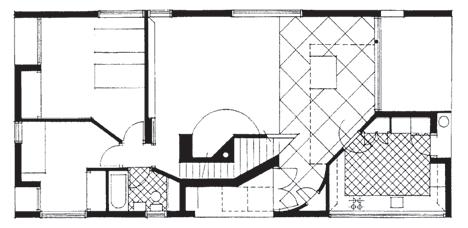
Architecture creates enclosures for human activity or habitation. It is three-dimensional, highly spatial, functional, and closely bound with developments in technology and materials. Since it is difficult to capture in a photograph, several types of schematic drawings are commonly used to enable the visualization of a building:
Plans depict a structure’s masses and voids, presenting a view from above of the building’s footprint as if it had been sliced horizontally at about waist height.
Sections reveal the interior of a building as if it had been cut vertically from top to bottom.
Isometric drawings show buildings from oblique angles either seen from above (“bird’s-eye view”) to reveal their basic three-dimensional forms (often cut away so we can peek inside) or from below (“worm’seye view”) to represent the arrangement of interior spaces and the upward projection of structural elements.
Isometric projection from below: Istanbul, Hagia Sophia
Isometric cutaway from above: Ravenna, San Vitale
Section: Rome, Sta. Costanza
Plan: Philadelphia, Vanna Venturi House
Introduction
Learning Objectives
I.a Explain the cultural foundations of the diverse ways art has been defined and characterized.
I.b Distinguish four ways art historians investigate works of art.
The title of this book seems clear. It defines a field of academic study and scholarly research that has achieved a secure place in college and university curricula across North America. But Art History couples two words—even two worlds—that are less well focused when separated. What is art? In what sense does it have a history? Students of art and its history should pause and engage, even if briefly, with these large questions before beginning the journey surveyed in the following chapters.
What is Art?
What are the cultural foundations of the diverse ways art has been defined and characterized?
Artists, critics, art historians, and the general public all grapple with this thorny question. The Random House Dictionary defines “art” as “the quality, production, expression, or realm of what is beautiful, or of more than ordinary significance.” Others have characterized “art” as something human-made that combines creative imagination and technical skill and satisfies an innate desire for order and harmony—perhaps a human hunger for the beautiful. This seems relatively straightforward until we start to look at modern and contemporary art, where there has been a heated and extended debate concerning “What is art?” The focus is often far from questions of transcendent beauty, ordered design, or technical skill; it centers instead on the conceptual meaning of a work for an elite target audience or the attempt to pose challenging questions or unsettle deep-seated cultural ideas.
The works of art discussed in this book represent a privileged subset of artifacts produced by past and present cultures. They were usually meant to be preserved,
I.c Identify the components of the four-part method of art historical investigation that leads to the historical interpretation of a work of art.
and they are currently considered worthy of conservation and display. The determination of which artifacts are exceptional—which are works of art—evolves through the actions, opinions, and selections of artists, patrons, governments, collectors, archaeologists, museums, art historians, and others. Labeling objects as art is usually meant to signal that they transcended or now transcend in some profound way their practical function, often embodying cherished cultural ideas or asserting foundational values. Sometimes it can also mean they are considered beautiful, well designed, and made with loving care, but this is not always the case. We will discover that at various times and places, the complex notion of what art is has little to do with standards of skill or beauty. Some critics and historians argue broadly that works of art are tendentious embodiments of power and privilege, hardly sublime expressions of beauty or truth. After all, art can be unsettling as well as soothing, challenging as well as reassuring, whether made in the present or surviving from the past.
Increasingly, we are realizing that our judgments about what constitutes art—as well as what constitutes beauty—are conditioned by our own education and experience. Whether acquired at home, in classrooms, in museums, at the movies, or on the Internet, our responses to art are learned behaviors influenced by class, gender, race, geography, and economic status as well as education. Even art historians find that their definitions of what constitutes art—and what constitutes artistic quality—evolve with additional research and understanding. Exploring works by twentieth-century painter Mark Rothko and nineteenth-century quilt-makers Martha Knowles and Henrietta Thomas demonstrates how definitions of art and artistic value are subject to change over time.
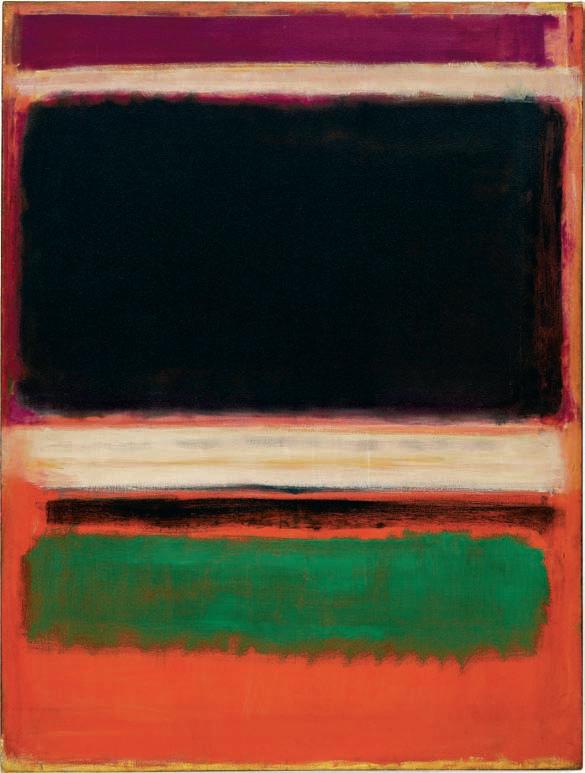
Rothko’s painting NO. 3/NO. 13 (MAGENTA, BLACK, GREEN ON ORANGE) (FIG. Intro–1), is a well-known example of the sort of abstract painting that was considered the epitome of artistic sophistication by the mid-twentiethcentury New York art establishment. It was created by an artist who meant it to be a work of art. It was acquired by the Museum of Modern Art in New York, and its position on the walls of that museum is a sure sign of its acceptance as art by a powerful cultural institution. However, outside the context of the American artists, dealers, critics, and collectors who made up Rothko’s art world, such paintings were often received with skepticism. They were seen by many as incomprehensible—lacking both technical skill and recognizable subject matter, two criteria that were part of the general public’s definition of art at the time. Abstract paintings inspired a popular retort: “That’s not art; my child could do it!” Interestingly enough, Rothko saw in the childlike character of his own paintings one of the qualities that made them works of art. Children, he said, “put forms, figures, and views into pictorial arrangements, employing out of necessity most of the rules of optical perspective and geometry but without the knowledge that they are employing them.” He characterized his own art as childlike, as “an attempt to recapture the freshness and naiveté of childish
INTRO–1 Mark Rothko MAGENTA, BLACK, GREEN ON ORANGE (NO. 3/NO. 13)
1949. Oil on canvas, 7 13∕8 × 5 5 (2.165 × 1.648 m). Museum of Modern Art, New York.
vision.” In part because they are carefully crafted by an established artist who provided these kinds of intellectual justifications for their character and appearance, Rothko’s abstract paintings are broadly considered works of art and are treasured possessions of major museums across the globe.
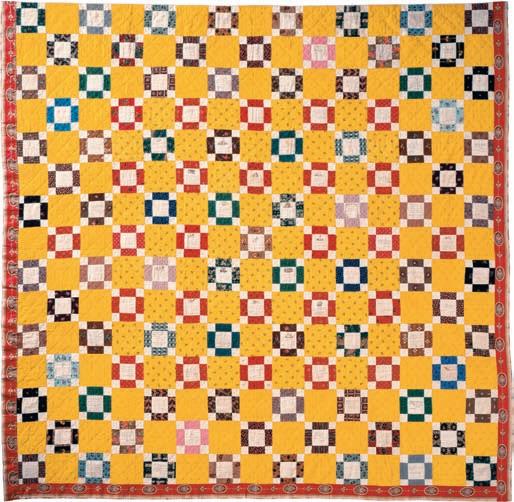
Works of art, however, do not always have to be created by individuals who perceive themselves as artists. Nor are all works produced for an art market surrounded by critics and collectors ready to explain, exhibit, and disperse them, ideally to prestigious museums. Such is the case with this quilt (FIG. Intro–2) made by Martha Knowles and Henrietta Thomas a century before Rothko’s painting. Their work is similarly composed of blocks of color, and, like Rothko, they produced their visual effect by arranging these flat chromatic shapes carefully and regularly on a rectangular field. But this quilt was not meant to hang on the wall of an art museum. It is the social product of a friendship, intended as an intimate
INTRO–2 Martha Knowles and Henrietta Thomas MY SWEET SISTER EMMA 1843. Cotton quilt, 8 11 × 9 1 (2.72 × 2.77 m). International Quilt Studies Center and Museum, University of Nebraska, Lincoln.
gift presented to a loved one for use in her home. An inscription on the quilt itself makes this clear: “From M.A. Knowles to her Sweet Sister Emma, 1843.” Thousands of such friendship quilts were made by women during the middle years of the nineteenth century for use on beds, either to provide warmth or as a covering spread. Whereas quilts were sometimes displayed to a broad and enthusiastic audience of producers and admirers at competitions held at state and county fairs, they were not collected by art museums or revered by artists until relatively recently.
In 1971 at the Whitney Museum in New York—an establishment bastion of the art world of which Rothko had been a part—art historians Jonathan Holstein and Gail van der Hoof mounted an exhibition entitled “Abstract Design in American Quilts,” demonstrating the artistic affinity we have already noted in comparing the way Knowles and Thomas, like Rothko, create abstract patterns with fields of color. Quilts were later accepted—or perhaps appropriated—as works of art and hung on the walls of a New York art museum because of their visual similarities with the avant-garde, abstract works of art created by elite New York artists.
Art historian Patricia Mainardi took the case for quilts one significant step further in a pioneering article of 1973 published in The Feminist Art Journal. Entitled “Quilts: The Great American Art,” her argument was rooted not only in the aesthetic affinity of quilts with the esteemed work of contemporary abstract painters, but also in a political conviction that the definition of art had to be broadened. What was at stake here was historical veracity. Mainardi began, “Women have always made art. But for most women, the arts highest valued by male society have been closed to them for just that reason. They have put their creativity instead into the needlework arts, which exist in fantastic variety wherever there are women, and which in fact are a universal female art, transcending race, class, and national borders.” She argued for the inclusion of quilts within the history of art to give deserved attention to the work of women artists who had been excluded from discussion because they created textiles and because they worked outside the male-dominated professional structures of the art world—because they
were women. Quilts now hang as works of art on the walls of museums and appear with regularity in books that survey the history of art.
As these two examples demonstrate, definitions of art are rooted in cultural systems of value that are subject to change. And as they change, the list of works considered by art historians is periodically revised. Determining what to study is a persistent part of the art historian’s task.
Architecture
This book contains much more than paintings and textiles. Within these pages you will also encounter sculpture, vessels, books, churches, jewelry, tombs, chairs, temples, photographs, houses, and more. But as with Rothko’s No. 3/No. 13 (Magenta, Black, Green on Orange) (SEE FIG. Intro–1) and Knowles and Thomas’s My Sweet Sister Emma (SEE FIG. Intro–2), criteria have been used to determine which works are selected for inclusion in a book titled Art History. Architecture—which includes churches, tombs, temples, and houses, as well as many other kinds of buildings—presents an interesting case.
Buildings meet functional human needs by enclosing human habitation or activity. Many works of architecture, however, are considered “exceptional” because they transcend functional demands by manifesting distinguished architectural design or because they embody in important ways the values and goals of the culture that built them. Such buildings are usually produced by architects influenced, like painters, by great works and traditions from the past. In some cases they harmonize with, or react to, their natural or urban surroundings. For such reasons, they are discussed in books on the history of art.
Typical of such buildings is the church of Nôtre-Damedu-Haut in Ronchamp, France, designed and constructed between 1950 and 1955 by Swiss architect CharlesEdouard Jeanneret, better known by his pseudonym, Le Corbusier (FIG. Intro–3). This building is the product of a significant historical moment, rich in international cultural meaning. A pilgrimage church on this site had been destroyed during World War II, and the creation here of a new church symbolized the end of a devastating war, embodying hopes for a brighter global future. Le Corbusier’s design—drawing on sources that ranged from Algerian mosques to imperial Roman villas, from crab shells to airplane wings—is sculptural as well as architectural. Built at the crest of a hill, it soars toward the sky but at the same time seems solidly anchored in the earth. And its coordination with the curves of the natural landscape creates an outdoor setting for religious ceremonies (to the right in the figure) to supplement the spaces of the church interior. In fact, this building is so renowned today as a monument of modern architecture that the bus-loads of pilgrims who arrive at the site are mainly architects and devotees of architectural history.
What is Art History?
What are four ways art historians investigate works of art?
There are many ways to study or appreciate works of art. Art history represents one specific approach, with its own goals and its own methods of assessment and interpretation. Simply put, art historians seek to understand the meaning of art from the past within its original cultural contexts, both from the point of view of its producers— artists, architects, and patrons—as well as from the point of view of its consumers—those who formed its original audience. Coming to an understanding of the cultural meaning of a work of art requires detailed and patient investigation on many levels, especially with art that was produced long ago and in societies distinct from our own. This is a scholarly rather than an intuitive exercise. In art history, the work of art is seen as an embodiment of the values, goals, and aspirations of its time and place of origin. It is a part of culture.
Art historians use a variety of theoretical perspectives and interpretive strategies to do their work. But as a place to begin, the work of art historians can be divided into four types of investigation:
1. assessment of physical properties,
2. analysis of visual or formal structure,
3. identification of subject matter or conventional symbolism, and
4. integration within cultural context.
Assessing Physical Properties
Of the methods used by art historians to study works of art, this is the most objective, but it requires close access to the work itself. Physical properties include shape, size, materials, and technique. For instance, many pictures are rectangular (SEE FIG. Intro–1), but some are round (see FIG. C in “Closer Look” on page xxvii). Paintings as large as Rothko’s require us to stand back if we want to take in the whole image, whereas some paintings (see FIG. A in “Closer Look” on page xxvi) are so small that we are drawn up close to examine their detail. Rothko’s painting and Knowles and Thomas’s quilt are both rectangles of similar size, but they are distinguished by the materials from which they are made—oil paint on canvas versus cotton fabric joined by stitching. In art history books, most physical properties can only be understood from descriptions in captions, but when we are in the presence of the work of art itself, size and shape may be the first thing we notice. To fully understand medium and technique, however, it may be necessary to employ methods of scientific analysis or documentary research to figure out the details of the practices of artists at the time when and place where the work was created.
Analyzing Formal Structure
Art historians explore the visual character that artists give their works—using the materials and the techniques chosen to create them—in a process called formal analysis On the most basic level, it is divided into two parts:
• assessing the individual visual elements or formal vocabulary that make up pictorial or sculptural communication, and
• discovering the overall arrangement, organization, or structure of an image, a design system that art historians often refer to as composition.
THE ELEMENTS OF VISUAL EXPRESSION Artists control and vary the visual character of works of art to give their subjects and ideas meaning and expression, vibrancy and persuasion, challenge or delight (see “Closer Look” on pages xxvi–xxvii). For example, the motifs, objects, figures, and environments in paintings can be sharply defined by line (SEE FIGS. Intro–2, Intro–4), or they can be suggested by a sketchier definition (SEE FIGS. Intro–1, Intro–5). Painters can simulate the appearance of three-dimensional form through modeling or shading (SEE FIG. Intro–4 and FIG. C in “Closer Look” on page xxvii), that is, by imitating the way light from a single source will highlight one side of a solid while leaving the other side in shadow. Alternatively, artists can avoid any strong sense of three-dimensionality by emphasizing patterns on a surface rather than forms in space (SEE FIG. Intro–1 and FIG. A in “Closer Look” on page xxvi).
A Closer Look
VISUAL ELEMENTS OF PICTORIAL EXPRESSION: LINE, LIGHT, FORM, AND COLOR
LINE
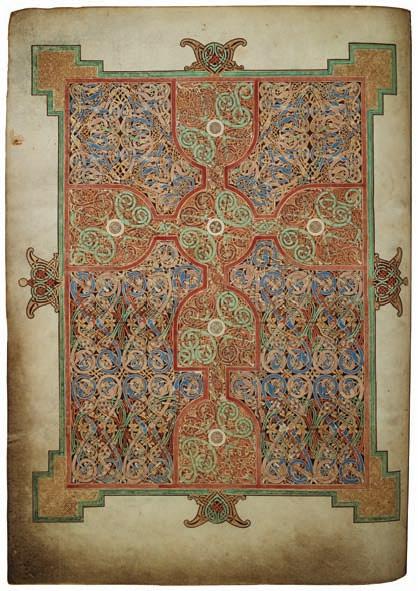
A. CARPET PAGE FROM THE LINDISFARNE GOSPELS
From Lindisfarne, England. c. 715–720. Ink and tempera on vellum, 133∕8 × 97∕16 (34 × 24 cm).
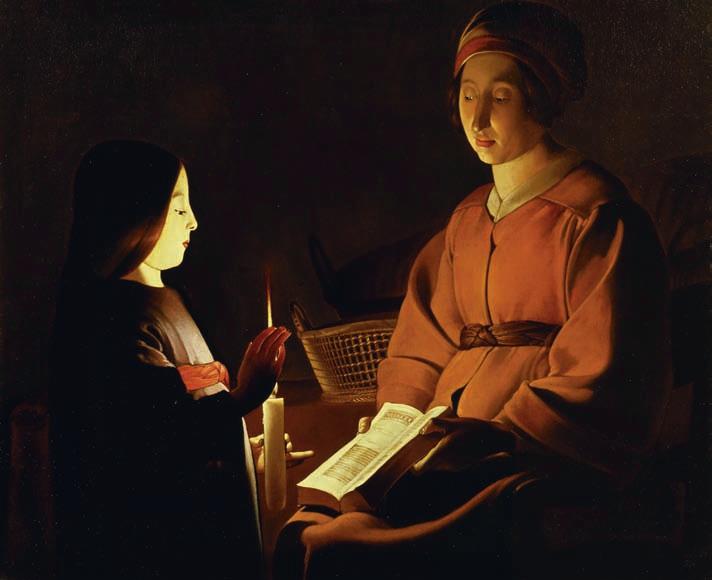
B. Georges de la Tour THE EDUCATION OF THE VIRGIN c. 1650. Oil on canvas, 33 × 391∕2 (83.8 × 100.4 cm). The Frick Collection, New York. Purchased by the Frick Collection 1948. (1948.1.155).
The source of illumination is a candle depicted within the painting. The young girl’s raised right hand shields its flame, allowing the artist to demonstrate his virtuosity in painting the translucency of human flesh.
Since the candle’s flame is partially concealed, its luminous intensity is not allowed to distract from those aspects of the painting most brilliantly illuminated by it—the face of the girl and the book she is reading.
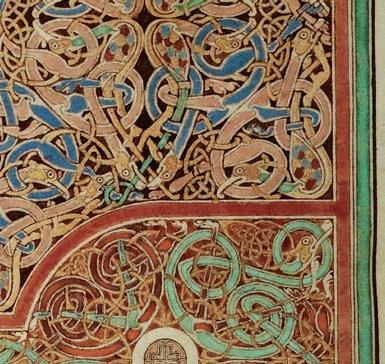
Every element in this complicated painting is sharply outlined by abrupt changes between light and dark or between one color and another; there are no gradual or shaded transitions. Since the picture was created in part with pen and ink, the linearity is a logical extension of medium and technique. And although line itself is a “flattening” or two-dimensionalizing element in pictures, a complex and consistent system of overlapping gives the linear animal forms a sense of shallow but carefully worked-out three-dimensional relationships to one another.
FORM
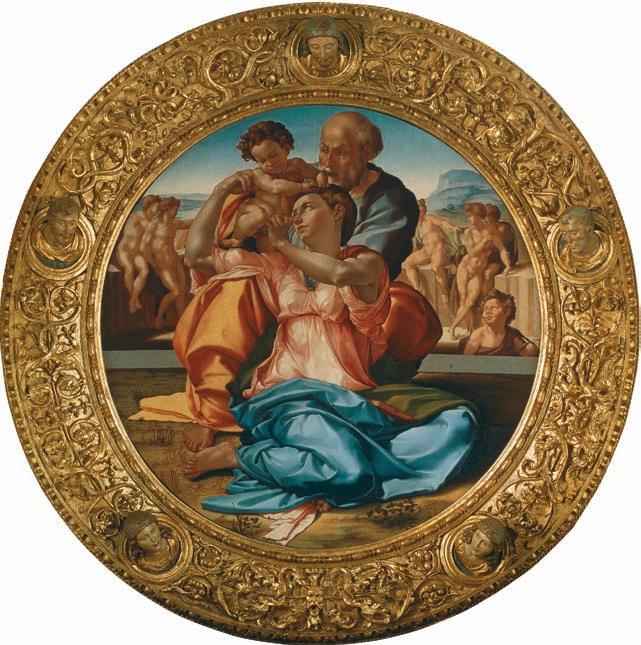
C. Michelangelo THE HOLY FAMILY (DONI TONDO)
c. 1503. Oil and tempera on panel, diameter 3 111∕4 (1.2 m). Galleria degli Uffizi, Florence.
The actual threedimensional projection of the sculpted heads in medallions around the frame—designed for this painting by Michelangelo himself— heightens the illusion of three-dimensionality in the figures painted on its flat surface.
Junayd chose to flood every aspect of his painting with light, as if everything in it were illuminated from all sides at once. As a result, the emphasis here is on jewel-like color. The vibrant tonalities and dazzling detail of the dreamy landscape are not only more important than the simulation of threedimensional forms within a space, they actually upstage the human drama taking place against a patterned, tipped-up ground in the lower third of the picture.
COLOR
D. Junayd HUMAY AND HUMAYUN
From a manuscript of the Divan of Kwaju Kirmani. Made in Baghdad, Iraq. 1396. Color, ink, and gold on paper, 125∕8 × 97∕16 (32 × 24 cm). The British Library, London.
The complex overlapping of their highly threedimensionalized bodies conveys the somewhat contorted positions and spatial relationship of these three figures.
Through the use of modeling or shading—a gradual transition from lights to darks—Michelangelo imitates the way solid forms are illuminated from a single light source—the side closest to the light source is bright while the other side is cast in shadow—and gives a sense of threedimensional form to his figures.
In a technique called foreshortening, the carefully calculated angle of the Virgin’s elbow makes it seem to project out toward the viewer.
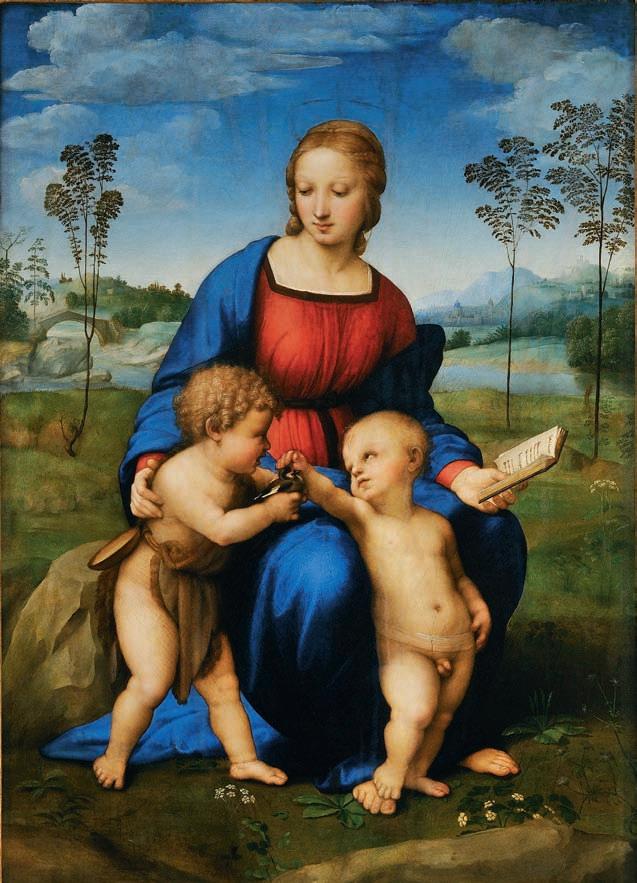
INTRO–4 Raphael MADONNA OF THE GOLDFINCH (MADONNA DEL CARDELLINO)
1506. Oil on panel, 42 × 291∕2 (106.7 × 74.9 cm).
The vibrant colors of this important work were revealed in the course of a careful, ten-year restoration, completed in 2008.
In addition to revealing the solid substance of forms through modeling, dramatic lighting can also guide viewers’ attention to specific areas of a picture see FIG. B in “Closer Look” on page xxvi), or it can be lavished on every aspect of a picture to reveal all its detail and highlight the vibrancy of its color (see FIG. D in “Closer Look” on page xxvii). Color itself can be muted or intensified, depending on the mood artists want to create or the tastes and expectations of their audiences.
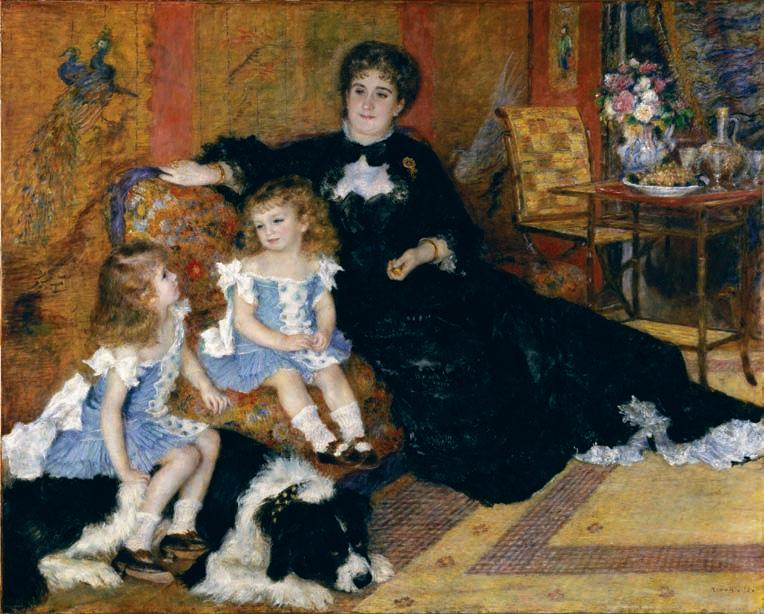
Thus, artists communicate with their viewers by making choices in the way they use and emphasize the elements of visual expression, and art historical analysis seeks to reveal how these choices bring meaning to a work of art. For example, in two paintings of women with children (SEE FIGS. Intro–4, Intro–5), Raphael and Renoir work with the same visual elements of line, form, light, and color in the creation of their images, but they employ these shared elements to different expressive ends. Raphael concentrates on line to clearly differentiate each element of his picture as a separate form. Careful modeling describes these outlined forms as substantial solids surrounded by space. This gives his subjects a sense of clarity, stability, and grandeur. Renoir, on the other hand, focuses on the flickering of light and the play of color as he minimizes the sense of three-dimensionality in individual forms. This gives his image a more ephemeral, casual sense. Art historians pay close attention to such variations in the use of visual elements—the building blocks of artistic expression—and use visual analysis to characterize the expressive effect of a particular work, a particular artist, or a general period defined by place and date.
COMPOSITION When art historians analyze composition, they focus not on the individual elements of visual expression but on the overall arrangement and organizing design or structure of a work of art. In Raphael’s MADONNA OF THE GOLDFINCH (FIG. Intro–4), for example, the group of figures has been arranged in a triangular shape and placed at the center of the picture. Raphael emphasized
this central focus by opening the clouds to reveal a patch of blue in the middle of the sky and by flanking the figural group with lacelike trees. Since the Madonna is at the center and the two boys are divided between the two sides of the triangle, roughly—though not precisely—equidistant from the center of the painting, this is a bilaterally symmetrical composition: on either side of an implied vertical line at the center of the picture, there are equivalent forms on left and right, matched and balanced in a mirrored correspondence. Art historians refer to such an implied line—around which the elements of a picture are organized—as an axis. Raphael’s painting has not only a vertical, but also a horizontal axis, indicated by a line of demarcation between light and dark—as well as between degrees of color saturation—in the landscape. The belt of the Madonna’s dress is aligned with this horizontal axis, and this correspondence, taken with the coordination of her head with the blue patch in the sky, relates her harmoniously to the natural world in which she sits, lending a sense of stability, order, and balance to the picture as a whole.
The main axis in Renoir’s painting of MME. CHARPENTIER AND HER CHILDREN (FIG. Intro–5) is neither vertical nor horizontal, but diagonal, running from the upper right to the lower left corner of the painting. All major elements of the composition are aligned along this axis—dog, children, mother, and the table and chair that represent the most complex and detailed aspect of the setting. The upper left and lower right corners of the painting balance each other on either side of the diagonal axis as relatively simple fields of neutral tone, setting off and framing the main subjects between them. The resulting arrangement is not bilaterally symmetrical, but blatantly asymmetrical, with the large figural mass pushed into the left side of the picture. And unlike Raphael’s composition, where the spatial relationship of the figures and their environment is mapped by the measured placement of elements that become increasingly smaller in scale and fuzzier in definition as they recede into the background, the relationship of Renoir’s figures to their spatial environment is less clearly defined as they recede into the background along the dramatic diagonal axis. Nothing distracts us from the bold informality of this family gathering.
Both Raphael and Renoir arrange their figures carefully and purposefully, but they use distinctive compositional systems that communicate different notions of the way these figures interact with each other and the world around them. Art historians pay special attention to how pictures are arranged, because composition is one of the principal ways artists give their paintings expressive meaning.
Identifying Subject Matter
Art historians have traditionally sought subject matter and meaning in works of art with a system of analysis that was outlined by Erwin Panofsky (1892–1968), an influential German scholar who was expelled from his academic position by the Nazis in 1933 and spent the rest of his career of research and teaching in the United States. Panofsky proposed that when we seek to understand the subject of a work of art, we derive meaning initially in two ways:
• First we perceive what he called “natural subject matter” by recognizing forms and situations that we know from our own experience.
• Then we use what he called “iconography” to identify the conventional meanings associated with forms and figures as bearers of narrative or symbolic content, often specific to a particular time and place.
Some artworks, like Rothko’s abstractions and Knowles and Thomas’s quilt, do not contain subjects drawn from the world around us, from stories, or from conventional symbolism, but Panofsky’s scheme remains a standard method of investigating meaning in works of art that present narrative subjects, portray specific people or places, or embody cultural values with iconic imagery or allegory.
NATURAL SUBJECT MATTER We recognize some things in works of visual art simply by virtue of living in a world similar to that represented by the artist. For example, in the two paintings by Raphael and Renoir just examined (SEE FIGS. Intro–4, Intro–5), we immediately recognize the principal human figures in both as a woman and two children— boys in the case of Raphael’s painting, girls in Renoir’s. We can also make a general identification of the animals: a bird in the hand of Raphael’s boys, and a pet dog under one of Renoir’s girls. And natural
INTRO–5 Auguste Renoir MME. CHARPENTIER AND HER CHILDREN
1878. Oil on canvas, 601∕2 × 747∕8 (153.7 × 190.2 cm). Metropolitan Museum of Art, New York.
subject matter can extend from an identification of figures to an understanding of the expressive significance of their postures and facial features. We might see in the boy who snuggles between the knees of the woman in Raphael’s painting, placing his own foot on top of hers, an anxious child seeking the security of physical contact with a trusted caretaker—perhaps his mother—in response to fear of the bird he reaches out to touch. Many of us have seen insecure children take this very pose in response to potentially unsettling encounters.
The closer the work of art is in both time and place to our own situation temporally and geographically, the easier it sometimes is to identify what is represented. However, it’s not always that simple. Although Renoir painted his picture almost 140 years ago in France, the furniture in the background still looks familiar, as does the book in the hand of Raphael’s Madonna, painted five centuries before our time. But the object hanging from the belt of the scantily clad boy at the left in Raphael’s painting will require identification for most of us. Iconographic investigation is necessary to understand the function of this form.
ICONOGRAPHY Some subjects are associated with conventional meanings established at a specific time or place, some of the human figures portrayed in works of art have specific identities, and some of the objects or forms have symbolic or allegorical meanings in addition to their natural subject matter. Discovering these conventional meanings of art’s subject matter is called iconography (see “Closer Look” opposite).
For example, the woman accompanied in the outdoors by two boys in Raphael’s Madonna of the Goldfinch (SEE FIG. INTRO–4) would have been immediately recognized by members of its intended early sixteenth-century Florentine audience as the Virgin Mary. Viewers would have identified the naked boy standing between her knees as her son Jesus and the boy holding the bird as Jesus’s cousin John the Baptist, sheathed in the animal skin garment that he would wear in the wilderness and equipped with a shallow cup attached to his belt, ready to be used in baptisms. Such attributes of clothing and equipment are often critical in making iconographic identifications. The goldfinch in the Baptist’s hand was at this time and place a symbol of Christ’s death on the cross, an allegorical implication that makes the Christ Child’s retreat into secure contact with his mother—already noted on the level of natural subject matter—understandable in relation to a specific story. The comprehension of conventional meanings in this painting would have been almost automatic among those for whom it was painted, but for us, separated by time and place, some research is necessary to recover associations that are no longer part of our everyday world.
Although it may not initially seem as unfamiliar, the subject matter of Renoir’s 1878 portrait of Mme.
Charpentier and her Children (SEE FIG. Intro–5) is in fact even more obscure. There are those in twenty-first-century American culture for whom the figures and symbols in Raphael’s painting are still recognizable and meaningful, but Marguérite-Louise Charpentier died in 1904, and no one living today would be able to identify her based on the likeness Renoir presumably gave to her face in this family portrait commissioned by her husband, the wealthy and influential publisher Georges Charpentier. We need the painting’s title to make that identification. And Mme. Charpentier is outfitted here in a gown created by English designer Charles Frederick Worth, the dominant figure in late nineteenth-century Parisian high fashion. Her clothing was a clear attribute of her wealth for those who recognized its source; most of us need to investigate to uncover its meaning. But a greater surprise awaits the student who pursues further research on her children. Although they clearly seem to our eyes to represent two daughters, the child closest to Mme. Charpentier is actually her son Paul, who at age 3, following standard Parisian bourgeois practice, has not yet had his first haircut and still wears clothing comparable to that of his older sister Georgette, perched on the family dog. It is not unusual in art history to encounter situations where our initial conclusions on the level of natural subject matter will need to be revised after some iconographic research.
Integration within Cultural Context
Natural subject matter and iconography were only two of three steps proposed by Panofsky for coming to an understanding of the meaning of works of art. The third step he labeled “iconology.” Its aim is to interpret the work of art as an embodiment of its cultural situation, to place it within broad social, political, religious, and intellectual contexts. Such integration into history requires more than identifying subject matter or conventional symbols; it requires a deep understanding of the beliefs and principles or goals and values that underlie a work of art’s cultural situation as well as the position of an artist and patron within it.
In the “Closer Look” on iconography, the subject matter of two still life paintings (pictures of inanimate objects and fruits or flowers taken out of their natural contexts) is identified and elucidated, but to truly understand these two works as bearers of cultural meaning, more knowledge of the broader context and specific goals of artists and audiences is required. For example, the fact that Zhu Da (1626–1705) became a painter was rooted more in the political than the artistic history of China at the middle of the seventeenth century. As a member of the imperial family of the Ming dynasty, his life of privilege was disrupted when the Ming were overthrown during the Manchu conquest of China in 1644. Fleeing for his life, he sought refuge in a Buddhist monastery, where he wrote poetry and painted.
A Closer Look
ICONOGRAPHY
These grapes sit on an imported, Italian silver tazza, a luxury object that may commemorate northern European prosperity and trade. This particular object recurs in several of Peeters’s other still lifes.
Luscious fruits and flowers celebrate the abundance of nature, but because these fruits of the earth will eventually fade, even rot, they could be moralizing references to the transience of earthly existence.
Detailed renderings of insects showcased Peeters’s virtuosity as a painter, but they also may have symbolized the vulnerability of the worldly beauty of flowers and fruit to destruction and decay.
An image of the artist herself appears on the reflective surface of this pewter tankard, one of the ways that she signed her paintings and promoted her career.
A. Clara Peeters STILL LIFE WITH FRUIT AND FLOWERS
c. 1612. Oil on copper, 251∕5 × 35 (64 × 89 cm). Ashmolean Museum, Oxford.
Credit: Bridgeman Images
Quince is an unusual subject in Chinese painting, but the fruit seems to have carried personal significance for Zhu Da. One of his friends was known as the Daoist of Quince Mountain, a site in Hunan Province that was also the subject of a work by one of his favorite authors, Tang poet Li Bai.
These coins, including one minted in 1608–1609, help focus the dating of this painting. The highlighting of money within a still life could reference the wealth of the owner—or it could subtly allude to the value the artist has crafted here in paint.
This knife—which appears in several of Peeters’s still lifes—is of a type that is associated with wedding gifts.
The artist’s signature reads “Bada Shanren painted this,” using a familiar pseudonym in a formula and calligraphic style that the artist ceased using in 1695.
This red block is a seal with an inscription drawn from a Confucian text: “Teaching is half of learning.” This was imprinted on the work by the artist as an aspect of his signature, a symbol of his identity within the picture, just as the reflection and inscribed knife identify Clara Peeters as the painter of her still life.
B. Zhu Da (Bada Shanren) QUINCE (MUGUA) 1690. Album leaf mounted as a hanging scroll; ink and colors on paper, 77∕8 × 53∕4 (20 × 14.6 cm). Princeton University Art Museum.
2016. University Art Museum/Art Resource/Scala, Florence. Photo: Bruce M. White.