Introduction
Reviewing Postwar Fiction
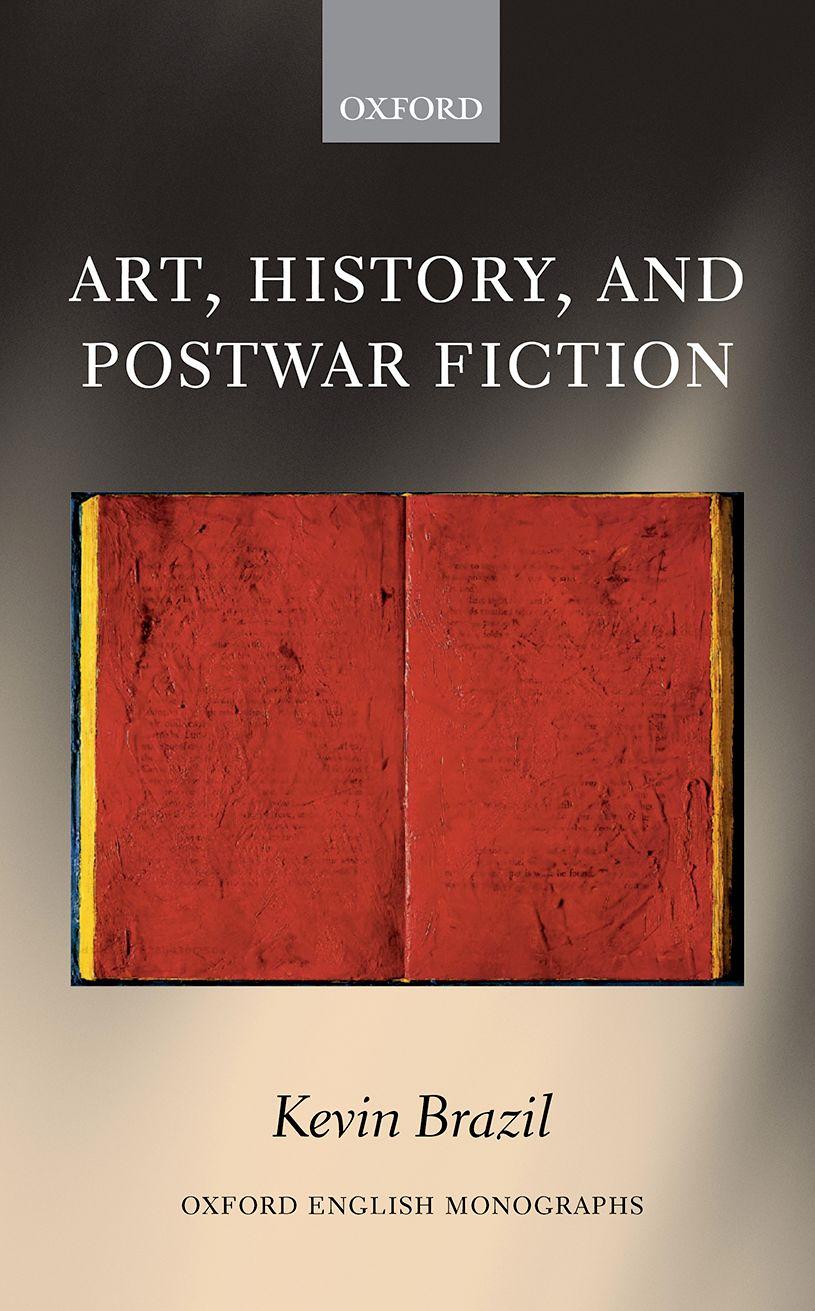
In 1957 Jasper Johns covered a book with red and yellow encaustic paint and stuck it to a blue wooden frame. An object became a work of art, a book became Book (1957). That book was Lost Worlds by Anne Terry White, a popular history of archaeological adventures. The pages Johns painted describe the moment when Carter and Carnarvon, on the threshold of their discovery of Tutankhamen’s tomb, begin to feel ‘strangely suspended in time and space’, and suddenly not ‘the unbelievable tomb, but the actual world of the twentieth century seemed unreal to these enchanted explorers’.1 Buried under layers of paint, these words are invisible to the naked eye: like the tomb in the desert, exposed and disguised, they are hidden in plain sight. Some tantalizing and carefully chosen fragments of text can be glimpsed, if you look hard enough: ‘first sight’, ‘swathed’, ‘folds’, and down at the bottom, ‘that is what he found’. Yet there is nothing to be found at first sight in this Book, where seeing and saying are in opposition. Paint disguises words, yet knowledge of the book they came from is necessary to grasp Book’s ironic attitude towards the resistance between text and image upon which its formal effects depend. By painting over a book called Lost Worlds, Johns signals an awareness of past explorations of the relationship between text and image, and incorporates an archaeology of this past into his own historically self-conscious investigation of the differences between artistic media. In Book the past is an inescapable part of the object presented for consideration: the relationship between art and literature in the ‘actual world’ of Johns’s twentieth-century present.
1 Anne Terry White, Lost Worlds: Adventures in Archaeology (London; Toronto; Wellington; Sydney, 1943), 119; James Coddington and Suzanne Siano, ‘Infrared Imaging of TwentiethCentury Works of Art’, in Tradition and Innovation: Advances in Conservation, ed. by Ashok Roy and Perry Smith (London, 2000), 39–44. I am grateful to Katherine Hinds, Curator of the Margulies Collection, Miami, and James Coddington, Chief Curator of the Museum of Modern Art, New York, for this information about Johns’s Book.
That relationship is the subject of another book: this one. Art, History, and Postwar Fiction explores the ways in which novelists since 1945 have viewed, commented upon, and often vociferously complained about visual art. It argues that as well as offering a surprisingly vital means for reflecting on the aesthetic implications of political developments like McCarthyism, the rise of the New Left, or the memorialization of the Holocaust, engaging with art provided novelists with new ways of conceptualizing the novel’s relationship to history. The sense that not only the novel but culture and society more broadly had become unmoored from history was pervasive in the postwar decades. This was most influentially expressed in Fredric Jameson’s detection of a ‘waning of our historicity’ in the representations produced in Western late capitalism, and a scepticism about historical change was central to many theorizations of postmodernism.2 Yet postmodernism never became the dominant cultural logic of the postwar decades: it quickly passed from emergent to residual over the course of a decade or so. In showing the ways in which visual art, especially modernist painting, enabled postwar novelists to imagine diverse ways of relating their work to history, this book argues that attention to one of the oldest topics in aesthetic theory, interactions between artistic forms, also offers the literary critic new ways to think about an equally perennial question: the relationship of literature to history.
Pursuing this argument concentrates the scope of this book primarily on the work of four writers, each of whom develops out of their engagements with art a distinctive way of figuring the relationship of the novel to history: Samuel Beckett, William Gaddis, John Berger, and W. G. Sebald. If the scope of these chapters is focused, and that focus is part of an argument for sustained and close attention to manuscripts, composition, and literary form in studying the relationship between text and image, the scope of the arguments they collectively inform expands outwards into broader considerations of the comparative study of literature and visual culture. You don’t need to take as obvious an example as Johns’s Book to show that an artwork’s relationship to the history of art is often central to its meaning—often its primary, even exclusive theme for the critics and novelists who view it. But the history of art is not the same as the history of literature, and as a consequence of what was once quaintly called the ‘new art history’, it would be more accurate to speak of an artwork’s relationship to a range of institutionally formed and contested histories of
2 Fredric Jameson, Postmodernism, Or, the Cultural Logic of Late Capitalism (London, 1991), 20.
art.3 In studying literary engagements with art in the postwar decades, this book proceeds from the argument that the histories of art are multiple, non-simultaneous, and often generatively out of sync with the formal and institutional histories of literature. It is the difference between art and fiction, and the differences between art history and literary history, that make art important to the study of postwar fiction.
Novelists’ responses to works of art are neither passive reflections of their content (whatever ‘content’ might mean), nor of their institutionally codified histories; rather, they are a form of interpretative work, whose outcome can be traced in the form and style of a novelist’s prose. In focusing as much on the ways in which fiction is made through an engagement with art as on the final published work, this book provides a hermeneutics of poeisis which tracks the moments in which writers produced their own interpretations of works of art, and used these simultaneously as interpretations of their writing and the form of the novel. In doing so, this book offers a different way to approach the self-reflexivity and selfreferentiality that has long been seen as one of the characteristic traits of the postwar novel: as a process of productive self-interpretation through a different medium rather than a metafictional closure where ‘forms of fiction serve as the material upon which further forms can be imposed’, or as a terminal self-consciousness that leaves writer and reader alike ‘lost in the funhouse’.4 By drawing attention to the historicizing ways in which writers interpreted art as part of the production of their own work, this book foregrounds the ways in which postwar writers historicized themselves and the novel more broadly. It therefore revises our understanding of the postwar novel as characterized by a waning of historicity, arguing instead for an understanding of modern and contemporary historicity as complex, plural, and articulated by visual and verbal forms, and it shows the different modes of thinking about the relationship of the novel to history developed from the aftermath of the Second World War to the beginning of the twenty-first century.
History emerges as a central concern of these writers’ engagements with art not only because of their shared if diffuse sense of a waning of historicity, or because a reflection upon the art of the past, whether by Vermeer or Pisanello, reveals historical difference in a fairly obvious way. Visual modernism of the postwar period was theorized, institutionalized, and practised according to a historical periodization that was very different
3 For an overview, see John Harris, The New Art History: A Critical Introduction (London, 2001).
4 William H. Gass, Fiction and the Figures of Life (New York, 1970), 25; John Barth, Lost in the Funhouse: Fiction for Print, Tape, Live Voice (London, 1969).
to that of literary modernism, or rather, the version of literary modernism these writers had themselves periodized in order to relate themselves to it. Whether in Beckett’s perfect-tense description of T. S. Eliot’s poetry as ‘the new thing that has happened’, Gaddis’s transformation through satire of modernist style into a commodity, or Sebald’s doctoral research on Döblin, these novelists, like many others of the period, saw themselves as coming after, if not exactly fully escaping from, the moment of literary modernism. But when faced with French tachisme, American Abstract Expressionism, or postwar British sculpture, or with the hugely influential criticism of Clement Greenberg, it was as clear then as it is now that visual modernism extended well into the 1950s and 1960s. It is a testament to Greenberg’s influence that the art historians who have provided the most developed justifications for the extension of visual modernism backwards as well as forwards in time, T. J. Clark and Michael Fried, have both positioned themselves as inheritors of different strands of Greenberg’s criticism.5 This striking difference between what modernism means across literature and art opened up for these writers a necessarily more complex and differentiated understanding of the periodicity and historicity of their own work. Furthermore, this extension of modernism was enabled in theory and practice by a distinctive historicist modernism, according to which certain forms were the product of a logical historical development and which expressed that sense of historical continuity as their primary meaning. To paraphrase a famous claim made by Michael Baxandall, if ‘[a] fifteenth-century painting is the deposit of a social relationship’, then a postwar modernist painting is the deposit of a historical theory.6
Modernism thus has an important place in this book, and the arguments it makes concerning modernism’s relationship to postwar and contemporary fiction and about periodicity more generally are part of a broader series of debates about the historicity of modernism and its relationship to the present. The geographical and historical expansion of the scope of modernist studies has brought to the fore the question of the periodization of modernism as the cultural response to modernity. One response to the theoretical difficulties this entails has been to reject the periodization of modernism and modernity altogether, whether because it is merely a tool of institutional legitimization, according to Eric Hayot, or inherently
5 T. J. Clark, ‘Clement Greenberg’s Theory of Art’, Critical Inquiry, 9/1 (1982), 139–56; Michael Fried, ‘How Modernism Works: A Response to T. J. Clark’, Critical Inquiry, 9/1 (1982), 217–34; T. J. Clark, Farewell to an Idea: Episodes From a History of Modernism (New Haven; London, 1999); Michael Fried, ‘An Introduction to My Art Criticism’, in Art and Objecthood: Essays and Reviews (Chicago; London, 1998), 1–76.
6 Michael Baxandall, Painting and Experience in Fifteenth-Century Italy: A Primer in the Social History of Pictorial Style, 2nd edn (Oxford, 1988), 1.
ethically dubious, according to Susan Stanford Friedman.7 Another response would be to complicate our understanding of the concept of a period and the practice of periodization, a practice which, as David James and Urmila Seshagiri have pointed out, is undertaken by novelists as well as critics and thus cannot be ignored without sandpapering over a significant feature of postwar and contemporary writing.8 Attending to the difference between visual and literary modernisms and their postwar critical constructions is one way to achieve this complexity. It breaks apart the view of modernism as taking place within a single historical period without the concept of periodicity being discarded altogether; related developments in different forms can be seen as taking place on different timescales and according to different rhythms; and it is this lack of fit that makes the questions of periodicity and historicity more rather than less pressing for the literary critic.
The problem of the uneven development of cultural formations (since that is what modernist art and modernist literature ultimately are) was suggestively raised in Marx’s Grundrisse, which speculates on ‘[t]he uneven development of material production relative to e.g. artistic development. In general, the concept of progress is not to be conceived in the usual abstractness. Modern art etc [italics original]’. Furthermore, ‘this is the case with the relation between different kinds of art within the realm of the arts . . . The difficulty consists only in the general formulations of these contractions’.9 That, it might be observed, has proved to be no small difficulty. These speculations have been elaborated by subsequent Marxist theorists, as in Louis Althusser and Étienne Balibar’s notions of differentiated and relatively autonomous temporalities interacting in a conjecture, or Raymond Williams’s model of emergent, dominant, and residual formations.10 But this issue also has a long genealogy within the discipline of art history, intersecting with Marxist theory in the writings of Ernst Bloch. Bloch’s concept of Ungleichzeitigkeit, or the ‘non-synchronous’, attempted to address the issue of the differential development of culture raised by Marx in the context of twentieth-century modernity.11 But this concept, as Frederic J. Schwarz has written, was lifted ‘out of a debate
7 Eric Hayot, On Literary Worlds (New York, 2012); Susan Stanford Friedman, Planetary Modernisms: Provocations on Modernity Across Time (New York, 2015).
8 David James and Urmila Seshagiri, ‘Metamodernism: Narratives of Continuity and Revolution’, PMLA, 129/1 (2014), 87–100.
9 Karl Marx, Grundrisse: Foundations of the Critique of Political Economy (Rough Draft), trans. by Martin Nicolaus (London, 1973), 109; 110.
10 Raymond Williams, Marxism and Literature (Oxford, 1977), 121–8; Louis Althusser and Étienne Balibar, Reading Capital, trans. by Ben Brewster (London, 1997), 91–118.
11 Ernst Bloch, ‘Nonsynchronism and the Obligation to Its Dialectics’, trans. by Mark Ritter, New German Critique, 11, 1977, 22–38.
among art historians and theorists of culture about periodicity and the nature of historical time’, specifically the response of Wilhelm Pinder to the historicism of Aloïs Riegl, Max Dvorák, and Heinrich Wölfflin.12 Reflecting upon the use of different styles within the same historical moment, Pinder concluded that ‘[t]here is no simple “present” because every historical “moment” is experienced by people with their own different senses of historical duration’, and that different cultural artefacts must be analysed through the concept of ‘the non-simultaneity of the simultaneous’, a concept which retains a notion of a historical period but allows for a more complex sense of its internal differentiation.13 Like his more well-known contemporaries Georg Simmel and Walter Benjamin, Pinder was theorizing the experience of time, but his objects of analysis, as Erwin Panofsky pointed out, were cultural artefacts.14 It is from the nonsimultaneity of styles that the non-simultaneity of history is inferred, and not the other way around.
This overlap between the problematics of Marxism and art history is one example of the ways in which both fields have complex and rich theorizations of the relationship between form and historicity. These overlaps provide the grounds for understanding that the uneven development of modernism across media does not reflect but in a concrete sense is a manifestation of the differentiated temporality of modernity. Of course, this insight has long been central to accounts of modernism within individual disciplinary confines, whether those offered by T. J. Clark in art history, or Michael Levenson in literary studies.15 The aim of this book is to use comparison not to generate a more unified understanding of modernism—usually the goal of comparisons between the arts—but a more disaggregated one. For the writers discussed in this book, the striking difference between what modernism meant across the arts in the postwar decades opened up a more multifaceted understanding of modernism and of the historicity of their present. The argument that visual-verbal comparison opens up differentiated understandings of history for novelists and critics alike underpins this book’s methodological claims for how to undertake comparative work on literature and art, how to relate modernism to the contemporary, and how to bring together literary studies and art history in the study of postwar culture. By showing that an engagement with visual art was a means by which postwar novelists produced their own
12 Frederic J. Schwartz, ‘Ernst Bloch and Wilhelm Pinder: Out of Sync’, Grey Room, 3 (Spring 2001), 55; 57.
13 Quoted in Schwartz, ‘Ernst Bloch and Wilhelm Pinder: Out of Sync’, 62.
14 Erwin Panofsky, ‘Reflections on Historical Time’, Critical Inquiry, 30/4 (2004), 697–8.
15 Clark, Farewell To An Idea; Michael Levenson, Modernism (New Haven, 2011).
understandings of the relationship of their work to history, it follows that this engagement can be used retrospectively to understand postwar fiction in history. In history, and as history, for how to historicize postwar literature has emerged as a pressing debate in recent literary scholarship. As many critics are now asking: when exactly does literary history begin?
HISTORICIZING POSTWAR FICTION
Will Postwar be nothing but ‘events’, newly created one moment from the next? No links? Is it the end of history?16
Moving chronologically from the end of the Second World War to the turn of the millennium, this book concerns itself with what Amy Hungerford has influentially defined as ‘the period formerly known as contemporary’.17 On the one hand her argument is disarmingly simple. With the passing of time, and of the authors of that time, the decades since the war are now ‘history, not memory’, and that distance—or rather the methodological adoption of such a distance—is ‘an advantage when it comes to the business of historicizing’.18 On the other hand, distinguishing a past constructed through the adoption of historicizing distance from the contemporary makes any definition of the postwar as a period dependent upon a definition of the contemporary. What ‘the contemporary’ means has been the subject of a wave of recent reflection in work by Giorgio Agamben, Terry Smith, Lauren Berlant, Robert Eaglestone, and particularly Peter Osborne, who has provided the richest account of what it means to think the contemporary, offering a suggestive model for literary studies.19 Osborne draws a distinction between the postwar and the contemporary from the opposite perspective to Hungerford. He wants to preserve the ‘increasingly complex temporalexistential, social, and political meanings’ of the contemporary against its reduction to ‘a simple label or periodizing category’. The ‘distinctive conceptual grammar of con-temporaneity’, he writes, expresses ‘a coming together of different but equally “present” temporalities or “times”, a temporal unity in disjunction, or a disjunctive unity of present times’, and ‘[t]his
16 Thomas Pynchon, Gravity’s Rainbow (New York, 1973), 56.
17 Amy Hungerford, ‘On the Period Formerly Known as Contemporary’, American Literary History, 20/1–2 (2008), 418.
18 Hungerford, ‘On the Period Formerly Known as Contemporary’, 416.
19 Giorgio Agamben, ‘What Is the Contemporary?’, in What Is an Apparatus? And Other Essays, trans. by David Kishik and Stefan Pedatella (Stanford, 2009), 39–54; Terry Smith, ‘Contemporary Art and Contemporaneity’, Critical Inquiry, 32/4 (2006), 681–707; Lauren Berlant, Cruel Optimism (Durham; London, 2011); Robert Eaglestone, ‘Contemporary Fiction in the Academy: Towards a Manifesto’, Textual Practice, 27/7 (2013), 1089–102; Peter Osborne, Anywhere or Not at All: Philosophy of Contemporary Art (London, 2013).
problematically disjunctive conjunction is covered over by straightforward, historicist uses of “contemporary” as a periodizing term [italics original]’.20 As Giorgio Agamben has pointed out, there is nothing particularly ‘contemporary’ about this definition of the contemporary as a disjunctive relationship towards one’s present: it goes back to Nietzsche’s critique of nineteenth-century historicism.21 For Osborne, it is in fact the historicizing gaze which produces the difference between the time of the contemporary and the time of the historicized past. Hungerford and Osborne end up neatly symmetrical: what the philosopher of contemporary art wants to avoid, the historian of postwar literature wants to embrace.
This embrace of the historicizing gaze has underpinned much recent revisionary work on postwar fiction. Steven Belletto, Julia Jordan, and Alex Houen have found common ground between British and American literature in their concerns with chance and potentiality, discerning aesthetic and thematic concerns as responses to Cold War politics and postwar disciplinary transformations in game theory, economics, and existential philosophy.22 Like these critics, when historicizing the relationship between logical positivism and postwar fiction, Michael LeMahieu has uncovered its impact on a group of writers—John Barth, Saul Bellow, and Iris Murdoch—that cuts across boundaries between national cultures and so-called experimental and conventional authors, forming the kind of unexpected but suddenly convincing constellation that makes such revisionary work so important. In contrast, when Mark McGurl, Stephen Schryer, and Michael Trask have historicized the institutional role of the university and its discourses of professionalism in defining postwar American literature, they show just how distinctly American this development was. As McGurl admits, professionalized ‘[c]reative writing is, in sum, as American as baseball, apple pie, and homicide’. Less convincing is his claim that the spread of the writing programme throughout the world is not an instance of ‘Americanization’ but part of the overall process of ‘reflexive modernity’.23 One central insight of postwar art history has been that the American institutionalization of forms of modernism and modernization elided in their constitution the national political contexts from which they emerged, and this elision was witnessed in action by the writers
20 Osborne, Anywhere or Not at All, 17.
21 Agamben, ‘What Is the Contemporary?’, 40–1; Friedrich Wilhelm Nietzsche, ‘On the Uses and Disadvantages of History for Life’, in Untimely Meditations, trans. by R. J. Hollingdale (Cambridge, 1997), 57–124.
22 Steven Belletto, No Accident, Comrade: Chance and Design in Cold War American Narratives (New York, 2011); Julia Jordan, Chance and the Modern British Novel (London, 2011); Alex Houen, Powers of Possibility: Experimental American Writing since the 1960s (Oxford, 2011).
23 Mark McGurl, The Program Era: Postwar Fiction and the Rise of Creative Writing (Cambridge, MA; London, 2009), 364–5.
discussed in this book.24 For both novelist and critic, engaging with postwar art involves entering a transnational field shaped by national and political commitments in a way which enables writing beyond the confines of a single nation while remaining sharply aware of the slippage between the trajectory of one national culture and the wider development of modernity.
Just as influential for the impetus towards revisionary work on postwar literature and recent theoretical attention to the contemporary has been the perceived waning of postmodernism as the postwar era’s dominant cultural logic, with David James and Lisa Siraganian making strong cases for the continuing relevance of modernism to postwar and contemporary fiction.25 When Laura Marcus and Peter Nicholls compiled one of the first literary histories of England spanning the twentieth century as a whole, they observed that ‘the notion of the Postmodern, in apparent violation of its own terms, has not proven to be an efficient periodizing concept that clearly situates us in a context distinct from modernity; rather, it affirms a continuing and troubled relation to a modernity we cannot evade’.26 On the other side of the Atlantic, both postmodernism and postmodernity are absent from Werner Sollors and Greil Marcus’s A New Literary History of America. 27 As Jason Gladstone and Daniel Worden reflected in response to that volume, postmodernism now seems understood either as ‘a symptom for the postwar condition’ or ‘one aesthetic among many’.28 Intentionally or not, this is a direct refutation of Jameson’s central claim: ‘I cannot stress too greatly the radical distinction between a view for which the postmodern is one (optional) style among many others available and one which seeks to grasp it as the cultural dominant of the logic of late capitalism’.29 ‘Late capitalism’ was always the weakest link in Jameson’s thesis, never quite recovering from Bill Warren’s retort: ‘late for what?’30 But Jameson’s account of postmodernism was as much motivated by the need for periodization as by the need to schematize a cultural dominant to follow realism and modernism: it was, after all,
24 Serge Guilbaut, How New York Stole the Idea of Modern Art: Abstract Expressionism, Freedom, and the Cold War, trans. by Arthur Goldhammer (Chicago; London, 1983).
25 David James, Modernist Futures: Innovation and Inheritance in the Contemporary Novel (Cambridge, 2012); Lisa Siraganian, Modernism’s Other Work: The Art Object’s Political Life (New York, 2012).
26 Laura Marcus and Peter Nicholls, ‘Introduction’, in The Cambridge History of Twentieth-Century English Literature, ed. by Laura Marcus and Peter Nicholls (Cambridge, 2004), 4.
27 Greil Marcus and Werner Sollors, eds., A New Literary History of America (Cambridge, MA; London, 2009).
28 Jason Gladstone and Daniel Worden, ‘Introduction: Postmodernism, Then’, Twentieth-Century Literature, 57/3–4 (2011), 292.
29 Jameson, Postmodernism, 45–6.
30 Quoted in Fred Halliday, ‘The Ends of Cold War’, New Left Review, I, 180, 1990, 18.
‘a periodizing hypothesis, and that at a moment in which the very conception of historical periodization has come to seem most problematical indeed’.31 It is on the problems of periodization and historicization that Jameson and his successors converge.
David J. Alworth has observed that for all that such revisionary work on postwar literature rejects Jameson’s claim that postmodernism is the cultural logic of the period, it adheres closely to a different claim of his work: his imperative to ‘Always historicize!’.32 Like a number of other critics, he worries that if scholarship on postwar literature succumbs to a routine historicism, it will fail to respond to calls for surface, enchanted, or distant readings, or even simply more temporally wide-ranging methodologies in which we ‘historicize differently’, as Sianne Ngai has written.33 These critics have caught a postwar strain of what Jennifer Fleissner has diagnosed as the ‘Historicism Blues’. She points out that across the discipline of literary studies historicism has been cathected with a complex of anxieties concerning the political salience, moral purpose, and seeming theoretical stasis of criticism since the 1990s. Fleissner doesn’t have a cure; instead she suggests the couch. For her, the inescapable urge towards historicization and the anxieties it generates show the ‘constitutive elusiveness of the history that is its aim’, and turns to Nietzsche, Freud, and Dominick LaCapra to prompt critics to theorize more fully what is assumed and produced by the act of historical explanation.34
It is important to point out that the historicism under discussion in these debates, and that targeted by a strand of critique running from Eve Kosofsky Sedgwick to Rita Felski, is not historicism tout court but rather New Historicism.35 As the name for a methodology of interpretation, historicism signifies a diverse range of approaches. It can be a philosophy of language in which linguistic meaning is contextual, as in Schleiermacher’s hermeneutics or Cambridge School historiography; it can be a Hegelian belief in a teleologically unfolding process of development according to
31 Jameson, Postmodernism, 3.
32 David J. Alworth, ‘Hip to Post45’, Contemporary Literature, 54/3 (2013), 630.
33 Stephen Best and Sharon Marcus, ‘Surface Reading: An Introduction’, Representations, 108/1 (2009), 1–21; Sianne Ngai, Our Aesthetic Categories: Zany, Cute, Interesting (Cambridge, MA; London, 2012), 14; other attempts to historicize postwar literature differently include Michaela Bronstein, ‘Ng ug ı’s Use of Conrad: A Case for Literary Transhistory’, Modern Language Quarterly, 75/3 (2014), 411–37; Hans Ulrich Gumbrecht, After 1945: Latency as Origin of the Present (Stanford, 2013); David J. Alworth, Site Reading: Fiction, Art, Social Form (Princeton, 2016).
34 Jennifer Fleissner, ‘Historicism Blues’, American Literary History, 25/4 (2013), 707.
35 Eve Kosofsky Sedgwick, ‘Paranoid Reading and Reparative Reading, Or, You’re So Paranoid, You Probably Think This Essay Is About You’, in Touching Feeling: Affect, Pedagogy, Performativity (Durham; London, 2003), 123–51; Rita Felski, The Limits of Critique (Chicago, 2015).
a unifying principle; or it can be an evaluative approach to the diversity of individual cultures, as in Herder’s anthropology or contemporary identity politics. New Historicism involves a rather different set of assumptions, largely descending from Foucault’s archaeologies.36 It is the continuous and therefore contingent relationship between literature and the totality of culture considered as a text that has triggered anxieties about the reduction of literature to its contexts, and it is the belief that power circulates on the surface of the text yet still requires the act of critical exposure that has led to fatigue with the hermeneutics of suspicion and calls for modes of enchanted or surface reading—with the metaphor of surface ironically describing two contrasting approaches, as Felski has pointed out.37
Although methodological debates about historicism have been taking place across the discipline of literary studies, they have a particular salience for critics working on postwar literature. If only because it is being done for the first time, thinking about your relationship to the most recent past is a different task than engaging with a past already assumed as separate from the present. That assumed separation is the condition for the dramatic finale of much literary scholarship on earlier eras: the revelation that we remain Victorians, still share Enlightenment print culture, are socially networked like early modern intellectuals, and so on in the upending of naïve presentist assumptions. Historicizing the recent past, in contrast, cuts a line through a present in which we think we still belong. Part of Eric Hayot’s critique of periodization is that it is ‘the untheorized ground of the possibility of literary scholarship’.38 For Joshua Kates, periodization in contemporary literary studies homogenizes its temporal objects, pointing instead to Althusser’s elaboration of a theory of periodization governed by a ‘differentiation at once temporal and object oriented’, with different classes of events answering to various structures of time.39 Yet the reasons the postwar period might now be so generatively unsettling for assumptions about periodicity and historicism have been theorized by both Hannah Arendt and Theodor W. Adorno. Countering the homogenization of historical time and the assumption that periodizing claims are merely pragmatic acts for the convenience of scholarship, impulses they developed out of a shared engagement with Walter Benjamin while rejecting Benjamin’s complete historical relativism in the service of politico-theological redemption, Arendt and Adorno both identified a temporal relationship called the
36 Catherine Gallagher and Stephen Greenblatt, Practicing New Historicism (Chicago, 2000), 1–19.
37 Felski, The Limits of Critique, 52–6. 38 Hayot, On Literary Worlds, 154.
39 Joshua Kates, ‘Against the Period’, Differences: A Journal of Feminist Cultural Studies, 25/2 (2012), 137; 143.
‘vantage point’ of the ‘most recent’: a unique and ever-shifting alignment between the present and the past from which it has just departed.40 This was their formulation of the historiographical problem given metaphorical expression by Hegel’s famous claim that ‘the owl of Minerva spreads its wings only with the falling of dusk’, arguing that we ascend to knowledge of history, the apprehension by the ideal of the real, only when an event has come to an end.41
What we call ‘the postwar’ is now simply this ‘most recent’ past, and in this book I argue two things: that some of the novelists of this recent past used an engagement with art to develop their own ways of thinking about the relationship of literature to history, and that studying these engagements can offer the critic a way to navigate between the reductive understandings of historicism and formalism that tend to emerge in response to the eternally recurring question of the relationship of literary criticism to historical explanation. By carefully tracing acts of commentary and composition, and by approaching these as mediating interpretations rather than continuities or reflections, this book avoids the affective anxieties generated by New Historicism’s arbitrary use of a single text as a metonymic encapsulation of a historical period. By approaching literary form as having its own historical developments, often out of sync with political history, and by seeing writers’ uses of forms as acts of self-historicization, I argue that not all objects of historicist analysis are the same: productively, challengingly, and generatively so. In doing so, this shows there are better ways to attend to literary form as a justifiable reaction against an overtly contextualizing historicism than becoming naïve and uncritical readers enchanted by the surface of our texts. And simply by the fact of not focusing only on literature, but by working comparatively across fiction and visual art, this book shows up the frequent lack of interdisciplinarity in debates about historicism or a putative postwar studies and uses such comparisons to show what a more interdisciplinary analysis of the period looks like. Worries that the study of postwar literature is suffering, as Nietzsche wrote of his own time, from a ‘surfeit of history’ are misplaced. After all, Nietzsche’s counsel was that ‘the unhistorical and the historical are necessary in equal measure for the health of an individual, of a people, and of a culture [italics original]’—and, one might add, a discipline.42
40 Hannah Arendt, The Human Condition, 2nd edn (Chicago; London, 1998), 5; Theodor W. Adorno, Aesthetic Theory, trans. by Robert Hullot-Kentor (London, 1997), 359.
41 Georg Wilhelm Friedrich Hegel, Hegel’s Philosophy of Right, trans. by T. M. Knox (Oxford, 1942), 13.
42 Nietzsche, ‘On the Uses and Disadvantages of History for Life’, 63.
HISTORY BETWEEN ART AND FICTION
When Susan Sontag offered in ‘Against Interpretation’ (1966) one of the first attempts to define a new postwar sensibility by detecting a ‘flight from interpretation’ into formalism across the art of Frank Stella and Jasper Johns and the fiction of Samuel Beckett and William Burroughs, she was doing more than fulfilling her self-appointed role as her era’s most sensitive cultural antenna (or perhaps its hippest cultural consumer).43 In basing her claim for a new historical period on a comparison between the arts, she was relying on an art historical assumption that dates all the way back to Vasari, and forward through Vico and Hegel into the works of Riegl, Wöllflin, and Panofsky, that laid the foundations for the field as a professionalized academic practice.44 Vasari developed ‘a historical point of view’, according to Panofsky, in proposing the periodization of the history of art, and that each period be evaluated according to the criteria of its own time, on the basis of a connection between different art forms in the same historical epoch. 45 This assumption is almost always latent in acts of comparison between art and literature—as Jacques Lacan once quipped, ‘everybody is a Hegelian without knowing it’—but self-consciousness about it surfaced in the more astute comparisons between art and literature during the postwar decades.46 In trying to show that ‘the post-war years gave birth to a period of artistic achievement quite distinct to modernism’ that nevertheless could not be reduced to postmodernism, Christopher Butler compared techniques across the arts because it is in technique ‘that the close analogies between the arts can be appreciated and an implied Zeitgeist discerned’.47 In studies of postwar poetry, when Charles Altieri wanted to discuss John Ashbery’s ‘contemporaneity’ with his time, he turned to ‘Ashbery’s relationship to the experiments in visual art that first set themselves the task of constructing a postmodern sensibility’, although as he subsequently reflected, the ‘postmodern’ too unreflectively replaced what was primarily an attempt to use comparison to theorize a writer’s contemporaneity with his time.48
43 Susan Sontag, Essays of the 1960s & 1970s (New York, 2013), 16; 733–44.
44 See Michael Ann Holly, Panofsky and the Foundations of Art History (Ithaca, 1985).
45 Erwin Panofsky, ‘The First Page of Giorgio Vasari’s “Libro”’, in Meaning in the Visual Arts (Garden City, NY, 1955), 205.
46 Jacques Lacan, The Seminar of Jacques Lacan: Book II: The Ego in Freud’s Theory and in the Technique of Psychoanalysis, trans. by Sylvana Tomaselli (Cambridge, 1988), 73.
47 Christopher Butler, After the Wake: An Essay on the Contemporary Avant-Garde (Oxford, 1980), 160; x.
48 Charles Altieri, Postmodernisms Now: Essays on Contemporaneity in the Arts (University Park, PA, 1998), 55; 7.