3
Oxford University Press is a department of the University of Oxford. It furthers the University’s objective of excellence in research, scholarship, and education by publishing worldwide. Oxford is a registered trade mark of Oxford University Press in the UK and certain other countries.
Published in the United States of America by Oxford University Press 198 Madison Avenue, New York, NY 10016, United States of America.
© Oxford University Press 2020
All rights reserved. No part of this publication may be reproduced, stored in a retrieval system, or transmitted, in any form or by any means, without the prior permission in writing of Oxford University Press, or as expressly permitted by law, by license, or under terms agreed with the appropriate reproduction rights organization. Inquiries concerning reproduction outside the scope of the above should be sent to the Rights Department, Oxford University Press, at the address above.
You must not circulate this work in any other form and you must impose this same condition on any acquirer.
CIP data is on file at the Library of Congress ISBN 978–0–19–006031–2
1 3 5 7 9 8 6 4 2
Printed by Integrated Books International, United States of America
Acknowledgments
It seems only fitting for a project thinking queerly about our relations to and with the past that I cannot summon one seamless narrative or singular starting point for this book, so long in the making.
It is at least partially tied to an overly ambitious dissertation proposal drafted at the end of my comprehensive examinations, and the moment Mary Tolbert, as sage and as snarky as ever, announced that it sounded like a proposal for not one, but three different books! This book arrives after that dissertation and a few other projects that got in the way, but it grew out of many of those initial ideas, and many of the things I learned in Tolbert’s Feminism, Queer Theory, and the Bible seminar. Glimmers of this also shimmered behind a truly horrible undergraduate honors thesis, patiently supervised by Mary Rose D’Angelo, and even my amateurish work in Mark Jordan’s seminar on Christianity and sexuality (in which I swore I would never ever read Augustine or Aquinas again—only to find myself recurrently poring over Paul’s letters, and a dozen years later, subjecting students to all three of these problematically prominent figures). Yet, I may have been on those campuses, in those rooms, looking to those brilliant people because of the way (other) people have long responded to me and several contours of my embodied existence and attempted negotiation within the world. So, this book might have an even clearer origin in those moments when I first began to notice how people responded to me, my body, my mannerisms, habits, refusals, obliviousness, or (un)chosen comportments in appalling ways.
Because this has been long simmering, too many friends and colleagues to name or even count have contributed to its final shape. Those who have suggested sources or strategies, prodded with questions, read drafts, portions, or proposals, or otherwise improved this through their engagement include Efraín Agosto, Randall Bailey, Jennifer Bird, Ward Blanton, Sheila Briggs, Denise Kimber Buell, Sean Burke, Allen Callahan, Susannah Cornwall, Ben Dunning, Neil Elliott, Lynne Gerber, Jennifer Glancy, Megan Goodwin, Rhiannon Graybill, Sally Gross, Holly Hearon, David Hester (Amador), Jacqueline Hidalgo, James Hoke, Dick Horsley, Ted Jennings, Johnathan Jodamus, Gwynn Kessler, Uriah Kim, Cynthia Briggs
Kittredge, Jennifer Knust, Laurel Koepf-Taylor, Jennifer Koosed, Maia Kotrosits, Kwok Pui-lan, Tat-siong Benny Liew, Davina Lopez, Karmen MacKendrick, Anna Miller, Kelsi Morrison-Atkins, Monique Moultrie, Jorunn Økland, Angela Parker, Todd Penner, Christina Petterson, Jeremy Punt, Robert Seesengood, Katherine Shaner, Mitzi Smith, Shanell Smith, William Smith, Will Stockton, Max Strassfeld, Eric Thomas, Gillian Townsley, Jay Twomey, Caroline Vander Stichele, Gerald West, Heather White, and Demetrius Williams.
Some of their feedback contributed to or responded to earlier versions of the ideas presented here, portions of which appeared as “Bodies Bound for Circumcision and Baptism: An Intersex Critique and the Interpretation of Galatians,” Theology and Sexuality 16:2 (2010): 143–161; “The Usefulness of an Onesimus: The Sexual Use of Slaves and Paul’s Letter to Philemon,” Journal of Biblical Literature 130:4 (2011): 749–770; “ ‘Making History’ Queerly: Touches Across Time Through a Biblical Behind,” Biblical Interpretation 19 (2011): 373–395; “Female Masculinity in Corinth? Bodily Citations and the Drag of History,” Neotestamentica: Journal of the New Testament Society of Southern Africa 48:1 (2014): 93–113; “The Exceptional Proves Who Rules: Imperial Sexual Exceptionalism in and Around Paul’s Letters,” Journal of Early Christian History 5:1 (2015): 87–115. Before an unexpected right turn from above thwarted us, Doug Mitchell’s robust support buoyed the initial development of this manuscript. Gratefully, Steve Wiggins immediately recognized the value of this work, and seamlessly brought us over to Oxford University Press. Since then, Steve and the whole team at OUP, including Hannah Campeanu and Asish Krishna (at Newgen) have been an immense help in making this manuscript an object in the world. This arrival would not have been possible without the impeccably astute suggestions of Katie Van Heest in a key, penultimate phase of editing.
The completion of this project was supported by research and writing funding from several sources, starting with my home department at Ball State University, but most especially the Religion and Sexuality Initiative run by Mark Jordan at Emory University (with support from the Ford Foundation), the Wabash Center for Teaching and Learning in Theology and Religion, and the Institute for Research in the Humanities at the University of Wisconsin-Madison, under the magisterial leadership of Susan Friedman. The year in Madison was crucial for this project, and it bears traces of the insights, questions, and good humor of several colleagues made in that year together, including Justine Andrews, Ayelet Ben-Yishai, Leslie Bow,
Nan Enstad, Ramzi Fawaz, and Molly Zahn. The unflappable staff at several libraries, at UW Madison, Ball State, the Graduate Theological Union, and particularly Lorna Shoemaker at the Christian Theological Seminary (here in Indianapolis), made this idiosyncratic project possible. Beyond the eternally useful annual meetings of the Society of Biblical Literature and the American Academy of Religion, a range of speaking engagements at conferences, workshops, and seminars at Bates College, Christian Theological Seminary, Council for World Mission (in Mexico City), Drew University, Eden Theological Seminary, Emory University, Marian University, Pomona College, University of California-Riverside, University of Kent, University of Kwa-Zulu Natal, University of Manchester, University of Oslo, University of Sheffield, and the University of South Africa (Pretoria) provided invaluable insight, inspiration, and motivation.
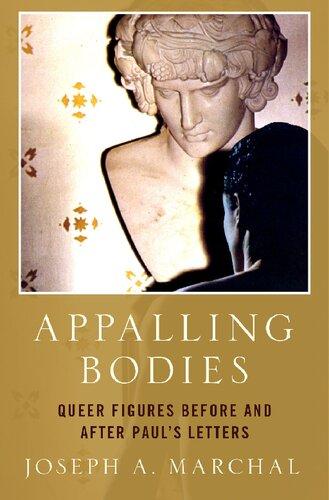
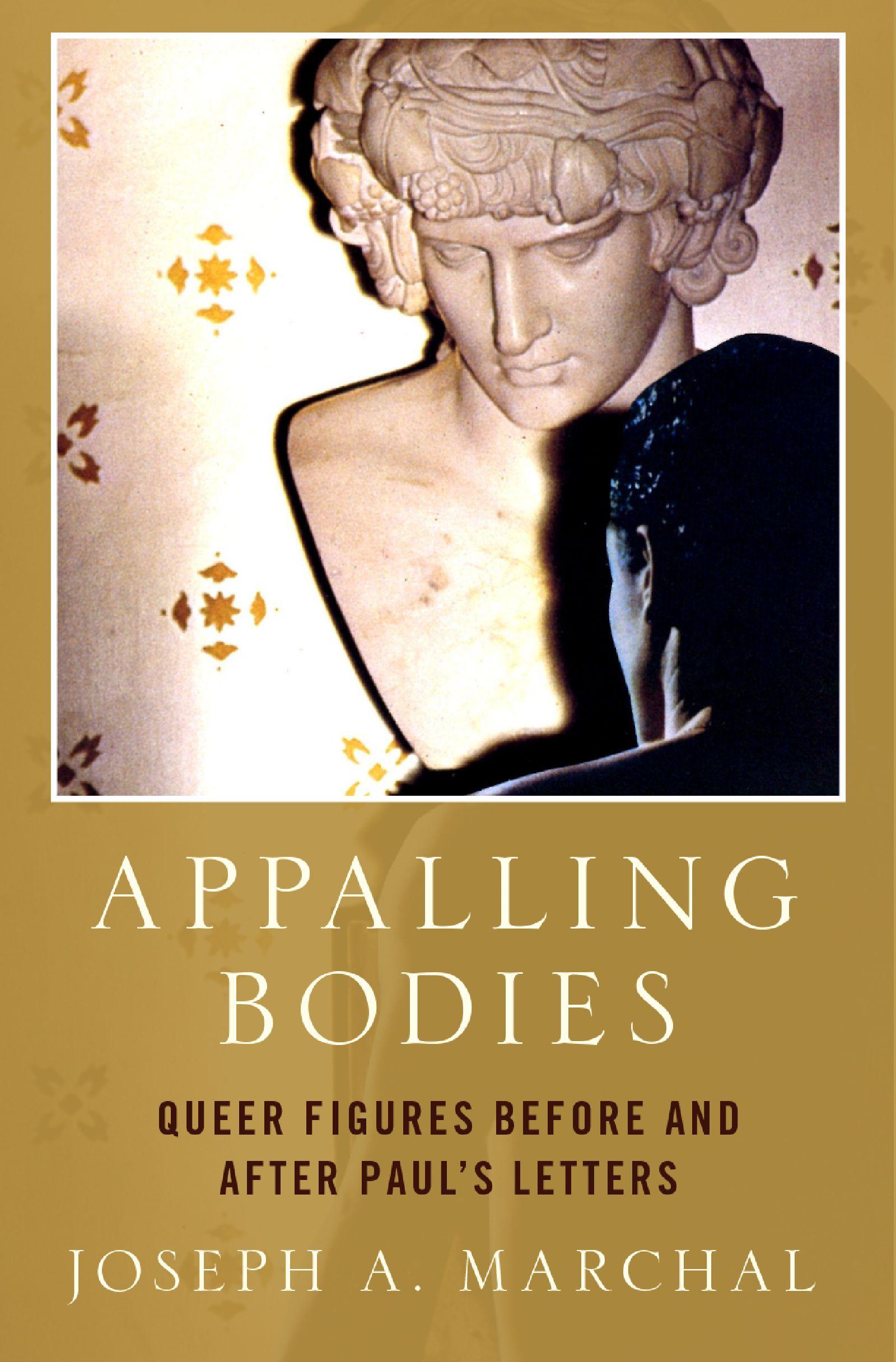
All of these could be seen as still further queer starting points for the contents to follow. While I do not know how much they will approve of this appalling book, this project and my life, indeed my overall disposition as a scholar and a person, are irrevocably shaped by the passionate commitments of two of my mentors: Antoinette Clark Wire’s roving, but indefatigable curiosity, and Elisabeth Schüssler Fiorenza’s persistent efforts to counter kyriarchy in its varying forms. My intellectual debts to Bernadette Brooten should be apparent to any who read this, as her work is all over this manuscript. Methodologically, I could not have imagined any of these queer approaches to these materials without the extraordinary paths cleared by Erin Runions, Ken Stone, and Stephen Moore. To this point, I do not think anyone has been asked to read this manuscript more frequently than Stephen. The final version of this is much improved by this reading and the attention of other, still anonymous readers at OUP (and elsewhere). My sanity in these years has been saved multiple times by the continued mentorship-turned-friendships of Melanie Johnson-DeBaufre and Shelly Matthews. It was further buoyed in key moments by the generosity of Elizabeth Freeman, Judith Butler, and Jasbir Puar. This generosity has been matched and multiplied by the gracious permission Peter Lyssiotis gave for us to re-use a photomontage out of From the The Secret Life of Statues . . . on this cover—a visceral hint of the haunting juxtapositions I have tried to summon and negotiate.
As once marked by a series of epigraphs, a passion for queer punk, queer theory, and queer hermeneutics shared with Lynn Huber and Teresa Hornsby animates this book. In the background of chapter 2, I can still
hear the Scissor Sisters throw off lines like: “She’s my man, and we’ve got all the balls we need” (“She’s My Man”). Some of the outrage seeping through chapter 3 echoes those expressed by Sleater-Kinney: “I’m no monster. I’m just like you. All my life is before me. Call the doctor. Call the doctor. Call the doctor” (“Call the Doctor”). As I struggle with the haunting histories of bodily contact in chapter 4, Magnetic Fields rings through: “If you think you can leave the past behind, you must be out of your mind. If you think you can simply press rewind. You must be out of your mind, son. You must be out of your mind” (“You Must Be Out of Your Mind”). The urgent words of The Gossip, “There’s an equation—you plus me equals death—to the science of those who dare to forget” (“Eighth Wonder”), cut through the phobic, even terrorizing readings I aim to counter in chapter 5. In these and in many other ways, music has kept me alive now for years, in ways that the biblical never has or ever likely will, as my partner knows all too well. As my queer historical narration here indicates, this project predates our relationship and hopefully will persist somehow well past our time here; but in the meantime I cannot imagine anyone with whom I would rather share this strange mess of a life. I am sorry for the appalling attention I have been giving to a book when we have been trying to read each other for so long now. The duration of this project stretches back so far that Kent Brintnall is the one friend and colleague who has walked with, commiserated over, and cheered on its development longer than anyone. It is almost here; I am sorry it took so long, but I am forever grateful for your companionship through all of these appalling turns.
My work as a teacher and a scholar has in turn been shaped by so many students, colleagues, friends, and companions—particularly those who have shared how their own gender, sexuality, and embodiment have been figured as appalling, often (but not always) in relation to biblical texts and traditions. I would not be so foolish to claim that this book does, or even could, represent the response of all who have been touched across time by such texts and traditions, so I hesitate to say that this book is for them. Yet, this project is motivated by their (and sometimes our) disclosures and resistances, wounds and outrages, debilities and desires, troubles and tricks, particularly when we have been targeted with or simply as figures of vilification or stigmatization. I try to find alternative angles on these figures as one kind of intervention (or one set of provocations) to these scenes that shape so many of our lives. This book, then, is dedicated to who and what haunts it—what has already
happened, what has been done, those who have and have not survived, echoed in my not so elastic heart, in my ears when I am overcome by the wails of Sleater-Kinney or The Gossip, in my mind’s eye when I remember Carol and too many to name and adequately honor, but who still touch me. This may not be worth the trouble, but it is well past time I tried.
Prelude
Before and After
Paul is probably the least interesting thing about Paul’s letters. Perhaps confusion is now setting in—isn’t this a book about Paul? The shortest answer is: not really. It is, in part, about Paul’s letters, though. But those epistles are not particularly interesting to me for their own sakes. Oh, but certainly it’s about the sex, then, right? All I know about Paul, sorry, Paul’s letters, is that they condemn homosexuals. Those are the parts I want to know more about. This should get juicy. Yes, indeed, I will be discussing sexual matters along the way, at times in great, even excessive detail, which is sure to please some and trouble others. This difference is one of the first lessons of queer studies, a close companion to the project of this book: “Most people find it difficult to grasp that whatever they like to do sexually will be thoroughly repulsive to someone else, and that whatever repels them sexually will be the most treasured delight of someone, somewhere.”1 Here, in a signal essay that also ends up serving as a prelude (to queer studies), Gayle Rubin highlights people’s inordinate preoccupations with sex—their own and others’—and traces a “fallacy of misplaced scale” about this variation in erotic tastes. Not only do these tastes and their embodied practices vary but also they are ordered in hierarchical valuations, with only some counting as natural and normal, healthy and holy.2 In the wake of Rubin’s work, then, the naturalization and normalization of some practices of gender, sexuality, and embodiment, typically in order to discipline, stigmatize, or exclude other practices, become persistent, even defining features for queer critique. In a striking, if brief connection to biblical studies—the other, possibly strange book-fellow with queer studies in this present project—Rubin lays the responsibility for our overwhelming sex negativity that generates these fallacies and hierarchies at the feet of Paul and those who follow him.3 I actually think this would be a relatively difficult case to make, as the letters themselves reflect more ambivalences and tensions than most users of these texts are willing to admit. This is, in part, why this book is not primarily dedicated
Appalling Bodies. Joseph A. Marchal, Oxford University Press (2020). © Oxford University Press.
DOI: 10.1093/oso/9780190060312.001.0001
to figuring out Paul’s stance(s) on sexualized topics. There are already some excellent studies about this.4
Instead of figuring that out, then, I will be reaching past Paul toward other, far more fascinating figures, before and after these letters: androgynes, eunuchs, slaves, and barbarians—each depicted as perversely gendered and strangely embodied figures in their own distinctive, though interrelated ways, before and after the letters. Once called up, these people can be used to call out others in the audiences, figures targeted by the letters and often ignored in traditions about these texts. The rhetorical figures called up by the letters were circulating in the Roman imperial context before the letters were dictated and directed to their respective assembly audiences around the northern and eastern Mediterranean. The potential historical figures addressed by these letters gathered together in these assemblies (rather than “churches”) before anyone sent such epistles, and likely persisted after their arrival, even as it now looks like the letters were sent to target them, to call out and pursue these people—to come after them.
In seeking out these other figures, we encounter variations and valuations not entirely distant from the kinds Rubin highlights for more recent contexts. Yet, the distance in space and time between the “there and then” of these first-century epistles and audiences and the “here and now” of those twentyfirst-century people who receive, interpret, and use them has also proved troubling. Our expectations around these texts and indeed studies of them (like this one) are conditioned by present-day assumptions, as people are still most likely to hear biblical, and specifically Pauline, arguments when groups are disputing matters of gender, sexuality, and embodiment. The most common positions taken in such conflicts involve primarily condemnatory or defensive responses and invoke a biblical past as either obviously applicable or distantly outdated. Neither is exactly correct, especially because the continued citation and use of Paul’s letters demonstrates an ongoing impact and influence that is outsized in comparison to the historical contexts of these ancient epistles. We need another approach, savvier to the before and after of this present-day context.
To start, this approach requires treating the letters as rhetorically sophisticated objects, situated within longer exchanges between Paul and a range of communities in cities and regions within the Roman empire—Corinth, Galatia, Colossae, and even Rome itself. Yet, one of the goals of this book is to find new ways to reach out and know more about the historical figures targeted by the letters to these assembly communities. This entails situating
each of the ancient figures deployed in these letters in their specifically Roman imperial settings, an ambience that cast each of these rhetorical figures as complicated, debased, and dangerous. Such contextualizations can begin to trace how the letters and their audiences would have known and heard references to androgynes, eunuchs, slaves, and barbaric foreigners, at least on one level.
However, these figures are deployed to address specific historical figures in these audiences, to convince them and those around them of a course of action outlined in the letter. This ancient context is more helpful in presenting the perspective of the epistle, but not necessarily those targeted by these argumentative and figurative practices. In short, any attempt to reach out and know more about the people within such ancient collectives will meet some rather clear limits if it does not make efforts to reposition the kinds of figures deployed and then targeted by the letter. Paul’s letters recurrently repeat and reinscribe ancient (often Roman imperial) ideas about a constellation of perversely gendered and strangely embodied figures. Certainly, greater familiarity with these figures and forms of argumentation provides key contexts for approaching and reimagining those “others” still so marginalized within both these epistles and their interpretations. In an effort to find alternative angles on the arguments and especially the audiences for these letters, angles aside from the perspective presented by or as Paul’s, I suggest juxtaposing these ancient figures against or alongside other, more recent figures of vilification or stigmatization—like drag kings or trans butches, or people with intersex conditions, or those engaged in BDSM practices, or those targeted as terrorists.
By implementing key insights about these people and practices from queer studies, my project defamiliarizes and reorients what can be known about both these other historical figures active in these ancient assemblies and those rhetorical figures that continue to be activated in contemporary settings. In tracing the (potential) traffic between these ancient and more recent figures, the aim is not to claim that they are somehow identical to each other. Rather, it is through these subversively anachronistic juxtapositions that this book highlights the particular, but still only partial connections between them: a set of shared features shaped by their practices of gender, sexuality, and embodiment that depart from prevailing perspectives (in both the times we call “then” and “now”).5 Such a strategy takes the biblical interpretation of such topics beyond the most common practices of condemnation or apology, in between assumptions of historical alterity or identity, toward a
critical “elsewhere” that reflects more consistently and capaciously on those before-and-after figures who have been targeted by biblically based claims across the centuries.
Such an approach involves disorienting or reacquainting different readers with one or more of the elements this project arranges within and beyond an admittedly audacious ancient, queer, and Pauline threesome.
Romosexuality
Our sources on the larger Greco-Roman context for these epistles and assemblies, for instance, definitely display different attitudes and ideas about human bodies and behavior. Starting with the work of Amy Richlin, scholars of the Roman republic and empire have described their sexual terms and practices as following a Priapic protocol, named after a hypermasculine, superphallic deity Priapus.6 Males at the top of the sociopolitical, Romosexual hierarchy are imagined as akin to this violent, vigorous, and threatening deity, and thus were expected to be “active” in all things, including sexual acts, where they should only take insertive roles.7 Elite Romans traditionally tended to think hierarchically about bodies, assuming and then reinforcing claims of elite, free, Roman imperial, male superiority.8 This prevailing view shapes the belief that sex is not a mutual activity; it is not done with someone else, but to someone else: a superior can, even should make use of an inferior in sexual practices.9
In delineating the boundaries between superior and inferior, the Romans tended to hold different ideas about the physical characteristics and sociopolitical significance of bodies, not just around gender but also around ethnoracial, free, and economic status as well as imperial and geographic location. Thus, insertive and receptive roles did not map exclusively on males and females, but on superior and inferior along multiple, intersecting trajectories. Unlike more recent expectations, then, just surviving to become an adult male does not make one a “man” in the Roman imperial context. For the free, elite, adult, Roman imperial male, masculinity is incredibly hard (no pun intended) to achieve and maintain. A good Roman man (a free, elite, adult, male, citizen) would need to constantly demonstrate that he was unlike his social inferiors because he was an exception, part of a relatively small group of people who can be, in the words of Jonathan Walters, “the impenetrable penetrators.”10 (This exceptionalism will be an important topic in the fifth and final chapter.)
All the rest are women and what scholars of Roman antiquity have dubbed “unmen.” These are the people who apparently cannot control or preserve the boundaries of their bodies. The unmen might appear to be masculine in one way or the other to twenty-first-century people, but the traditions reflected in Roman imperial sources presume that young, peasant, enslaved, castrated, conquered, foreign, and/or receptive males were not masculine.11 They were something else and more than a little like women, feminized in this system. Their inferiority is reflected in ideas about their gendered, embodied, and sexualized status, making all of these less problematic receptacles for the “real” man’s use than his peers among elite, freeborn, Roman imperial figures.
Such “receptacles” are precisely the kinds of figures I consider in much greater depth in successive chapters. From this politically prevailing perspective, gender-variant females, castrated males, sexually available enslaved people, and barbarically gendered foreigners were ostensibly inferior and degraded figures. Yet the same traditions that cast them in such roles also reflect anxieties about masculinity and a related set of complicated ambivalences around these other figures. The prevailing perspective itself leaves hints that it is not the whole picture.
Queer Reconfigurations
Such alternative angles can be developed with some key concepts and reconfigurations from queer studies. But which part of queer studies suffices for such a task? To attempt a brief overview of the places queer studies can be used for projects in religious or even just biblical studies would be daunting, possibly foolish (as I among others can attest).12 Even the term “queer” twists people into knots, some embracing, many others loathing it and its connotations as perverse or abnormal. To be sure, such connotations are the point for those who use it, a deliberate strategy to reclaim it from pejorative or derogatory uses.
In early twenty-first-century English the term is used as both a form of identification and a mode of critique or analysis. One can identify as “queer,” marking oneself as a sexual or gender minority. In practice, this use of queer often functions as a shorthand for a series of abbreviations from LG, to LGB, LGBT, and LGBTIQA, for lesbian, gay, bisexual, trans, intersex, queer or questioning, and ally (though asexual also appears in some contexts). These growing practices of affiliation, tethering different potential identities to each
other, reflects a certain politic that seeks to cross specific practices of gender, sexuality, and embodiment. Those groups and scholars who have reclaimed this word do not dispute that it connotes abnormality or nonconformity; rather, they dispute that such a contrary relation to “the natural” and “the normal” is negative. Queer, then, can also indicate a challenge to regimes of the normal, a desire to resist and contest such a worldview. In this second sense, queer is less an identity and more a disposition, a mode of examining the processes that cast certain people and practices into categories of normal/ natural and abnormal/unnatural and then of interrogating the effects of such processes. Figures, then, can be queer because they self-identify under such an umbrella sign or because they twist, turn, challenge, and reconfigure processes of naturalization and normalization. In what follows, I mostly tend toward the latter sense (a kind of critique), but leave open possibilities for the former (a form of identification).
Various scholarly and activist trajectories fed into the emergence of the subdiscipline of queer studies in the 1990s, as the work of a kinky trinity of Judith Butler, Michel Foucault, and Eve Kosofsky Sedgwick found wider audiences by bringing critical attention to ideas and practices that seemed normal or natural.13 I grapple with each of these in the following, first full chapter, in order to establish the contours of a queer approach that can reach past Paul, toward other, before-and-after figures, and negotiate between the presumed poles of either continuity or discontinuity between the first and twenty-first centuries. As my preceding discussion of the ancient, Roman imperial context indicates, questions about the historical differences of gender and sexuality remain prominent, which accounts for why Foucault has been more regularly engaged in biblical and classical studies than any other figure in queer theory.14 Yet, Butler more persistently informs my project, as reflected by the continued discussion into the second chapter and the important, if more implicit role her work plays in framing each of the chapters that follow. Her influential explication of performativity and citationality merits wider consideration within biblical interpretation, particularly wherever alternative historical and political horizons are sought.
All three of these scholars helped to define queer studies’ interests in troubling identity and history, bodies and power, representations and effects. One can see their influence in many directions, including later in my second chapter, where Jack (Judith) Halberstam troubles the attachment of masculinity to men (in ways ancient elite males appeared not to imagine) and underscores the difficulties and ambiguities of bodily practices. Yet, because
I remain interested in figures before and after “canonical” lodestars, including those who have emerged as central to queer studies, my engagement with queer interlocutors is also more eclectic, even idiosyncratic, reflecting that there are actually multiple, alternative, even competing genealogies for queer studies. My selection of partners and influences is mostly strategic and intentional, even as it is frankly often just affective and intuitive—these interlocutors are a sampling of available resources (often crossing queer genealogies), those who help me to make sense of the worlds I cycle between, including those in the first and twenty-first centuries.
Indeed, for a project that crosses time like this one, I cannot help but build on the foundation of the historians and social scientists who established the social construction of sexuality (like Mary McIntosh and Jeffrey Weeks).15 As the first chapter demonstrates at length, the shape of my own approach is as informed by the historical efforts of Bernadette Brooten and David Halperin as the aforementioned “canonical” thinkers in queer studies. In the chapters that follow, still other historians, sociologists, and anthropologists of gender, sexuality, and embodiment provide crucial insight and context for trans and butch practices (Susan Stryker and Rubin), the treatment and response of people with intersex conditions (Alice Domurat Dreger and Katrina Karkazis), and BDSM practices and the continuing legacies of slavery (Rubin, Margot Weiss, and Saidiya Hartman).
Of course, queer studies is inspired and informed by the audacity and irreverence associated with and deployed by the radical, initially gay and lesbian, political actions of groups like ACT UP (AIDS Coalition to Unleash Power) and Queer Nation. Such actions led the way in intentionally reclaiming stigmatizing terms like “queer” for an explicitly confrontational, subversive, and resistant form of advocacy. This accounts for the activist tendencies in queer studies, even as activists “outside” the academy were informed by and generated their own kinds of theoretical practices. One can see this influence in the chapters to follow, given the queer strategies of those working on trans (Leslie Feinberg and Kate Bornstein), intersex (Cheryl Chase), sex-positive (Pat Califia), and race-critical (Isaac Julien) forms of advocacy.
In many instances the lines between academy and activism are not as clear as this basic survey of my project’s interlocutors initially indicates, particularly when one considers queer studies’ emergence alongside, out of, and from within other projects that blur or cross such lines, as feminist, anti-racist, and postcolonial studies tend to do. These interconnections suggest still other starting points for queer studies, particularly given the necessity for thinking
of gender and sexuality as inherently shaped and mutually informed by race, ethnicity, economy, and empire. As several scholars have highlighted,16 the work of women of color feminists, like Gloria Anzaldúa, Audre Lorde, Barbara Smith, and Hortense Spillers, precede and exceed the focus of the more commonly canonized queer work.17 Their bodies of work mark a longer critical engagement with the operations of gender and sexuality as they are profoundly delineated by and necessarily intertwined with the dynamics of race, ethnicity, and economy (among others). In what follows, this mode of critique comes especially into the foreground in the discussion of enslaved people and barbarians (in chapters 4 and 5) aided by the work of Spillers, Jasbir Puar, and Jacqui Alexander. Yet, it not only reconfigures our approach to captive, enslaved, conquered, and incarcerated bodies, branded as slaves or religious/racial minorities, but also underscores that other figures of gender and sexual variation (including the androgynes and eunuchs considered in chapters two and three) were always already marked by ethnoracial difference, monstrously gendered and perversely racialized.
Many might expect more psychoanalytically influenced kinds of approaches when a project addresses ideas like perversion or deviance, as this one occasionally does. To be sure, Butler, Foucault, and Sedgwick each respond to and work with elements from Sigmund Freud, Melanie Klein, or Jacques Lacan. Freud is lingering in the background of the third chapter’s discussion of castration—with a focus on male genitalia and JewishGentile difference, how could he not be? For the present project, however, I find some of the more recent, psychoanalytically informed queer work on desires and death drives less compelling than those projects that focus on queering our relations to time and history.18 Thus, I use the first chapter to jump off from Butler, Sedgwick, and Foucault and split the difference between presumptions of historical alterity or identity. Here, the insights of Carla Freccero, Elizabeth Freeman, and most especially Carolyn Dinshaw expand the relational possibilities for reaching back and reckoning with the haunting force of the past on our present. Dinshaw’s beautifully juxtapositional ruminations enact a desire to “make relations with” elements of the past, seeking a “touch across time.”19 I find that my own efforts to know queer figures before and after Paul’s letters link up with Dinshaw’s efforts to make “connections across time between, on the one hand, lives, texts, and other cultural phenomena left out of sexual categories back then and, on the other, those left out of current sexual categories now.”20
Such touches and connections offer more than crude conflations of people and practices across the centuries. Indeed, the image of a touch across time entails rather contingent connections that split the difference between the continuities and ruptures that have disciplined historical discussions of gender, sexuality, and embodiment. After further discussion of this approach in the first chapter, then, each chapter stages its own touch across time through anachronistic juxtapositions of figures before and after Paul’s letters: androgynes with trans and butch, eunuchs with intersex, enslaved people with the bottom in eroticized bondage practices, and barbarian foreigners with the monstrous terrorist.
Past Paul
Such juxtapositions can trouble oversimplified notions about the present’s relation to the past and reconfigure the political, cultural, and religious significance of these biblical epistles. These letters have already proven to be quite influential, as even a brief survey of their use in historical and often ongoing disputes—about the roles and status of women, enslaved people, Jews, foreigners, racial minorities, religious dissenters and minorities, the poor, children, the government, and, yes, also LGBTIQ people—shows. Of course, these letters are also among the scriptures of the Christian New Testament. More materials are traditionally attributed to Paul than to any other author or community (fourteen of the twenty-seven books) within the New Testament. For Christians the letters are also valued as the work of a sanctified figure— Saint Paul—and, thus, important sources on communal organization, ritual practice, and theological belief.
Historically inclined interpreters highlight the letters’ place as the earliest surviving materials within and about the early Jesus movements. Some of the more enthusiastic interpreters have dubbed Paul the “founder of Christianity,” given his epistolary and (presumed) evangelizing labors among the communities that would eventually become, or at least be treated as the predecessors of, early Christianity. Many stress the ways Paul worked among non-Jewish peoples (or Gentiles) as particularly important for the growth, even survival of this movement, a claim with an uncomfortable, but clear resonance with Christian claims of supersessionism (their replacement of Judaism as God’s true people). Historical or theological claims about the
epistles or their author, then, are never purely academic or simply spiritual, as they often have significant social and political consequences.
Thus, these letters do not map smoothly onto more expected configurations. They are neither field manuals, theological treatises, nor autobiographical accounts, even when they make claims about their recipients, refer to theological ideas, or shape Paul’s claims about himself. They are rhetorically sophisticated objects, situated within longer exchanges between Paul and a range of communities. In short, when we read the epistles now, we are reading other people’s mail! More specifically, though, they are attempts to persuade, likely meant to be read out loud, to be performed. Among the more circumspect, then, these letters are valuable because they provide one, albeit specific angle on the author and these audiences, one perspective on the assembly communities in action.
Still, their importance never simply resides on the historical horizon, as resources for reconstructing debates and deliberations in the middle decades of the first century ce. It remains important to grapple with Paul’s letters because they continue to be used; they are not just artifacts from the past, creating arguments with and for others long ago. This also suggests why these epistles are not just for Christians or even for people living in Christianmajority cultures. Because biblical ideas have become central to the planet’s most populous religion, and because people from Christian-majority cultures have gone virtually everywhere else on the planet, often claiming a biblical basis for doing so, it would be inadvisable to ignore the impacts of biblical, and especially Pauline, argumentation and figuration. As I will discuss in greater length in the chapters to follow, the biblical already crosses time and space. Why not, then, try a different, if intentionally anachronistic strategy of juxtaposition, in an attempt to reach out and know more about the historical figures targeted by the letters and those rhetorical figures circulating before and after the letters?21
For those unacquainted with Pauline epistles or interpretations, though, some further winnowing of the materials and approaches is necessary. While fourteen texts are attributed to Paul, the scholarly consensus treats only seven as among the “authentic” or “undisputed” letters: Romans, 1 and 2 Corinthians, Galatians, Philippians, 1 Thessalonians, and Philemon. The first four of these (in canonical, not historical order) are traditionally described as Hauptbriefe, the essential or more important letters, not because they are among the longest, but because Protestant scholars hold that they stress important concepts, like justification by faith, more than the others.
The second chapter reconsiders aspects of 1 Corinthians, a relatively long letter that ranges over a number of topics. Traditional approaches focus on the letter’s calls for unity, discussions of the cross, the Lord’s supper, and resurrection, and instructions about sex, food, and living among “outsiders.” It is often cited because it also contains two passages that aim to circumscribe the speaking roles of women in the community (in 1 Cor 11 and 14). While 1 Corinthians signals conflicts, Galatians (the subject of my third chapter) strikes an even more polemical tone. Though it narrates a select number of events in Paul’s life, it does so only to address his concerns about circumcision among the Gentile members of the audience, potentially indicating multiple, even competing teachers and leaders. It contains a famous formula, likely recited at baptisms: “no longer Jew or Gentile, slave or free, not male and female, for you are all one” (Gal 3:28).
The fourth chapter may examine the shortest of these letters, Philemon, but its allusions to the enslaved figure Onesimus (Phlm 10) has led to an inordinate amount of interpretation on slavery and freedom. However, the letter is not only brief, but its exact purpose is also difficult to determine, given the more evasive, even diplomatic approach it takes toward Philemon, the potential addressee and owner of the enslaved person in question. The fifth and final chapter returns to 1 Corinthians, while also reconsidering Romans. Romans is traditionally treated as an elaborate theological statement either because it was meant to be Paul’s last testament of his beliefs or his introduction to a community he has not already visited. Both approaches tend to focus on the letter’s arguments about salvation and justification, again treating concerns about Jewish and Gentile difference in the community.
Yet the aim of this book is to reach past Paul and toward those figures before and after these letters. Any such attempt will be thwarted in advance if it only seeks to follow the perspective presented by the letter, if it does not work to find alternative angles on these figures. This interest in people beside Paul is inspired by and indebted to a significant body of feminist historical and rhetorical work. Starting especially with Elisabeth Schüssler Fiorenza and Antoinette Clark Wire, feminists reading for the perspectives of women, among others, demonstrated how Paul’s letters are not descriptive of a firstcentury reality, but are attempts to be prescriptive of a reality they are seeking to construct.22 This opens the way to decentering Paul, and treating him and the letters attributed to him as representing only one among many voices acting and negotiating within the contexts of the assemblies and the wider world.23 This approach also requires swerving away from the predominant
politics of identification with Paul and against nearly any other figure mentioned in the letters.24 With a different set of commitments, one can factor for the persuasive function of a letter, recognizing the points of considerable strain, conflict, or tension, to move beyond Paul’s perspective and see another side to those addressed.25
Thus, my queer approach is also a specific kind of feminist project.26 As I have already suggested, each of the ancient figures deployed in Paul’s letters—the androgynes, eunuchs, slaves, and foreigners—would fit with Roman imperial characterizations of unmen. From the perspective of the Priapic protocol, they are defined negatively, they are not like the “real” (read: elite, free, Roman imperial, citizen) men, they lack the ability to control or preserve the boundaries of their bodies, thus they are lower in the prevailing sociopolitical hierarchy. Since males like these are marked as inferior by their association with womanliness or femininity, this could also suggest the potential for rethinking their positionality from below. Schüssler Fiorenza suggests the term “wo/men,” to indicate not only the differences within and among females, but also the potential connections between most females and subaltern, or nonelite males.27 Wo/men highlights that not all females experience intersecting dynamics of power in the same way (consider nonelite, enslaved, and/or foreign females) and may often hold more in common with males toward the bottom than females toward the top. Adopting this understanding, rather than a prevailing perspective disciplined by identifications with Priapus, helps to instead identify these figures before and after the letters as wo/men.
This also signals that the complexity of the sociopolitical dynamics within both ancient and more recent settings is not easily summed up by terms like “empire,” “sexual penetration,” or even “patriarchy.” The Roman imperial era is shaped by all of these dynamics, and more. This is why Schüssler Fiorenza coined the term “kyriarchy” to describe and analyze the multiple, intersecting, and mutually influencing pyramidal structures of power and oppression.28 Kyriarchy is a system where only certain kinds of males are “men”—elite, educated, freeborn, propertied, imperial, and typically from particular racial/ethnic groups—who rule all who might be wo/men— females but also nonelite, uneducated, enslaved, subaltern, and/or often racially or ethnically oppressed groups of males. Imagining these dynamics as pyramidal visualizes steep angles, where very few reach an apex, while more and more people subsist under multiple forms of subordination and marginalization in the spaces below.
These are the spaces where one would find gender-variant females, castrated males, enslaved people treated as sexually available, and barbarically gendered foreigners, even as scholars typically remain stuck on the prevailing perspective of texts written by and for those toward the apex as descriptive. Thinking and looking with a concept of kyriarchy presents another tool for approaching these figures from a different angle, from below.29 This book, then, is also a counter-kyriarchal project.
After This Before
The following chapters pursue alternative angles on appalling bodies. The first chapter, “Touching Figures: Reaching Past Paul,” further situates queer approaches to history and temporality as a way forward and out of persistent debates about whether and how the past is different from the present. Dinshaw’s queer touches across time provide an inspiration that directs the four, more extended chapters, each structured by a specific anachronistic juxtaposition to reach out for those figures cast as appalling bodies, before and after Paul’s letters.
Chapter 2, “A Close Corinthian Shave: Trans/Androgyne,” grapples with 1 Corinthians 11:1–16, one of the letter’s attempts to limit women’s prophetic speech in the community. Allusions to androgyny appear in a couple of places in this text, but most especially in strange references to head hair (11:5–6). This is just one vexed marker of gender variety and multiplicity, which can be reimagined with more recent figures of female masculinity like drag kings, butch lesbians, transgender dykes, or gender queers (especially as examined in transgender studies). Chapter 3, “Uncut Galatians: Intersex/Eunuch,” reconsiders the multiple ways Galatians argues with and about bodies and two practices of genital cutting— circumcision and castration. Though it quotes a baptismal tradition (3:28) prized for its scrambling of several embodied factors (Jew/Gentile, slave/ free, male/female), it also violently wishes for those seeking circumcision to be castrated (5:12), bringing the eunuch as a lingering point of contrast into the foreground of the letter’s argument. Critical reflections on the meaning of modifying bodies with intersex conditions contrast with such uses of eunuch figures, subverting the persistent scholarly focus on Paul focusing on the circumcised penis, a focus that reinstalls a normative view of “member”-ship in the community.