FOREWORD
a new form of nationalism in its own right? How does nostalgia infect the political debate? And, more importantly, why was nostalgia spreading so quickly across the whole world?
The time was ripe to analyse in greater depth an emotional syndrome that will probably shape domestic and international politics for many years to come. This is exactly what induced Michael Dwyer, managing director at Hurst Publishers, to accept our proposal for a book about the changing landscape of emotions and ideas in Western politics: Brexit was the perfect test case. We are immensely grateful to him for this opportunity.
The book focuses on the link between nostalgia and nationalism. Demographic, economic and technological forces are spreading the disease of longing at an impressive pace. Older people are struggling to keep up with a world that is changing too fast. Globalization and technological progress disrupt traditional industries, creating job opportunities for a small elite of highly qualified professionals. And immigration destabilizes self-contained local communities, questioning the traditional values that keep them together. These forces, being structural in nature, are producing a generalized sense of insecurity that jingoist leaders are addressing by promising to “take back control” at the national level—as in an idealized past.
At the heart of today’s nationalist narrative is a promise to turn the clock back. Of course, memories of bygone eras are emotionally and historically biased. But that is how nostalgia works. It is selective by nature.
To improve our understanding of the phenomenon, we crossed the boundaries of a number of fields, well beyond our comfort zones of international relations and economics. We turned to psychology, anthropology, cultural studies, and history. We came to the conclusion that nostalgic nationalism is indeed a new form of nationalism—rather than a simple populist revolt. But only in the United Kingdom, given its historical legacy, was this phenomenon so ripe that it contributed to a highly temporally regressive decision such as Brexit. The tiny majority of the highly polarized British population who voted Leave and were brainwashed with nostalgic national myths of past glories did not just want divorce from Brussels. They wanted to return the United Kingdom to a time when the country was fully sovereign and simulta-
neously able to play a global role. That is why this book refers in detail to the debate over the Anglosphere as a geopolitical alternative to the European Union.
Our Anglo-Saxon interlocutors were intrigued that two Italians had dared intrude on their debate and delve into what many perceive as a highly emotional topic. Our bet is that two outsiders, while strongly connected to the Anglo-American world through a number of policy, academic, and corporate connections, could provide an interesting perspective on these issues.
Along the way, we benefited from the expertise of a number of collaborators. Ph.D. candidates Niccolò Serri and Edoardo Andreoni provided excellent research assistance for some of the historical chapters. The journalist Hannah Roberts improved our understanding of the nostalgic flavour that characterized the United Kingdom in the years leading up to the Brexit referendum. At Hurst, we are indebted to Lara Weisweiller-Wu for her patience, competence, and steadfastness, as well as to the rest of the editorial and marketing staff. We are also grateful to Gyneth Sick and the team at the journal Aspenia for running an editorial on nostalgia. Edoardo also had the opportunity to write a long essay on a related topic for Project Syndicate. He is grateful to Ken Murphy, Romand Frydman, and Nicolas Chatara-Morse for supporting this idea.
A number of fr iends and colleagues commented on part of the draft or the entire manuscript: Pramit Pal Chaudhuri (Rhodium Group), Stephanie Flanders (Bloomberg Economics), Timothy Garton Ash (Oxford University), Christopher Hill (Cambridge University), Ivan Krastev (The New York Times and Centre for Liberal Strategies in Sofia), Charles A. Kupchan (Council on Foreign Relations), Walter Russell Mead (Bard College), Roberto Menotti (Aspen Institute Italia), Larry Summers (Harvard University), George Tsarouchas (Dialectica). We are also very grateful to two anonymous reviewers whose comments and suggestions contributed greatly to improving the book.
On a more personal level, we would like to thank our relatives for putting up with our frequent “detours” from our family lives throughout the project. Edoardo would like to thank Margherita for continuing to be a source of unconditional support and for reading every word of his writings, even the most boring. The article in Foreign Affairs was
published the day after Costanza’s birth, and she has since been the best source of distraction from his Anglo-Saxon ruminations. Marta wishes to thank the Aspen Institute Italia for having enabled her to work on a book largely focused on topics that are central to the Aspen network, as well as thanking her own family, starting with Gianluca and Otti, for being patient and supportive.
The book is dedicated to Costanza and Nina.
INTRODUCTION
“Remembrance of things past is not necessarily the remembrance of things as they were”
Marcel Proust
The world is marching backwards into the future. More and more countries are becoming trapped in a past that no longer exists—and probably never really existed at all. Millions of people, particularly in advanced economies, believe that life was better fifty years ago: job opportunities abounded, local communities were intact, and the pace of technological change was under control.1 A majority of Russians still mourn the Soviet Union. Hardline Brexiteers yearn for the days when the British Empire ruled the waves, while a significant portion of the American population longs for the power and influence that the United States used to enjoy during the Cold War and its immediate aftermath. Even Mao Zedong has been rediscovered, with hordes of Chinese descending each year on his rural home town, Shaoshan, to pay homage.2 It is a sense of loss that is fuelling this epidemic of nostalgia—a lost global status, a lost socio-economic prosperity, a lost cultural integrity. Ordinary citizens no longer project their aspirations onto utopian visions of an idealized future. They prefer to look back to a time when national borders were less porous and governments supposedly did a better job of protecting their citizens. Nostalgia offers relief from socio-economic angst. Yesterday is associated with progress; tomorrow with stasis or regression.
From a purely psychological point of view, nostalgia represents a coping strategy for dealing with moments of deep uncertainty and
radical discontinuity. It removes its victims from an unpleasant present and throws them into a familiar past, reinforcing their self-esteem and the self-confidence needed to navigate periods of sustained stress. Collectively, it strengthens bonds with those who reminisce about the same idealized time—thus drawing a clear line between competing groups in a highly exclusionary way, particularly with respect to newcomers and immigrants. With the world on the cusp of massive geopolitical, demographic, and technological transformations, there is no shortage of reasons to be nostalgic. The denouement of American liberal hegemony is creating opportunities for post-imperial powers such as China, Russia, and Turkey to reassert their lost status on the world stage. Reviving moments of past glory helps motivate a nation, and shows that reshuffling the global order is possible, and somewhat legitimate. At the same time, the employment threats posed by globalization and exponential technological change induce workers, particularly in the West, to long for the economic security and the social mobility enjoyed by their parents. And the ageing of the population in Europe, North America, and parts of Asia psychologically compounds all these factors. Older people are the most likely to fall victim to nostalgia.
Far from being innocuous, this infatuation with a mythicized past, which is usually remodelled at will, is shaping our politics in risky ways. Collective anxieties weaken the ties of civil society, give rise to tribalism, and splinter civilizations into warring factions. Not only does nostalgia blur the past, present, and future, it also induces citizens and governments to find comfort in a time when national borders were still rigid—a pre-globalization era in which each nation was (supposedly) in control of its fate. This is why nostalgia and nationalism are intimately interlinked.
Nostalg ia becomes an emotional weapon in the political debate that can be used either defensively or offensively. To those who reject a cosmopolitan world and yearn for the socio-economic opportunities enjoyed by older generations, nationalism promises a source of identity and security: a return to full sovereignty will supposedly stem the global forces responsible for today’s uneasiness. Solidarity is then restricted to small clans, and nostalgia acts as a self-defence mechanism. Equally, to those who aspire to restore the national glory of the past, nationalism provides a means to gain influence to the detriment
of other nations. Here, nostalgia is deployed aggressively to fuel tension among states, leveraging fractures generated by ethnic, cultural, or historical factors and making cooperation on global issues impossible. The logical endpoint of these trends is a Hobbesian world characterized by conflict. Nostalgia can only rarely be employed in a cooperative way. This occurs when nations share special cultural, religious, or historical links (like the Anglo-Saxons). But national interests might diverge even between similarly nostalgic countries, inevitably leading to tension. Cooperative nostalgia, in other words, is the exception that confirms the rule.
The age of nostalgia has begun. It is an age of false myths, unparalleled political miscalculations, and rising tensions between nations—a time of regression and pessimism. Jingoistic leaders are increasingly activating and harnessing nostalgia for their own ends.3 They do not simply view the past through critical eyes, recognizing that, even though some things have been lost, much has been gained along the way. They want instead to start over, rebuild the lost home, and restore the past as it was; turning the clock back to face the challenges of the future with the strength of the past. This is the most toxic form of nostalgia.
Chinese President Xi Jinping calls for the “great rejuvenation of the Chinese people”. With 5,000 years of continuous civilization, China is re-emerging as a global economic and political power. For his part, Donald Trump was elected President of the United States with a clear mandate to preserve and restore Washington’s primacy and “Make America Great Again”. Turkish President Recep Tayyip Erdogan harbours neo-Ottoman ambitions, while Japanese Prime Minister Shinzo Abe’s political lodestar is the nineteenth-century Meiji Restoration, which laid the foundations for an expansive Japanese empire. In other cases, nostalgic leaders reject their countries’ historical reversals of fortune. While Hungarian Prime Minister Viktor Orbán still regrets the Kingdom of Hungary’s territorial losses after the First World War, Russian President Vladimir Putin has described the collapse of the Soviet Union as “the greatest geopolitical catastrophe” of the twentieth century. Nostalgia is animating all the far-right nationalist or populist movements that are currently fracturing Western Europe, from the League in Italy to the National Front in France and the Danish People’s Party in Denmark.
But it is Brexit that epitomizes our new age of nostalgic nationalism in its purest form. It captures the economic pain of the left-behind, the social disruptions generated by immigration, and the geopolitical ambitions of a once glorious empire. During the referendum campaign, and in the aftermath of the vote, nostalgic arguments have been used defensively against the European Union, offensively to boost Britain’s global influence, and cooperatively to strengthen ties with its former colonies. Brexit, as argued by the distinguished political scientist Albert Weale, was a “triumph of nostalgic democracy”.4
Only in the United Kingdom is it possible to clearly identify the three moments of a periodizing nostalgic narrative: the “golden days”; the “great rupture”; and the “present discontent”.5 The golden age is represented by the imperial era, during which the United Kingdom held sway over “one continent, a hundred peninsulas, five hundred promontories, a thousand lakes, two thousand rivers, ten thousand islands”.6 It was a multi-faith, multi-lingual, and multi-ethnic maritime imperium, with no rivals in terms of vastness and richness. Global maritime, commercial, and political links turned this offshore island into, first, an “Atlantic nation” and eventually into the centre of a worldwide network of trade, culture, and politics. The rupture came not only with the slow demise of the British Empire, but also with the United Kingdom’s decision to join the European project in 1973. The present discontent is caused by the unwillingness of many Britons to come to terms with Britain’s transformation into an ordinary nationstate. In the eyes of a hardcore Eurosceptic, the European Union represents an abrupt break from the uninterrupted history of continuous progress that has characterized the United Kingdom since the introduction of Magna Carta. Brexit was supposed to close this nostalgic cycle by bringing Britain back to its golden era—not just immediately before the infamous decision to join the European Economic Community, but possibly to a more distant glorious past. No other country has yet made a comparable leap backward.
Suc h an apparently irrational and masochistic choice took place in a country that has, over the last five centuries, created and developed the most growth-friendly institutional setting in the world.7 This is the nation that nobody would have expected to fail—in the sense of deliberately making economically harmful decisions. The Brexiteers
spoke masterfully to the gut of their fellow citizens and leveraged their emotions to overcome the terrifying messages of “Project Fear” (which was unusually associated with mainstream parties), denigrating the experts, deriding their gloomy predictions, and keeping up the morale of their crew with dreams of a past that they promised to restore—at least to some extent. The Brexit debate, as former Prime Minister John Major put it, had turned into a “battle between economics and emotion”.8
Post-empire melancholy—as well as an eagerness to regain full control of the law and the borders—completely altered any rational cost–benefit analysis about the economic consequences of a historic decision of this kind. But this is how nostalgia works. It projects its victims two or three generations back and two or three generations ahead, heavily discounting short-term costs and massively overstating long-term benefits. The warnings of academic and commercial economists about the negative-growth spillovers of a divorce from Brussels were simply ignored. The Organization for Economic Cooperation and Development (OECD) published a report ahead of the referendum stating that by 2020 and 2030 GDP per household would be, respectively, £2,200 and £3,200 lower.9 But Britons simply did not care. This indifference was not only a by-product of the generalized distrust of experts that was spreading across the world at that time.10 Brexiteers were to some extent aware that their grand strategy of restoring full sovereignty could not be implemented overnight. It would clearly be costly and painful, but was worth pursuing.
From the perspective of the Leave camp, Brexit provided an opportunity to regain control of Britain’s past and future, allowing it, once freed from European constraints, to take advantage of all the great economic opportunities that the world could offer to a global power rediscovering itself. But, as Vince Cable of the British Liberal Democrats puts it, “Too many were driven by nostalgia for a world where passports were blue, faces were white and the map was coloured imperial pink.”11 With their minds completely obfuscated by questionable myths of national glory, nostalgic Leavers ignored the greed, depredation, and cruelty at the heart of British imperialism. That, after all, is how nostalgia works. The negative emotions associated with our memories tend to dissipate more quickly than the positive ones.
However, these imperial inclinations are also associated with a key feature of British nostalgia: the lack of a proper British nationalism. There are Scottish, Welsh, and Irish national identities that have developed in reaction to a stifling English imperial identity, but not a truly collective British identity.12 The English first built a land empire by expanding from the south of the British Isles to the north-west. They then created an overseas empire, the first in the Western Hemisphere, in North America and the Caribbean, and then in the East, in India and Southeast Asia. The “inner empire” was clearly a creation of the English. But the “outer empire” was, despite the many contributions of the Welsh, Irish, and Scots, also de facto considered an English endeavour. After all, it was English Common Law, the English Parliament, and the English monarchy that supplied the key institutions to the two empires. It was this outer empire that allowed the different national identities of the United Kingdom to converge and merge into a common British identity. Once the empire dissolved, only the English were left without a traditional national identity. But they remained a “post-imperial” people, and Brexit deluded them with Anglosphere fantasies aimed at restoring their imperial past—at least to some degree.13 The empire was in fact a recurring, but not exclusive, theme in the nostalgic rhetoric of hardcore Brexiteers that possibly also influenced the voting decisions of moderate Leavers who cared very little about it, but needed a source of strong inspiration to ditch Brussels. They swapped what they perceived as a mediocre future within the European Union for a glorious past.
When one looks at the geography of the Brexit vote, these contrasting views manifest themselves plainly. Excluding London, England voted to leave the European Union by 55.4 per cent to 44.6 per cent, whereas 62 per cent of Scots and 55.8 per cent of the Northern Irish voted to remain.14 As the writer Anthony Barnet put it: “It was England’s Brexit.”15 London, instead, is in a class of its own, thanks to its melting-pot of languages, religions, ethnicities, and nationalities. But the truth is that never in recent history has the United Kingdom been as divided as it is today, with political and economic divides cutting across cities, regions, and social groups. Using the jargon of journalist David Goodhart, there are, on the one hand, the “Somewheres”, who are rooted in a specific place and are often less educated, and on
the other there are the “Anywheres”, who are footloose, urban, and socially liberal. These fault lines characterize the whole of the West. But it is in Britain that tensions between these two groups have manifested themselves in the most dramatic way.16
Those who campaigned for Brexit did not propose an amorphous future outside the European Union. There was certainly a lot of confusion and inconsistency in the arguments put forward by the Leavers. They all shared a desire to free their country from the tight fetters of a rule-imposing Brussels; but they had confused ideas as to how to turn their aspirations into reality. Ultimately they believed that a divorce from Brussels would allow Britain to regain “control”, first of all of external borders, and even rejoin its true “kith and kin”—that is, English-speaking countries that are committed to common law, democracy, and free markets. “Global Britain” was meant to strengthen its relationship with the United States and the old Commonwealth, while also establishing new trade ties with countries in the Far East. Hardcore Brexiteers, a minority within the Leave camp, clung nostalgically to the idea that Britain would find her right place within a renewed Anglosphere—namely, Australia, New Zealand, Canada, the United Kingdom, and the United States; that it would go from being an ordinary European Union member state to a modern version of the old imperial Mother Country. In addition, within this core group of English-speaking countries, Leavers overemphasized the special relationship with America that was instrumental to easily navigating any post-Brexit adversity. After all, the most enthusiastic Eurosceptic sees in the American Empire the natural evolution and continuation of its British predecessor.17
The debate concerning Great Britain’s global role is nothing more than the culmination of an intellectual dispute that has lasted for more than 150 years—since the late Victorian era when the British Empire’s global pre-eminence was slipping as a result of combined internal and external fractures. It all started in 1873 at the Oxford Union, with a debate on how to reorganize and modernize Pax Britannica. 18 Since then, plans have differed in detail, but they have all sought to unite the Anglosphere behind a common purpose. Some have called for the cre-
ation of a British imperial federation or a multi-national commonwealth, while others would have liked to see a more formalized Atlantic Union, or even a new Anglo-American state. Hardcore Brexiteers simply continued this project. All the institutional arrangements proposed over the years were intrinsically nostalgic and utopian. They attempted to creatively preserve a past that was falling apart by promoting Britain’s political and economic interests to the detriment of increasingly more assertive colonies. Not surprisingly, none of these proposals has ever amounted to anything. Nostalgia, which tends to oversimplify reality, hardly makes for enlightened politics and effective policies.
To be sure, only a minority of Leave voters truly yearn for a revival of their imperial past. In a way, only a few eternally nostalgic people, such as the leading Brexiteers Boris Johnson or Jacob Rees-Mogg really believed in the restoration of a sort of modern empire. According to a poll taken by Lord Ashcroft Polls, only 6 per cent of Leavers wanted to expand British economic and trade opportunities outside the European Union.19 But even if the Anglosphere was not the chief concern of a dissatisfied British electorate, the legacy of a globe-spanning empire acted as an ideological construct that sugared the Brexit pill. Away from Brussels, but without an Anglo-Saxon alternative, the United Kingdom would have enjoyed more political and policy freedom, but its economic prospects would have been grim. The Anglosphere created the illusion of preferential access to a trading area that was expected to provide more commercial opportunities than Europe— despite the fact that the continent is still Britain’s largest market for its exports. This was the offensive and cooperative side of nostalgia in the Brexit debate: the eagerness to regain global influence, while leveraging ancestral global connections. In political jargon, it coincided with the idea of Global Britain.
Most Brexiteers were probably more pragmatic and somewhat more realistic. They primarily wanted to regain control of their borders and laws. Taming what was perceived as an out-of-control immigration process and pushing back an intrusive Brussels were their most pressing priorities. Nearly half of the Leave voters believed that decisions about the United Kingdom should be taken in the United Kingdom, and 33 per cent wanted to regain control over immigration.20 But even these issues were heavily tinged with nostalgia in its defensive form.
The empire fuelled a sense of exceptionalism that makes the United Kingdom uncomfortable when in a position of equality rather than leadership. This is especially true when it comes to sharing power with other countries, such as France and Germany, which are not even part of the Anglo-Saxon clan; or when a supranational actor such as the European Union undermines sovereignty from above, betraying the democratic principles that the United Kingdom has upheld for centuries. From the very beginning, Britain had joined the European project with a chauvinistic otherness that nourished the expectation of deserving special status. As Margaret Thatcher put it: “God separated Britain from mainland Europe, and it was for a purpose.”21 But the many “optouts” that were offered to the United Kingdom never proved enough to secure its full engagement. For almost fifty years, nostalgia for a time when Westminster was fully in charge of British affairs has provided a rallying cry against external intrusions.
An additional manifestation of defensive nostalgia emerged in the years leading up to the Brexit debate. Fear of foreigners triggered by the intensification of migratory flows from Eastern Europe and the dislocation generated by globalization and technological progress pushed many British citizens (although the phenomenon is widespread in the West) to look back to a past when their governments (supposedly) had the political power and the economic tools to stem these global forces. Due to its lack of steadfastness, the European Union represented an obstacle to addressing these public concerns. Both forms of defensive nostalgia (against Brussels and against globalization in all its different forms) correspond to the idea of a Little England, even if no one really likes this branding, which finds its lifeblood in the myth of the island nation—an insular geography that shapes the character of its people.22
In no other place in the world is nostalgia so multifaceted as to be used as a political weapon defensively, offensively, or cooperatively, depending on the circumstances. In the United Kingdom, nostalgia is an emotion that is both inward and outward looking, generating conflicting worldviews: that of Global Britain and that of Little England (two nostalgic terms themselves with roots in the political debate of the late Victorian era). Moreover, Englishness itself has a distinctive nostalgic feature that sets it apart from any other national identity.
Yearning for the past is somewhat intrinsic to the English way of being, and this mindset is compounded, although not outright created, by the demographic, geopolitical, and economic forces that are spreading this epidemic of nostalgia across the globe. It feels as if the United Kingdom has produced such a surplus of history that it can still be consumed decades later. Some say that “Englishness inevitably appears tinged with nostalgia and consistently evokes pictures of an older, more tranquil England, an England of times gone by”.23 Others say that the English are “chronically nostalgic”.24
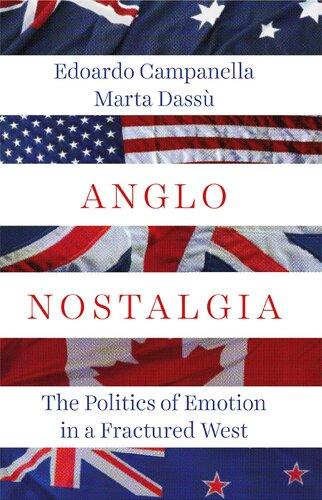
In a way, it is possible to speak of “Anglo Nostalgia”: a state of mind that induces the British (and particularly the English) to constantly look back to their glorious history to confront the present, usually ignoring the changes that have occurred in the meantime, and often aspiring to restore the past altogether.25 As stated by the historian David Edgerton: “The past is appealed to as an explanation of the present, for this and that policy, the place where a true national essence is revealed.”26 This also reflects Britain’s continuous and painful search for its own national identity since the end of the Second World War.27 Until the 1940s, the United Kingdom was liberal, cosmopolitan, capitalist, and anti-nationalist, at the heart of a European and global web of trade and influence. Then, as its global position eroded, and after the introduction of the welfare state, it quickly became a more circumscribed, but ordinary, successful nation with shared goals and horizons. In the 1970s it reinvented itself again as part of the European project, and in the following decade as a magnet for global financial and human capital. Since then, under the pressure of these external forces, Britain has struggled to be a nation.
The rhetoric of the Leave campaigners was so filled with nostalgic arguments and historical references that at times it felt as if the United Kingdom was completely removed from the present. Trump went back no further than the 1950s in depicting his ideal of America; Brexiteers, however, dug deep in reminiscing about the British past—all the way back to the introduction of the Magna Carta in 1215. On many occasions it seemed that leading Brexit supporters were living in a different era. Throughout the campaign the former
Mayor of London, Boris Johnson, continuously mobilized his political hero Winston Churchill; Nigel Farage, leader of the UK Independence Party (UKIP), celebrated military victories that only specialist historians still remember; and the MP Jacob Rees-Mogg revived a lost ideal of pure Englishness. Their narrative centred on a sort of atavistic conflict between the United Kingdom and the “old continent”. It fleshed out four key elements: imperial pride; the discomfort of being ruled by others; an unparalleled sense of trust among Anglo-Saxon countries; and a pronounced mistrust of foreigners seen as invaders. Brexit was a modern-day Battle of Britain. After having defeated the French and the Spaniards throughout the centuries, after having stopped Wilhelm II, Hitler, and Brezhnev from permanently disrupting the global order, the time had come for Britain to push back Brussels’ technocrats. In April 2016, the former Deputy Prime Minister Nick Clegg explicitly accused the Leave campaign of nostalgia during a speech at Princeton University:
Those campaigning for us to leave the European Union like to evoke a sentimental, nostalgic vision of Britannia, proud and independent, ruling the waves once again. But the truth is, leaving cannot return us to a halcyon age—if such an age ever existed—and may even mean sacrificing the United Kingdom itself.28
However, the inclination of some British people to live in the past was not only the fault of the Brexiteers. Thanks to various semi-fortuitous circumstances, the country was especially receptive to nostalgic arguments. Events such as the Royal Wedding, the Queen’s Diamond Jubilee, and the 2012 Olympics, or the anniversaries of the First World War, Magna Carta, and Shakespeare’s death contributed to create that emotional sense of national pride and belonging which turned out to be key in the United Kingdom’s decision to say goodbye to the European Union. Furthermore, the British culture and entertainment industry had unwittingly lent the Leave campaign a helping hand by reinvigorating the “Blitz spirit” related to Britain’s military triumphs in the two World Wars and creating a national infatuation with the late Victorian and Edwardian eras. In the years leading up to the 2016 referendum, an outpouring of films, television series, books, and art exhibitions glorified Britain’s past and celebrated Englishness as the lost apotheosis of noblesse oblige.
This pathological infatuation with the past distorted reality, misleading millions of British citizens about the future of their country outside Europe. Brexiteers mobilized the history of their nation to create myths about the United Kingdom’s global role, the uniqueness of the relationship with America, the construction of the Anglosphere, and the uselessness of the European Union. By deploying nostalgia both offensively and defensively, Brexiteers found themselves promoting two inconsistent visions of the United Kingdom: an outward-looking Global Britain and an inward-looking Little England. The former depicts the ambitions of a part of the Oxbridge elite that is against the European Union, while the latter embodies the frustrations of lowskilled workers. As shown by Brexiteers’ inability to agree on a shared post-Brexit plan during the negotiations with Brussels, striking a balance between global and insular aspirations is simply a Herculean challenge. The only thing they have in common is the idea of reclaiming sovereignty. But then these two groups would use their regained power to achieve conflicting goals.
This book analyses how nostalgia has infected the political debate globally, and then looks at the United Kingdom as a case study. Coming from outside the Anglo-Saxon world, while being closely connected to it through our professional network, we attempt to provide a balanced outsiders’ assessment of the nostalgia phenomenon in the United Kingdom, with no emotional or practical involvement in British politics. The first section is about the psychological biases produced by nostalgia that end up creating national myths (by definition a mix of truth and falsehoods), highlighting the role of history, politics, and the media. Chapter One analyses the global epidemic of nostalgia as a major force affecting both domestic and international politics. Chapter Two emphasizes the link between nostalgia and nationalism, defining the features of Anglo Nostalgia. We will argue that Brexit is the only true example of nostalgic nationalism—a new category of nationalism in its own right. Chapter Three describes the nostalgic atmosphere that characterized the years leading up to the Brexit referendum, and how Brexiteers used it as leverage along with their propaganda machines to create a narrative about bygone glorious times. Chapter Four analyses the history of the intellectual debate surrounding the United Kingdom’s role in the world since the Victorian era, all the way to