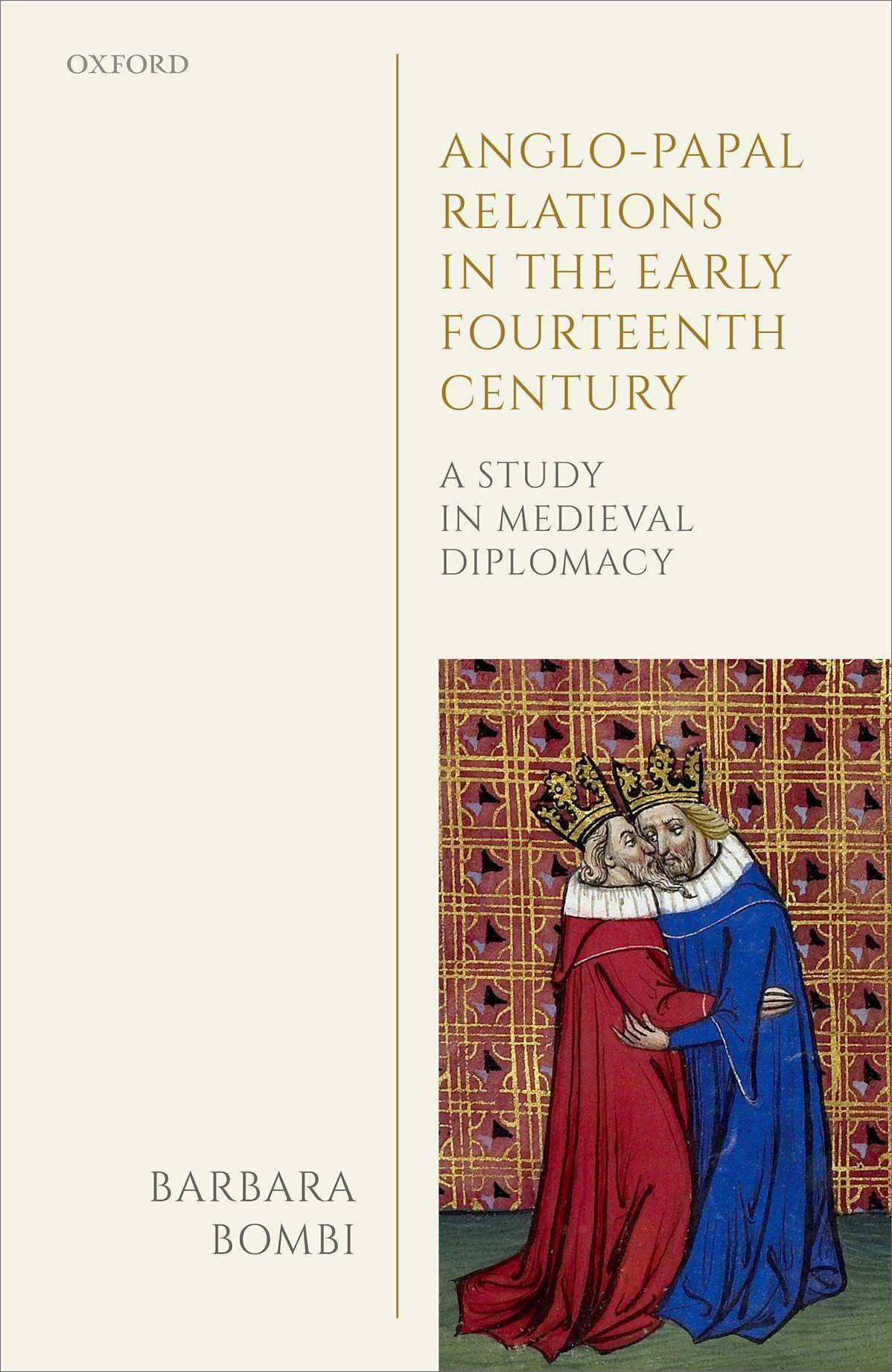
Anglo-Papal Relations in the Early Fourteenth Century
A Study in Medieval Diplomacy
BARBARA BOMBI
1
Great Clarendon Street, Oxford, OX2 6DP, United Kingdom
Oxford University Press is a department of the University of Oxford. It furthers the University’s objective of excellence in research, scholarship, and education by publishing worldwide. Oxford is a registered trade mark of Oxford University Press in the UK and in certain other countries
All rights reserved. No part of this publication may be reproduced, stored in a retrieval system, or transmitted, in any form or by any means, without the prior permission in writing of Oxford University Press, or as expressly permitted by law, by licence or under terms agreed with the appropriate reprographics rights organization. Enquiries concerning reproduction outside the scope of the above should be sent to the Rights Department, Oxford University Press, at the address above
You must not circulate this work in any other form and you must impose this same condition on any acquirer
Published in the United States of America by Oxford University Press 198 Madison Avenue, New York, NY 10016, United States of America
British Library Cataloguing in Publication Data Data available
Library of Congress Control Number: 2018959209
ISBN 978–0–19–872915–0
Printed and bound by CPI Group (UK) Ltd, Croydon, CR0 4YY
Links to third party websites are provided by Oxford in good faith and for information only. Oxford disclaims any responsibility for the materials contained in any third party website referenced in this work.
To Matteo, Peter, and Olivia
Acknowledgements
This book has been in the making since 2012 and builds on my previous research on the representatives at the papal curia of the Teutonic Order and the kings of England, Edward II and Edward III. Its inspiration lies in the research on diplomatic and administrative practices by Cuttino and Chaplais, whom unfortunately I never had the privilege to meet. Throughout many years the participation and collaboration with two different clusters of scholars have been essential to develop the ideas argued in this book: first, the workshop ‘Negotiating Europe: Practices, Languages and Diplomacy in 13th–16th century’—organized in 2012 in Benasque (Spain) by Professor Isabella Lazzarini (Molise), Professor John Watts (Oxford), and Dr Stéphane Péquignot (École des Haute Études, Paris)—which saw the participation of an international group of scholars specializing in late Medieval and early Modern diplomacy;1 second, the international research network “Stilus curiae: Spielregeln der Konflikt- und Verhandlungsführung am Papsthof des Mittelalters (12.-15. Jahrhundert)”, funded by the DfG, which has met three times a year between 2014 and 2018 in Freiburg and Munich and has been organized by Dr Georg Strack (Munich) and Dr Jessika Nowak (Basel).2 Furthermore, a third international research network ‘Papal Communication and Authority in the Central Middle Ages’, funded by the Danish Council for Independent Research and directed by Professor Iben Fonnesberg-Schmidt, has helped me to develop and shape my thought.3 I am also most grateful for their help and support in the making of this book to other colleagues and friends, who have kindly and generously advised me throughout the years on specific points and through the organization of stimulating conferences and workshops on topics relevant to my current research: Professor Nicholas Vincent (UEA); Dr Malcolm Vale (Oxford); Professor Elizabeth Brown (New York); Professor Fabrice Delivré (Paris); Professor Hélène Millet (CNRS—LAMOP, Paris); Professor Christine Barralis (Metz); Professor Pascal Montaubin (Amiens); Professor Julian Gardner (Warwick); Professor Richard Sharpe (Oxford); Dr Peter Linehan (Cambridge); Dr Martin Brett (Cambridge); Dr Michael Haren (Dublin), who generously shared with me his research notes on the First Avignon Conference; Professor Armand Jamme (CNRS—Lyon); Dr Pierre Jugie (Archives Nationale); Professor Maria-Joao Branco (Lisbon); Professor Hermínia Vilar (Évora); Professor Robert Bartlett (St Andrews); Professor Othmar Hageneder (Vienna); Dr Herwig Weigl (Vienna); Dr Martin Bertram (DHI, Rome); Dr Andreas Rehberg (DHI—Rome); Professor Maria Pia Alberzoni (Milan); Professor Jochen Johrendt (Wuppertal). A special mention is reserved to Professor David D’Avray (UCL), who kindly encouraged me at the very beginning
of this project and supported me throughout it acting as a referee and adviser on several occasions and ultimately as a reader of this book. The completion of this project has only been possible thanks to the British Academy Mid-Career Fellowship, which I was awarded in 2016/17. The latter allowed me to complete my research in Italian and French archives and gave me time free of teaching and administrative duties to complete the book. In this respect, I ought to thank Dr Emily Corran, who acted as my replacement at the University of Kent during the period of my fellowship, brilliantly relieving me from many duties and worries. I am also most grateful to my colleagues and the management of my department at the University of Kent, who have supported me in the completion of this project, granting me institutional study leaves. Alongside the already mentioned colleagues, two dearest friends very much deserve a special mention for reading drafts of this work and commenting on them: Patrick Zutshi (Cambridge) and Brenda Bolton (London). The archival research for this book has been mainly conducted in British, Italian and French archives and libraries, which I ought to thank for making their documentary and manuscript material readily available: The National Archives in London, where I am especially indebted to Dr Paul Dryburgh and Dr Sean Cunningham, who kindly made available for consultation Pierre Chaplais’s notes and transcriptions of the diplomatic miscellanea C 47; the staff of the British Library; the staff of the John Rylands Library in Manchester, especially Jane Gallagher, whom I came to know from her time as curator in Special Collections in the University of Kent Library at Canterbury; the staff of the archive of the Society of Antiquaries in London; the staff of the manuscript department of the Bibliothéque Nationale in Paris; the staff of the Archives Nationale in Paris, especially Dr Pierre Jugie, who generously helped me during my visits to this archive; the staff of the Biblioteca Apostolica Vaticana; and the staff and the Prefetto Padre Sergio Pagano of the Archivio Segreto Vaticano. Last but not least, I must thank Professor John Arnold, Professor John Watts, Professor Patrick Geary, editors of the series Oxford Studies in Medieval European History, who believed in this book and accepted it for publication, together with the OUP editors Stephanie Ireland and Cathryn Steele and the anonymous readers of my manuscript for their helpful comments and suggestions. Finally, a very special thank goes to the staff of the Oaks Nursery at the University of Kent, Canterbury, who brilliantly helped me with the childcare of my son, while I was working on this book (without their support, the book would not have been written), and to Arianna Zuberti, who helped me to organize my research trip to Rome. My love and gratitude are especially reserved to my friend Brenda Bolton; my parents, Giorgio e Marilena; my husband Peter Clarke, who always supported me, gave me time and space to work on this project and patiently read several drafts of this book (checking that my ‘canon law was in order!’); my small son Matteo, whose unconditional love keeps me grounded and makes me laugh against all the odds; and Olivia, who has patiently spent so many days under my desk waiting for some cuddles. This book is dedicated to them.
PART I. MODALITIES OF MEDIEVAL
1. Bureaucratization of Polities in the Thirteenth and Fourteenth Centuries
2. Chancery Practices in England and at the Papal Curia
3.
PART II. CASE STUDIES
7.
(1323–1327)
8. Benedict XII and the Outbreak of the Hundred Years’ War
9. From the Battle of Poitiers to the Treaty of Brétigny-Calais: Administrative and Diplomatic Practice in England and at the Papal Curia
AHP
ASV
List of Abbreviations
Archivum Historiae Pontificiae
Archivio Segreto Vaticano, Città del Vaticano.
Barbiche Les actes pontificaux originaux des Archives Nationales de Paris, ed. B . Barbiche, III (Città del Vaticano, 1975).
BAV
Biblioteca Apostolica Vaticana, Città del Vaticano.
BL British Library, London.
BRUO A biographical register of the University of Oxford to A.D. 1500, ed. A.B. Emden, III (Oxford, 1958).
Carte Catalogue des Rolles Gascons, Normans et François conservés dans les Archives de la Tour de Londres, ed. T. Carte, II (London, 1743).
CCR Calendar of the Close Rolls preserved in the Public Record Office (London, 1892–1913).
CCW
Calendar of Chancery Warrants preserved in the Public Record Office, ed. H.C. Maxwell-Lyte, I (London, 1927).
Coulon Lettres secrètes et curiales du pape Jean XXII (1316–1334) relatives à la France, ed. A. Coulon, III (Paris, 1961–1972).
CPL
Calendar of Entries in the Papal Registers Relating to Great Britain and Ireland: Papal Letters, ed. W.H. Bliss, C. Johnson, I–IV; I: Petitions (London 1893–1902).
CPR Calendar of Patent Rolls preserved in the Public Record Office, XV (London, 1893–1966).
EHR
The English Historical Review
EMDP English Medieval Diplomatic Practice, ed. P. Chaplais, I/1–2 (London, 1982).
FEA Fasti Ecclesie Anglicane, 1330–1541, ed. J. Le Neve, D.E. Greenaway, XII (London, 1962–1967).
MEFR Mélanges de l’École française de Rome. Moyen Age
MIÖG
Mitteilungen des Instituts für Österreichische Geschichtsforschung. ODNB New Oxford Dictionary of National Biography: http://www. oxforddnb.com.chain.kent.ac.uk
QFIAB
Quellen und Forschungen aus italienischen Archiven und Bibliotheken
Reg. Ben. XII (France) Benoit XII (1334–1342). Lettres closes, patentes et curiales se rapportant à la France, ed. G. Daumet (Paris, 1920).
Reg. Ben. XII (communes) Benoit XII (1334–1342). Lettres communes analysées d’après les registres dits d’Avignon et du Vatican, ed. J.M. Vidal, III (Paris, 1903–1911).
Reg. Clem. IV
Les registres de Clément IV. Recueil des bulles de ce pape, publiées et analysées d’après les manuscrits originaux des Archives du Vatican, ed. E. Jordan, II (Paris, 1893–1945).
Reg. Clem. V Regestum Clementis pape V, ed. L. Tosti, IX (Rome, 1885–1888).
List of Abbreviations
Reg. Clem. VI (de curia) Clément VI (1342–1352). Lettres closes, patentes et curiales intéressant les pays autres que la France (1342–1352), ed. E. Déprez, III (Paris, 1961).
Reg. Clem. VI (France) Clément VI (1342–1352). Lettres closes, patentes et curiales se rapportant à la France, ed. E. Déprez, IV (Paris, 1925–1961).
Reg. Hon. IV Les registres d’Honorius IV (1285–1287). Recueil des bulles de ce pape, publiées et analysées d’après les manuscrits originaux des Archives du Vatican, ed. M. Prou (Paris, 1886–1888).
Reg. Inn. IV Les registres d’Innocent IV publiés ou analysés d’après les manuscrits originaux du Vatican et de la Bibliothèque Nationale, ed. E. Berger, IV (Paris, 1881–1921).
Reg. Inn. VI (curiales) Innocent VI (1352–1362): Lettres secrètes et curiales, publiées d’après les Registres des Archives Vaticanes, ed. P. Gasnault, M.H. Laurent, III (Paris, 1959–1968).
Reg. John XXII
Reg. Urban IV
Lettres communes de Jean XXII (1316–1334), ed. G. Mollat, XVI (Paris, 1904–1946).
Les registres d’Urbain IV (1261–1264). Recueil des bulles de ce pape, publiées ou analysées d’après les manuscrits originaux des Archives du Vatican, ed. L. Dorez, J. Guiraud, S. Clémencet, IV (Paris, 1899–1958).
Rymer Foedera, conventiones, litterae et cuiuscunque generis acta publica inter reges Anglie et alios quosvis, ed. T. Rymer, R. Sanderson (London, 1816–1830).
Sayers Original Papal Documents in England and Wales from the Accession of Pope Innocent III to the Death of Pope Benedict XI (1198–1304), ed. J. Sayers (Oxford, 1999).
TNA The National Archives, London.
Treaty Rolls Treaty Rolls, ed. P. Chaplais, I: 1234–1325 (London, 1955); Treaty Rolls, ed. J. Ferguson, II: 1337–1339 (London, 1972).
TRHS Transactions of the Royal Historical Society Willershausen A. Willershausen, Die Päpste von Avignon und der HundertJährige Krieg. Spätmittelalterliche Diplomatie und kuriale Verhandlungsnormen (1337–1378) (Berlin, 2014).
Zutshi Original papal letters in England (1305–1415), ed. P.N.R. Zutshi (Città del Vaticano, 1990).
Introduction
This book is concerned with the modalities, namely the modes and procedures, of Anglo-papal diplomacy in the first half of the fourteenth century, when diplomatic affairs between England and the papacy intensified following the transfer of the papal curia to southern France in 1305 and on account of the on-going Anglo-French hostilities, which resulted in the outbreak of the Hundred Years’ War in 1337. On the one hand, the book investigates how diplomatic and administrative practices developed in England and at the papal curia from a comparative perspective, whilst, on the other hand, it questions the legacy and impact of international and domestic conflicts on diplomatic and administrative practices.
Such a comparative approach to administrative history builds on a longstanding tradition initiated in the 1920s by Tout whose seminal work investigated the similarities and chronological overlap in the development of English and continental administrative practices, focusing especially on the comparison between England and France during the thirteenth century. Tout’s comparative approach allowed him to emphasize that a true differentiation between administrative systems in England and France took place in the fourteenth century, when English bureaucracy developed into public and national administration while that of France remained part of the king’s household.1 In a similar fashion, from the 1950s Pantin, Cheney, Wright, Haines, and Denton focused on relations between Church and State in England, further touching on the nature of Anglo-papal diplomacy in the late Middle Ages.2 Finally, Francophone historiography has recently employed comparative approaches in order to explore the existence of shared administrative
1 T.F. Tout, Chapters in administrative history, I (Manchester, 1920), pp. 7–8; 149–57. Tout advanced a similar argument with regard to the development of the chamber in England and France. On Tout’s attitude towards the compilation of a comparative history of England and France and his rejection of Stubbs’s approach to English constitutional history, see M. Vale, ‘England, France and the Origins of the Hundred Years War’, in, ed. M. Jones, M. Vale, England and her neighbours, 1066–1453. Essays in honour of Pierre Chaplais (London—Ronceverte, 1989), pp. 199–201.
2 C.R. Cheney, English Bishops’ Chanceries, 1100–1250 (Manchester, 1950); C.R. Cheney, From Becket to Langton: English Church Government, 1170–1213 (Manchester, 1956); W.A. Pantin, The English Church in the Fourteenth Century (Cambridge, 1955), pp. 76–102; C.R. Cheney, Hubert Walter (1967); C.R. Cheney, Pope Innocent III and England (Stuttgart, 1976); R.M. Haines, The Church and Politics in Fourteenth-Century England: the Career of Adam Orleton, c.1275–1345 (Cambridge, 1978); J.R. Wright, The Church and the English Crown, 1305–34 (Toronto, 1980), pp. 99–173; J.H. Denton, Robert Winchelsey and the Crown, 1294–1313 (Cambridge, 1980); C.R. Cheney, Episcopal Visitation of Monasteries in the 13th Century (Manchester, 1983); R.M. Haines, Archbishop John Stratford: Political Revolutionary and Champion of the Liberties of the English Church, ca. 1275/80–1348 (Toronto, 1986).
Anglo-Papal Relations in the Early Fourteenth Century cultures all over Europe between the thirteenth and fifteenth centuries.3 Whilst historians noted the existence of similarities among bureaucratic systems from the late twelfth century onwards, they have ultimately struggled to find decisive evidence of mutual influence and dissemination of administrative practices across late Medieval Europe. This was especially the case for Barraclough, Clanchy, Sayers, and Zutshi, all of whom similarly played down the possible influence of papal administrative models on English practices.4 In Zutshi’s words, the bureaucratization and rising number of administrative concerns in fourteenth-century Europe were prompted as ‘parallel responses to comparable circumstances’, while ‘it is more likely that the English and papal practices arose simply from administrative convenience than from the one borrowing from the other’. 5 More recently, D. D’Avray maintained that the growth of ecclesiastical and secular government in Europe from the late twelfth century embodied forms of ‘practical dualism’, whereby secular and ecclesiastical jurisdictions were prompted to adapt to similar circumstances and demands and grew independently, overlapping only occasionally. In D’Avray’s opinion these parallel and distinct developments made use of ‘legal formal rationality’, namely formal legal rules which allowed them to operate without the support of fully developed bureaucratic and fiscal organizations.6 Ultimately, these administrative systems could only function as a result of the expertise of men, who were paid in benefices and favours rather than in salaries and were employed on a part-time basis.7
Equally, historians of late Medieval diplomacy have overlooked the importance of administrative and bureaucratic practices in diplomatic discourse, narrowly defining diplomacy as the management of foreign affairs. This was precisely so for Lucas, Mattingly, Queller, Ferguson, and Reitemeier, all of whom have maintained that diplomatic relations mostly concerned political issues and evidenced the
3 J.M. Moeglin, S. Péquignot, Diplomatie et « relations internationales » au Moyen Age (IXe–XVe siècle) (Paris, 2017), pp. 126–47; 621–2. See also H. Millet, ‘Introduction’, in Suppliques et requêtes. Le gouvernement par la grace en Occident (XIIe–XVe siècle), ed. H. Millet (Rome, 2003), pp. 1–13. See also Chapter 1.
4 J. Sayers, ‘The influence of papal documents on English documents before 1305’, in Papsturkunde und europäisches Urkundenwesen. Studien zu ihrer formalen und rechtlichen Kohärenz vom 11. bis 15. Jahrhundert, ed. P. Herde, H. Jakobs (Cologne—Weimar—Vienna, 1999), pp. 161–200, at p. 173, underlines how in the thirteenth century there is no evidence of any borrowing between the English and the papal chancery as far as registration is concerned. See also G. Barraclough, ‘The English Royal Chancery and the Papal Chancery in the reign of Henry III’, MIÖG 62 (1954), pp. 365–73; M. Clanchy, From memory to written record. England 1066–1307 (London, 1979), pp. 44–6; P.N.R. Zutshi,‘The papal chancery and English documents in the 14th and early 15th centuries’, in Papsturkunde und europäisches Urkundenwesen, pp. 201–18.
5 Zutshi, ‘The papal chancery’, p. 217. Similar conclusions are suggested in A. Paravicini Bagliani, Il Trono di Pietro L’universalità del papato da Alessandro III a Bonifacio VIII (Roma, 1996), p. 72.
6 D. D’Avray, Medieval Religious Rationalities. A Weberian Analysis (Cambridge, 2010), pp. 121–47.
7 D’Avray, Medieval Religious Rationalities, pp. 137–8; 147–8. See also M. Weber, Wirtschaft und Gesellschaft: Grundriss der verstehenden Soziologie, here quoted from its English translation based on Weber’s 4th edition published by M. Weber and J. Winckelmann in Tübingen in 1956 and revised in 1964: M. Weber, Economy and Society. An outline of interpretive sociology, ed. G. Roth, C. Wittich, II, (New York, 1968), pp. 656–7; 792–7, which refers to those administrators paid in benefices and employed on a part-time basis as honoratiores.
making of the modern bureaucratic state in the fifteenth century, especially through the creation of professional diplomatic representatives who held full powers of negotiation and representation, such as the resident ambassadors.8 Most recently, Plöger has addressed the cultural and social issues of Anglo-papal relations in the second half of the fourteenth century, focusing instead on the flexibility and lack of continuity within diplomatic practices.9
As I have argued elsewhere, I believe that the interpretation of Medieval diplomacy as the exclusive management of foreign affairs and international relations ought to be revised and extended to the study of administrative practices and routine affairs. My argument is based on the assumption that in the late Middle Ages governmental and bureaucratic organizations, such as those which operated in England and the papacy, were not fully developed in accordance to the Weberian ‘monocratic’ model, but still relied upon ‘patrimonial’ structures, operating their foreign policy not only through the management of international relations in the modern sense but also through negotiations concerning more routine matters.10 In this respect, what historians of late Medieval diplomacy have so far pigeon-holed as routine business, exerted a seminal importance in the late Medieval diplomatic discourse because of the modalities of government within late Medieval polities, such as England and the papacy. I maintain, therefore, that the complexity of late Medieval diplomacy can only be fully appreciated when examining bureaucracy and diplomacy as complementary, or, in other words, as two sides of the same coin. Most importantly, this approach allows us to include under the umbrella of Anglo-papal diplomacy the management of foreign affairs as well as negotiations of routine business, such as provisions to benefices, marriage dispensations, recommendations of royal protégés, and, in general, disputes between the papacy and the English crown concerning control over temporalities and spiritualities, themselves undoubtedly at the core of the political relationship between crown and curia in the early fourteenth century.11
8 H.S. Lucas, ‘The machinery of diplomatic intercourse’, in The English Government at Work, 1327–1336, ed. J.F. Willard, W.A. Morris (Cambridge, MA, 1940), pp. 300–31; G. Mattingly, ‘The first resident embassies: medieval Italian origins of modern diplomacy’, Speculum 12 (1937), 423–39; G. Mattingly, Renaissance Diplomacy (New York, 1955); D.E. Queller, The office of ambassador in the Middle Ages (Princeton, NJ, 1967). Without discussing the meaning of diplomacy in any detail, J. Ferguson, English Diplomacy, 1422–61 (Oxford, 1972), stressed the intimate relationship between diplomacy and foreign policy in England during the reign of Henry VI. The same approach has recently been carried on by A. Reitemeier, ‘Das Gesandtschaftswesen im spätmittelalterlichen England’, in Aus der Frühzeit europäischer Diplomatie. Zum geistlichen und weltlichen Gesandtschaftswesen vom 12. bis zum 15. Jahrhundert, ed. C. Zey and C. Märtl (Zürich, 2008), pp. 231–53. On the nineteethand early twentieth-century historiography concerning late medieval diplomacy see F. Ernst, ‘Über Gesandtschaftswesen und Diplomatie an der Wende vom Mittelalter zur Neuzeit’, Archiv für Kulturgeschichte 33 (1950), 64–95. A brief summary of the historiographical debate on diplomacy is also available in K. Plöger, England and the Avignon Popes: the Practice of Diplomacy in Late Medieval Europe (Oxford, 2005), pp. 4–6.
9 Plöger, England and the Avignon Popes, pp. 226–9.
10 For a discussion of the Weberian theory of bureaucracy see Chapter 1.
11 B. Bombi, ‘The Roman rolls of Edward II as source of administrative and diplomatic practice in the early fourteenth century’, Historical Research 85 (2012), pp. 602–3.
This approach is not completely new, and it indeed requires that the traditional debate among administrative historians should inform the discussion amongst those specializing in diplomatic history. The achievements of this methodology are strongly evidenced in the work of Chaplais, which encompassed these two traditions that had previously influenced each other only occasionally in AngloAmerican historiography.12 As is well known, Chaplais’ reputation owed much to his distinctive insights into diplomatic and legal history which made bureaucracy and diplomacy the core of his work, underpinned by the French historiographical tradition of legal history, which so noticeably influenced his training.13 Unlike others, Chaplais acknowledged that administrative practices are rooted in different legal systems, expressed in the diplomatic of the documents through ad hoc formulae, which could ultimately be adapted to a new political state of affairs.14 In a similar fashion, in the 1940s Cuttino had focused on English diplomatic and administrative procedures between the thirteenth and fourteenth centuries, although he continued to maintain that routine affairs ought not to be included strictly speaking under the umbrella of diplomacy and management of foreign affairs. 15 More recently, Zutshi has taken forward Chaplais’ approach in the volume of collected essays England and her neighbours , dedicated to this French scholar in 1989. In his chapter, Zutshi states that only a full understanding of the complex administrative structures overseeing the issuing of documents in the fourteenth century and knowledge of their diplomatic features can shed new light on the history of diplomacy and international relations in the late Middle Ages.16 Equally, in his work the French historian Barbiche has focused in his work on the diplomatic and administrative features of official documents and the practice of diplomacy, playing on the shared etymology of the words ‘diplomatic’ and ‘diplomacy’ and their obvious connections.17 Accordingly, Moeglin and Péquignot recently maintained the importance of approaching Medieval diplomacy not only as political negotiations among polities, but also in its specific modalities from a comparative perspective, looking at the documentation and rhetoric employed in diplomatic discourse.18
12 Pierre Chaplais’ articles on the topic published between 1951 and 1975 are collected in P. Chaplais, Essays in Medieval Diplomacy and Administration (London, 1981).
13 R. Sharpe, ‘Pierre Chaplais, 1920–2006’, Biographical Memoirs of Fellows of the British Academy 11 (2012), pp. 125–9.
14 P. Chaplais, ‘English diplomatic documents to the end of Edward III’s reign’, in The Study of Medieval Records: Essays in Honour of K. Major, ed. D.A. Bullough, R.L. Storey (Oxford, 1971), pp. 23–56; P. Chaplais, ‘The chancery of Guyenne, 1289–1453’, in Chaplais, Essays in Medieval Diplomacy, pp. 61–96; P. Chaplais, English Diplomatic Practice in the Middle Ages (London, 2003).
15 G.P. Cuttino, English Diplomatic Administration, 1259–1339 (Oxford, 1940), esp. pp. 20–1; 84–137; 166. On the role of V.H. Galbraith as adviser of Cuttino and Chaplais see Cuttino, ‘Preface’, in English Diplomatic, p. i; C.S.L. Davies, ‘Pierre Chaplais: a personal memory’, in England and her neighbours, pp. xvii–xviii.
16 P.N.R. Zutshi, ‘The letters of Avignon popes (1305–78): a source for the study of Anglo-Papal relations and of English ecclesiastical history’, in England and her neighbours, pp. 259–76.
17 B. Barbiche, Bulla, legatus, nuntius. Études de diplomatique et de diplomatie pontificales (XIIIe–XVIIe siècle) (Paris, 2007), p. 9.
18 Moeglin, Péquignot, Diplomatie et « relations internationales », pp. 617–21.
Building on the approaches of Chaplais, Zutshi, and Barbiche, this book sets out to explore Anglo-papal relations in the first half of the fourteenth century, focusing on two main questions: Were contemporary bureaucratic developments undertaken because of mutual influences or do they just result from parallel but independent developments?19 And, where then did the responsibility for the bureaucratization of administrative and diplomatic practices fall?
The first question will be specifically addressed in Part I of this book, which explores how foreign and diplomatic relations, conducted through both official and unofficial diplomatic communications among polities, prompted the need to adapt and ‘translate’ different traditions in order to forge a ‘shared language of diplomacy’.20 As we will see, this was achieved thanks to the adaptation of house styles, formularies, and ceremonial practices as well as through the contribution of intermediaries and diplomatic agents acquainted with different diplomatic and legal traditions.
Part II of the book engages further with the second question, assessing whether the development of comparable diplomatic and administrative practices in England and at the papal curia during the first half of the fourteenth century was influenced by economic, political, and other external factors or whether its driver was an inherent ‘autonomous’ logic, to use Weber’s expression. 21 In particular, I am interested here in investigating the impact of political change and conflict on administrative and diplomatic practices after the papacy’s move to France in 1305, which marked a new phase in the history of the Medieval papacy, and during the first phase of the Hundred Years’ War between England and France, which was concluded in 1360 with the agreement of the Treaty of Brétigny-Calais.
The clash between England and France had originated in 1154 when the son of Count Geoffrey of Anjou succeeded not only to the kingdom of England as Henry II but also to Normandy, Maine, Anjou, Touraine, Poitou and Aquitaine as vassal of the French crown. As the result of military action between 1204 and 1224, the French recovered all these territories apart from Aquitaine and, in 1259, the Treaty of Paris marked the resumption of feudal relations between Henry III of England and Louis IX of France. Henry surrendered his claims over the English continental possessions to the French suzerain, in return for control of Gascony and other areas in the Duchy of Aquitaine. The long-term implications of the Treaty of Paris were twofold: on the one hand, as a vassal of the French crown, the English king was obliged to pay homage to the French at every change of monarch in either England or France; on the other hand, as overlord, the French crown retained judicial powers of appeal with regard to the English continental possessions, the boundaries of which were not precisely defined, giving rise to on-going jurisdictional appeals to the Parlement in Paris and military clashes in the region. This state of affairs led
19 This second question rephrases that originally proposed by Weber: ‘was development of administrative structures influenced by economic, political or other external factors or is it driven by an inherent “autonomous” logic?’. See below n. 20.
20 For a definition of this expression see Chapter 2.
21 Weber, Economy and Society, III, p. 1002. Here, Weber further questions ‘What, if any, are the economic effects which these administrative structures exert?’
Anglo-Papal Relations in the Early Fourteenth Century to the outbreak of Anglo-French wars in northern France in the last quarter of the thirteenth century, notably between 1294 and 1298, when the French crown confiscated the Duchy, and between 1324 and 1327, when the French moved against the bastide of St Sardos in the Agenais which was under English rule, initiating the so-called war of St Sardos. Finally, in 1337 the tension between England and France mounted when Edward III, king of England, repudiated in 1329 the homage given to Philip VI, king of France, and claimed his succession rights to the French throne by virtue of his mother’s inheritance. These new claims ultimately led to the outbreak of the Hundred Years’ War, which saw the English and the French armies opposing each other at different stages in northern France until 1453, while the papacy steadily attempted mediation among the parties through the use of diplomacy.22
Given the length of the period and the wealth of available documentation, in Part II I will proceed by means of case studies, focusing on four examples that historians have so far considered as marking development and change in the history of fourteenth-century Anglo-papal relations: the papacy’s move to France after the election of Pope Clement V (1305) and the succession of Edward II to the English throne (1307); Anglo-papal relations from the war of St Sardos (1324) to the deposition of Edward II in 1327, which was orchestrated by Roger Mortimer and Queen Isabella to accelerate Edward III’s succession; the outbreak of the Hundred Years’ War in 1337 and the mediatory role of the papacy in the AngloFrench conflict; and lastly the conclusion of the first phase of the war, which was marked in 1360 by the agreement between England and France known as the Treaty of Brétigny-Calais. In this respect, a proviso is needed before moving any further. Arguably, as always when proceeding by means of case studies, different examples could be chosen to illustrate such a rich historical period as the first half of the fourteenth century. I am, however, confident that, although selective and arbitrary by definition, my sample of case studies will provide satisfactory evidence to answer the research questions that the book poses and will help me to exemplify my methodological points and develop my main argument.
My study employs both edited and unedited source material preserved in English and continental archives together with relevant contemporary chronicles. The main unedited sources used in this book are the so-called Roman rolls (C 70), now preserved at The National Archives in London. The latter are a series of enrolments produced by the English chancery between 1306 and 1357 that record the correspondence dispatched from England to the papal curia. Together with the Roman rolls, this book also makes use of other series of English chancery diplomatic enrolments and documents, kept at The National Archives in London: the so-called Treaty and French rolls (C 76); and the miscellaneous diplomatic
22 M. Gavrilovitch, Étude sur le Traité de Paris de 1259 (Paris, 1899); F. Lot, La France des origines à la Guerre de Cent Ans (Paris, 1942); E. Perroy, The Hundred Years War (London, 1959); P. Contamine, La guerre de Cent ans (Paris, 1968); J. Favier, La guerre de cent ans, 1337–1453 (Paris, 1980); C. Allmand, The Hundred Years War. England and France at war, c. 1300–c. 1450 (Cambridge, 1988); M. Vale, The Angevin legacy and the Hundred Years War, 1250–1340 (Oxford, 1990); A. Curry, The Hundred Years’ War, 1337–1453 (Oxford, 2002).
documents preserved in so-called diplomatic miscellanea (C 47). Furthermore, the book extensively employs and examines fourteenth-century papal records preserved in the Vatican Archives, namely the Vatican registers, the Avignonese registers, the Registers of supplications and records of the apostolic chamber. Accordingly, relevant unedited English and French diplomatic documents, examined in this study, are now found at the Bibliothèque Nationale de France (BNF) and the Archives Nationales (ANF) in Paris.23 In addition, my work makes further careful use of edited source material, such as Rymer’s Foedera, an invaluable edition of English documents, and Chaplais’ editions of English diplomatic documents and of the first two Treaty rolls.24 Finally, I have based my research extensively on calendars of original papal letters preserved in English and French archives, on Bliss’s calendar of entries in the papal registers for England and Wales, on the Gascon Rolls, recently edited and available on-line, and on the calendars of chancery warrants, close rolls, and patent rolls.25
23 See Bibliography, Archival and Manuscript Sources.
24 Foedera, conventiones, litterae et cuiuscunque generis acta publica inter reges Anglie et alios quosvis, ed. T. Rymer, R. Sanderson (London 1816–1830) (hereafter Rymer); English Medieval Diplomatic Practice, ed. P. Chaplais, I/1–2 (London, 1982) (hereafter EMDP); Treaty Rolls, ed. P. Chaplais, I: 1234–1325 (London, 1955); Treaty Rolls, ed. J. Ferguson, II: 1337–1339 (London, 1972) (hereafter Treaty Rolls).
25 See Abbreviations: Barbiche; Sayers; Zutshi; editions and calendars of thirteenth- and fourteenth-century papal documents published in the series Bibliothèque des Écoles françaises d’Athènes et de Rome; The Gascon Rolls project: http://www.gasconrolls.org/en/; CPL, CCR, CPR, CCW.
PART I MODALITIES OF MEDIEVAL DIPLOMACY
1
Bureaucratization of Polities in the Thirteenth and
Fourteenth
Centuries
Is the word ‘bureaucracy’ appropriate to describe administrative practices and governmental organizations in Late Medieval Europe as so many historians have suggested? Scholars have focused on whether, in the thirteenth and fourteenth centuries, England, France, and the papal curia witnessed the birth of ‘prebureaucratic’ state systems which became neither inclusive nor fully developed until the Early Modern period.1 Historians’ notions of ‘bureaucracy’ are mostly borrowed from Max Weber’s work Wirtschaft und Gesellschaft: Grundriss der verstehenden Soziologie 2 As is well known, Weber maintained that ‘monocratic bureaucracy’ belongs to the category of ‘legal authority’ and is defined through ten criteria, which apply to its administrative staff.3 These criteria include: impersonal obligations of the official; hierarchy of offices; definition of spheres of competence; free contractual relationship between the authority and its officials; free selection and appointment on the basis of technical qualifications; remuneration by means of fixed salaries in money; office as the primary occupation of the official; career patterns for the official; separation between the official and the ownership of the means of administration; and finally, systematic disciplinary control over the official’s conduct. According to Weber’s schema, bureaucracy is, therefore, characterized through its formalism and its rational, abstract, and impersonal rules.4 Weber ultimately argued that bureaucracy was fully developed within political and ecclesiastical communities only in the modern state, where the office, or bureau,
1 This argument was maintained by F. Chabod, ‘Y a-t-il un état de la Renaissance?’, in Actes du colloque sur la Renaissance (Paris, 1958), pp. 57–74. Very informative overviews of these themes are available in A.I. Pini, ‘La “burocrazia” comunale della Toscana del Trecento’, in, ed. S. Gensini, La Toscana nel secolo XIV. Caratteri di una civiltà regionale (Pisa, 1988), pp. 215–21; A. Jamme, O. Poncet, ‘Offices et papauté. Une question ouverte’, in Offices et papauté (XIVe–XVIIe siècle). Charges, hommes, destins, ed. A. Jamme, O. Poncet (Rome, 2005), pp. 1–12; A. Jamme, O. Poncet, ‘L’écriture, la mémoire et l’argent. Un autre regard sur les officiers et offices pontificaux (XIIIe–XVIIe siècle)’, in Offices, écrit et papauté (XIIIe–XVIIe siècle), ed. A. Jamme, O. Poncet (Rome, 2007), pp. 1–13.
2 M. Weber, Wirtschaft und Gesellschaft: Grundriss der verstehenden Soziologie, here quoted from its English translation based on Weber’s 4th edition published by M. Weber and J. Winckelmann in Tübingen in 1956 and revised in 1964: M. Weber, Economy and Society. An outline of interpretive sociology, ed. G. Roth, C. Wittich (New York, 1968), I, pp. 218–26.
3 Weber defines ‘legal authority’ as ‘resting on a belief in the legality of enacted rules and the right of those elevated to authority under such rules to issue commands’: Weber, Economy and Society, I, p. 215.
4 Weber, Economy and Society, III, pp. 956–1004.
Anglo-Papal Relations in the Early Fourteenth Century was constituted through the continuous operation of officials, whilst administrative acts, decisions and rules were formulated and recorded in writing.5
Nevertheless, Weber maintained that some forms of ‘traditional authority’ developed ‘impure’ models of bureaucracy.6 Traditional authority employed its administrative staff through patrimonial recruitment among the circle of persons who held traditional ties of loyalty to the ruler as well as through extra-patrimonial recruitment, namely staffing the office with free men who voluntarily enter into a relationship of personal loyalty with the ruler and soon become his personal followers. This form of bureaucracy is, therefore, characterized by the absence of: clearly defined spheres of competence subject to impersonal rules; separation between private and public spheres; a rationally established hierarchy and rational rulings; a regular system of appointment on the basis of free contract and orderly promotion; technical training as a regular requirement; and finally, fixed salaries paid in money.7 In particular, Weber focused on the payment of extra-patrimonial officials, which takes place through patrimonial maintenance by means of fiefs and benefices. In Weber’s words, benefices, namely allowances from the lord’s treasury and storehouses, rights of land use in return for service and appropriation of property income, fees or taxes, resulted in ‘prebendalism’ especially within Late Medieval Europe.8 Weber concluded that from the late thirteenth century both the English administration and the Church represent historical examples of ‘Western patrimonial bureaucratic states’, which developed pre-bureaucratic systems, thus making an arbitrary distinction between private and official property and powers as well as supporting their administrative staff through benefices.9 More recently, D’Avray took this argument further, maintaining that the twelfth- and thirteenthcentury papacy did not match Weber’s ideal-type of legal formality and bureaucracy. D’Avray persuasively concluded that the Medieval Church was capable of running its business without the bureaucratic and fiscal foundations of its modern counterparts, supplementing bureaucratic deficiencies with legal inventiveness and ad hoc rules, namely formal rationality.10
Thus far, D’Avray’s argument provides a very convincing answer to the question concerning the lack of a modern bureaucratic apparatus in the Late Medieval Church. What I intend to address here is rather the historical process that led to a certain state of affairs, namely the mechanisms that initiated and favoured the process of bureaucratization during the thirteenth and fourteenth centuries. In particular, I am interested in bureaucratization as fundamental to the process of communication among polities, namely as complementary to diplomatic practices. This is what Weber defined as ‘routinization’ and ‘rationalization’ of
5 Weber, Economy and Society, I, p. 219; III, pp. 954–7.
6 Weber defines ‘traditional authority’ as ‘resting on an established belief in the sanctity of immemorial traditions and the legitimacy of those exercising authority under them (traditional authority)’: Weber, Economy and Society, I, p. 215.
7 Weber, Economy and Society, I, pp. 228–9; III, pp. 1028–31.
8 Weber, Economy and Society, I, pp. 235–41; III, pp. 1036–42. See Chapter 4.
9 Weber, Economy and Society, III, p. 964, 1041, 1059–64. See also D. D’Avray, Rationalities in History: A Weberian Essay in Comparison (Cambridge, 2010), p. 187.
10 D. D’Avray, Medieval Religious Rationalities: A Weberian Analysis (Cambridge, 2010), pp. 121–36. See also D’Avray, Rationalities in History, p. 187.
Bureaucratization of Polities in the Thirteenth and Fourteenth Centuries 13 actions, in particular the rationalization of the law that developed along with the bureaucratization of patrimonial monarchies, such as the English crown, and hierocratic authorities, such as the thirteenth- and fourteenth-century papacy.11
In the first instance, this book will therefore question the extent to which bureaucratization was a shared feature of European polities during the late thirteenth and early fourteenth centuries and, if so, whether bureaucratization took place in different regions at the same time because of parallel developments or rather owing to mutual influences.12 I will primarily address the examples of England and the papal curia, which together form the main focus of the book, occasionally introducing relevant comparative instances concerning other polities. In this chapter my investigation will be principally conducted through a review of relevant secondary literature in order to outline the historiographical debate, which lies behind my original contribution.
THE BUREAUCRATIZATION IN ENGLAND AND AT THE PAPAL CURIA DURING THE THIRTEENTH AND FOURTEENTH CENTURIES: A HISTORIOGRAPHICAL SURVEY
Weber acknowledged that the bureaucratization of Western patrimonial states generally began when clerical and financial officials gained actual control over the ruler’s offices owing to the increasing continuity and complexity of the grants and privileges that characterized patrimonial and feudal societies and the rationalization of finances.13 This was the case for the creation of the exchequer in twelfth-century England, a bureau or office which was constituted through the continuous operation of officials, who formulated and recorded in writing administrative acts, decisions and rules.14 In other words, literacy and record-keeping along with the creation of chancery practices and organization of finances set off the process of bureaucratization. How far is this a fair description of what happened in England and at the papal curia between the thirteenth and fourteenth centuries?
Bureaucratization, literacy, and record-keeping
From the 1970s historians working on the development of bureaucratic practices in the Middle Ages have focused on bureaucratization with regard to literacy, especially addressing the issues of communication, record-keeping, and state
11 Weber, Economy and Society, II, pp. 753–8, 809–15; III, pp. 1158–64.
12 For a comparative analysis with the bureaucratization of the Italian communes in the thirteenth and fourteenth centuries see: Pini, ‘La “burocrazia” comunale della Toscana del Trecento’, pp. 215–40; G. Gardoni, ‘Notai e scritture vescovili a Mantova fra XII e XIV secolo. Una ricerca in corso’, in Chiese e notai (secoli XII–XV) (Verona, 2004), pp. 51–85; M.C. Rossi, ‘I notai di curia e la nascita di una burocrazia vescovile. Il caso veronese’, in, ed. G.G. Merlo, M.C. Rossi, Vescovi medievali (Milano, 2003), pp. 73–164.
13 Weber, Economy and Society, III, p. 1089. This point has been recently developed in U. Kypta, Die Autonomie der Routine. Wie im 12. Jahrhundert das englische Schatzamt entstand (Göttingen, 2014), pp. 272–310.