Preface to the Second Edition
Over 20 years have passed since the First Edition was published in 1998; in that time, changes both technological and human have occurred. Regarding human changes, we regret the death of one of the coauthors, Dr. Paul S. Cohen, just as preparations began in 2004 for the Second Edition. Hence this book has a new coauthor, Dr. Stephen M. Cohen. The basic premises and criteria for inclusion in our book, however, have not altered.
The GPS has rendered the art of map-reading nearly obsolete, and many sites have added instructions to their facilities. Thus there was no longer a need for us to include detailed directions. In addition, the Internet now provides most of us with a ready and quick fountain of site information, sometimes accurate, and occasionally not. This information includes details about most of the sites we have chosen to include in the Second Edition, such as temporary exhibits, changeable daily schedules of lectures, and guided tours. In fact, many websites even provide driving directions. At the request of our readers, we have included information about how to go to sites by public transportation.
In the Second Edition, we continue our focus on providing an ancillary background to each site, including some of the unusual, unique, or important aspects of its collection. As before, at least one of the authors has visited practically every site we discuss. We now include each site’s own website and unusual directions such as latitude and longitude to correct for occasional errors in GPS directions or when a site may be reached by water as well as land. Because this book showcases science and technology for a worldwide readership, we now indicate metric units as well as English units for all measurements. This edition now lists treasures in all 50 states
As to other changes since the First Edition, we include the expected ones, such as new museums of interest happily appearing, others regrettably closing, and those sites whose focus or presentation has changed pleasantly for the better (i.e., we now decide to include them in the Second Edition), or sadly for the worse (they have shifted their subject away from science or the adult visitor). New sites worthy of our review often appear, and we wish we could include the newest ones that open after this manuscript is completed, and—in fact—every site devoted to science. We do clarify that although the title of the book mentions “scientific” treasures, this book has always included technological and engineering sites of interest.
Among the changes in sites themselves, we have seen a general tendency for sites of scientific or technological focus to “dumb down” their exhibits in order to supposedly increase their family-friendly traffic. While we applaud all attempts to bring science and technology to as many people as possible, in many cases these efforts have resulted in less information and a lower intellectual level presented to the public. Therefore, in the Second Edition, we have eliminated some sites that were listed in the First Edition. We hope that those sites veer away from this current trend.
Another problem we note is a significant number of sites that have unreachable staff members for discussions as to details about their collection or exhibits. In certain cases, we were unable to make contact (despite repeated attempts) with staff members, and therefore could neither confirm the accuracy of our descriptions, nor ask about future plans for those sites. In other instances we found staff members who initially agreed to
help us—but such help never appeared. Such a phenomenon is new to us, and we hope that readers do not encounter this difficulty.
For dates we occasionally use the terms b.c.e . (Before the Common Era) and c.e . (Common Era), for inclusiveness to all people, as well as these being the preferred designations in the academic world. For our non-American readers, we use Système International conventions of spaces between digits to indicate thousands and millions, thus avoiding commas, which have a different meaning depending on geography.
Many museums, zoos, and other sites belong to consortiums. These groups share ideas, exhibits, and membership lists. Joining a facility may prove to be a valuable activity for the both the organization and you. Members often receive special privileges at a facility, as well as reduced fees or free admission and gift-shop discounts at other sites that belong to the consortium. Such groups include the Association of Science-Technology Centers (ASTC, www.astc.org) and the Association of Zoos & Aquariums (AZA, www. aza.org). Ask your local science museum, zoo, or other sites about these memberships.
Sites frequently change their days and hours of operation, telephone numbers, exhibits, food offerings, and other variables. Many sites do not update their websites as frequently as we, the visitors, would like. We apologize in advance for any inconvenience caused by any changes, and urge you to always call ahead and confirm the facts so that your plans will go smoothly. Many sites may be reached with public transportation; we suggest that visitors confirm the best route to the site, because bus and train routes often change. When citing handicapped accessibility, we usually accepted the self-definition of the site. In a few cases, however, we note that a site has limited accessibility even though the site may not recognize the limitations.
We gratefully acknowledge those treasures that have donated a photograph to illustrate their section of the book, and those that have helped with our queries. We also thank Jeremy Lewis at Oxford University Press for allowing our unique presentation to continue to assist travelers from all over the United States and the world with finding scientific treasures throughout the United States.
From the Preface to the First Edition
Why write a book on travel to places with scientific content? The reasons are many. We love to travel, and to travel with a purpose; targeted travel, we feel, offers many rewards. We also love museums of all types, and enjoy science exhibits. When we searched for a book to help us on one of our travel ventures, we found none targeted for science travel, so we decided that a book on this subject was in order. What better way can we indulge ourselves in our own passion, than writing this book?
Travel in the United States is growing rapidly for both American and foreign visitors, and both groups want information about the areas they are about to see. Many people are science-lovers; gardeners, birdwatchers, museum buffs, aquarium devotees, zoo aficionados, and just ordinary folks seeking something different to see. The love of science may come from formal training, from hobbies, or out of curiosity. Many individuals travel, whether for business or pleasure, and seek unusual and worthwhile escapes. When away from their home town, they often do not know where to find the great science sites. In fact, many people do not know some of the treasures in their own hometowns!
When we set out to describe America’s scientific museums, zoos, aquariums, and other sites, we naively assumed that the relatively short history of the United States would
provide us with a relatively short list of sites. What we found was a treasure trove of magnificent science exhibits, natural or manmade, far too numerous for one volume to hold. The diversity of subjects, the depth of content, and the imagination of exhibit creation is superb. An all-inclusive publication would end up being an encyclopedia too large to be useful as a take-along book, and too expansive to be readable.
The task of selecting those scientific sites that we deemed to be treasures proved difficult. One of our criteria was that every site included in the book must be one that we personally enjoyed; we did not want to rely only on others for their evaluations. In the end, our tastes dictated the sites that we included.
While it was possible to fill this book with discovery centers or zoos alone, we felt this volume should cover a wider scope. We decided to provide a variety of sites on a wide assortment of subjects that would meet a broad spectrum of reader interests. Science is not a narrow subject; it includes a broad expanse of material.
We also decided that, to be considered a scientific treasure, a site must meet one or more of the following minimum qualities:
• The content or completeness of the collection must be special. To be suitable for inclusion, the site must have one or more of the following: a single collection of national stature; a comprehensive collection; items worthy of note; a one-of-akind specimen; or be representative of an area, industry, or museum type.
• The site must provide an educational component. The visitor should come away with a greater understanding of the material exhibited, and the exhibit should provide instruction about the science material that is presented.
• The presentation of the exhibits must be beyond the ordinary. This quality might be fine teaching, original displays, or completeness of subject coverage.
Our intended audience is the adult or teenage science-lover, age 15 and up. Science sites are often viewed as a place intended to entertain the younger visitor. While it is true that most of the sites we selected have something to offer children, we reviewed all sites with adults in mind.
While putting this volume together, we spoke with museum personnel or met with site staff, read materials prepared for the staff and press, and most importantly, we visited each site personally. No site paid a fee to receive space in this book. To assure our readers the most accurate and up-to-date information, we provided each site with an opportunity to review an early draft of our work for accuracy and completeness.
We realize that to produce a timely book, we could not see all the possible places that might merit inclusion. Some states had so many potentially worthy sites but, with great regret, we simply had to omit some of them. We apologize for omitting any sites that are indeed treasures.
New England
Connecticut
Bristol
American Clock and Watch Museum
Science, technology, and art come together at this museum devoted to the history of American horology and America’s role in clock-making, particularly in Connecticut. The museum is housed in a Federal-style building, constructed in 1801, with a sundial garden, located in the historic “Federal Hill” district of Bristol.
The eight galleries display over 1500 clocks and watches, about 100 of which are kept running at this facility. This museum exhibits one of the most extensive collections displayed in the United States, with over 5500 pieces. (See National Watch & Clock Museum, Columbia, Pennsylvania.)
The earliest watch dates from 1595 and the earliest clock from 1680, up through the present; however, the majority of the collection ranges from 1800 to 1940. Such pieces on exhibit include grandfather clocks, ornately decorated shelf clocks, cuckoo clocks, sundials, and more.
The museum explores the three main periods of American clock-making: the Colonial, or pre-1800 period, when clocks were handcrafted objects; the period from 1800 to 1860, when machinery and factories were introduced and Connecticut became a prominent clock-making region; and 1860 to World War II, when mass manufacturing developed. In the mid-19th century, central Connecticut was known worldwide as a clock- and watch-manufacturing region. Some 250 companies in the state produced either parts or whole timepieces. Today very few manufacturers in Connecticut produce any parts or timepieces.
In the mid-1950s, Bristol created a museum to inform the public and preserve the history of the clock- and watch-making industry, using the Federal-style home of Miles Lewis, built in 1801. The Ebenezer Barnes Memorial wing was added, using original paneling and beams from other historic local properties. Another wing, the Ingraham Memorial Wing, was added in the 1980s.
The Ingraham Wing exhibit, Connecticut Clock Making and the Industrial Revolution, introduces clock-making, from handmade at the beginning of the 19th century to a mostly machine-made product by century’s end. Production costs were significantly cut, and the product became available to a much larger market. Time-keeping equipment for the world went from Europe to America, particularly to Connecticut. Eli Terry revolutionized clock-making by founding the first mass-producing American factory, making clocks and their components. In 1810 Terry sold his shop in Terryville to Silas Hoadley and Seth Thomas, who also gained major recognition in the clock business. Seth Thomas gave his name to the town of Thomaston, as well as the company he
founded. A two-story tower clock in the exhibit is large enough that visitors can have a good, close-up look at the inner workings of a clock.
Historic timepieces are shown primarily in the Ebenezer Barnes Wing. The oldest clock in the collections is an English lantern clock built by Henry Webster of Aughton, Lancashire, England, ca. 1680–1700. The clock, with an eight-day time movement and a strike movement, is powered by a single weight suspended by a chain. Its dial is made of cast brass. A “30-hour” tall clock designed by Benjamin Franklin in 1780 is also exhibited. Thomas Harland, the father of Connecticut clock-making, has a tall clock displayed. After emigrating from London to Connecticut in 1773, his fame as a craftsman drew many apprentices. One apprentice, Daniel Burnap, has a tall clock on view, as does Burnap’s apprentice, Eli Terry. On view is the patent for the shelf clock that Terry developed in 1815, a timepiece about two feet (0.6 m) tall, the first clock affordable by the general public.
Other interesting time-keeping equipment includes grandfather clocks made in Bristol around 1800, to the shelf clocks so popular in the 1930s. A 19th-century masterpiece displayed is an astronomical clock, known as the Raingo Orrery clock, made in 1825 in Paris, France, by Raingo Frères. This orrery provides the time of day, the phase of the moon, the day of the lunar month, and the relative position of the moon, sun, and Earth. Fewer than 12 of these are known to exist, and only one other Raingo clock has a music box. A Japanese clock with a copper dial, probably from late 17th to the early 18th century, known as a Japanese pillar clock, is on display. The Braille clock on view was invented by John W. Hamilton of Rochelle Park, New York, to help his young blind son.
A collection of regulator clocks reminds visitors of the important role the railroads played in timekeeping. Until 1883, each town kept its own time based on the sun’s position in the sky. Coherent railroad timetables were impossible because of the confusing array of times across the nation. International time zones were established to bring some uniformity, but clocks still varied from one to another because they stopped for several seconds while they were being wound. The regulator clock solved that problem—it had a pendulum that kept running while the clock was being wound—and railroad time became the standard.
The Miles Lewis wing exhibits a clock shop of the 1890s containing original timepieces and sales-cases with prices of the day marked on the items. There is also a reassembled 1825 clock shop similar to the one used by Edwards and Willard of Ashby, Massachusetts. They were in business from 1793 to about 1830 making handcrafted clocks in the traditional 18th-century manner, using simple tools. Unfinished clock components on display, such as hands, faces, and gears, come from a recently found collection. Clockmakers in shops of this type needed to be mechanics, carpenters, founders, metalworkers, and engravers. Dutch and English craftsmen who came to America brought their clock-making skills with them and built such superior timepieces that many are still in use.
Not all clock inventions were positive. For example, one alarm clock on view had a match that popped up to strike against an abrasive stone and light a small lamp. Sometimes, however, the match threw sparks that set fire to the house.
The museum has created an authentic American sundial garden landscaped with seasonal herbs and flowers.
A large research center is maintained by the museum, including books, photographs, and other literature. The materials are organized in two sections: a basic reference area where anyone may review the existing literature, and a vault containing rare books and photographs, available by contacting the museum staff.
Watch for temporary exhibits.
Address: American Clock and Watch Museum, 100 Maple Street, Bristol, CT 06010.
Phone: (860) 583-6070.
Days and hours: Daily 10 a.m.–5 p.m. Closed Thanksgiving, 12/24–12/25, 1/1. Hours may vary seasonally.
Fee: Yes.
Tours: Self-guided, or guided on demand; introductory video.
Handicapped accessible: Mostly. One gallery (lower level) is only accessible by stairs.
Public transportation: Take a local bus #502 from New Britain, CT, then walk about 0.6 mile (1 km) to site; taxis are also available to the site.
Food served on premises: None on site; restaurants are in the area.
Website: www.clockandwatchmuseum.org/
Mystic
Mystic Aquarium
This museum of aquatic life, the Mystic Aquarium, opened in 1973, and over the years has grown to be one of the country’s leading museums and research centers that study sea life. Displayed here are both traditional exhibits and unique exhibits. The research and education center, open to visitors, is involved with marine-life rehabilitation. The aquarium is devoted to researching marine life and helping the public to gain a deeper appreciation for the dignity and uniqueness of aquatic animals.
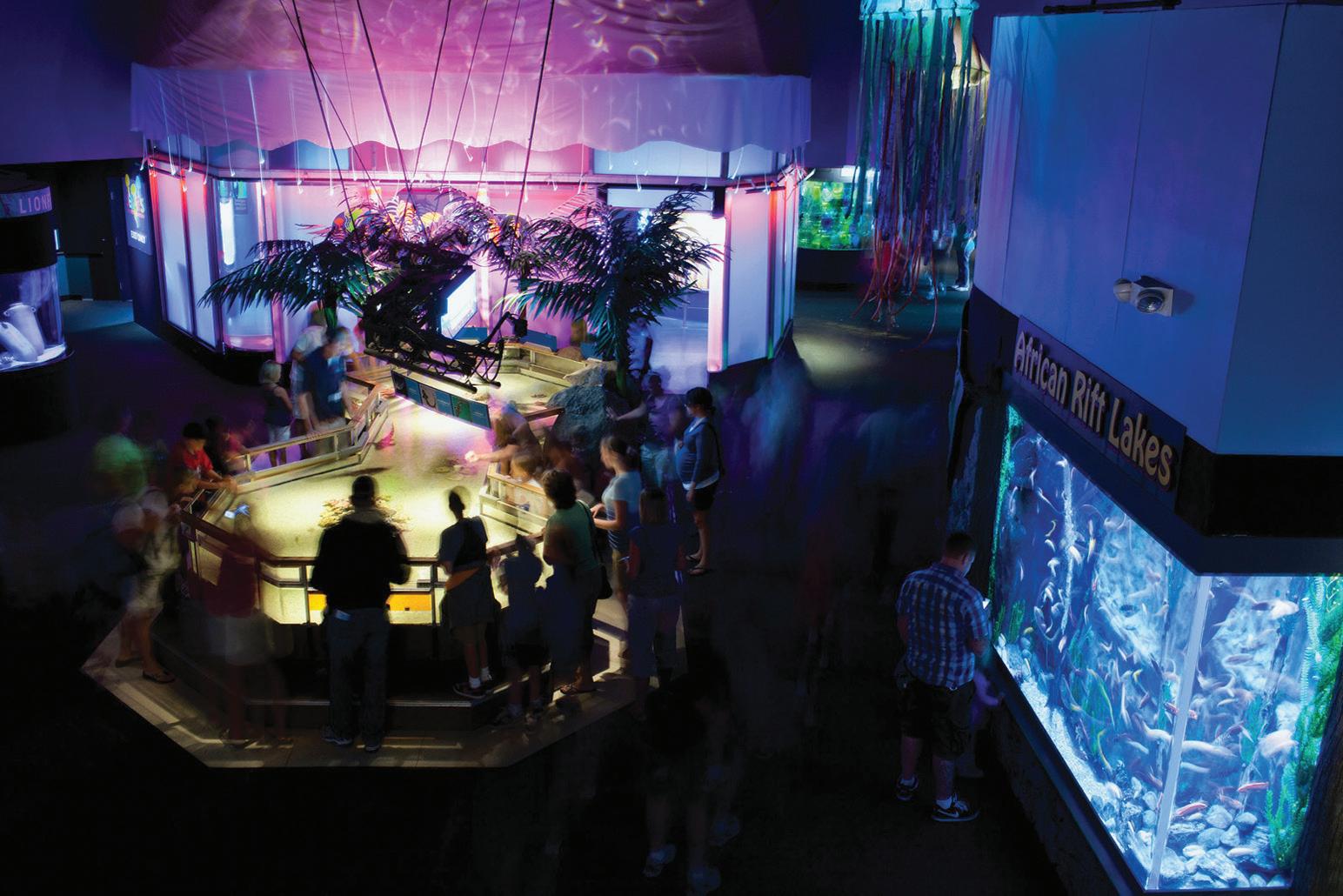
The facility has a range of exhibits representing a wide variety of places around the world. Displays include penguins, sea lions (with daily shows in the Foxwoods Marine
Mystic Aquarium’s Main Gallery. Photo Ryan Donnell. Courtesy of Mystic Aquarium.
Theater), beluga whales, more than 30 species of frogs, and piranha. Some rescued injured animals are also on view. The exhibits range from the very large to the very small.
A wonderful exhibit, the one-acre (0.4-hectare) outdoor habitat, Arctic Coast, is home to beluga whales. It is the largest outdoor whale exhibit in the United States and the only Beluga whale on exhibit in New England. The exhibit area is surrounded with jagged rocks, glacial streams, and northern evergreens in keeping with the natural habit of these whales. There are underground caves with bubble-shaped viewing windows at various levels. Several rocky overlooks provide an above-ground vantage point. The name “beluga” originates in the Russian word belii, which means white, the characteristic color of these whales. Belugas are playful, social creatures that can spit upon and soak their aquarium handlers. They can grow up to 16 feet (4.8 m) long. The aquarium was one of the first to try an insemination program with beluga whales to help promote the survival of this species. Currently the aquarium researches the behavioral ecology and health of these whales.
The Mystic Aquarium has designed an exhibit with three pools, re-creating the California coast and the Pribilof Islands, off the coast of Alaska in the Bering Sea. This exhibit is home to Northern fur seals and Steller sea lions. There are only three facilities in the United States that, as of this writing, display these animals. Steller sea lions are threatened animals, found in the waters from Alaska to California. They are the largest of the eared seals. (See Sea Lion Caves, Florence, Oregon.)
A colony of South African penguins (also called black-footed penguins) lives in the “Roger Tory Peterson Penguin Exhibit,” named for the famed American naturalist and ornithologist. The presentation allows the public to observe above and below the water-line. There are underwater viewing windows for visitors to see these birds swim and socialize. Black-footed penguins are listed as an endangered species under the Endangered Species Act. The aquarium is actively involved in the African Penguin Species Survival Plan®.
The studio of Roger Tory Peterson (1908–1996), who wrote the well-known Field Guide to Birds, has been replicated here. At this exhibit we have a view of Peterson’s world, including his desk, drawing table and implements, and briefcase.
Jellies: The Ocean in Motion currently displays a number varieties of jellies (or jellyfish), such as moon jelly, comb jelly, mangrove upside-down Jelly, South American nettle, blue bubbler, Mediterranean (fried egg) jelly, and crystal jelly. Each of these creatures has its own unique characteristics. For example, the comb jelly lacks nematocysts that sting, and the upside-down jelly lives mainly as a bottom-dweller as an adult and glows in the dark.
White-spotted sharks are a nearly threatened species as listed by the International Union for Conservation of Nature’s Red List. They inhabit the waters of the Indo-Pacific west oceans, mostly in tropical waters and coral reefs, as well as Shark Encounters at Mystic Aquarium. This exhibit is shallow and allows visitors to touch these fish. Their food source is small fish and marine invertebrates; predators include larger fish and marine animals, as well as humans. In the wild these sharks can live up to 25 years, although they do live longer in zoos and aquariums. The sharks have muscular pectoral fins that allow them to “crawl” around reefs.
Larger sharks, sand tiger sharks and nurse sharks, are found in the deeper waters of Shark Lagoon. These sharks grow to as much as six feet (1.8 m) long. There are over 30 at the aquarium.
Stingray Lagoon not only houses Atlantic, Southern, and cow-nose rays; it also is home for a green sea turtle named Charlotte who is part of the aquarium’s rehabilitation program. The cow-nose rays are part of the shark family, as indicated by cartilage and a small dorsal fin similar to sharks. These rays swim near the top of the tank, whereas other species of rays prefer the bottom.
The beautiful Coral Reef exhibit, with a 30 000 gallon (110 000 L) tank, provides above- and below-water viewing. Displays in this area present clownfish, anemones, loggerheads, and more.
Using sliding color filters, coral reefs can be illuminated, and the aquarium presents an interesting Fluorescent Corals exhibit. Research is in process to explore the dwindling populations of corals as well as medical treatments of illnesses like Alzheimer’s disease and cancer using the fluorescent proteins discovered in coral.
Within the Hidden Amazon are poisonous frogs, electric eels, piranhas, iguanas, and lots more. Learn of the importance of conserving this area and its relevance to the health of planet Earth.
Moray eels and barracuda are also on display.
The Mystic Aquarium’s reptile-encounter program, Scales and Tales, showcases bearded dragons, pythons, and American alligators, and offers visitors a chance to touch these creatures.
Address: Mystic Aquarium, 55 Coogan Boulevard, Mystic, CT 60355.
Phone: (860) 572-5955
Days and hours: Mar. 1–31: 9 a.m.–5 p.m.; Apr. 1–Labor Day: 9 a.m.–5 p.m.; Sep.–Nov.: 9 a.m.–4 p.m.; Dec. 1–Feb. 28: 10 a.m.–4 p.m.; closed Thanksgiving and 12/25. Hours do vary seasonally, so check in advance.
Fee: Yes. Additional fees may apply for some encounters, rides, and shows.
Tours: Self-guided; some exhibits have docents available.
Public transportation: Peter Pan Bus Lines offers daily, round-trip service to Mystic from Providence, Boston, and New York City. Amtrak offers train service to Mystic and New London along the Washington-Boston corridor.
Handicapped accessible: Yes.
Food served on premises: Café.
Special note: Be sure to check the times of shows and feeding times. Website: www.mysticaquarium.org
Mystic Seaport: The Museum of America and the Sea
Parts of two towns on opposite banks of the Mystic River—Groton on the west bank and Stonington on the east—make up the community of Mystic Seaport, which, since the 17th century, has built some of the world’s finest ships. It is a small seaport, covering only six square miles (16 km2), but it has produced a larger tonnage of quality ships than any other US port of equal size.
Mystic Seaport Museum was the vision of three local men, Charles K. Stillman, Edward E. Bradley, and Carl C. Cutler, who formed the Maritime Historical Association, Inc., in 1929 and created a living museum of the sea to preserve the skills, values, and traditions of shipbuilding and seafaring in the 19th century. Today the museum’s purpose has expanded to include educating the public about US maritime history and its effect on the economic, social, and cultural life of the country.