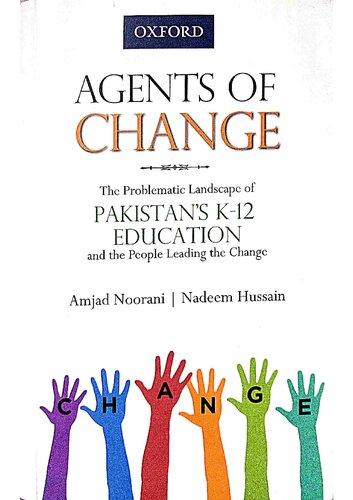
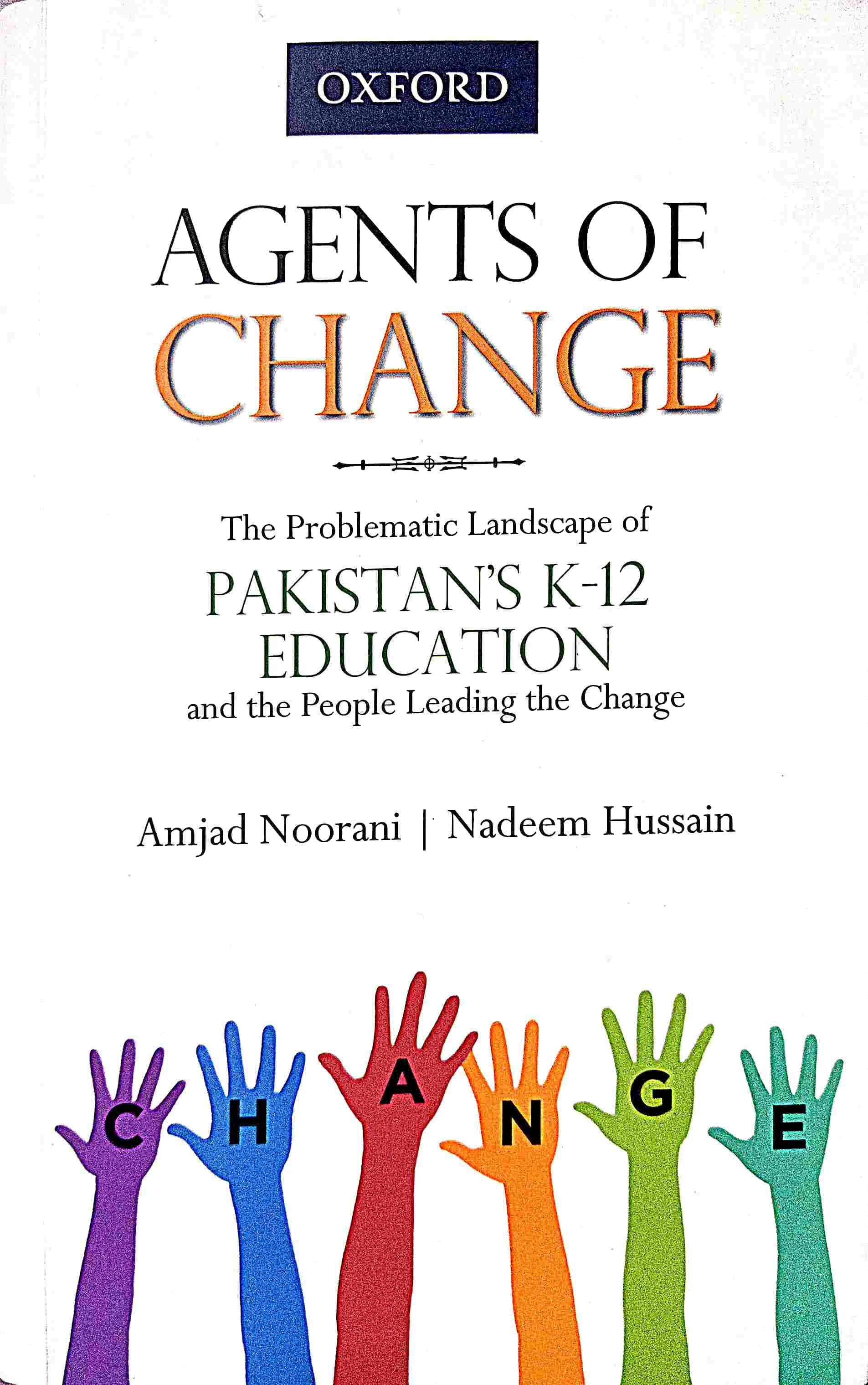
The Problematic Landscape oflPakistan's K-12 Education and the People Leading the Change
Amjad Noorani and Nadeem Hussain
The principal purpose ofthe book is to initiate non-political conversation on primary and secondary education and explore how effective voice and civil society action can lead to solutions which must be debated, implemented, and sustained by participation ofall segments of Pakistani society. This book beautifully weaves the political and policy challenges faced by Pakistan, with the powerful human stories behind The Citizens Foundation (TCF) and the fight for education: the people who make TCF work; the parents who place their trust in this institution even when every other institution has failed themns the children whose lives are forever transformed by thejourney; and what all this can mean to the country and the cause ofeducation. Perhaps the most important point the book underscores is the critical role ofeducation-particularly girls education-to the future ofa country struggling to find its place in the world.
www.agentsofchange.website
Advance praise for Agents ofChange: The Problematic Landscape ofPakistan's K-12 Education and
the People Leading the
Change
Education reform in Pakistan has been pronounced dead-but here comes a comprehensive suggestion for an all-inclusive national discourse. The atrociously high fertility rate causes an alarming increase ofyouth out ofschool. We must do our bit to help change the tenacious, conservative beliefs ofour people. There is hope that redemption can be earned by keeping the candle lit.
- HAAMID JAFFER, social entrepreneur, philanthropist, and co-founder The Citizens Foundation
The book chronicles the story ofTCF which needs to be better known-a remarkable journey of impact, innovation, and integrity in a noble effort to provide quality education to a large number ofPakistani children who would otherwise follow their parents in unrealized potential. In the broader context ofeducation policy and reform in Pakistan, the book shows also just how much more needs to be done to provide equitable and quality education to the millions ofchildren still being deprived ofit.
- MAsooD AHMED, President, Center for Global Development, Washington DC
The author combines scholarly research, ethnography, and personal narrative, built on a lifetime ofexperience and decades ofservice, into a comprehensiveyet pragmatic blend ofpolicy proposals for educational reform in Pakistan. It is refreshing to see genuinely constructive engagement with madrasas, balancing their integral nature to Pakistani history, society, and culture, with the need for meaningful change. [..] Offering concrete recommendations, the book argues that -for those who possess power at all levels ofsociety-the most important ingredient for reform may be the simple act ofcommitment with sincerity.
- MAHAN MIrzA, Executive Director, Ansari Institute for Global Engagement with Religion, UniversityofNotre Dame
Agents ofChange is a widelyapplicable best practices guide and an excellent resource tor understanding and reforming the educational landscape of Pakistan. The book examines the state of literacy standards in public schools, the role of NGOs and madrasas, along with the stifling effects of feudalism on retorm. It highlights the necessityfor a shift in languagepolicy, pedagogy, and technological literacyalong with ne need for bridgingresource gaps between public and private education to transform the country's education towards creating a society free of wealth, gender, and health nequalities. Let us all embark upon this noblejourney byjoining hands and becoming gents ofChange. Development ofPakistan's education system is vital for the future of the country's healthcare infrastructure.
- ZEBA VANEK, MD, Emeritus, UCILA Assoc. Prof. Neurology
e many other public policy dilemmas, Pakistan's educational challenges are dom addressed in a meaningful way. This is not tenable in a country where the Like
failure to spearhead real education reform has such troubling and far-reaching implications-for the economy, for public health, security, and much more. Agents ofChangemakes a vital contribution to this longstanding debate by outlining a clear, practical, and actionable way forward. It warrants a close read globally - and from all Pakistanis.
- MICHAEL. KuGELMAN, South Asia Program, Woodrow Wilson Center
Agents ofChange is an incredible story ofcommitment and resolve placed within the larger historic and material context. It is an important compendium ofinformed and reflective commentary on education policies and practice in Pakistan. The authors have successfully initiated a deeply political conversation. However, to borrow from Antonio Gramsci, they promote a 'politics ofconsent' in the realm ofeducation.
-
HARRIs KHALIQUE, poet and author, Secretary-General, Human Rights Commission ofPakistan
A good school is never an island of good practice. It is nested in and supported by a complex system. There will not be any good schools without effective institutions that deliver curriculum, teaching and learning materials, teachers, and school leaders. There will be none ofthe above without a vibrant public sphere, including both civil and political actors. In the absence ofthese elements, a high demand for education will only promote private, not public good. Amjad Noorani goes beyond serving us with a jolting reminder ofthe dysfunction ofour civil and political spheres by also suggesting viable remedies to revitalize them. Read and pay heed!
- IRFAn MUzAFFAR, educator, independent researcher, and consultant to education reform programs; co-author of Educational Crisis and Reform: Perspectivesfrom South Asia
The state of school education in Pakistan calls for extensive discussion. The authors have done a service by highlighting the lessons derived from the TCF initiative. They have suggested what difference new ideas can make to public education while being realistic in pointing out that the barriers to better education go beyond the lack of good ideas. The book provides a much-needed opening to re-imagine the movement for reform.
- ANJUM ALTAF, social economist; former Dean, LUMS
In its 25 years, The Citizens Foundation (TCF) has become a remarkable model for low-cost, high-quality childhood education in Pakistan. Its acceleration ofequity and justice works to eliminate barriers ofgender, class, and privilege to enable all citizens to become agents ofpositive change. Amjad Noorani and Nadeem Hussain show how TCF has created a pathway to prosperity in a challenging and complex landscape through education reform and an insistence that equity ofopportunity is an unquestionable human right.
- DONALD Girs, CE0, Skoll Foundation, Palo Altositet
The power ofthis narrative comes from the passion invested in it. A first-hand account of the amazing story ofTCF is in itself a most valuable contribution. But by bringing in multiple voices, personal experiences, and an unrelenting focus on the education
challenge in Pakistan, the authors have produced an important addition to a literature that needs fresh ideas and approaches.
ADIL NAJAM, former Vice Chancellor, LUMS; Dean and Professor, School ot Global Studies, Boston University
The book holds great value for policy research organizations, think-tanks, and development practitioners globally. It roots the debate on delivering quality education to all children in Pakistan in the context of elite capture, institutional challenges, inequity, and marginalization. It argues that the education challenge is not only technical in nature but also deeplypolitical; and reforms that fail to establish a vibrant interface between the technical and the political are likely to be short-lived. Political yet non-partisan advocacy embedded in robust data and evidence is the key.
- SALMAN HUMAYUN, Executive Director, Institute ofSocial and Policy Sciences, Islamabad
When the world is silent, even one voice becomes powerful. So says Malala Yousafzai, the youngest Nobel Prize laureate, who understands the challenges ofmaking societal changes in Pakistan better than most. In Agents of Change, the authors paint an unerringly accurate portrait of Pakistan's broken education system, but more, much more, than that-they offer a pathway forward with detailed, informed ideas to bring all the voices-political and public-together to advocate real change. They see their book as just the beginning. It is now up to us, their readers, to pick up the baton.
- David GARDNER, US Editor, London Standard
Agents ofChange offers deep insights into Pakistan's enormous challenges to educate tens of millions of its children-insights acquired through years of work done with teachers, planners and administrators serving at schools in the most underprivileged neighborhoods ofthe country. The authorhas shared his knowledge ofthese challenges and the book explains the enormityofthe task. It also gives reasons to hope for a better tomorrow. A must read for anyone wanting to learn about education in Pakistan.
- RIAZ HAQ, high-tech entrepreneur, writer, and blogger in Silicon Valley
Agents ofChange is an audacious, labor oflove which brings a uniquelyhuman lens to the seemingly impossible challenge of reforming education in Pakistan. This is more than a book; it's a dramatic, hopeful Call to Action which seeks to rally agents of change, engaging them to push for and sustain education reforms. A must read for anyone interested in understanding or reforming Pakistan's education sector.
M. BILAL LAKHaNI, writer, columnist
hen classrooms are open to women, you open their minds to the possibilities that await them. My camera has often captured the strength and resilience ofwomen who e ighting to create a better tomorrow for their nelghborhoods, communities, and Or Pakistan. Education has allowed them to have a voice enabling them to be better ens. The next revolution will almost certainly be powered by these lights seeking to torch out ignorance.
SHARMEEN
OBAID-CHINOY, AcademyAward winning storyteller and women's rights activist
A thoughtful assessment of Pakistan's education challenges. A call to action. And an inspiring story about an amazing organization that has overcome all those challenges.
SHASHI BULUSWAR, Assoc. Prof. International Development, UC Berkeley; CEO-Founder, Institute ofTransformative Technologies, Berkeley
Agents of Change is a unique and in-depth work on education in Pakistan. Within its pages are serious scholarship but also much needed hope. It charts out a difficult journey but without just pointing fingers-which has often been the norm. And it encourages conversation instead ofargument. It points not to a them' but a collective us' as future catalysts for the change and effort that is required to ensure a more educated and prosperous country.
- RAs SIDDIqUI, writer, Pakistan Link newspaper (USA)
Discussions about education in Pakistan typically focus on the very top-down role of the government and international actors. AgentsofChangeprovides a rare window into Pakistan's vibrant civil society, their efforts to provide quality education in the country that has the world's second largest out-of-school population. Reform will require leadership from Pakistan's elites, activists, intellectuals, teachers, and students. This book provides the author's perspectives directly. It outlines the potential for collective action, drawing from local experience, to put Pakistan on a path to positive change.
- NaDIa NAvIWaLA, independent writer on education policy; advisor to TCF; Fellow, Wilson Center
We are often told that the only solution to all ofPakistan's problem is better education. We have also seen that some ofPakistan's most chronic problems are caused bypeople who are educated. This book captures the myths surrounding education in Pakistan and also brings us face to face with civic leaders and organizations trying to bring about that change. It is a must read for educators and policy makers.
- MOHAMMED HANIE, author ofA Case ofExplodingMangoes
This book lays out the enormity of the problem that Pakistan faces in educating its youth, together with an inspiring account of efforts made by brave and dedicated individuals to put our out-of-school children into schools. One hopes that such examples will lead to more such initiatives.
- PERVEZ HooDBHOY, Professor of Physics, Islamabad and Lahore
TCF by all accounts is perhaps the most remarkable story in creating a confluence of providinga fundamental service, i.e. primaryeducation,raising the consciousness of an entire society regarding education, mobilizing wide spread community ownership and philanthropy for a crucial cause and now finally providing incisive insights for comprehensive response and rational policy making. Amjad and Nadeem cohesively bring forward the scale ofTCF's 25 years ofintervention, that provides both qualitative and quantitative basis to decisively shape the direction of primary and secondary education in Pakistan, laying the foundation for development ofindividuals with civic responsibility and consciousness to address challenges humanity is globally facing.
- WASIP A. RIzvi, President, Habib University
The book is a thought-provoking, engaging, and moving read. Amjad and Nadeem have given a humane narrative to the notion of a level playing field in education.
- AJAz A. QURESH1, Founding Director, Sindh Development Study Center (SDSC)
Agents of Change is a unique effort to initiate debate around K-12 education retorms. It is a conversation that access to quality education can transform lives of underprivileged and working classes. The authors have reminded our ruling-elite that investment in education will set the course for national progress and prosperity.
Oxford University Press is a department ofthe University ofOxford. It furthers the University's objective ofexcellence in research, scholarship. and education by publishing worldwide. Oxford is a registered trade mark of Oxford University Press in the UK and in certain other countries
Published in Pakistan by Oxford University Press No. 38, Sector 15, Korangi Industrial Area, PO Box 8214, Karachi-74900, Pakistan
Oxford UniversityPress 2021
The moral rights ofthe author have been asserted
First Edition published in 2021
All rights reserved. No part ofthis publication may be reproduced, stored in a retrieval system, or transmitted, in any form or by any means, without the prior permission in writing ofOxford University Press, or as expressly permitted by law, by licence, or under terms agreed with the appropriate reprographics rights organization. Enquiries concerning reproduction outside the scope ofthe above should be sent to the Rights Department, Oxford University Press, at the address above
You must not circulate this work in any other form and you must impose this same condition on any acquirer
ISBN 978-0-19-070550-3
Typeset in Minion Pro Printed on 55gsm Book Paper
Printed by The Times Press (Pvt.) Ltd., Karachi
Acknowledgements
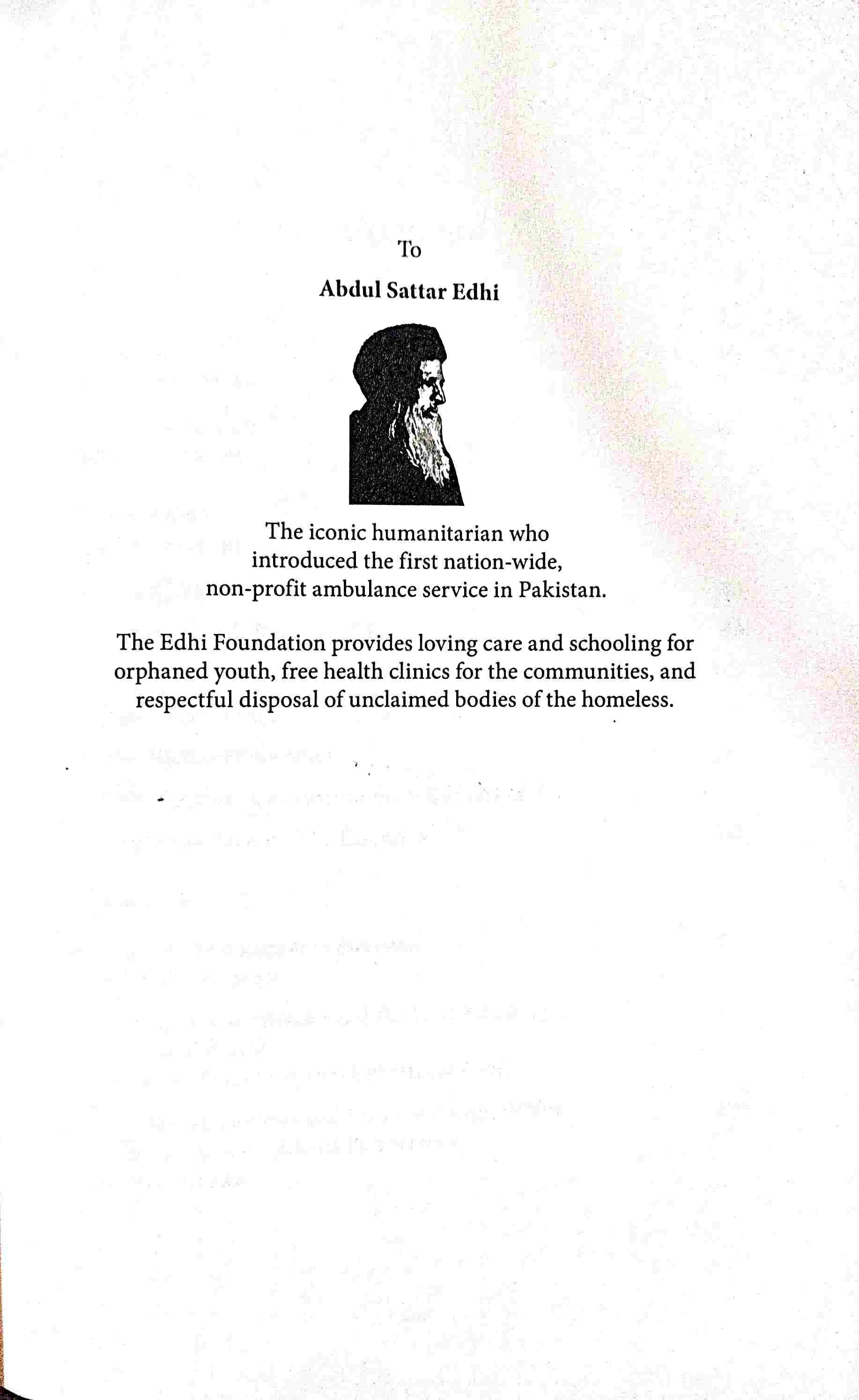
Rendition ofAbdul Sattar Edhi's photograph Rabia Adil with permission from Faisal Edhi (Edhi Foundation).
To
Abdul Sattar Edhi
The iconic humanitarian who introduced the first nation-wide, non-profit ambulance service in Pakistan.
The Edhi Foundation provides loving care and schooling for orphaned youth, free health clinics for the communities, and respectful disposal ofunclaimed bodies ofthe homeless.
Foreword
The years 2020 and 2021 will likely go down as perhaps the most difficult in recent memory. Even before Covid-19 struck, countries everywhere were electing autocrats who valued greed and power over peace and human rights. Communities around the world are retrenching into the Us vs. Them' doctrines that had torn the world apart in eras past; Islamophobia in many parts of the world has reached toxic levels; the Me Too' movement is reminding us exactly how egregiously men exploit their structural power over women; and all the while, the effects of climate change rage on. Pakistan is beset by its own share ofproblems, when it comes to development, inclusivity and religious tolerance; and the rise ofnationalism across the border in India-my home countryis not making matters any better. No matter where you look, it can be hard to tind reasons tor optimism. That is why writing this foreword gives me so much joy.
I work in global development, and one ofmy occupational privileges is the chance to travel all over the world and meet remarkable people and institutions. It was during an unlikely visit to Pakistan fifteen years back that I was introduced to The Citizens Foundation (TCF). Since then, I have advised and analyzed over a hundred ofthe world's leading NGOs and international institutions working on health, education, food security, human rights, and other pressing issues. I can say objectively, and in no uncertain terms-that TCF is among the most effective NGOs anywhere in the world working on any issue; arguably, it is the world's single most effective NGO in Education. This is because TCF has a profoundly thoughtful methodology, laid on a foundation ofdeep-rooted ethics and followed up by exceptional execution. TCF's methodology has many facets which are explored later in this book. Here are some ofmy own observations: every teacher is handpicked and goes through rigorous, ongoing training: the fees are on a sliding-scale basis so that even the poorest of the poor can aftord education while also enjoying a sense ofagency by virtue ofpaying for it; and 100 percent of its faculty members are women, which dramatically increases the trust parents (especially parents ofgirls) place in the schools. TCF insists on-
and invests in-a culture ofeducation in the families and communities t serves. Most importantly, it has an intensive performance assessment system which allows the management to keep an active finger on the pulse of its vast network of schools, teachers and students.
The results speak for themselves. TCF has grown into one of the largest private non-profit education systems in the world with over 250,000 students actively enrolled across more than 1500 schools, virtually all ofwhom come from Pakistan's poorest communities. It costs TCF only $120 per student per year (25 percent less than government-run schools), but its quality metrics are even more impressive: an 86 percent attendance rate (compared to a nationwide averageof62percent);a 95 percent of secondary school graduation rate (compared to 50 percent across Pakistan); and over 40 percent of TCF graduates attain higher education (compared to only 6 percent nationwide). Remarkably, nearly halfofits students are girls many ofwhom go on to get productive jobs, take care oftheir families, and break intergenerational cycles ofpoverty and long-held gender stereotypes. In one of the toughest contexts tor education-particularly for girls-TCF has accomplished what would be considered remarkable even in contexts that are significantly more supportive. As impressive as these results are, I have every reason to believe that the arc of TCF's journey is long, and it will continue to become a formidable force for equity, inclusion and social justice in Pakistan.
Still, for all its accomplishments, TCF is not very well known in the wider world. This is because the global media's coverage ofPakistan is narrowly skewed towards the country's troubles with fundamentalism and militancy. The other reason is that the TCF community and leadership are far too modest to toot their own horn. In recent years, as word ofthis remarkable institution has gotten out, awards and accolades have soon followed.
That's why I'm so glad that my friend Amjad took it upon himself to share the TCF story. In this book, Amjad thoughtfully weaves the larger political and policy challenges faced by Pakistan with the powerful human stories behind TCF and the fight for education. We learn about the people who make TCF work; the parents who place their trustin this institution; the children whose lives are forever transformed by the journey; and what all this can mean to the country. The stories in this book demonstrate the fundamental role of quality education in alleviating poverty and boosting development. Amjad makes the
case that TCF's ability to offer quality education at such a large scale offers a template for Pakistan's public education system. His analysis is based on sound research, conversations with many members of the TCF community, interviews with several experts in the field, and deep first-hand knowledge of the many challenges within Pakistan's education system. He also offers a number of suggestions for reform, geared specifically to the Pakistani context. One particularly innovative suggestion, tor example, is on the value of integrating the vast numberor informal madrasas into the mainstream education system. In discussing the essentials of such a reform process within Pakistan's policy ecosystem, Amjad makes a forceful appeal for broader public support and strong civic leadership to shape and oversee potential reforms over the long term. He argues that, while TCF has been an inspiring catalyst for bringing about change, it will take much more on the part of Pakistani and international supporters in terms of public participation and political advocacy to achieve effective and deep systemic reforms. Perhaps the most important point the book underscores is the critical role of education-particularly girls' education-to the future of a country struggling to findits place in the world.
One of the more remarkable geopolitical events of recent decades has been the rise of India as a global force. Every analysis of India's emergence highlights the critical role education has played in unlocking the technical and entrepreneurial potential ofits people. Pakistan has an equally rich cultural history and institutional appreciation tor education, a deep well of local talent that is hungry for opportunity, as well as a global diaspora willing to invest in its uplift. There is no reason Pakistan cannot build on this foundation and make education a pillar of its own emergence onto the global stage. Getting there, though, requiresthe types ofbroad engagement and policy reforms that this book describes.
I am profoundly grateful to Amjad for opening this window into a remarkable institution and how TCF-and the rest of us-can help improve education in Pakistan.
SHASHI BULUSWARR PhD, University ofCalifornia, Berkeley
On a Personal Note
My parents, Abdul Khaliq and Aziza, were 16 and 14, respectively, when marriage was arranged for them, as was common in pre-Partition India (and still is, in that part of the world). My eldest brother Obaid was born when Mother was not quite 16. By age 27, she had three more children-Hamid, Niloufer, and me. Both my parents were minimally educated to a 5th or 6th grade level, as was also common but onlyin the progressive' families ofthat era. Mother was from a relatively affluent family and privately tutored at home. Father went to a madrasa schoo in a Bombay (now Mumbai) mokalla (neighborhood). A parent at 18, he had to support a family. Both parents were avid readers. Mother preferred Urdu and Father took to English. Books and magazines were in abundance at home. Father became impressively knowledgeable on his own. His knowledge of current affairs, history, classic literature, and Urdu poetry were equal to the best readers and highly educated persons. In Bombay, Mother was a proud volunteer and activist for independence and the creation of Pakistan. She was about 32 when the family moved to Karachi, with dreams ofprosperity and a peaceful life in a harmonious Pakistan. Without much formal education orcapital for a business start-up, Father got offto a rough beginning and it remained a bumpy ride for several years. Our dream migration was turning out to be a nightmare, saved only by the kindness of the Ahmed and Ali Mulla family (Arab-Indian friends from Bombay who had also migrated to Karachi) and we were given refuge for two years in a single room about 10 by 12 feet, above the garage in the spacious home ofthe Mulila brothers. Despite difficult times and meager resources, our parents apparently had a clear vision for our future: they wouldfind the best education affordable. Young Obaidwassentto anair force cadetschool. Hamid got into the prestigious BVS Boys School, sister Niloufer vwent to St. Joseph's. I went to Happy Home School, run by a kindly ladywho operated the school in her home and chargedjust two rupees a month. In 1952, we moved from the Mulla's single room over the garage to a three-room flat in Patel Para for 150 rupees per month in rent. And we lived there for eleven years. Our modest tlats were surrounded by
ON A PERSONAL NOTE
slum dwellings and gave us a graphic view of the daily struggles of the neighbors. After a rainstorm flooded the area, I vividly remember the mud walls, the straw roofs, pots, and pans from some of the huts being Swept away. I recall Mother taking me to admission tests at St. Patrick's, St. Paul's and St. Lawrence's schools. One lucky day, I was accepted in second grade at St. Lawrence's where the fees were 12 rupees per month, a big jump from Happy Home. But Mother had a modest stream of income through sewing, embroidery work, and part-time jobs. Father struggled with work and had a health crisis which put him out ofwork for two years. I think we probably got by with financial assistance from relatives and I am sure my brothers pitched in too. Both parents were socially progressive, especially Mother, who had made connections with elite families that were good for her business ofselling quality household linen to the affluent ladies.
Mother was the entrepreneur and had a "business plan' to move from the Patel Para area to the nicer PECHS area ofKarachi and encouraged Father to take the plunge. Our rent went up from 150 to 450 rupees a month, but Mother attracted more clients and the family income went up. I was 16 then and had just finished 10th grade matric from St. Lawrence's. Father set up a small bookstore with brother Hamid's helpP and kept himselfbusy but the cash flow was onlyjust enough to pay the store rent and some home expenses.
After serving thirteen years in the air force, brother Obaid managed manufacturing plants in Dhaka and later in the UAE. Hamid, the family genius, went to UC Berkeley at age 16 on a private scholarship, thanks to a benevolent community leader, Mohammed Ali Rangoonwala. Obaid and Hamid sent money home for family support. Niloufer pursued her creative talent and became a professional commercial artist. And I've had a most satisfying career as a physical therapist and safety consultant in the US.
This ordinary history chain of my family's minor struggles is not unique. I present it here only to illustrate how education in my family resulted in short cuts to attain middle-class life standards. Succeeding generations have done better than previous ones, gone further in education and in professional or business achievements. Yes, we have seen struggle, but it was made easier only because ofthe education we received, and the values instilled in us. Like mostparents, Mother and Father took risks to give us the gift of education, which has paid dividends. At the endoftheday, I have had a cool familyofsiblings, cousins, aunts, and uncles and we are the first generation ofcollege graduates!
My Pather, ourneighborhood activist..ourPatelPara neighborhood and flats were improved in manyways bymyfather's efforts: multiple trips and letters to the Karachi Municipal Corporation to convert a 200-yard art strip into an asphalt road, stopping and reminding the donkey-cart owners (our neighbors) to clean up after theanimals
Paying a sweeper to keep the compound of our flats swept clean, with equalcontributions collected from the eight tenants (not a small feat paying a man to monitor the water supply and storage tanks,| and operatethewater pump, again with equal contribution from the tenants;installingbetterstairs and safetyhandrailsfortheupperlevel flats. He made it more livable and cleaner for us and ourneighbors. Everyneighborhoodneedsa civic-minded activistlikemyfather.
My Family
Time marches on. New stories replace older ones. Najma, my amazing life partner for more than fifty years (counting the sweetheart years of courting), deserves all the credit for raising our family of three wonderful children. Born in the US, our kids fill us with pride and all have college educations. Ali works very hard with incredible focus and heads a national non-profit for immigration policy and advocacy. Zeba is an educator; she is a mother-teacher, home schooling her two smart and adorable daughters Aysha and Zenaya, as well as professionally coaching' California teachers in math pedagogy. Farah is a remarkably talented and acclaimed performing artist and teacher ofkathak, a classical dance form; she has a smart and spirited daughter Aziza.
The underlying point in extending the story to us, our children, and grandchildren is that my parents had no formal schooling ofany great duration, but the tradition was established by them that children must have a good education. It was only a generation ago in my large extended family that college education was not a very common thing. The present tradition is one ofcollege education being the norm.
I live a charmed, blessed, and idyllic life. Enjoy the book. Support education. Be an agent of change. Rome wasn't built in a day. Finally, Saint Francis ofAssisi reminds us: For it is in giving that wereceive.
Here's a fond homage to a very dear friend and Silicon Valley neighbor, Don McDonald, whose encouragement to write the book was priceless. Passing at 99, he lived well and was a wise mentor. We
Xxii ON A PERSONAL NOTE
had in conmmon our love for poetry, music, and aviation and I have great memories ofmorning walks with him, coffee stops and occasional games ofchess. A good man, great friend, and a generous supporter of education in Pakistan. Cheers, Don...
Among the many blessings I enjoy is an incredible bond with my dearest friend of many years, Mumtaz Feroz (Chunnu to the family). He has always been there and made life easier for me. Generosity and fairness are in his veins. In his unique ways, he's changing Pakistan for the better. I am grateful. Be happy, myyaar.
Note
1. Zebahas also conducted math teacher training at TCF on two ofhervisits to Pakistan.
Introduction
Pakistan has its share ofproblems,but it also has possibilities. Munis D. Faruqi, Associate Professor, History, South and South East Asian Studies; Director, Pakistan Initiative, University of California, Berkeley
The institution that needs immediate attention is Pakistan's broken K-12 education system. It is not hopeless or beyond redemption. It can be fixed. But can it be salvaged and reformed without a strategically planned political advocacy and public demand campaign? Dealing with this requires that we look in the mirror and face some unpleasant facts. Procrastinating will not change anything. To simplify the challenging process, we must focus on actions to rebuild a durable, equitable and progressive education ecosystem. We must identify and mobilize the stakeholders, bring together people from civil society, put heads together to develop an action plan and roadmap, with open communication and eagle-eye focus on actionable priorities.
This book aims to energize open discourse on the education landscape and initiate civil societyaction for sustainable change. From the historical to the present state, thebookvividlydescribes the feudal and dysfunctional environments which have impeded reforms. It addresses sensitive areas such as the politics oflanguage, the curriculum content, quality improvement measures and inclusive education; the misunderstood and maligned madrasas (Islamic seminary schoois; the struggles of transition from poverty to a middle-class position; and the need for organized political advocacy. It interlaces bold ideas and proposes civil society ownership for implementation ofreforms. It proposes that the influential eliteshould lead as committed stakeholders and recommends long-term public engagement to uphold the changes. It urges action to reduce inequities and promote policies and practices that will even the playing field for the underprivileged. Addressing the important area ofquality education, it proposes achievable measures of improvement in academic inputsas well as managementefticiencies in the school systems. I believe that Pakistanis are capable ofimplementing the technical changes needed for reforms but we must employ more
AGENTS OF CHANGE
effective ways to resolve the complex underlying issues. My optimism is based on first-hand experience over the last twenty years, diligent research, and wide-ranging conversations with numerous educators, activists and reformists ofeducation.
The central character ofthe book is the quintessential underprivileged Pakistani child. The unrelenting focus is the prevailing social inequity in the country. Deprived of the right to quality education in a feudal system, the disadvantaged child struggles in a divisive, conflict+-ridden, principally patriarchal and unjust society. Tyrannical practices persist not only those ofsuppression ofthought and oppression ofrights-but the ongoing injustice oflanguage discrimination, education apartheid, and the inequities ofclass-based quality ofeducation.
Pakistan seriously lacks an effective system of education for its population of children from underprivileged households. Roughly, 80 percent of child-citizens are in this segment of the underprivileged population and only the fortunate ones go to public schools in a system which anyhow generally delivers low-grade literacy or mediocre learning at best. The highest quality education is reserved exclusively for the affluent and privileged in private schools which have costs ranging fronm low to expensive. Combined, the provincial education departments and the Ministry of Federal Education and Professional Training are the largest employers ofpublic servants in the country!
Sadly, there appears to be no urgent mobilization bymembers ofcivil society groups to propose viable solutions. Tactically planned, politically smart, citizen-led demand and voices for education reforms are almost entirely missing.
Whether in the media or in casual conversation, the mention of Pakistan evokes an image of a country with many dilemmas: a volatile nation, a burgeoning population, a struggling economy, sporadic violence, endless poverty, poor health services, atrocious environmental practices, governance plagued by corruption ofscandalousproportions.. and a severely stressed education system with high levels of illiteracy and millions ofchildren not in schools. Regrettably and painfully, those images are accurate. The negative perceptions are a reality. Despite all ofthat, Pakistan has robust possibilities.
In the chronicles of nations, Pakistan is a young country with a complex historic past. It is a country severely hampered by political, religious, cthnic, and social challenges. Additionally, it has been plagued by mismanagement, poor governance, malfeasance, and erosion of
INTRODUCTION
resources by both civilian and military administratíons. These realitiess have shaped Pakistan into a dysfunctional state. In many respects, it is a difficult country to govern and turning it around after decades of mismanagement will not be an easy task. But it also has tremendous potential if the problematic challenges are confronted and seen as opportunities to make change.
In the last decade, Pakistan has been heading towards institutionalization of its democratic civilian governance and recent changes are heartening. But it remains to be seen if good governance and efficient management will take hold or will we have another roller coaster experience. Instant romance with a new set of political leaders, putting them on pedestals, prematurely singing their praises before they've proven themselves worthy of public trust, and having unrealistic expectations oftheir performance: these traits have been a longstanding weakness in our national culture. Instead, for a change, we should expect our elected leaders to workfor the citizens and demand better performance, not mere promises ofaction. Theirjob is to serve the public good. They must contribute to good policies for social reforms and they must earn our support, or they should be replaced democratically by someone possibly more capable.
Every country has the government it deserves. These words are attributed to Joseph de Maistre, an eighteenth-century French lawyer, diplomat, and philosopher. Our expectation should be that Pakistani youth deserve good stewardship. It's time we raised our expectations and directed our leaders to serve the needs of the people, instead of the people being driven like sheep. It's time for social justice. It's time to expect a sound education system grounded in the best values ofour cultures, our local languages, and a contemporary curriculum that provides learning of life skills and a path to incremental prosperity Government leaders and administrations may come and go. But the education system must remain unaffected, steadtast and solid.
At the outset, I acknowledge that I'm an emigrant American citizen from Pakistan, and I include myselfin the 'we' both as a Pakistani of origin and as a global citizen. I also include myselfamong the fortunate and affluent. I am extremely concerned about the bleak future of a large number ofPakistani children. At the same time, I am exceedingly optimistic about the many possibilities of my remarkable home country. Even as we in the Diaspora remain intensely involved citizens of the adopted country, being away does not diminish the love and sincere
concern we have for Pakistan. In fact, being away probably dríves many of us to do even morc with the idea that 'giving back' to our country of origin is an obligation and that our prosperity must be shared. When we are critical, we do not mean to be cynical, hurtful, or condescending. We express our ícelings and our views with empathy, because we want to help.
THE ROLE OF CIVIL SoCIETY IN EDUCATION
The principal purpose of the book is to initiate a non-political conversation on primary and secondary cducation (and to some extent, the entire education ccosystem), to explore how eftective voice and civil society action can lead to proposed solutions. These should be considered, dcbated, implemented, and sustained by participation of all segments of Pakistani society led by the elite and middle-class, and including the grassroots ranks. Our education system is in a state of chronic illncss. Remedies have been attempted but perhaps not enough, or not the right ones. A question we must ask ourselves: are we ready to applysome uncomfortable remedies to the sick education system?Ifwe have theexpertise to cxecute the technical steps for reforms, then what's missing? Is it resources (answer: maybe), or is it the political will, or is it because we haven't effectively demanded for it to be fixed? In these pages, we will look for answers to those vexing questions through the views ofwell-informed persons with expertise in the fields ofeducation and development. We will also look for clues in samplings of the work that has been done in the context ofreforms, learn which ofthese efforts are enduring, what's in progress and what can be built upon. We must Jearn and adopt more forceful ways to deal with the issues and the polítics ofeducation.
In recent times, there has been greater global awareness of and emphasis on quality education, Improving quality is probably the supreme challenge within reform and admittedly negligible progress has been made in this area., There is evidence ofeffort in reform, but perhaps it has not been aggregated into neat building blocks. Though valuable groundwork has been taking place, the monentum has been sluggish and sporadic, Relative to the scale of the problem, the achievements have been modest. The reform efforts have also gone largely unnoticed by average citizens and Diaspora-1upporters. Many have become
INTRODUCTION
disappointed and hopeless, feeling that the malaise is permanent, that Pakistan's education is doomed forever. The book presents bits and bytes of good news, and also reveals the reality that there is a trermendously difficult task ahead. With time, the monstrous problern is almost guaranteed to grow unless the right steps are taken in short order. Strong civic leadership and a large base of support will be needed to see that those steps are taken and the nomentum is sustained into the future.
As the book unfolds and its content is absorbed, you wili agree witn some information and views. The fact that you're reading this is eviderce of your curiosity to learn more through a diversity of opinions. But I urge you to be critical and to challenge anything. Please do not hesitate to offer constructive suggestions for solutions. Explore the references and sources shared here, read up on what's going on in the sphere of education reform, speak with friends and family and motivate them to act by supporting the campaign tor better education. It's a never-ending task and we must prepare for the long haul.
First, we can all start by becoming mindful of the suffering of marginalized communities. Walk the dirt roads of the katchi abadisthe communities of'unauthorized' homes in the city slums and the rural countryside. Meet the people who líve there. Learn oftheir aspirations. Explore and study the various initiatives for education. Identify the initiatives that have the vision, the infrastructure and the capacity to create lasting, large-scale impact. Ask how you can support them with volunteer action and grassroots political advocacy, not only with donations. Learn how you can help disadvantaged communities through education, how you can get more children into schools, how you can make the schools deliver better education. Find out where and who the local education bureaucrats are, learn what they do and what more can be done by citizens in the local area to demand better public education. Mobilize support in the community to join in these efforts. Spread the word about your findings and successes. Pursue your leads to create unemotional, objective impact. Ask friends and family to start similar eftorts. These are justfew examples of how we can build upon civil society action to transform Pakistan's education.
This book is an important project to challenge our assumptions about Pakistan's educationlandscape. Gleaningfromthe research of academics, agencies, and think tanks and viewpoints ofknowledgeable journalists, and social scientists, I have assimilated diverse perspectives for discussion. Nothing is intended as the final word. This book is not a
AGENTS OF CHANGE
prescriptive manual ofdo's and don'ts, nor a collection ofconcrete policy suggestions. I have tried to create a framework ofideas and aspired goals. I speak for like-minded colleagues and it is our collectivenope that this compilation will stimulate discussion and serious study ofspecific areas such as language issues and quality education. The promise of the ideas contained in the book is in the hands of its readers as citizens of Pakistan, its well-wishers and supporters of its prosperity. I hope that every person finds information and insights of value because the momentum and direction of future reforms will depend on our collective political will and actions. I am convinced that we will need well-directed advocacy and constructive activism for effective change in policy and it must involve leaders from civic society. Ireiterate these points to be deliberately redundant and drive home their importance. So, what is the aspired takeaway from the book? There's more than one:
1. Please do not be overwhelmed by past failures ofthe governance and mismanagement as it affects the education system. There are also many good things happening. Learn about them.
2. Please do make constructive suggestions, but please dont jump to hasty conclusions or offer advice impulsively. Explore all aspects of the issues with patience and an open mind. Learn the facts, especially at the policy and political level. Learn how the politics affects the system and what everyone can do to advocate for a sound, sustainable education system. And please be especially courteous to people you may not agree with. For the bigger goal, we must learn to differ with respect and grace.
3. More money is needed but more money is not the only answer. The solution must begin with greater involvement and commitment of every parent, every citizen, and all supporters far and near. Education must be valued for its own sake and for the development ofevery child in preparation for life as a tolerant and balanced adult, regardless ofthe choices she makes in life.
4. We must believe that education provides the best possible tools to achieve a way out ofthe vicious, multi-generational cycle ofilliteracy and poverty.
5. Learn and be confident in the beliefthat poverty can be overcome with equitable opportunity for every child to receive quality education and achieve her potential in life.