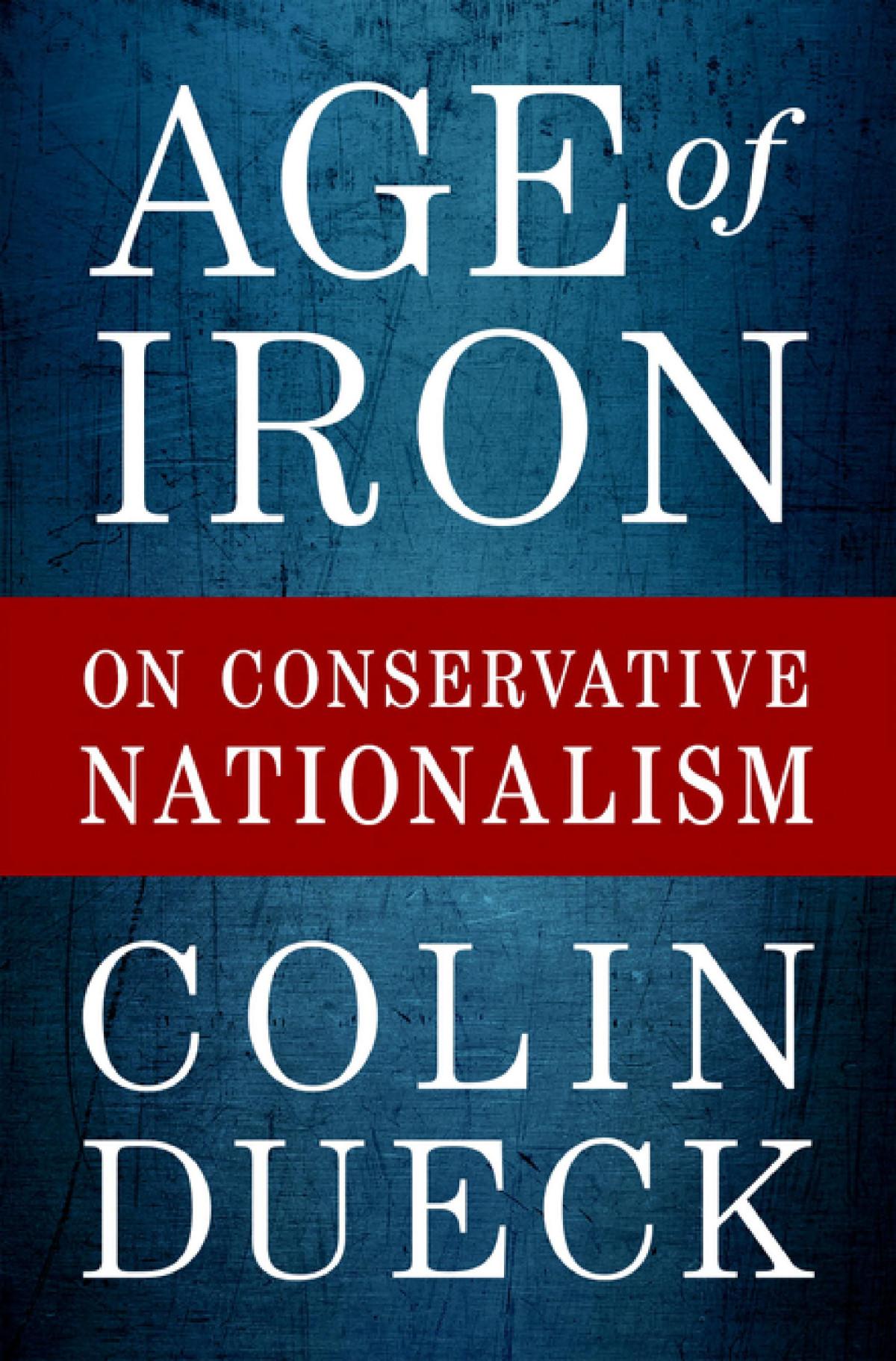
Age of Iron
On Conservative Nationalism
BY COLIN DUECK
Oxford University Press is a department of the University of Oxford. It furthers the University’s objective of excellence in research, scholarship, and education by publishing worldwide. Oxford is a registered trade mark of Oxford University Press in the UK and certain other countries.
Published in the United States of America by Oxford University Press 198 Madison Avenue, New York, NY 10016, United States of America.
© Colin Dueck 2020
All rights reserved. No part of this publication may be reproduced, stored in a retrieval system, or transmitted, in any form or by any means, without the prior permission in writing of Oxford University Press, or as expressly permitted by law, by license, or under terms agreed with the appropriate reproduction rights organization. Inquiries concerning reproduction outside the scope of the above should be sent to the Rights Department, Oxford University Press, at the address above.
You must not circulate this work in any other form and you must impose this same condition on any acquirer.
CIP data is on file at the Library of Congress ISBN 978–0–19–007936–9
1 3 5 7 9 8 6 4 2
Printed by Sheridan Books, Inc., United States of America
Acknowledgments vii
Introduction: On Conservative Nationalism 1
1 Nationalism, Internationalism, and American Conservatives 8
2 Global versus National: From TR to Eisenhower 38
3 Global versus National: From Goldwater to Bush 70
4 National versus Global: The Trump Era 105
5 Populism, Foreign Policy, and the GOP 134
6 Age of Iron 155
Notes 179
Index 215
ACKNOWLEDGMENTS
My understanding of contemporary US foreign policy challenges—and of related conservative traditions—has been enriched by discussions, interviews, panels, debates, and conversations with a wide range of people over the years. An incomplete list of such people would include Elliott Abrams, David Adesnik, Alex Alden, Michael Allen, Robert Art, Emma Ashford, Misha Auslin, Michael Barone, Peter Beinart, Peter Berkowitz, Russell Berman, Richard Betts, Dan Blumenthal, John Bolton, Anna Borshchevskya, Karlyn Bowman, Hal Brands, Christopher Bright, Cherise Britt, Ted Bromund, Chris Brose, Ian Brzezinski, Mark Brzezinski, Jonathan Burks, Joshua Busby, Dan Byman, Steve Cambone, Jim Carafano, Paul Carrese, Omri Ceren, Steve Chan, Dean Cheng, Eliot Cohen, Bridge Colby, Heather Conley, Zack Cooper, Ryan Crocker, Audrey Cronin, Ted Cruz, Ivo Daalder, Tom Davis, Jackie Deal, Rick Dearborn, Bob Deitz, Michael Desch, Daniel Deudney, Paula Dobriansky, Michaela Dodge, Giselle Donnelly, Michael Doran, Peter Doran, Michael Doyle, Daniel Drezner, Joseph Duggan, Mackenzie Eaglen, Nicholas Eberstadt, Eric Edelman, Jeff Engel, Drew Erdmann, Peter Feaver, Michele Flournoy, Jamie Fly, Richard Fontaine, John Fonte, Rosemary Foot, Chris Ford, Aaron Friedberg, David Frum, Francis Fukuyama, John Gaddis, Mike Gallagher, Nile Gardiner, Adam Garfinkle, Erik Gartzke, Jeff Gedmin, Michael Gerson, Derek Gianino, Jonah Goldberg, James Goldgeier, Lyle Goldstein, Seb Gorka, Ron Granieri, Kelly Greenhill, Chris Griffin, Jakub Grygiel, Nick Gvosdev, Richard Haass, Mary Habeck, Stephen Hadley,
David Hamon, Jerad Harper, will Hay, Michael Hayden, Yoram Hazony, Jacob Heilbrunn, Tom Henriksen, Jon Herrmann, Roger Hertog, Charles Hill, John Hillen, Jordan Hirsch, Rachel Hoff, Frank Hoffman, Kim Holmes, Brian Hook, Michael Horowitz, Mike Hunzeker, will Inboden, Bruce Jentleson, Bob Jervis, Fred Kagan, Roy Kamphausen, Maya Kandel, Robert Kaplan, Tom Karako, Robert Karem, Mark Katz, Robert Kaufman, Richard Kauzlarich, Zachary Keck, Charles Kesler, Zalmay Khalilzad, Yuen Khong, Jamie Kirchick, Greg Koblentz, Richard Kohn, Julius Krein, Andrew Krepinevich, Sarah Kreps, Bill Kristol, Matt Kroenig, Charles Kupchan, James Kurth, Jim Lacey, Mark Lagon, Ellen Laipson, Chris Layne, Richard Ned Lebow, Derek Leebaert, Melvyn Leffler, Daniel Leger, Paul Lettow, Scooter Libby, Robert Lieber, Tod Lindberg, Fred Logevall, Becky Lollar, Rich Lowry, Alan Luxenberg, Tom Mahnken, Peter Mandaville, Harvey Mansfield, Peter Mansoor, Dan Markey, Damir Marusic, John Maurer, Andrew May, walter McDougall, Eric McGlinchey, Bryan McGrath, John McIntyre, H.R. McMaster, walter Russell Mead, Benjamin Miller, Myra Miller, Paul Miller, Joshua Mitchell, wess Mitchell, Bert Mizusawa, Mark Moyar, Mitch Muncy, Joshua Muravchik, Chuck Myers, Henry Nau, Daniel Nexon, Hung Nguyen, Michael Noonan, Grover Norquist, Michael
O'Hanlon, Meghan O'Sullivan, Henry Olsen, Josiah Osgood, Rich Outzen, John Owen, Mac Owens, Roland Paris, Jim Pfiffner, Peter Pham, Danielle Pletka, Ken Pollack, Alina Polyakova, Ionut Popescu, Patrick Porter, Chris Preble, Maud Quessard, Jeremy Rabkin, Brian Rathbun, Mitchell Reiss, Stanley Renshon, Michael Reynolds, Ed Rhodes, Peter Rightmyer, Joe Riley, Nadege Rolland, Gideon Rose, Stephen Rosen, Robert Ross, Joshua Rovner, Mark Royce, Michael Rubin, will Ruger, Donald Rumsfeld, Dan Runde, Paul Saunders, Phil Saunders, Nadia Schadlow, Kori Schake, Gabe Scheinmann, Gary Schmitt, Randy Schweller, Derek Scissors, Zachary Selden, James Sherr, Keith Shimko, Jim Shinn, Kristen Silverberg, Dmitri Simes, Michael Singh, Kiron Skinner, Lee Smith, Marion Smith, Henry Sokolski, Elizabeth Spalding, Matt Spalding, Luke Strange, Jeremi Suri, Ray Takeyh, Jim Talent, Jordan Tama, Ashley Tellis, Jim Thomas, Trevor
Thrall, Peter Trubowitz, John Unger, Dan Vajdich, Kelley Vlahos, Ming wan, Vin weber, George will, Ryan williams, william wohlforth, woj
wolfe, Paul wolfowitz, Joe wood, Leet wood, Thomas wright, Ali wyne, John Yoo, Paul Zajac, Dov Zakheim, Roger Zakheim, Robert Zarate, and Philip Zelikow. My thanks to all of them.
In the end however, the specific arguments contained in these pages— including with regard to the current administration—are mine alone.
It has been a real pleasure to work again with Editor David McBride, as well as Holly Mitchell and the staff of Oxford University Press on this book. My sincere thanks to them all.
Thank you to Andrew wylie for representing me as a client, a task he performed with impressive capability, efficiency, and precision. I look forward to similar projects together in the future.
Thanks to Dean Mark Rozell, the faculty, staff, and students of the Schar School of Policy and Government at George Mason University for providing a supportive, stimulating, and excellent environment within which to study US foreign policy.
while writing this book in 2017–19, I was a Jeane Kirkpatrick visiting fellow at the American Enterprise institute. Thanks to Dany Pletka, the scholars, staff, administration, and research assistants Taylor Clausen and Max Frost of AEI for their marvelous assistance during that time. This book is in many ways a defense of conservative nationalism. I think the fact that AEI was willing to back it, demonstrates its openness to a range of ideas.
Portions of various chapters are drawn and revised from my own articles in Orbis, The National Interest online, and at the Foreign Policy Research Institute. My thanks to the editors and publishers of those journals and websites for permission to reprint these sections.
Finally, greatest thanks go to my wife Kirsten. This book is dedicated to our son Jack. Jack is American by birth. His father is American by choice.
On Conservative Nationalism
The rise of populist nationalism on the right is one of the most striking trends of our time. Critics on both sides of the Atlantic fear that we are witnessing a return to the 1930s, including the resurgence of fascism, authoritarian forms of governance, and possibly catastrophic wars. In relation to the Trump administration’s foreign policy, these same critics contend that the United States is now deliberately undermining what they call the rules-based liberal international order. Yet in relation to the United States, observers have misunderstood both the nature of American nationalism—past and present—and the foreign policy of the Trump administration. Conservative American nationalism is arguably the oldest US foreign policy tradition in existence, and is neither fascistic nor undemocratic. On the contrary, it is meant to preserve the very right of American citizens to self-government. Nor is a conservative US nationalism historically incompatible with American engagement overseas, including the promotion and defense of democracy. However, accumulated US foreign policy frustrations of the twenty-first century—both military, political, and economic—have led to the resurgence of a distinct form of American nationalism on the Right, emphasizing the need for allied burden-sharing, US sovereignty, and the promotion of material American interests. And because this resurgence is based upon domestic and international factors
much larger than Donald Trump, it is probably not about to disappear simply when and because the president leaves the scene.
Conservative nationalism is a democratically oriented and civic form of patriotism: a love of a particular place, maintaining that the world is best governed by independent nation-states, and that only within the context of such states can a free citizenry experiment with constitutional forms of self-rule. In relation to foreign policy, conservative nationalists focus on preserving and promoting their own country’s interests, rights, values, security, traditions, and way of life, believing it is entirely legitimate to do so. within the United States, a kind of conservative American nationalism was the mainstream bipartisan political and foreign policy tradition for most of the country’s history. But America’s founders also hoped that the nation’s example of popular self-government would eventually spread worldwide, and they saw no contradiction between holding out that hope, or even pressing it forward, and preserving US national sovereignty.
In the heat of world war I, President woodrow wilson offered a fundamental alternative to the American nationalist foreign policy tradition by arguing that the United States adopt global, binding, multilateral security commitments in order to best promote progressive liberal values internationally. And while he lost that argument in the short term, he won it posthumously one generation later, when American presidents Franklin Roosevelt and Harry Truman picked up the liberal internationalist or “globalist” banner during the 1940s, adapting it for the most part skillfully to new geopolitical, economic, and domestic conditions.
Republicans, for their part, had grave concerns about wilson’s foreign policy vision from the very beginning, along with its domestic implications. But they disagreed over how far exactly to correct or resist it. Three main GOP foreign policy options or groupings were already visible during the great debates surrounding wilson’s policies in response to world war I:
1. Nonintervention. Republicans like Senator Robert LaFollette (RwI) argued for peace, disarmament, nonintervention, and strict disengagement in response to the First world war.
2. Hawkish or hardline unilateralism. Republicans like Senator william Borah (R-ID) argued for robust national defenses and firm responses to any intrusion on the nation’s honor, while attempting to remain apart from Old world hostilities or alliances.
3. Conservative internationalism. Republicans like Senator Henry Cabot Lodge (R-MA) argued for vigorous responses to German aggression and postwar alliance with France and Great Britain, without making any sweeping commitments to worldwide collective security.
The interaction between these three factions or schools of thought has determined the history of Republican foreign policy approaches, whether in or out of office.
As of 1918–1919, the most common foreign policy view among Republican senators was that of Lodge, in favor of a western alliance. But the final outcome of the League debate was essentially a victory for GOP unilateralists and noninterventionists like Borah and LaFollette. That victory informed Republican foreign policy approaches throughout the 1920s, and into the opening years of world war II. Then conservatives again divided, with one side arguing for US aid to Great Britain against Nazi Germany, and the other side opposing it. The Japanese attack on Pearl Harbor settled that debate in favor of the GOP’s internationalists.
The rise of the Soviet Union after world war II only reinforced the new predominance of conservative internationalists within the GOP. Strict noninterventionists were marginalized. But in reality, hardline conservative nationalists and unilateralists had to be dragged kicking and screaming into a set of postwar US commitments overseas, and the only thing that ensured their support was a fierce anti-Communism. No subsequent Republican president was able to entirely ignore the continued force of hardline nationalism at the grassroots level, and most achieved political and policy success precisely by incorporating aspects of it into their overall approach. The specific manner in which they did so varied considerably from one president to the next. Those who failed to strike effective
balances on this score—such as Senator Barry Goldwater (R-AZ)—tended to lose elections, whatever their other virtues.
In the immediate aftermath of the Cold war, the most common Republican feeling with regard to the party’s foreign policy record was one of satisfaction. But already in the 1990s, noninterventionists resurfaced, led by Pat Buchanan on the one hand and libertarian Ron Paul on the other. Though they seemed marginal at the time, over the long run Buchanan in particular was prophetic. President George w. Bush managed to rally most hardline GOP nationalists to his policy of a war on terror, combined with the 2003 invasion of Iraq and a freedom agenda for the Middle East. But frustrations in Iraq raised some obvious criticisms, and once Bush left office the GOP again splintered into its most basic divisions. In 2016, insurgent candidate Donald Trump took advantage of these divisions to do what had previously seemed impossible, and upend the dominance of internationalists in favor of the other two groupings. The actual practice of the Trump administration, however, has been a hybrid or mixture of all three tendencies.
In the following chapters, I flesh out these arguments in order to trace the past, present, and—possibly—future of conservative American nationalism.
Chapter 1 sketches the outlines of US nationalism prior to the twentieth century; the liberal internationalist or globalist alternative offered by woodrow wilson, including subsequent variations from FDR to Barack Obama; and conservative nationalist responses since world war I. The latter includes a fuller definition of the nature and varieties of conservative American nationalism, including its recurring breakdown into the three distinct tendencies mentioned here.
Chapters 2 and 3 explore GOP presidencies from Theodore Roosevelt to George w. Bush, along with periods in opposition, to demonstrate how different Republican leaders have each combined or balanced nationalist with internationalist impulses to craft their own unique foreign policy approach. And while each GOP president has expressed it differently, conservative American nationalism—along with a repeating tension between the national and the global—has always been a powerful theme in Republican foreign policy.
The Trump phenomenon is best understood as a resurgence of one specific form of conservative American nationalism against liberal internationalism. while researching this book, I found it surprisingly difficult to locate a brief summary of the Trump administration’s foreign policy, free from invective. So I decided to write one. It can be found in the middle of chapter 4. That section is preceded in the same chapter by a brief analysis of Donald Trump’s incoming foreign policy assumptions, decisionmaking style, and 2016 presidential campaign, including how he was able to turn national security and transnational issues to his advantage in both the Republican primaries and general election. The final section of the chapter offers my own analysis of the Trump doctrine as a set of international pressure campaigns, along with some advantages and disadvantages of each. Here I make no pretense other than having a particular point of view, and simply offer my own thoughts as to the strengths and weaknesses of his chosen approach. This includes issues of alliance management, strategic unpredictability, and orientations toward world order.
Chapter 5 explores issues of populism, foreign policy, and the Republican Party—past, present, and future. A close look at public opinion polls over the past ten years reveals that a new conservative nationalism began to coalesce among many GOP voters during Barack Obama’s first term in the white House. At that time, the median Republican voter remained supportive of aggressive counterterrorism and strong defense spending, while revealing increased ambivalence toward economic globalization and protracted US military interventions overseas. Internationalist candidate Mitt Romney won the 2012 GOP nomination in spite of this ambivalence. Four years later, Donald Trump tapped into and encouraged the new conservative nationalism in his own direction with distinct stands on foreign policy, trade, and immigration. Yet Republican voter opinion has remained surprisingly stable on international issues throughout this time. Even on the now highly politicized matter of US–Russia relations, most Republican voters retain a negative image of Vladimir Putin. And on free trade, the base of the party is not so much protectionist as divided.
Viewed over the longer term, however—say, by comparison with the New Deal era—there has indeed been a profound shift in the composition
of the Republican Party toward political populism, cultural conservatism, and white working-class voters. And again, Trump is not so much the cause of this trend as an effect. what Trump has done, to an unusual extent, is to bring the policy preferences of newly empowered populist supporters into tension with orthodox conservative economics on selected key issues. For now, he retains the support of the vast majority of GOP voters, whether traditionally conservative or populist. But because certain internal party differences over foreign policy, immigration, free trade, and domestic economic issues predate his candidacy, and have now been brought into the open, these divisions will likely outlast him as well.
The long-term future of Republican foreign policy will therefore involve and require striking effective and appropriate balances between conservative internationalist, hardline, and noninterventionist concerns. The specific character and substance of how this is done will be up to future conservative leaders. Donald Trump has cracked existing orthodoxies and opened up previously latent foreign policy options. Yet his very ability to do so indicates that he acts upon structural forces bigger than he is, and therefore likely to persist. Or to put it another way, whether in one form or another, conservative nationalism is here to stay.
In the concluding chapter, “Age of Iron,” I describe some of the advantages of a US-led alliance system and strategic forward presence, along with key reasons that both the theory and practice of an associated liberal international order has come under question. The leading reasons for this discontent are categorized and described in more detail as economic, national, and geopolitical. I argue against any deep US disengagement overseas, and make the case for a forward-leaning conservative American realism based upon regionally differentiated strategies of pressure against authoritarian competitors. In some ways, at least, the current administration has pursued such an approach, and deserves credit for it. I then outline three main areas of concern regarding the president’s foreign policy approach, centering on trade, alliances, and decision-making style.
Liberals on both sides of the Atlantic today argue that the rules-based global order is under grave assault from the United States. But world order has never been simply a framework of liberal rules. Rather, it has rested on
certain geopolitical underpinnings—notably, American power—which liberals themselves have regularly critiqued. There was indeed a kind of golden age of US liberal internationalism, stretching from FDR’s leadership during world war II through the opening of John F. Kennedy’s presidency, and it did considerable good. But that age ended over fifty years ago, in Vietnam. Ever since then, American liberals have struggled to develop robust approaches to US national security, erring on the side of excess optimism. Conservative Republicans, for their part, have made some similarly optimistic errors, most notably during 2003 in Iraq. Indeed the entire post–Cold war period may be viewed as one of excessive wilsonian idealism. But now that wilsonian quarter-century is definitely over. Both the United States, its allies, and its adversaries appear to have entered a new era of geopolitical competition. The new era is characterized by intensified great-power rivalry, resurgent nationalisms both authoritarian and democratic, popular skepticism regarding the benefits of globalization, shifts in focus from the Atlantic to the Pacific, and severe challenges to American primacy from multiple directions. Donald Trump’s presidency is more an effect of all these trends than their primary cause. In truth, the golden age of liberal internationalism ended some time ago. This is the age of iron.
Nationalism, Internationalism, and American Conservatives
Prior to woodrow wilson’s presidency, the mainstream and bipartisan US foreign policy tradition was one of American nationalism. This tradition valued the strict preservation of US national sovereignty, and the expansion of republican forms of government, preferably by example, but also through US territorial and commercial expansion. Key figures such as George washington, John Quincy Adams, and Abraham Lincoln showed a kind of geopolitical awareness regarding America’s international surroundings. Out of the catalyst of world war I, President woodrow wilson offered a fundamental alternative to the US nationalist tradition. He argued that only through a new set of global, binding, and multilateral commitments could liberal values be served. This wilsonian or US liberal internationalist tradition lost politically in the short term, but eventually became a leading influence on American foreign policy over the course of the next century. In particular, Presidents Franklin Roosevelt and Harry Truman adopted and revised it during the 1940s in a more hard-nosed direction to counter first the Axis powers and then the Soviet Union. American frustrations in Vietnam led to a liberal splintering, and a new school of thought emphasizing international accommodation. Most conservative Republicans, for their part, never entirely embraced all aspects of the wilsonian tradition, but wrestled with how far to correct or resist
it. Conservative American nationalism is essentially the GOP’s answer to woodrow wilson, and it has come in multiple varieties.
AMERICAN NATIONALISM
Nationalism is a form of collective identity with both cultural and political aspects. Academics tend to emphasize the way in which it is imagined, invented, or subject to manipulation. They also tend to emphasize the grave dangers of nationalism. And of course there are certain versions of nationalism that really are exceptionally violent, aggressive, and authoritarian, based upon the image of a single ethnic group as racially superior and imperial by right. The memory of the 1930s and of the wartime struggle against fascists has informed all reflection on nationalism ever since.
Yet the mainstream western tradition, going back to the ancient world, includes a civic conception of nationalism that is far more benign. In this civic conception nationalism is essentially patriotism, or love of country, based upon an affectionate identification with a particular place, a particular way of life, and a particular set of lawful institutions that sustain the common liberty. For civic nationalists the enemy is not ethnic contamination, but rather domestic tyranny, corruption, and any foreign adversary who threatens the republic. In the early modern era, European philosophers in this civic tradition argued that the world was best governed by independent nation-states, precisely in order to protect the freedoms of both countries and individuals. The belief was that every nation had its own traditions worth preserving—and that only within the context of a sovereign nation-state could individual citizens experiment with versions of republican or constitutional rule. This belief eventually had immense impact worldwide, helping to reorder the international system along lines of national sovereignty and self-determination. And whatever the limitations of the nation-state, in terms of allowing for democratic forms of popular self-government, no superior form of political organization has yet been found.1
American nationalism, properly understood, is a form of civic nationalism. To be sure, as a matter of historical record, the original American colonies were founded by English Protestant settlers, and this specific cultural and religious heritage was the context for US founding principles. Over the years, some US nationalists have defined their identity mainly in religious or ethnic terms. This has long encouraged tensions between an ethnic definition of the American nation and a civic one.2 Yet in their declaration of independence the American revolutionaries said that “all men are created equal,” and they said so deliberately. In other words, they justified their rebellion in part by claiming natural rights based upon universal truths, and these claims were informed by beliefs well described as classically liberal. There has consequently been within the United States, from the very beginning, a kind of “American creed,” civic religion, or national identity with classical liberal elements, including the rule of law, individual freedom, majority rule, equality of right, enterprise, progress, and limited government. As nineteenth-century Marxists such as Frederick Engels noted, that classical liberal creed made it very difficult to promote socialism within the United States. This is what Engels meant by American exceptionalism, and he found it exceptionally frustrating.3
In terms of its worldwide implications, the leaders of the American Revolution hoped that it would encourage the spread of republican forms of government and the creation of a new international system characterized by peaceful commercial exchange, individual liberty, the rule of law, and human progress. They rejected the eighteenth-century European state system as corrupt, militaristic, warlike, and autocratic. Of course, the question was inevitably how to interact with states still a part of that Old world system. To varying degrees, the Founders and succeeding generations embraced America’s westward continental expansion, to create what Thomas Jefferson described as an “empire of liberty.” They also embraced commercial opportunities overseas. In this sense, US economic and territorial expansion beyond existing boundaries long predated America’s later rise to global power. Simultaneously, however, these very same early statesmen cherished the preservation of US national sovereignty, and for that matter held to a policy of disengagement from European alliances, a
policy best laid out formally by George washington in his 1796 Farewell Address when he said that “the great rule of conduct for us in regard to foreign nations is in extending our commercial relations, to have with them as little political connection as possible.” This emphasis on avoiding what Jefferson called “entangling alliances” became a key component of US foreign policy throughout the nineteenth century. Early American statesmen saw no contradiction between expanding the sphere of republican governments, and preserving US national sovereignty.4
Partisan political debate over the precise foreign policy implications of American nationalism was evident from the very start. Thomas Jefferson and Alexander Hamilton agreed on American exceptionalism, US national sovereignty, and the long-term expansion of republican governments. They did not agree on its exact foreign policy implications. whereas Jefferson envisioned the United States as a vast, decentralized, agrarian republic, Hamilton looked to encourage a centralized treasury and nascent US manufacturing, along with other apparatus of state power in the international arena including professional standing armed forces. During the 1790s Jefferson tended to sympathize with revolutionary France; Hamilton, with Great Britain. It was precisely these differences between Jefferson and the Federalists that washington hoped to quell in issuing his Farewell Address. To his mind, one advantage of US nonentanglement overseas was the avoidance of domestic factional controversies inside the United States.
Each round of nineteenth-century US territorial expansion was typically characterized by some significant internal debate over whether said expansion was constitutional, cost-effective, or appropriate. These genuine philosophical differences were often bound up with sectional interests and party politics—along with support of, or opposition to, individual presidents. And presidents sometimes acted aggressively to direct American territorial expansion. Jefferson, for example, decried the centralization of executive authority, but when the opportunity presented itself in 1803 to purchase the vast Louisiana territory from France he did so, admitting he stretched the constitution until it cracked. Later waves of attempted territorial expansion and US warfare against Britain, Mexico, and Native
American tribes brought intense controversy and debate, pitting those Americans who favored expansion against those who did not. Both sides often argued that the other was untrue to America’s founding principles. Early American expansion was therefore powered by a number of central factors. It was powered by land-hunger. It was powered by the search for commercial opportunity. It was powered by the relative weakness of surrounding neighbors. It was powered by a common Anglo-American belief, at the time, in their own superiority as a people. It was powered by sectional interests, partisan debate, and genuine differences over the relative merits of specific acts of national self-assertion. And it was powered by the desire to promote the spread of a republican form of government. In practice, early American nationalism encompassed all of these things. Nor were US ambitions limited to their own continent. Americans hoped to see the creation and encouragement of a friendly system of republican regimes throughout Latin America. The 1823 Monroe Doctrine, conceived primarily by Secretary of State John Quincy Adams, clarified that the United States would at least in principle oppose any further European colonial interventions or annexations within the western hemisphere. It would be a mistake, however, to think that the United States in these early years was entirely immune from geopolitical pressures and national security anxieties—or that early American statesmen were utterly unaware of such considerations. America’s position in between two great oceans did make it relatively safe and secure, but only by a difference of degree. The United States had no absolute security, and as Americans rediscovered in 1814 when the white House was burnt down by the British, the loss of control over nearby waters could be a pathway for attacks upon the United States. Even the idealistic Jefferson understood that the security of the New world depended upon a division and balance of power within the Old. Moreover, early American continental expansion was sometimes driven as much by security concerns—or fear of great-power encirclement—as by any other consideration, and this fear had deep roots in colonial experience, for example during the French and Indian wars. Early nineteenthcentury Americans feared that the still-mighty British Empire could use surrounding military and naval bases in Canada and the Caribbean to
occupy, raid, harass, and blockade the United States, and of course during the war of 1812 this is precisely what happened. The argument for war against Mexico in 1846—like the argument for the annexations of Florida, Oregon, and Texas—was at least partly defensive. The westward continental expansion of American explorers, hunters, trappers, and settlers was encouraged by the federal government partly to ensure that US citizens reached and occupied these vast trans-Mississippi territories before any European power did. Americans were determined to prevent any balance of power from forming on their own continent. Hamilton and Jefferson did not disagree on this point. The United States would be predominant in North America. There would be a balance of power in the Old world—not in the New.5
The tension between liberty and union, and the exact meaning of American national identity, were brought into sharp relief by the question of whether newly acquired western territories would be open to slavery. The Republican Party was founded on the understanding that slavery be confined to the South. More broadly, Republicans shared an ideology that emphasized social harmony and order, mercantilism, economic growth, free labor, and American nationalism. Abraham Lincoln ran and won on this platform in 1860, triggering the secession of Southern states from the Union. The resulting Civil war opened up the possibility of renewed European intervention in the Americas, and to some extent such interventions actually happened. France took advantage of America’s wartime disunity to intervene in Mexico—a spectacle that very much worried Lincoln. Skillful Union diplomacy helped stave off more direct European aid to the Confederacy, and in truth the British had little interest in going to war with the United States. The war itself resolved some central questions: slavery would be abolished. In effect, the American creed was redefined to include a fuller application of declared US founding principles to African Americans. As Lincoln noted in his second inaugural address, neither the North nor the South had initially sought this outcome. Yet the war revealed a new American nation in other ways as well. Under Lincoln’s leadership the Union was revealed as a newly coherent, organized nation-state, heavily armed, capable of fielding extensive and
successful battle-hardened armies with broad popular support. In this sense the Civil war resolved not only the issue of slavery and the issue of union, but also the issue of which great-power or assortment of powers would be dominant on the North American continent—an issue of evident concern to Lincoln. with the North’s victory in 1865, any possibility of a balance of power on that continent was removed. Paradoxically, this eventually led to somewhat improved relations with the British Empire, since London had to recognize the resulting power imbalance within North America as well.6
In 1898, American nationalism was expressed in yet another form. President McKinley had not previously possessed any notion of going to war with Spain. But when the USS Maine exploded in the harbor of Havana that February many Americans concluded that Spain was the culprit, and demanded US military action to liberate Cuban rebels from Spanish rule. McKinley oversaw and channeled this determination effectively, leading a war effort that ended in US military victories over Spanish forces located in Cuba, Puerto Rico, and the Philippines. On the question of what to do with these newly seized territories, most Americans were happy to see US influence extended over Cuba and Puerto Rico in the Caribbean. The case of the Philippines was more controversial. This was far more of a stretch geographically, and to determined anti-imperialists such as Mark Twain and william Graham Sumner, the whole exercise seemed an abandonment of US foreign policy and constitutional traditions. In this sense, Sumner described the war’s outcome ironically as the “conquest of the United States by Spain.”7 Anti-imperialists often argued that the Filipinos were racially inferior, and therefore unfit to be brought into an American system of rule. But a new wave of US nationalists, led by figures like Theodore Roosevelt, argued that the acquisition of the Philippines was indicative of America’s new international role; necessary to secure access to the vast China market, while staving off Japanese or European advances in the region; potentially beneficial to the Filipinos themselves, under enlightened rule; and the logical extension of previous US expansion westward across the North American continent. In the end McKinley was convinced of these arguments, and so assumed US control over the Philippines under
a peace treaty with Spain. Most Americans quickly tired of the momentary enthusiastic outburst for war and empire, and the Philippines was left as something of a strategic liability for the United States, practically indefensible if attacked—a weak spot in the US posture with long-term consequences. Nevertheless, the Spanish-American war had indeed revealed the United States as a potential global power with some impressive military capabilities and the ability to project them across oceans. No new multilateral commitments were made.8
Even as it was consolidating its overseas acquisitions from Spain, the McKinley administration issued a new US foreign policy principle in relation to China, with broad implications. The American fear was that Europe’s great powers—together with Japan—would join in formally partitioning China, as Europeans had already partitioned Africa. This would shut out US exports, and violate American hopes for the Chinese. Secretary of State John Hay responded by issuing a series of notes in 1899, calling upon other nations to respect the territorial integrity and independence of China, together with open and equal economic access for all. Hay’s declaration of this “Open Door” policy was viewed as a great success within the United States, gaining immediate and bipartisan support for the principle. US diplomatic historians have tended to see it as tremendously significant. And to be sure, it captured longstanding US aspirations toward a kind of benign informal empire of commercially interdependent sovereign nations, not only in East Asia but beyond. But in reality, Hay’s Open Door declaration had limited impact on the ground inside China, where European colonial powers, the Japanese empire, local nationalists, and Qing dynasty officials wrestled for influence amidst increasingly chaotic conditions. The Open Door policy was certainly indicative of American national ambitions, but at least in relation to China, the United States had little ability to enforce them.9
Taken as a whole, the United States entered the twentieth century with a foreign policy posture characterized by the aggressive promotion of US trade and investment overseas; an intense belief in American exceptionalism; a small standing army; a growing blue-water navy; effective hegemony on the North American continent; an increasingly