After Violence
Russia’s Beslan SchoolMassacre andthe Peace That Followed
DEBRA JAVELINE
Oxford University Press is a department of the University of Oxford. It furthers the University’s objective of excellence in research, scholarship, and education by publishing worldwide. Oxford is a registered trade mark of Oxford University Press in the UK and certain other countries.
Published in the United States of America by Oxford University Press 198 Madison Avenue, New York, NY 10016, United States of America.
© Oxford University Press 2023
All rights reserved. No part of this publication may be reproduced, stored in a retrieval system, or transmitted, in any form or by any means, without the prior permission in writing of Oxford University Press, or as expressly permitted by law, by license, or under terms agreed with the appropriate reproduction rights organization. Inquiries concerning reproduction outside the scope of the above should be sent to the Rights Department, Oxford University Press, at the address above.
You must not circulate this work in any other form and you must impose this same condition on any acquirer.
Library of Congress Cataloging-in-Publication Data
Names: Javeline, Debra, 1967– author.
Title: After violence : Russia’s Beslan school massacre and the peace that followed / Debra Javeline.
Description: First Edition. | New York : Oxford University Press, [2023] | Includes bibliographical references and index.
Identifiers: LCCN 2022058618 (print) | LCCN 2022058619 (ebook) | ISBN 9780197683347 (Hardback) | ISBN 9780197683354 (epub) | ISBN 9780197683361
Subjects: LCSH: Beslan Massacre, Beslan, Russia, 2004. | Terrorism Russia— History 21st century. | Violence Psychological aspects.
Classification: LCC HV6433.R9 J38 2023 (print) | LCC HV6433.R9 (ebook) | DDC 363.3250947 dc23/eng/20221207
LC record available at https://lccn.loc.gov/2022058618
LC ebook record available at https://lccn.loc.gov/2022058619
DOI: 10.1093/oso/9780197683347.001.0001
TothepeopleofBeslan.Yourpainisnotforgotten.Yourpeaceful activismisadmiredandappreciated.
Figures
Tables
Acknowledgments
GlossaryofIndividuals
Introduction: Peace after Violence in Beslan
PART I. THE BESLAN SCHOOL HOSTAGE TAKING
Grievances against Ethnic Rivals
Political Grievances
The Surprisingly Nonviolent Aftermath
The Surprisingly Political Aftermath
PART II. WHY POLITICS AND NONVIOLENCE?
Anger and Other Emotions
Ethnic Prejudice
Political Alienation and Blame
Social Alienation versus Social Support
Self-Efficacy and Political Efficacy
Biography: Demographics, Prior Harm, and Prior Activism
A Portrait of Political Activists and Violent Retaliators
13. PART III. GENERALIZING FINDINGS FROM BESLAN VICTIMS
Should Results Apply to Nonvictims?
Should Results Apply to Victims in Other Places and Times?
Conclusion: Peace after Violence
AppendixA:ChronologyofActivitiesaftertheBeslanSchoolHostage Taking
AppendixB:SurveyandFocusGroupMethodologies
References
Index
11.1.
11.2.
11.3.
11.4.
11.5.
Figures
Support for retaliatory violence by level of political participation
Support for retaliatory violence short of killing by level of political participation
Predicted number of political activities with other variables held constant at means
Magnitude of effects on political participation, predicted probabilities
Magnitude of effects on support for retaliatory violence, predicted probability that a victim would somewhat or fully approve of killing Chechens
I.1. I.2. I.3. I.4.
2.1.
2.2.
3.1.
3.2. 4.1. 4.2. 4.3. 5.1. 5.2. 5.3. 5.4. 5.5. 5.6.
Tables
Examples of Study Samples
Beslan Victim Survey: Respondent Description and Response Rate
Nonvictim Surveys Response Rates
Focus Group Composition
Hotly Contested Questions about the September 2004 School
Hostage Taking in Beslan
Number of Hostages, Deaths, and Injuries
Support for Retaliatory Violence among Beslan Victims
Support for Less Extreme Retaliatory Violence among Beslan Victims
Political Participation of Beslan Victims in Specific Activities
Cumulative Political Participation of Beslan Victims
Categories of Political Participation of Beslan Victims
Emotions of Beslan Victims
Anger and Political Participation
Anger and Support for Retaliatory Violence
Emotions, Political Participation, and Support for Retaliatory Violence
Interactive Effects of Anger and Social Alienation on Support for Retaliatory Violence
Hypothesized Interactive Effects of Anger on Support for Retaliatory Violence
5.7.
5.8.
5.9.
6.1.
6.2.
6.3.
6.4.
6.5.
6.6.
6.7.
6.8.
7.1.
7.2.
7.3.
7.4.
7.5.
7.6.
7.7.
8.1.
8.2.
9.1. 9.2.
9.3.
9.4.
9.5.
10.1.
Anger and Other Explanatory Variables
The Similar Role of Emotions in Moderate versus Extreme
Political Action
Depression among Beslan Victims
Attitudes of Beslan Victims toward Ingush
Prejudice of Beslan Victims
Attitudes toward Ingush and Support for Retaliatory Violence
Prejudice Index and Support for Retaliatory Violence
Blaming Chechens and Support for Retaliatory Violence
Interactive Effects of Anger with Prejudice and Blaming
Chechens on Support for Retaliatory Violence
Attitudes toward Ingush and Political Participation
Prejudice Index and Political Participation
Political Alienation, Shame, and Blame among Beslan Victims
Political Alienation and Support for Retaliatory Violence
Shame and Blame and Support for Retaliatory Violence
Political Alienation and Political Participation
Shame and Blame and Political Participation
Hypothesized Interactive Effects of Political Alienation/Blame and Efficacy
Political Alienation/Blame and Efficacy
Social Alienation and Support for Retaliatory Violence
Social Alienation and Political Participation
Self-Efficacy and Political Efficacy among Beslan Victims
Self-Efficacy and Support for Retaliatory Violence
Self-Efficacy and Political Participation
Political Efficacy and Political Participation
Optimism and Support for Retaliatory Violence
Prior Harm and Support for Retaliatory Violence
10.2.
Prior Harm and Political Participation
10.3.
10.4. 11.1.
11.2. 11.3. 11.4. 11.5.
12.1. 12.2.
12.3.
12.4.
B.1.
B.2.
Prior Political Activism and Political Participation
Demographics, Political Participation, and Support for Retaliatory Violence
Participatory Acts of Beslan Victims by Level of Support for Retaliatory Violence
Correlations of Support for Violent Responses to the Hostage Taking
Participatory Acts of Beslan Victims by Approval of Responses to the Hostage Taking Measures
Explaining Peaceful Political Participation and Retaliatory Violence
Political Participation of Victims and Nonvictims
Explaining Nonvictim Responses to Violence
Support for Retaliatory Violence among Victims and Nonvictims
Comparing Beslan and Vladikavkaz Nonvictim Responses to Violence
Age, Gender, and Education: Nonvictim Survey and Census Comparisons
Focus Group Participant Recruitment
Acknowledgments
This entire book is an acknowledgment, an expression of profound appreciation for the fortitude of the people of Beslan.
To those victims who agreed to participate in surveys and/or focus groups, thank you for sharing your stories. I hope I have treated these stories and the memories of your loved ones with the dignity and respect they deserve, and I hope my interpretations of events after the school hostage taking have done justice to your complex and difficult situations. I am grateful for the privilege of learning from you. Hearing your concerns and frustrations, I understand that you yourselves often see the ineffectiveness of your public actions after the terrorist attack that forever changed your lives. I hope that this narrative of your actions may slightly alter your perspective, for even if you were received poorly by the authorities and sometimes by each other, I see much in your overall reaction that could serve as a model for other communities. You did the best you could under extraordinarily horrible circumstances, and thanks to you, violence in your region did not spiral into greater violence. Given the interethnic violence plaguing other regions of the world, the peaceful outcome after violence in Beslan is worthy of global gratitude.
Thank you to the many Russian journalists who courageously covered the aftermath of the Beslan school hostage taking with incredible thoroughness, sensitivity, and insight. I am especially indebted to Elena Milashina and Marina Litvinovich, without whom I and the world would have a far weaker understanding of the terrorist attack and victim activism.
Thank you to Anna Andreenkova and her talented staff at the Institute for Comparative Social Research (CESSI) for collaborating
and implementing the surveys and focus groups from which this book’s findings are drawn. I cannot imagine a more fulfilling partnership. Thank you to Vanessa Baird who began this journey with me and contributed greatly to survey and focus group methodologies and data analysis. The book builds on Javeline and Baird (2011). Thank you to Betsy Brooks, one of the most impressive undergraduates I have ever taught, who collaborated on the chronology in the Appendix and helped puzzle through inconsistencies in the official and unofficial records of the hostage taking.
Several scholars read parts of this manuscript and offered thoughtful feedback that shaped the final product. Many thanks to Dave Campbell, Matt Evangelista, Evgeny Finkel, Jill Gerber, Sarah Lindemann-Komarova, Kim Marten, Jim McAdams, and Roger Petersen. Mark Beissinger and Sid Tarrow went above the call of duty in providing detailed, highly critical but always constructive and helpful comments. Tim Colton has my special gratitude as advisor and friend throughout the years who helped usher the manuscript to ultimate publication. Ruth Abbey also has my special gratitude for friendship and insightful guidance along the way.
Funding for surveys, focus groups, and writing was generously provided by the National Council for Eurasian and East European Research, as well as Notre Dame’s Nanovic Institute for European Studies, Institute for Scholarship in the Liberal Arts (ISLA), Kellogg Institute for International Studies, and Kroc Institute for International Peace Studies. ISLA also generously funded indexing and permissions to use the book’s cover and interior images. Notre Dame colleagues Matthew Sisk and Monica Moore have my deep thanks for assistance with map creation and image searching, respectively, as do David McBride and his team at Oxford University Press for decisively steering the publication process. Early versions of the manuscript were presented at Indiana University’s Department of Political Science and Russian & East European Studies program and the University of PennsylvaniaTemple University European Studies Colloquium; conferences of the Southern Political Science Association, Midwest Political Science
Association, American Political Science Association, Program on New Approaches to Russian Security (PONARS), and Association for Slavic, East European, and Eurasian Studies; and the University of Notre Dame’s Rooney Center for the Study of American Democracy, Kellogg Institute for International Studies, Kroc Institute for International Peace Studies, and Social Movements and Politics workshop. I thank all participants for helpful feedback.
I have the good fortune and privilege to love and be loved by my cherished adult family, Tony Ciliberti, Barbara Javeline, Brian Javeline, Lucy Venegas, Jodi Simons, Clayton Simons, Jill Gerber, Cynthia Belis, Stephen Belis, Carol Rose, Sylvia Tesh, Carol Smith, and Philip Smith, and to enjoy the fond memories of Anna Goldberg, Lester Soloway, Ilene Singer, Don Singer, Elaine Rose, and Stanley Goldberg. I also have the good fortune and privilege to parent three amazing kids, Jake, Gabrielle, and Danielle, to be an aunt to my fantastic nieces, Taylor, Jennifer, Hailey, and Lindsey, and to be a special kind of aunt, Aunt Jav, to the fabulous Sam, Alex, and Jessie. During the writing of this book, these privileged roles allowed me to appreciate the gravity of the loss of a child, if one could even do so, because the mind fights a parent on daring to imagine the kind of loss faced by Beslan parents. I cried from imagining, I cried from fighting the imagination. I hope the writing that emerged was better for the struggle. I thank all these wonderful people with whom I am lucky enough to share my life.
Glossary of Individuals
Beslan activists
Bzarova, Emilia Voice of Beslan
Diova, Zalina Voice of Beslan
Dudiyeva, Susanna Mothers of Beslan
Gadiyeva, Aneta Mothers of Beslan
Guburova, Zalina Mothers of Beslan
Karlov, Valery Independent activist
Kesayeva, Ella Voice of Beslan
Khamitseva, Alma Voice of Beslan
Kochishvili, Mziya Mothers of Beslan
Kokoity, Mziya Mothers of Beslan
Margiyeva, Svetlana Voice of Beslan
Melikova, Marina Voice of Beslan
Nogayev, Elbrus Retired lieutenant colonel of Beslan police investigations department
Pak, Marina Mothers of Beslan
Sabanov, Azamat Independent activist
Sidakova, Rita Mothers of Beslan
Tagayeva, Emma Voice of Beslan, wife of Ruslan Betrozov, sister of Ella Kesayeva
Tebiyev, Ruslan Independent activist
Techiyeva, Rita Mothers of Beslan
Tedtov, Elbrus Editor-in-chief of local Beslan newspaper, Zhizn Pravoberezhnya, former police officer
Tuayeva, Elvira Mothers of Beslan
Tuayev, Mairbek Chairman of Beslan Public Council
Frequently referenced former hostages
Betrozov, Ruslan Father, assassinated
Dudiyeva, Fatima Police officer
Mamitova, Larisa Doctor
Tsaliyeva, Lydia Former principal of Beslan School No. 1
Officials of the Russian Federation
Anisimov, Vladimir Deputy Director of Federal Security Service until 2006
Aslakhanov, Aslambek Advisor to President Putin on the Caucasus 2004–2008
Chaika, Yuri Prosecutor General 2006–2020
Fridinsky, Sergei Deputy Prosecutor General for Southern Federal District until 2004
Khloponin, Alexander Presidential Envoy to North Caucasus Federal District 2010–2014
Kolesnikov, Vladimir Deputy Prosecutor General 2002–2006
Kozak, Dmitry Presidential envoy to Southern Federal District 2004–2007
Krivorotov, Konstantin
Lead investigator for Prosecutor General’s official investigation until 2005
Medvedev, Dmitry President 2008–2012, Prime Minister 2012–2020
Nurgaliyev, Rashid Minister of Internal Affairs 2003–2012
Patrushev, Nikolai
Federal Security Service Director 1999–2008
Peskov, Dmitry Spokesperson for Vladimir Putin 2000–present
Pronichev, Vladimir Deputy Director of Federal Security Service until retirement in 2013
Putin, Vladimir President 2000–2008 and 2012–present, Prime Minister 1999–2000, 2008–2012
Savelyev, Yuri Former Rector of St. Petersburg Institute of Military Mechanics, State Duma deputy and dissenting member of Torshin commission, conducted independent investigation
Shepel, Nikolai Deputy Prosecutor General for Southern Federal District 2004–2006
Sobolev, Viktor Lieutenant General and Commander of 58th Army 2003–2006
Sydoruk, Ivan Deputy Prosecutor General for Southern Federal District 2006–2012
Tikhonov, Alexander General and Special Forces Commander of Federal Security Service
Tkachov, Igor Lead investigator for Prosecutor General’s official investigation as of September 2005
Torshin, Alexander Federation Council Deputy Speaker, head of parliamentary commission investigation
Ustinov, Vladimir Prosecutor General 2000–2006, Presidential Envoy to Southern Federal District 2008–present
Officials of the Republic of North Ossetia
Aguzarov, Tamerlan Chief Justice of North Ossetia’s Supreme Court, 1999-2011
Andreyev, Valery Director of Federal Security Service until 2004
Bigulov, Alexander Prosecutor until 2006
Dzantiyev, Kazbek Minister of Internal Affairs until 2004
Dzasokhov, Alexander President 1998–2005, Federation Council member 2005–2010
Dzgoyev, Boris Minister of Emergency Situations 1997–unknown
Dzugayev, Lev Presidential Press Secretary until 2004, Minister of Culture and Mass Communications 2004–unknown
Gobuyev, Oleg Mayor of Beslan
Kesayev, Stanislav Deputy Speaker of Parliament, head of republic’s independent investigation
Khalin, Alexei Lead investigator for Prosecutor’s Office 2009–unknown
Mamsurov, Taimuraz President 2005–2015, Parliament leader 2000–2005
Solzhenitsyn, Alexander Lead investigator for Prosecutor’s Office until 2009
Zangionov, Vitaly Officer of Federal Security Service, official negotiator during hostage taking
Other officials or public individuals
Aidarov, Miroslav Director of Pravoberezhny District Department of North Ossetian Interior Ministry, tried for negligence and amnestied
Aushev, Ruslan President of Ingushetia 1993–2001
Chedzhemov, Taimuraz Attorney for Beslan victims until 2007
Dryayev, Georgy Chief of Staff of Pravoberezhny District Department of North Ossetian Interior Ministry, tried for negligence and amnestied
Grabovoi, Grigorii Tried and convicted self-declared messiah who claimed to resurrect the dead
Gurazhev, Sultan Ingush police officer abducted and released by hostage takers on route to Beslan
Gutseriyev, Mikhail Former Deputy Speaker of Russian State Duma, president of Rusneft oil company, unofficial negotiator during the siege
Kotiyev, Akhmed
Former Deputy Director of Malgobek [Ingushetia] District Division of Internal Affairs, tried for negligence and acquitted
Martazov, Taimuraz Deputy Head of Public Security of Pravoberezhny District Department of North Ossetian Interior Ministry, tried for
Maskhadov, Aslan
negligence and amnestied
Former President of Chechnya and separatist leader
Roshal, Leonid Moscow pediatrician, unofficial negotiator during the siege
Yevloyev, Mukhazhir
Former Director of Malgobek [Ingushetia] District Division of Internal Affairs, tried for negligence and acquitted
Zyazikov, Murat President of Ingushetia 2002–2008
Journalists
Allenova, Olga Kommersant
Chivers, C. J. The New YorkTimes, Esquire
Farniyev, Zaur Kommersant
Litvinovich, Marina Pravda Beslana
Marzoyeva, Emma Caucasian Knot
Meteleva, Svetlana Moskovskiikomsomolets
Milashina, Elena Novayagazeta
Politkovskaya, Anna Novayagazeta, book author
Shavlokhova, Madina Izvestia, Kommersant, Gazeta
Tokhsyrov, Vadim Kommersant
Voitova, Yana The Moscow Times
Militants
Basayev, Shamil Chechen rebel leader and presumed mastermind of the Beslan attack
Khodov, Vladimir Wanted terrorist, second-in-command of the hostage takers, known as Abdul or Abdulla
Khuchbarov, Ruslan Wanted terrorist, leader of the hostage takers, known as Polkovnikor “Colonel”
Kulayev, KhanPasha Brother of Nur-Pasha
Kulayev, Nur-Pasha Surviving hostage taker, captured, tried, and presumably incarcerated for life
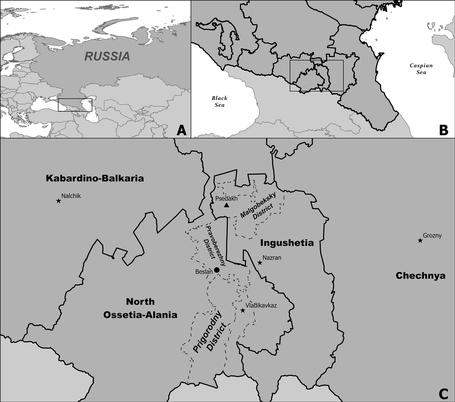
The town of Beslan (C) is located in the North Caucasus (B) of the Russian Federation (A).
Credit: Matthew Sisk.