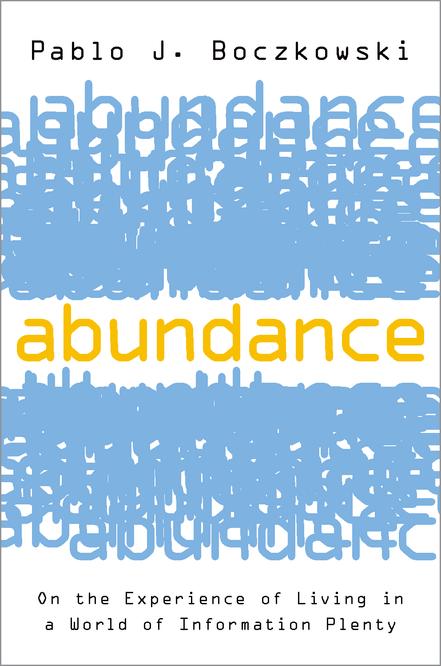
Abundance
On the Experience of Living in a World of Information Plenty
PABLO J. BOCZKOWSKI
3
Oxford University Press is a department of the University of Oxford. It furthers the University’s objective of excellence in research, scholarship, and education by publishing worldwide. Oxford is a registered trade mark of Oxford University Press in the UK and certain other countries.
Published in the United States of America by Oxford University Press 198 Madison Avenue, New York, NY 10016, United States of America.
© Oxford University Press 2021
All rights reserved. No part of this publication may be reproduced, stored in a retrieval system, or transmitted, in any form or by any means, without the prior permission in writing of Oxford University Press, or as expressly permitted by law, by license, or under terms agreed with the appropriate reproduction rights organization. Inquiries concerning reproduction outside the scope of the above should be sent to the Rights Department, Oxford University Press, at the address above.
You must not circulate this work in any other form and you must impose this same condition on any acquirer.
Library of Congress Cataloging-in-Publication Data
Names: Boczkowski, Pablo J., author.
Title: Abundance : on the experience of living in a world of information plenty / Pablo J. Boczkowski.
Description: New York, NY : Oxford University Press, [2021] | Includes bibliographical references and index.
Identifiers: LCCN 2020056387 (print) | LCCN 2020056388 (ebook) | ISBN 9780197565742 (hardback) | ISBN 9780197565759 (paperback) | ISBN 9780197565773 (epub)
Subjects: LCSH: Information society. | Information technology—Social aspects—Argentina. | Mass media—Social aspects—Argentina. | Information behavior—Argentina. | Media literacy—Argentina.
Classification: LCC HN 270.Z9 I44 2021 (print) | LCC HN 270.Z9 (ebook) | DDC 302.230982—dc23
LC record available at https://lccn.loc.gov/2020056387
LC ebook record available at https://lccn.loc.gov/2020056388
DOI: 10.1093/oso/9780197565742.001.0001
1 3 5 7 9 8 6 4 2
Paperback printed by Marquis, Canada
Hardback printed by Bridgeport National Bindery, Inc., United States of America
To Emma and Sofia, for the abundance of our love
Alguien dijo una vez
Que yo me fui de mi barrio,
Cuando?. . . pero cuando?
Si siempre estoy llegando!
Aníbal Troilo (1969), “Nocturno a mi barrio”
Aunque me fuercen
Yo nunca voy a decir
Que todo tiempo por pasado fue mejor
¡Mañana es mejor!
Luis Alberto Spinetta (1973), “Cantata de los puentes amarillos”
List of Figures
2.1.
2.2.
2.3.
2.4.
2.5.
2.6.
2.7. Frequency of “almost constantly” and “several times a day” online access,
2.8.
3.1.
3.2.
3.3. Percentage of users which agrees with the statement “access to social media is indispensable to me.”
3.4. Popularity of the leading platforms.
3.5.
4.1.
4.2.
4.3.
4.9.
4.10. Perceived
4.11. Perceived
x List of Figures
5.1. Main leisure activity.
5.2. Watching television as main leisure activity.
5.3. Listening to music as main leisure activity.
5.4. Being on social media as main leisure activity.
5.5. Listening to the radio as main leisure activity.
Preface
Poets and beggars, musicians and prophets, warriors and scoundrels, all creatures of that unbridled reality, we have had to ask but little of imagination, for our crucial problem has been a lack of conventional means to render our lives believable. This, my friends, is the crux of our solitude
Gabriel
García Márquez1
One evening in late June 2018, I was walking down Avenida Corrientes toward Plaza de Mayo, in the heart of the City of Buenos Aires. Research for this book had ended half a year before, and I was in the thick of data analysis. I had many ideas bubbling up and an intuition that they might connect, but had not yet found the theme to weave them together. I passed by my late father’s office and shortly afterward by the Centro Cultural Ricardo Rojas—where three decades earlier I had taken an enthralling course about the works of Jorge Luis Borges with the writer and literary scholar Ricardo Piglia that forever changed my views of how to read. In the midst of this familiar territory, I saw a sadly common situation with a novel twist. It caught my attention, and subsequently led to the theme that made this book’s argument coalesce.
There were two young people living on the street. They were seated next to each other on a couple of worn out chairs, facing the sidewalk, with a few possessions tucked away between their backs and the façade of a building. They had a large cardboard box turned upside-down in front of them, as an improvised dinner table, and were surrounded by smaller cardboard boxes piled up, feebly demarcating their semi-private space on the sidewalk. They were eating from a plastic container, with a can of Coke next to it. Their eyes were fixed on a screen from which emanated a dim light within an otherwise fairly dark setting. The screen in question belonged to a smartphone. The scene was a twenty-first-century, pauperized version of the iconic twentieth-century image of a family dining in front of the television set. In a situation of extreme material scarcity, these two people were nonetheless connected to an abundance of information.
The interpretations, emotions, and practices of dealing with this abundance in everyday life are the subject of this book. I ask: what is the experience of living in a world of information plenty? How do variations in macro-level structural factors such as age, socioeconomic status, and gender affect conditions of access to the array of technological and content options—from personal screens to social media platforms, and from news stories to serialized fiction—that embody this information plenty? Within these broad structural patterns, how do variations in meso-level cultural dynamics represented by the meanings individuals attribute to these technologies and content, and the routines enacted to engage with them, shape that experience in everyday life? Finally, what implications does this experience, and the various configurations of these structural factors and cultural dynamics, have for media, society, and politics?
The story of the homeless youth not only brings up the digital connection to a world of information abundance even in situations of material scarcity, but it also illustrates one of the three major findings of the present study: age—by itself and also as a proxy for being in a particular life stage—appears to be more important than socioeconomic status and gender in shaping the structural conditions within which people access technology and content. The structuring of information practices around age endows the contemporary moment with a high degree of dynamism since people grow older more frequently and predictably than they change socioeconomic status and gender identity—if at all—during the course of their lives. This dynamism, in turn, unsettles society since it ties to a destabilization of prevailing meanings and routines.
Within these structural formations, the meanings and routines of sociality are aspects of daily life in which this destabilization has been strongly felt. Cristian2 is a forty-four-year-old employee at a small grocery store in a suburb of Buenos Aires, and father of three adolescent boys. He shares two related stories about this matter:
Cristian: [At the dinner table] while the TV is on, there is a play in a [soccer] game that catches my attention. And I tell [my sons] “check it out.” And they’re like this [hunched over and immersed on their cell phones]. I don’t like it.
Interviewer: How do they reply when you say that?
Cristian: They laugh [and] don’t pay any attention to me [laughs] . . . Nobody gets off their phones. I just had a mom and a daughter at the store. The
mom asked the daughter, “one or two kilograms?” And the daughter was like that [makes a gesture of looking at the cell phone]. Three times the mom asked and the girl continued being like that. . . . I told the mom, “Send her a [message on] WhatsApp!” “Yes, we’ve done it more than once, even at home.”
Interviewer: Have you done something like this?
Cristian: Of course! I shout to Gonzalo [son] for instance, “Can you check . . .?” And he ignores me. So, I sent him a “Gonza” [over WhatsApp] and ask him for a pair of socks. He leaves his room, brings me the socks, and laughs. And I tell him: “Don’t laugh at me, I have to send you a WhatsApp to get an answer.” Otherwise he pretends I’m not there.
These two stories convey the deep imbrication of personal screens, social media, and messaging platforms in everyday communication. There has been a qualitative leap in the information that people routinely make available about their lives, and in their access to comparable content about the lives of others. This has been coupled with a remarkable level of attachment to the technologies that make this possible, and to the content accessed through them. The client’s daughter and Cristian’s sons are among many who find it increasingly difficult to detach from devices and platforms. What has emerged from these transformations is nothing short of an ongoing reconstitution of how we conceive and enact our sociality, and ultimately of what it means to be social beings. This is the second main finding of the inquiry summarized in this book.
Contemporary information abundance also affects how individuals look at traditional media. Like many other young people, Isabel, a twenty-fouryear-old student from the province of La Pampa, some 400 miles southwest of the City of Buenos Aires, struggled to develop news consumption habits until she found a way to integrate them into her broader social media practices:
I don’t sit in front of the television news because I don’t like or enjoy [it]. . . . I asked myself: how can I stay updated? Because I’m also not prone to go to [the website of conservative newspaper] Lanacion.com and read [the news]. . . . It’s not a habit that I have. . . . So, I took advantage of the fact that I do have social media incorporated [into my routines] and that I’m [connected] all the time. . . . I wake up and in the five minutes that it takes me to get up I [grab the phone and] check Twitter, Facebook. So, I told
myself “let’s read the headlines” [on social media]. Let’s say it’s like the way I found to . . . more or less stay updated. . . . I wouldn’t say informed, because if you ask me, the truth is that I don’t have any idea about what happened.
Isabel’s derivative news consumption routines contrast with her audiovisual entertainment practices—even when they involve the same screen, the television set, that she so readily dismisses for learning about current affairs. She recalls that a few years prior to the interview she had become
a huge fan of a series called One Tree Hill. . . . I watched eight seasons in two weeks. . . . I had a final exam and failed it . . . [even though] I had passed the two midterms. . . . What normal person does watch eight seasons in two weeks? I hadn’t even intended to watch [just] two episodes per day. But I [would wrap up] one day watching one and wake up [the next one] thinking “I have to keep watching.”
Isabel is one of millions of viewers who intensely engage with serialized fiction on a daily basis, especially on streaming services. The contrast between her routines of news and entertainment consumption, and their respective roles in her everyday life, point to the divergent experiential valuation of these two types of traditional media content. Thus, the third key finding reported in this book is that while the uptake of news has devalued this type of content, the opposite has happened to the reception of serialized fiction.
This is an unsettled—and also unsettling—society, marked by the reconstitution of sociality, the depreciation of facts, and the appreciation of fictions. Welcome to the contemporary experience of information abundance, one that requires—paraphrasing Gabriel García Márquez—little of our imagination and lots of our observation once we stop taking for granted the unbridled reality of the society we have come to live in.
Four Distinct Features of This Book
In this book I analyze this experience in ways that set it apart from most existing research on the broad topic of how people, organizations, and societies deal with a massive surge in the information available. More precisely, there are four distinct features of this analysis.
The first one has to do with the overall framing of the project. As I will elaborate in detail in chapter 1, the vast majority of the relevant research has concentrated on how this surge affects the ways that both individual and collective actors process information, in particular for work-related purposes. By contrast, it is evident from both the questions asked and the vignettes presented in the previous section that I am interested in the meanings that people attribute to the technologies and content that embody this surge, how those meanings orient action, and how they are embedded in larger routines of everyday life undertaken for a range of instrumental, relational, and leisure purposes. One way to understand the difference between the prevailing research and the approach I have adopted is through media studies scholar James Carey’s distinction between communication as transmission and communication as ritual.3 For him, these “two alternative conceptions of communication have been alive in American culture since this term entered common discourse in the nineteenth century.”4 On the one hand, “the transmission view . . . is the commonest in our culture—perhaps in all industrial cultures—and dominates contemporary dictionary entries under the term. . . . [It views] communication [a]s a process whereby messages are transmitted and distributed in space for the control of distance and people.”5 On the other hand, the ritual view of communication “is directed not toward the extension of messages in space but toward the maintenance of society in time; not the act of imparting information but the representation of shared beliefs.”6 He adds that “if the archetypal case of communication under a transmission view is the extension of messages across geography for the purpose of control, the archetypal case under a ritual view is the sacred ceremony that draws persons together in fellowship and commonality.”7
Carey argues that one reason for the dominance of the transmission over the ritual views is an “intellectual aversion to the idea of culture [which] derives in part from our obsessive individualism that makes psychological life the paramount reality.”8 Yet, as Jerome Bruner, one of the founders of cognitive psychology, argued in his seminal 1989 Harvard-Jerusalem lectures, “Our culturally adapted way of life depends upon shared meanings and shared concepts and depends as well upon shared modes of discourse for negotiating differences in meaning and interpretation.”9 Thus, to complement the individualistic tendencies of the research about what has commonly been labeled as “information overload,” in this book I will offer an account that concentrates on meanings and routines, with a strong relational sensibility and an awareness of structural formations. This also goes against
the grain of much scholarship on digital media, so often suffused with a fascination for big data and the counting prowess enabled by computational social scientific methods. Adding a novel twist to the old saying, I hope to show that while big data counts might be enlightening, small data accounts can be beautiful.
The second distinctive feature of the analysis undertaken in this book is in part tied to the first one. As stated above, the rise in the volume of information available has both technological and content dimensions. This can be clearly seen in the stories shared by Cristian and Isabel since they entangle screens and platforms with news and entertainment. By looking at shared meanings and broader routines, in this book I will complicate the neat division of labor in communication scholarship that has artificially separated the study of technology and content. This division has arisen from the historical tendency to separate the technological dimension of electronic, print, broadcast, and computational media from inquiries into the content dimension of interpersonal and mass communication.10 In addition, scholars of the socalled new media have rarely incorporated insights from the work of their colleagues who have examined older media, and vice versa; and students of the news have rarely engaged with their counterparts focusing on entertainment, and vice versa. Moreover, as communication theorist Silvio Waisbord has perceptively noted, “During the past decades, intellectual fragmentation has become even more pronounced.”11
Contrary to this division of labor dominant among the analysts—further reified in specialized journals, organizational units within learned societies, and sub-units within academic departments—the account offered in this book will be organized by the logic that emerges from, borrowing from science studies scholar Bruno Latour, following technology users/media audiences through society.12 Because individuals use various kinds of technologies and consume diverse types of content not in isolation but in relation to each other, I will show that this strategy endows the resulting account with more realistic descriptions, greater explanatory power, and more grounded assessments of its societal implications. In other words, crossing subfields and integrating knowledge about objects of inquiry that are often kept separate sheds light on patterns that would have been lost had they not been analyzed in relation to the others.
The third distinct feature builds from the first two. In this book I not only integrate subfields and objects of inquiry that are often separate but also a meso-level cultural focus with a macro-level structural sensibility, and a
contemporary foreground with a historical background. These two additional research strategies further differentiate the resulting text from the bulk of the comparable social and behavioral science examinations of the current rise in the volume of information available. I mix methods to integrate a cultural focus on the role played by meanings and routines with a structural sensibility that concentrates on variables such as socioeconomic status, age, and gender. I will provide details of the methodology in chapter 1 but, in a nutshell, I rely on data gathered through interviews with 158 individuals conducted in Argentina—primarily in the City of Buenos Aires and its adjacent suburbs—from March 2016 to December 2017. Then, I supplement the interview findings with data from a survey of 700 adults in Buenos Aires and its suburbs administered in October 2016, and designed to situate these findings within broader patterns of technology and media access and use. This research design will provide data about both fine-grained configurations of meanings and routines, and their embedding in broad patterns of technology adoption and content reception.
This is not the first time in history that members of a society find themselves in the midst of a significant rise in information relative to what they could access prior to that change. As I will discuss in chapter 1, people living in eras ranging from Antiquity to the Middle Ages, and from the Renaissance to the Enlightenment confronted various challenges arising from major transformations in technology and content. As is common during periods of historical discontinuity, this led them to talk about their assumptions, review prior practices, keep some of them, and develop new ones. While there is no preestablished threshold after which one can say that a historical discontinuity has taken place, a reading of both scholarly and popular analyses about the contemporary situation signals an information environment going through another significant historical shift. I take this situation as a transition that makes more visible patterns that are less visible during periods of greater stability, and whose study can yield knowledge useful to make sense not only of these patterns but also of more routine periods and future transitions— should the latter occur, as we might anticipate in light of the current pace of technological innovation. Thus, in the pages that follow I will draw from what we know from historical analyses to inform my assessment of contemporary dynamics.
Last, the fourth distinct feature of this account has to do with the location of the inquiry: Argentina, a relatively peripheral country in the worldwide circulation of economic, political, and cultural influence. To the best
of my knowledge, as I will show in chapter 1 there have not been previous large-scale studies of the rise of information in countries outside of the Global North. Furthermore, as is often the case with scholarship in and about settings in the Global North, the vast majority of the relevant contemporary research has adopted a view from nowhere, furnishing findings and interpretations without much justification or self-reflexivity about the particularities of the conditions where the research has taken place. Against this backdrop of geographic concentration and lack of reflexivity, in this book I will present a self-aware tale originating at the very end of the world. While this novelty in itself amounts to a scholarly contribution, it turns out that Argentina has three key advantages for an inquiry of this kind, an issue I address in the concluding section of this preface.
On Argentina as a Site for This Inquiry
When I began the research that led to this book, as often happens with largescale ethnographic projects, I only had an ill-defined focus in mind: the connection across the consumption of news, entertainment, and technology in the contemporary media environment. It was the sight of the homeless couple dining on the street while glancing at their smartphone that made me envision the topic of information abundance as the main thread tying together otherwise seemingly disparate trends that had emerged during fieldwork. I did not go on a walk down Corrientes Avenue to find that scene, nor did I set out to find the topic of information abundance. On the contrary, both the scene and, most important, the topic found me. The two prior years of research created the conditions of possibility that allowed me to be open to the topic—and receptive to the larger meaning of that scene. Buenos Aires in particular, and the Argentine context in general, were central to creating these conditions. As I have realized since then, there are three critical aspects that make Argentina a particularly conducive setting for the inquiry reported in these pages.
Usually known around the world for its red meat and hearty Malbec, political figures Juan Domingo Perón and Eva Perón, soccer superstars Diego Maradona and Lionel Messi, and religious leader Pope Francis, Argentina has been characterized over the past 100 years by what historian Luis Alberto Romero has called an “anguished and tumultuous national experience”13 marked by a succession of military coups for the better part of the twentieth
century and recurrent economic crises that remain to this day. One of the most salient indicators of these crises has been persistent high levels of inflation. According to data from the World Bank, the annual inflation rate of Argentina was 41% in 2016 and 26% in 2017, several orders of magnitude lower than the record-high 3,046% of 1989, but still much higher than the 1.1% and 1.9% annual inflation levels in the United States during 2016 and 2017, respectively.14 As is often the case with endemic high levels of inflation, the socioeconomically disadvantaged strata of society have suffered it the most, further condemned to a life in structural poverty.
The devasting existence of structural poverty constitutes one of the three aspects that have turned Argentina into a fruitful setting for the study reported in this book. As I will show in chapter 1, the research on information abundance conducted in countries of the Global North has often taken for granted access to the technologies that both embody and connect to this information. By contrast, in a nation of the Global South like Argentina, it is more difficult to take this access for granted. Thus, a situation of greater material scarcity helps shed light on when, how, and why people might value information so much that they are willing to spend a sizable portion of their income on it. To illustrate these issues with some economic figures, the Argentine gross domestic product per capita—using the purchasing power parity comparison—was $20,308 in 2016 and $23,563 in 2017.15 This was approximately three times less than the comparable figures in the United States. This relatively low level of average income is tied to a high level of inequality. At the time of this study, the top decile of income earners made almost twenty times more than the bottom decile.16 Thus, the Organization for Economic Co-operation and Development’s (OECD) “Multi-Dimensional Economic Survey” of Argentina for 2017 concluded that “the distribution of income . . . is currently very unequal and leaves one third of the population in poverty, and one out of five Argentinians at risk of falling into poverty.”17
Putting these rather abstract figures more concretely, in order to not fall below the poverty line, a household required a monthly income of at least $909 during the second half of 2017.18 In other words, a third of the population lived in households making less than $30 a day at the time of the study. An even more obscenely sad fact can be gleaned through what the Argentine government calls the “indigence line,” which is essentially a measure of the most extreme poverty. During the second half of 2017 a household required a monthly income of at least $352, or almost $12 per day, to avoid being considered in indigence, a condition that applied to one in sixteen households
then. The couple living in the streets that I mentioned at the start of this book are probably toward the bottom of this group since they do not appear to have a permanent dwelling. Purchasing a smartphone for them would entail several months of their entire—not just their disposable—income. The very fact that they possessed one, and likely connected to a world of information abundance through freely available Wi-Fi, is nothing short of a remarkable sociocultural event that signals how much individuals yearn for that connection.
This leads us into the second aspect that makes Argentina an especially fruitful setting for this inquiry. That connection afforded by personal screens and social media platforms is in no small measure a connection to others. There is a news and entertainment component, too—and I will get to that in a couple of paragraphs. But a major element of the recent rise in information availability has to do with the content that people contribute to the platforms they use and the reactions to the content contributed by their contacts, all of which are constantly and feverishly accessed by many through their ubiquitous smartphones. This content is mostly about sociality, and its spectacular growth is contributing to refashioning it. For the average Argentine, sociality has been a central element of everyday life and much more intensely so than in countries of the Global North. Thus, the Argentine context helps foreground and make visible the importance of a ritual view of communication that recedes into the background and loses some visibility in societies marked by more individualistic and utilitarian associational cultures.
In the second volume of their Historia de la Vida Privada en Argentina—La Argentina Plural: 1870–1930, Fernando Devoto and Marta Madero argue that “Argentine society is like a ‘leopard skin’: strategies of alliance, diverse forms of associative life, multiple uses of the same space, do not separate groups with systematic and differentiated strategies.”19 Strong and multifaceted associational bonds have marked the past couple of centuries of everyday life in the country. These bonds were in part born of relational practices that characterized settings such as the café and the pulpería an all-purpose grocer’s shop—in the nineteenth and early twentieth century,20 and further deepened in the leisure, arts, and civic societies that blossomed in the first half of the twentieth century.21 Cutting across these historical transformations has been the prominence of family life in everyday practices. The resulting centrality of strong associational bonds seems to have only intensified since then, as foreigners have often commented on visiting the country. For instance, Brian
Winter, editor-in-chief of Americas Quarterly, reflected about his experience in Argentina at the dawn of the twenty-first century as follows:
I have lived in other Latin American countries in the years since, and social bonds are tight there, too. But—I insist—there’s something special about Argentina. So much else has gone wrong over the years: the brutal dictatorship of the 1970s, the hyperinflation of the 1980s, and the devastating 2001–02 economic crisis, which I experienced firsthand—and eventually covered in my first reporting job. Why hasn’t everybody just abandoned the country? Well, many did. But those Argentines who remained will almost universally tell you it was because of those bonds—family, yes, but also their crew from high school or college. The national talent for lifelong camaraderie is surely Argentina at its very best.22
Needless to say, not all Argentines who might have wanted to leave the country during one of its many recent crises had the monetary and social capital to be able to do so. But this “national talent” permeates all socioeconomic strata, and its embodiment in strong familial and friendship ties has historically often provided the most vulnerable sectors of society with an extra layer of social support to weather economic and political turmoil.
The third aspect that makes Argentina a useful setting for this study centers on issues of trust in mediated information. Periods of major technological developments have often been marked by moral media panics. A recent wave of this type of panic has emerged in the aftermath of the Brexit vote and United States presidential election, both in 2016. Trying to make sense of what to many were unforeseen—and unforeseeable—outcomes, media commentators and communication scholars zeroed in on the role of the very technologies and content that are at the core of this book. Social media turned into the nemesis of democracy, smartphones became addictive, and the news an endangered species that had to be protected. For instance, in Antisocial Media: How Facebook Disconnects Us and Undermines Democracy, media scholar Siva Vaidhyanathan has written one of the strongest indictments of the role of platforms in society, in which he states that
if you wanted to build a machine that would distribute propaganda to millions of people, distract them from important issues, energize hatred and bigotry, erode social trust, undermine journalism, foster doubts about
science, and engage in massive surveillance all at once, you would make something a lot like Facebook.23
There is an assumption that users are devoid of agency and critical capacity in accounts of this kind. Thus, to Vaidhyanathan, “We have become data-producing farm animals, domesticated and dependent. We are the cows. Facebook clicks on us.”24 In order for individuals to be so passive and non-critical, they have to first trust the information they are exposed to. But, do they? Argentina provides a highly suitable environment to probe this question within the context of issues addressed in this book. For instance, the 2017 Digital News Report from the Reuters Institute for the Study of Journalism found that only 39% of respondents in Argentina agreed with the statement “Most of the time I trust the news overall.”25 This put the country in the bottom third of all nations included in that year’s report. Furthermore, only 16% of respondents agreed with the notion that “the media is free from political/economic influence”—placing Argentina in the bottom fifth of those nations that year.26 In other words, five out of six respondents saw journalistic organizations as chained to political and economic interests. These remarkably high levels of distrust in the news are not new. On the contrary, they have resulted from decades of perceiving even the most reputable media outlets not as objective but as presenting a slanted version of reality in relation to alleged political and economic gain. To cope with this situation, many Argentines have become highly skeptical and, as I will show later in this book, developed critical practices of reception and sociability to try to ascertain what they consider to be the real news behind the reported news. In a world in which, according to the 2020 Digital News Report, “overall levels of trust in the news [are] at their lowest point since we started to track these data,”27 Argentina provides a sort of avant-garde to examine the character of agentic media reception and put in perspective the hypodermic needle nightmares commonly associated with contemporary information abundance—an abundance whose roots we start unpacking in chapter 1.
Acknowledgments
I worked on this book for almost five years and benefited tremendously from the contributions made by many people during the process.
I draw upon data that were gathered as part of a project jointly designed and led with Eugenia Mitchelstein under the auspices of the Center for the Study of Media and Society in Argentina (MESO). This is a joint initiative between Universidad de San Andrés in Argentina, and Northwestern University in the United States, that Eugenia and I co-founded in 2015. We are exceedingly grateful for the support provided by Carlos Rosenkrantz and Lucas Grosman, former and current rectors at Universidad de San Andrés, respectively, and Barbara O’Keefe, former dean of the School of Communication at Northwestern University, during the period the project was developed and undertaken.
The interviews were conducted by a team at the Center. It was coordinated by Mora Matassi, and included the research assistance of Victoria Andelsman, Tomás Bombau, Sofía Carcavallo, Paloma Etenberg, Rodrigo Gil Buetto, Camila Giuliano, Belén Guigue, Silvana Leiva, Inés Lovisolo, Mattia Panza, Jeanette Rodríguez, Celeste Wagner, and Marina Weinstein. The survey was undertaken by a third-party vendor led by Silvia Sánchez. I am truly grateful for the excellent data collection efforts regarding the interviews and the surveys.
Eugenia and I wrote a number of media articles and research papers based on findings from these data sets—one or more of them also co-authored with either Mora Matassi, Celeste Wagner, or Camila Giuliano. In addition to many wonderful conversations about the research project, Eugenia read earlier versions of many of the chapters and helped me with her always smart and no-nonsense advice during the review process. What started as a mentor-mentee relationship more than thirteen years ago has evolved into a wonderful intellectual partnership and a cherished friendship.
In addition to our jointly authored texts, Mora Matassi and Celeste Wagner also made major contributions to this book. As coordinator of research team, Mora played an integral role in the data collection process and was involved in many aspects of the initial analyses. She also read and gave feedback on
earlier versions of several chapters of this book. Celeste commented on the entire manuscript before it went for the first round of peer review, advised on the revision process, and read the resulting final versions of key chapters.
Amy Ross Arguedas also read the entire manuscript in an earlier version and greatly improved it. She did triple duty by double-checking all the quotes from the interviews, copyediting the text and verifying the reference list, and providing feedback on the content. With the reviews at hand, I consulted Amy on revised versions of key chapters as well.
Other readers who provided most helpful comments on earlier versions of different chapters include Chris Anderson, Charlie Beckett, Claudio Benzecry, Ann Blair, Rachel Plotnick, Jane Singer, Facundo Suenzo, Fred Turner, and Silvio Waisbord.
Initial formulations of several ideas that I further developed for the book were published in single- and jointly-authored pieces—in the latter case with Eugenia Mitchelstein and Mora Matassi—written for Revista Anfibia. I learned hugely about making my work more accessible through the process of having the writing edited by Martín Alé, Sonia Budassi, Silvina Heguy, and Tomás Pérez Vizzón, and from conversations with Cristian Alarcón, María Mansilla, and Leila Mesyngier.
The heart of the conceptual argument emerged during a stay as Senior Research Fellow at the Weizenbaum Institute for the Networked Society in Berlin, Germany, during summer 2019. I thank Martin Emmer, Pablo Porten-Cheé, Lena Ulbricht, and Jeannette Hoffman for their hospitality and for providing ample time to pursue my own work, and the library staff at the WZB for their assistance with reference material. My experience was greatly enriched through discussions and outings with fellow visitors Sandra González-Bailón, Neta Kligler-Vilenchik, Dan Kreiss, and Mike Xenos. I had the great fortune that my visit to the Weizenbaum Institute coincided with Sheila Jasanoff’s stay at the Robert Bosch Stiftung’s Academy, which afforded many inspiring conversations reminiscent of past times in Ithaca, New York, and Cambridge, Massachusetts. Last but not least, neither my productivity nor my happiness would have been the same without the steady supply of cortados during long hours spent at Röststätte Berlin on Ackerstrasse, and the mango lassi sorbets at Rosa Canina adjacent to it.
A book like this is in no small measure the result of myriads of conversations, and a handful of them had a critical role in the process. An early chat with Claudia Greco made me realize the deep connection between the topic of abundance and facets of my personal life, which greatly
energized the writing journey. Long discussions with Claudio Benzecry, Eugenia Mitchelstein and Silvio Waisbord helped me both made sense of key relevant traits of the Argentine context and, hopefully, properly convey them to readers not familiar with the country’s history and everyday culture. As the book was coming to a close—and reminiscent to our exchanges around the same stage in the writing of my first book—Fred Turner encouraged me to not missing the forest for the trees.
The arguments I make in the book also gained by conversations about them with a large number of colleagues and practitioners, including Natalia Aruguete, Javier Auyero, Ingrid Bachmann, Christian Baden, Martín Becerra, Lance Bennett, Menahem Blondheim, Sandrine Boudana, Dominique Brossard, Michael Brüggemann, Julia Cage, Ernesto Calvo, Inés Capdevila, Dominique Cardon, John Carson, Lilie Chouliaraki, Iris Chyi, Akiba Cohen, Jean-Philippe Cointet, Jorge Coronado, James Curran, Michael Delli Carpini, Noshir Contractor, Nick Couldry, Guillermo Culell, Roei Davidson, Mark Deuze, Rafael Di Tella, Jamie Druckman, Brooke Duffy, Shira Dvir Gvirsman, Paul Edwards, Wendy Espeland, Elena Esposito, Martín Etchevers, Noah Feinstein, Patricia Ferrante, Richard Fletcher, Brenda Focás, Jean-Francois Fogel, Daniel Fridman, Paul Frosh, Marcela Fuentes, Sue Fussell, Julián Gallo, Karina Galperín, Dilip Gaonkar, Gerry Garbulsky, Víctor García Perdomo, Bernie Geogheghan, Homero Gil de Zúñiga, Gernot Grabher, Lucas Graves, Jonathan Gray, Shane Greenstein, Roberto Guareschi, Francisco Guerrero, Daniel Hadad, Daniel Halpern, Thomas Hanitzsch, Bob Hariman, Rod Hart, Kaori Hayashii, Gabrielle Hecht, Carol Heimer, Andreas Hepp, Mariana Heredia, César Hidalgo, MeiLing Hopgood, Phil Howard, and Lee Humphreys.
I also got valuable input from Belén Igarzábal, Steve Jackson, Sharon Jarvis, Nicholas John, E. Patrick Johnson, Candace Jones, Zohar Kampf, Elihu Katz, James Katz, Katharina Kleinen-von Königslöw, Rasmus Kleis Nielsen, Pablo Lapegna, Omar Lavieri, Bruce Lewenstein, David James Lick, Sonia Livingstone, Oren Livio, Wiebke Loosen, Amanda Lotz, Juan Manuel Lucero, Celia Lury, Mirca Madianou, Guillermo Mastrini, Gina Masullo, Lisa Merten, Gustavo Mesch, Oren Meyers, Norma Möllers, Fabian Muniesa, Gina Neff, Lilach Nir, José Nun, Barbara O’Keefe, Wanda Orlikowski, Marcos Peña, Trevor Pinch, Alison Powell, Woody Powell, Cornelius Puschmann, Eleonora Rabinovich, Jothie Rajah, Stephen Reese, Byron Reeves, Sue Robinson, Hugo Rodríguez Nicolat, Hernando Rojas, Alan Rusbridger, Dietram Scheufele, Annika Sehl, Julieta Shama, Limor Shifman, Susan Silbey, David Stark,