Acknowledgements
This book is an extensively revised version of the doctoral dissertation that I defended in September 2015 at Wadham College, Oxford. I am most grateful to my two veritable mentors, Homa Katouzian and Edmund Herzig at Oxford University, under whose patient and thoughtful supervision the seeds of this book were first planted. The many doors they opened into new ideas, texts, and ways of thinking have shaped who I am today.
At Oxford, I found a warm and intellectual home; so it seems fitting that this book should also have found a home there, with the Oxford University Press. I am immensely grateful to my doctoral viva examiners, Laurent Mignon and Asghar Seyed-Gohrab for their insightful comments on the final draft of my doctoral dissertation. My deepest gratitude goes to Mohammad Mehdi Khorrami, who has read earlier drafts of this book over the past two years, generously sharing his insightful comments, and making time to talk it through with me at times when completing it felt impossible.
The book is a culmination of the support and guidance of so many friends and colleagues. In particular, the ground-breaking scholarship and mentorship of three scholars, Dick Davis, Ahmad Karimi-Hakkak, and Fatemeh Keshavarz, have shaped, influenced, and inspired me over all these years. Countless hours of discussions with Ahmad helped me to rework many parts of this book. I was also extremely fortunate that two inspiring historians of modern Iran, Stephanie Cronin and Behrooz Ghamari-Tabrizi, read earlier drafts of the book, providing sensitive and sophisticated suggestions to improve my arguments. Kamran Matin’s thoughtful suggestions helped me revise the final chapter of this book.
Paul Losensky, from whom I have learned a great deal, kindly read parts of the book during and after the Yarshater Junior Scholars Workshop, held at the University of Maryland (May 2019) and provided constructive
feedback. I am particularly indebted to him for his masterful translations of post-revolutionary elegies, produced on the occasion of Khomeini’s death. His insightful work proved essential in shaping my core argument throughout the book, especially in Chapter 6.
I have presented various parts of this book in different academic workshops, organized by three brilliant scholars: Kathryn Babayan, Fatemeh Keshavarz, and Nasrin Rahimiyeh. Thanks to these workshops, and the insightful feedback I received from the organizers and participants, I could rethink and sharpen the book’s conceptual framework and structure. My dear colleagues, Samad Alavi, Cameron Cross, Mathew Thomas Miller, Alexander Jabbari, Black Atwood, and Austin O’Malley offered insightful criticism and raised important questions during these workshops. I am indebted to all of them for their intellectual curiosity and honesty. I am grateful to Eskandar Sadeghi-Boroujerdi for his genuine friendship and intellectual support during the most difficult years of exile while at Oxford University. I owe serious debt to Abdollah Yousefzadegan and Siavush Randjbar-Daemi for their generous support with accessing archives and their vast knowledge of primary and archival resources.
At SOAS University, Narguess Farzad’s friendship, passion for the Persian language and literature, and highly competent translation skills, have influenced me on both academic and human levels—a true friend during challenging times. The same goes for my dear friends, my family of choice, Rowena Abdulrazak, Mazlinda Makhzan, Kerem Tinaz, Mehmet Tinaz, and Pinar Tinaz, who are deserving of abundant gratitude and appreciation. I could not have survived the most difficult moments in exile without their support on all levels. Masoumeh Naseri, Sanam Dolatshahi, Kiana Memaran-Dadgar, and Rana Daroogheh offered me a great deal of emotional nurturing when this long intellectual journey, far away from my loved ones, felt unbearable.
At the University of Pennsylvania, my current host institution, I am indebted to Paul Cobb, the chair of the Department of Near Eastern Languages and Civilizations (NELC), for his unconditional support since
my arrival, and to my dear colleagues, Al Filreis, Firoozeh Kashani-Sabet, Nili Gold, Heather Sherkey, Joseph Lowrey, Huda Fakhreddine, Ahmad Almallah, Jamal Elias, Emily Steiner, Mahyar Entezari, Brian Kim, and Oscar Aguirre-Mandujano for being a constant source of inspiration and for their invaluable friendship and support.
I am grateful to the University Research and SAS Research Funds for offering me financial support in the final stages of completing this book. Linda Greene at the NELC departmental office at Penn deserves abundant gratitude for being a constant source of support in every way possible when I was finalizing this manuscript.
At Oxford University, my immense gratitude goes to the staff members of Wadham College and St. Antony’s College, where I gained so much more than just a degree during my doctoral studies. The generous financial support of the Clarendon Fund at Oxford University was vital to my intellectual growth and the completion of my doctoral degree. I could not have completed this book without the constant intellectual, editorial, and emotional support that I received from my brilliant editor Holly Dawson. Holly’s sharp and masterful editorial skills, and her extreme generosity and kindness, kept me going at times of darkness and hardship. I could not wish for a better and more experienced editor. My deepest gratitude also goes to Dena Afrasiabi for generously lending her sharp editorial eye and her time at the very final stage of the production of this book.
To Zahra Shams, my sister, who has spent these years finding rare books for my research from the offset publishers in Revolution Square, Tehran, and sending them to me wherever I was in the world, I owe a gracious debt of gratitude for all her kindness and support. I am also grateful to Ali Vahidi-Yeganeh for his help with designing the chart in the final chapter of this book.
The book is dedicated to my first mentors in life, my parents, Mohammad Shams and Sedigheh Molazemian, who have fostered my love of poetry and literature since the early years of my life. I cannot imagine having completed this book, during a decade in exile, without their constant material, spiritual, and intellectual support.
I am forever grateful to my partner Brendan Bercik who patiently held my hand and offered me unconditional love when I needed it most to get through the very last stages of finalizing the manuscript.
Sepās-e besyār to you all. It only remains to say that I am, of course, solely culpable for any errors or shortcomings in this book.
Rethinking
2. “Surgery of the Soul”: Introducing the Howzeh
3. Returning to the Roots: The Dark and Light of the Village
4. A War to Remember (1): Decoding the Poetic Violence of War
5. A War to Remember (2): The Other Face of War
6. Loss and Nostalgia: Official Poetry in Post-War Chaos
7. Inventing a Courtly Tradition: Poetry and Power in Khamenei’s Islamic Republic
List of Abbreviations
WAI Writers’ Association of Iran (Kānūn-e Nevisandegān-e Iran, 1968)
CRH Cultural Revolutionary Headquarters (Showrā-ye Enqelāb-e Farhangi, 1980)
Howzeh The Center of Islamic Art and Thought (Howzeh-ye Honar-va Andisheh-ye Islāmi, 1979–1980)
OIP Organization for Islamic Propaganda (Sāzmān-e Tablighāt-e Islāmi, 1981)
MRF The Mobilization Resistance Force (Basij-e Mostazʿafin, 1979–1980)
CAIM Cultural Association of the Islamic Movement (Kānūn-e Farhangi-ye Nehzat-e Islāmi, 1979)
FDWV The Foundation of the Downtrodden and War Veterans (Bonyād-e mostazʿafān-va jānbāzān, 1980)
Note on Transliteration and Translation
Except for standard spellings of names and locations and the original quotes, I have used a slightly modified transliteration scheme of the journal of Iranian Studies.1 In referring to words of Arabic origin, such as qasidah, I have transliterated them based on the standard spelling and pronunciation of the word in Persian, e.g. qasideh. The slight modifications have been applied to make the transliterated pronunciation of the words as close as possible to the original language.
In translating the poems, I have worked to remain loyal to the literal meaning of the original Persian, while conveying the sense and effect of the poem in English. The translations have been done only for academic purposes and therefore, where the ambiguity of the verse superseded the meaning, I have tried to unfold the meaning while explaining the aesthetic and literary qualities of the verse as part of the analysis. All translations in the book are mine, unless stated otherwise.
1 Association for Iranian Studies, November 28, 2019, https://associationforiranianstudies. org/journal/transliteration.
Consonants
Vowels
ShortLongdiphthongs a (as in ashk) ā (as in āb)e (as in fekr) i (as in melli) ey (mey) o (as in pol) ū (as in tūs) ow (as in rowshanfekr)
Other Rules
– The ezafeh is written as -e after consonants, e.g. ketāb-e and as -ye after vowels (and silent final h), e.g. daryā-ye and khāneh-ye
– The silent final h is written, e.g. dowleh
– The tashdid is represented by a doubling of the letter, e.g. takhassos
– The plural hā is added to the singular, e.g. dast-hā
– The conjugating va (and) is linked to the word that precedes it, e.g. vezārat-e farhang-va ershād.
Introduction
“Awakening the Nation”: Poetry and Power in Modern Iran
On November 4, 1964, under the orders of Mohammad Reza Shah Pahlavi, Ruhollah Khomeini, was forcibly exiled following his arrest by the Shah’s Secret Police (SAVAK). Iran, still haunted by the memory of the CIA/MI6-backed 1953 coup, which toppled the democratically elected prime minister, Mohammad Mosaddegh (d. 1967), was in the grip of rising protests against the Shah.1 At the heart of this political resistance were some of the country’s most prominent poets, writers, and intellectuals. With little interest in, or knowledge of, poetry, the Shah was more likely to have read poets’ names in the news related to the persecution of the political opposition2 rather than on the covers of their poetry collections. The people, meanwhile, were slowly awakening to the idea of change. They were steadily mobilizing; although it would take another fifteen years for the “unthinkable revolution”3 to arrive and shake the world to its core. The stirring rhetoric of the emerging leader Ruhollah Khomeini,
1 See Ervand Abrahamian, The Coup: 1953, the CIA and the Roots of Modern US–Iranian Relations (London and New York: The New Press, 2013) for an analytical history of the 1953 Coup. For a detailed historical overview of the June 1963 Riot and Khomeini’s rise to the political scene and his exile, see Abbas Amanat, Iran: A Modern History (London and New Haven: Yale University Press, 2017), 587–602.
2 Khosrow Golsorkhi (d. 1974) was one such poet who was put on trial for his Marxist Communist activism, including his connection to the guerilla-armed struggle of the 1970s. Other leading poets, such as Ahmad Shamlu (d. 2000), Mehdi Akhavan Sales (d. 1990), Siavash Kasra’i (d. 1996), Reza Baraheni (b. 1935), and Esmaʿil Shahroudi (d. 1981), along with several other poets from the first generation of the Islamic Republican trend (who will be introduced in the first chapter of this book), count among the political prisoners and dissidents of the Pahlavi regime. For more details about the post-Coup literary condition, see Mohammad Shams-Langroudi, Tārikh-e tahlili-ye sheʿr-e now, vol. 2 (Tehran: Markaz, 1991), 2–25.
3 Charles Kurzman, The Unthinkable Revolution in Iran (Cambridge, MA and London: Harvard University Press, 2004).
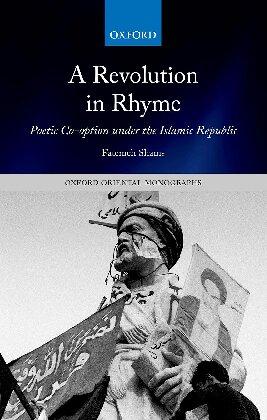
A Revolution in Rhyme: Poetic Co-option under the Islamic Republic. Fatemeh Shams, Oxford University Press 2021. © Fatemeh Shams.
DOI: 10.1093/oso/9780198858829.001.0001
who increasingly embodied the revolutionary spirit, was reaching the hearts of Iranians of all backgrounds—including poets. A twenty-fiveyear-old budding poet, Nemat Mirzazadeh (b. 1939)—known by the pen name M. Azarm—was one of the first poets to take up his pen and write an ode in praise of the exiled cleric. Originally from Khorasan—one of the major literary (poetry) hubs of Iran—and well-versed in Persian prosody, Azarm followed the long-lasting tradition of praise poetry in Arabo-Persian literary tradition by choosing to write in a form that goes as far back as the pre-Islamic era: the qasideh, which in its oldest form typically starts with the poet’s complaint of the separation from his beloved. For Azarm, this longing for reunion took a political turn, resonating with the collective cause of a nation in its quest for political change:
O’ you, far away from the homeland, the imprisoned fighter
The heart of the nation is bound by your love
Like a [repressed] rage hidden in the fist, your throat is silent
Your soul is restless, like a lion in captivity
The poet’s complaint about the separation from his beloved as a typical feature of the pre-Islamic qasideh no longer seems to be just personal. The poet’s desire for an alternative political rulership is echoed through the collective voice of the people of the nation (ahl-e vatan). With the most familiar poetic form and a fairly simple lexicon, Azarm co-opts a long-lasting poetic tradition to form a new political discourse of resistance geared towards Islam and Shiʿism.
Years after the revolution, Azarm came to be known as one of the first poets, if not the first poet to mythicize Khomeini as “Imām” in his famous panegyric qasideh (ode),4 a title that, prior to this, was only bestowed upon the eminent Muslim thinkers and philosophers such as Imam
4 “Ayatollah Khomeini chetor beh Imām Khomeini molaqqab shod?” Jamārān, December 31, 2012, https://www.jamaran.news/fa/tiny/news-20014.
Mohammad Ghazzali (d. 1111) and the twelve infallible Shiʿite Imāms, identifiable as descendants of the Prophet of Islam. In elevating Khomeini to such sacred ranks, Azarm offered readers an emotive provocation, inviting them to make the connection between their current circumstances in Iran and the mythologies and heroic figures deeply entrenched in the Islamic past. The forty-eight-line ode, entitled “By Your Name” (beh nām-e tow sowgand, 1965),5 is a gushing paean to the exiled cleric that makes use of an extensive religious intertextuality and deploys literal reminiscences between its subject of praise and the saintly figures of the past:
O’ Imām Khomeini! Far away from the homeland, You resemble the unique son of [Imām] Ali
After one thousand three hundred and some years, You have manifested the spirit of Islam6
Throughout the rest of the poem, it proves nearly impossible to delineate the boundary between the divine power of God and the terrestrial power of the then little-known, exiled cleric. Curiously, Azarm himself was not overtly pious, belonging, in fact, to the circle of secular-minded, leftist-leaning poets who would become the founding members of the Writers’ Association of Iran (Kānūn-e Nevisandegān-e Iran, 1968, WAI).7 Rather than holding a spiritually orthodox position, the intertextuality of Azarm’s verse is to be understood as an act of political resistance, inspired by the intellectual landscape of the time,8 leveraging
5 This ode, which was originally written in 1964, was published in the introduction of a book entitled, The Biography of the Leader (1970). I have not seen this book, but its details have been published in Eteleā’āt Newspaper, no. 19671, January 16, 1979, 5. The author confirmed the original publication date of this ode in a personal correspondence (June 20, 2020).
6 Personal correspondence with the author (June 20, 2020).
7 For a detailed history of this association, see Ahmad Karimi-Hakkak, “Protest and Perish: A History of the Writers’ Association of Iran,” Iranian Studies, vol. XVIII, nos. 2–4 (Spring–Autumn 1985), 189–229.
8 I will discuss the “return to the roots” movement (jonbesh-e bāzgasht beh risheh-hā) of the 1960s and ’70s in Chapter 3.
common anti-colonial and Third Worldist tropes and indigenizing such ideas in light of Shiʿite beliefs and views on equality and justice.9
As scholars of cultural intertextuality in visual art, theatre, and literature have argued, “religious intertextuality provides the kind of historical and specific referentiality that literary works need in order to preserve their own autonomy and dignity.”10 In search of “autonomy and dignity,” at a time when the censorship and prosecution of the intelligentsia were approaching their apex, poets and writers saw this style of thinking and writing as a novel mode of resistance.
Against the odds, the poem came to the attention of its subject, Ruhollah Khomeini, in Najaf. In 1969, Khomeini wrote a letter to the Qom-based scholar Mohammad Reza Hakimi (b. 1935), in which he told Hakimi he had read Azarm’s poem and believed it to be a “highly acclaimed message” (payām-e bolandpāyeh). “The educated youth,” Khomeini writes in the letter, “must awaken the nation with poetry, prose, sermons, books, and whatever makes the society aware of its condition.”11 This is perhaps the first documented letter in which Khomeini spoke of poetry and its role in “awakening nations” (bidār kardan-e mellat-hā).12 The exchange became a significant step in strengthening the ties between Persian poetry and political power that had been deeply embedded in the Persian literary tradition.
Given Azarm’s literary credentials, and his deep familiarity with the past poetic tradition, it can be no accident that he chose to write a panegyric qasideh; a form that first came to prominence in the medieval Persian courts. This deliberate act of poetic co-option maintained a
9 Supporting Khomeini as the leader of the 1979 revolution was widely accepted among a group of leftist intellectuals of the time, who were active under the banner of the Council of Writers and Artists of Iran (showrā-ye nevisandegān-va honarmandān-e Iran). In their newly drafted constitution, which was published in the fall of 1980, the founding members of this council reiterated their support for Khomeini as the leader of the “anti-imperialist revolutionary movement.” Mahmoud Etemadzadeh (aka. Beh Azin, 1915-2006) served as the editor-inchief of this magazine for a number of years. For the full draft, see Showrā-ye nevisandegān-va honarmandān, vol. 1 (Tehran: Fall 1980).
10 Virgil Nemoianu, “Literary Play,” in Virgil Nemoianu and Robert Royal (eds.), Play, Literature, Religion: Essays in Cultural Intertextuality (Albany: State University Press, 1992), 14.
11 Ruhollah Khomeini, Sahifeh-ye Nūr, vol. 2 (Tehran: Vezārat-e farhang-va ershād-e enqelāb-e Islāmi, 1989–2000), 253. For the online version, see “Tajlil-e Imām Khomeini az yek Sheʿr,” Ettelāʿāt, November 21, 2013, https://www.ettelaat.com/new/index.asp?fname=2013/ 11/11-20/20-03-58.htm.
12 For the full text of Khomeini’s letter to Hakimi, see Ruhollah Khomeini, “Pāsokh beh nāmeh-ye Mohammad Reza Hakimi dar sāl-e 1348,” Jamārān, October 9, 2017, https://bit. ly/2NqoEbY.
dialogue with the poetic tradition, continuing13 and manipulating an ancient poetic form that, as the medievalist literary scholar Julie Scott Meisami notes, had undergone significant development since its heyday in the eleventh century.14 The Persian qasideh that inspired Azarm’s poem is written in a long-form monorhyme style, historically associated with the Arabic poetic tradition. The form, as A. J. Arberry notes, is the “creation of pre-Islamic Arabia, which the Arabs ever afterwards esteemed as their highest form of poetic expression.”15 Originally a poem of mourning or praise, the qasideh is also associated with patronage. Meisami describes qasideh as a “courtly poem par excellence” which is “at one and the same time celebration, homage, and gift, presented by the poet to his prince.”16
According to the literary historian Charles-Henri De Fouchécour, “the aim of a writer of the qasideh (as implied by its name) is to sing the praises of an individual and often, in return, to reap a reward. The poet draws on and enhances the patron’s historical reputation.”17 In the past, then, the goal of the panegyrics, as the medievalist scholar Jocelyn Sharlet highlights, was “to transform the particular deeds of a patron into a hegemonic universality of legendary proportions.”18
These archaic principles are clearly at play in Azarm’s contemporary qasideh, even if his “patron,” Khomeini, remains passive in the transaction.19 Indeed, the exiled Khomeini is elevated to the role of the
13 I say “continuing,” because other poets such as Mohammad-Taqi Bahar (d. 1951), Badiʿozzaman Foruzanfar (d. 1970), Amiri Firuzkuhi (d. 1984), and Mehdi Hamidi Shirazi (d. 1986) were among the practitioners of qasideh during the 20th century. Although at times they used their literary skills to communicate with the seat of power, none of these poets had a peaceful and intimate relationship with the seat of power.
14 Julie Scott Meisami, Medieval Persian Court Poetry (New Jersey: Princeton University Press, 1987), 40.
15 A. J. Arberry, Classical Persian Literature (London, New York: Routledge Curzon, 1995), 9.
16 Julie Scott Meisami, “The Persian Qasida to the End of the 12th Century,” in Qasida Poetry in Islamic Asia and Africa, edited by Stefan Sperl and Christopher Shackle (Leiden, New York, Köln: E. J. Brill, 1996), 139. In the same chapter, Meisami notes that qasideh may be also written for non-courtly or non-panegyric purposes. However, she also notes that the origins of Persian qasideh are undoubtedly linked to the court.
17 Charles-Henri De Fouchécour, “Iran viii. Persian Literature (2) Classical,” Encyclopedia Iranica, http://www.iranicaonline.org/articles/iran-viii2-classical-persian-literature.
18 Jocelyn Sharlet, Patronage and Poetry in the Islamic World: Social Mobility and Status in the Medieval Middle East and Central Asia (London and New York: I. B. Tauris, 2011), 69.
19 It must be noted that Khomeini did not remain completely passive if we look closely at the content of his response letter to Hakimi. He took this opportunity to invite the intellectuals and writers to “awaken” the people through their writings. For more details, see Ruhollah
“Beloved” (mamdūh), of the panegyric qasideh; the “chosen leader” (rahbar-e bargozideh), waiting in the wings to claim leadership of the Islamic “ummah” (ommat-e Islāmi) or community. Azarm’s hagiographic intent here peaks with the final lines of the ode:
Your thought triumphed with the Quran’s blessing, Your name became immortal, I swear by your name
The use of religious allusions to consecrate a subject of praise underscores Sharlet’s point about medieval Arabic and Persian court poets, who “described their patrons in conjunction with legendary figures, linking their deeds here and now with the vastly greater significance of legends” in order to amplify “the patron’s deeds while also contrasting their performance with their legendary counterparts.”20
Having penned such glorifying odes, cementing the leader’s status as an infallible Imām in the modern literary history of Iran, one would expect Azarm to receive the reward of Khomeini’s approval and patronage in the model of his medieval predecessors. Azarm, however, met a very different fate, one that illuminates the arbitrary fragility of the poetry/ power relationship. In 1981, two years after the revolution brought his beloved patron to the seat of power, Azarm was banished into exile, a victim of the mass purge and prosecution of secular and leftist intellectuals during the cultural revolution (1980–1983) that was launched and executed under the direct command of Khomeini. His fate, as Sharlet observes in the case of court poets, reckons the fact that the “relationships between poets and patrons have always been fraught with risks. Starting, ending, changing or simply maintaining these relationships in a competitive environment entailed a range of complications for poets.”21 It was not enough for Azarm to praise Khomeini; he had to show loyalty to the man’s political ideology, not merely to the man himself.
Khomeini, “Towsiyeh-ye Imām beh rowshanfekrān,” Sahifeh-ye Nūr, vol. 2 (Tehran: Vezārat-e farhang-va ershād-e enqelāb-e Islāmi, 1989–2000), 345–348.
20 Sharlet, Patronage and Poetry, 69. 21 Ibid., 22.
Like any other revolution across the globe, the 1979 revolution in Iran led to ideological divisions and internal conflicts between the dominant party and its oppositions. The consolidation of the Islamic Republic came at the cost of the prosecution, purge, arrest, imprisonment, death, and exile of the members of those divisions that did not conform to the ruling ideology.22 The story of Azarm’s qasideh, and his fate after the revolution, is the story of many Iranian intellectuals who supported the revolution itself—but found their hopes destroyed by its outcome.23 Historians, anthropologists, and economists of modern Iran have dealt with different aspects of the revolution and its consequences.24 One question, however, has not been addressed: what makes poetry such an integral part of the ideological state apparatus in today’s Iran?
While the cases of prosecuted and censored poets of the pre-revolutionary intelligentsia, such as Mehdi Akhavan Sales (d. 1990), Ahmad Shamlu (d. 2000), and Simin Behbahani (d. 2015), have been subject to academic investigation by literary scholars such as Ahmad Karimi-Hakkak,25 Kamran Talattof,26 Farzaneh Milani,27 and others, the enigmatic relationship between the Islamic Republic and the conformist poets who align with its ideological apparatus still demands investigation. Having acknowledged the shift in the poet-patron dynamic and explored how this manifested in the works of certain poets regardless of their personal religious views, it becomes necessary to paint a wider portrait of the systems and ideologies at play in the realm of literary production. It is not enough to examine the fates of those prominent poets who were against the regime (as tempting and timely as that is for scholars outside Iran looking in); it is crucial to offer a counter-analysis
22 See Ervand Abrahamian, Tortured Confessions: Prison and Public Recantations in Modern Iran (Berkeley, Los Angeles, London: University of California Press, 1999), Chapters 3–5.
23 Karimi-Hakkak, “Protest and Perish.”
24 Houchang E. Chehabi, Iranian Politics and Religious Modernism: The Liberation Movement of Iran Under the Shah and Khomeini (Ithaca, N.Y.: Cornell University Press, 1990); Roy Mottahedeh, The Mantle of the Prophet: Religion and Politics in Iran (New York: Simon & Schuster, 1985); Charles Kurzman, The Unthinkable Revolution in Iran; Teda Skocpol, “Rentier State and Shiʿa Society in the Iranian Revolution,” Theory and Society, vol. 11, no. 3 (1982), 265–83.
25 Ahmad Karimi-Hakkak, Recasting Persian Poetry: Scenarios of Poetic Modernity in Iran (Salt Lake City: University of Utah Press, 1995).
26 Kamran Talattof, Politics of Writing in Iran: A History of Modern Persian Literature (Syracuse: Syracuse University Press, 2000).
27 Farzaneh Milani, Words Not Swords: Iranian Women Writers and the Freedom of Movement (Syracuse: Syracuse University Press, 2011).
of the state-sponsored process of poetic production in the Islamic Republic to better understand the complex mechanisms of literary canonization, re-canonization, and censorship of the alternative literati after the revolution. Today, if you ask Iranian intellectuals and literary critics who oppose the ruling power in Iran about their opinion on conformist poets of the Islamic Republic, they would describe most—if not all—of them as ‘minor’ or ‘insignificant’ poets and rush to devalue their work in comparison to the work of alternative, independent poets. None of these critics have reflected on the ways in which these ‘minor’, ‘insignificant’ poets appeared in the literary scene, dominated the statesponsored cultural milieu and found their ways to the school textbooks. They have not ask themselves how is it that after four decades since the victory of the revolution, these poets continue to be canonized in official platforms and hold key cultural posts in the governmental institutions and ministries regardless of the poor reception of their literary output among the independent literati. They never bothered to ask how the relationship between poetry and power has affected the aesthetics, form, and content of the works of those poets who adhere to the regime’s ideology. This book, for the first time, tackles this lacuna in the existing scholarship. As the following chapters shall reveal, poetry in modern Iran is still part and parcel of a dialogue: between the poet and the seat of power, between the state and the citizenry, between the present and the past. What can we learn from listening closely to this ongoing conversation?
The Origins of Poetry and Patronage in Iran
While the appetite for poetry in many modern cultures has dwindled into antiquity, poetry remains at the core of Iranian life and governance.28 The people of Iran encounter poetry every day—in newspapers, classrooms, religious sermons, political broadcasts, advertising billboards, television and radio, as well as in the home. Poetry is so embedded within Iran’s ruling structures and political thought that it has become almost impossible to separate it from the rhetoric of power over
28 Naima Jahromi, “Poetry and Politics in Iran,” New Yorker, July 14, 2015, https://www.newyorker.com/books/page-turner/poetry-and-politics-in-iran.
the past four decades. Both leaders of the Islamic Republic, Ruhollah Khomeini and Ali Khamenei, are poets in their own right. Much is yet to be written about the influence of poetry on the romanticization of political thought in Iran, as has been explored in other cultures such as Soviet Russia, Franco’s Spain, Castro’s Cuba or Italy under Mussolini, where the role of the “poet-tyrant” has been critically investigated.29 The intersection of poetry and politics in the Islamic Republic can be quickly and pragmatically evidenced, however, by a glance at the directory of state-sponsored literary institutions,30 the presence of an elegy-making industry (sanʿat-e nowheh-khāni),31 indoctrination programs in schools and universities,32 and the leader’s annual poetry ceremonies, broadcast live across the nation.33 Why does poetry, one might wonder, remain at the heart of everyday life for Iranians?
To answer this question, it is important to keep in mind that the current leader of the Islamic Republic, Ali Khamenei, is by no means the first Iranian ruler to possess a deep fascination with poetry. The earliest evidence of the dynamic between poetry and power goes back to Persian court life before the Arab Conquest (AD 633–656) when poets were, as Meisami describes, “practitioners of an oral art closely associated with music.”34 But the role of court poets at this time extended beyond that of entertainers—they could influence the king through the power of their
29 Konstantin Kaminskij and Albrecht Koschroke, Tyrants Writing Poetry (Budapest: Central European University Press, 2017); Jean-Pieter Barbian, The Politics of Literature in Nazi Germany, trans. Kate Sturge (New York, London: Bloomsburry Academic, 2010); Asha Rogers, State-Sponsored Literature: Britain and Cultural Diversity after 1945 (Oxford: Oxford University Press, 2020); Charles Brudett, Vincenzo Cardarelli and his contemporaries: fascist politics and literary culture (Oxford; New York: Clarendon Press, 1999).
30 In Chapter 2, I will delve into the history of a major state-sponsored literary institution, the Howzeh. Other institutions include The Saʿdi Foundation (2012), Center for the Islamic Propaganda (1981), and the Ministry of Islamic Culture and Guidance (1983). Moreover, London Academy of Iranian Studies (2003), based in the United Kingdom, is fully sponsored by the Islamic Republic. Its responsibility is to promote Islamic Philosophy and Islamic Mysticism (ʿerfān). This foundation has so far published English translations of some of the Islamic Republican poets such as Alireza Qazveh and Qaysar Aminpur. For more information, see http://iranianstudies.org/fa/.
31 For an aesthetic and historical overview of the evolution of the eulogy industry in Iran, see “Mostanad-e az tekyeh tā disco: negāhi beh sabkhā-ye jadid-e maddāhi dar Iran,” BBC Persian Documentary, January 24, 2012, https://www.bbc.com/persian/arts/2012/01/ 120123_l42_hossein_ghazian_madd.
32 Saeid Golkar, Captive Society: The Basij Militia and Social Control in Iran (New York: Columbia University Press, 2015), 123–55.
33 See Chapter 7.
34 Julie Scott Meisami, Medieval Persian Court Poetry, 4.