Exploring the Variety of Random Documents with Different Content
craft already noticed, in which, on their second expedition, the Saxons are said to have landed seventeen thousand men on the shores of Britain.
Indeed, the accounts of the internal state of Britain and Ireland during that portion of the dark ages to which we now refer, so far as regards its trade and manufactures, are of the most meagre description; and the little we do find is rather in the form of incidental notices in books devoted to other objects than commerce or science. For instance, it is merely to an incidental remark of the venerable Bede[469] that we are indebted for the earliest notes of London after the abdication of the Romans.
London.
Speaking of the East-Saxons, at the commencement of the seventh century, he says that “their metropolis is the city of London, which is situated on the bank of the aforesaid river (Thames), and is the mart of many nations resorting to it by sea and land;” adding that “King Ethelbert built the church of St. Paul, in the city of London, where he and his successors should have their episcopal see.”
That the Britons then possessed no naval force fitted to compete with the Saxons is clear, from the fact that their contests with them were invariably carried on by land, and that no effectual resistance by sea was offered to the vast numbers of Saxons and Angles who poured into the island. It is, indeed, not improbable that the Romans, when they assumed the government of Britain, discouraged the inhabitants from the creation of a fleet, which might endanger their possession of the island, a fact which would naturally account for the inferiority of the Britons when matched against invaders, who, from the nature of their previous lives, were more at home on the sea than on land.
One only of the kings of the Heptarchy, Offa of Mercia,[470] exerted himself to resuscitate the declining trade and commerce of Britain. Offa, having in view the raising of a naval force to defend his dominions, encouraged his subjects to fit out ships, and to carry goods in their own bottoms instead of trusting for transport to so large an extent
Accession of Offa, A.D. 755.
as they had hitherto done, to the vessels of foreign nations. But his praiseworthy efforts were only transient in their character. Some of the English traders who resorted to the continent (including Rome and Venice), in order to evade payment of the customs exacted from them in their transit through France, pretended to be pilgrims on their journey to the imperial city, whose baggage was exempted from duties. This attempt to evade the duties was discovered, and reported to Charlemagne by his collectors of customs; the payment of the duties was enforced, and the goods of the English merchants, consisting chiefly of works in gold and silver, for which English workmen were then famous, and which were in great demand in Italy,[471] were seized and confiscated until the pleasure of the emperor was known. The merchants appealed to Offa for redress, who, by way of retaliation, laid an embargo upon the French shipping frequenting his ports. Thus differences arose between Charlemagne and Offa which continued for some years, and thus the improvement in commerce which, since the time of the Roman dominion in Britain, had been well-nigh extinguished, was nipped almost in its bud. These differences, combined with the incessant wars then waged between the Anglo-Saxons and their remote ancestors, the Danes and Norwegians or Northmen, for the supremacy of the Northern Ocean, prevented for the time all hope of any permanent improvement in the maritime commerce of Britain.
Nor, indeed, did the laws of the Saxon kings afford much encouragement to the development of trade. Those of Kent, which were considered as patterns for the other kingdoms, enacted that if any Kentish Saxon should buy anything in London, and bring it into Kent, he should have two or three honest men, or the Portreeve (the chief magistrate of the city), present at the bargain.[472] By the same laws, no man was allowed to buy anything above the value of twenty pence, except in a town, and in the presence of a magistrate or some other trustworthy and responsible witness. Similar, and even greater restraints were imposed on bartering one commodity for another. In fact, during a considerable period of time, no bargain
Restrictions on trade and commerce.
could be contracted without the personal presence of some principal person or chief magistrate as a witness; a restrictive system, which may have been necessary when few, if any, of the traders could write, and disputes were frequent and inevitable, but which, like some laws of much more recent times, seriously retarded the progress of commerce. It is curious to note that the origin of every protective or restrictive law, even from the infancy of commerce, has proposed for its object the securing individual profits or the supposed safety of the revenue. At this period of English history the king claimed a portion of the price of all goods imported or sold within his dominions above the value of twenty pence; a practice which we learn, from an entry in Domesday, prevailed till after the Norman invasion. It is there stated that a certain per centage of everything bought or sold in the borough of Lewes was to be paid to the Portreeve (royal tax collector), and especially the sum of fourpence for every man sold as a slave within its boundaries.[473]
The limited trade of the Saxons was, however, regulated by some salutary provisions, such as that preventing the execution of bargains and sales on Sundays, on which day the people were, without exception, expected to assemble for the performance of their religious duties. The contests, on these grounds, between the clergy and people were as violent then as now, but with this difference, that modern legislation strikes at the humble retailer, whereas in those days the great merchant was equally compelled to obey the law. Not that we are to suppose that no trade was done clandestinely under the guise of these Religious Assemblies—the origin, no doubt, at least partially, of the Statute Fairs of later ages— but this is certain, that bargains, though planned and discussed, could not be completed till the next “lawful” day.
Salutary regulations.
Charlemagne’s first treaty of commerce with
But though the maritime commerce of England made little progress till the reign of Alfred the Great, there can be no doubt that it derived various advantages from the impulse given to that
England, A.D. 796.
of the neighbouring country of France by the exertions of Charlemagne, as that wise and able monarch is justly deemed to have laid the foundations of French trade with distant countries. Nowhere do we find a more striking instance of his tactthan is displayed in his letter to Offa, with the object of renewing the commercial relations between France and England:[474]
“Charles by the grace of God, king of the Franks and Lombards, and patrician of the Romans, to our venerable and most dear brother Offa, king of the Mercians, greeting. First, we give thanks to Almighty God for the sincere Catholic faith, which we see so laudably expressed in your letters. Concerning the strangers, who, for the love of God and the salvation of their souls, wish to repair to the thresholds of the Blessed Apostles, let them travel in peace without any trouble. Nevertheless, if any are found among them not in the service of religion but in pursuit of gain, let them pay the established duties at the proper places. We also will, that merchants shall have lawful protection in our kingdom according to our command; and if they are in any place unjustly aggrieved, let them apply to us or our judges, and we shall take care that ample justice be done to them.”
It is, further, no small evidence of the effect produced by the energetic rule of Charlemagne that, only a few years later, the merchants of Lyons, Marseilles, and Avignon, confiding in his power and fame, and in the friendship between him and Harún-al-Rashíd, whose ships were then supreme in the Mediterranean, made a joint plan for sending vessels twice a year to Alexandria, whither no Christian vessels had adventured since it came into the possession of the Muhammedans. The spices of India and the perfumes of Arabia were then for the first time brought direct to their own port of Marseilles by the merchants of France, and one of the most ancient trades was thus re-opened.[475] From Marseilles these goods were conveyed by one of the inland continental routes we have already described, up the Rhône and the
Extension of French commerce, A.D. 813.
Saône, then re-embarked on the Moselle for the Rhine, and, by means of this latter river, distributed through Germany and the northern countries.
Nor can we doubt that England would have followed where France had so cleverly led the way, but for the ruin caused by the ceaseless incursions of the Danes, who, having effected their first landing on the island of Thanet,[476] soon made good other settlements in the northern and eastern portions of Britain whence they were never wholly expelled till the Norman conquest. As a maritime people the Danes equalled, if they did not surpass, all the nations or tribes of the north of Europe, and possessed, even at this early period of their history, vessels superior and more varied than any of their northern competitors, and rivalling all others for many centuries afterwards. These vessels were chiefly distinguished by the name of Drakers and Holkers; the former of which has been supposed to have derived its name from the figure of a dragon on its bows. These and other vessels are said to have carried the ancient Danish flag of the raven at the top of their masts.
Commerce of England harassed by the Danes.
Their ships, and the habits of their owners.
The Holker was originally a small boat, hollowed out of the trunk of a tree, but in process of time the word “hulk” was used evidently for vessels of larger dimensions, adapted for the conveyance of troops, and even for landing them with facility on a beach; hence it is probable that it bore much resemblance to the ordinary barge. But this name was first applied to light vessels used for exploring purposes, or for “scouts,” and other swift craft engaged in carrying despatches. The Danes and most of the other Scandinavian nations had also another kind of vessel they called Snekkar (serpent), apparently shorter in proportion to her breadth, and therefore not unlike the ordinary Dutch merchant galliot of the sixteenth and seventeenth centuries.[477]
Nature furnished abundance of materials to the mariners of the north for the building of their vessels; indeed, to this day, the
primeval forests of Norway and Sweden supply vast quantities of timber, for ship-building and other purposes, to the European markets. The outfit of these vessels seems to have been singularly inexpensive—even provisions were supplied to them but scantily their commanders being constantly in the habit of landing in the course of their passage to replenish their limited stock of meat, wine, and beer. Indeed this practice became a constant tax upon the people of the countries they visited, and whom they but too frequently pillaged of their whole stock of provisions. Nor was this all: it was customary in Sweden and Norway to compel the people of the maritime districts to hold in readiness a stated number of ships for the use of the king and, nominally, for purposes of defence: these vessels were, however, not unfrequently used for warlike and predatory expeditions, a custom which doubtless led to many of the unwarrantable attacks, whereby England and other parts of Europe were in succession, and for many ages, laid waste. From this marauding and unconquerable race, the daring and hardy sailors of England had their descent; and the adventures of this progeny of the Scandinavians, in more recent times, show that they have retained for many ages the adventurous, and too often lawless, spirit of their ancestors.
The piratical expeditions of the Northmen were more easily suppressed in France than in England, where, among the numerous islands contiguous to her coasts, their vessels could take refuge. Thus Wales suffered severely from their marauding attacks; the island of Anglesey was more than once pillaged by them; while, in Ireland, they long held the ports of Dublin, Waterford, Limerick, and Cork. A Danish king resided in Dublin and in Waterford; and the invaders preserved their warlike spirit and predatory habits long after the remaining portions of the kingdom had acquired peaceful habits.[478] The Scandinavian language survived the independence of the Northern pirates; and, centuries after these had ceased to dominate the seas, a Norse
Increase of the northern marauders.
Language of the Northmen still spoken by mariners in the North.
dialect was still spoken. Even to this day remnants of this original language remain in the Orkneys and Shetland Islands, and is often used among the seafaring population, especially for the ordinary nautical expressions employed on board of their ships.
When Alfred ascended the throne, he found England overrun by the Danes, so that for a short time he was obliged to dissemble and to conceal himself, with the few faithful subjects who had not deserted him. In his retreat, however, he was the better able to arrange future plans, as he at once perceived that without an effective maritime force his island must be ever at the mercy of every piratical adventurer. He accordingly determined to meet the enemies of England on the sea, and having studied the best models of the Danes, and added many improvements of his own, his efforts were in the end completely successful. His galleys are said to have been twice as long as those of the enemy, and to have carried sixty oars. They were also loftier and better built, and proved of much greater speed. [479]
Accession of Alfred the Great, A.D. 871: his efforts to improve navigation, and to extend the knowledge of geography.
Alfred, who, by the attention he devoted to maritime pursuits, has justly earned the title of the “Father of the British Navy,” was also the first native of Britain who made an attempt to extend the science of geography. Having obtained information from Ohthere, a Norwegian,[480] and from other sources, of the Baltic Sea and adjacent countries stretching to the extreme northern regions of Europe, he corrected many of the prevailing errors of geographers. Ohthere, who had coasted along the country of the Fins, now known as Lapland, and had passed the North Cape and penetrated into the bay where Archangel now stands, speaks of the vast abundance of whales and seals along that northern coast, and gives a description of the mode of life of the natives, which is not unlike that of the ancient Scythians. They brewed no ale; mead was the ordinary drink
of the poorer classes; while the rich drank a species of liquor prepared from the milk of goats.
But though Alfred was successful in raising, after four years’ labour, six small vessels, with which he put to sea and overcame seven of the Danish ships, capturing one and driving back the rest, intestine troubles compelled him for a considerable time to neglect maritime affairs: after some years, however, having induced those of the Danes whom he had brought under subjection to embrace Christianity, he assigned them lands in the kingdom of the East Angles, and made it their interest to defend that portion of Britain with which, from their own repeated descents upon it, they were most familiar. These newly settled people possessed many vessels, were skilled in ship-building, and excellent mariners, and thus aided him effectually in fitting out a powerful fleet with which he encountered, with varied success, the Danish ships who still claimed the dominion of the northern seas. Many of his subjects were likewise persuaded to acquire the art of navigation, to study for themselves the best mode of conducting naval warfare, and to devote their attention to commercial and maritime pursuits, which, while they increased the number of merchant vessels, laid at the same time the surest foundation for the creation and maintenance of a royal navy.
Foundation of a royal and commercial navy.
The exertions of his people were so energetically supported by their king, that at length a fleet was raised sufficiently powerful to guard the sea coast, and protect the foreign trade of the country. Nor were the defences of the sea-port towns, and especially those of London, where the chief commercial wealth of the country had been collected and stored, forgotten.[481] In addition to these judicious measures, he introduced new manufactures, and discovered new articles of growth which, if exported, would prove a considerable source of profit to those merchants who undertook their shipment to other countries. It was by such means, by liberal and wise laws, and by well conceived arrangements for the best development of the natural
resources of England, that he greatly increased the wealth of his people, and laid the foundation of that powerful royal and commercial navy, which, through many vicissitudes, has continued, though often neglected, to be the pride and boast of the English people.
Nor, indeed, was this all. Alfred, also, sent out ships on voyages of discovery to the south as well as to the north; and, having opened communications with the patriarch of Jerusalem, obtained from him much information on various important subjects, which ultimately proved of great value to his people: moreover, if William of Malmesbury can be relied on, he sent Sighelm, bishop of Sherbourne, with many gifts to the Nestorian Christians of St. Thomas, at Maliapur, on the Coromandel coast, and received from them in return various products of Indian growth and manufacture.[482]
His voyages of discovery and missions to the East.
To Alfred the Great, England also owes the first attempt to secure a more speedy and equal distribution of justice by the division of the kingdom into hundreds and tithings, combined with a careful survey of the whole country, known as the “Book of Winchester,” the model probably of the later and still more famous Domesday Book. The laws of the Anglo-Saxons were also revised, and a code was formed with selections from the best of those of other nations. The wisdom and the justice of Alfred first raised England out of the darkness of one of the darkest ages, and secured for her a position at sea she had never previously held; and, though a thousand years have since passed away, we cannot but think that those statesmen who are now devoting their attention to the commercial and maritime interests of their country would do well to study the policy of Alfred at a period of bigotry, superstition, and ignorance, when piracy at sea, and plunder on land, afforded a large source of remunerative employment to the people.
His son Edward followed his example in the care he bestowed on his fleet; and, though much of his time was occupied in constructing
Reign of Edward the Elder, A.D. 901-925, and of his son Athelstan, A.D. 925-941.
castles to keep back the ever encroaching Danes, he was able to equip and to maintain during his reign one hundred ships to protect trade and guard the coasts. But his son, Athelstan, displayed even greater anxiety to increase the power of his fleet, being at the same time the first English monarch who, by his laws, made trade a road to honour. One of these laws enacted, that if any merchant or mariner successfully accomplished three voyages on the high seas with a ship and cargo of his own, he should thenceforth be advanced to the dignity of a Thane and entitled to all the privileges attaching to his rank; and he, at the same time, established mints in such towns as enjoyed any considerable amount of foreign trade, with the necessary provisions to ensure the purity and just weight of the coins issued.[483] These salutary laws and other prudent regulations had the effect of considerably improving trade during his reign.
William of Malmesbury has preserved the record of a gift by Harold, king of Norway, to Athelstan, about the year 931, of a ship adorned with a golden prow, having a purple sail, and armed with a complete bulwark of shields. A similar arrangement of shields may be seen on many of the ships delineated on the Bayeux tapestry.[484]
From the death of Athelstan to the accession of Edgar, there are no incidents in connection with shipping or commerce worthy of record. Edgar, however, greatly increased the royal navy; nay, the monkish writers of the period assert that he had three or four thousand vessels, an exaggeration not requiring refutation.[485] Edgar, besides living in considerable splendour, spent large sums of money on monastic foundations; hence the only historians of his day took care to sound his praises with their highest notes. The more effectually to repress the ravages of the Danes, he is said to have divided his fleet into three divisions, and to have sent each squadron to separate stations, thus, for the first time, stationing his ships in a systematic manner along the
Edgar’s fleet, and his arrangements for suppressing piracy.
English coasts, so as to guard against surprise, and protect the merchantmen trading with his seaports. Nor was he satisfied with the mere organization of his plans. Every summer he himself visited the fleets, making excursions from station to station, and by his vigilance kept the sea from being disturbed by marauders, thereby greatly contributing to the strength of his kingdom.
But though he has been credited with numerous victories, nay even with the complete subjugation of Ireland, it is clear that his policy was really one of peace and progress, and that he was anxious to maintain peace as the best safeguard for progress by the maintenance of a force sufficient for that purpose, rather than by increasing it to such dimensions as might have overawed his neighbours and rendered it an aggressive one. To be prepared for war is undoubtedly a guarantee for peace; but a naval force exceeding what is necessary for the protection of its shores and commerce is dangerous to the nation which has created it, as other nations then naturally increase their forces, and a rivalry in arms arises, with war for its probable result. Edgar evidently knew where to draw the line, and having secured the safety of his dominions from foreign aggression, he devoted his attention to the improvement of his internal affairs. Thus, to facilitate commerce, all money coined in the kingdom was decreed to be of one kind in its relative value,[486] so far as regards receipts and payments; and the Winchester measures were fixed as the standard of all measures throughout the country. Many restrictions were enforced as to the method of transacting business; and no one was permitted to buy or sell except in the presence of two or more witnesses. Every member of a tithing was required, if he went to a distant market, to inform the borst-holder, not merely what he intended to purchase or dispose of, but on his return to declare into what transactions he had entered. Restrictions, however, which would be ruinous to modern commerce may have been necessary in its infancy.
The wisdom of his policy.
Ethelred II., A.D. 979-1016.
Sufferings of the people.
The annals of the long and disastrous reign of Ethelred II. afford but one continued picture of rapine and plunder. “The Danish and Norwegian robbers,” remarks Macpherson, in his Annals of Commerce,[487] “now united, and led by Swein, king of Denmark, and Olaf Trygvason, who afterwards became king of Norway, spread the horrors of slaughter, captivity, and desolation over all the country. After wasting the lands, and utterly extinguishing cultivation and industry, they compelled the miserable people to bring in provisions for their subsistence; and they moreover extorted in the name of tribute, as the price of peace, but in reality the premium for invasion, the enormous sums of ten thousand pounds of silver in the year 991, sixteen thousand pounds in 1007, and forty-eight thousand pounds in 1012. After which the greatest part of the country sunk under the power of the Danes.”[488] Nor was this all. London itself was burnt; extraordinary inundations prevailed in different parts of the country, followed by contagious disorders destructive of both man and beast.
Yet amid all the desolations of this unhappy reign, some attention was paid to maritime and internal commerce, and a law was passed commanding every proprietor of 310 hides[489] of land to furnish a ship for the protection of the State; the result being a larger naval force than had ever been collected before.[490] Fresh regulations were also made with reference to the coasting trade. Boats arriving at Billingsgate were required to pay a toll of a halfpenny, a penny, or four pennies, according to their size and build. Each vessel with wood left one piece as toll or tribute; boats with fish coming to London bridge (first mentioned, according to Spelman, in the reign of Ethelred)[491] paid either one halfpenny, or one penny, according to their size. Foreign merchants from Rouen, Flanders, and Liege, frequenting the Port of London with their ships and manufactures, were in some respects privileged, but were still required to pay the duties, and forbidden to “forestall the market to
Charges upon vessels trading to London.
the prejudice of the citizens.” At Easter and Christmas the German merchants,[492] resident in the city, were further required to pay for the privilege of trading two pieces of grey cloth and one piece of brown cloth, ten pounds of pepper, five pairs of gloves, and two casks of wine. The larger description of vessels engaged at this period in the foreign trade, appear to have discharged their cargoes on the Middlesex shore at wharves or jetties, between the Tower and London bridge, while the smaller craft lay above bridge, chiefly in the Fleet river near the port of Ludgate, where many of the merchants then resided. Within the limits of the Fleet to the west, and of Billingsgate to the east, were to be found the warehouses and dwellings of all the traders, and the chief portion of London was then, and, indeed, for two or three centuries after the Conquest, embraced within those limits.
Olaf, who had given so much trouble to Ethelred, having by his piratical excursions gained considerable knowledge of the wants of various countries, endeavoured on his accession to the crown of Norway to encourage commerce in his own country. With this object he founded Nidaros, now known as Drontheim, and made it an emporium for trade. He also built various ships of war, larger than had ever been seen in the Northern seas. One of these, the Dreki, or “Dragon,” is described as having a hull one hundred and eleven feet in length, with thirty-four benches or thwarts for rowers. Her head and stern were finely adorned with carved work, elaborately gilt, and from the description of her which has been preserved, she must have resembled in many respects the state galleys of the Italian republics during the fourteenth and fifteenth centuries, thus showing very considerable advancement in the science of ship-building among the nations of the north.[493]
Olaf, king of Norway, his ships, and those of Swein.
Some record has also been preserved of the ships with which Swein, the father of Canute, made a descent in A.D. 1004 on the coasts of Norfolk. Each vessel had a high deck, and their prows were ornamented with figures of lions, bulls, dolphins, or men, made of
copper gilt; at their mast-heads were vanes in the shape of birds with expanded wings to show the quarter whence the wind blew. Swein’s own ship, also called “the Great Dragon,” is said to have been built in the form of the animal whose name it bore; its head forming the prow, and its tail the stern. It bore also a standard of white silk, having in the centre a raven with extended wings and open beak, which had been embroidered by three of that monarch’s sisters.[494]
Nor need we suppose that there was much exaggeration in the chronicles describing these and other ships of that time. It was evidently a period when gorgeous displays were not uncommon. Only a few years later, Earl Godwin, to appease the wrath of Hardicanute, presented him with a ship, the prow of which was richly decorated with gold;[495] and Macpherson has recorded how the step-father of Olaf, though usually a plain man and good farmer, would, on state occasions, dress himself in “breeches or trousers of Cordovan leather, and clothes made of silk, with a scarlet cloak over them. His sword,” remarks the same writer,[496] “was richly adorned with carving in gold, and his helmet and spurs were gilded. His horse had a saddle embellished with golden ornaments, and a bridle shining with gold and gems.”[497]
Love of display.
It is probable that such decorations were not unfrequently the prizes of piracy rather than of fair trade: for, though some of the people of the southern portions of Norway are said to have been considerable traders to England, Ireland, Saxony, Flanders, and Denmark, yet their attachment to trade in no way interfered with occasional amusements of a very different kind, or with quartering themselves during the winters on the countries of the Christians. Nor were they particular in their objects of plunder. In the periodical fairs of Germany, which were established about this period, a large portion of the merchandise brought to them for sale consisted of slaves of both sexes; ordinary slaves of either sex realizing about a mark, or eight ounces of silver, while three times that sum was frequently
given, at these northern fairs, for female slaves who were “fair in form and beautiful in countenance.” Helmold relates that he saw seven thousand Danish slaves at one time exposed for sale in the market at Mecklenburg.[498]
Long before the compass was known, the seamen of Norway, like the ancient mariners of the Island of Ceylon, regulated their track through the ocean by the flight of birds set free from on board their vessels; a proof that, in regions of the world far removed from each other, the same primitive practices prevailed. It is related of Flok, [499] a famous Norwegian navigator, that when about to set out from Shetland[500] to Iceland, he took with him some crows on board of his ship. Under the impression that he had made considerable progress in his voyage, he liberated one of these birds, which, seeing land astern, flew for it; whereby Flok, considering that he was nearer Shetland or Faroe “than any other land, kept on his course for some time, and then sent out another crow, which, seeing no land at all,” returned to the vessel. At last, as he conceived, having accomplished the greatest part of his voyage, a third crow was set at liberty, which seeing land ahead immediately flew for it, and Flok, following his guide, fell in with the east end of the island of Iceland.
Mode of navigating.
Canute, A.D. 1016. Reduction of the English fleet.
Happily, the accession of Canute to the throne of England had put a stop to the cruel wars so long waged between the Danes and English, and commerce once more began to flourish; the influence and dread of this prince being so great, that he found it unnecessary to maintain more than forty[501] ships at sea to protect his coasts and his maritime commerce, a number which was afterwards reduced to sixteen.[502] Indeed, so far from entertaining any apprehensions of an inclination to revolt among the English, he frequently made voyages to the Continent, once proceeding even as far as Rome, where he met the Emperor Conrad II. and other
A.D. 1031.
princes, from whom he obtained, for all his subjects, whether merchants or pilgrims, a complete exemption from the heavy tolls usually exacted on their visits to that city.[503] Canute, indeed, by his conquest of Norway, represented in his own person both the English whom he had subjugated, and the Danes, who had been their constant and persevering rivals, thus uniting under one sovereignty all the maritime nations of the north.
Prosperity of commerce.
Under such favourable circumstances as these, the trade and shipping of England could hardly fail to prosper, although there are no records left whereby we can measure their extent or character.
But as Canute materially increased the number of mints[504] throughout the kingdom, and as the merchants of London had become sufficiently powerful to be the chief instruments in placing his son Harold upon the throne at his death,[505] it may be inferred that the mercantile community, while requiring a greater amount of currency for the conduct of their business, had likewise become an important element in the State. It is further recorded, that the merchants of London, with the seamen of that city, many of whom had probably become Thanes, mingled with the nobility and performed a leading and conspicuous part at the coronation of Harold at Oxford, who soon afterwards increased the wages of the sailors of his fleet, giving to each of them eight mancusses[506] (2l. 16s. 8d.) annually; but when Hardicanute increased his navy to seventy-two ships,[507] a further advance was required to be made in the wages of the seamen, who were discontented with the remuneration they received.
During the short period of the restoration of the Saxon monarchy the Danes resumed their marauding expeditions; but, after ravaging the coasts of Wales and Sussex, they were repulsed with great slaughter by the English under Harold II., who was however less successful in resisting the Norman invasion under William the Conqueror, whose accession constitutes a new era in the
Norman invasion, A.D. 1066.
commercial and maritime, as well as in the political and general, history of Britain.
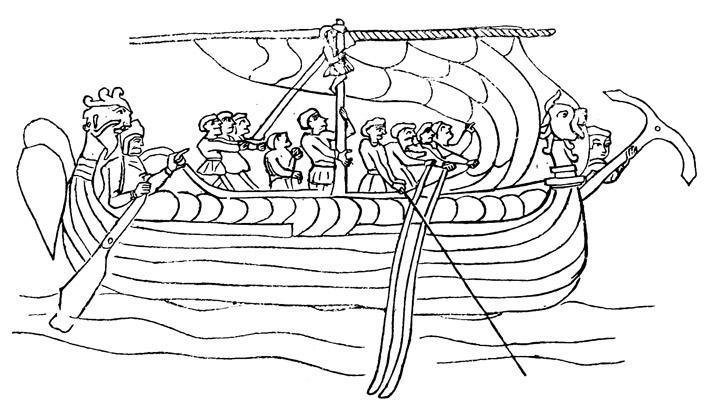
The stories as to the number of vessels under the orders of the Conqueror on this memorable expedition are very conflicting. Some writers have asserted that the total number amounted to no less than three thousand, of which six or seven hundred were of a superior order, the remainder consisting chiefly of boats temporarily built, and of the most fragile description. Others place the whole fleet at not more than eight hundred vessels of every sort, and this number is likely to be the nearest to the truth. There are now no means of ascertaining their size; but their form may be conjectured from the representations of these vessels on the famous roll of tapestry still preserved at Bayeux, from which the following has been copied.[508]
Number of vessels engaged, and their form.
It is related that when William meditated his descent upon England, he ordered for that purpose “large ships” to be constructed at his seaports, collecting, wherever they could be found, smaller vessels or boats to accompany them. But even the largest must have been
of little value, as the whole fleet were by his orders burned and destroyed as soon as he landed with his army, so as to cut off all retreat and to save the expense of their maintenance.[509]
Those of our readers who have visited the north of Scotland, during the herring-fishery season, will readily notice the resemblance to the traditional form of the war vessels of the Saxons in the eleventh century exhibited by the larger boats owned by the present Wick or Lerwick fishermen. But as we have more than once had occasion to observe, though we are greatly indebted to antiquaries for their researches, the few drawings of ancient vessels preserved are scarcely objects of instruction. Even the vessels on the Bayeux tapestry give us little that is definite, and we can hardly infer from them more than that we see in them an ideal but imperfect representation of the boats which were hastily constructed for William the Norman; while we may at the same time feel sure that the Saxon and Danish ships in ordinary use must have been stronger and better adapted to encounter stormy weather and rough seas than the vessels of a similar size and class in the Mediterranean. All details respecting them must, however, be conjectural; and a drawing of one class, even if accurate, may give as faint an impression of ships of another class, as the collier of to-day would afford of a modern Indiaman or Ocean-Steamer.
Nor, indeed, is it likely that the Conqueror’s fleet included many ships of a superior class or size, as we know that the great bulk, if not the whole of them, were built or collected, and fitted between the first of January and the latter end of August. Norman writers of the period state that their merchant vessels or transports were in length about three times their breadth, sometimes propelled by oars, but generally by sails: their galleys appear to have been of two sorts, the larger, occasionally called galleons, carrying in some instances sixty men, well armed with iron armour, besides the rowers. The smaller galleys, which are not specially described, doubtless resembled ships’ launches in size, but of a form enabling them to be propelled at considerable speed. Besides these, the Normans would
appear to have also used, for purposes of war, small light boats covered with leather resembling those already described.[510]
It is almost as difficult to arrive at any sound conclusion with regard to the actual state of trade and commerce in England at the time of the Conquest as it is with regard to the shipping. Agriculture, which had been in so flourishing a state under the Roman government, that large shipments of corn were frequently made to the Continent, had been much neglected during the long wars between the Britons, Saxons, and Danes; and there is no instance on record of any export of grain of any sort during the whole period of the Anglo-Saxon rule. On the other hand, in unfavourable seasons, the Britons did not grow enough for themselves, though the country must have been thinly peopled, and, consequently, but too frequently suffered severely from famine. In the account of the sales of church property and of other estates, many records of which are still extant,[511] we find that land even of the best quality seldom realized a higher price than five pounds[512] of silver for a hide of land, showing that while the people must have been widely scattered few persons were in opulent circumstances.
State of trade and commerce.
Exports.
Wool was however produced to a considerable extent, the rich pastures of England having furnished from the earliest ages ample food for large flocks of sheep. By the eighth law of King Edgar, the highest price which could be taken for wool was somewhat less than threefourths of a penny for a pound; and though there is no positive information on the subject, the Flemings, who were then and for some centuries afterwards the chief manufacturers of fine woollen goods for the whole of Europe, must have bought wool largely in the markets of England, and carried it away to be spun and woven in their own country. Lead was frequently used for the roofs of churches and other buildings; and from the records in Domesday Book it is clear that, during the reign of Edward the Confessor, there were iron works in the neighbourhood of Gloucester, of a date
perhaps as early as the Roman colonization.[513] Although there is no account of the exportation of any metals in the age now under consideration, it is reasonable to suppose that the demand at home and abroad for lead, tin, and iron, could never have wholly ceased, and that they must have formed a considerable part of the few exports during the Anglo-Saxon period.[514]
Horses, it may be presumed, were sometimes exported, as King Athelstan made a law against carrying any out of the kingdom except as presents.[515] The natives of Britain, too, were not unfrequently exported to the Continent and even to Rome, the handsome figures of these female slaves naturally attracting much attention. The merchants of Bristol and of Northumberland appear to have been the chief dealers in this inhuman traffic, the former finding in Ireland the readiest and the largest market for their slaves. [516]
Concerning the ordinary description of manufactures, the meagre chronicles of the period furnish little information. We find, however, that Northumberland was then comparatively famous, as it has been ever since, for the manufacture of glass, while the English jewellers and workers in gold surpassed those of most other nations. Nor were the women of England less famous for their taste and skill in the embroidering of silk of various colours interspersed with threads of gold and silver. So famous, indeed, were they in this description of work, that when William the Conqueror sent to his patron, Pope Alexander II., the banner of Harold wrought for him by them, it was remarked that “it might be greatly admired even in Constantinople,”[517] then the wealthiest and most refined city of the world; and similar presents made by him to the church of Caen in Normandy are said to have been “such as strangers of the highest rank, who had seen the treasures of many noble churches, might look upon them with delight; and even the natives of Greece and
Manufactures.
Arabia, if they were to travel thither, would be equally charmed with them.”[518]
At this early period there must have been a considerable amount of accumulated wealth in England, to have enabled Canute to have expended the vast sums he is said to have done on his pilgrimage to Rome, or to have allowed Edward the Confessor to build the Abbey of St. Peter’s at Westminster, and many other churches, at an enormous expense. Nor do the resources of his treasury appear to have been drained by all this expenditure; for the quantity of money the Conqueror took from Harold enabled him to be, in the words of his biographer, “incredibly liberal” to the Church of Rome;[519] moreover, that some of the nobles had great wealth, may be inferred from the present of Earl Godwin to Hardicanute already alluded to, together with the other rich gifts which he bestowed upon the Church.[520]
Wealth.
Imports.
But the governing class and the great ecclesiastics must have had in those days the bulk of the wealth of the country in their hands; indeed, the limited extent of trade, and the character of the imports of the period, demonstrate plainly that such was the case. Silk, and similar expensive articles of dress, precious stones, perfumes, and other oriental luxuries, purchased in the ports of Italy or at Marseilles, are, with one or two extraordinary exceptions, the only items the historians of the period record as having been brought from foreign countries: these exceptions, strange to relate, consisted of portions of legs, arms, fingers, and toes, supposed to have belonged to canonized saints. It is almost impossible now to conceive that such articles constituted, at any period of English history, important items of her imports. There is, however, no doubt of the fact; and so high in estimation were such remains held, that Egelnoth, archbishop of Canterbury, is said[521] to have purchased at Paris, on his return from Rome, an arm of St. Augustine for one hundred talents of silver and one talent of gold; while Elfsig, abbot of Peterborough, gave no
less than five thousand pounds of silver for a headless body, which some knavish dealer had pronounced to be that of a distinguished saint.[522]
By the records of Domesday, nearly all the cities and boroughs of England appear to have been, in the reign of Edward the Confessor, the property of the king, or of some noble to whom the inhabitants looked for protection and paid a rent or borough-mail. London, Winchester, York, and Exeter alone enjoyed exemptions from taxes imposed on other cities of the kingdom. London was afterwards especially favoured by the Conqueror, who, recognizing the great importance of that city, endeavoured to conciliate the goodwill of the inhabitants by a charter, which not merely confirmed all the privileges they had previously possessed, but enjoined that “every child should be his father’s heir after his death.” To William the City owes the jurisdiction of the Thames,[523] the conservancy of which is even now to some extent in its hands, the Lord Mayor being still ex-officiochairman of the present board for that purpose. The inhabitants, or burgesses of London, also enjoyed the highly-prized privilege of hunting in the extensive chases of Chiltern, Middlesex, and Surrey, which, with the conservancy over the Thames, was confirmed by subsequent charters, and especially by that of Henry I.
Taxation. London specially favoured.
Chester specially burdened.
It is clear that the taxes imposed on the seaport as well as inland towns, were not arranged by any systematic law. Thus, for no especial reason that can now be discerned, Chester was taxed far more heavily than any other city in the reigns of both William I. and his predecessor, Edward. Dover again paid 18l. annually, but the burgesses, who were required to provide twenty ships, carrying twenty-one men each, for fifteen days in the year, were exempted from all tolls throughout the country. Sandwich was placed on a similar footing, but only paid 15l.per annum. In Southwark, the king claimed a duty on all vessels entering the “dock,” and levied a toll on
those that used the strand for the delivering or loading of their cargoes. Colchester paid two marks of silver, and also, as a composition for the rent of six pennies on every house, 15l.5s. 4d., of which 4l. was paid by the coiners. Yarmouth, which had seventy burgesses, was taxed to the extent of 27l. by toll to the king and earl. In Ipswich there were eight hundred and eight burgesses paying custom to the king, but the amount is not stated.
No determinate principle can now be discerned why such dues were exacted, small towns being in many cases required to pay more than others of double their size. In some places the taxes were paid in produce or merchandise—as, for instance, at Gloucester, where, besides 36l. levied in toll, the inhabitants had to contribute twelve gallons of honey, and one hundred iron rods to the king’s ships, together with a few other petty customs. Again, Leicester had also to provide honey, and twelve burgesses to supply the king’s army, and four horses to carry arms and stores to London when any maritime expedition was about to sail from the Thames. In Shrewsbury the king levied a tax of ten shillings on the marriage of every maid, and twenty shillings on that of every widow, besides numerous taxes upon the people in the shape of services or customs; and in Hereford, the king had one hundred and three tenants, including six blacksmiths, who performed certain services in lieu of rents, while the burgesses had, among other burdens, to provide “a bear, and six dogs for the bear.” At Sandwich, forty thousand herrings were demanded for the use of the monks of the neighbourhood.[524]
In many places, the records of Domesday show that considerable portions of the inhabitants were too poor to pay any taxes. Thus, in Norwich, while six hundred and sixty-five are rated among the burgesses, there are no less than four hundred and eighty heads of families who had no means of contributing. Notices are also preserved of the number of houses at that time in a state of decay or disuse: thus, at Winchester, whole streets and
State of the people at the time of the Conquest.
many churches were in a state of ruin; in Thetford, there were one hundred and twenty houses empty; in Ipswich, more than three hundred and twenty-eight falling to decay. In Chester, once so flourishing and so heavily taxed, there were, soon after the Conquest, two hundred and five houses lying waste; while, in York, four hundred houses were so much decayed, as to pay only one penny each, or even less; five hundred and forty were waste, and paid nothing; and one hundred and forty-five were occupied by Frenchmen, who were relieved from the tax.
But while poverty and oppressive taxation ground down the masses of the people, the nobles abandoned themselves to the excesses of gluttony, drunkenness, and promiscuous concubinage, frequently not scrupling to consign the objects of their lust, and even their own offspring, to the miseries of slavery, for paltry sums of money to be squandered in wretched folly. Learning was almost at as low an ebb as it had been at the commencement of the reign of Alfred; while the middle classes, with some, though few, exceptions, were, in many respects, no better than the nobles, and trade and commerce languished and declined. Such was the state of things in England when the Norman conqueror landed on its shores.[525]
FOOTNOTES:
[464] Laing’s Transl. of the Heimskringla, p. 135.
[465] Monach. Sangall. De rebus Caroli Magni ap. Muratori. Antiq. v. 1.
[466] Full details of this, and of two other less perfect vessels discovered about the same time, at Thorsbjerg and Nydam, in S. Jutland, are given in the very interesting work by Mr. C. Engelhardt, entitled “Denmark in the early Iron Age,” Lond. 4to. 1866. From the frontispiece of this work the accompanying plate has been taken. Special attention has been called to it by Mr. J. H. Burton, to whose “History of Scotland” we are indebted for some of the notices of the Scandinavians.
[467] We have also a record of the discovery in England of two very ancient oak boats of considerable size. The first was found in 1822, in a deserted bed of the
River Rother, near Matham, in Kent, and has been fully described in the Archæol. vol. xx. p. 553. This boat, which was sixty-three feet long by fifteen feet broad, appears to have been half-decked, and to have had at least one mast. It had been caulked with moss. The second was found in 1833, at North Stoke, near Arundel, in what was formerly a creek running into the River Arun. This boat, which was made of the half of a single oak-tree, hollowed out like a canoe, was thirty-five feet four inches long, and four feet six inches broad. It is now preserved in the British Museum, having been presented to that institution by the Earl of Egremont. —Vide Archæol. vol. xxvi.
[468] St. Patrick flourished from A.D. 432, the year of his mission to England, to 493; St. Brigit, about 500; and St. Columba, from 522-97. The venerable and more trustworthy Bede, who mentions Horsa by name (Eccles. Hist. i. c. 15), lived at a much later period, A.D. 750.
[469] Bede, ii. 3.
[470] The kingdom of Mercia comprised the midland and western counties.
[471] Muratori, Antiq. v. 12.
[472] Laws of Hlothar and Eadric, ap. Schmid’s Anglo-Sax. Laws, c. 1-5, p. 11. Leipsig, 1858.
[473] Scriptores Brit. Gale, p. 762.
[474] William of Malmesbury, s. 17, and M. Paris Vit. Offæ.
[475] Macpherson, i. p. 251; and compare Monach. Sangall, i. c. 13, ap. Muratori, Antiq. v. 1.
[476] This first Danish invasion is said to have taken place A.D. 753. Macpherson, i. p. 247; and Chronic. Augustin, ap. Twysden.
[477] Sir H. Nicolas (“Hist. Roy. Navy,” i. p. 10) states that the Snekkar, or Serpent, was manned by twenty rowers. See also Depping, “Hist. des Exped. Maritimes des Normands.” i. 71-73.
[478] Macpherson, in his “Annals of Commerce,” vol. i. p. 254, says that “the Norwegians and Danes, under the names of Ostmen (i.e. eastern men), Gauls, Gentiles, Pagans, &c., were the chief, or rather the only commercial, people in Ireland, and continued for several centuries to carry on trade with the mother countries, and other places on the west coast of Europe, from their Irish settlements.”
[479] See Saxon Chronicle A.D. 897, Florence of Worcester; Simeon of Durham, the Chronicle of Melros; and Pauli, “Life of Alfred,” p. 212.
[480] Pauli, “Life,” &c., p. 178.