Introduction
In his Second Inaugural Address, delivered years into a war that had torn the nation apart, Abraham Lincoln remarked that both North and South “read the same Bible and pray to the same God, and each invokes His aid against the other.”1 The speech was brimming with biblical quotations—“more like a sermon than a state paper,” according to Frederick Douglass.2
But Lincoln’s famous speech was only the most prominent example of biblically infused wartime rhetoric. The Bible saturated the Civil War. Preachers, politicians, and people everywhere reached for the Bible because it was a text for the times. It evoked sacred history and sacrifice. It presented a drama of salvation and damnation, of providence and judgment.
It was also a book of war. In the Old Testament, God’s people of Israel battled Canaanites, Philistines, and others.3 Sometimes they even fought among themselves—Israel erupted into a civil war between northern and southern kingdoms after King Solomon’s death. The New Testament also highlighted war, but in different ways. The Gospels and epistles represented the Christian life as spiritual warfare, and the book of Revelation offered a tale of cosmic war.
Much of this was common knowledge during the Civil War; from Massachusetts to Mississippi and beyond, the Bible was the nation’s most-read and most-respected book.4 B. H. Nadal, a Methodist pastor in Washington, DC, and a southerner who sided with the North, found the Bible wherever he looked: “So thoroughly does the Bible pervade the country, that no house is respectable without it, every room in the chief hotels contains it; it is found in every steamboat cabin; its teachings are sought to be illustrated and enforced by largely more than half the literature of the country.”5
By the time of the Civil War, Christianity was prospering in the United States. Protestants dominated, with more churches, more members, and more money than other religious groups. In 1860, about fifty thousand Protestant churches were spread across the nation, compared with seventyseven synagogues or temples and approximately twenty-five hundred Catholic churches.6 There were an estimated 450,000 enslaved Christians by
the beginning of the war, most of them Baptist or Methodist.7 Americans seemed more involved in churches than in national politics. “Nearly four times as many attended church every Sunday in 1860 as voted in that year’s critical presidential election,” wrote Drew Gilpin Faust.8
This religious nation shaped a religious military. “Civil War armies were, arguably, the most religious in American history,” James McPherson has written.9 Americans cited the Bible in addressing many wartime issues, including slavery, secession, patriotism, federal versus state authority, white supremacy, and violence. In scripture, both Union and Confederate soldiers found inspiration for dying and killing on a scale never before seen in American history: the war’s approximately 750,000 fatalities are far more than the nation suffered in any other conflict.10
“War is hell,” as many have said, including General William Tecumseh Sherman. Americans who endured the Civil War agreed. “War is the highest exhibition of hatred on the largest scale,” said a Virginia minister in 1861.11 Hell though it was, war often served divine purposes, many Americans believed. Wars could be both terrible and righteous. Americans fought the Civil War with Bibles in hand, with both sides calling the war just and sacred. This is a book about how Americans enlisted the Bible in the nation’s most bloody and arguably most biblically infused war.12
“The Bible Is a Wonderfully Simple Book”
Although Protestantism dominated the religious landscape during the Civil War, the Bible’s appeal extended beyond Protestantism, beyond Catholicism and Judaism, beyond any religious tradition. Even Americans who claimed no religious affiliation could find political value in the scriptures. Americans sometimes “detheologized” the Bible, believing that it held political insights regardless of whether it was the inspired Word of God.13
When searching for biblical guidance on the war and other issues, especially slavery, Americans often looked to ministers as the leading experts on scripture, but not always. Some found insightful biblical commentary in poetry, as in the writings of abolitionist and lecturer Frances E. W. Harper, including her “Bible Defense of Slavery.”14 Few speakers rivaled the fame of abolitionist Frederick Douglass, who fine-tuned the prophetic witness of scripture and, as historian David Blight wrote, “mastered the oratorical art of the jeremiad, the rhetorical device made famous in America by the
Puritans.” The jeremiad—named for the Old Testament prophet Jeremiah— confronted people with their sins, warned that God would punish them unless they repented, and promised that repentance would lead to redemption. In the hands of Douglass and countless others, the jeremiad flourished during the Civil War, in Union and Confederate variations.15
The Bible’s status was growing as the Civil War approached. After the Revolution, Americans gained more trust in their ability to govern themselves and to think for themselves. As they trusted themselves more, Americans depended on other authorities less, including their traditional superiors in social class, politics, and religion—except for the Bible, that is. As other traditional authorities lost credibility, the Bible gained religious and cultural authority.16
Diverse as they were, many Americans united around their respect for the Bible. Americans typically had a common-sense view of biblical interpretation, and they took the Bible at face value, without thinking of it as a collection of texts from an ancient world far removed from the nineteenth-century United States. Many Americans agreed with Methodist author and evangelist Phoebe Palmer’s statement from 1865: “The Bible is a wonderfully simple book; and, if you had taken the naked word of God as . . . your counsel, instead of taking the opinions of men in regard to that Word, you might have been a more enlightened, simple, happy and useful Christian.”17
Not everything in scripture had to be read literally—some texts were poetic, some contained metaphors and symbols. But the dominant mode of reading the Bible at the time suggested that if a text described a historical event, that event occurred. Although modern biblical criticism, much of it originating in Germany, had made inroads into the United States, most Americans didn’t know about it. When Americans argued over the Bible— as when they defended or attacked slavery—they usually collected as many quotations as they could to support their points. Yet that way of reading scripture only went so far, as many Americans came to see during the Civil War. Too often, biblical debates over slavery and the war had no clear winner.18
Americans cited the Bible in various ways. Sometimes a text from scripture was a rhetorical allusion, used to support a viewpoint but with little or no elaboration on the scripture, its context, or its full meaning. At other times, biblical passages received extensive focus. Most often Americans looked for analogies between biblical wars and the Civil War. It seemed to them that biblical heroes, villains, and battles leapt off the page, strikingly relevant to the heroes, villains, and battles of the Civil War.19 Americans also
called on biblical precepts—including the Old Testament command “Thou shalt not kill” and Jesus’s commands to love one’s enemies and to turn the other cheek—and argued for their relevance to the war.20
Americans’ use of scripture wasn’t always simple. In his book on Lincoln, historian Joseph R. Fornieri identified several ways Lincoln cited scripture, including theologically (discussing God and providence), civil theologically (“as a transcendent rule and measure to judge public life”), and evocatively (“for stylistic purposes and rhetorical emphasis”). While Americans may have read the same Bible, they appealed to it in many ways. Whether examined closely, alluded to briefly, or cited in an offhand, poetic, or even sarcastic way, the Bible appeared almost everywhere during the Civil War.21
“The Bible Is Eminently a Patriotic Book”
No matter where or how they cited it, many Americans believed the Bible had a unique connection to the United States. They often said God worked through providence, guiding history—and guiding the nation—but they disagreed on how providence worked, and differing views of providence shaped differing opinions on the Bible.22
Because many Americans believed that God controlled the war, they pondered the roles of human agency and free will. In 1862, Bishop Charles Pettit McIlvaine of the Northern Episcopal church wrote of “the great rebellion,” saying, “There are two aspects in which we must contemplate it”—how it came “by the agency of man, and as it comes from the Providence of God.” He advised people to remember that “God’s Providence has no interference with man’s responsibility.”23 Charles Hodge, professor at Princeton Theological Seminary, offered an explanation of providence when the nation seemed to need it most—after Lincoln’s assassination. Hodge said that God “governs free agents with certainty, but without destroying their liberty”— a point often made but often misunderstood during the Civil War. “Every great event,” wrote Hodge, “is to be viewed in two different aspects: first, as the effect of natural causes; and, secondly, as a design and result of God’s providence.”24
Both human agency and divine providence brought about the Civil War, and many believed that Americans needed to see it that way. This was a delicate balance, in victory and defeat. Ministers instructed soldiers to trust in God, not in their own effort in combat—but not too much. They needed to
drill and fight zealously, and not depend only on God, because God helped soldiers who helped themselves.
Scripture demanded patriotism, Americans vowed. “The Bible is eminently a patriotic book,” preached William Barrows to a regiment of Massachusetts volunteers in 1863. The Bible, Barrows told these troops, promoted “the love of country” and opposed “treason and rebellion.” The Bible, Americans believed, supported personal virtue, political liberty, and republican government—a lesson drawn from the American Revolution.25
Sometimes patriotism went too far. “God cannot afford to do without America,” said Methodist bishop Matthew Simpson.26 Idolatry—worship of the nation—was a real danger, many believed, and they used scripture to draw the line between patriotism and blasphemy. “One cause of our present adversity is found in the national idolatry to which we have been addicted,” said a Baptist minister in Philadelphia. As northerners waved American flags like never before, he cautioned, “We have been disposed to love our country with an undue affection.” People thought of the Union as “some deity worthy of our homage. We have thought that there was such magic in that word ‘Union,’ that no assault made upon it could be successful.”27
Lincoln had fabricated an idol out of the nation and forced the people to worship it, southerners claimed. Lincoln was “the American Nebuchadnezzar,” the Babylonian king discussed in the book of Daniel, who ransacked Jerusalem, forced God’s people into exile, and commanded them to worship a golden image.28 In turn, many northerners charged the South with crafting its own golden image out of slavery.
These ideas relate to “civil religion,” which, in George Rable’s brilliantly concise definition, was “a set of beliefs about the relationship between God and the nation that emphasized national virtue, national purpose, and national destiny.” Religious views of the nation varied and shifted over time, but in general most Americans believed in some version of civil religion. The Civil War strengthened this belief for most Americans on both sides of the fighting, and Americans used the Bible to shape their views of national destiny—and national idolatry.29
“A
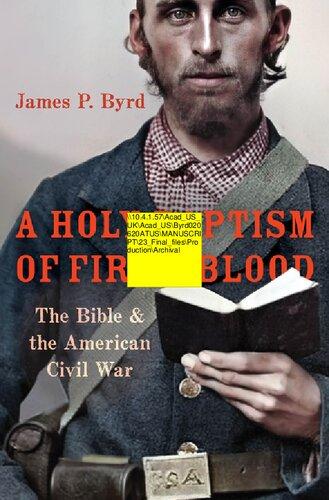
Holy Baptism of Fire and Blood”
In addition to the massive death tolls in the Civil War, the way Americans died still shocks us. During “Pickett’s charge” at Gettysburg, about fourteen
thousand Confederate soldiers advanced against heavy fire—a virtual suicide mission. James McPherson has asked: “What made these men do it?” Compared with soldiers in other wars, many soldiers in the Civil War were more willing to sacrifice themselves in battle. Several factors accounted for this courage, and religion was one of the major ones, with some soldiers calling the war “a crusade.”30
Martyrdom and blood sacrifice surrounded the Civil War. The pages of the Bible were filled with martyrs, and martyrdom was a major theme shared by the Old and New Testaments. “The Bible gives a significance to the shedding of blood, such as no human history ever did or ever will,” said a Congregationalist in Minnesota. “The shedding of blood in war, terrible and awful as it is, is sometimes not only justifiable, but absolutely demanded by the Almighty.”31 “Our cause is sacred,” said a North Carolina minister, responding to the Battle of Shiloh in 1862. “How can we doubt it, when we know it has been consecrated by a holy baptism of fire and blood.” The war “has been rendered glorious by the martyr-like devotion of [Confederates] who have offered their lives as a sacrifice on the altar of their country’s freedom.”32
Preachers were not alone in this martyrdom obsession. Southerner Lucy Rebecca Buck wrote in her diary about visiting soldiers’ graves in 1862: “There under my very feet they rested so still, so silent, those men who had for the love of country and freedom risked their lives and lost them in battling the usurper of their sacred rights.” So many of these soldiers did not die in glorious battles; they succumbed to disease, languishing “in agony upon friendless couches.” But these men “died no less martyrs to their cause.”33
Biblical views of sacrifice resonated so strongly because of the unprecedented death toll of the war, which, as Drew Gilpin Faust wrote, was “approximately equal to the total American fatalities in the Revolution, the War of 1812, the Mexican War, the Spanish-American War, World War I, World War II, and the Korean War combined.” Further, “The Civil War’s rate of death, its incidence in comparison with the size of the American population, was six times that of World War II.” The toll was worse on the South, as “Confederate men died at a rate three times that of their Yankee counterparts; one in five white Southern men of military age did not survive the Civil War.”34
The body counts skyrocketed partially because military technology had improved. Smoothbore muskets with a range of one hundred yards were being replaced by rifles, accurate to three hundred yards. By late 1864 some Union soldiers had breech-loading rifles, which could be loaded more
quickly and thus fire more rounds. Cannons killed thousands of soldiers in the war. Still, in comparison with more recent wars, few Civil War deaths were impersonally inflicted—that is, killed from long distance. Faust argues that “physical distance between enemies facilitates emotional distance from destructive acts.” In the Civil War, much of the killing was up close and personal.35
Many Americans who lost family members had nothing to bury—their loved ones’ remains lay unidentified, often in mass graves near battlefields. This was particularly traumatizing to Americans in the nineteenth century, when many believed in a bodily resurrection and insisted on a proper burial. Many Americans didn’t think it strange, for instance, that Abraham Lincoln reportedly had his son Willie’s coffin exhumed on two occasions; it comforted Lincoln to see his son’s body. Such comfort was impossible for thousands of Americans who lost loved ones in the war, and many turned to the Bible to deal with the death they encountered. All this death had cheapened human life, many believed, and they revered the Bible’s teachings on the sacredness of the body and life in this world, not just in the hereafter.36
“Harder Courage”
Dying for God and homeland was honorable, respected on earth and rewarded in heaven. But what about killing? In 1862, Orestes Brownson ruminated on the horrific bloodshed that gripped the nation. “It is real blood, not red paint that flows, and real life-warm blood must still flow, and flow in torrents.” Shedding this blood was terrible but necessary, he wrote. “We must have not only the courage to be killed, but we must have . . . the harder courage to kill,—not simply to bear, but to do harm, to strike the enemy in his tenderest part our quickest and heaviest blows.”37 As Drew Gilpin Faust wrote, motivating soldiers to kill was more difficult than inspiring them to die for the cause. It “required the more significant departure from soldiers’ understandings of themselves as human beings and . . . as Christians.”38
The Bible made it hard for many Americans to kill. The Ten Commandments declared, “Thou shalt not kill,” even though the Old Testament itself was suffused with war and killing. The New Testament, by contrast, seemed to forbid killing. Many Americans—including some Protestants, Catholics, and especially Mennonites and Quakers—believed Jesus rejected war, indeed any kind of violence.39 Jesus refused to fight to
defend himself, choosing instead to die on a cross, and in his Sermon on the Mount he commanded his followers to turn the other cheek, not to strike back when attacked. These words dampened wartime zeal—and not just for those in traditionally pacifist denominations. Many agreed with an officer from Indiana: “Read all Christ’s teaching, and then tell me whether one engaged in maiming and butchering men can be saved under the Gospel.”40
This explained why a Jewish woman from Richmond reportedly claimed she was glad to be “born of a nation, and religion that did not enjoin forgiveness on its enemies, that enjoyed the blessed privilege of praying for an eye for an eye” (Exodus 21:24). She told her Christian friends that “till the war was over they should all join the Jewish Church, let forgiveness and peace and good will alone and put their trust in the sword of the Lord and Gideon” (Judges 7:20).41 Throughout the war, Americans often turned to scripture to inspire the “harder courage to kill,” and this involved convincing Americans that the Bible didn’t forbid war.
“History Ever Repeats”
“Even the simplest records of the word of God” were “many-sided, and full of light,” said a minister in 1865.42 As Americans pored over every detail of the Bible, searching for God’s will, they often found uncanny similarities between biblical events and current events. “We have had parallels given us from all history,—from the old history of the Bible,” said a minister in 1863. These parallels were “very eloquent and convincing, showing how History ever repeats” itself.43
Wars held special meaning in God’s providence, many Americans believed. Wars signaled turning points in the history of nations, and people seemed more attentive to God’s providence in wartime.44 Americans often agreed with Southern Methodist John Caldwell’s statement that God “is in every war, in every campaign, in every battle, in every great political and social change, and directs every movement for the accomplishment of his own grand purposes. If war results in the subjugation of a people, or the annihilation of an institution of society, we must accept such result as Heaven’s decree.”45
In theory, then, belief in providence should bring comfort in wartime—all events rested securely in God’s hands. In reality, however, faith in providence could falter. In an unpublished letter from 1862, a woman from Georgia
wrote to her husband that she would “try to believe that providence has called you to the field for some special work, and I pray I may be spared to see some of the fruits of your labors.”46
Both Yankees and Confederates looked for evidence that God was on their side. Defeats didn’t mean God had abandoned a nation; they meant God had punished the nation, perhaps in order to redeem it. In an unpublished letter from 1862, Chaplain Richard Johnson of South Carolina wrote, “It is folly to suppose that a war which has assumed such gigantic proportions can be ended without a great deal of blood-shed.” The reason? “God is chastening us, but he has not forsaken us. If we endure not chastisement whereof all are partakers, then are we not sons but bastards.”47 Consequently, God punished those whom God loved, and the Bible is replete with evidence for this in the Old Testament, which Americans turned to for comfort in hard times.
“An
Admirable Political Sermon Very Warlike in Its Tone”
War, Jill Lepore writes, involves “wounds and words”—violence and interpretation, words to justify killing, to cope with loss, and to make sense of victory and defeat. In the Civil War, these words of war often came from scripture, and people often encountered them in preaching. Sermons filled the Civil War—spoken and printed, both separately and in thousands of newspapers. In his history of religion in the Civil War, George Rable states, “Sermons are vitally important, often revealing, and occasionally even stimulating sources for understanding how Americans interpreted the war through a religious lens.”48
Americans were used to wartime preaching. They frequently labeled the Civil War as a second American Revolution, and ministers followed rituals of wartime preaching that figured so prominently in the Revolution. Americans heard sermons on special days of prayer and fasting, when people were called on to repent and to ask for God’s help during times of defeat and trial, and on days of thanksgiving, when they were called to thank God for victories. These rituals, which had flourished in Puritan New England and in Revolutionary America, expanded during the Civil War. Southerners embraced these rituals—in fact, “The Confederacy would employ the public fast more frequently than the North,” Harry S. Stout concluded. “In all, Abraham Lincoln would proclaim three national fasts throughout the war while, in the same period, Jefferson Davis would proclaim ten,” not counting the many “state
and local fasts” held in the South, in addition to “fasts in the army.” Lincoln proclaimed more thanksgiving days (four) than Davis (two) as, over time, the progress of the war gave the North more to be thankful for.49
Ministers called people to pray and fast for both spiritual and military reasons. As in the Revolutionary War, Christians in the Civil War saw a clear connection between spiritual warfare, a fight between good and evil in the soul, and military struggle. Prayer, then, could have strategic power, and ministers found biblical texts to prove this point. In an unprinted manuscript sermon from 1862, an Episcopal bishop in Tennessee wrote, “We know not how often prayer spreads an adamantine armor around those, near & dear to our hearts, who like the men of Zebulun & Naphtali jeopard their lives, for country’s sake, in the high places of the battle-field” (Judges 5:18).50
Evangelical Protestantism dominated in the South before and during the Civil War, and the sermon was central to evangelical worship. New England Puritans may have introduced the jeremiad to colonial America, but southern preachers tried to perfect it.51 Sermons echoed throughout the Civil War, as they had throughout the Revolutionary War, but Civil War sermons had even more exposure, as they frequently appeared in thousands of newspapers. When Americans saw or heard the Bible applied to the war, it was often in sermons.
Not all sermons were profound, however. Americans, especially those who loved scripture, could be harsh critics of bad sermons. “Does it not seem that the ministry is overstocked with fools?” asked Sarah Morgan of Louisiana in 1862. As she wrote of a bad preacher in her diary, “The most beautiful passages of the bible, those I cry over alone, appear absurd from his lips.”52
Americans were just as ready to praise a good preacher. A year earlier Emma Holmes, a South Carolinian in her twenties, applauded a preacher who showed “an exact parallel between the separation of the Israelites from the Jewish Nation under Rehoboam’s oppressive rule and our secession.” In December of that year she glowed over “a most beautiful & appropriate sermon,” noting that “the text [was] the most appropriate that could have been chosen: Job’s reply to his wife, ‘We have received good from the Lord & shall we not receive evil also.’ ” It was a fitting text, since “Many of the congregation had lost their homes & almost everything.” Understandably, “There were but few dry eyes when he finished.” Again, in February 1862, she reported on “an admirable political sermon very warlike in its tone.”53
If Emma Holmes liked a sermon “very warlike in its tone,” she was not alone. As had been the case during the American Revolution, Civil War
preachers strove to meet military needs, often enlisting the Bible to inspire soldiers to join up and fight.54
Many of these “warlike” sermons focused on the New Testament, which was the trend of the times. As Eran Shalev has argued, “By the second half of the nineteenth century the Old Testament’s influence on the American political imagination had dramatically diminished.” Americans had turned to the New Testament, in part because of revivalism and in part because many Americans used the New Testament to address slavery. In wartime, however, Americans often turned back to the Old Testament, with its stories of God’s people at war, led by heroes like David and Joshua. “The Old Testament, in our current notions and sympathies, has been almost outlawed from human affairs,” said A. L. Stone of Boston in 1862. “We have turned its leaves for its curious and quaint old histories, but felt as though we were living under a new dispensation.” The war had changed that, however. As he said, “Now the days have come upon us, for which these strong-chorded elder Scriptures have been waiting. Their representations of God, as the Rewarder of the evil doer, the Avenger of the wronged . . . suit the day and the hour of the intense present.”55
Americans continued to hold on to the image of the United States as “God’s new Israel” in every arena in which people discussed politics— newspapers, sermons, letters, and diaries. This view had a long history. Beginning in Europe and extending through colonial America, some political thinkers looked to the Old Testament for models of republican government. Historians have shown how traditions of “Hebraic Republicanism” shaped “an American national and political culture from the Revolution to the Civil War.”56 What happened during the Civil War, when God’s new Israel ruptured? Which side—the Union or the Confederacy—could claim to be God’s chosen nation in 1861? This was no mere academic question for many Americans.
“The tragic irony of the Civil War,” wrote James McPherson, “is that both sides professed to fight for the heritage of liberty bequeathed to them by the Founding Fathers. North and South alike in 1861 wrapped themselves in the mantle of 1776.”57 This reverence for the Revolution was almost universal. An African Methodist Episcopal publication called on the memory of African Americans who fought in the Revolution: “Colored Americans! From the blood-consecrated soil of Lexington, and the heroic heights of Bunker Hill . . . the martial spirit of your brave progenitors, calls upon you now to do your duty to the ‘stars and the stripes.’ ” From the other side,
Confederates showed their loyalty to the Revolution by fighting against the nation the Revolution created. In an unprinted manuscript sermon preached from New Orleans in November 1861, Methodist minister Linus Parker said, “The principles of the first revolution are involved in this effort of the South to shake off the oppressive shackles of northern domination & Tyranny.”58
Americans admired the patriots of the Revolution, and among those patriots were preachers. During the Civil War, ministers read and even imitated sermons preached during the Revolution. After the fall of Fort Sumter, a Philadelphia minister titled his sermon after a patriotic sermon from 1775 and held up a Bible used during the American Revolution. Like many, this minister proclaimed (in all caps) that cowardice was unbiblical: “The last OF ALL PLACES IN THE UNIVERSE, BEHIND WHICH FOR COWARDICE TO SKULK OR FIND REFUGE, IS THE HOLY BIBLE.”59 Americans in the Civil War had the Revolution on their minds, not only as they fought the war but also as they preached and read the Bible.
“The Negro Is Not Your Equal, Unless the Bible Be Untrue”
The debate over the Bible’s view of slavery had raged for decades before the Civil War, and it picked up greater intensity—with higher stakes—during the war. As noted earlier, Americans typically assumed a democratic view of biblical interpretation—they claimed that individuals had the right to read the Bible for themselves, with no interference from any tradition or higher authority than the conscience. What happened, then, when Americans disagreed on what the Bible said about slavery? There was no authority in place to mediate the dispute; only war could settle the issue.60
For antislavery Americans, one of slavery’s greatest offenses was that it denied enslaved people the right to read, which meant it kept them from reading the Bible. Access to the Bible was a sacred right, and securing that access was a Christian responsibility. To block the Bible was to block salvation.
Slavery was one issue; race was another. Regardless of white Americans’ views of slavery, most of them believed their race to be superior to all others. Some of the most egregious uses of the Bible surfaced in racist biblical satire. In 1864, so-called “Peace Democrats” or “copperheads”—northerners who opposed Lincoln and the war—published a Lincoln Catechism, calling him “Abraham Africanus the First.” Included therein were Lincoln’s “Ten
Commandments,” such as “Thou shalt have no other God but the Negro” and “Thou shalt steal—everything that belongeth to a slaveholder.”61
Many white Americans, even in the North, agreed with several South Carolinians who declared, “The negro is not your equal, unless the Bible be untrue.”62 These racist assumptions went unchallenged by most Americans, even though supporters of these views struggled to find biblical evidence for them. Evidence or not, many Americans’ views of the Bible were replete with racist views, which whites were often oblivious to, despite efforts of many African Americans to strip scripture of its racist veneer.
“If the Bible Can’t Prevent War, How Is It to Stop a Bullet?”
The Bible had an important physical presence in the Civil War. As Mark Noll wrote, the Bible was “America’s most comprehensively present ‘thing’ from first European contact through the American War of Independence.”63 That was true also during the Civil War era. If Americans owned any books, the Bible was probably one of them. “If we did not have a Bible,” said Lizzie Ozburn in Georgia, “what would we do—tis more comfort to me than anything else now.”64 A copy of the Bible could offer solace in times of trial; it could also be essential battle gear. “Gallant sons of a gallant State,” preached a Methodist minister to South Carolina troops, “away to the battle field, with the Bible in your arms and its precepts in your hearts.”65
Americans did try to send soldiers into battle with the scriptures in their arms. Bible distribution was an enormous task, with chaplains and Bible societies handing out complete Bibles and New Testaments to soldiers. Printing presses, powered by steam, churned out thousands of Bibles for mass distribution. The American Bible Society had been in existence for forty-five years when the Civil War began, and with the war came the challenge of reaching the troops with the scriptures—a challenge the society accepted, reportedly handing out more than three million copies of the Bible or New Testament during the war.66
Bible distribution faltered in the South, and southerners often received Bibles from the American Bible Society. The Confederacy inaugurated its own Bible society in 1862, which tried, but failed, to meet the demand. The war made it difficult for the ABS to get Bibles to the South, in part because of logistical problems and in part because many southerners did not want Yankee Bibles.67
The Authorized Version of the Bible—the “King James” translation, so named because England’s King James I authorized it in 1611—was by far the most used version of scripture in the United States. The King James Bible dominated because Protestants dominated. The King James, in the view of most Protestants, was the only Bible.
Not so for Catholics and Jews. Catholics preferred the Douay-Reims, a translation from the Latin Vulgate, and, shortly before the Civil War, many Jews praised a new translation by Rabbi Isaac Leeser of Pennsylvania. Finally, Jews could put aside the Bible of “a deceased king of England [King James] who certainly was no prophet,” wrote Leeser. This statement offended Protestants, who distrusted Catholics and Jews even more because they rejected the King James Bible.68
The King James Bible exerted a tremendous influence on language and literature in the United States. This was the case with soldiers in the Civil War, as well as with President Lincoln, whose speeches were often strewn with language that resembled phrasings from the King James Bible.
Many soldiers treasured their copies of the scriptures; others ignored them or spat tobacco into their pages. A colonel from Pennsylvania bragged, “I know but one text of the scriptures, ‘Cain murdered Abel’; go and do likewise.” Regardless, when offered Bibles or testaments, soldiers rarely turned them down.69
Soldiers often claimed that the Bible could save them in the heat of battle. In any war, control could seem to be an illusion—it seems like nothing ever happened as planned. Many soldiers trusted in God’s providential control; others entrusted their lives to the whims of chance or fate, and they grasped at any opportunity for comfort in the chaos. In some wars, soldiers relied on charms, including rabbits’ feet and locks of hair, for good luck. But this was not so prevalent in the Civil War. In his study of soldiers’ motivations, James McPherson found “no evidence of Civil War soldiers carrying rabbits’ feet or anything else that they might have considered a talisman. But many of them did carry pocket Bibles or New Testaments, and numerous are the Civil War stories of a Bible in a breast pocket stopping a bullet.”70
Even those who were not religious sometimes kept a Bible around for protection. A soldier from the Third New York Independent Battery reported “cases when card players, on going into battle, would throw away their cards and place their testament in their breast pocket over the heart.”71 Scripture was both sword and shield, sometimes literally.
The Bible didn’t always work its bulletproof magic, however. Mary Chesnut noted a soldier was “found with a bullet through his heart and a Bible in his pocket, marked: ‘From the Bible Society to the defender of his country.’ ” She observed, “If the Bible can’t prevent war, how is it to stop a bullet?”72
The Data: Confederate and Union Bibles
Both North and South “read the same Bible,” Lincoln said. But the Bible is a large collection of books. Which biblical texts did Americans turn to most often in the Civil War? In pursuing this question, I have examined thousands of biblical citations in over two thousand sources, including sermons, diaries, letters, and newspapers.73 Consequently this book reveals more information than ever before about the Bible’s ubiquitous presence in the American Civil War.
The book’s appendix lists rankings of the most-cited biblical texts in the Civil War era, including separate rankings of the most popular scriptures in the Union and the Confederacy. These rankings indicate the contrasting approaches northerners and southerners took to the Bible. Although there was no single “northern” view of the Bible any more than there was one unified “southern” view, certain biblical texts rose to the forefront during the war. Overall, the most cited texts of the “Union Bible” were used to defend Lincoln and the nation against rebellion, which often involved insisting that the United States was God’s chosen nation. Among the critical passages was Romans 13, which Union interpreters used to condemn rebellion by citing Paul’s threat of damnation against radicals who attacked their God-given rulers. How could anyone rebel against the government if to do so was to rebel against God?
Yet the Confederates had a strong retort: didn’t the patriots of 1776 revolt against their “higher powers”? Revolt was not out of the question for Americans, and Romans 13 had been popular in the American Revolution, used by loyalists and patriots alike. Arguments for and against “rebellion”— or “revolution”—were just part of the appeal of Romans 13. Americans also quoted it to call for justified violence, citing Paul’s endorsement of the civil ruler as God’s “revenger to execute wrath upon him that doeth evil.” Typical was a letter to Lincoln, printed in a Methodist newspaper after Bull Run, telling the president that Paul gave him permission to be God’s “revenger,” and pledging devotion to Lincoln “in the holy bonds of patriotism.”74