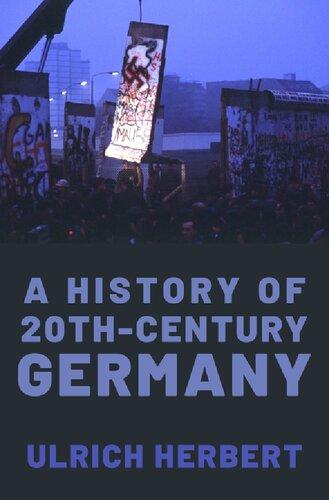
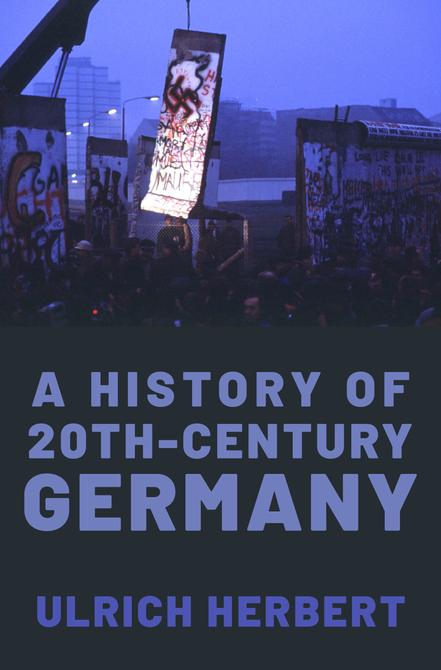
A History of TwentiethCentury Germany
ULRICH HERBERT
TRANSLATED
BY
BEN FOWKES
Oxford University Press is a department of the University of Oxford. It furthers the University’s objective of excellence in research, scholarship, and education by publishing worldwide. Oxford is a registered trade mark of Oxford University Press in the UK and certain other countries.
Published in the United States of America by Oxford University Press 198 Madison Avenue, New York, NY 10016, United States of America.
© Oxford University Press 2019
All rights reserved. No part of this publication may be reproduced, stored in a retrieval system, or transmitted, in any form or by any means, without the prior permission in writing of Oxford University Press, or as expressly permitted by law, by license, or under terms agreed with the appropriate reproduction rights organization. Inquiries concerning reproduction outside the scope of the above should be sent to the Rights Department, Oxford University Press, at the address above.
You must not circulate this work in any other form and you must impose this same condition on any acquirer.
CIP data is on file at the Library of Congress ISBN 978–0–19–007064–9
1 3 5 7 9 8 6 4 2
Printed by Sheridan Books, Inc., United States of America
Originally published as Geschichte Deutschlands im 20. Jahrhundert.
© Verlag C. H. Beck, 2016
Preface
The image of Germany has changed, but the country’s murderous past has not been forgotten. In spite of all the differences in detail, Germany is still initially associated in most other countries with Hitler and the Nazis. When the subject of Germany comes up in films or novels, it is as a rule in the context of the Second World War or National Socialism. In those Eastern and Western European countries which suffered most under German occupation, the Germans continue to be among the least popular European nations, for reasons it is not difficult to comprehend.
And yet, at the same time the present Federal Republic is almost everywhere regarded as a stable, though somewhat boring, Western democratic state. The peaceful reunification of the country in November 1989 has in many respects made a deep impression. Surveys of public opinion have shown that things like Germany’s commitment to ecological concerns and its acceptance of millions of refugees are viewed positively, although of course there are also diametrically opposed positions held on these matters.
In general, however, people actually have very little knowledge of presentday Germany, and what they do know tends to be associated vaguely with subjects like prosperity, social policy, football or fast cars. There seems to be a practical disconnect between the deeply-rooted and persistent memory of the Nazi period and this German present. A much less disturbed but also rather less interesting present has apparently edged its way into people’s minds alongside Germany’s catastrophic twentieth-century history, and it is evidently not easy to connect the two things together.
The situation was different in earlier decades. World-wide public perceptions of the history of Germany in the previous century, indeed perhaps of the whole of German history, were so much overshadowed, indeed dominated, by the massive crimes, inconceivable in their monumentality and frightfulness, which were committed during the Nazi dictatorship, that preceding years and decades were viewed as their historical background and the times that followed as their aftermath. The core question of contemporary German history was therefore: how did it come to this? ‘This’ was understood above all to mean the Nazi seizure of power, in 1933, and then later on the beginning of the systematic mass murder of the Jews of Europe, in 1941.
Contemporaries, both the protagonists themselves and observers from abroad, had also posed this question. For a long time the dominant conviction
was that the coming to power of the Nazis was to be attributed to aberrations in Germany’s more distant past. These were alleged to constitute a Sonderweg, or special path, stretching back into the eighteenth century or even earlier. This idea, that the development of a German ‘spirit of subservience’ could be traced back to Frederick the Great or possibly even Martin Luther, soon turned out to lack substance. On the other hand, the thesis that problematic structures had taken shape in Germany in the course of the nineteenth century, and that they had favoured the establishment of the Nazi dictatorship after 1933, appeared to be more convincing. To put it briefly, this thesis was based on the view that owing to Germany’s historically conditioned Kleinstaaterei, the nation-state could only arise, and industrialisation only take place, with the belatedness this necessitated. The German bourgeoisie had therefore been unable to develop a liberal, democratic self-awareness, or it had developed this only incipiently. As a result, the movement of liberal nationalism was defeated along with the 1848–49 revolution, mainly owing to the resistance of the nobility and the King of Prussia. The consequence was the emergence of a semi-feudal and authoritarian state, with which the bourgeoisie rapidly came to terms, partly because it feared the rising workers’ movement. According to this thesis, the overpowering influence of the old elites on the landed estates, in the military, and in the government administration had prevented the coming of democracy and parliamentary rule to Germany, and at the same time nationalism had become an ever more important way of binding the masses to the state. The democracy of the Weimar Republic, which replaced the Empire after defeat in the First World War, was therefore only able to draw support from a rapidly shrinking section of the population, and was finally destroyed by an alliance between the old elites and a nationalist mass movement.
Some aspects of this interpretation retain their persuasive force, but there are two arguments which have invalidated it as a whole. Firstly, the concept of a Sonderweg presupposes the existence of a norm from which there could be a deviation, in this case Germany’s deviation from the development of the big Western democracies. But neither in France nor in Great Britain did conditions reflect such a norm of ‘Westernism’. This is true whether one looks at the limited franchise, at the massive social contradictions, or, in the French case, at the deep chasm that separated the supporters of the republic from its opponents at the turn of the century, not to mention the colonial policies of the European states, which were the complete antithesis of any value-oriented conception of ‘Westernism’.
Secondly, the Sonderweg theory presented a distorted picture of the German Empire. It was impossible, it was true, to overlook the defects of the political system as regards the role of parliament or the influence of the military. But
these were offset by remarkable advances of a kind only achieved much later in other countries, such as universal male suffrage, the well-entrenched rule of law and social policy, in which Germany was a world pioneer. Moreover, the extreme right by no means exerted a determining influence in Germany before 1914. And if one bears in mind that throughout the period between 1919 and 1930 the democratic parties always possessed a clear electoral majority, the collapse of the Weimar Republic was, it seems, not unavoidable. Even in the spring of 1933 more than half of the population voted against the National Socialists.
During the post-war decades, both the Federal Republic and the GDR were long viewed primarily from the perspective of the Nazi state. Thus for many observers in the West, the East German state counted as a ‘second German dictatorship’ in continuation of the Nazi regime, as a repetition of that regime under different circumstances, and at the same time as a specific bureaucratic variant of communist rule within the Soviet Union’s sphere of influence. On this view, what the Nazi state and the SED state had in common was a rigid rejection of democracy, liberalism, freedom and human rights.
West German society, too, was long suspected of being nothing more than a successor of the Volksgemeinschaft of the National Socialists. The number of National Socialist officials who were able to continue their careers in the Federal Republic was also too large for this suspicion not to arise, and the impression was confirmed by constantly repeated scandals over personnel appointments. Moreover, although the fear that the drive towards expansion and world hegemony lived on in the German national character, and might possibly find expression at any time, was not voiced openly by the country’s western neighbours and allies, the feeling still existed. In 1989, after the fall of the Berlin Wall, the first thing the British Prime Minister said was a reference to a ‘Fourth Reich’, and in 1993, when outrages were committed against foreign asylum-seekers, world opinion placed them in the context of the pogroms of 9 November 1938.
Thus the shadow of the Nazi regime hung over the whole of Germany’s twentieth-century history. The period before 1933 was regarded as a preliminary to the dictatorship, while the period afterwards was viewed in the light of its consequences.
After 1989, however, when the reunification of Germany failed to produce the boastful nationalism which Mrs. Thatcher was not alone in expecting, the initial reaction of the outside world was one of irritation. When German foreign policy turned out to be marked rather by reticence, as in the case of the Gulf Wars of 1991 and 2003 or the war over Libya in 2011, and the German government persistently refused to take up the leading political role in Europe indicated by the country’s economic strength, there was great amazement.
Indeed, some people even called upon the Germans to exercise greater leadership, to become more engaged militarily and greeted Germany’s rejection of these demands with an angry response.
It had become obvious that the history of the Nazi period was no longer an adequate guide to understanding Germany. Other questions now came to the forefront: how could it have come about that within less than forty years the Federal Republic had become not only prosperous but as democratic, liberal and civil as the average Western society? To find an answer to this question is made more difficult by the fact that according to all the major parameters, West German society has developed in consonance with the other Western European countries since the 1950s. If one looks on the contrary for specific cultural, political and social features of West Germany as compared with the rest of Europe, leaving aside the debates over Germany’s past, it is not easy to find anything which can stand up to a more detailed examination.
This applies even in the sphere of economic development. After the country’s reunification and the unprecedentedly expensive reconstruction of the ailing regions of East Germany the German economy displayed a considerable shortfall in modernisation, and at the beginning of the new century Germany, with its five million unemployed, was regarded as the ‘sick man on the Rhine’, and certainly no longer as the economic Hercules its European neighbours had learned to fear. Admittedly, the (comparatively moderate) neoliberal thrust, which led after 2003 to a restructuring of the labour market and the tax system, and still more the tremendous appetite of foreign countries, above all China, for German products, entailed fresh growth and tremendous export surpluses, but these developments also increased the gap between rich and poor to a degree hitherto almost unknown in the country. The crises that followed, particularly those resulting from the world financial crisis and the euro crisis, threw the Federal Republic into a condition of turbulence, both domestically and in foreign policy. But Germany did not differ in this respect from other European countries, though the opportunity was repeatedly taken to criticise it as the new European hegemon, owing to its significant influence in the European Union, which was based both on its size and its economic strength. At the height of the Greek government-debt crisis, Greek demonstrators marched in condemnation of the European Union’s ‘policy of austerity’ with placards on which Angela Merkel was depicted wearing an SS uniform with a swastika sign. But attempts of this kind to brand the German Chancellor’s policy as a continuation of Hitler’s were almost universally regarded as utterly absurd.
It would not, I think, be too daring to derive the following prognosis from the above observations: Germany’s past will in the future continue to be perceived as its key feature. From the end of the nineteenth century onwards,
for more than a hundred years, right up to the fall of the Berlin Wall and reunification, Germany has stood at the centre of international crises. Now, however, perceptions of German history have begun to be less dramatic, and the country has as a result moved out of the centre of international interest, becoming comparable with countries like New Zealand or Canada. According to some opinion surveys, Germany is now even regarded, seventy-five years after the end of the Second World War, as one of the most respected countries in the world, a view which reflects not just its prosperity, economic strength and political stability, but also a liberalism in domestic politics, noted by many observers, which is perhaps highly unexpected in the German case, given the country’s past history.
The present work is chiefly concerned with the twentieth century. In its German version, it was completed at the end of 2013. One or two small changes have been incorporated into the English edition. The book constitutes an attempt to recount the frequently fractured, contradictory and complex history of the country, and to explain this history in a convincing manner, without reducing the story of Germany’s century to one or two strong theses. To write a national history, particularly in the German case, in a global and transnational age, is somewhat anachronistic, it should be said. It is clear that the national framework is not an adequate basis for understanding German twentiethcentury history, because even a cursory inspection would demonstrate that many important developments are not nationally specific but pan-European or even global phenomena. How could one possibly use the categories of the nation-state to explain historical manifestations of supranational dimensions— ranging from imperialism and the world economic crisis of the 1930s to the youth rebellion of the 1960s—when fundamental common processes, in their numerous variants, are patently involved?
Europe is indubitably our present. But our past continues to be rooted in the national. There are good reasons for this, for just as in all other European countries so also in Germany personal experiences and social traditions, political choices, cultural orientation and everyday familiarity are related to a person’s country of origin and residence.
The history of Germany and German society is therefore recounted here for its own sake, but it is also narrated in the context of Europe-wide developments and global interconnections. It is hoped that it will be possible in this way to free national history from its self-referential character without neglecting the innate momentum and the specific traditions of the country.
Whether the author has been successful, and whether he has been able to communicate his objective to the readers of the English-language edition, will be for those readers to decide. It only remains for me to thank the publishers
xvi Preface
for including this voluminous book in their programme, and the Stiftung Geisteswissenschaften International for awarding the book the German translation prize for the year 2015 and thereby laying the groundwork for the Englishlanguage edition. Above all, however, I should like to thank Ben Fowkes for his wonderful translation, and Larissa Wegner for her expert work in proofreading and correcting the text.
Ulrich Herbert, Freiburg, March 2019
Introduction
The twentieth-century history of Germany is marked by its division into two epochs, each of which could not be more markedly different from the other. The first half of the century was characterised by wars and catastrophes on a scale the world had never seen before. Germany occupied the central point in these events, and it has been associated ever since with the most frightful crimes in human history. The second half of the century, by contrast, led finally to a degree of political stability, freedom and well-being which, in 1945, had appeared to be utterly unattainable. The problem of how the two halves of the twentieth century are historically related in the German context represents the first unifying theme in the argument of this book. If a symbolic date has to be assigned to mark the transition from one epoch to the other, it should perhaps be the summer of 1942, when ‘Aktion Reinhard’ set in motion the systematic murder of almost all Polish Jews and the mass deportation of Jews from Western Europe to Auschwitz. How the economic and cultural blossoming of Germany from around the turn of the century could lead to such a bloody nadir is one question. The other question is how the German nation found a way out of this apocalypse over the sixty years that followed.
Nevertheless, as little as fifteen or twenty years before the summer of 1942, ordinary people could not even have suspected where events were leading. Nor could the anti-Semites and the National Socialists, who were relatively few in number at that time. This fact circumscribes the question, ‘How could it have come to that?’, by illuminating the openness of the historical process and the manifold byways and detours of history. The First World War was avoidable as late as June 1914. At the Reichstag elections of 20 May 1928, the National Socialists obtained no more than 2.6 per cent of the vote. As late as the autumn of 1939, the fate of the European Jews was still uncertain. Any attempt to unravel the problems of the present by reference merely to the facts of the past without consideration of the multiple possible alternative paths that events could have taken will only ever offer a partial teleology, one that unduly overlooks those historical developments that were cut short, ended in failure or simply petered out.
The course of events between the turn of the century and the apocalypse of mass murder was not predetermined, although the propulsive forces in that direction were plainly visible. Nor was there anything inevitable about the recovery of liberty and well-being after 1945, which occurred firstly in the western part of Germany, then in the whole country. Bearing in mind Germany’s
industrial potential, it was not out of the question that an economic boom could take place, although in view of the level of mass destruction at the end of the war, few people believed this was possible. But that it would once again be possible to awaken a sense of democracy, the rule of law and human dignity within such a nation and its leadership, and to give this a lasting character, appeared to be almost out of the question. The slow transformation which we can trace in the Federal Republic from a society moulded by National Socialism into an increasingly western and liberal society is one of the most remarkable developments of the century. Indeed, the more clearly we see the actual weight of the burden imposed by the personal and psychological legacy of the Nazi dictatorship, the more remarkable it becomes.
The second half of the century was divided in its turn. This was a division between East and West. As a result, people who lived in the eastern part of Germany only had an opportunity at the end of the century to share in the freedom and well-being of the West Germans. After 1945, people in the West fared much better than their counterparts in the East, even if this was not of their own doing, but resulted rather from the vagaries of fate and the decisions of the Occupying Powers. It soon appeared as if the Germans in the East of the country had to bear the consequences of the war by themselves. In this context, the history of the GDR was related more strongly to the year 1945 than that of the Federal Republic, as a product of the occupation policies of the victorious power, the Soviet Union, but also as a reaction by the German communists to fascism and war. The present book is in no sense a comparative history of the two German states, but it is impossible to deny that their relations, entanglements and antagonisms play as great a role here as the differences and similarities between them.
Without a doubt, the first strand of argument followed here bears an exclusively German signature. German history in this century differs from the history of all other countries, and cannot simply be subsumed under European history. Nevertheless, it is also a part of European history, hence the second major strand of the book’s argument is in conflict with the first, because it encompasses the caesura of the year 1945.
This second strand of our argument is intimately connected with the rise of industrial society in the two decades before the First World War and the repercussions of that fundamental transformation for the economy, the society, the culture and particularly the politics of twentieth-century Germany. After the turn of the century, the immanent tendencies of industrialisation were no longer restricted to specific groups and a minority of regions, as they had been in previous decades. Instead, they transformed the lives of almost all people. Moreover, this took place within the lifetime of one generation, and its impact was more far-reaching than had ever been seen before.
The intensity and the dynamic force of these changes confronted contemporaries with extraordinary challenges. The political, social and cultural movements which emerged in the decades that followed, each of which adopted highly radical positions, should be understood above all as attempts to react and respond to these challenges, which were perceived as previously unimaginable advances, but at the same time as symptoms of a profound and existential crisis of bourgeois society. Subsequent decades were moulded by the reaction to these tremendous changes, expressed in the search for a way of ordering politics and society which would promise to combine security with dynamic development, equality with continuing growth.
The First World War, the inflation and particularly the world economic crisis all eroded the legitimacy and persuasiveness of the liberal capitalist model in Germany. It found that it was faced with competition from radical left-wing and right-wing alternatives, which set the principle of unity against plurality, and countered diversity with dichotomies which were based on the categories of class or race. Large stretches of twentieth-century German history can be understood as the narrative of this competition between rival social and political models. At the same time, National Socialism and Communism did not embody ‘anti-modern’ social formations but rather proposals for a different way of organising the modern world, in which the liberal triad of the free economy, open society and belief in universal human values was disrupted in ways specific to each movement. Both movements should be understood as shorthand solutions to the dynamic changes that had taken place since the turn of the century. These responses were rendered more radical by the experiences of the First World War and the fierceness of the confrontation between the two competing proposals for a new social order.
After the Second World War, the principles of liberal and democratic capitalism were reactivated by the victory of the West, especially the USA, with its superior military and economic strength. In Germany, as over the whole of Europe, these principles developed a power of attraction which could hardly have been imagined during the 1930s. But it was only in the 1950s, when the free market economy and the liberal system had proved to be stable and successful, that liberalism really gained the upper hand. As the ‘social market economy’, it was clearly in competition with the Soviet conception of socialism dominant in the GDR, and it was closely bound up with the global confrontation of the Cold War.
In West Germany, as in most other Western European societies, a model gradually took shape in which capitalism was integrated with the social state. Liberal ideas were combined with ever broader conceptions of planning, and a focus on the nation-state by no means excluded an involvement in European integration. All this was understood in terms of an explicit and coherent
narrative of progress, which continued throughout this time to be focused on the challenges presented by the industrial society which had emerged during the late nineteenth century. Classical industrial society reached its zenith in the 1960s, but it increasingly declined in strength and prestige after that date. Until then, heavy industry and mass industrial employment had occupied an unchallenged position, but their dominance now began to be challenged. The model of industrial progress reached its limits, both in the West, where mines, steelworks and shipyards began to close, and in the GDR and the other lands of the Soviet Empire. In the latter case, the social and political order was completely oriented towards heavy industry and mass employment, and the erosion of classical industrial society led to collapse. The liberal capitalism of the West, on the other hand, proved to be more flexible, and after the 1970s it successfully adapted to the new conditions of the post-industrial era. Since then, a painful process of transformation has allowed the beginnings of a new economic structure to emerge, characterised by the provision of services, the globalisation of the economy and the return of traditional market-based models, with an outcome, however, which is by and large unknown.
This, the second strand of our argument, makes it possible to grasp the years between 1890 and 1990, the years of ‘high modernity’, as a historical unity, despite the frequent political disruptions experienced in this period, and to relate the very diverse individual developments in economics, politics, society and culture with one another. This allows us to decipher the associations between the first and second halves of the century without relying exclusively on the two world wars, the Nazi dictatorship, the GDR regime and the triumph of socially renewed and democratic capitalism.
It will already be clear from this short sketch that we are dealing here with transnational processes; and that our decision to concentrate on the history of Germany is in considerable need of justification. Until a few years ago, the situation was different, because the interest of the public and of modern historians in this country was almost self-evidently directed towards contemporary German history. The sequence of German Empire, First World War, 1918 Revolution, Weimar democracy, National Socialist dictatorship, Second World War, Holocaust and finally division and eventual reunification of Germany contained such a wealth of dramatic and large-scale events with such far-reaching consequences (and unexplained connections) that, as a rule, twentieth-century history meant German history. There is no doubt that Europe’s twentieth century cannot be understood without a detailed knowledge of German history. And, even if one approaches all attempts to construct a historico-political identity with the deepest suspicion, especially when they proceed from the fiction of naturally given units, one still possesses a living cultural attachment to the country in which one grew up and where one resides, and to its history.
But it is anachronistic to regard a concentration on national history as a matter of course, even if the manifold attempts that have been made to escape from German history and its consequences by asserting a European or universal identity can be recognised as an evasion of responsibility. The constant use of categories such as ‘industrial society’, urbanisation, imperialism, migration or ‘Cold War’ shows that the history of the twentieth century cannot be decoded nationally. This point applies specifically and emphatically to Germany.
This leads us back to the two overarching strands of argument which span the present work, and which also make it clear that Germany’s twentieth century cannot be summarised if we have recourse to a single thesis. Such an approach would be at variance with the multiplicity and contrariety of the movements involved, as well as the opaque and above all the contingent character of the developments investigated here. But there are some guiding threads we can follow for considerable periods of time: the abovementioned issue of the relation between industrial society and the political order is one such, and there are several others, such as the rise and decline of radical German nationalism, the relation between the culture of modernity and mass society, the dynamics of violence and war, the relation between the Self and the Other, and the tendency of developed industrial societies to converge. In this context, the attempt will be made to integrate the different fields of study, classically defined as politics, society, the economy and culture, and to demonstrate the connections between them. Culture will be understood here in the broad sense, as the reflection and the working out of social processes in the arts, science, public debate and ways of life.
In any case, the contradictory diversity of the twentieth century can also be gleaned from the author’s failed efforts to choose a catchy title for this book. Alternative titles under consideration all failed, needless to say, because they inevitably led to a one-size-fits-all approach. There was perhaps one exception: the author would have liked to have given the book the title The Years That You Know, following the title of a book written in 1972 by Peter Rühmkorf, in which he combined his memories of the 1960s with all sorts of poems and fanciful reflections. But the title is protected by copyright, since the book was reprinted in 2000, and, in any case, it would doubtless be somewhat impertinent to make such a takeover bid. This is why the present book is now drily entitled A History of Twentieth-Century Germany, which is after all a precise description of what is being attempted here. The Years That You Know, however, would have addressed the complex relationship of the Germans to their own twentieth century—a contemporary history which never fades from view. It is true that when this book came out, the beginning of the Second World War already lay seventy-five years in the past, but for anyone who follows newspapers and television programmes, not a single day has gone past without a mention
of that war, the post-war years or the period of Nazi rule. The First World War began over one hundred years ago, and in the jubilee year of 2014 the title pages of the weekly magazines were full of it, and there were probably more than a hundred books published on the subject by the time the year had ended. The events symbolised by the number ‘1968’ are far from being regarded as entirely in the past; even now, every undesirable development in West German history is certain to be explained with a reference to them. Even people who know almost nothing, or at least very little of relevance, about these events have an opinion on the subject. Contemporary observers of the history of Germany in the twentieth century are therefore of a very special kind, almost independently of their generation, and we need to take account of them, albeit from a largely critical point of view. The purpose of the book is not to present novelties of a suspiciously sensational character. The advantage of the historical view is rather that chronological separation and the use of a variety of perspectives allow new connections to be laid bare. It is also possible to reveal long-term processes and changes in conditions of life, political mentalities and cultural orientation, the meaning of which was often entirely opaque to contemporaries.
The book is articulated in five sections, with the years 1918, 1933, 1945, 1973 and 1990 marking the breaks between them. The external structure conforms to these politically important dates, but the course of the argument as a rule does not. Chapters that provide a cross-sectional view have been included in each section. In these chapters, individual years or time intervals are examined more closely, independently of the course of political events. The years in question are 1900, 1926, 1942, 1965 and 1989–90.
Since work on the manuscript has taken much longer than planned, owing to a number of interruptions, the author has been forced into a constant chase after history, or, more precisely, the writing of history, because his own presentation had to be corrected, expanded, or accented differently, owing to the way new studies of the period constantly kept appearing. Certainly, no one who has written a work of contemporary history could possibly have coined the aphorism that one must imagine Sisyphus to have been a happy man! In some respects, indeed, work done on later phases of the twentieth century has led the presentation of earlier phases to undergo modification. The assertion that history is a construct has never appeared more persuasive to the author than on those occasions. And yet a return to the sources, and to the statements by contemporaries that they contain, has repeatedly brought him back to the view that the history presented here really did happen and that it is the historian’s professional obligation to fulfil the responsibility that arises from this.
PART ONE 1870–
1918