Introduction
It’s a wonder that anybody invests in startup companies. Sure, a successful startup company creates jobs, grows the economy, and generates a healthy return for its early investors—but the typical startup company achieves none of these things. For every venture that makes it big, there are thousands of others that simply burn through all their investors’ money with nothing to show for it.
This makes it tough for entrepreneurs to raise capital in the first place. Potential investors are rightfully wary that any given startup company is much more likely to go out of business than to grow tenfold. But if a startup can’t raise seed money at the outset, it will never have the chance to grow and succeed—to the detriment of us all. Where would we be without Uber rides, Facebook posts, or Amazon Prime?
For the past half-century, startup companies have mainly been funded by courageous (and wealthy) angel investors and venture capitalists (VCs). These are not legal or technical terms, but they have a well-understood meaning: VCs are professional startup investors, usually found in Silicon Valley and certain other hotspots, while angel investors are wealthy amateurs based in many major cities. VCs and angels invest in a diversified portfolio of startup companies, hoping that a couple of huge successes will more than make up for the many that will fail. They also invest locally, allowing them to advise, and keep an eye on, the companies they own.
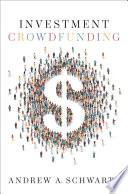
With the advent of the internet, however, geography is no longer a constraint, and a radically inclusive new form of startup finance has become suddenly possible. In a break from the analog past, entrepreneurs now have the ability to solicit investments directly from the broad public—the “crowd”—simply by posting an idea to a website and asking each person to pitch in a small amount. If 1,000 people each contribute $1,000, you’ve got $1 million in capital right there—and you don’t have to trek out to Palo Alto and convince a bunch of guys in fleece vests.
Sounds great, there’s only one problem: this sort of “investment crowdfunding” was previously illegal—and remained so prior to the recent legal changes that are the subject of this book.
Century-old laws, designed to protect the public from losing our shirts in speculative ventures, make it illegal to offer “securities”—meaning shares of stock, bonds, or any other financial investment—the same way you would a
Investment Crowdfunding. Andrew A. Schwartz, Oxford University Press. © Andrew A. Schwartz 2023. DOI: 10.1093/oso/9780197688526.003.0001
bicycle or a piece of land. You can’t offer shares of stock in a company on a website like Craigslist or via Twitter.
Rather, a suite of federal laws enacted in response to the great stock market crash of 1929 require that all securities first be “registered” with the government before they can legally be offered to the public. This registration process—sometimes called an IPO or “initial public offering”—is run by the Securities and Exchange Commission (SEC), and other jurisdictions have similar laws operated by analogous regulators, such as the Australian Securities and Investments Commission (ASIC) or the United Kingdom’s Financial Conduct Authority (FCA).
The registration process is covered by hundreds, if not thousands, of rules and regulations. To register securities, you must provide the SEC with extensive mandatory disclosures about the business and its finances. It is complex and technical and requires the assistance of specialized (and highly paid) attorneys and accountants. It is like filing a tax return—times ten thousand.
The regulations are as thick as an old-fashioned phonebook, and the costs of compliance can run to millions of dollars, which is way too expensive for most startup companies to afford. It doesn’t make sense to spend $3 million in compliance costs when you only want to raise $1 million in the first place. It would be like paying for a building permit to construct a Lego skyscraper in your attic.
This legal framework explains why startup companies have traditionally been funded by VCs, angels, and the friends and family of the founders—but never the broad public. If an entrepreneur privately offers the chance to invest to a limited number of close friends and family, this does not count as a public offer, and so it is specifically exempted from the registration requirement. There is also a legal exemption for offers made to so-called “accredited” investors, sometimes called “wholesale” investors. This group includes professional investors (like VCs) as well as wealthy investors (angels), as they have the expertise to identify promising companies, or at least the deep pockets to withstand significant losses.
The practical effect of these rules is that, as long as entrepreneurs studiously exclude the public and limit investment to accredited investors and their personal contacts, they can raise startup capital without going through the registration process. No surprise, that is just what they have done—and who can blame them?
The unfortunate result, however, is that our market for startup finance became more like a private club than a public market, for both investors and for entrepreneurs. On the investor side, ordinary people—those who don’t know an entrepreneur personally and who aren’t wealthy enough to qualify as accredited—have been completely left out of the market for startup finance.
On the entrepreneur side, women and many marginalized groups have found it especially tough to raise seed money for their startups. This would include
many racial minorities, rural populations, and those raised in poverty. Fewer of them have wealthy friends and family, and few of them know any VCs or angels, making it less likely that they will raise the money they need. This is not just a problem for these frustrated entrepreneurs, it is a social problem, as we will never see the companies they might have developed if given the chance.
In response to these concerns, as well as a general desire to foster startup activity, countries around the world, led by the United States, amended their securities laws over the past decade to expressly authorize and regulate a new type of online stock market that I call “investment crowdfunding.”1 The goal is to give everyone—regardless of wealth or whom they know—the chance to invest in startup companies and to likewise give all entrepreneurs the chance to pitch their ideas to the broad public. It is not formally limited to startup companies—a local café could surely participate—but the emphasis is on new ventures in their early stages.
Investment crowdfunding is modeled on the earlier, and highly successful, concept of “reward crowdfunding,” as practiced on Kickstarter, Indiegogo, and other websites. In reward crowdfunding, entrepreneurs use the internet to obtain financing from strangers to produce a creative or consumer product, such as a documentary or a wristwatch. The funders are later compensated with the product itself or some other reward, like having their names listed in the film credits.
Investment crowdfunding works much the same way, except instead of getting a physical product or some other reward, investors receive a financial interest in the company. On a specialized website, entrepreneurs post information about their companies and the targeted level of funding that they need. Potential investors peruse the various opportunities and decide which to invest in, as well as how much to contribute.
If investors collectively pledge enough to meet the funding target, the deal goes through: the startup company2 gets the money, and the investors receive shares of stock, or some other security, in return. If the target is not met by the specified deadline, the pledges are voided and there is no deal. The whole endeavor is on a small scale, as each company is only allowed to raise a limited amount of capital, such as $5 million per year.
1 I and others have also used other names for the same concept, including “equity crowdfunding” and “securities crowdfunding.”
2 When I use the term “startup company,” I mean to include all types of entrepreneurship, including small businesses and SMEs (small and medium enterprises). Some people reserve the term “startup company” exclusively to refer to a company that plans to “scale up” and grow into a significant player in the business world, like Netflix or Uber. They would call other companies, those that have more modest ambitions, small businesses. In this book, however, I am just using the term as a shorthand, not to make a point. I use the term “startup company” to refer to all types of small and early-stage companies, as they are all invited to participate in investment crowdfunding.
Consider a hypothetical rock band that needs $50,000 to record and promote its first album. The band has talent, and the album might generate a huge number of sales—perhaps $500,000 or more—although this is obviously speculative, as there are countless highly talented bands that never make it big.
The band has been playing live concerts in small, local venues for the past two years and has a hundred loyal fans who attend regularly, as well as a thousand “followers” on social media websites like Facebook. The album could do well—the loyal fans are almost certain to buy it—but the band lacks the seed money it needs to rent a recording studio, hire a sound engineer, and advertise the album.
Investment crowdfunding enables the band to raise the $50,000 it needs and provides an avenue for its fans and followers to invest in a band they love and want to see succeed. The band simply posts information to an investment crowdfunding website, including a video of a recent concert, and invites the public to invest.
Likely, the loyal fans and followers will be the first to buy in, and the campaign will have some momentum. Other people, who had never heard of the band before, will see that it has caught the attention of the crowd, and some of them will invest as well. (This is called the “snowball effect” or, more negatively, “herding,” and will be addressed in Chapter Four.)
If the $50,000 target is reached, the band gets the money, and the investors each receive a share of the band’s profits. Hopefully, it will be a success, and the investors will all make money, along with the band. This outcome is far from certain, of course, and the very nature of releasing a new rock album—like all startup ventures—is inherently uncertain. Most albums don’t sell a million copies, and most startups aren’t worth a billion dollars.
Importantly, however, the very fact that the album was crowdfunded increases its chances of success. The fans are now investors, making them highly motivated, for both aesthetic and economic reasons, to buy the album, post about it on social media, and otherwise support the band. These efforts, in turn, make the album more likely to succeed. This idea that crowdfunding investors are also consumers and advocates—I call them “brand ambassadors”—represents an important advantage of crowdfunding over traditional forms of startup finance, a point to which we will return in Chapter Four.
In short, investment crowdfunding makes good sense, and the only thing standing in the way has been the law. But the law can be changed at any time— and so it was. In 2012, a strongly bipartisan Congress passed the Jumpstart Our Business Startups (JOBS) Act, which introduced a new legal regime to authorize and regulate this new form of stock market in the United States. In signing the JOBS Act into law in 2012, President Barack Obama offered these cogent remarks on investment crowdfunding:
And for start-ups and small businesses, this bill is a potential game changer. Right now, you can only turn to a limited group of investors—including banks and wealthy individuals—to get funding. Laws that are nearly eight decades old make it impossible for others to invest. But a lot has changed in eighty years, and it’s time our laws did as well. Because of this bill, startups and small business will now have access to a big, new pool of potential investors—namely, the American people. For the first time, ordinary Americans will be able to go online and invest in entrepreneurs that they believe in.3
This is a compelling vision, and it was ultimately put into effect in 2016, when the SEC issued the final regulations, known as Regulation Crowdfunding.
Investment crowdfunding, though born in America, quickly spread around the world, with dozens of other countries following suit and amending their securities laws to allow this new form of stock market. The JOBS Act and Regulation Crowdfunding provided what I will call the “standard model” for investment crowdfunding regulations, and countries around the world used it as their template. To date, most countries with a legal regime for investment crowdfunding have hewed closely to the American original, in places as disparate as Australia, Brazil, Canada, France, Israel, Korea, Malaysia, Nigeria, and many more.
Two jurisdictions—namely, the United Kingdom and New Zealand—took a different path and adopted a more lightly regulated version of investment crowdfunding, which I will refer to as the “liberal model.” In contrast with the standard model, which emphasizes law and regulation, the liberal model relies primarily on private ordering, where market participants, incentivized by market forces, make their own rules and structures.
For example, the standard model requires that companies provide certain mandatory disclosures on official government forms. The liberal model, by contrast, allows each platform and company to decide, based on investor demand, what type of information to disclose, and in what format.
A primary purpose of this book is to compare the standard model with the liberal model, with an eye toward finding the best, and worst, aspects of each one. I focus on a set of six jurisdictions. Four of them follow the standard model: America, Australia, Canada, and the European Union. Two of them follow the liberal model: New Zealand and the United Kingdom.
In Chapters Five and Six, I will describe and analyze the investment crowdfunding regulations in these countries using legal and economic theory, as well as in light of the real-world experience to date (as limited as it may be). I spent the past decade researching investment crowdfunding on four continents. I have spoken with legislators, regulators, platform operators, entrepreneurs, and
3 Press Release, White House, Remarks by the President at JOBS Act Bill Signing (Apr. 5, 2012).
others. I’ve collected statistics myself and reviewed those collected by others. I’ve read dozens of journal articles, as well as innumerable news stories and blog posts on the subject. In the end, I have a lot of anecdotes, and a fair bit of data to boot—my empirical report could fill the entire book.
Even so, I will try not to cram a full statistical analysis and global history of investment crowdfunding into the following pages. A comprehensive review would be overwhelming, repetitive, and quickly outdated—several jurisdictions completely overhauled their investment crowdfunding laws while I was drafting this book, forcing me to go back and make revisions. (I’m looking in your direction, Canada.) Nevertheless, I have learned a lot in my empirical research, and I will insinuate relevant data, anecdotes, and my observations throughout the book.
Most basically, what I’ve learned is that investment crowdfunding has a sound footing and significant promise—but that it has not yet reached its full potential. Moreover, the legal regime in place makes a big difference, and the liberal approach followed in New Zealand and the United Kingdom is, with a few tweaks, what I would recommend for any country designing or reforming a regulatory scheme for investment crowdfunding.
That’s my conclusion—but to get there will take the entire book. I proceed as follows.
In Chapter One, I introduce the concept of “investment crowdfunding,” describe its background and origins, and situate it within its broader context. “Crowdfunding” is a broad concept, and so I must delineate the parameters of what exactly we are talking about. To that end, I define investment crowdfunding as the public offering of unregistered securities through an independent online platform. Each word is pregnant with meaning, but I will hold off on a full explanation until Chapter One—which is only a few pages away.
For now, permit me to highlight that this definition excludes a number of related areas of “fintech,” such as initial coin offerings (ICOs) and non-fungible tokens (NFTs). Those types of transactions, although they take place online, are not conducted through independent online platforms. The definition also excludes certain types of online platforms that call themselves “crowdfunding” but are only open to accredited investors rather than the public. I don’t begrudge them the use of the word, I am just trying to clearly define the subject matter at hand.
In Chapter Two, I elucidate the three policy goals investment crowdfunding is meant to achieve: (1) to provide a simple and inexpensive method for startup companies and other small businesses to raise business capital from the public; (2) to create an inclusive market where all entrepreneurs—regardless of location, gender, race, or anything else—have an equal opportunity to access investors; and (3) to democratize the market for startup investment by allowing ordinary
people to make investments that have traditionally been limited to the wealthy and connected. At times, these goals are in tension—in particular with respect to “gatekeeping,” a major subject of Chapter Four. For the most part, however, they all live in harmony.
Chapter Two also reports that investment crowdfunding is making significant progress toward these goals—in the United States and around the world. As for the first goal, the dollar value of crowdfunding investments is relatively small, but growing quickly. In the year 2021, for instance, more than 1,000 American companies raised money through investment crowdfunding; each company raised about $400,000, on average, for a total of more than $400 million. The numbers are even larger in other countries, especially the United Kingdom.
Investment crowdfunding is also succeeding in creating an inclusive and democratic market for startup finance. Female and minority entrepreneurs have found a receptive audience that is not only open to investing in their companies but affirmatively seeking out such opportunities. And from the investor side, their numbers are small but growing. Looking again at 2021 in the United States, over 500,000 investors participated that year, from every corner of the land, with each of them investing an average of roughly $800.
Chapter Three interrupts this happy story by focusing on the challenges facing investment crowdfunding. Recall how it works: retail investors convey their hard-earned money to someone they’ve never met, to buy in to a startup company with little or no track record, entirely on the internet, all without the benefit of the usual disclosures or professional advice. What could go wrong?! A lot. For one thing, the entrepreneur might perpetrate a fraud, meaning that she fibs to the investors to get them to buy in. Even an honest entrepreneur might nonetheless fail in her business; indeed, that happens all the time. Either way, the crowd loses its entire investment.
In Chapter Three, I employ a widely used theoretical framework, developed by economists and legal academics over the past fifty years and crystallized by Ronald Gilson. The core of the idea is that investment crowdfunding—like all forms of entrepreneurial finance—must respond to three fundamental challenges: (1) uncertainty: nobody can predict the future, including how a startup company will perform; (2) information asymmetry: entrepreneurs know much more about their business than do potential investors; (3) agency costs: entrepreneurs are human and will be tempted to shirk and enrich themselves at the investors’ expense. If it cannot surmount this “trio of problems,” nobody will participate, and the market will collapse.
There was widespread fear in the early days of investment crowdfunding that, by exempting the market from the usual disclosure and registration rules of a public offering, the market would devolve into a snake pit full of fraudsters and thieves. The Wall Street Journal, for instance, published an article in 2017 titled
“Investors, Beware of [Investment] Crowdfunding,” in which it reported on an academic article itself called “Crowdfrauding.”4 The Journal author painted a dire picture:
In a paper published in the journal Business Horizons, [the authors] say it’s easy for swindlers to circumvent safeguards in the Jumpstart Our Business Startups Act. . . . [T]he researchers say that because many small investors simply aren’t sophisticated enough to evaluate a startup, they could be sucked into investing in a fraudulent company. . . . The required level of disclosure is lower than that for a company planning an initial public offering, the researchers say, and swindlers can fabricate documents that appear legitimate.5
In practice, things haven’t been nearly so bad! We have seen very few allegations of fraud or other illegal behavior, across all jurisdictions. Consider that the SEC has only ever brought one single, solitary case alleging fraud (or anything else) in the context of investment crowdfunding, in a case involving roughly $2 million.6 By way of comparison, the SEC has brought more than eighty cases alleging misbehavior among ICOs, NFTs, and the like, leading the SEC to establish a special Crypto Assets and Cyber Unit that has recovered more than $2 billion in fines and damages.7
How has investment crowdfunding achieved such a clean record, despite the fears of malfeasance? Looking again to theory, there are two basic ways for a market to respond to Gilson’s three fundamental challenges. One is to rely on market forces, incentives, and other aspects of “private ordering.” The other is to use formal law and government regulation. Investment crowdfunding, wisely, uses both methods, as I describe in Chapters Four, Five, and Six—which is the heart of the book.
I begin with private ordering. In Chapter Four, I describe the most important methods that private parties use to govern the investment crowdfunding market, the most important of which is probably “gatekeeping.” This is the idea that entrepreneurs cannot solicit investors directly and are required to act through an online platform. The platform—like a medieval gatekeeper—stands at the
4 Louise Lee, Investors, Beware of Crowdfunding, Wall St. J., Nov. 27, 2017, at R2 (reporting on Melissa S. Baucus & Cheryl R. Mitteness, Crowdfrauding: Avoiding Ponzi Entrepreneurs when Investing in New Ventures, 59 Bus. Horizons 37 (2016)).
5 Louise Lee, Investors, Beware of Crowdfunding, Wall St. J., Nov. 27, 2017, at R2; Melissa S. Baucus & Cheryl R. Mitteness, Crowdfrauding: Avoiding Ponzi Entrepreneurs when Investing in New Ventures, 59 Bus. Horizons 37, 41 (2016) (asserting that the “JOBS Act unlocks the door to crowdfrauding”); id. at 48 (claiming to “demonstrate the ease with which scheming individuals can engage in crowdfrauding”).
6 Complaint, Sec. and Exch. Comm’n v. Shumake, No. 21-cv-12193 (E.D. Mich. Sept. 20, 2021).
7 Sec. and Exch. Comm’n, SEC Nearly Doubles Size of Enforcement’s Crypto Assets and Cyber Unit, May 3, 2022.
metaphorical “gate” between entrepreneurs and investors and is expected to only allow legitimate and promising companies to list on the platform. We can count on the gatekeepers because they want investors to come back again tomorrow (and because they can lose their license), so it is in their self-interest to be a diligent gatekeeper.
Another key method of private ordering is the fear that “brand ambassadors”— like the fans and followers of our hypothetical rock band—might become “brand assassins.” If a crowdfunded company were to mislead its investors or misuse the money it raised, it would not only be abusing its investors, it would be ticking off its biggest fans—who might respond by trashing the company on social media and in real life. So it probably won’t.
Gatekeeping and brand ambassadors are just two of the numerous methods of private ordering described in Chapter Four. The key takeaway is that, collectively, these private methods have considerable force, meaning that law and regulation should focus on enhancing and complementing them, rather than piling on additional regulatory burdens.
Chapters Five and Six then turn to the law. Chapter Five describes and critiques the American legal regime for investment crowdfunding, namely, the JOBS Act and Regulation Crowdfunding. Chapter Six, in turn, does the same for the investment crowdfunding laws of Australia, Canada, the European Union, New Zealand, and the United Kingdom.
I sort the legal regimes adopted in these different jurisdictions into two types, which I call the “standard” model and the “liberal” model, and distinguish as follows: the standard model depends primarily on legal regulation to address the three challenges of uncertainty, information asymmetry, and agency costs. By contrast, the liberal model depends primarily on private ordering, supplemented by a light-handed set of regulations, to address the trio of problems. This is not a binary distinction, but more like a range of possibilities, with shades between them.
The United States created the standard model when it passed the JOBS Act and Regulation Crowdfunding, and many countries around the world followed its lead. In Chapter Six, we will see that Australia, Canada, and the European Union all adhere to the standard model. The United Kingdom and New Zealand, in contrast, went their own way and adopted a much lighter set of regulations that are specifically designed to harness the power of private ordering, which I call the liberal model.
Notably, the countries that adopted the liberal model, that is, the United Kingdom and New Zealand, have larger and more impactful investment crowdfunding markets than the United States and the others that followed the standard model—and without higher levels of fraud or failure. In the United Kingdom today, there are more investment crowdfunding deals each year than there are
angel rounds, and numerous British crowdfunding companies have gone on to an IPO or have been acquired. Tellingly, the UK antitrust regulator blocked a merger between that country’s two leading platforms in 2021 on the ground that investment crowdfunding had “become an important part of the overall financial ecosystem.”8 This is consistent with my general support for the liberal approach.
Finally, in Chapter Seven, I summarize the thesis of the book: because investment crowdfunding only allows companies to raise a limited amount of money, the only workable legal regime is a simple one that imposes very low costs. Rather than depending on legal regulation to police the market, we should rely primarily on the powerful methods of private ordering described in Chapter Four and shape our laws to enhance them. We should, in short, follow the liberal approach, not the standard model.
That said, I do not favor a laissez-faire approach to the regulation of investment crowdfunding. There are certain aspects of the form that do call for legal regulation, where private incentives will not lead to the optimal outcome. In fact, I recommend beefing up Regulation Crowdfunding in certain ways, such as by mandating annual reports after a company has raised money on an investment crowdfunding platform, and putting some legal limits on the company’s choice of funding target—both points to which we shall return in Chapter Five.
With that introduction, let us proceed to define investment crowdfunding and take a look at its origins and how it works today.
8 UK Competition & Markets Authority, Anticipated Acquisition by Crowdcube Limited of Seedrs Limited Provisional Findings Report 5 (2021) (observing that investment crowdfunding platforms “have grown from accounting for a negligible number of equity raises at the start of the last decade to accounting for almost 500 equity raises in 2020”).
Chapter One Investment Crowdfunding
Investment crowdfunding is one species of the broader genus known as “crowdfunding,” which is “the practice of obtaining needed funding (as for a new business) by soliciting contributions from a large number of people especially from the online community.”1 Multiple varieties of crowdfunding have developed since the turn of the millennium, including “reward” crowdfunding (as on Kickstarter) and “donation” crowdfunding (as on GoFundMe). But those are not the subject of this book.
Rather, this book is about “investment” crowdfunding. Before going any further, then, allow me to clarify just what I mean by this term. This chapter accordingly defines the concept, explains is origins, and begins to describe how it works in law and practice—a topic that we will cover throughout the rest of the book.
A. HISTORICAL ORIGINS
The word “crowdfunding” was only added to the dictionary in 2014.2 The concept, however, is far older. Crowdfunding is seen whenever a group of people—a crowd—gathers their funds together in a common pool and for a common purpose. The internet has energized crowdfunding into a powerful global phenomenon, but the basic notion of crowdfunding is ancient.
A church collection plate is one of the oldest and simplest examples of crowdfunding. A plate (or bowl or basket) is passed around the congregation, from hand to hand, and each person drops a couple of coins on it. After completing a lap around the church, the plate is full of money to pay the pastor, provide charity, purchase Bibles, and otherwise fund the expenses of the church. Slightly more sophisticated techniques, such as tithing or membership dues, are really just variations on the theme. All of them accomplish the same goal: gather funds from all (or nearly all) members of the congregation to finance the church and keep it running.
1 Merriam-Webster’s Collegiate Dictionary (11th ed. 2019).
2 Press Release: Merriam-Webster, Merriam-Webster’s Collegiate Dictionary Updated for 2014 (May 19, 2014).
Investment Crowdfunding. Andrew A. Schwartz, Oxford University Press. © Andrew A. Schwartz 2023. DOI: 10.1093/oso/9780197688526.003.0002
Crowdfunding is not the only way to fund a church, of course. It is certainly possible for a single person or family to build a church and cover its expenses. But there is something special about a community of people coming together and collectively contributing their money to the church. The funders feel invested in the project, because they are. It is not just a church; it is their church. They are more likely to attend services or Mass, serve as ushers, and bring in new members.
Beyond churches, many types of charities have long raised money through crowdfunding, rather than soliciting large donors. The March of Dimes is a notable example. This organization was founded by President Franklin D. Roosevelt in 1938 as the National Foundation for Infantile Paralysis (NFIP) to conquer polio, an infectious disease that can paralyze its victims. At the time, the United States was in the midst of a polio epidemic, with tens of thousands of diagnoses each year, many of them children who suffered greatly. President Roosevelt himself had been diagnosed with polio as a young man and was forced to use a wheelchair in his later years.
The NFIP needed to raise money to fund research, education, and assistance. Instead of targeting a few wealthy donors, as with prior anti-polio organizations, the NFIP sought a huge number of small donations. Upon its establishment in 1938, a radio celebrity of the time went on the air and urged every American to contribute just ten cents apiece to the NFIP; his goal was to generate a “march of dimes to reach all the way to the White House.” The call was answered, and within weeks, the White House was deluged with tens of thousands of letters, each containing just one dime. That first campaign raised nearly $100,000 (roughly $2 million today) and started a long tradition of dime-based donations. Over time, the organization collected more than 7 billion dimes ($700 million), demonstrating the power of crowdfunding for charity.3
Crowdfunding is not only for charities, however. In colonial America, canals, bridges, and even universities were commonly financed via crowdfunding. Projects like these required tremendous sums, with money often raised through the sale of lottery tickets. Hundreds or thousands of people would each pay a small sum to buy a lottery ticket, and a few lucky winners would win the prize money. The rest of the collected funds would go toward building the canal or bridge—or Harvard.4
The chance of winning the lottery was one reason people bought tickets, but that was not the only motivation. Most of them surely realized that their chances of winning were slim and that the prize money was not enough to make it a
3 David W. Rose, The March of Dimes 9, 43 (2003).
4 Records Reveal Harvard Lottery to Bolster Early Building Funds—Stoughton and Holworthy Owe Existence to Tickets, Harv. Crimson, Mar. 15, 1927.
sensible bet. Rather, they were contributing their money toward the project because, once completed, it would benefit the whole community, including themselves. A new canal or bridge is a “public good” (meaning something that benefits the whole community) that could be expected to expand trade, bring new settlers to the town, and lower the cost of doing business for everyone.
One of the most famous examples of crowdfunding in American history is the pedestal for the Statue of Liberty, situated in the harbor of New York City. The colossal monument was a gift from France to honor the United States’ centennial of independence and the friendship between the two countries. It was designed by a French sculptor and constructed in Paris in the late 1870s and early 1880s, at which point it was shipped to the United States. While the gift was welcome, the monumental sculpture needed a massive pedestal to support its tremendous weight, and it fell to the Americans to construct that pedestal.
After it was shipped from France, the Statue of Liberty’s pedestal was not yet complete. Wealthy donors in Boston and New York could not raise the $300,000—roughly $8 million in today’s dollars—it would cost, and neither New York nor the federal government agreed to pay for it. Joseph Pulitzer, publisher of the New York World, a leading newspaper at the time, called upon the American people to contribute what they could toward the cost of the pedestal. “Let us not wait for the millionaires to give us this money,” he wrote, and he set a goal of raising $100,000—nearly $3 million today—in small donations from the public to pay for the pedestal.
In a brilliant marketing maneuver, Pulitzer promised to print the name of every person who contributed to the “Pedestal Fund,” regardless of how little they gave, and the campaign caught on like wildfire. Beyond publicity, donors who gave at least $1 received a small replica of the Statue of Liberty as a token of appreciation, with the size of the replica increasing with the size of the donation. This foreshadowed the modern practice of “reward” crowdfunding, to be discussed shortly.
Within six months, 125,000 people had donated to the cause, with most of them giving less than $1 (roughly $25 today), and more than $100,000 was raised, enough to complete the pedestal. The following year, 1886, the pedestal was finished and the Statue of Liberty was placed upon it, where it still stands as a symbol of liberty, brotherhood—and crowdfunding.5
Crowdfunding continued into the twentieth century, most famously with the Green Bay Packers, an NFL football team based in an obscure city in northern Wisconsin of just 100,000 souls. Most NFL teams, of course, are based in giant
5 Yasmin Sabina Khan, Enlightening the World: The Creation of the Statue of Liberty 168–73 (2011).