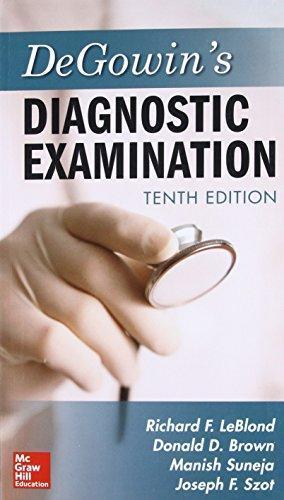
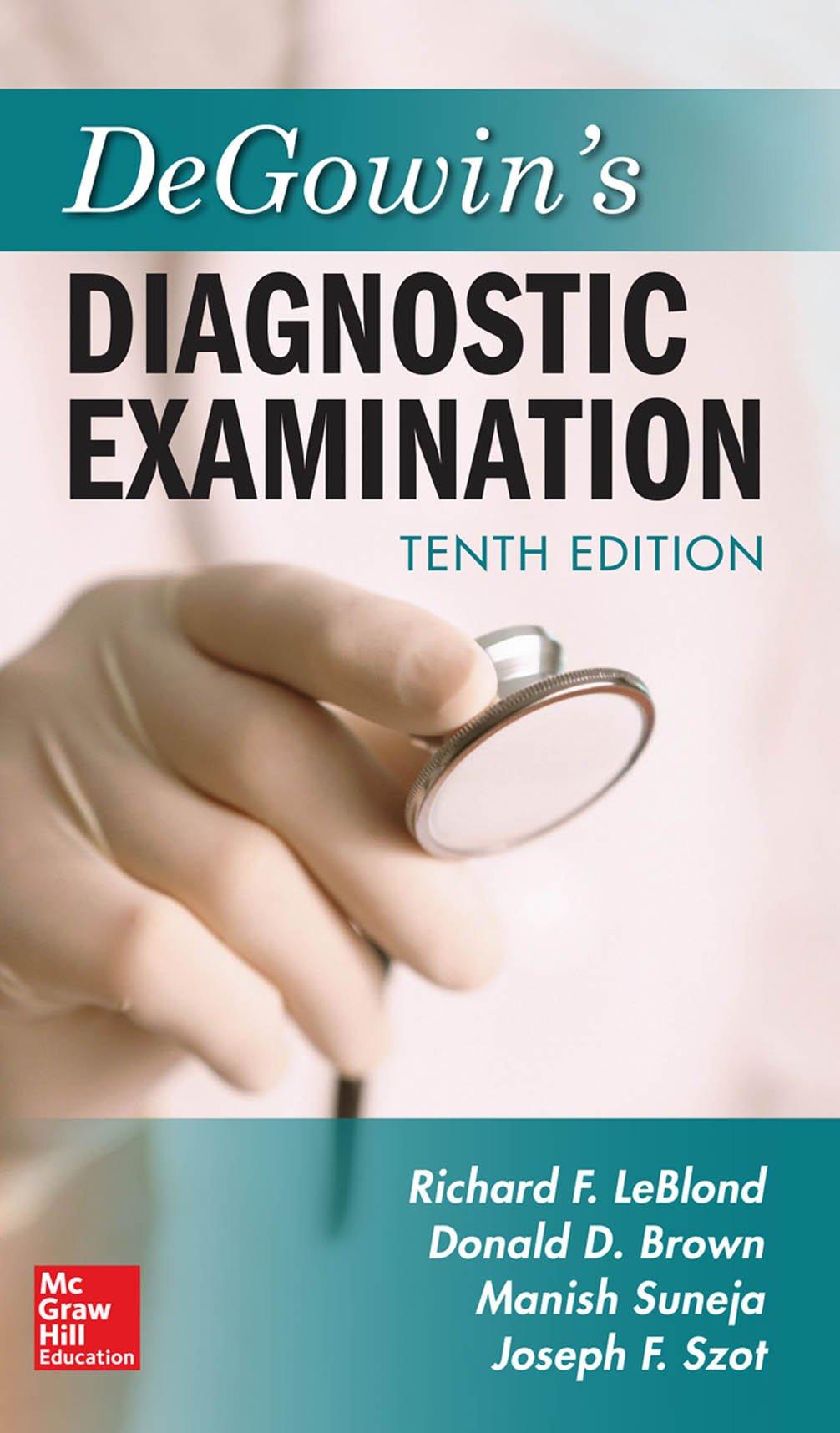
https://ebookmass.com/product/degowins-diagnosticexamination-tenth-edition-lange-10th/
Instant digital products (PDF, ePub, MOBI) ready for you
Download now and discover formats that fit your needs...
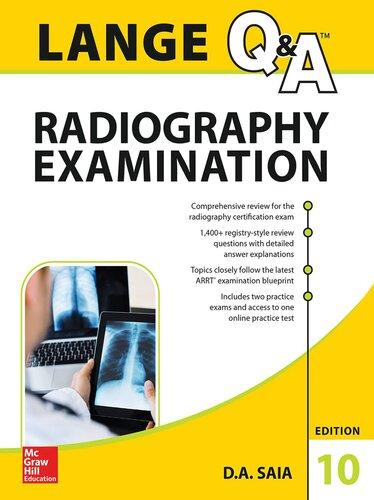
Radiography examination 10th Edition Dorothy A. Saia
https://ebookmass.com/product/radiography-examination-10th-editiondorothy-a-saia/
ebookmass.com
Wills Trusts & Estates, Tenth Edition [Connected Casebook] (Aspen Casebook) 10th
https://ebookmass.com/product/wills-trusts-estates-tenth-editionconnected-casebook-aspen-casebook-10th/
ebookmass.com
(Original PDF) America: A Narrative History (Tenth Edition) (Vol. 1) 10th Edition
https://ebookmass.com/product/original-pdf-america-a-narrativehistory-tenth-edition-vol-1-10th-edition/
ebookmass.com
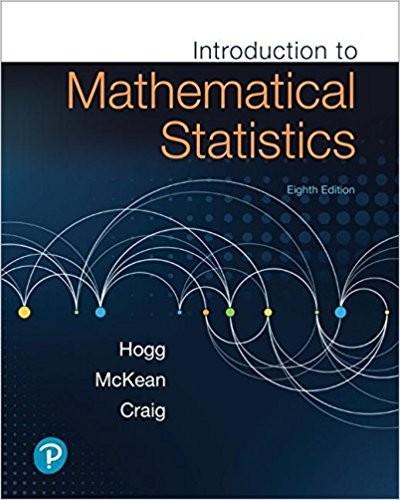
(eTextbook PDF) for Introduction to Mathematical Statistics 8th Edition by Robert V. Hogg
https://ebookmass.com/product/etextbook-pdf-for-introduction-tomathematical-statistics-8th-edition-by-robert-v-hogg/
ebookmass.com
How to Develop Your Career in Dental Nursing 1st Edition
Janine Brooks
https://ebookmass.com/product/how-to-develop-your-career-in-dentalnursing-1st-edition-janine-brooks/
ebookmass.com
Grumpy Boss Trouble: A Grumpy/Sunshine MM Sports RomanceAnthology (Snow Tip Falls Book 4) Alex Mcanders
https://ebookmass.com/product/grumpy-boss-trouble-a-grumpy-sunshinemm-sports-romance-anthology-snow-tip-falls-book-4-alex-mcanders/
ebookmass.com
Shadow Hill Thomas Kies
https://ebookmass.com/product/shadow-hill-thomas-kies/
ebookmass.com
Thirteen Theories of Human Nature 7th Edition Leslie Stevenson
https://ebookmass.com/product/thirteen-theories-of-human-nature-7thedition-leslie-stevenson/
ebookmass.com
Green Synthetic Approaches for Biologically Relevant Heterocycles Volume 1: Advanced Synthetic Techniques Book • Second Edition • 2021 Goutam Brahmachari
https://ebookmass.com/product/green-synthetic-approaches-forbiologically-relevant-heterocycles-volume-1-advanced-synthetictechniques-book-second-edition-2021-goutam-brahmachari/
ebookmass.com
La Sociedad por la Preservación de los Kaiju John Scalzi
https://ebookmass.com/product/la-sociedad-por-la-preservacion-de-loskaiju-john-scalzi/
ebookmass.com
These ashcards will help you to brush up on your diagnostic examination procedural skills by asking questions that test your knowledge and provide answers that impart mustknow information.
Each of the 250 two-sided cards contains an openended question with a concise, bulleted answer on the ip side. This unique review focuses on the diagnoses most frequently tested on the USMLE Step 2 and 3 examinations.
It is not easy to give exact and complete details of an operation in writing; but the reader should form an outline of it from the description.
—h ippocRates “ O n JOints ”
[Studies] perfect nature, and are perfected by experience: for natural abilities are like natural plants, that need pruning, by study; and studies themselves, do give forth directions too much at large, except they be bounded in by experience. Crafty men contemn studies, simple men admire them, and wise men use them; for they teach not their own use; but that is a wisdom without them, and above them, won by observation. Read not to contradict and confute; nor to believe and take for granted; nor to nd talk and discourse; but to weigh and consider.
—FRancis Bacon “ O f s tudies ”
A little observation and much reasoning lead to error; many observations and a little reasoning to truth.
—d R. a Lexis c aRReL
It is only by persistent intelligent study of disease upon a methodical plan of examination that a man gradually learns to correlate his daily lessons with the facts of his previous experience and that of his fellows, and so acquires clinical wisdom.
— s iR WiLLiam o sLeR
Sources for Quotations:
Brecht quotation from: Bertolt Brecht. Poems, 1913–1956. London, Methuen London Ltd., 1979.
Eliot quotation from: T.S. Eliot. The Complete Poems and Plays, 1909–1950. New York, Harcourt, Brace & World, Inc., 1971.
Frazer quotation from: Sir James George Frazer. The Golden Bough, A Study in Magic and Religion, abridged edition. New York, MacMillan Publishing Company, 1922.
Hippocrates quotation from: Jacques Jouanna (M.B. DeBevoise translator). Hippocrates. Baltimore, The Johns Hopkins University Press, 1999.
Osler quotation from: Sir William Osler. Aequanimitas, with other Addresses to Medical Students, Nurses and Practictioners of Medicine. Philadelphia, P. Blakiston’s Son and Co., 1928.
Roethke quotations from: Theodore Roethke. On Poetry and Craft. Port Townsend, Washington Copper Canyon Press, 2001.
This page intentionally left blank
5.
6.
7.
8.
2.
1.
2.
3.
4.
5.
6.
7.
5.
35.
36.
38.
39.
This page intentionally left blank
R prEFaCE
To The Reader:
Pray thee, take care, that tak’st my book in hand
To read it well: that is, to understand.
—Ben Jonson
The clinician’s goal in performing a history and physical examination is to generate diagnostic hypotheses. This was true for Hippocrates and Osler and remains true today. The purpose of DeGowin’s Diagnostic Examination is to encourage a thoughtful, systematic approach to the history, physical examination, and diagnostic process.
The practice of medicine would be simple if each symptom or sign indicated a single disease. There are enormous numbers of symptoms and signs (we cover several hundred) that can occur in a nearly in nite number of combinations and temporal patterns. These symptoms and signs are the rough bers from which the clinician must weave a clinical narrative, anatomically and pathophysiologically explicit, forming the diagnostic hypotheses. Mastering the diagnostic process requires:
(1) Knowledge: Familiarity with the pathophysiology, symptoms, and signs of common and unusual diseases.
(2) Skill: The ability to take an accurate and complete history and perform an appropriate physical examination.
(3) Experience: From longitudinal exposure to many clinical situations, diseases, and patients, each thoroughly evaluated, the skilled clinician develops familiarity with the presenting symptoms and signs of a wide variety of pathophysiologic processes allowing him to generate a probabilistic differential diagnosis for each new patient.
(4) Judgment: Knowledge of medical science and the medical literature, combined with re ective experience, develops the judgment necessary to ef ciently test the hypotheses in the laboratory or by clinical interventions [Reilly BM. Physical examination in the care of medical inpatients: an observational study. Lancet. 2003;362:1100–1105].
DeGowin’s Diagnostic Examination has been used by students and clinicians for over 40 years precisely because of its usefulness in this diagnostic process:
(1) It describes the techniques for obtaining a complete history and performance of a thorough physical examination.
(2) It links symptoms and signs with the pathophysiology of disease.
(3) It presents an approach to differential diagnosis, based upon the pathophysiology of disease, which can be ef ciently tested in the laboratory.
(4) It does all of this in a format that can be used as a quick reference at the “point of care” and as a text to study the principles and practice of history taking and physical examination.
In undertaking this tenth edition of a venerable classic, my goal is once again to preserve the unique strengths of previous editions, while adding recent information and references, reducing redundancy, and improving clarity. The second edition is one of the few books I have retained from medical school, 40 years ago. The reason is that DeGowin’s Diagnostic Examination emphasizes the unchanging aspects of clinical medicine—the symptoms and signs of disease as related by the patient and discovered by physical examination.
Pathophysiology links the patient’s story of their illness (the history), the physical signs of disease, and the changes in biologic structure and function revealed by imaging studies and laboratory testing. Patients describe symptoms, we need to hear pathophysiology; we observe signs, we need to see pathophysiology; the radiologist and laboratories report ndings, we need to think pathophysiology. Pathophysiology and pathologic anatomy provide the framework to understand disease as alterations in normal physiology and anatomy, and illness as the patient’s experience of these changes.
A discussion of pathophysiology (highlighted in the second color) occurs after many subject headings. The discussions are brief and included when they assist understanding the symptom or sign. Readers are encouraged to consult physiology texts to have a full understanding of normal and abnormal physiology [Guyton AC, Hall JE. Guyton and Hall Textbook of Medical Physiology . 12th ed. Philadelphia, PA: W.B. Saunders Company: 2011]. In addition, each chapter discusses syndromes associated with that body region to give a sense of the common, and uncommon but serious, disease patterns.
DeGowin’s Diagnostic Examination is organized as a useful bedside guide to assist diagnosis. Part 1, Chapter 1 introduces the conceptual framework for the diagnostic process, Chapter 2 the essentials of history taking and documentation, and Chapter 3 the screening physical examination with a short introduction to bedside ultrasound. Part 1 and Part 4, Chapter 17, which introduces the principles of diagnostic testing, should be read and understood by every clinician.
Part 2, Chapters 4 through 14, forms the body of the book. Two introductory chapters discuss the vital signs (Chapter 4) and major physiologic systems that do not have a primary representation in a single body region (Chapter 5). Chapters 6 to 14 are organized around the body regions sequentially examined during the physical examination. Each chapter has a common structure outlined in the Introduction and User’s Guide. To avoid duplication, the text is heavily cross-referenced. I hope the reader will nd this useful and not too cumbersome.
References to articles from the medical literature are included in the body of the text. We have chosen articles that provide useful diagnostic information including excellent descriptions of diseases and syndromes, thoughtful discussions of the approach to differential diagnosis and evaluation of common and unusual clinical problems, and, in some cases, photographs illustrating key ndings. Most references are from the major general medical journals, the New England Journal of Medicine, the Lancet, the Annals of Internal Medicine, and the Journal of the American Medical Association. This implies that a clinician who regularly studies these journals will keep abreast of the broad eld of medical diagnosis. Some references are dated in their recommenda-
tions for laboratory testing and treatment; they are included because they give thorough descriptions of the relevant clinical syndromes, often with excellent discussions of the approach to differential diagnosis. Tests and treatments come and go, but good thinking has staying power. The reader must always check current resources before initiating a laboratory evaluation or therapeutic program.
Evidence-based articles on the utility of the physical examination are included, mostly from the Rational Clinical Examination series published over the last 20 years in the Journal of the American Medical Association. They are included with the caveat that they evaluate the physical examination as a hypothesis-testing tool, not as a hypothesis generating task. The emphasis on transforming the qualitative hypothesis generating task of the history and physical examination into a quantitative hypothesis testing task is, I think, misguided [Feinstein AR. Clinical Judgement revisited: the distraction of quantitative models. Ann Intern Med. 1994;120:799–805].
Each chapter was independently reviewed by faculty members of the University of Iowa Roy J. and Lucille A. Carver College of Medicine. Their feedback and assistance is gratefully acknowledged. Reviewers for this edition are Jane Engeldinger, MD, Professor, Clinical Obstetrics and Gynecology (Chapters 10 and 11); Christopher J. Goerdt, MD, MPH, Associate Professor, Clinical Internal Medicine, Division of General Internal Medicine (Chapters 1–4); Vicki Kijewski, MD, Assistant Professor of Clinical Psychiatry and Internal Medicine (Chapter 15); Victoria Jean Allen Sharp, MD, MBA, Clinical Associate Professor, Departments of Urology and Family Medicine (Chapters 10 and 12); William B. Silverman, MD, Professor, Clinical Internal Medicine, Division of Gastroenterology and Hepatobiliary Diseases (Chapter 9); Haraldine A. Stafford, MD, PhD, Associate Professor, Clinical Internal Medicine, Division of Rheumatology (Chapter 13); and Michael Wall, MD, Professor of Neurology and Ophthalmology (Chapters 7 and 14).
My co-authors for this edition, Donald D. Brown, MD, Joseph Szot MD, and Manish Suneja MD, have been instrumental in seeing that the tenth edition maintains the strengths of previous editions while continuing to evolve to meet the reader’s needs. Dr. Brown directed the history taking and physical examination course at the University of Iowa for over 25 years. He is annually nominated for best teacher awards by the students in recognition of his knowledge and enthusiasm for teaching these essential skills. As a practicing cardiologist, he is the primary editor for Chapters 8 and 16. Dr. Szot is a general internist and Dr. Suneja is a general internist with subspecialty certi cation in Nephrology. They are Associate Program Directors in the University of Iowa Internal Medicine Residency Program.
This is the rst time that DeGowin’s Diagnostic Examination does not have direct participation by the DeGowin family of physicians. We, of course, are building on the solid foundation they have built and which we will continue to honor with the book’s title.
Ms. Christine Diedrich and Mr. James Shanahan, our sponsoring editors, and Mr. Robert Pancotti, our project development editor, at McGrawHill, have been actively involved from the beginning in the planning and execution of the tenth edition. Their encouragement and support are deeply appreciated. The McGraw-Hill editorial and publishing staff have been prompt and professional throughout manuscript preparation, editing, and production.
For the tenth edition, a standard e-book edition is available, as is an enhanced e-book edition that includes embedded video segments demonstrating fundamental physical examination procedures. We have included complimentary access to ve of these videos in the standard print and e-book editions. The videos are available at: mhprofessional.com/diagnosticexam/ I wish to thank my colleagues who have encouraged me throughout the course of this project. I have incorporated many suggestions from my coauthors and each of the reviewers; any remaining de ciencies are mine. Ultimately, you, the reader, will determine the strengths and weaknesses of this edition. I welcome your feedback and suggestions. Email your comments to rleblond@billingsclinic.org (please include “DeGowin’s” on the subject line).
Richard F. LeBlond, MD, MACP Billings, Montana
R
COmmON aBBrEVIaTIONs
CHF congestive heart failure
COPD chronic obstructive pulmonary disease
CLL chronic lymphocytic leukemia
CML chronic myelogenous leukemia
CMV cytomegalovirus
CN cranial nerve
CNS central nervous system
CSF cerebrospinal uid
CVP central venous pressure
DDX differential diagnosis
DIP distal interphalangeal joint
EBV Epstein–Barr virus
HIT heparin-induced thrombocytopenia
HSV herpes simplex virus
ITP idiopathic immune thrombocytopenia
LLQ left lower quadrant
LUQ left upper quadrant
LV left ventricle
MCP metacarpal–phalangeal joint
MI myocardial infarction
MS multiple sclerosis
MTP metatarsal–phalangeal joint
NBTE nonbacterial thrombotic endocarditis
PE pulmonary embolism
PIP proximal interphalangeal joint
RA rheumatoid arthritis
RLQ right lower quadrant
RUQ right upper quadrant
RV right ventricle
SBE subacute bacterial endocarditis
SLE systemic lupus erythematosus
TTP thrombotic thrombocytopenic purpura
This page intentionally left blank